1
DELTA STATE UNIVERSITY: ANNUAL REPORT
for the Calendar Year 2004-2005
I. Unit Title: Division of Social Sciences School: Arts & Sciences
Unit Administrator: Albert B. Nylander, III
II. Data and information for division:
The Division of Social Sciences aims at a broad development of the individual. Its goal is to present the main approaches to understanding our world and maintain a student-centered
environment. In the process, faculty in the Division seek to develop certain skills and enduring habits of mind--intellectual curiosity, critical thinking, tolerance of and openness to different views and values, and the ability to communicate one's thoughts orally and in writing. In short, this philosophy of learning should enable students to embark on a lifetime of learning and to adapt to a rapidly changing world. It is also the mission of the Division to serve the Delta by developing programs of study that match the cultural needs of the region and state. To determine the extent to which the Division is meeting some of these needs, an analysis of trends is
presented in the next section.
ANALYSIS OF TRENDS
Number of graduates
The Division’s seven programs have shown consistent graduate production. Table 1 shows the number of graduates in each program over a five-year period:
Table 1: Number of Graduates for five-year period (academic year) Degree 2001 2002 2003 2004 2005
BSE 12 13 13 12 6
BA 2 8 6 4 2
BSCJ 26 25 17 27 22 BS 4* 2 21 16 16
MED 5 11 8 5 14
MSCJ 5 8 6 6 9
MSCD 4 10 5 13 9
Total 58 77 76 83 78
*New Degree
The data in Table 1 suggest that the number of graduates in the Division has been stable since 2002. It should be noted, however, that this will be difficult to maintain. The Division has lost 4 positions over the past five years, and we must be extremely creative to keep the same number of graduates in the future. Thus, I recommend to the Dean of Arts & Sciences that the Division of Social Sciences and the administration work together to create Teacher Assistants at the graduate level, and construct a competitive stipend package for TA’s.
The three graduate programs and the four undergraduate programs are being adversely affected by the losing of faculty positions. In last year’s annual report (2003-04), the chairman requested additional faculty members in the areas of Criminal Justice, Geography, and Political Science. This request was not met; thus, it still exists. Additionally, another position in
Faculty members in the Division of Social Sciences cannot continue to produce at their current rate without additional resources. From the table below (2004 annual report), it is obvious that the Division is more than carrying its load in the college.
Number of undergraduate & graduate majors in Arts & Sciences (Spring)
Department 2004 FTE Degree Programs
Art 134 10.75 2
Audiology/Speech Pathology 68 3 1
Biological/Physical Sciences 243 17.75 5
History 36 6 1
Languages and Literature 78 22.70 5
Mathematics 38 7.75 2
Music 54 15.10 3
Social Sciences 272 13.25 7
Social Work 122 3.5 1
Total 1045 99.8 27
Source: Institutional Research & Planning, Delta State University; Degree Programs (Sally Rogers, Secretary in Arts & Sciences)
The current faculty size, 12.5 full-time faculty members (while maintaining over 300 majors), is the smallest it has been in recent years and is clearly insufficient to maintain four excellent undergraduate programs and three excellent graduate programs. The current average is 1.7 faculty members for each degree program. This must be one of the lowest ratios in the university. The division and administration need to work together to create a viable plan to address these issues.
Ideally, the division should begin the process of hiring for the positions discussed above. Given the current budget restraints, this is unlikely however. Yet maintaining the status quo for the Division of Social Sciences will likely cause a decline in majors. Thus, it is important that the division faculty, chair, and dean meet to discuss the future of its programs.
Number of Majors
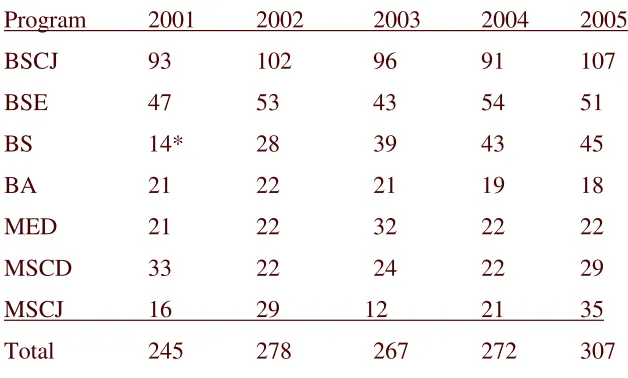
In this section, a five-year trend in the number of majors in each program is presented. The following table shows the data for the number of majors:
Table 2: Number of majors (Fall)
Program 2001 2002 2003 2004 2005
BSCJ 93 102 96 91 107
BSE 47 53 43 54 51
BS 14* 28 39 43 45
BA 21 22 21 19 18
MED 21 22 32 22 22
MSCD 33 22 24 22 29
MSCJ 16 29 12 21 35
Total 245 278 267 272 307
*BS B New program replaces the Bachelor of Science in General Studies
III. PERSONNEL
Noteworthy activities and accomplishments: DIVISION OF SOCIAL SCIENCES, 2004-2005
1. ALAN WILLIAM BARTON
Assistant Professor, Sociology and Community Development
Faculty Associate, Center for Community and Economic Development Student Engagement Champion, 2004–05
Started at DSU: January 2003
TEACHING
Courses Developed and Taught
Spring 2005
SOC 101: Principles of Sociology, Enrollment: 34 UG
SSC 470/570: Methods of Social Research, Enrollment: 14 UG, 2 GR
SOC 422/522, COD 522: Environment and Society, Enrollment: 5 UG, 5 GR Fall 2004
SOC 101: Principles of Sociology, Enrollment: 40 UG
SSC 470/570: Methods of Social Research, Enrollment: 18 UG, 10 GR SOC 421/521, COD 521: Sustainable Development, Enrollment: 2 UG, 9 GR Summer I 2004
SOC 485/585: Population and Environment, Enrollment: 11 UG, 8 GR
Guest Lectures and Presentations
“Access to and Use of Technology in the Mississippi Delta,” Madison Center Brown Bag Presentation, May 4, 2005.
“The Delta Rural Poll,” Slide presentation at the May We Present: What Delta State Professors Do Outside the Classroom and How It Shapes Our Teaching colloquium, Delta State University, Cleveland, MS, April 18−22, 2005.
"An Overview of Changing Conditions in the Mississippi Delta," Presented to the Third World on the Mississippi: An Exploration of Sustainable Development Strategies in the Lower
“The Delta Rural Poll,” Presented at the Center for Community and Economic Development Tenth Year Celebration, Delta State University, Cleveland, MS, December 2, 2004.
"The Delta Rural Poll," Presented at the Workshop on Community-Based Research in the Mississippi Delta, Institute for Community-Based Research, Center for Community and Economic Development, Delta State University, Cleveland, MS, October 15, 2004.
“The Global Media,” for SPE 318: Mass Communication, Delta State University, Cleveland, MS, May 5, 2004. (Not included in last year’s report).
“The Role of Community-Based NGOs in International Development,” for COD 685: Issues in Community Development, Delta State University, Cleveland, MS, April 14, 2004. (Not included in last year’s report).
Most Important Accomplishments in Teaching Over the Past Year
New Courses
Last year I established the following goal for myself in my faculty activity report:
Develop the “Sustainable Development” (SOC 421/521 COD 521) core course for the Sustainable Development track in the Community Development MS program, and the “Population and Environment” (SOC 485/585) course as an elective for community development and sociology students.
Dr. John Green and I continued to develop the Sustainable Development track over the past year, and as part of this effort I created the core course entitled “Sustainable Development” (SOC 421/521 COD 521) and taught this course in Fall 2004. I also taught “Environment and Society” (SOC 422/522 COD 522) in the Spring of 2005 and developed an elective course for this track entitled “Population and Environment” (SOC 485/585 COD 585) which I taught Summer I 2004 and will teach again Fall 2005.
Improved Courses
I worked to improve the “Methods of Social Research” course (SSC 470/570) this year, by developing a more challenging course for graduate students and by creating a series of PowerPoint slideshows to accompany each individual lecture. I now use different texts for undergraduate and graduate students, and an additional reader and discussion sessions for graduate students. I also restructured the research proposal that students work on during the semester, by adding rewrites and other tasks, and increasing the expectations for this
intermediate work.
Improved Teaching Methods
course. I also added a service learning assignment for the graduate students taking the
Environment and Society course. I have also continued to work on my on-line syllabi to make them more useful sources of information for students.
RESEARCH
Research and Policy Reports
Alan W. Barton and Roshun N. Williams. Technology Use in the Mississippi Delta: A Summary Report from the 2003 Delta Rural Poll. Policy Paper No. 05-01, Center for Community and Economic Development. Delta State University, Cleveland, MS. April, 2005.
Alan Barton. 2004. Evaluation of the Delta Volunteers Environmental Stewardship Project: Final Report covering the activities during 2004. Delta Center for Culture and Learning Program Evaluation Report.
Alan W. Barton. Employment and Quality of Life in the Mississippi Delta: A Summary Report from the 2003 Delta Rural Poll. Policy Paper No. 04-02, Center for Community and Economic Development. Delta State University, Cleveland, MS. September, 2004.
Alan W. Barton. The 2003 Delta Rural Poll: Methods and Summary Results. Research Paper No. 04-01, Center for Community and Economic Development. Delta State University, Cleveland, MS. August, 2004.
Conference Presentations
Alan Barton. “The Delta Rural Poll: Collecting Data in the Delta.” Panel Presentation at the 36th Annual Meeting of the Alabama-Mississippi Sociological Association, Tuscaloosa, AL, February 24−25, 2005.
Alan Barton. “Race and Expectations for Public Schools in the Mississippi Delta: Evidence from the 2003 Delta Rural Poll.” Paper presented at the 30th Annual Meeting of the Mid-South
Sociological Association, Biloxi, MS, October 20−23, 2004.
Panel Chair, “Rural People and Rural Policy: Comparing Results from Rural Polls,” 67th Annual Meeting of the Rural Sociological Society, Sacramento, CA, August 11−15, 2004.
Alan Barton. “Work and Well-Being in the Mississippi Delta.” Paper presented at the 67th Annual Meeting of the Rural Sociological Society, Sacramento, CA, August 11−15, 2004.
Conferences Attended
Alabama-Mississippi Sociological Association Annual Meeting, Tuscaloosa, AL, February 24−25, 2005.
Mid-South Sociological Association Annual Meeting, Biloxi, MS, October 20−23, 2004.
American Sociological Association Annual Meeting, San Francisco, CA, August 14−17, 2004. Rural Sociological Society Annual Meeting, Sacramento, CA, August 11−15, 2004.
Workshop Presentations
Alan Barton. “Heritage Tourism in the Local and Global Context,“ Paper presented at the Delta in Global Context workshop, Delta State University, Cleveland, MS, May 27−28, 2005.
Alan Barton. “Future Writing Seminars and Workshops,” Presentation at the Faculty Writing Forum, Delta State University, Cleveland, MS, November 15, 2005.
Workshops Attended
Delta in Global Context Workshop, Delta State University, Cleveland, MS, May 27−28, 2005.
Social Sciences/History STEP Workshop, Fitzgerald’s Hotel, Tunica, MS, April 29−30, 2005.
Writing in the Disciplines Workshops and Keynote Address, Delta State University, Cleveland, MS, April 20−22, 2005.
Writing Across the Curriculum Workshops and Keynote Address, Delta State University, Cleveland, MS, February 17−18, 2005.
Faculty Writing Forum, Delta State University, Cleveland, MS, November 15, 2005. Mississippi Hills Heritage Area Workshop, Oxford, MS, June 10, 2004.
DSU/Mississippi STEP Workshop, Sam’s Town Hotel, Tunica, MS, May 18−19, 2004.
Community Development Student Organization Symposium, Cleveland, MS, April 16−17, 2004.
Research in Progress
Delta Rural Poll
Mississippi Delta National Heritage Area
As part of an on-going action research projected oriented around the establishment of national heritage area in the Mississippi Delta, I interviewed informants from a variety of organizations in the Delta (June, July 2004), at a heritage areas conference held in Oxford, MS (June, 2004), and at two national heritage areas in Pennsylvania (July, 2004). I intend to continue these interviews during the summer of 2005.
Protected Areas Boundaries
I am working on this research project with co-authors John Sydenstryker, Max Pfeffer, and John Schelhas. In July, 2004, I traveled to Ithaca, NY, to complete a GIS analysis of spatial data on a national park in Honduras, which will form the basis of a paper we are currently preparing to submit to a conservation journal.
The Delta in Global Context Workshop
In collaboration with John Green, I coordinated this workshop held May 27−28, 2005 on the DSU campus. We have presenters coming from around the Delta, Mississippi, and other states, and a keynote speaker from Mississippi State University.
Other Professional Development
I took the course on Proposal Writing (COD 695) taught by Jerry Robinson in the Fall semester, 2004.
Most Important Accomplishments in Research Over the Past Year
Delta Rural Poll Papers
In last year’s faculty activity report, I established the following goal for myself: Prepare research and policy reports from the 2003 Delta Rural Poll and qualitative interviews conducted in the Spring and Summer of 2004. Present these reports at conferences and meetings (including the Rural Sociological Society, the Mid-South Sociological Society, and the Alabama-Mississippi Sociological Association). Develop at least one article from these to submit to a journal.
Over the past year, I was able to launch two paper series, published through the Center for Community and Economic Development. I have contributed to these series by completing one research report and two policy reports using data from the 2003 Delta Rural Poll. Dr. John Green also contributed a policy paper to this series.
the 2005 meeting of the Alabama-Mississippi Sociological Association. I am working on a paper based on the MSSA presentation to submit to a journal. I anticipate finishing this during the summer of 2005.
Administering the Delta Rural Poll
In last year’s faculty activity report, I established the following goal for myself:
Plan and conduct qualitative interviews and focus groups to complement the survey portion of the 2003 Delta Rural Poll, and prepare and conduct the next annual survey of the Delta Rural Poll in February 2005.
I conducted and coordinated interviews during the summer and fall of 2004, with several graduate assistants. In collaboration with the other Community Development faculty, I coordinated the preparation of the questionnaire for the 2005 Delta Rural Poll, and the Social Science Research Center at Mississippi State University administered it in February, 2005. We received the results back from them shortly thereafter and I am currently involved in the process of cleaning and preparing the data for analysis.
Conference Presentations
I presented at 3 sociology conferences in the past year. At the Rural Sociological Society annual meeting, I presented a paper on employment and quality of life in the Mississippi Delta as part of a panel on surveys in rural areas. I presented a paper on race and education in the Delta at the Mid-South Sociological Association meeting. I attended the Alabama-Mississippi Sociological Association meeting and participated in a panel on research in the Mississippi Delta, discussing the Delta Rural Poll.
SERVICE
College and University Service
Student Engagement Champion, 2004−05
The Student Engagement Committee was created as part of our SACS review, and the purpose is to oversee the implementation of the university’s Quality Enhancement Plan (QEP). As a
administration on projects that would increase student engagement across campus. Finally, we attended training seminars to help us serve the DSU campus better.
Organizer, Seminar on Writing Across the Curriculum, February 16–18, 2005
I coordinated a two-day seminar on writing across the curriculum, which included various workshops for faculty and a keynote address, held in BPAC auditorium. As organizer, I identified and contracted the presenters, hosted the presenters on their visit, managed logistical concerns such as transportation, rooms and food, oversaw publicity for the event, and established collaborative partnerships with the Writing Across the Curriculum committee and the STEP coordinator.
I prepared an evaluation of the event, which required collecting and analyzing a variety of data. I authored Evaluation of the Seminar on Writing Across the Curriculum, February 2005, which reported the results of the evaluation.
Organizer, Faculty Writing Forum, November 2004
I coordinated a forum for DSU faculty to initiate a conversation on writing, and in particular, how we as educators can assist our students to improve their writing skills. I secured the
location, developed the program for the event, contacted the speakers from various groups across campus, coordinated refreshments, organized publicity, and arranged for audio-visual needs, including videotaping the event. I authored Evaluation of the Delta State University 2004 Faculty Writing Forum, which reported the results of an evaluation of the event.
Standards-Based Teacher Education Project (STEP)
Over the past year, I have been involved in a number of activities sponsored by the STEP project. First, I represented social sciences at the Social Studies STEP workshop in Tunica on April 29–30, 2005. The writing forum and seminar described above were sponsored by the STEP project, so I worked closely with the local coordinator to ensure these events came off smoothly. I also represented DSU at the annual Mississippi STEP meeting, held in Jackson on October 29, 2004. Finally, I represented social sciences at the DSU STEP workshop in Tunica on May 18–19, 2004.
National Council for Accreditation of Teacher Education (NCATE)
Search Committee, GIS Center Director, June and December, 2004
I served on two search committees to find a director for the new GIS Center on campus over the past year. We first convened in June and reviewed applications, the interviewed the top
candidate. He accepted the job, but failed to come to work, so we reconvened in December, 2004 and repeated the process. This time, we selected a candidate who began work in January, 2005.
Departmental Service
Committees
I served on the following ad hoc and on-going committees in the Division of Social Sciences over the past year:
Search Committee, Assistant Professor, Social Science Education, 2005
Search Committee, Assistant Professor, Sociology/Community Development, 2005 Community Development Committee
Social Science Methods Committee Undergraduate Handbook Committee
Curriculum Development Committee, Social Science Education
Disciplinary Service
Reviewer/Referee
In July, 2004, I peer reviewed an article (“New Zealand Park-People Relationship”) for the journal Society and Natural Resources. I peer reviewed a revised version of this article for the same journal in March, 2005.
I peer reviewed a second article (“Collaboration in Context”) for Society and Natural Resources in September 2004, and also did a peer review on a revised version of this article in February 2005.
I reviewed a manuscript for an introductory sociology textbook under consideration at Prentice-Hall Publishers in May, 2005.
Panel Organizer
I organized and directed a panel discussion entitled “Rural People and Rural Policy: Comparing Results from Rural Polls” for the annual meeting of the Rural Sociological Society, held in Sacramento, CA in August, 2004.
Community Service
I am a Board Member of the Friends of the Dahomey National Wildlife Refuge, a local group dedicated to assisting our nearby refuge with a variety of fund-raising and service projects. My term is from 2004−2006, and in addition, I am Vice President of the Board in 2005. We have organized and participated in various events, including hosting Alternative Spring Break groups working at Dahomey, setting up booths as local events such as Oktoberfest and the Crossties festival, coordinating the annual Audubon Christmas Bird Count in Bolivar County, and carrying out environmental education projects related to the wildlife refuge.
Most Important Accomplishments in Service Over the Past Year
Writing Seminars
Organizing the Faculty Writing Forum in November, 2004 and the Writing Across the
Curriculum Seminar in February, 2005 was my most important accomplishment over the past year. These efforts demanded a substantial time commitment and required me to use various skills to ensure that the events were successful.
Student Engagement Champion
In last year’s faculty activity report, I established the following goal for myself:
Serve the college and the university with distinction as a Student Engagement Champion. I have been nominated to serve in this capacity, and I hope to advance the goals of the university’s Quality Enhancement Plan by coordinating and facilitating activities among faculty that increase student engagement across the university. I also hope to use this opportunity to make myself a better instructor, and to learn techniques from other faculty that I can apply in my classrooms to increase student engagement.
I believe I accomplished this goal. I took the lead on several SEC initiatives over the past year, and contributed to all of the products of this committee.
Writing Partnerships
After Dean Parker assigned me the task of organizing the writing seminars, I coordinated a collaborative partnership between the Student Engagement Committee, the Writing Across the Curriculum Committee, and the STEP Project to sponsor these events. Involving various groups widened the impact of these events, and evaluations of these events by faculty and students were very positive. Hopefully, these initiatives will continue next year.
Journal Reviewer
One of my long-term goals is to take a leadership role in one of the national professional
and Natural Resources, the journal of the International Association for Society and Natural Resources. In both cases, the editor selected me to do a second review of the articles, which indicates he appreciated the first reviews. This increases my chances of serving as an associate editor of this journal in the future.
Friends of Dahomey
I have been active in establishing the Friends of Dahomey National Wildlife Refuge organization in Cleveland. As one of the first people involved in this effort, I was an original board member. I was elected to the board for the next two years at the annual meeting this year, and
subsequently I was elected vice president of the board for the next year. Participation in this organization complements activities on campus, as I have worked closely with the staff at Dahomey on an evaluation of an environmental education project, and I have taken my Environment and Society class on a field trip to the refuge twice.
ADVISING
Student Advisees
Over the past year, I have been the faculty advisor for 3 General Education students, for 5 students with a major in Sociology, for 14 students concentrating in Social Sciences, for 1 student with a Social Science Education major, and I have served on 7 graduate committees for Community Development students. I have also sat on 6 thesis defenses (for 5 students), and I have supervised 6 graduate assistants. My advisees are as follows:
General Education
Mason Dean Porsha Humphries Joshua Townsend
Sociology Justin Allen
Jennie Jones Lisa Lias Jeffrey Lizell Latona Martin-Burns Social Sciences
Denio Buck Charles Cross Jolana Gibbs
Andrea Hardy-Terry Jennifer Minyard
Quanetta Montgomery Gureka Price
Jurnis Reed
Reginald Rousseau Lindsay Stout
Paul Spears Sharone Thomas Nakikke Wallace John Weilenman
Community Development
Sharon Caton (Thesis committee) Tomeka Harbin (Thesis committee) Todd Holt (Thesis committee) Mary Huhnke (Thesis committee)
Sarah Leonard (Thesis committee) Donielle Lovell (Thesis committee) Roshun Williams (Thesis committee)
Thesis Defenses
I participated in thesis defenses for the following students: Sharon Caton, 7-28-04
Tomeka Harbin, 4-22-04
Mary Huhnke, 4-23-04; 11-23-04
Donielle Lovell, 6-29-04 Roshun Williams, 7-28-04
Graduate Assistants
I supervised the following students as graduate assistants: Shannon Bussey, Spring, 2004
Rebecca Kimport, Summer, 2004 Betty Moss, Fall 2004
Kim Proffit, Fall, 2004 Josh Stovall, Summer, 2004 Roshun Williams, Spring, 2004
OTHER
Honors
I joined Pi Gamma Mu Social Science Honor Society in April 2004.
Professional Memberships
I am an active member of the following professional organizations: American Sociological Association
Environment, Technology and Society working group Rural Sociological Society
Natural Resources working group Mid-South Sociological Association
Alabama-Mississippi Sociological Association
International Association for Society and Natural Resources Society of American Foresters
International Society of Tropical Foresters Society for Conservation Biology
2.Mark Bonta
Title of position: Assistant Professor of Geography Number of years at DSU: 4
Specific evidence of teaching effectiveness Course and curriculum development
new course: Special Topics: Geography of Vietnam revised syllabus for Geography of Terrorism
new course: Advanced Research Methods in Geography (GEO 690)
new syllabi for Military Geography, for both Shiloh and Vicksburg courses revised Human Geography (GEO 201) syllabi.
new syllabus for Cultural Geography.
List all classes that you have taught, number of students, and major achievements for each class.
Human Geography: Around 150 students over the course of the year, in 5 sections. Students improved writing skills through essay exams and other writing assignments; students kept current events news journals; students worked in groups on real-world issues such as poverty alleviation in 3rd world countries.
Geography of Asia: Special Topics, Geography of Vietnam. Team-taught with Garry Jennings, c. 15 students grad/undergrad.
World Regional Geography, Fall and Summer, 45 students total.
Geography of Terrorism, Spring only, around 15 students grad/undergrad.
Cultural Geography, Spring, 10 students, undergrad only, students did original research projects on aspects of cultural geography in the Delta. We had weekly mini-field trips to cultural landscapes in and around Cleveland.
Advanced Research Methods in Geography, 3 grad students. Military Geography: 15 students, grad/undergrad, Fall and Spring List any Division and University committees on which you serve.
Elected to Faculty Senate, 2005-2006, as rep. for Social Sciences. Safety and Environment Committee Member.
Research Committee—chaired Promotion and Awareness subcommittee. Undergraduate Curriculum Committee, chair (Div. Soc. Sci.).
List any presentations or papers which you presented at professional meetings.
Human Geography of Cycads. Brown Bag Luncheon, Department of Biological Science, Florida International University, Miami, 2005.
MBC and the Human Geography of Cycads. Seminar, Montgomery Botanical Center, Miami, 2005. Authors Meet Critics: Mark Bonta and John Protevi’s Deleuze and Geophilosophy, a Guide and Glossary. Special session, AAG, Denver.
Post-Conflict Landscapes. Discussant for special session, Association of American Geographers Conference, Denver, 2005.
Birds, People, and Conservation in Honduras. Keynote Speaker for Mississippi Audubon meeting, Tara Wildlife, Vicksburg, Mississippi, 2004.
Deleuze, Al Qaeda, and the Multitude. Paper given at the AAG conference, Denver.
Cycads in the vernacular: a world compendium of local names (1); Ethnobotany of Honduran cycads (2); Redescription of Dioon mejiae: toward a taxonomic description standard (2nd author, with Jody Haynes) (3). Papers given at the 7th Annual International Congress on Cycad Biology, Xalapa, Mexico. Conservation Geography of Olancho, Honduras. Presentation to Manejo Integrado de Recursos
Ambientales (MIRA) workshop, USAID/International Resources Group, Tegucigalpa. Geographies of the Multitude. Co-chair and co-organizer of paper session, AAG 2005.
Honduran Cycad Study Tour. Co-organizer and leader, with J. Haynes, Montgomery Botanical Center, Miami FL. Jan 2005.
Workshop on Honduran cycads. Co-organizer. 7th Annual International Congress on Cycad Biology, Xalapa, Mexico, 2005.
List all professional associations in which you hold membership. Association of American Geographers, since 1994.
Conference of Latin Americanist Geographers, since 1994. Board member, 2004-2007; Membership Committee member.
Latin American Studies Association, 2000, 2004-. Central America section. Southeastern Division, AAG, since 2001.
Sociedad Mesoamericana para la Biología y la Conservación, since 1995. Bulletin editor 2004; Board Member 2003-present; US Coordinator, 1998 - 1999.
The Cycad Society, since 2003.
The Society for Economic Botany, since 2003. Professional honors and awards
DSU Foundation Faculty Scholarship Award, 2005. $5,000.00
Montgomery Research Fellow, 2005-. Research fellowship with cycad/palm gene bank. Up to $2,000.00/year in direct funding.
Attendance at Professional meetings
7th Conference on Cycad Biology, Xalapa, Veracruz, Mexico, January 2005. 101st conference of the Association of American Geographers, Denver, Colorado. Continuing Education Activities
Military Geography: Geography of Shiloh (Fall and Spring semesters); Geography of Vicksburg (Spring)
Ongoing Graduate Student Research Supervision (Master’s supervision, Thesis supervision: Indicate your role in the supervision: P= primary, S=secondary, O=other).
Four Master’s students ongoing, M.S.E. 1 undertaking thesis research. Primary.
Completed Graduate Student Degree Supervision (For degree completed July 1, 2003-June30, 2004. Again, indicate your role).
Three Master’s (M.Ed.) completed degrees, no thesis. Primary Other Student-oriented activities.
Coordinated the political/geographical film series, The Politics of Perseverance: Snapshots of the Human Condition.” Spring 2005.
Proposal and Award Activity – (July 2004- Present.) Indicate percentage of responsibility if not P.I. Also, indicate if funded, pending, or denied).
Proposal for Anne White Award, Association of American Geographers, for cycad research in Chiapas, Mexico, denied.
Proposal to Montgomery Botanical Center, Miami, FL, for research on human geography of cycads, funded, $2000.00, research undertaken at MBC in May 2005.
Publications – (Printed July 2004-present. Do not list works published only as abstracts. Do not list a work as published if it was listed as published on a previous report. Indicate whether it is a refereed publication).
Deleuze and Geophilosophy: A Guide and Glossary (Columbia University Press, 2004), with John Protevi (Dept. of French Studies, LSU). (Scholarly book).
Becoming-forest, becoming-local: Transformations of a protected area in Honduras. 2005. Geoforum 36(1):95-112. In special themed issue, Critical Geographies of the Caribbean and Latin America, P. Kingsbury and B. Sletto, eds. Refereed.
Publications submitted but not published – (submitted July 2004- present. List whether accepted as publication, still under review, in revision in response to review or editor’s comments.). All are refereed.
Ethnobotany of Tiusinte (Dioon mejiae) in Honduras. Submitted to Journal of Ethnobiology. Synopsis of ‘Mapping enredos of complex spaces: A regional geography of Olancho, Honduras.’ Geoscience and Man special edition (publ. 2006). Ed. Kent Mathewson. LSU: Geoscience and Man Publications. In revision.
Redescription of Dioon mejiae: toward a taxonomic description standard. With Jody Haynes.
Forthcoming (publ. 2006), Proceedings, 7th Annual International Congress on Cycad Biology, 2005. Accepted; in revision.
Cycads in the vernacular: a world compendium of local names. With Roy Osborne. Forthcoming (publ. 2006), Proceedings, 7th Annual International Congress on Cycad Biology, 2005. Accepted; in revision. Ethnobotany of Honduran cycads. Forthcoming (publ. 2006), Proceedings, 7th Annual International Congress on Cycad Biology, 2005. Accepted; in revision.
‘Geography’ and ‘Lefebvre.’ Entries in the forthcoming Edinburgh Dictionary of Continental Philosophy (publ. 2005), J. Protevi, editor.
Extracts and reviews of my work:
Extract published online: Complexity Digest (abstract from a Geoforum article). http://www.comdig.com, Issue 2004.34
Reviews of Deleuze and Geophilosophy: in Continental Philosophy Review, July 2004:37(3):375-381 (Smith, Daniel); Newsletter of the Environmental Studies Association of Canada, May 2005:14(2):17 (O’Hara, Charles); Transactions: Institute of British Geographers (2005) (Woodward, Keith)
Research or Creative Activity in progress.
Human Geography of Cycads. Expanding research conducted in Honduras (2000-2003) to a global survey of cycad ethnobotany and human relationships to cycads.
List any other activities not included in any of the above items.
Peer reviewer for: Annals of the Association of American Geographers; Political Geography; Professional Geographer; Journal of Latin American Geography.
What do you consider to be your most important achievement in your professional growth and development during the period covered by this report?
Winning the DSU Foundation Research Award, and becoming a Montgomery Botanical Center Research Fellow.
Please list any other items which you would like to include:
Friends of Dahomey National Wildlife Refuge (Cleveland), environmental NGO, elected Board
Member, 2005. Organized first-ever Christmas Bird Count for Bolivar County (event picked up by local media and AP); chair of science and education subcommittee. Organizing various educational and scientific events focused on Dahomey Wildlife Refuge for 2005-2007, in tandem with refuge managers and biologists as well as biologists in the DSU Division of Physical and Biological Sciences.
As chair of the Promotion and Awareness Subcommittee of the DSU Research Committee, organized the first-ever faculty scholarship week, “May We Present”, in April 2005. This will most likely become a yearly event for DSU. Reception was very positive, and it was well-attended and picked up by local and statewide media.
Associate Director, Madison Center, DSU. 2004-. --Planned and led ‘Marvellous Mississippi,’ a summer program of geography field trips for Yazoo City High School students (July 2004). --Coordinated visit of Jon Carter, Anthropology Fellow at Columbia University (NYC) to DSU; he spoke on the
ethnography of youth gangs in Honduras. --Currently coordinating Central America Program with July 2005 DSU field course entitled ‘Struggles for Justice: Peace, Human Rights, and the Environment in Central America’; Spring 2005 film series ‘The politics of perseverance: snapshots of the human condition.’
Editor, Mesoamericana (Bulletin of the Mesoamerican Society for Biology and Conservation). Board member of this Mexicno- and Central America-based professional association.
3. Julie Campbell
Assistant Professor of Criminal Justice Years at Delta State University – 3
Positions held:
Assistant Professor of Criminal Justice, Division of Social Sciences, Delta State University, October 2003 – Present)
Courses taught on campus:
Applied Criminal Investigation (CRJ 410/510). Division of Social Sciences, Delta State University. Spring, 2005.
Historical Analysis of the American Criminal Justice System (CRJ 670). Division of Social Sciences, Delta State University. Spring 2005.
Family Violence (CRJ 476/575). Division of Social Sciences, Delta State University. Fall 2004.
Professional and Institutional Ethics (CRJ 655). Division of Social Sciences, Delta State University. Fall 2004. Applied Criminalistics (CRJ 435/535). Division of Social Sciences, Delta State University. Spring 2005. Independent Study (CRJ 689). Division of Social Sciences, Delta State University. Fall 2004, Spring 2005. Women in Crime (CRJ 490/590). Division of Social Sciences, Delta State University Fall 2004.
New course developed by instructor.
Independent Study (CRJ 689). Division of Social Sciences, Delta State University. Spring 2005.
Courses taught through continuing education:
Family Violence (CRJ 475/575). Continuing Education, Delta University, Greenville Higher Education Center. Fall 2004 – Interactive video course.
Organization and Philosophy of Juvenile Justice (CRJ 315). Continuing Education, Delta State University, Online Course. Fall 2004.
Juvenile Corrections (CRJ 450/550). Continuing Education, Delta State University, Online Course. Fall 2004. Juvenile Justice (CRJ 425/525). Continuing Education, Delta State University, Online Course. Spring 2005. Seminar: Issues in Criminal Justice (CRJ 675). Continuing Education, Delta State University, Online Course. Spring 2005.
Historical Analysis of the American Criminal Justice System (CRJ 670). Continuing Education, Delta State University, Online Course. Summer I 2005.
Applied Criminal Investigation (CRJ 410/510). Continuing Education, Delta State University, Online Course. Summer I 2005.
Organization and Philosophy of Juvenile Justice (CRJ 315). Continuing Education, Delta State University – Mississippi Gulf Coast Community College. Spring 2005 – Interactive video course.
Comprehensive Exam Committees, Practicum Committees, and Thesis Committees in Criminal Justice
Amy Spencer, Comprehensive exam committee, Chair Kevin Washington, Comprehensive exam committee, Chair Jonathan Watts, Comprehensive exam committee, Chair Gerald Wesley, Comprehensive exam committee, Chair Andy Granger, Practicum, Supervisor
Tami Scrivner, Practicum, Supervisor Jonathan Watts, Practicum, Supervisor Allen Inman, Practicum, Supervisor
Christina Weeks, Thesis committee, Chair (ongoing) Mashondia Redmond, Thesis committee, member
University Service
Delta State University Academic Excellence Committee, Member 2004 – Present.
Delta State University Faculty Senate, Proxy for the Division of Social Sciences, 2003 – Present. Social Science Methodology Group, Member, 2003 – Present.
Graduate Studies Team – Recruiting, Member, 2003- Present. Criminal Justice Graduate Program, Advisor, 2004 – Present.
• Personally advised 18 graduate students during the 2004-2005 term.
• Roughly 36 hours spent advising graduate students during the 2004-2005 term.
Criminal Justice Graduate Curriculum Committee, Chair, 2003 – Present. • Revised the 2005-2006 graduate catalog.
Alpha Phi Sigma, Faculty Advisor, 2003 – Present. • Coordinator of the Induction Banquet
Criminal Justice Student Association, Faculty Advisor, 2003- Present.
Professional Development
Proposals Submitted and Approved
Development of an Academic Minor in Forensic Science, Spring 2005.
Faculty Exchange Program (Mississippi Gulf Coast Community College, Spring 2005.
“Crime and Justice” Summer Camp Program (in conjunction with Dr. Bobby Moore and Dr. Garry Jennings), Summer 2005.
Articles Submitted for Review
Self-Perceptions of Stalking Victimization and Impacts on Victim Reporting at Three Southern Universities, Co-authored with Dr. Bobby Moore, Summer 2005.
Conferences and Workshops
Annual Mississippi Coalition Against Domestic Violence Conference, Biloxi, Mississippi, Summer 2004. Forensic Science Semester at Sea, The University of Southern Mississippi, Summer 2004.
Professional Memberships
Academy of Criminal Justice Sciences, National Criminal Justice Association Southern Criminal Justice Association, Regional Criminal Justice Association Lambda Alpha Epsilon, National Criminal Justice Association
Phi Kappa Phi, National Honor Society
Mississippi Association of Adult and Community Education
4. John J. Green
Assistant Professor of Sociology and Community Development Graduate Coordinator, Community Development
Years at DSU: 3
Instructional Activity
Courses Taught
Community Development Research Methods (COD 680). Fall 2004, 9 graduate students.
Delta in a Global Context (SOC 426/526 and COD 526). Fall 2004, 8 graduate students, 4 undergraduate students.
Planning, Implementing and Evaluating Community Development Projects (COD 635). Summer I 2005. (Has not been taught yet – June 2005).
Special Topics: Education and Workforce Development (COD 695). Interim Summer I 2005. (Has not been taught yet – May 2005 interim course).
Seminar on Issues in Community Development (COD 685). Spring 2005, 5 graduate students. Social Theory (SOC 440/540). Spring 2005, 2 graduate students, 9 undergraduate students. Social Problems (SOC 403/503). Spring 2005, 2 graduate students, 13 undergraduate students. Practicum in Community Development (COD 698). Every Semester.
Thesis in Community Development (COD 699). Every Semester.
Note – All of the community development courses I have taught in the past year involved service learning projects. I plan to continue in this direction.
Advising and Practicum/Thesis Committees
Clark, Yolanda (Practicum Director), Graduated in Spring 2005. Edwards, Alkie (Practicum Director).
Holt, Todd (Thesis Director).
Huhnke, Mary (Practicum Director).
Johnson, Tonja (Practicum Director), Graduate in Fall 2004. Joseph, Jerry (Practicum Director), Graduated in Fall 2004. Kimport, Rebecca (Thesis Director).
Lovell, Donielle (Thesis Committee Member), Graduated in Fall 2004. Parker, Starr (Practicum Director), Graduated in Spring 2005.
Rash, Theresa (Practicum Director), Graduated in Spring 2005. Rice, Catherine (Thesis Director).
Stovall, Joshua (Thesis Director), Graduated in Spring 2005. Webster, Ambrose (Thesis Committee Member).
Williams, Roshun (Thesis Director), Graduated in Spring 2005.
Note – Practicum and thesis research projects conducted during the time period covered in this report included partnerships with the Center for Community and Economic Development, Dreyfus Health Foundation, Greater Delta Health and Human Services Network, Mound Bayou Housing Authority, St. Gabriel Mercy Center, Tri-County Workforce Alliance, and the United Family Life Center.
Publications and Reports
Green, J.J., A. Jones and J.C. Pope. Forthcoming. “Underemployment and Workforce Development in the Mississippi Delta: Community-Based Action Research for Program Planning to Increase Livelihood Security.” Southern Rural Sociology.
Green, J.J. 2004. Access to Health Care in the Mississippi Delta: A Summary Report from the 2003 Delta Rural Poll. Center for Community and Economic Development Research Report 01-1.
Green, J.J. 2004. “Community Development Research Course Syllabus.” In Resources for Teaching Community-Based Research Methods edited by Sam Marullo and Kerry Strand. American Sociological Association.
Green, J.J. 2004. “Review of The New Poverty Studies edited by J. Goode and J. Maskovsky.” Journal of the Community Development Society 34(2): 118-120.
Green, J.J. 2004. “Changes in the Cotton Regime and Exploration of Policy Alternatives: In Search of Comprehensive Rural Development for the Mississippi Delta.” A Working Paper Report to Oxfam America. Green, E. and J. J. Green. 2004. “Sustainable Enterprise Development Learning Network: An Evaluation of Participant Perceptions of a Southern Sustainable Agriculture Working Group Program.”
Picciano, L., B. Toommaly and J.J. Green. 2004. “Assessing the Needs and Interests of Women in Agriculture: A Summary Review of Results from Community-Based Research.” Working Paper for the Farm Services Agency. Rural Coalition.
Presentations
Presentations for Academic Audiences
Green, J.J. 2005. “Scholarship and Teaching.” Remarks Made for the Opening of Scholarship Week at Delta State University. Cleveland, MS.
Green, J.J. 2005. “Community-Based Research to Inform Development and Teach Research Strategies.” Presented at the Annual Meeting of the Alabama-Mississippi Sociological Association. Tuscaloosa, AL. Green, J.J. 2004. “Community-Based Research to Inform Workforce Development, Health Care and Transportation Efforts in the Mississippi Delta.” Presented to a Study Group from the Dreyfus Foundation, Harvard School of Public Health, and the Social Science Research Center/Mississippi State University. Delta State University, Cleveland, MS.
Green, J.J. 2004. “Conducting Community-Based Research to Diversify Voices: Teaching, Scholarship and Service through Community Engagement.” Presented as the Introduction to a Roundtable at the Annual Meeting of the Rural Sociological Society. Sacramento, CA.
Green, J.J. 2004. “Underemployment, Poverty and Access to Health Care in the Mississippi Delta: A
Community-Based Approach to Understanding Problems and Exploring Alternatives.” Presented at the In the Shadows of Poverty Conference, Southern Rural Development Center and the Rural Poverty Research Institute. Memphis, TN.
Presentations for Community Residents, Development Practitioners and Policy Makers
Green, J.J. 2004. “Forestry and Rural Development in the Lower Mississippi Delta.” Presented at the Experiencing the Mississippi Delta and the Lower Mississippi Alluvial Valley. U.S. Forestry Service, Stoneville. MS.
Green, J.J. 2004. “Workshop on Community-Based Research in the Mississippi Delta.” Delta State University. Cleveland, MS.
Green, J.J. and E. Green. 2004. “Farmers Markets and Community-Based Cooperatives.” Presented at the Delta Food Traditions Exhibit Brown Bag Luncheon, Charlie Capps Archives, Delta State University. Cleveland, MS. Green, J.J. and J. Strassburg. 2004. “Field Research for Planning and Evaluation: A Preliminary Report from a Research Experience in the Arkansas Delta.” Arkansas Land and Farm Development Corporation and the Livestock Association of Eastern Arkansas. Fargo, AR.
Green, J.J. 2004. “Cooperatives as an Economic Development Tool in Rural Communities.” Presented to a Study Group from Nigeria Hosted by the Mississippi Consortium for International Development. Stoneville, MS.
Service
Public Service through Community-Based Research Activities
Public Transportation Assessment in Clarksdale, Mississippi. (Dreyfus Health Foundation).
Community-Based Collaboration for Improvement of Social and Health Services. (Dreyfus Health Foundation). Organizational History Narrative with the Tri-County Workforce Alliance.
Evaluation of the Healthy Community Program. Delta State University.
Evaluation of Rural Health Network Development. Greater Delta Health and Human Service Network. (Office of Rural Health Policy, Department of Health and Human Services).
Needs Assessment, Asset Mapping and Program Planning. St. Gabriel Mercy Center. (Catherine’s Legacy, Sisters of Mercy).
Understanding the Needs and Interests of Limited Resource and Minority Farmers and Farmworkers. (Rural Coalition).
Committee Assignments with Public Organizations
Research Advisor, Rural Coalition.
Departmental and University Committees
Chair, Faculty Search Committee for Sociology and Community Development, Delta State University. Faculty Advisor, Community Development Student Organization, Delta State University.
Faculty Advisor, Pi Gamma Mu Social Science Honors Society, Delta State University. External Project Reviewer, Institutional Review Board, Delta State University.
Committee Member, Delta Rural Poll, Center for Community and Economic Development, Delta State University.
Member, Graduate Studies Council, Delta State University.
Departmental and University Events Organized
Co-Organizer. “Delta in Global Context Workshop.” Delta State University, Cleveland, MS. May 2005.
Session Organizer. “Community Development in the Mississippi Delta.” Sustainable International Development Program Capstone Week at Brandeis University. May 2005.
Honoree Induction. Pi Gamma Mu Social Science Honors Society. Division of Social Sciences, Delta State University.
Display Organizer. “Community Development” and “Graduate Studies.” Scholarship Week at Delta State University. Cleveland, MS.
Co-Organizer. Visiting Course on Development in the Mississippi Delta from the Sustainable International Development Program at Brandeis University.
Professional Organizations and Service
Organizational Membership Rural Sociological Society
American Sociological Association Community Development Society Southern Rural Sociological Association Alabama-Mississippi Sociological Association Pi Gamma Mu Social Sciences Honors Society Organizational Service
At-Large Committee Member for Mississippi. Alabama-Mississippi Sociological Association.
Reviewer. Agriculture and Human Values. Journal of the Agriculture, Food and Human Values Society. Reviewer. Southern Rural Sociology. Journal of the Southern Rural Sociological Society.
Reviewer. Human Organization.
Awards and Recognition
Nominee, Delta State University Kossman Teaching Award. Nominee, Delta State University Faculty Prize for Research. Nominee, Delta State University Faculty Prize for Service.
Information Recognition of the Institute for Community-Based Research by the Board of Trustees of State Institutions of Higher Learning.
Professional Development Activities
Participation in “Comprehensive Community Change Initiatives in the Delta” sponsored by the Foundation for the Mid South. Olive Branch, MS.
Participation in “Traditional Leaders Seminar” sponsored by the Foundation for the Mid South. Itta Bena, MS. Participation in Faculty Development Workshop on “Service Learning: Best Practices” sponsored by the Delta State University Service Learning Committee, Office of Student and Community Engagement, and the
Mississippi Center for Community and Civic Engagement. Cleveland, MS.
Financial Resources
Through community-based research activities, evaluation projects and sponsorship of conferences, the
following organizations provided financial resources for my combined teaching and research work through the Institute for Community-Based Research (ICBR), primarily in the form of subcontracts. Total financial
resources paid between July 2004 and June 2005 will be $19,930; $18,330 will have gone through the University.
Note – Some of these projects were started in the previous academic reporting period. The figures presented here are for the actual funds that came in during the July 2004 – June 2005 reporting period.
Rural Coalition - $3,750 for the ICBR Foundation account and two payments to DSU ICBR accounts - $4,000 and $2,280. These were payments for research activities subcontracted under grants to the Rural Coalition from the Risk Management Agency, US Department of Agriculture.
Dreyfus Health Foundation - $1,600 in direct research support to me for expenses and $4,000 to the ICBR for transportation system assessment.
Mississippi Association of Cooperatives - $2,300 to the ICBR to help with costs associated with the Delta in Global Context Workshop.
5. Brent D. Hales
Assistant Professor of Sociology and Community Development Division of Social Sciences
Director of the Center for Community and Economic Development Number of years at DSU: 5
I. Instructional Activities
Teaching Effectiveness:
During the 2004-2005 school year, I taught three courses. In each of these courses, I have received numerous comments regarding the effectiveness of my teaching including those garnered in my teaching evaluations. I take a personal interest in my students and work with them individually to increase the likelihood that they not only pass my courses but excel in the courses.
Course/Curriculum Development:
I taught one new course this year, Sociological Theory. I also taught two other courses but significantly altered the texts, grading, and course requirements such that all three courses required equally large preparation. I have attached the syllabi for each of the courses taught.
Conferences, Workshops, and Seminars Attended:
• Annual meeting of the Community Development Society – Cleveland, OH, July 2004 • Annual meeting of the Rural Sociological Society – Sacramento, CA, August 2004
• Annual meeting of the Alabama/Mississippi Sociological Association – Tuscaloosa, AL, February 2005 • Department of Housing and Urban Development: Community Outreach Partnership Communities
Conference – Chicago, IL, April 2005
Innovative Instructional Techniques:
In the course of my teaching, I require students to be prepared prior to class. One way that I insure this is to have students bring questions on the readings to be covered. These are awarded participation points. I also encouraged classroom discussions, require that students work collaboratively on group projects, and
encourage their use of technology in their research and their presentations.
Research Undertaken to Support Teaching:
In an effort to broaden my teaching and to stay current with the most up-to-date materials in the field, I attempt to have new books for graduate students to read in each of my courses. As a result, I reviewed 11 new texts or manuscripts for course development for the three courses taught in 2004-2005. I have also undertaken significant Internet-based research on topics not thoroughly covered in the text materials. These resources are fused into my teaching and course content.
Mentoring Student Research Beyond the Classroom:
I have regular meetings with students via phone, email, or face-to-face in order to insure that their needs are being met. I also regularly work with student athletes through Dr. Randy Grierson. I work with the
academic support lab and writing lab to insure that the students receive the attention they need to excel in my courses.
2004-2005 Courses Taught:
I taught three courses this year including one new prep. In the Fall semester, I taught one section of Sociological Theory (SOC 440/540) with 15 undergraduate and 10 graduate students. This course was a new course for me so I created PowerPoint based seminar-based lectures focusing on the points of classical sociological theory. Students wrote several theory critiques, lead class discussions, prepared questions for each lecture, wrote one group paper, and were given two non-comprehensive exams.
In the Fall semester, I also taught an overload course entitled Introduction to Sociology (SOC 101) with 14 students. This course utilized both text-based, lecture, and on-line learning components. Students were also awarded points for a service-learning project that was built into the curriculum. Students were encouraged to participate in the Delta Health and Wellness Day, work with the Volunteer Center, or other community project.
In the Spring 2005 semester, I taught Racial and Cultural Minorities (SOC 450/550) with 18 undergraduates and 7 graduate students. Students were required to participate in the seminar-based learning format, to write four topic-based commentary papers, participate in a group paper and presentation, and take two exams. Graduate students were also required to read and prepare critical reviews of four additional books. Students presented papers ranging from “The Impact of Women in the Civil Rights Movement” to “The
Representation of Minorities in Faculty and Administration at Delta State University”. In all projects, students worked together in teams to prepare research papers, presentations, and findings to the class and wider community if appropriate.
Refereed Publications:
Non-refereed Publications or Reports:
In 2004, I completed the Annual Report for the Center for Community and Economic Development. I also distributed numerous news releases for the Center and the Mississippi Delta Technology Council. I am in the process of developing content for the web portal for the Mississippi Delta Technology Council. This web portal will go online June 1, 2005.
The Center and its programs regularly release newsletters that I review for programs prior to distribution. Additional reports are due for programs to their funding agencies that I either author or edit. Reports were generated that I either authored or edited include:
• Delta Health and Wellness Day – Dreyfus Health Foundation • Delta Health and Wellness Day – Delta Health Alliance
• Mississippi Delta Technology Council – Small Business Administration
• Delta Reads Partnership – Mississippi Commission for Volunteer Services and Corporation for National and Community Service
• Business Development and Assistance Project – Delta Regional Authority
The Provost at Delta State University has instituted a new evaluation and review policy for the Center for Community and Economic Development. As part of this review, I submit monthly progress reports to the Provost and participated in the 2005 Center evaluation.
I conducted numerous interviews and wrote articles for the Delta Business Journal and Pointe Innovation Magazine.
II. University and Public Service
Division and University Committees:
• Member of the President’s Technology Development Team • Member of the University Web Oversight Committee
• Member of Graduate Faculty Committee, Division of Social Science, Delta State University • Member of the Delta State University Staff Council
• Principal organizer of the First Annual Delta Health and Wellness Day
Public Service
• Primary evaluator of the Mississippians Engaging in Greener Agriculture Food Security Project. My primary responsibilities included developing and administrating an evaluation instrument used in program evaluation, grant review, and staff training, 2004-2005.
• Chair of the MS Walk, Cleveland, MS, April 2005.
• Consultant to and organizer of the Humphreys County Partners for Progress - Developed a strategic plan for Humphreys County and created an organization (Partners for Progress) to oversee the utilization of the plan, 2004.
III.Professional Development
Presentations at Professional Meetings:
July 2004 – Annual meeting of the Community Development Society – Cleveland, OH
• Presented a paper entitled “Forming Regional Technology Councils: A Strategy for Community and Economic Development”
• Received the New Professional Award from the Society
August 2004 – Annual meeting of the Rural Sociological Society – Sacramento, CA • Presented a paper entitled “The Methodologies of Polling in Rural Areas” • Organized the sessions for the Rural Poverty Research Interest Group • Served as Poster Session Chair
February 2005 – Annual meeting of the Alabama/Mississippi Sociological Association – Tuscaloosa, AL • Presented a paper entitled “Business Retention and Expansion – An Effective Mechanism for
Rural Economic Development”
April 2005 – Department of Housing and Urban Development: Community Outreach Partnership Communities Conference – Chicago, IL
• Attended the conference and accompanying grant writing workshop in preparation for proposal submission.
Brent D. Hales. "Linking Research to Practice and Policy: Improving Technology Access and Use among Underserved Populations" A panel discussion presented at the Annual Conference of the Community Development Society, Baltimore, MD, June 2005.
Jerry W. Robinson, Jr. and Brent D. Hales. "The Social and Psychological Dynamics for Creating Sustainable Community Development Organizations" A paper presented at the Annual Conference of the Community Development Society, Baltimore, MD, June 2005.
Presentations to Communities and Community Groups
February and March 2005 – Leadership 82 – Mathiston, MS
• Presented “Resource Mapping – A Strategy for Rural Community and Economic Development”
May 2005 – Webster County Economic Development Foundation Board – Eupora, MS
• Presented “Resource Mapping – A Strategy for Rural Community and Economic Development” June 2005 – Foundation for the Mid-South (Leflore County, MS and Phillips County, AR)
• Presented “Models of Effective Community Organizing”
June 2005 – Arkansas State University (Corning, AR)
Professional Development Workshops, Seminars And Conferences Participated in:
• Mississippi Commission for Volunteer Services Fall Conference, September 2004 • Cyber Security Assessment Training, November 2004
• CIT.MS Annual Meeting, November 2004
• Center for Community and Economic Development 10 Year Celebration, December 2004 • Delta Health and Wellness Day, December 2004
• Mississippi Economic Development Council Winter Conference, February 2005 • Brandeis Economic Development Forum, February 2005
• Southern Policies Board Rural Prosperity Focus Group, March 2005 • Governor’s Winter Symposium on Momentum Communities, March 2005
• Mississippi Delta Technology Council, Membership Development Meetings (ongoing monthly meetings)
• Employment Law Workshop, Delta State University, April 2005
Professional Memberships:
• Rural Sociological Association • Community Development Society
• Alabama/Mississippi Sociological Association • Sigma Xi, The Scientific Research Society • Southern Sociological Society
• Western Social Science Association
• Mississippi Economic Development Council • Mississippi Economic Council
Honors and Awards:
• New Professional Award, Community Development Society, 2004.
Ongoing Graduate Student Research Supervision (Master’s Supervision, Thesis Supervision: Indicate Your Role In The Supervision: P= Primary, S=Secondary, O=Other)
In 2004-2005, I participated in 8 master’s theses with one as a primary supervisor and seven in a secondary position. I am also serving in a secondary role on a Ph.D. committee for a student at USM.
Proposal And Award Activity – (July 2003- Present. Indicate Percentage Of Responsibility If Not P.I. Also, Indicate If Funded, Pending, Or Denied)
Research or Creative Activity in Progress:
Wellness Day by sponsoring activities around that theme. We are working with State Representatives to have the third Thursday in October declared Mississippi Health and Wellness Day in 2006.
• Delta Rural Poll – This project is focused on providing a reliable means of assessing current conditions in the Delta and current attitudes of Delta residents. Has or will issue reports on recent poll results pertaining to access to health care, the status of education, technology use, and projections on workforce in the Delta.
• Mississippi Delta Youth Entrepreneurship Program – Working with government, business, education, and non-profit groups in the Bolivar, Washington, and Coahoma County region to provide educational training and assistance in the areas of entrepreneurship and business development and sustainability to young adults, aged 17 to 25, in this economically distressed area. In particular, we foresee two cohorts, each with 30 students and 15 alternates. Each cohort will receive in-class training and access to and interaction with mentors who have established successful regional businesses. Each program participant upon successful completion of educational portion of the program will receive a grant of $5,000 to support establishment of a new business in the Mississippi Delta.
• Community Outreach Partnership Centers Program (COPC) – I am working with numerous groups in Coahoma County to establish the HUD funded program that will work with the “hard core unemployed” collaboratively to create a Neighborhood Work-Net Group. This group would conduct resource
assessments with participants and design training opportunities in collaboration with the Coahoma Community College Workforce Development Training Center and the Tri-County Workforce Alliance. The group would also work to establish viable housing alternatives for participants.
• Certified Technology Community Program. Wave two of a multi-wave study examining community technology readiness in the Mississippi Delta. This project utilizes graduate students in the Master’s of Community Development program for data collection, data analyses, and report generation providing the students with valuable field experience. Primary duties include design, implementation, and analyses of survey instruments and data collection efforts. Currently conducting a Delta-wide Technology
Readiness Assessment through the Mississippi Delta Technology Council.
6. Robert B. Hunt III
Assistant Professor of Criminal Justice Three(3) years at Delta State University
I. Instructional Activities
During this period I developed the curriculum for two new forensic science classes, FSC 435/535 Arson Investigation and FSC 445/545 Medical Legal Investigation of Death.
For Medical Legal Investigation of Death we are using actual crime scene photographs and autopsy reports to determine the cause of death.
In Drug ID and Enforcement I have brought in agents of the Mississippi Bureau of Narcotics, the U.S. Drug Enforcement Agency, and local drug task force as guest speakers. The students also got to see the various equipment used in investigation, surveillance and detection. They were introduced to some of the paraphernalia used in the drug trade and for ingestion of the narcotics. They got to see a drug dog in action and how the dog alerted when he located narcotics.
For the Prison Community class I brought in guest speakers, the Superintendent of the state penitentiary at Parchmon and the Warden of the Bolivar Regional Correctional Facility, who also arranged for two inmates to speak to the class.
In Criminal Law the students learn how to research case law and utilize the facilities available at the DSU Library.
II. University and Public Service
I have been involved with comprehensive exams for a number of our graduate students and sat on one thesis committee.
I have assisted the University Police Department in how to write and execute a search warrant and in training in the use of a hand held metal detector (I am a certified instructor in the use of this device).
I am the Chairman of the Board for the Cleveland-Bolivar County Crime Stoppers, Inc. and have worked to develop this program for the local community. It will become active on August 1st 2005.
I am a commissioned Deputy Sheriff for Bolivar County and work with the Narcotics Compact for Bolivar County and Cleveland.
III. Professional Development
I have reviewed two text books, Criminal Procedure by Samaha, and Introduction to Law Enforcement and Criminal Justice by Wrobleski and Hess. I have also authored a student study guide for the Wrobleski and Hess text and it was published in May 2005.
I have attended a seminar put on by the U.S. Attorney’s Office and the Department of Alcohol, Tobacco, and Firearms on firearm recovery and identification and crime scene analysis, including new techniques in fingerprinting.
I attended a seminar of the U.S. Department of Transportation, Department of Homeland Security, and Mississippi Bureau of Narcotics on highway interdiction of WMD, hazardous material and narcotics.
I became certified as an instructor for the Mississippi Police Academy in the areas of Evidence, Arrest, Search and Seizure; Mississippi Criminal Code; Report Writing; Crime Scene Investigation; and Civil Liability and Use of Force.
IV. Advising, Student Evaluations and Teaching Schedule
Courses taught
Summer II CRJ 490/590 Seminar in Law Enforcement, Community Policing 2004 CRJ 650 Organization and Philosophy of Criminal Justice
Fall CRJ 412/512 Legal Liabilities (25/0) 2004 CRJ 430/530 Prison community (18/3)
CRJ 404/504 Criminal Law (26/0)
CRJ 630 Theory of Criminal Behavior (9) Spring CRJ 412/512 Legal Liabilities (online) (12/4) 2005 CRJ 406/506 Criminal Procedure (30/0)
CRJ 415/515 Drug ID and Enforcement (28/0) FSC 435/535 Arson Investigation (19/7)
CRJ 650 Organization and Philosophy of Criminal Justice (13) Summer I CRJ 491/591 Seminar in Corrections, Prisoner’s Rights (16/4) 2005 FSC 445/545 Medical Legal Investigation of Death (8/4)
I advise approximately 42 students each semester, in addition I assist graduating student find appropriate employment upon graduation if my help is requested.
I have consistently had excellent student evaluations during my time at DSU.
7. Garry Jennings
Professor of Political Science Summer 2004
Research trip to Boston College and to University of Massachusetts in support of new course, Vietnam: Politics and Policy
Led 21 students in Washington Semester trip to Washington, DC
The Madison Center (TMC) hosted Jon Carter, fellow at Columbia University Began The Rosedale Project with a $15,000 grant from Delta Pine & Land Co.
Autumn 2004
New course. The Democracy Project - followed the presidential election and resulted in a student debate at the campus student union.
New seminar. Specifically focused on the relationships among education, poverty and race. The seminar focused specifically on comparing
Meeting with Noam Chomsky. The meeting dealt with the Prof. Chomsky’s work on the relationship between education and democracy, as well as a possible visit to The Madison Center.
Chair, Tenure and Promotion Committee, Division of Social Sciences Spring 2005
The Democracy Project - new preparation focusing on the political philosophical underpinings of democracy concluding with John Lukacs analysis of the populist nature of the American electorate. Meeting with Abigail Thernstrom, senior fellow at the Manhatten Institute and commissioner on the U.S. Civil Rights Commission. The meeting dealt with Dr. Thernstrom’s research on education and the importance of community support mechanisms outside conventional schools.
Meeting with Duncan Shipley-Dalton, fellow in Peace Studies, Kennedy School of Government, Harvard University. The meeting established formal contacts with non-governmental organizations in Northern Ireland in anticipation of a trip to Belfast, Northern Ireland.
Trip to Ireland. The trip focused on the roles played by non-governmental organizations in helping the resolve conflict in Belfast. Plans were laid for trip to Belfast by DSU and high school students. Conference participation. The American Democracy Project in Portland, Oregon. The tr