DOES A GOOD FIT BETWEEN MOBILE WORK SUPPORT
FUNCTIONS AND MOBILE SALES-FORCE WORKER TASKS LEAD
TO IMPROVED WORK PERFORMANCE?
Dr Markus Lembach
School of Management and Enterprise, University of Southern Queensland
Email:
[email protected]
*Dr Michael Lane
School of Management and Enterprise, University of Southern
Queensland
Email: [email protected]
ABSTRACT
Mobile devices can improve the way sales-force work is conducted in information intensive industries such as the pharmaceutical industry. However, there is a lack of empirical research which has examined the extent to which a good fit between mobile work support functions and sales-force worker tasks and individual characteristics influences intention to use. Does a good fit translate into a perceived positive impact on sales-force worker performance?
Drawing on TTF and TAM theories, an online survey was conducted with sales-force workers in the German division of a large pharmaceutical company. The findings indicate that location dependence and time criticality positively influence perceived usefulness of mobile work support functions and that this perceived fit positively influences intention to use and perceived performance impact of mobile work support functions. Furthermore, there are differences in the perceived usefulness of mobile work support functions across job roles, pharmaceutical business units and length of tenure.
Keywords: Mobile computing technologies (MCT), mobile work support functions, task-technology fit (TTF), pharmaceutical sales-force work, sales task-technology
INTRODUCTION
Despite high investments in sales technology and a considerable amount of research
An adaptation of Goodhue and Thompson’s task-technology fit (TTF) model which includes two aspects of the technology acceptance model (TAM) (Davis, Bagozzi, & Warshaw, 1989) provides the theoretical framework for this research. The main objectives of this study are to investigate
1. the extent to which perceived usefulness (task/mobile work support function fit) is influenced by task characteristics and individual sales-force worker characteristics;
2. the extent to which perceived usefulness (task/mobile work support function fit) and intention to use mobile work support functions influence mobile sales-force worker performance; and
3. does the perceived degree of innovativeness of mobile work support functions moderate the relationships between perceived usefulness and intention to use and perceived impact on mobile work performance.
BACKGROUND TO THE STUDY
Sales-force work and technology supportIn this research, pharmaceutical sales-force work is considered to be a specific form of mobile work, as pharmaceutical sales-force workers are ‘working away from their desk for at least 20% of their time’ (Gartner, 2002). According to Lilischkis’ (2003) categorization of types of mobile work, pharmaceutical sales-force workers in this study's case organization can be considered ‘Yo-Yos’ as they have many working locations inside a geographically limited area. Their main purpose is to promote pharmaceutical products (‘detailing’), and maintain and enhance customer relationships by visiting traditional customers in the German pharmaceutical market such as physicians, hospitals and pharmacies (Fischer & Breitenbach, 2007).
Initially, sales-force automation (SFA) applications were designed to support sales-force workers in information-gathering tasks (Saxe & Weitz, 1982). An effective CRM initiative that is supported by the appropriate SFA applications is expected to positively affect an organization’s sales-force effectiveness (Larpsiri & Speece, 2004, p. 392). Often referred to as mobile SFA or ‘mSFA’ (Scornavacca & Sutherland, 2008), MCT can provide the
technological foundation for certain SFA applications and thereby has the potential to positively affect sales-force worker performance.
Benefits of mobile computing technologies (MCT)
Benefits of MCT can be considered from two perspectives, namely at the individual worker level and at the organizational level. At the individual mobile worker level, four major benefits of MCT have been identified that have the potential to increase an individual mobile worker’s work efficiency and effectiveness, namely effective use of dead times or waiting times, improved preparation for unexpected events increased communication, collaboration and information-gathering capabilities and work process optimisation (Henri & Aurelie, 2006; IBM Cooperation, 2004; Liang & Wei, 2004; Perry, et al., 2001; Schierholz, et al., 2007; Sheng, et al., 2005).
increased organizational effectiveness through business process optimization and reengineering (2004; Henri & Aurelie, 2006; Koschembahr, 2005; Liang & Wei, 2004; Schierholz, et al., 2007; Scornavacca & Sutherland, 2008; Sheng, et al., 2005).
Mobile work support functions
The perceived fit of MCT with pharmaceutical sales-force worker tasks was examined using Zheng’s (2007) six specific mobile work support functions. These are defined as: (1) Mobile workers can use ‘mobile communications’ in order to interact with their colleagues and their clients through voice and text messages; (2) ‘Mobile information searching’ helps mobile workers to receive time-critical information in real-time while working in their mobile work setting; (3) ‘Mobile transaction processing’ facilitates routine organizational and business transactions as they are performed on the spot and thereby can be conducted in a more efficient and cost effective way; (4) ‘Location-related services’ support mobile workers by providing job-related location information like e.g. showing the availability of certain resources or colleagues that are within reach; (5) ‘Mobile job scheduling’ includes both scheduling of shared resources (like e.g. equipment) and scheduling of appointments (like tasks, time and location); and (6) ‘Mobile office’ applications enable mobile workers to use word processing, spreadsheet, presentation software and personal information software while being on the move (Zheng 2007).
Task-technology fit (TTF) theory & Technology acceptance model (TAM)
TTF is a comprehensive theoretical model that explains the linkage between the fit of tasks with an information system and its impact on individual performance (Goodhue &
Thompson, 1995, p. 213). TAM is an adaptation of the Theory of Reasoned Action (TRA) to the field of Information Systems. TAM posits that perceived usefulness and perceived ease of use determine an individual's intention to use a system with intention to use serving as a mediator of actual system use (Davis et al. 1989). Two constructs of TAM (intention to use, perceived usefulness) have been integrated into an adaptation of the TTF model. Intention to use is measure of the strength of one's intention to perform a specified behaviour (e.g., Fishbein & Ajzen 1975, p. 288). Perceived usefulness deals with ‘the prospective user’s subjective probability that using a specific application system will increase his or her job performance within an organizational context’ (Davis et al. 1989, p. 985). Perceived usefulness as a measure for task-technology fit has been supported in a number of previous studies (e.g., Garrity & Sanders, 1998; Lee et al., 2005; Staples & Seddon, 2004; Vuolle & Käpylä 2010; Yuan et al. 2010; Zheng, 2007). The validity of this variation in the TTF model has been confirmed in a number of studies that examined the use of mobile technologies (Dishaw & Strong, 1999; Gebauer & Tang, 2008; Lee, Lee & Kim, 2005; Vuolle & Käpylä 2010; Yuan et al., 2010; Zheng, 2007).
RESEARCH FRAMEWORK
Research model
In this study, an adaptation of the TTF model is empirically tested in the specific context of an industry by considering the characteristics of mobile work and the characteristics of sales force workers in a large pharmaceutical company. The original TTF model was adapted by including two key constructs from TAM (perceived usefulness as a measure of
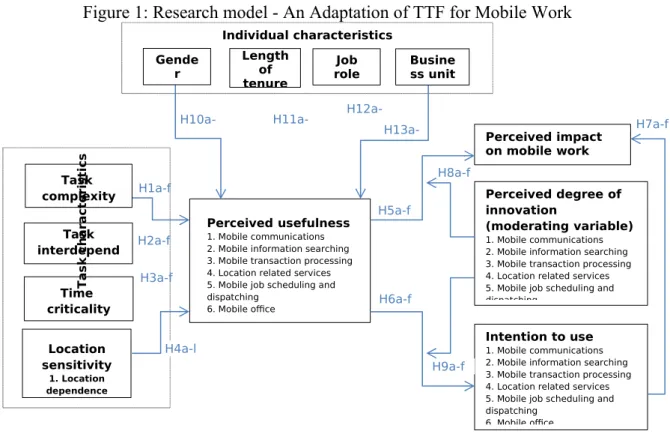
mobile work performance, and perceived degree of innovativeness were rated for each of six mobile work support functions. The hypothesized relationships in proposed research model (see Figure 1) are justified by the existing literature for each of the six mobile work support functions and respective sub hypotheses (a-f).
Mobile Work - Task characteristics
Task complexity
Task complexity considers the degree of non-routineness and non-repetitiveness of a task being performed (Zheng, 2007). To accomplish unstructured, non-routine tasks, a large amount of information is necessary (Gebauer et al., 2010). The increased need for
information due to task complexity can be effectively addressed with mobile work support functions. However, mobile work support functions might not be considered necessary for low complexity tasks with low information needs (Gebauer et al., 2010). Therefore, the literature provides support for the following hypotheses:
H1a-f: Tasks with high complexity have a positive impact on perceived usefulness of mobile
work support functions.
Task interdependence
Task interdependence is concerned with the extent to which workers depend upon each other to accomplish their tasks (Zheng, 2007). Even though pharmaceutical sales-force workers work autonomously in their mobile work setting, coordination among them might be necessary in case of unexpected events (such as an urgent visit of a VIP customer). Coordination efforts increase with the level of task interdependence. Hence the amount of coordination that can be effectively handled by mobile work support functions is positively related to task interdependence (Smolen, 2006; Tushman, 1978; Tushman, 1979). Therefore, the literature provides support for the following hypotheses:
H2a-f: Task interdependence has a positive impact on perceived usefulness of mobile work
support functions.
Time criticality
Time criticality is the degree to which time is critical to the performing a specific task (Zheng, 2007). This research assumes that pharmaceutical sales-force workers have to accomplish time-critical tasks in their mobile work setting. Information via email or SMS provided by colleagues and support staff can help a sales-force worker to provide better information to the customer within the time constraints of a visit. Information about their current location and their work schedule can help them to better decide what task to
accomplish next. Current research supports these assumptions (e.g., Yuan et al., 2010; Zheng, 2007). Therefore, the literature provides support for the following hypotheses:
H3a-f: Time criticality has a positive association with the perceived usefulness of mobile work support functions.
Location sensitivity
Location sensitivity deals with the extent to which performing a task is dependent on
the sub constructs 'location dependence' and 'location variance'. Location variety refers to the extent to which mobile workers work at various locations (Zheng 2007), location dependence refers to extent to which dynamic location-related information is required to perform a task (Junglas and Watson 2003). For pharmaceutical sales-force workers, the information about their current location, information about other colleagues in reach and supporting information from navigation systems can be valuable in completing their daily work (Junglas, Abraham & Watson, 2008; Liang & Wei, 2004; Schierholz et al., 2007). Therefore, the literature provides support for the following hypotheses:
H4a-f: Location variance has a positive impact on perceived usefulness of mobile work
support functions.
H4g-l: Location dependence has a positive impact on perceived usefulness of mobile work
support functions.
Influence of perceived usefulness of mobile work support functions on perceived impact in mobile work performance
According to the original TTF model, a technology that is utilised and that fits with the tasks it supports positively affects work performance (Goodhue & Thompson, 1995). Previous research has confirmed this relationship (e.g., Dishaw & Strong, 1999; Gebauer & Tang, 2008; Lee et al., 2005; Zheng, 2007). Therefore, the literature provides support for the following hypotheses:
H5a-f: Perceived usefulness of mobile work support functions has a positive impact on
perceived mobile work performance.
Influence of perceived usefulness on intention to use mobile work support functions
According to TAM, perceived usefulness of a specific technology positively affects the intention to use it (Davis et al., 1989). Strong support for this relationship can be found in the current literature (e.g., Chau & Hu, 2002; Hu, Chau, Sheng & Tam, 1999; Venkatesh & Davis, 1996; Venkatesh, Speier & Morris, 2002; Verkasalo, López-Nicolás, Molina-Castillo & Bouwman, 2009). Therefore, this study assumes that the perceived usefulness of mobile work support functions positively affects the intention to use. Therefore the literature provides support for the following set of hypotheses:
H6a-f: Perceived usefulness of mobile work support functions has a positive impact on
intention to use.
Influence of intention to use mobile work support functions on perceived impact in mobile work performance
Another major relationship in the original TTF model is the impact of the utilization of a specific technology on work performance (Goodhue & Thompson, 1995). Empirical support can be found for this relationship (Dishaw & Strong, 1999; Gebauer & Tang, 2008; Lee et al., 2005; Cane & McCarthy 2009). Therefore, one can conclude that the intention to use mobile work support functions has a positive impact on perceived mobile work performance.
Therefore the literature provides support for the following hypotheses:
H7a-f: Intention to use mobile work support functions has a positive impact on perceived
Moderating effect of innovativeness of mobile work support functions
In this research, the moderating effect of the perceived degree of innovativeness of mobile work support functions was investigated. Previous empirical studies found technologies that can be used in an innovative way, have the potential to improve work performance
(Adegbesan & Ricart, 2007; Rogers, 1998). Therefore, this study assumes that the relationship between the perceived usefulness of mobile work support functions and
perceived mobile work performance is moderated by the degree of innovativeness of mobile work support functions. Therefore, the literature provides support for the following
hypotheses:
H8a-f: The relationship between the perceived usefulness of mobile work support functions
and perceived mobile work performance is moderated by the perceived degree of innovativeness of mobile work support functions.
Innovative technologies make people curious to use them; ‘early adopters’ especially like to test and try new technologies (Rogers, 2003). The six mobile work support functions
examined in this research have the potential to be used innovatively and therefore increasing the intention to use in mobile work. Thereby, this study concludes that the relationship between the perceived usefulness and intention to use mobile work support functions is moderated by the degree of innovativeness of mobile work support functions. Therefore, the literature provides support for the following set of hypotheses:
H9a-f: The relationship between the perceived usefulness of mobile work support functions
and intention to use mobile work support functions is moderated by the perceived degree of innovativeness of mobile work support functions.
Mobile Work – Individual Characteristics
Gender
Gefen and Straub (1997) conducted research on gender differences in the perception and use of email and found that there is a lack of gender-based research using TAM and other IT diffusion research models. Their findings indicate that gender does have an impact on the IT diffusion process (Gefen & Straub, 1997). Chesley (2005) found that cell phone use over time is associated with increases in negative family-work spill-over for women, but not for men. She explains this finding by stating that family worries and responsibilities are more likely to influence the outcomes for women. In a similar context Lee et al. (2007) argued that there are individual differences regarding the fit of a PDA across gender. Thereby, the literature provides support for the following set of hypotheses:
H10a-f: There are differences in perceived usefulness of mobile work support functions
across gender.
Length of tenure
hypotheses:
H11a-f: There are differences in perceived usefulness of mobile work support functions
across length of tenure.
Job role and type of business unit
In the case organization for this study, depending on their job role, sales-force workers have different needs for mobile work support. Supervisors have to accomplish more managerial tasks in the mobile work setting, while operational sales-force workers primarily focus on reaching their sales-call quota. Sales-force workers from different business units visit different kinds of customers and promote different products. Recent studies (e.g., Deibert, Heinzl, & Rothlauf, 2008; Gebauer, et al., 2010) support the notion that perceived usefulness of mobile application can differ amongst different groups of workers. A prominent example is mentioned by Scornavacca and Sutherland (2008), who state that sale-force workers and management share different perceptions regarding the extent to which mSFA could improve individual performance. With regard to differences in technology perceptions, Jurison (2002) identified a substantial variance across user groups (e.g., business units in this research setting). Thus, the literature provides support for the following set of hypotheses:
H12a-f: There are differences in perceived usefulness of mobile work support functions
across job roles.
H13a-f: There are differences in perceived usefulness of mobile work support functions
across business units.
Figure 1: Research model - An Adaptation of TTF for Mobile Work
RESEARCH METHOD
Data collection procedures
Individual characteristics Gende
r roleJob Business unit Length of tenure H12a-f H7a-f H10a-f H11a-f
H13a-f Perceived impact on mobile work
performance T a s k c h a ra c te ri s ti c s H1a-f Task complexity H8a-f
Perceived degree of innovation
(moderating variable)
1. Mobile communications 2. Mobile information searching 3. Mobile transaction processing 4. Location related services 5. Mobile job scheduling and dispatching
Perceived usefulness
1. Mobile communications 2. Mobile information searching 3. Mobile transaction processing 4. Location related services 5. Mobile job scheduling and dispatching
6. Mobile office
H5a-f H2a-f Task interdepend ence Time criticality H3a-f H6a-f Location sensitivity 1. Location dependence 2. Location
Intention to use
1. Mobile communications 2. Mobile information searching 3. Mobile transaction processing 4. Location related services 5. Mobile job scheduling and dispatching
6. Mobile office H4a-l
A quantitative online survey was the main data collection instrument in this research. The sampling unit for the online survey was pharmaceutical sales-force workers employed at the German division of the case organization. The sample size was the whole population of 795 sales-force workers (N=795). The sales force workers were invited to participate on a voluntary and anonymous basis by email with a URL link to the online survey. The study’s variables and respective measurement items are summarized in the table 1.
Variables in
adapted TTF model
Measurement items Source
Mobile sales-force worker
task characteristics
Task complexity (6 items)
Task interdependence (6 items)
Time criticality (4 items)
Location sensitivity
1. Location variety (3 items)
2. Location dependence (5 items)
Ordinal 7 point likert scales
(Goodhue & Thompson 1995; Lee et al. 2005; Perrow 1967; Withey et al. 1983; Zheng 2007)
Individual characteristics of mobile sales-force workers
Gender (male, female)
(1 item nominal scale)
Job role
(operational or supervisor) (1 item nominal scale)
Length of tenure
(< 5 yrs, 5-10 yrs, 10-20 yrs, > 20 yrs)
(1 item ordinal scale)
Business units (BU1, BU2, BU3,
BU4)
(1 item nominal scale)
(Meyer 2007; Middleton 2007; Middleton & Cukier 2006)
Perceived usefulness of mobile work support functions
3 items ordinal 7 point likert scale (Goodhue & Thompson 1995; Lee et al. 2005; Zheng 2007)
Intention to use mobile work support functions
Perceived impact on mobile work
performance
3 items ordinal 7 point likert scale (Davis et al. 1989; Dishaw & Strong 1999; Goodhue & Thompson 1995; Lee et al. 2005; Zheng 2007)
Perceived degree of innovativeness of mobile work support functions
1 item ordinal 7 point likert scale (Adegbesan & Ricart 2007; Rogers 2003; Rogers 1998)
Table 1: Variables & Measurement items (Source: Lembach 2012, pp. 97-99)
Gender, Job roles and business units are nominal variables. These were converted into a set of binary or dummy variables which allows differences between Gender, job roles and business units to be measured in percentage terms using the beta score with one binary variable as the reference variable. The detailed survey instrument for measuring these variables is available online (Lembach 2012, pp. 301-321).
In the online survey, the research model and the six model work support functions were empirically assessed using a hypothetical scenario method (Weber, 1992). This technique uses scenarios also known as vignettes that ’present subjects with written descriptions of realistic situations (See Appendix 1) and then request responses on a number of rating scales that measure the variables of interest‘ (Trevino, 1992). The real-life usage scenarios for each of the mobile work support functions were derived from in-depth interviews with sales-force workers in the first phase of data collection in this research project (Lembach & Lane, 2011). The participants had to rate a technology, MCT, that was not formally in place in the case organization at the time the research was conducted. Hence, real-life usage scenarios were provided for each mobile work support function in the online survey to facilitate appropriate responses from the survey participants.
Data analysis procedures
Partial Least Squares – structural equation modeling (PLS-SEM) is considered to be an appropriate advanced statistical technique to validate the measurement model and to test the proposed hypothesized relationships in the research model (Byrne, 2001; Kline, 2005). The research model is analysed and interpreted in a rigorous two phase approach: (1) an
assessment of the reliability and validity of the measurement model (outer model) describing the relationship between the latent constructs and their manifest indicators; and (2) an
assessment of the structural model (inner model) describing the relationships between the latent constructs (Barclay et al., 1995). This approach ensures that construct measures are determined to be valid and reliable before drawing conclusions about the predictive strength of relationships between the constructs in the theoretical model. For PLS-SEM, the overall goodness of fit (GoF) of the research model for each of the six mobile work support functions was determined by manually calculating the effect size of the measurement model, the effect size of the structural model and the model’s overall effect size (Nitzl, 2010; Tenenhaus et al., 2005; Wetzels, Odekerken-Schroder & Oppen, 2009).
RESULTS OF DATA ANALYSIS
The demographic profiles of the survey respondents is summarised in table 2.
Number of respondents 208
BU2: 11.06%
BU3: 13.94%
BU4: 7.21%
Distribution by gender Females: 42.79%
Males: 57.21%
Distribution by job roles Supervisors: 13.94%
Operational: 86.06%
Distribution by length of tenure < 5 years 8.17%
5-10 years 33.17% 11-20 years 46.15% > 20 years 12.50% Table 2: Respondent profiles
The distribution of sales force workers by business unit shows that business unit 1 had two thirds of the sales force workers survey responses. Males were slightly more representative in the responses with 57 percent compared to 43 percent for females. Supervisors represented 14 percent of the responses compared to 86 percent for operational sales force workers. The distribution of sales force workers by length of tenure shows that 80 percent of sales force workers fell within 5-10 years and 11-20 years of tenure.
Instrument validation
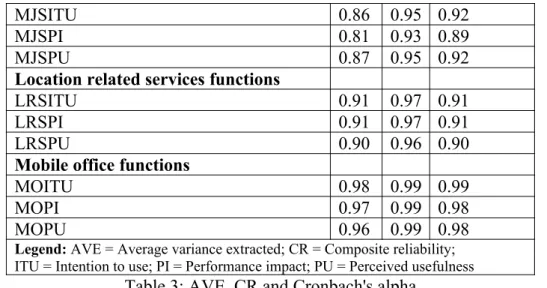
In the outer model (measurement model) assessment, indicators that met the recommended threshold of 0.7 for factor loadings were retained (Hair, 2008). Based on the results shown in table 3, it can be concluded that the AVE and CR are within acceptable ranges for all research constructs in the six mobile work support functions models examined — no further
modifications were made at this stage to the measurement model used for each of the six mobile work support functions.
Categories of Variables
AV
E CR
Cronbach' s alpha Tasks
TC Task complexity 0.61 0.86 0.64
TCR Time criticality of task 0.78 0.94 0.91
TI Task interdependence 0.72 0.84 0.62
LOCDEP Location dependence 0.61 0.86 0.79
Mobile communication functions
MCITU 0.95 0.98 0.99
MCPI 0.95 0.98 0.98
MCPU 0.94 0.98 0.97
Mobile information searching functions
MISITU 0.97 0.99 0.98
MISPI 0.97 0.99 0.99
MISPU 0.92 0.97 0.96
Mobile transaction processing
MTPITU 0.97 0.99 0.99
MTPPI 0.98 0.99 0.99
MTPPU 0.96 0.99 0.98
MJSITU 0.86 0.95 0.92
MJSPI 0.81 0.93 0.89
MJSPU 0.87 0.95 0.92
Location related services functions
LRSITU 0.91 0.97 0.91
LRSPI 0.91 0.97 0.91
LRSPU 0.90 0.96 0.90
Mobile office functions
MOITU 0.98 0.99 0.99
MOPI 0.97 0.99 0.98
MOPU 0.96 0.99 0.98
Legend: AVE = Average variance extracted; CR = Composite reliability; ITU = Intention to use; PI = Performance impact; PU = Perceived usefulness
Table 3: AVE, CR and Cronbach's alpha
Adequate discriminant validity was established as the square root of the AVE for all research constructs is larger than the correlations with other research constructs. Regarding the
goodness of fit (GoF) of the six research models based on each mobile work support function investigated, overall effect sizes are considered large, with small size effects for the structural models and large-size effect for the measurement models (cf. table 4 below).
Six mobile work support models tested H2 F2 GoF
Mobile Communications 0.80 0.27 0.61
Mobile information searching 0.82 0.20 0.68
Mobile transaction processing 0.82 0.16 0.67
Mobile job scheduling and dispatching 0.77 0.16 0.62
Location related services 0.79 0.16 0.64
Mobile office 0.82 0.23 0.68
Legend: H2 = Average communality (Fit of Measurement model); F2 = Average redundancy (Fit of Structural
Model); GoF = Goodness of fit overall for each mobile work support function model
Table 4: Goodness of fit
Discussion of the results of hypothesis testing
Hypothese
s Relationship tested for six mobile work support functions Supported?
Task characteristics of sales force workers
H1a-f Task complexity has a positive impact on perceived usefulness (fit) of mobile work support functions
None
H2a-f Task interdependence has a positive impact on perceived usefulness (fit) of mobile work support functions
H2b, H2f
H3a-f Time criticality has a positive impact on perceived usefulness (fit) of mobile work support functions
All
H4a-l Location sensitivity (variance, dependence) has a positive impact on perceived usefulness (fit) of mobile work support functions
H4g-l
Impact of fit (perceived usefulness of mobile work support functions) on intention to use and perceived work performance
H5a-f Perceived usefulness (fit) of mobile work support functions has a
positive impact on perceived mobile work performance All H6a-f Perceived usefulness (fit) of mobile work support functions has a
positive impact on intention to use All
H7a-f Intention to use mobile work support functions has a positive impact on perceived mobile work performance
All
Moderating variable – perceived degree of innovativeness of mobile work support functions
H8a-f The relationship between the perceived usefulness (fit) of mobile work support functions and perceived mobile work performance is moderated by the perceived degree of innovativeness of mobile work support functions
None
work support functions and intention to use mobile work support functions is moderated by the perceived degree of innovativeness of mobile work support functions
Individual characteristics of sales force workers
H10a-f There are differences in perceived usefulness (fit) of mobile work support functions between female and male gender
None
H11a-f There are differences in perceived usefulness (fit) of mobile work support functions between length of tenure
H11b-d, H11f H12a-f There are differences in perceived usefulness (fit) of mobile work
support functions between job roles
H12b, H12d-f H13a-f There are differences in perceived usefulness (fit) of mobile work
support functions between business units
All
Table 5: Results of hypotheses testing
The results summarized in table 5 indicate that mobile work support functions have the potential to positively affect mobile work performance. In addition, the study provided new insights regarding the impact of individual characteristics on perceived usefulness of mobile work support functions and the impact of the perceived degree of innovativeness on intention to use mobile work support functions and perceived impact on mobile work performance.
Regarding the influence of task characteristics constructs on perceived usefulness (fit) of mobile work support functions, it can be concluded that task complexity of mobile sales-force workers does not appear to affect perceived usefulness of any of the six mobile work support functions. With regard to the task interdependence construct, two hypotheses (H2b, H2f) were supported, and a positive and significant relationship exists between task
interdependence and both mobile information searching and mobile office functionalities. These findings indicate that completion of interdependent tasks are facilitated by mobile information searching and mobile office applications. In addition, a significant positive relationship exists between the time criticality of tasks and all mobile work support functions investigated in this study. This finding indicates that mobile work support functions are likely to facilitate completion of sales force worker tasks that are time critical.
Furthermore, a significant positive relationship between location dependence of tasks and the perceived usefulness of all mobile work support functions was found. This finding indicates that the completion of location dependent tasks is facilitated by gaining access to relevant dynamic location related information through the use of all six mobile work support functions. However, no significant relationship between location variance of tasks and perceived usefulness of all mobile work support functions was found. This finding may be explained in that mobile sales-force workers in a large pharmaceutical company work within well-defined boundaries and with a designated set of physicians.
Moreover, it is concluded that for all mobile work support functions, perceived usefulness positively influences perceived impact on mobile work performance and intention to use. In addition, intention to use directly positively influences perceived impact on mobile work performance. These findings confirm the relationships established within the original TTF model and also indicate that overall the use of MCT and the six mobile work support functions is viewed in a positive manner by sales-force workers.
differences in perceived usefulness of mobile work support functions across job roles can be explained in that information searching, job scheduling and dispatching, location related services and office applications will be used differently by sales-force workers in managerial roles in comparison to those in operational roles where the focus is on completing a sales-call quota each day. In contrast mobile communications and transaction processing will be used in a similar manner regardless of whether the job role is managerial and operational in focus. The findings regarding the differences in perceived usefulness of mobile work support functions across length of tenure can be explained in part in that mobile communication and location related services are used by all mobile sales-force workers because of the ubiquitous and uncomplicated nature of these functions in comparison to the other four mobile work support functions. Information searching, transaction processing, job scheduling and office applications may be more challenging to use for older sales-force workers with longer lengths of tenure who are less likely to innovate or change their working routines (Meyer 2007). Similar to a recent study of mobile work using PDAs (Lee et al 2007), this study found no differences in the perceived usefulness of six mobile work support functions across gender. This finding may be explained by the relatively homogeneous nature of the job roles of sales-force workers surveyed in this study across one organization.
In addition, perceived degree of innovativeness did not moderate the relationship between perceived usefulness and intention to use mobile work support functions and the relationship between perceived usefulness of mobile work support functions and perceived impact on mobile work performance. Instead, this research identified that perceived degree of
innovativeness can be a precursor of intention to use mobile work support functions and for perceived impact on mobile work performance. This finding indicates that mobile sales-force workers are of the view that when a mobile work support function can be used an innovative manner in completing a task that it is more likely to be used and result in improved work performance.
CONCLUSIONS AND IMPLICATIONS FOR FUTURE RESEARCH
The following conclusions are drawn from the results of this study. The characteristics, time criticality and location dependence of mobile sales-force workers’ tasks would appear to positively affect the fit (perceived usefulness) of mobile work support functions. Mobile work support functions with good fit (perceived usefulness) would appear to positively affect intention to use and mobile work performance. While the degree of perceived innovativeness associated with mobile work support functions does not moderate the relationship between the fit of mobile work support functions and intention to use and work performance, sales-force workers are of the view it does directly positively influence their intention to use and work performance. In terms of individual characteristics, differences in the perceived
usefulness (fit) of mobile work support functions were found across type of job role, length of tenure and business units. However this study found no differences between female and males sales-force workers in relation to the perceived usefulness (fit) of mobile work support functions.
implementing MCT in the workplace. Sales-force supervisors can benefit from the findings of this study by being aware that mobile work support functions are perceived to accelerate communication, improve information delivery, reduce paper-based work, reduce double-handling of data entries, improve preparation for ad-hoc sales calls and facilitate a more efficient usage of dead times. Both organizational needs and task characteristics of mobile sales-force workers will differ from industry to industry and from company to company. Thus, the fit of MCT with mobile sales-force worker tasks needs to be investigated
thoroughly as there is no 'one size fits all' application for all the different types of tasks that are undertaken by sales-force workers in the field.
The scope of this research is limited with regard to the study's context, the type of innovation decision used to introduce MCT (mandatory in contrast to voluntary) in the case organization and the measurement of the perceived degree of innovativeness as a single item. This
research provided a unique opportunity (not often available to researchers) to conduct an in-depth test of the proposed research model within a large organization. Future research could retest the research model empirically validated and tested in this study in other contexts and across a range of industry sectors and analyze the impact of perceived innovativeness on intention to use and perceived performance impact. In addition, the research model should be retested with more recent and advanced MCT to particularly investigate the use of ‘mobile apps’ and tablets (e.g., iPads/Android tablets) and their potential impact on mobile work performance.
REFERENCES
Adegbesan, T., & Ricart, J. E. (2007). What we really know about when technological innovation improves performance (and when does it not)? University of Navarra, Barcelona: IESE Business School Working Paper No. 668.
Ahearne, M., Jones, E., Rapp, A., & Mathieu, J. (2008). High touch through high tech: The impact of salesperson technology usage on sales performance via mediating mechanisms. Management Science, 54(4), 671-685.
Ahearne, M., & Schillewaert, N. (2001). The effect of information technology on salesperson performance: Working paper of e-Business Research Center 2000, Pennsylvania State University.
Barclay, D., Thompson, R., & Higgins, C. (1995). The Partial Least Squares (PLS) Approach to Causal Modeling: Personal Computer Adoption and Use: An Illustration. Technology Studies, 2(2), 285-309. BenMoussa, C. (2006). Supporting the Sales Force through Mobile Information and Communication
Technologies: Focusing on the Pharmaceutical Sales Force.TUCS Dissertations 75, Turku Centre for Computer Science, Helsinki.
Byrne, B. M. (2001). Structural Equation Modelling with AMOS - Basic Concepts, Applications, and Programming. Mahwah, NJ: Erlbaum.
Cane, S., & McCarthy, R. (2009). Analyzing the factors that affect information systems use: a task-technology fit meta-analysis.. Journal Of Computer Information Systems, 50(1), 108-123.
Chau, P., & Hu, P. (2002). Examining a model of information technology acceptance by individual professional: an exploratory study. Journal of Management Information Systems, 18(4), 191-229.
Chesley, N. (2005). Blurring Boundaries? Linking Technology Use, Spillover, Individual Distress, and Family Satisfaction. Journal of Marriage and Family, 65(5), 1237-1248.
Davis, F., Bagozzi, R., & Warshaw, P. (1989). User Acceptance of Computer Technology: A Comparison of Two Theoretical Models. Management Science, 35(8), 982-1003.
Deibert, S., Heinzl, A., & Rothlauf, F. (2008). The Impact Logic of Mobile Technology Usage on Job Production. Paper presented at the Proceedings of the Fourteenth Americas Conference on Information Systems, Toronto, ON, Canada.
Dishaw, M. T., & Strong, D. M. (1999). Extending the technology acceptance model with task-technology fit constructs. Information & Management, 36(1), 9-21.
Fishbein, M. & Ajzen, I. 1975. Belief, attitude, intention, and behavior: An introduction to theory and research., Reading, MA: Addison-Wesley.
München: Elsevier.
Gartner. (2002). Trends and developments in wireless data applications. Retrieved April 19, 2009, from http://www.siventures.com/portfolio/pdf/070202/Wireless%20Data%20Applications.pdf
Gebauer, J., Shaw, M. J., & Gribbins, M. L. (2010). Task-technology fit for mobile information systems.
Journal of Information Technology, 25(3), 259-272.
Gebauer, J., & Tang, Y. (2008). Applying the theory of task-technology fit to mobile technology: the role of user mobility. International Journal of Mobile Communications, 6(3), 321-344.
Gefen, D., & Straub, D. (1997). Gender Difference in the Perception and Use of E-Mail: An Extension to the Technology Acceptance Model. MIS Quarterly, 21(4), 389-400.
Goodhue, D. L., & Thompson, R. L. (1995). Task-Technology Fit and Individual Performance. MIS Quarterly, 19(2), 213-236.
Hair, J. F., Black, W. C., Barry, B. J., Anderson, R. E., & Tatham, R. L. (2008). Multivariate Data Analysis (7th ed.). New York: Pearson Education Inc.
Hair, J. F., Ringle, C. M., & Sarstedt, M. (2011). PLS-SEM: Indeed a Silver Bullet. Journal of Marketing Theory and Practice, 19(2), 139–151.
Henri, I., & Aurelie, L. (2006). Give me a mobile phone, and I will work harder! Assessing the value of mobile technologies in organizations: An exploratory research. Paper presented at the International Conference on Mobile Business 2006.
IBM Cooperation. (2004). Mobilising your workforce: A blueprint for the utilities industry: IBM Corporation. Junglas, I., Abraham, C., & Watson, R. (2008). Task-technology fit for mobile locatable information systems.
Decision Support Systems 45(4), 1046-1057.
Jurison, J. (2002). Perceived value and technology adoption across four end user groups. Journal of End User Computing, 12(4), 21-28.
Kline, R. B. (2005). Principles and Practice of Structural Equation Modeling. New York: The Guilford Press. Koschembahr, C. V. (2005). Optimizing Your Sales Workforce through Mobile Learning. Retrieved November
20, 2010, from http://www.learningcircuits.org/2005/apr2005/vonKoschembahr.htm
Larpsiri, R., & Speece, M. (2004). Technology integration: Perceptions of sales force automation in Thailand's life assurance industry. Marketing Intelligence & Planning, 22(4), 392-406.
Lee, Ching-Chang, Cheng, Hsing Kenneth, & Cheng, Hui-Hsin. (2007). An empirical study of mobile commerce in insurance industry: Task–technology fit and individual differences. Decision Support Systems, 43(1), 95-110.
Lee, K. C., Lee, S., & Kim, J. S. (2005). Analysis of Mobile Commerce Performance by Using the Task-Technology Fit: IFIP International Federation for Information Processing, Springer Boston.
Lembach, M., & Lane, M. S. (2011). The fit of mobile work support functionalities with pharmaceutical sales-force worker tasks. Paper presented at the 11th International Conference on Electronic Business. Lembach, Markus. (2012). The fit of mobile work support functions with mobile sales-force worker tasks. USQ
ePrints, (Doctor of Business Administration Professional Doctorate), University of Southern Queensland. Retrieved from http://eprints.usq.edu.au/23419/1/Lembach_2012_whole.pdf
Liang, T.-P., & Wei, C.-P. (2004). Introduction to the special issue: Mobile commerce applications.
International Journal of Electronic Commerce, 8(3), 7-17.
Lilischkis, S. (2003). More Yo-yos, Pendulums and Nomads: Trends of Mobile and Multi-location Work in the Information Society: Issue Report 36, Star-project/Empirica.
Meyer, J. (2007). Older Workers and the Adoption of New Technologies. Retrieved from ftp://ftp.zew.de/pub/zew-docs/dp/dp08045.pdf
Nitzl, C. (2010). Eine anwenderorientierte Einführung in Partial Least Square (PLS)-Methode. Retrieved July 10, 2010, from http://www.ibl-unihh.de/ap21_Stand_Juni2010.pdf
Perrow, P. (1967). A framework for the comparative analysis of organization. American Sociological Review, 32(2), 194-208.
Perry, M., O’Hara, K., Sellen, A., Brown, B., & Harper, R. (2001). Dealing with mobility: Understanding access anytime, anywhere. ACM Transactions on Computer-Human Interaction, 8(4), 323-347.
Rogers, E. (2003). Diffusion of Innovations (5th ed.). New York: NY Free Press.
Rogers, M. (1998). The Definition and Measurement of Innovation: Melbourne Institute Working Paper 10/98. Saxe, R., & Weitz, B. A. (1982). The SOCO Scale: A measure of the customer orientation of salespeople.
Journal of Marketing Research, 19(3), 343-351.
Schierholz, R., Kolbe, L. M., & Brenner, W. (2007). Mobilizing customer relationship management: A journey from strategy to system design. Business Process Management Journal, 13(6), 830-852.
Business.
Sheng, H., Nah, F. F., & Siau, K. (2005). Strategic implications of mobile technology: A case study using Value-Focused Thinking. The Journal of Strategic Information Systems, 14(4), 269-290.
Smolen, M. (2006). Successfully Structuring Multicultural Teams in M&As - Based on the on the example of EADS N.V. Unpublished Bachelor, Hochschule für Oekonomie & Management gemeinnützige GmbH, Essen, Essen.
Staples, D. S., & Seddon, P. (2004). Testing the technology-to-performance chain model. Journal of Organisational and End User Computing, 16(4), 17-36.
Tenenhaus, M., Vinzi, V. E., Chatelin, Y., & Lauro, C. (2005). PLS path modeling. Computational Statistics & Data Analysis 48(1), 159-205.
Trevino, L. K. (1992). Experimental Approaches to Studying Ethical-Unethical Behavior in Organizations.
Business Ethics Quarterly, 2(2), 121-136.
Tushman, M. (1978). Technical Communication in R&D Laboratories: Impacts of Project Work Characteristics.
Academy of Management Journal, 21(4), 624-645.
Tushman, M. (1979). Work characteristics and subunit communication structure: a contingency analysis.
Administrative Science Quarterly, 24(1), 82-98.
Venkatesh, V., & Davis, F. (1996). A model of the antecedents of perceive ease of use: development and test.
Decision Sciences, 27(3), 451-481.
Venkatesh, V., & Davis, F. (2000). A theoretical extension of the technology acceptance model: Four longitudinal field studies. Management Science, 46(2), 186-204.
Venkatesh, V., Speier, C., & Morris, M. G. (2002). User acceptance enablers in individual decision making about technology: toward an integrated model. Decision Sciences, 33(2), 297-316.
Verkasalo, H., López-Nicolás, C., Molina-Castillo, F. J., & Bouwman, H. (2009). Analysis of users and non-users of smartphone applications. Telematics and Informatics, 27(3), 242-255.
Vuolle, Maiju, & Käpylä, Jonna. (2010). Theoretical Evaluation Models Used in Mobile Work Context. Paper presented at the Proceedings of the 2010 Ninth International Conference on Mobile Business / 2010 Ninth Global Mobility Roundtable.
Weber, J. (1992). Scenarios in Business Ethics Research: Review, Critical Assessment, and Recommendations.
Business Ethics Quarterly, 2(2), 137-160.
Wetzels, M., Odekerken-Schroder, G., & Oppen, C. (2009). Using PLS Path Modeling for Assessing Hierarchical Construct Models: Guidelines and Empirical Illustration. MIS Quarterly, 33(1), 177-195. Withey, M., Daft, R. L., & Cooper, W. H. (1983). Measures of Perrow's work unit technology: An empirical
assessment and a new scale. Academy of Management Journal, 26(1), 45-63.
Yuan, Y., Archer, N., Connelly, C. E., & Zheng, W. (2010). Identifying ideal fit between mobile work and mobile work support. Information & Management, 47(3), 125-137.
Mobile communication
In general, mobile workers can use mobile communication functionalities in order to interact with their colleagues and their customers through voice and text messages.
In dead times of your mobile work setting, imagine that you could access your emails (and email attachments) online and communicate via email with your customers, sales-force colleagues and headquarter staff. Customer satisfaction could be increased by responding more quickly to customer inquiries. The exchange of information within your company could be enhanced as you can communicate more rapidly with colleagues and headquarter staff. In addition, administrative tasks can be handled via email in dead times of your mobile work setting and not in your home office when you come home after work.
Mobile information searching
In general, mobile information searching functionalities support mobile workers to receive time-critical information in real-time while working in their mobile work setting.
Imagine you could access all relevant information sources (Intranet, Internet, ERP, CRM etc.) in real time whenever needed in your mobile work setting. You could thereby provide additional value for your customers by providing better information in the sales call. In addition, you could prepare more effectively for ad-hoc sales calls as you can look up online customer data and targeting information in the CRM system.
In general, mobile transaction processing facilitates routine organizational and business transactions as they are performed on the spot and thereby can be conducted in a more efficient and cost effective way.
Imagine you could enter all sales-/CRM-relevant data online (e.g., call feedback, customer response, plans for next calls etc.) directly after a sales call has taken place. Double work would be reduced as you would not have to make paper-based notes and enter this information in an online system after you come home in the evening. Medical inquiries from a customer could be typed in an online system in front of the customer (or directly after a sales call) and sample management would be facilitated as the system could check whether the respective customer is allowed to receive a specific medical sample.
Location-related services
In general, location-related services support mobile workers by providing job-related location information like e.g. showing the availability of certain resources, customers or colleagues that are within reach.
Imagine that your current navigation system is enhanced by value-adding information regarding the status and current position of your colleagues and customers. In order to facilitate the decision which customer should be visited next/spontaneously, the map of the navigation system would be enriched with internal targeting information (customer value; customer turnover, last visit, etc.), your distance to the customer (based on your location) and information regarding the customer’s availability (by considering the customer’s business hours, holiday from the CRM system). In addition, you would see the location and the status of your sales-force colleagues (available, within a call etc.) and you can decide whether you want to contact/meet a colleague. The information display would be updated in real time and would adapt to current position you have.
Mobile job scheduling & dispatching
In general, mobile job dispatching and scheduling includes both scheduling of shared resources (like e.g. equipment) and scheduling of appointments (like e.g. tasks, time and location).
Imagine a system that supports you in planning your sales calls. This system would make suggestions how your daily sales call plan could look like. You will also receive recommendations which customer to visit next and whether an ad-hoc sales call would fit into your current route.
Mobile office
In general, mobile office functionalities enable mobile workers to use word processing, spreadsheet, presentation software and personal information software while being on the move.