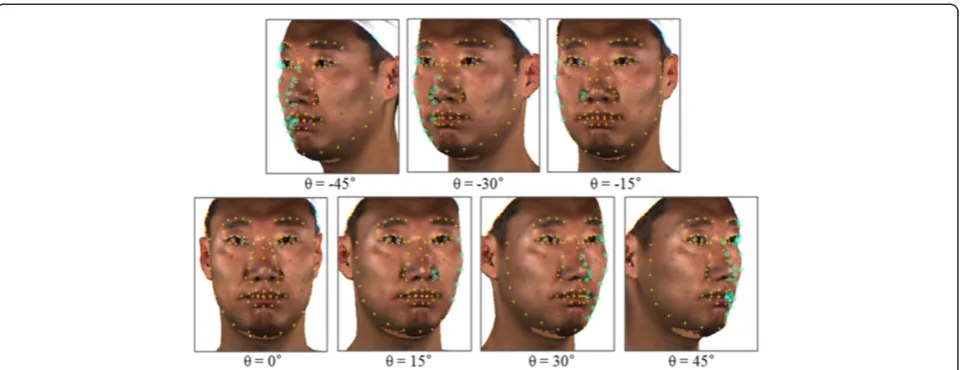
to self-occlusion
Youn Joo Lee
1, Sung Joo Lee
2, Kang Ryoung Park
3, Jaeik Jo
1and Jaihie Kim
1*Abstract
State-of-the-art 3D morphable model (3DMM) is used widely for 3D face reconstruction based on a single image. However, this method has a high computational cost, and hence, a simplified 3D morphable model (S3DMM) was proposed as an alternative. Unlike the original 3DMM, S3DMM uses only a sparse 3D facial shape, and therefore, it incurs a lower computational cost. However, this method is vulnerable to self-occlusion due to head rotation. Therefore, we propose a solution to the self-occlusion problem in S3DMM-based 3D face reconstruction. This research is novel compared with previous works, in the following three respects. First, self-occlusion of the input face is detected automatically by estimating the head pose using a cylindrical head model. Second, a 3D model fitting scheme is designed based on selected visible facial feature points, which facilitates 3D face
reconstruction without any effect from self-occlusion. Third, the reconstruction performance is enhanced by using the estimated pose as the initial pose parameter during the 3D model fitting process.
The experimental results showed that the self-occlusion detection had high accuracy and our proposed method delivered a noticeable improvement in the 3D face reconstruction performance compared with previous methods.
Keywords:3D face reconstruction, Single image, Self-occlusion, Arbitrary view, 3D model fitting
Introduction
3D face modeling originated with Parke’s pioneering studies [1,2], which aimed to generate realistic faces for computer animation. Since Parke’s work, 3D face recon-struction has attracted considerable attention from many computer vision researchers because it has many useful applications, such as pose-invariant face recognition [3,4], age-invariant face recognition [5,6], 3D face gener-ation for game and movie characters [7,8], monitoring suspects using surveillance camera systems, video con-ferencing, and automatic face conversion of a 2D face image into a 3D face for 3D TV.
3D face modeling technologies can be divided into two basic approaches. One approach uses specific sensors, such as stereographic cameras, structured light, or 3D laser scanners [9]. These methods produce accurate 3D face data, but they are expensive and require additional operations, such as calibration. To overcome these lim-itations, a monocular camera-based approach has been
researched intensively. This approach can be categorized further into single view-based and multi-view-based approaches. The multi-view-based approach uses more 2D facial information than the single view-based approach, but it has some limitations such as a requirement for mul-tiple images and detection of the correspondences among the images. In this study, we focus on the single view-based approach.
Among the single view-based methods, shape-from-shading (SFS) is a traditional method for deriving a 3D facial shape from the brightness variations in a single image. However, SFS-based methods have impractical constraints because the Lambertian reflectance model and a known light source direction need to be assumed to produce accurate results [10-12]. Recently, several new techniques have been proposed to overcome this problem. These methods reconstruct a 3D face by mod-eling the relationships between the intensities and the depth information of the face using statistical learning techniques, such as principal component analysis (PCA), partial least squares, and canonical correlation analysis [13-16]. However, all of these methods assume that the input face is viewed from the front, but this strict * Correspondence:[email protected]
1
School of Electrical and Electronic Engineering, Yonsei University, Seoul, Republic of Korea
Full list of author information is available at the end of the article
constraint cannot always be satisfied in real world appli-cations, such as surveillance camera systems.
The state-of-the-art 3D morphable model (3DMM), which was proposed by Blanz and Vetter [3,17], is a single-image-based 3D face reconstruction method that requires no frontal pose constraint. In this method, 3D face reconstruction is performed by fitting a morphable model to a 2D image. The reconstructed 3D face is repsented by model parameters that minimize the texture re-sidual errors between the rendered model image and the input image. To generate a high-quality 3D face, the model parameters contain rendering parameters, such as the camera geometry and illumination direction, as well as facial texture and shape parameters. Therefore, 3DMM can reconstruct a more realistic 3D face in less restrictive conditions. However, it has a high computational com-plexity because of the large number of model parameters that need to be estimated simultaneously [4]. In addition, 3DMM requires manual initialization and a dense point-to-point correspondence between all of the face images.
Simplified versions [5,6,18-20] of 3DMM have been proposed to reduce these computational costs. Unlike the original 3DMM, most simplified 3DMM (S3DMM)-based methods use a sparse shape model, which is con-structed by statistically learning a data set of 3D facial feature points (FFPs). The FFPs indicate the salient fea-tures of a face, such as the corners of the eyes, nose tip, and the corners of the mouth.
S3DMM reconstructs a 3D facial shape (that consists of 3D FFPs) by finding the optimal shape parameter and the pose parameter that minimizes the difference be-tween the projected 3D FFPs of the shape model and the input 2D FFPs. Therefore, the S3DMM-based method does not need to find a dense correspondence between the faces and it has a lower computational complexity because of the drastic reduction in the number of para-meters. However, some of these methods [18,19] still have the limitation that the input face needs to be a frontal view whereas others [5,6,20] are unaffected by pose variations. Wang et al. [20] proposed an automatic framework for 3D face reconstruction on the basis of an arbitrary view image and estimated the shape and pose parameters using an expectation-maximization (EM) al-gorithm. However, they did not report any quantitative results and only qualitative results were presented from some test images in their experiments. Park et al. [5,6] used S3DMM to create a 3D aging model for age-invariant face recognition. They derived a 3D facial shape by alternating the pose parameter and the shape param-eter until the shape residual error converged. The pose and shape parameters were estimated separately using the least squares method. This alternation methodology is used in most S3DMM-based methods [5,6,18,20] be-cause it reduces the computational time and produces a
linear cost function, compared with the one-step meth-odology that estimates all of the parameters at the same time using a non-linear optimization process.
Existing methods [5,6,20] are known to perform using an arbitrary view, but they are not robust to pose varia-tions. This is because they are vulnerable to self-occlusion errors in the 2D input FFPs caused by pose changes. If an input face is rotated, some parts of the face are self-occluded by other parts. Therefore, the occluded facial region is not visible in a rotated face image, and the real FFPs placed on the region are also not observable. As a result, the FFPs detected on the rotated face image contain location errors caused by self-occlusion. These errors degrade the performance of S3DMM-based 3D face reconstruction. Unfortunately, existing S3DMM-based methods have not addressed this problem.
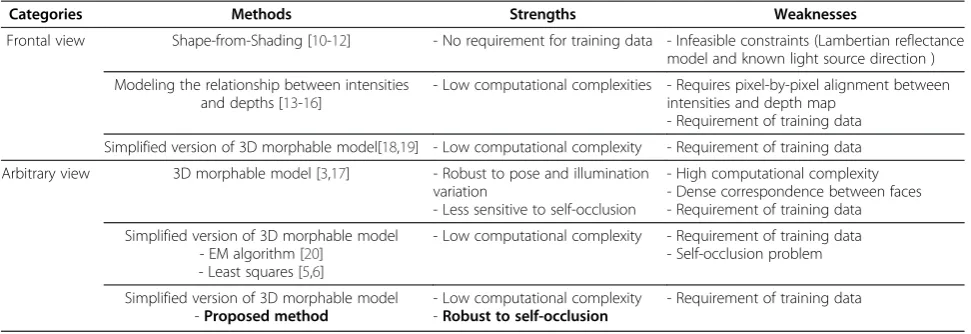
Therefore, we propose a solution to the self-occlusion problem of S3DMM-based 3D face reconstruction. Our proposed method consists of the following two steps. In the first step, visible FFPs that are not affected by self-occlusion are automatically discriminated from self-occluded FFPs by estimating the head pose using a cylindrical head model. In the next step, 3D face recon-struction is performed using a model fitting scheme based on selected visible FFPs to reduce the self-occlusion effect. The performance of the 3D face recon-struction is enhanced by using a pose estimated with the cylindrical head model as the initial pose parameter in the proposed model fitting. In experiments, we evalu-ated the performance of our proposed method qualita-tively and quantitaqualita-tively by using ground-truth 3D face data acquired with a 3D laser scanner. The experimental results showed that the visible FFPs were selected with high accuracy and that the 3D face reconstruction per-formance with the proposed method was improved greatly compared with previous S3DMM-based meth-ods. Comparisons of previous methods and our pro-posed method are summarized in Table 1.
The remainder of this paper is organized as follows. In the following section, the S3DMM is explained and the self-occlusion problem is analyzed. In Section“Proposed 3D face reconstruction method”, our proposed method is described, including the automatic selection of visible FFPs and the model fitting strategy. The experimental results are presented in Section “Experimental results”. Finally, our conclusions are summarized in Section “Conclusions”.
S3DMM and self-occlusion problem
S3DMM
In S3DMM, the geometry of a face is defined as a shape vectorS¼ðX1;Y1;Z1;X2;. . .Yn;ZnÞT2R3n, which
original 3DMM generally uses a dense shape with thou-sands of vertices, whereas S3DMM uses a sparse shape with only dozens of vertices. In order to build a morph-able shape model, S3DMM performs PCA on a training set of shape vectorsSj. The mean shapes0and mshape
variations si are then obtained, and a new shape S can
be expressed as a linear combination of the mean shape s0and the shape variationssias follows:
S¼s0þ
Xm
i¼1
βisi ð1Þ
where β¼β1;β2;. . .;βmT is the shape parameter and m is the dimension of the shape parameter which was determined to represent 99 % of the shape variations of the training face set [21]. Finally, a new 3D facial shape can be generated by changing the shape parameterβ.
Given the 2D FFPs of an input face image, such as s2d¼ðx1;y1;x2;. . .ynÞT 2R2n, the shape parameter β
needs to be determined such that it minimizes the shape residual between the projected 3D facial shape generated by the shape parameter and the input 2D facial shape. The optimal shape and pose parameters ðβ;Rθ;TÞ are obtained from (2):
arg minβ;Rθ;T P RθS~þT~
~s2d
2
ð2Þ
Where ~S is a 3 ×n matrix that is reshaped from the 3n× 1 model shape vectorSobtained using (1),~s2d is a
2 ×nmatrix that is reshaped from the 2n× 1 input shape vectors2d,Pis a 2 × 3 orthographic projection matrix,T~
is a 3 ×n translation matrix consisting of n translation vectors T¼ txtytz
T
, and Rθis a 3 × 3 rotation matrix where the yaw angle is θ. Note that in this paper, we consider mainly yaw rotation because the self-occlusion caused by yaw rotation is relatively greater than that caused by pitch rotation, and tz is set to 0 because an
orthographic projection is assumed.
Several methodologies are used to estimate the model parameters for S3DMM. We used the alternation meth-odology of [5], which alternately finds the optimal shape parameter and pose parameter until the shape re-sidual converges, because this approach reduces the computational cost by transforming a non-linear cost function into a linear one. As shown in Algorithm 1, the procedure for 3D model fitting is as follows. First, the shape parameter β0 and translation parameter T0
are initialized to 0 and the input 2D FFPs s2d are
aligned with the 2D mean shape obtained by projecting the 3D mean shape (s0) with a frontal pose onto the x–
y plane. As the alignment method, we use the Procrus-tes analysis, which includes translation, rotation, and scaling [22]. The optimal model parameters are deter-mined by alternately updating the pose parameter (Rθ, T) at the fixed β and updating the shape parameter β at fixed (Rθ,T) until the shape residual error converges. The cost function is solved as a least squares problem and the rotation matrix is calculated by QR decompos-ition, as in [5]. Finally, a new 3D facial shapeS3dis
recon-structed by applying the optimal shape parameterβto (1).
Algorithm 1 3D Model Fitting [5]
Input:s2d¼ðx1;y1;x2;. . .;ynÞT
Output:S3d¼ðX1;Y1;Z1;X2;. . .;Yn;ZnÞT
1. Initialization
Setβ0=0,T0=0andk= 1.
2. Alignment
s2dis aligned with the 2D mean shape obtained by projecting the frontal 3D mean shape (s0) onto the
x–yplane.
3. UpdateRθandTwith the fixed shape parameter
arg minðRθ;TÞk P RθS~þT~
~s2d
2
β¼βk1 Simplified version of 3D morphable model[18,19] - Low computational complexity - Requirement of training data
Arbitrary view 3D morphable model [3,17] - Robust to pose and illumination variation
- Less sensitive to self-occlusion
- High computational complexity - Dense correspondence between faces - Requirement of training data
Simplified version of 3D morphable model - EM algorithm [20]
- Least squares [5,6]
- Low computational complexity - Requirement of training data - Self-occlusion problem
Simplified version of 3D morphable model -Proposed method
- Low computational complexity -Robust to self-occlusion
Update the shape parameter with the fixed pose parameter
arg minβk P RθS~þT~
~s2d
2
Rθ;T ð Þ¼ðRθ;TÞk
4. Reconstruct (S3d)kusing the shape parameterβk 5. Verify whether
P Rθ ~S3d
kþT~
~s2d
R
θ;T ð Þ¼ðRθ;TÞk
<E If not, go to Step 3 andk=k +1
6. β=βkand (Rθ,T) = (Rθ,T)k
7. ReconstructS3dusing the final shape parameters
Self-occlusion problem
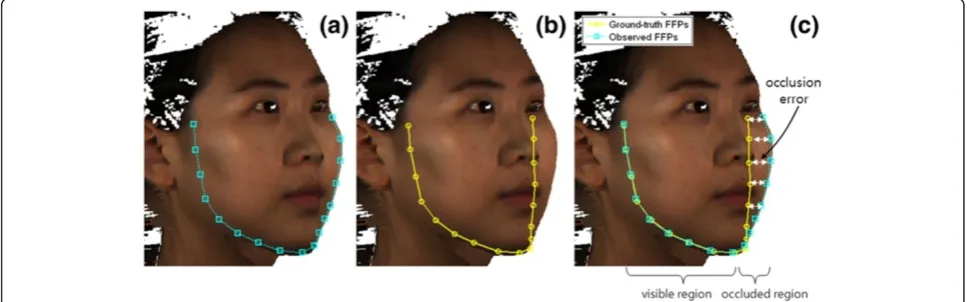
S3DMM-based methods reconstruct a 3D facial shape from 2D FFPs detected in an input 2D image. Therefore, these methods are vulnerable to large location errors that affect the 2D FFPs observed in a given image. Un-fortunately, the observed 2D FFPs may have severe loca-tion errors caused by self-occlusion when detecting the 2D FFPs in a highly rotated face image, as shown in Figures 1 and 2.
Figure 1 shows self-occlusion errors that occur after comparing the observed 2D FFPs with the ground-truth 2D FFPs of the facial contours. When detecting the fa-cial contour FFPs in a half-profile view image, the visible FFPs laid on the visible facial region can be detected as those of the ground-truth facial contour, but the observed FFPs on the occluded facial region are located in the outline of the face because the occluded real facial contour cannot be observed, as shown in Figure 1a. Therefore, the 2D FFPs observed in a rotated face image have location errors, which are the differences between the observed FFPs and the occluded real FFPs, as shown in Figure 1c. These errors increase as the degree of head rotation increases, as shown in Figure 2. As a re-sult, this self-occlusion problem degrades the S3DMM performance.
Proposed 3D face reconstruction method
Overall procedure of the proposed method
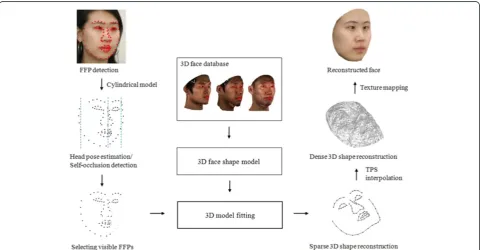
The proposed 3D face reconstruction process starts with the localization of the FFPs in a given 2D face image. To detect self-occlusion in an input face, the head pose is estimated using a cylindrical head model-based method [23]. The estimated pose can then be used to determine which FFPs are self-occluded. Next, a sparse 3D facial shape is reconstructed using the model fitting process based on the selected visible FFPs. Subsequently, a dense 3D facial shape is interpolated from the reconstructed sparse 3D facial shape using the Thin Plate Spline (TPS) method [24,25]. Finally, the facial texture directly extracted from the input image is mapped onto the dense 3D facial shape. The overall procedure of the pro-posed method is shown in Figure 3.
Head pose estimation
The head orientation of an input face is useful for deter-mining whether the FFPs are self-occluded. There are many appearance-based head pose estimation methods. Manifold embedding methods such as PCA, KPCA, LDA, and kernel discriminant analysis have been used to extract texture features, and these features are used to estimate the discrete head pose [26-29]. Murphy-Chutorian et al.[30] used local gradient orientation and estimated the continuous yaw and pitch using support vector regression. However, the accuracies of these methods can be affected by the detection performance in the face region and these methods require many training samples [31]. Therefore, we used a cylindrical head model [23] in this study, which is a geometry-based head pose estimation method. In general, S3DMM-based methods alone can estimate the head pose because they can rotate the 3D shape model as closely as possible to the pose of the input face to find the best-matched shape model for the input 2D facial
shape. However, pose estimation by S3DMM is vulner-able to self-occlusion because the head pose is obtained from the relationship between the projected 3D FFPs of the shape model and the 2D FFPs detected in the image. As shown in Figure 1, self-occlusion errors may occur between the projected 3D FFPs and the observed 2D FFPs in a highly rotated face image. Consequently, these errors lead to lower accuracy results during head pose estimation with S3DMM.
Therefore, instead of using the pose estimator included in S3DMM, we employed a cylindrical head model to estimate the pose. The estimated pose is used for self-occlusion detection. The cylindrical head model, proposed by Ohue et al. [23], was used to detect the dir-ection of a driver’s face in a real-time system. This method is based on the assumption that a human head is basically cylindrical in shape, as shown in Figure 4a. The head pose is calculated simply by using three facial
Figure 3Overall procedure of the proposed method.
lines, namely, the right facial edge, left facial edge, and the center line of the face, as shown in Figure 4b. The yaw angleθ of the face is calculated using the following equation:
θ¼ arcsin xmxc r
ð3Þ
whereris the radius of the cylinder,xmis thex
-coordin-ate of the cylinder center line andxcis thex-coordinate
of the facial center line. Here, the radiusrand the center line xmare obtained from the x-coordinates of the right
and left facial edges, i.e., r¼ðxlxrÞ=2 and xm¼ xl þxr
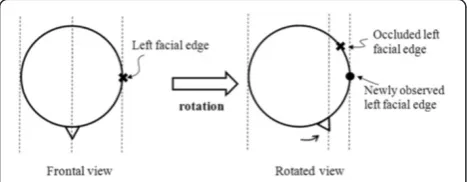
ð Þ=2 , respectively, as shown in Figure 4b. When detecting the facial edge linesxlandxrin a rotated view,
the cylindrical head model does not require the occluded facial edge line, and instead it uses the newly observed facial edge line of the rotated view, as shown in Figure 5. Therefore, this method is less affected by self-occlusion.
As shown in (3), the performance of this method depends on how accurately the three lines are detected in the face image. Ohue et al.[23] used image processing methods, such as a Sobel filter and histogram analysis, to detect the lines. However, in our study, the three lines are obtained from the 2D FFPs which are manually annotated or automatically detected using the Active
Appearance Models (AAMs) algorithm [32]. The
selected FFPs and the three facial lines are shown in
Figure 4c, where the facial center line is on the center point of the bottom of nose while the facial right and left boundaries are obtained from the midpoint between the two points located on each side of the facial contour, respectively.
Determination of visible FFPs
In this section, we present a method for automatically discriminating the visible FFPs and occluded FFPs by using the estimated head pose. The human head has a 3D structure but its shape varies slightly from person to person. Thus, the set of visible FFPs is inconsistent even with the same head pose and it changes depending on the individual. However, the individual differences be-tween the sets of visible FFPs are not very large, and therefore, we use the generic visible FFP set for each yaw angle. This set is defined by manually analyzing the training set of 3D FFPs annotated in the 3D face scans. When defining the generic set of the visible FFPs for each pose, a point is excluded as occluded in the generic set of visible FFPs if it is occluded in the face of a certain individual. In this manner, we can prepare an FFP index table that contains the indices of the visible FFPs for each head pose. Figure 6 shows the defined visible FFPs (as crosses) and the occluded FFPs (as circles) for each yaw angle. In this study, the yaw angles are quantized as seven discrete angles, which range from −45° to +45° at intervals of 15°, because the visible FFPs do not change greatly over a 15° interval.
Finally, given the estimated head pose, the pose angle is quantized into one of the seven discrete angles, and a masking matrix Mθ is obtained from the index table of the visible FFPs related to the quantized angle θ, as shown in Figure 7. Each component of the masking matrixMθrepresents a visible FFP as 1 and an occluded FFP as 0:
Mθ¼½m1m2m3. . .mn
mi¼ ½1 1 T;
if ithpoint is visible
0 0 ½ T;
if ithpoint is occluded
ð4Þ Figure 5Cylindrical head model is less affected by
self-occlusion.This method does not require the occluded facial edge
when detecting the right and left facial edges in a rotated view, and instead it uses the newly observed facial edge.
wherei=1,2,. . .,n, andnis the number of vertices. We used 80 vertices in this study. Mθ is a 2 × 80 binary matrix, the pose angle θ has one of the seven discrete values, andmiis a 2 × 1 column-vector.
3D Face model fitting
A detailed description of the proposed model fitting method is shown in Algorithm 2. This is a modified ver-sion of the earlier S3DMM-based algorithm mentioned in Section “S3DMM”. The proposed model fitting scheme is based on the selected visible FFPs, which
eliminates the self-occlusion effect. As a result, the cost function of (2) is modified as follows:
arg minβ;Rθ;T Mθ P Rθ~SþT~
~s2d
2
ð5Þ
where the symbol“°”represents the Hadamard product, which is known as entry-wise multiplication [33], while Mθ is the masking matrix at rotation angle θ. Mθ is obtained from the index table of the visible FFPs for the estimated pose, as explained in Sections“Head pose esti-mation” and “Determination of visible FFPs”. We can
Figure 7Masking matrix generation.
calculate the shape residual between the visible FFPs of the shape model and the input 2D facial shape using this masking matrix. The shape parameter β and pose par-ameter (Rθ,T) can be obtained without any self-occlusion effect by minimizing this shape residual. The proposed 3D model fitting algorithm has the following two advantages compared with the previous method:
1) The pose angle^θ estimated by the cylindrical model is used for the pose parameter initialization.
Therefore, the parameter estimation starts from a relatively exact initial pose parameter, which enhances the 3D face reconstruction performance. During the alignment step, an accurate alignment result is obtained by aligning the input 2D FFPs with the FFPs of the 2D mean shape, which are obtained by rotating the 3D mean shape (s0) from 0° to^θ and projecting it onto the x–yplane.
2) 3D model fitting is achieved on the basis of the visible FFPs by using the masking matrix. Therefore, the proposed method can reconstruct 3D faces that are less affected by self-occlusion.
Algorithm 2 Proposed 3D Model Fitting
Input:s2d¼ðx1;y1;x2;. . .;ynÞT
Output:S3d¼ðX1;Y1;Z1;X2;. . .;Yn;ZnÞT
1. Initialization
Setθ0¼^θ ,T0¼0,M¼Mθ, andk= 1. (^θ is the angle estimated by the cylindrical model andθis a quantized angle ofθ0.)
2. Alignment
s2d is aligned with the 2D mean shape produced by rotating the 3D mean shape (s0) from 0° toθ^and projecting it onto thex–yplane.
3. Update the shape parameter with the fixed pose parameter
arg minβk M
P R
θ~SþT~
~s2d
2
Rθ;T
ð Þ¼ðRθ;TÞk1 UpdateRθ andTwith the fixed shape parameter
arg minðRθ;TÞ
k M
P R
θ~SþT~
~s2d
2
β¼βk
4. ReconstructðS3dÞk using the shape parameterβk 5. Verify whether
M P R
θ S3~d
kþT~
~s2d
Rθ;T ð Þ¼ðRθ;TÞk
<E If not, go to Step 3 andk=k +1
6. β=βkand (Rθ,T) = (Rθ,T)k
7. ReconstructS3dusing the final shape parameter
Dense 3D facial shape and texture mapping
A sparse 3D facial shape is produced as the reconstruc-tion result after model fitting. Therefore, we have to
perform interpolation to produce a dense 3D facial shape. Interpolation is achieved by mapping a generic dense mean shape onto the reconstructed sparse 3D fa-cial shape using the TPS algorithm [24,25]. The TPS mapping function is designed by learning the relation-ship between the FFPs of the generic 3D mean shape and the reconstructed 3D facial shape, which is similar to [24]. Letube the FFPs of the generic mean shape and F(u) be the FFPs of the reconstructed facial shape. The mapping function is then:
Fð Þ ¼u cþAuþWTsð Þu ð6Þ
where c represents a translation, A is a rotation, W is the non-linear deformation, ands(u) is a spline function. The mapping functionF(u) is then used to transform all of the other vertices in the mean shape, which produces adapted dense 3D face.
Finally, an available texture in the input 2D image is mapped onto the dense 3D facial shape to complete the 3D face reconstruction. However, some facial texture regions can be self-occluded in rotated view images. Thus, the bilateral symmetry of a face is used for texture mapping to recover the self-occluded texture. Specifically, we produce a mirrored image of the half-face contained in the visible region, and use the mirrored texture of the visible half-face for texture mapping in the occluded facial region.
Experimental results
Face database
For the experiments, we acquired 86 male and 64 female 3D face scans using a 3D laser scanner (Cyberware3030 RGB model) [34]. To construct 3D shape models, each 3D face scan was manually annotated with 80 FFPs, and the annotated 3D FFPs were aligned with others by Pro-crustes analysis [22]. An iterative alignment method was applied to our data to produce accurate aligned data. A reference face scan was randomly selected and 3D FFPs in the remaining face scans were aligned with 3D FFPs in the reference face scan. The mean FFPs of the aligned data became the new reference FFPs in the next iter-ation, and this process was repeated until the mean FFPs stopped changing. The final aligned 3D FFPs were used to build a 3D shape model in the training stage. The training and test data-sets were divided using the leave-one-out methodology, which uses a single data as the test data and the remaining data as the training data.
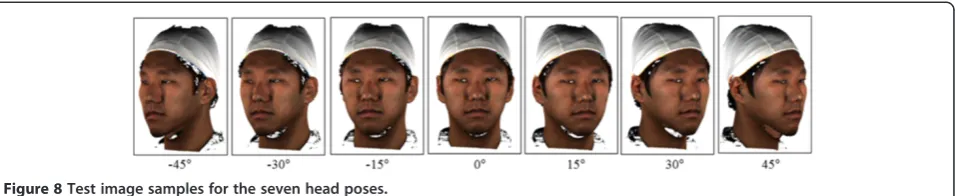
obtained 2D images is 1200 × 900 pixels and the size of the facial region was approximately 350 × 350 pixels. Figure 8 shows examples of the 2D face test images obtained. Given a test image, 2D FFPs were detected for 3D model fitting in S3DMM. In the experiments, we used two methods to detect 2D FFPs in the test images for ideal and practical cases. In the ideal case, Test data 1 was created by combining the ground-truth 2D FFPs in the visible facial region and the manually marked 2D FFPs (observed 2D FFPs) for the self-occluded facial regions, as shown in Figure 9a. The ground-truth 2D FFPs were acquired by rotating the ground-truth 3D FFPs (manually annotated points on a face scan) and projecting them onto the x–y plane. In the case of a rotated facial image, it is difficult to detect the ground-truth 2D FFPs on the self-occluded region because they are not visible. Therefore, the manually marked 2D FFPs (observed 2D FFPs) were used in the self-occluded facial regions. Test data 1 could be regarded as ideal data be-cause all of the FFPs were obtained manually. In the
practical case, Test data 2 was derived by automatically detecting the FFPs using the AAMs fitting algorithm, as described in Figure 9b. The AAMs used in this work is based on the simultaneous inverse compositional algo-rithm [32]. These data may have AAMs fitting errors as well as errors caused by self-occlusion.
We used the root mean squared error (RMSE) to measure the similarity between the reconstructed facial shape and the corresponding ground-truth facial shape. Let the reconstructed facial shape vector beSre= [X’1,Y’1,
Z’1,X’2,. . .,Y’n,Z’n]Tand the corresponding ground-truth
facial shape vector be Sgt= [X1,Y1,Z1,X2,. . .,Yn,Zn]T.
Given these two shape vectors, the RMSE is calculated as follows:
e¼1 n
Xn
i¼1
ffiffiffiffiffiffiffiffiffiffiffiffiffiffiffiffiffiffiffiffiffiffiffiffiffiffiffiffiffiffiffiffiffiffiffiffiffiffiffiffiffiffiffiffiffiffiffiffiffiffiffiffiffiffiffiffiffiffiffiffiffiffiffiffiffiffiffiffiffiffiffiffiffiffiffiffiffi
XiX′i
ð Þ2þ
YiY′i
ð Þ2þ
ZiZ′i
ð Þ2
q
ð7Þ
wherenis the number of FFPs.
Figure 9Procedure for generating the two types of test data:(a) Test data 1 is manually obtained by combining the ground-truth 2D FFPs for the visible facial regions and the manually marked 2D FFPs for the self-occluded facial region; (b) Test data 2 is derived by automatically detecting the FFPs using the AAMs fitting algorithm.
Effect of self-occlusion on 3D face reconstruction
To demonstrate the effect of self-occlusion on the formance of the previous S3DMM method, we per-formed 3D face reconstruction using the S3DMM
algorithm found in Section “S3DMM” with the
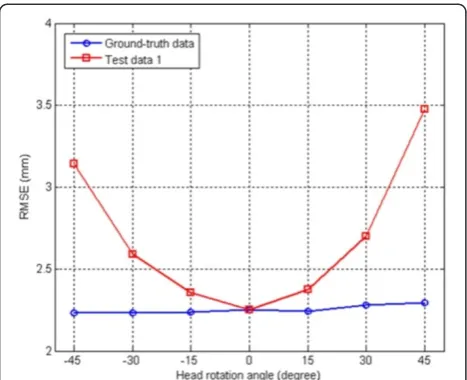
ground-truth data and Test data 1. The ground-truth data was obtained by projecting the ground-truth 3D FFPs onto the x–y plane, and hence no errors were caused by self-occlusion, whereas Test data 1 con-tained errors, as shown in Figure 9a. Figure 10 shows the RMSEs of the reconstructed facial shape for the two types of test data. As shown in Figure 10, the RMSE increased sharply when using Test data 1
because the degree of head rotation increased, and thus the location errors in the 2D FFPs in the occluded facial region also increased. In the highly rotated views (±45°), the RMSE differences between the two data sets were greater than approximately 1 mm. Both data-sets had the same RMSE in the frontal view (0°), because the frontal view was not affected by self-occlusion. The results showed that the 2D FFP location errors caused by self-occlusion se-verely deteriorated the reconstruction performance of the earlier S3DMM algorithm.
Head pose estimation performance
This section details the performance of the cylindrical model-based pose estimation method compared with QR decomposition-based head pose estimation, which was used in [5], and the effect of using the estimated pose as the initial pose parameter on the proposed 3D reconstruction method. Figure 11 and Table 2 show the mean absolute errors (MAEs) with the two different head pose estimation methods using Test data 1 and 2. The results clearly show the following:
1) The cylindrical model-based method showed better performance with the highly rotated face images (±30°, ±45°) because this method used facial features that were less sensitive to self-occlusion.
2) The QR decomposition-based method showed slightly better performance with the almost frontal face images (±15°, 0°) because the FFP location error in these images caused by self-occlusion was small and this method used a relatively larger number of facial features. However, these facial features were more sensitive to self-occlusion because the
Figure 11Performance comparisons of the different head pose estimation methods:(a) Test data 1; (b)Test data 2.
performance of this method was severely degraded in the highly rotated images.
3) The results were similar irrespective of the data set that was used, but the pose estimation error with Test data 2 was slightly larger than that with Test data 1 because the automatically obtained test data had more severe FFP location errors than the manually obtained test data. However, even in such case, the proposed 3D reconstruction method showed better performance than the previous method. This result will be discussed in Section “Quantitative results with yaw variations”. In order to remove noisy FFPs, we need a different approach such as texture analysis around each FFP.
To evaluate the effects of different head pose estima-tion methods on 3D face reconstrucestima-tion, we applied QR decomposition and the cylindrical head model to our proposed S3DMM algorithm seen in Section “3D face model fitting”, respectively. As shown in Figures 12a,b, the two methods showed similar performances in the −15° to +15° pose range, but the performance of the cy-lindrical model is better than that of the QR decompos-ition method at ±30° and ±45°, regardless of the test data-set. The method based on QR decomposition showed better pose estimation performance with the
almost frontal face images, but this method did not show a better 3D face reconstruction performance, as shown in Figure 12, because the low pose estimation error was compensated for by our proposed model fit-ting algorithm from Section “3D face model fitting”. Note that the cylindrical model-based method showed considerably better pose estimation performance with highly rotated face images, which led to an improvement in 3D face reconstruction performance.
In this work, the yaw angle estimated by the cylin-drical model was used as the initial pose parameter (θ0¼^θ ), as shown in the initialization step of the
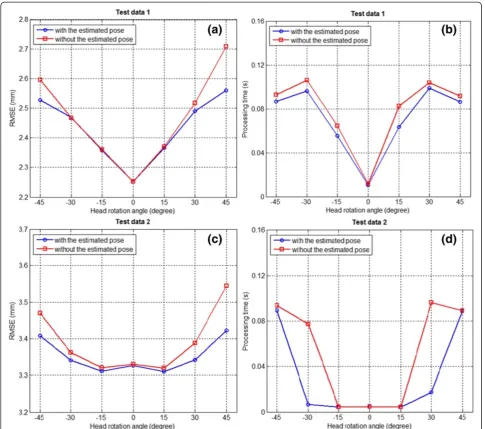
pro-posed 3D model fitting algorithm in Section “3D face model fitting”. To demonstrate the effect of using the estimated pose as the initial pose parameter, we further obtained results to compare the following two cases with Test data 1 and 2: the first case used the estimated pose whereas the second case did not. In the first case, 3D model fitting began with shape parameter estimation be-cause the approximate initial pose was known, as shown in Algorithm 2 in Section“3D face model fitting”. In the second case, the initial pose parameter was not provided, and hence the pose parameter had to be estimated prior to shape parameter estimation, as shown in Step 3 of Algorithm 1. As shown in Figures 13a,c, both cases pro-duced similar RMSEs with the almost frontal views
Figure 123D face reconstruction performance comparisons when using the cylindrical head model and the QR decomposition as a
(−15° to +15°). However, the first case showed the better performance with the highly rotated views (±30°, ±45°), irrespective of the test data-set used. As shown in Figures 13b,d, the use of the estimated pose was also more efficient than not using the estimated pose in terms of the processing time. Based on these observa-tions, we found that an accurate initial pose parameter led to a performance improvement during 3D face re-construction based on our proposed algorithm and reduced the number of iterations required for 3D model fitting.
In summary, the cylindrical model-based method is suitable for selecting a reliable set of visible FFPs while the use of the estimated yaw angle as the initial pose
parameter indicates that the proposed 3D model fitting algorithm shows better reconstruction performance with higher efficiency.
Quantitative performance of the proposed method
Quantitative results with yaw variations
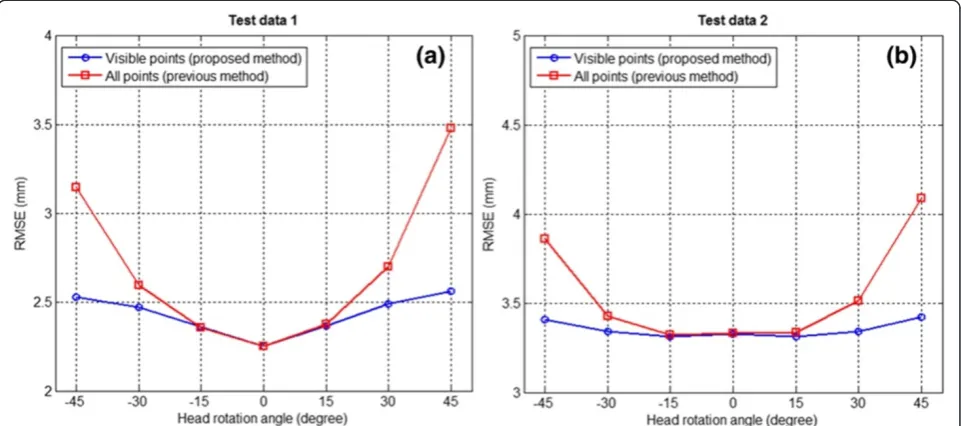
To evaluate the performance of our proposed method, we obtained results from the two test data sets with yaw variations using the proposed algorithm and we com-pared its performance with that of the previous S3DMM algorithm found in Section“S3DMM”.
significantly lower RMSE than the previous method as the head rotation increased. This was because the FFP self-occlusion errors increased with the head rotation. Figure 14b showed that although Test data 2 contained self-occlusion errors and detection errors, because they were obtained automatically using the AAMs algorithm, the results showed that the proposed method provided superior performance compared to the previous method. However, if detection errors of the FFPs were very large, the reconstruction performance of the proposed method could be significantly degraded because these FFPs still
contained large detection errors, although self-occlusion errors were excluded by the proposed method. This problem of FFP detection is a common limitation of S3DMM-based methods.
We also obtained results from Test data 1 and 2 using the step parameter estimation method. The one-step methodology has been used for model parameter estimation by the S3DMM-based method, which simul-taneously estimates the shape and pose parameters using a non-linear optimization algorithm [3,17,19]. In this study, one-step parameter estimation was achieved using Figure 14Performance comparisons of the proposed method and the previous method based on the alternation methodology:(a) Test data 1;(b)Test data 2.
formance than the previous method using all of the FFPs with both test data-sets. With the almost frontal views (0°, ±15°), both methods delivered similar reconstruction performances. From the observations in Figures 14 and 15, the proposed strategy of using the visible FFPs was an adequate solution for the self-occlusion problem dur-ing S3DMM-based 3D face reconstruction.
Quantitative results with yaw and pitch variations
In this experiment, we tested whether yaw and pitch var-iations affected the performance of the proposed method. For this experiment, face images were generated with yaw and pitch variations by rotating and projecting the textured face scans of 150 subjects, as explained in Section“Face database”. A head pose set consisted of 28 different poses, which were a combination of seven yaw angles (0°, ±15°, ±30°, ±45°) and four pitch angles (±15°, ±30°). The total number of the test images is 4200 (150 subjects × 28 poses). To evaluate the performance of the proposed method using these test images, Test data 1 and 2 were obtained from the test images, as explained in Section “Face database”, and the performance of the proposed algorithm from Section“3D face model fitting” was compared with that of the previous algorithm seen in Section“S3DMM”. Figure 16 shows the effects of yaw and pitch variations on the performance of the proposed method. In this figure, each graph shows the RMSEs of the proposed method and the previous method with yaw variations at a fixed pitch angle. From the results, it is found that the performance of the proposed method was remarkably improved compared to that of the previous method even with yaw and pitch variations. This was be-cause the self-occlusion error be-caused by yaw variations was more dominant than that caused by pitch variations. Consequently, it is found that the occlusion error oc-curred by a combination of yaw and pitch could be
com-pensated for using the proposed algorithm by
considering only yaw variations, as shown in Figure 16. However, the performance of the proposed method degraded slightly when both head yaw and tilt occurred because the cylindrical model could only estimate head yaw. In order to improve the performance of the pro-posed method when both head yaw and tilt occur, we need another tilt estimator.
Qualitative performance of the proposed method
We obtained qualitative results for the proposed method and the previous method using Test data 1 and 2.
umns show the reconstructed faces using the proposed method when the yaw angle of the input face was 15°, 30°, and 45°, respectively. In the same way, Figure 18 shows the faces reconstructed using Test data 2. As shown in Figures 17 and 18, the performance of the pro-posed method was almost the same as that of the previ-ous method with a 15° head pose because the almost frontal view is negligibly affected by self-occlusion. How-ever, we observed the following with the highly rotated views (30°, 45°):
1) The proposed method showed that the frontal and profile shapes were similar to the ground-truth facial shapes.
2) The previous method produced a wider facial contour in the frontal view compared with the ground-truth facial shape because self-occlusion error occurred, as shown in Figure19. Figure18 showed that the proposed method remarkably improved the reconstruction performance compared
with the previous method, even with the practical data (Test data 2).
Finally, we present the reconstruction results for real-world images from the FacePix database [36] and the CAS-PEAL-R1 database [37]. Figure 20 shows in-dividual results for five subjects in the Face Pix data-base, where the rows indicate different subjects and the seventh column shows the test images. The first and fourth columns show different views of the ori-ginal image. The a- and c- columns show the results with the previous method, whereas the b- and d- col-umns show the results with the proposed method. Figure 21 shows the results for five subjects in the CAS-PEAL-R1 database. From these figures, we can find that:
1) With highly rotated face images, the proposed method provided reconstructed facial shapes in the frontal and profile views that were closer to the ground-truth shape than the previous method were. In particular, the previous method had a wider facial contour in the frontal view compared with the ground-truth facial shape.
2) With almost frontal face images, the performance of the proposed method was similar to that of the previous method because self-occlusion error was very small, as shown in the fourth and fifth rows of Figure20and in the third, fourth, and fifth rows of Figure21.
The proposed 3D face reconstruction required about 0.1 s per test image using our proposed algorithm based on an alternation methodology and about 3.6 s per test image using the algorithm based on a one-step method-ology. The computation times were measured on an Intel Core i5 CPU 750, 2.7 GHz, 3 GB RAM machine.
Conclusions
We analyzed the self-occlusion problem that occurs in S3DMM-based 3D face reconstruction and proposed a method for solving this problem. Our main contribu-tions are summarized as follows
The 3D model fitting scheme of S3DMM was modified to make it suitable for 3D face reconstruction based on visible FFPs. The reconstruction accuracy of the proposed method
was improved greatly compared with the original S3DMM-based method by using the visible FFPs having no self-occlusion errors.
To exclude self-occluded FFPs in the 3D model fitting process, self-occluded FFPs were separated automatically from visible FFPs using a pose estimation method based on a cylindrical head model and an index table of visible FFPs.
The reconstruction performance was enhanced by using the estimated pose as the initial pose parameter during the 3D model fitting process.
Since the proposed method can automatically recon-struct a 3D face from an arbitrary-view image, it can be applied for to a variety of useful applications, such as 3D game and animation character generation, and 2D frontal face generation from a side-view face image which can be used for monitoring suspects in surveil-lance cameras.
In future works, we would research about the 3D face reconstruction method robust to the detection error of
FFP by combining the information of FFP and facial tex-ture. In addition, we would develop a more accurate 3D face reconstruction method for a wide range of pose var-iations and study a new method to solve the self-occlusion problem without eliminating occluded FFPs.
Abbreviations
SFS: shape-from-shading; PCA: principal component analysis; 3DMM: 3D morphable model; S3DMM: simplified 3D morphable model; FFPs: facial feature points; TPS: Thin Plate Spline; AAMs: Active Appearance Models; RMSE: root mean squared error; MAE: mean absolute error.
Competing interests
The authors declare that they have no competing interests.
Acknowledgements
This work was supported by the National Research Foundation of Korea (NRF) grant funded by the Korea government (MEST) (No. 2012–0005223).
Author details 1
School of Electrical and Electronic Engineering, Yonsei University, Seoul, Republic of Korea.2Technical Research Institute, Hyundai Mobis, Yongin, Republic of Korea.3Division of Electronics and Electrical Engineering, Dongguk University, Seoul, Republic of Korea.
Received: 14 January 2012 Accepted: 17 July 2012 Published: 17 August 2012
References
1. FI Parke, Proceedings of ACM National Conference, inComputer generated animation of faces, 1972
2. FI Parke,A parametric model of human faces(University of Utah, Salt Lake City, 1974). PhD thesis
3. V Blanz, T Vetter, Face recognition based on fitting a 3D morphable model. IEEE Trans. Pattern Anal. Mach. Intell.25(9), 1063–1074 (2003)
4. X Zhang, Y Gao, Face recognition across pose: a review. Pattern Recognit. 42(11), 2876–2896 (2009)
5. U Park, Y Tong, AK Jain,Face recognition with temporal invariance: a 3D aging model. Proceedings of International Conference on Automatic Face and Gesture Recognition, 2008, pp. 1–7
6. U Park, Y Tong, AK Jain, Age invariant face recognition. IEEE Trans. Pattern Anal. Mach. Intell.32(5), 947–954 (2010)
7. Example of game character generation, http://fightnight.easports.com/ featureFrame.action?id=Feature-TBA1&fType=video. Accessed 2 January 2012
8. A Maejima, S Wemler, T Machida, M Takebayashi, S Morishima, Instant casting movie theater: the future cast system. IEICE Transactions on Information and SystemsE91-D(4), 1135–1148 (2008)
9. B Gökberk, AA Salah, N Alyüz, L. Akarun, Handbook of Remote Biometrics for Surveillance and Security, in3D face recognition: technology and applications(Springer, 2009), pp. 217–246
10. R Zhang, P Tsai, JE Cryer, M Shah, Shape from shading: a survey. IEEE Trans. Pattern Anal. Mach. Intell.21(8), 690–706 (1999)
11. R Dobgard, R Basri, Statistical symmetric shape from shading for 3D structure recovery of faces. LNCS on European Conference on Computer Vision3022, 99–113 (2004)
12. A Ahmed, A Farag, T Starr,A new symmetric shape from shading algorithm with an application to 3-D face reconstruction. Proceedings of International Conference on Image Processing, 2008, pp. 201–204
13. M Castelan, WAP Smith, ER Hancock, A coupled statistical model for face shape recovery from brightness images. IEEE Trans. Image Process.16(4), 1139–1151 (2007)
14. M Castelan, JV Horebeek, Relating intensities with three-dimensional facial shape using partial least squares. IET Computer vision3(2), 60–73 (2009) 15. M Reiter, R Donner, G Langs, H Bischof,3D and infrared face reconstruction
from RGB data using canonical correlation analysis. Proceedings of the 18th International Conference on Pattern Recognition (ICPR’06), 2006, pp. 425–428
16. Z Lei, Q Bai, R He, SZ Li,Face shape recovery from a single image using CCA mapping between tensor spaces. Proceedings of IEEE Conference on Computer vision and Pattern Recognition (CVPR 2008), 2008, pp. 1–7. June 17. V Blanz, T Vetter,A morphable model for the synthesis of 3D faces.
Proceedings of SIGGRAPH, 1999, pp. 187–194
18. D Jiang, Y Hu, S Yan, L Zhang, H Zhang, W Gao, Efficient 3D reconstruction for face recognition. Pattern Recognit.38(6), 787–798 (2005)
19. S Wang, S Lai, Efficient 3D face reconstruction from a single 2D image by combining statistical and geometrical information. LNCS on Asian Conference on Computer Vision3852, 427–436 (2006)
20. C Wang, S Yan, H Li, H Zhang, M Li, Automatic, effective, and efficient 3D face reconstruction from arbitrary view image. LNCS on Advances in Multimedia Information Processing–PCM3332, 553–560 (2004). October 21. TF Cootes, GJ Edwards, CJ Taylor, Active appearance models. IEEE Trans.
Pattern Anal. Mach. Intell.23(6), 681–685 (2001)
22. I Matthews, S Baker, Active appearance models revisited. Int. J. Comput. Vision60(2), 135–164 (2004)
23. K Ohue, Y Yamada, S Uozumi, S Tokoro, A Hattori, T Hayashi, Development of a new pre-crash safety system. SAE World Congress (2006). April 24. U Park, AK Jain,3D face reconstruction from stereo video. Proceedings of the
3rd Canadian Conference on Computer and Robot Vision, 2006, p. 41. June 25. FL Bookstein, Principal warps: thin-plate splines and the decomposition of
deformations. IEEE Trans. Pattern Anal. Mach. Intell.11(6), 567–585 (1989) 26. P Watta, N Gandhi, S Lakshmanan,An eigenface approach for estimating
driver pose. Proceedings of IEEE Conference Intelligent Transportation Systems, 2000, pp. 376–381
27. S Lakshmanan, P Watta, YL Hou, N. Gandhi,Comparison between eigenfaces and fisherfaces for estimating driver pose. Proceedings of IEEE Conference Intelligent Transportation Systems, 2001, pp. 889–894
28. P Watta, S Lakshmanan, YL Hou, Nonparametric approaches for estimating driver pose. IEEE Trans. Veh. Technol.56(4), 2028–2041 (2007)
29. J Wu, MM Trivedi, A two-stage head pose estimation framework and evaluation. Pattern Recognit.41(3), 1138–1158 (2008)
30. E Murphy-Chutorian, A Doshi, MM Trivedi,Head pose estimation for driver assistance systems: A robust algorithm and experimental evaluation. Proceedings of IEEE Conference Intelligent Transportation Systems, 2007, pp. 709–714
31. E Murphy-Chutorian, MM Trivedi, Head pose estimation in computer vision: A survey. IEEE Trans. Pattern Anal. Mach. Intell.31(4), 607–626 (2009) 32. S Baker, R Gross, I Matthews,Lucas-Kanade 20 years on: a unifying framework:
part 3, (Technical Report CMU-RI-TR-03-35)(Carnegie Mellon University, Robotics Institute, 2003)
33. R.A. Horn, C.R. Johnson, (Cambridge University Press, Matrix Analysis, 1985) 34. 3D Scanner specification, http://www.cyberware.com/products/pdf/
headFace.pdf. Accessed 2 January 2012
35. T Boggs, JW Tolle, Sequential quadratic programming. Acta Nemerica1, 1–51 (1996)
36. J Black, M Gargesha, K Kahol, P Kuchi, S Panchanathan,A framework for performance evaluation of face recognition algorithms(ITCOM, Internet Multimedia Systems II, Boston, 2002)
37. W Gao, B Cao, S Shan, X Chen, D Zhou, X Zhang, D Zhao, The CAS-PEAL Large-Scale Chinese Face Database and Baseline Evaluations. IEEE Trans. SMC-Part A: Systems and Humans38(1), 149–161 (2008)
doi:10.1186/1687-6180-2012-176
Cite this article as:Leeet al.:Single view-based 3D face reconstruction robust to self-occlusion.EURASIP Journal on Advances in Signal Processing 20122012:176.
Submit your manuscript to a
journal and benefi t from:
7Convenient online submission 7Rigorous peer review
7Immediate publication on acceptance 7Open access: articles freely available online 7High visibility within the fi eld
7Retaining the copyright to your article