Volume 2011, Article ID 703752,8pages doi:10.1155/2011/703752
Research Article
A Modified Run-Length Coding towards the Realization of
a RRO-NRDPWT-Based ECG Data Compression System
Hsieh-Wei Lee, King-Chu Hung, Tsung-Ching Wu, and Cheng-Tung Ku
Department of Computer and Communication Engineering, National Kaohsiung First University of Science and Technology, Taiwan
Correspondence should be addressed to Hsieh-Wei Lee,[email protected]
Received 9 November 2010; Revised 1 March 2011; Accepted 4 March 2011
Academic Editor: Patrick Oonincx
Copyright © 2011 Hsieh-Wei Lee et al. This is an open access article distributed under the Creative Commons Attribution License, which permits unrestricted use, distribution, and reproduction in any medium, provided the original work is properly cited.
The wavelet-based approach that combines a reversible round-offnonrecursive discrete periodized wavelet transform (RRO-NRDPWT) and the set partitioning in hierarchical trees (SPIHT) scheme is an efficient ECG data compression. However, this RRO-NRDPWT-based system suffers from the high complexity of the SPIHT scheme during realization. In this paper, a modified run-length coding (MRLC) algorithm is proposed towards the realization of a RRO-NRDPWT-based ECG data compression system. The MRLC with its regularity and low computational complexity is suitable for hardware implementation, but at a cost of compression performance. This sacrifice is compensated by an efficient quantization scheme. By using the MIT-BIH arrhythmia database, the experimental results show that the proposed scheme can compete with the SPIHT scheme for a compression ratio (CR) greater than 8. Hardware simulations are taken using both the Verilog logic simulator with Cadence design platform, and a Xilinx FPGA EP2C35F672C6.
1. Introduction
An electrocardiogram (ECG) is a non-invasive modality that senses the electric action of heart motion from the surface of a body. Since the heart is a three-dimensional organ, heart disease diagnosis usually requires the use of several ECG signals sensed at various positions around the heart. A typical requirement for heart disease diagnosis and health care is a long-term record of 12-lead ECG signals [1]. To this end, portable ECG sensing systems associated with wireless data transmission have been developed for ambulatory monitoring and recording. ECG data compression is crucial for creating a reduction in power consumption, efficient data transmission, and storage [2,3].
In many ECG data compression methods, wavelet-based approaches with high compression performance have attracted much attention from researchers [4–7]. These approaches that attempt to optimize the compromise between CR and distortion all employ the lossy compression method in which the percentage root-mean-square diff er-ence (PRD) is usually used as the distortion measure. Lossy ECG data compression can be meaningful only if clinical information and reconstruction quality can be preserved and
maintained. Quality maintenance is usually time consuming due to the recursive process of compression and reconstruc-tion error measurement. For this reason, realizing wavelet-based data compression with hardware is required to create real-time recoding of multilead ECG signals. In realization, high compression performance, low complexity, and rapid convergence in reconstruction quality control are important considerations.
control. The RRO-NRDPWT-based ECG data compression also applies the SPIHT scheme for the coding of quantized wavelet coefficients.
The SPIHT scheme can be very efficient for data inherent in hierarchical self similarities. However, this scheme exploits the self similarities in terms of dynamic data structures that will impose practical limitation on hardware imple-mentation [8–12], especially for large-size data sequences. In order to save the three intermediate data sets, list of insignificant sets (LIS), list of insignificant pixels (LIP), and list of significant pixels (LSP), the SPIHT encoder should reserve a buffer size of 4.5 log2L bits where L is the image width. This buffer size is even larger than the image itself [9]. A simulation using Xilinx Virtex 2000E FPGA [10] shows that for encoding a 16×16 image, SPIHT scheme needs 61531 gates. The RRO-NRDPWT-based ECG data compression system was also simulated on the Xilinx FPGA, EP2C35F672C6 [12]. The system is composed of three functional blocks RRO-NRDPWT, quantization, and the SPIHT coding in which the RRO-NRDPWT block is performed with 21-bit precision. The evaluation result shows that for 1024 ECG samples, the first two blocks require 6254 and 2383 logic elements, respectively. On the other hand, for only 32 ECG samples, the SPIHT block will need 25480 logic elements, which occupy (254180/33216)×100= 76.7(%) of total logic elements. Note that with the limitation of EP2C35F672C6, we cannot evaluate 64-sample case or larger.
In this paper, towards the realization of RRO-NRDPWT-based ECG data compression system, a modified run-length coding (MRLC) method is presented in place of the SPIHT scheme. The MRLC can effectively reduce computational complexity at the cost of compression performance. For compensation, a modified quantization scheme with approx-imate linear distortion is presented for improving compres-sion performance. Several experiments are also taken by using the MIT-BIH arrhythmia database [13].
The rest of this paper is organized as follows. The nonlinear quantization scheme with the approximate linear distortion characteristic is developed in Section 2. The proposed ECG data compression scheme is described in
Section 3. In Section 4, several experiments in ECG data compression are evaluated. The analysis and synthesis report of the proposed MRLC architecture are presented and demonstrated in Section 5. Finally, the conclusion is provided inSection 6.
2. A Nonlinear Quantization Scheme
with Approximately Linear
Distortion Characteristics
The RRO-NRDPWT is a nonrecursive 1-D DPWT that can achieve fixed-point computation in terms of error propaga-tion resistance and a uniform distribupropaga-tion of subband error. The two mechanisms facilitate the significant normalization of subband data and a quantization scheme design with linear distortion characteristics.
Given a negative integerJwithN=2−J, whereNdenotes
the number of original sampled data of a finite 1-D signal. Letd∗j forJ < j≤0 be a vector encompassing the reversible wavelet coefficients of thejth level. The quantization process can be defined as
s∗0 =tr
s∗0
bDC
, d∗j =tr
d∗j
cj
, (1)
where tr(d∗j) denotes the truncation process that truncates each element of d∗j to an integer, and bDC and cj are the
terminate andjth levels’ quantization scales, respectively. In the inverse quantization process, each retrieved datum will be compensated by half of the quantization scale, namely
s∗0 =bDC
s∗0 + 0.5·sign
s∗0
,
d∗j =cj
d∗j + 0.5·signd∗j,
(2)
where sign(d∗j) denotes the sign vector of d∗j. For the determination of quantization scales, we definecjas
cj=
cpj
SNFj, (3)
where SNFj = maxl{ 2−j+1
k=2−j|akl|}is a significant
normal-ization factor and cp[j] are adjustable parameters andaklis
thekth row andlth column element of the inverse matrix of RRO-NRDPWT [7].
Equation (2) shows that for each segment (N = 1024 ECG samples), the reconstruction requires 11 cp[j] includingbDC. It will be efficient to generate cp[j] with a single variable. To this end, curve fitting is one simple approach. The cp[j] design process is described in the following.
Step 1. Find seven sets of cp[j], j=0, 1,. . ., 10 correspond-ing to different PRD values ranging from 0 to 7%.
Step 2. Introduce 11 quadratic equations for fitting the 11 cp[j] curves with single control variable QF. The coefficients of 11 quadratic equations are found by least square error criterion.
0 5 10 15 20 25 30 35
0 4 8 12 16 20 24 28 32
QF
PRD
(%)
Figure1: The PRD-QF curves of 48 ECG signals derived by the modified quantization scheme.
function in which the range of PRD is fitted by 16 QF values. One locally optimal solution is given in the following:
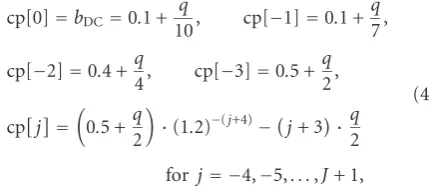
cp[0]=bDC=0.1 + q
10, cp[−1]=0.1 +
q
7,
cp[−2]=0.4 +q
4, cp[−3]=0.5 +
q
2,
cpj=
0.5 + q 2
·(1.2)−(j+4)−j+ 3 ·q 2
for j= −4,−5,. . .,J+ 1,
(4)
whereq=10·((QF + 1)/16)2. In (4), QF can be an available variable for desired PRD and CR control.
In order to explore the linear control performance of QF, all 48 ECG signals recorded in the MIT-BIH arrhythmia database were investigated. Each signal contains about a 15 minutes length of sampled data. The measurement results are depicted inFigure 1.Figure 1reveals that an approximately linear relationship between PRD and QF can be obtained for all signals with different gradients. The linear distortion characteristic will facilitate a rapid reconstruction quality control.
3. The Proposed ECG Data
Compression Scheme with the Modified
Run-Length Coding
The proposed RRO-NRDPWT-based ECG data compression scheme with the modified run-length coding is shown in
Figure 2. In the encoding process, the 1-D RRO-NRDPWT first produces reversible wavelet coefficientsd∗j. From (1), for a given QF value, we can obtain quantized data d∗j. The QF and these quantized data will be losslessly encoded with a differential pulse-code modulation (DPCM) and the
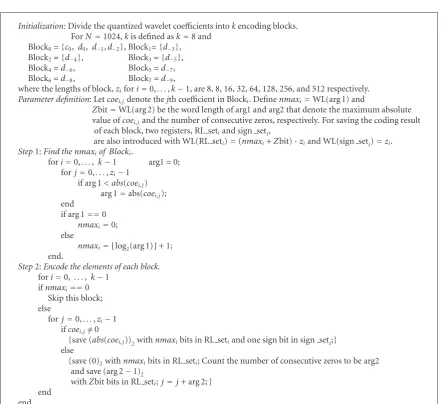
modified run-length method, respectively. The algorithm of modified run length coding is described inAlgorithm 1. Example 1 (neglecting sign bit representation). Let Block2 = [3 12 0 0 0 0 0 0 0 0 0 7 0 0 0 0]; it can be found that
nmax2 = log2(12) + 1 = 4 and there are two zero segments (i.e., arg 2 = 9 and 4). Both two zero segments will be represented with Zbit = log2(z2−1) = 4 bits, that is, (arg 2−1)2=(1000)2 and (0011)2). Consequently, the output sequence of Block2is given inTable 3.
In comparison with a specific run-length coding [14], 36 bits are required for Example 1. The proposed method needs less bits. For representation with sign bits, an example is given as follows.
Example 2(considering sign bit representation). Let Block2= [3 −12 −7 0 0 0 0 0 0 0 0 0 0 0 0 0]. Bothnmax2andZbit are equal to 4. The output sequence will be inTable 4, where the last three bits are used to represent the signed coefficients 3,−12, and−7, respectively. Note that the eightnmaxi,i=
0,. . ., 7, represented with the same word length will be put at the beginning of output sequence, that is, a MRLC codec.
The MRLC codec can be decoded real-time block by block. The decoding process of MRLC is described in
Algorithm 2.
After decoding, the reconstructed data, SJ can be
obtained directly from (2) where the quantization scales are generated by applying QF into (3) and (4).
4. Experimental Results
For hardware realization, complexity reduction usually leads to a sacrifice of compression performance. Several exper-iments were made in order to evaluate the compression performance of the MRLC-based approach. The original data compression scheme of [3] and the proposed scheme are referred to as NRDPWT-6r and NRDPWT-MRLC, respectively. A dataset comprising 11 ECG signals: 100, 101, 102, 103, 107, 109, 111, 115, 117, 118, and 119, recorded in the MIT-BIH arrhythmia database (360 samples/sec and 11 bit resolution) was built for the test. With 11 bit resolution, the word length of nmaxi is defined as WL(nmaxi) = 4.
Each signal contains about a 10-min length of sampled data. Each segment involves 1024 samples of ECG data. The experimental result is shown in Table 1 where each value denotes the average PRD for a specified CR. The value of PRD is defined by
PRD(%)= Ni=1
sJ[i]−sJ[i] 2
N
i=1
sJ[i] 2
∗100, (5)
wheresJ[i] andsJ[i] denote the reconstructed and original
Initialization:Divide the quantized wavelet coefficients intokencoding blocks. ForN=1024,kis defined ask=8 and
Block0={c0, d0, d−1,d−2}, Block1={d−3}, Block2={d−4}, Block3={d−5}, Block4=d−6, Block5=d−7, Block6=d−8, Block7=d−9,
where the lengths of block,zifori=0,. . .,k−1, are 8, 8, 16, 32, 64, 128, 256, and 512 respectively.
Parameter definition: Letcoei,jdenote thejth coefficient in Blocki. Definenmaxi=WL(arg 1) and
Zbit=WL(arg 2) be the word length of arg1 and arg2 that denote the maximum absolute value ofcoei,jand the number of consecutive zeros, respectively. For saving the coding result
of each block, two registers, RL setiand sign seti,
are also introduced with WL(RL seti)=(nmaxi+Zbit)·ziand WL(sign seti)=zi.
Step1:Find thenmaxiofBlocki.
fori=0,. . ., k−1 arg1=0; forj=0,. . .,zi−1
if arg 1< abs(coei,j)
arg 1=abs(coei,j);
end if arg 1==0
nmaxi=0;
else
nmaxi= log2(arg 1)+ 1; end.
Step2:Encode the elements of each block.
fori=0, . . ., k−1 ifnmaxi==0
Skip this block; else
forj=0,. . .,zi−1
ifcoei,j=/ 0
{save (abs(coei,j))2withnmaxibits in RL setiand one sign bit in sign seti;}
else
{save (0)2withnmaxibits in RL seti; Count the number of consecutive zeros to be arg2
and save (arg 2−1)2
withZbit bits in RL seti;j=j+ arg 2;}
end end.
Step3: Output sequence in the order of [nmaxi=0:k−1,, RL seti=0:k−1, sign seti=0:k−1].
Algorithm1
[2], NRDPWT-6R [3], NRDPWT-6T [15], and NRDPWT-MRLC where k denotes the number of blocks. For k =
1, Block0 = {c0, d0, d−1,. . ., d−9}; for k = 2, Block0 = {c0, d0, d−1,. . ., d−8}, and Block1 = {d−9}, and so forth. For the five partition modes (i.e.,k=7 to 11), their compression performances are very close, and k = 8 performs best.
Table 1, also shows that for CR > 8, the NRDPWT-MRLC (k = 8) can be competitive with the SPIHT scheme [2]. For CR<8, the average PRD difference between NRDPWT-6Rand NRDPWT-MRLC (k = 8) can be limited to within 1.5%.
For practical application, preserving clinical information is a crucial requirement for system development of ECG data compression. A quantitative relation between distortion and the degree of clinical information preservation was evaluated in [16]. The evaluation showed that reproduced ECG waveforms at specified PRDs of 7% and 9% were graded as “no diagnostic information lost” and “clinically acceptable”,
respectively. A reproduced waveforms at a PRD of 13% was “notably degenerated in some Q-waves and ST-segments”. The experimental results show that the proposed system can be competitive with other wavelet-based approaches for CR>8 and feasible for well preserving clinical information that includes amplitude and duration (PRD 7% for CR= 20).
Step1: Getnmaxi,i=0, . . ., k−1.
Step2:Decode the elements of each blocks.
fori=0, . . ., k−1 ifnmaxi==0
Assign all coefficients of Blockito be zeros. else
{forj=0,. . .,zi−1
Getnmaxibits to be arg 1;
if arg 1=/0
Decode arg 1 to beabs(coei,j);
else
{Decode arg 1 to be zero;
GetZbit bits to be arg2-1 and decode arg2 to be the number of zeros; j=j+ arg 2;}
end } end.
Step3: Correct the sign of nonzero coefficients using the sign bits.
Algorithm2
QF Encoding process
Reversible round-off1-D
NRDPWT
Nonlinear quantization
process
Modified run length
encoding
Inverse reversible round-off1-D
NRDPWT
Inverse quantization
process
Modified run length
decoding
Decoding process
˜ d∗j
˜ d∗j ^
d∗j d∗j
Reconstructed ECG data
^ S∗J
Original ECG data
SJ
Figure2: The RRO-NRDPWT-based ECG data compression scheme with modified run length coding.
Table1: PRD (%) comparison of the three methods SPIHT [2], NRDPWT-6R[3], NRDPWT-6T[15], and NRDPWT-MRLC.
Compression method CR
4 : 1 5 : 1 6 : 1 8 : 1 10 : 1 12 : 1 14 : 1 16 : 1 18 : 1 20 : 1
SPIHT [2] 1.19 1.56 — 2.46 2.96 3.57 — 4.85 — 6.49
NRDPWT-6R[3] 1.03 1.36 1.65 2.19 2.64 3.11 3.66 4.29 5.00 5.72
NRDPWT-6T[15] 0.98 1.29 1.57 2.07 2.52 3.03 3.60 4.23 4.94 5.74
NRDPWT MRLC (k=1) 1.95 2.27 2.56 3.21 4 4.97 6.07 7.28 8.41 9.71
NRDPWT MRLC (k=2) 1.89 2.2 2.48 3.12 3.89 4.83 5.88 7.06 8.14 9.36
NRDPWT MRLC (k=3) 1.74 2.05 2.34 2.92 3.64 4.53 5.47 6.62 7.73 8.85
NRDPWT MRLC (k=4) 1.66 1.95 2.23 2.75 3.41 4.14 5.07 6.08 7.21 8.29
NRDPWT MRLC (k=5) 1.62 1.91 2.17 2.66 3.24 3.93 4.74 5.71 6.69 7.74
NRDPWT MRLC (k=6) 1.61 1.9 2.14 2.63 3.17 3.8 4.53 5.41 6.34 7.32
NRDPWT MRLC (k=7) 1.61 1.9 2.14 2.61 3.14 3.76 4.46 5.29 6.19 7.12
NRDPWT MRLC (k=8) 1.61 1.9 2.14 2.61 3.14 3.75 4.44 5.26 6.15 7.06
NRDPWT MRLC (k=9) 1.61 1.9 2.14 2.61 3.14 3.75 4.44 5.26 6.15 7.07
NRDPWT MRLC (k=10) 1.61 1.9 2.14 2.61 3.14 3.76 4.45 5.28 6.17 7.09
NRDPWT MRLC (k=11) 1.61 1.9 2.14 2.62 3.15 3.76 4.47 5.3 6.2 7.13
Reconstructed signal; QF=6 (CR=8.52, PRD=1.11%)
Reconstructed signal; QF=10 (CR=14.24, PRD=1.86%)
Reconstructed signal; QF=15 (CR=22.2, PRD=2.6%) 200 400 600 800 1000 1200 1400 1600 1800 2000
200 400 600 800 1000 1200 1400 1600 1800 2000
200 400 600 800 1000 1200 1400 1600 1800 2000
200 400 600 800 1000 1200 1400 1600 1800 2000 Original signal MIT-BIH record: 117
600 800 1000 600 800 1000 600 800 1000 600 800 1000
(a) The original and reconstructed ECG signal of MIT-BIH record 117
200 400 600 800 1000 1200 1400 1600 1800 2000 200 400 600 800 1000 1200 1400 1600 1800 2000 200 400 600 800 1000 1200 1400 1600 1800 2000 200 400 600 800 1000 1200 1400 1600 1800 2000
Original signal MIT-BIH record: 232
900 1100 900 1100 900 1100 900 1100
Reconstructed signal; QF=6 (CR=6.52, PRD=4.7%)
Reconstructed signal; QF=10 (CR=11.26, PRD=8.94%)
Reconstructed signal; QF=15 (CR=20.76, PRD=14.44%)
(b) The original and reconstructed ECG signal of MIT-BIH record 232
200 400 600 800 1000 1200 1400 1600 1800 2000 200 400 600 800 1000 1200 1400 1600 1800 2000 200 400 600 800 1000 1200 1400 1600 1800 2000 200 400 600 800 1000 1200 1400 1600 1800 2000
Original signal MIT-BIH record: 109
800 1100 1200 800 1100 1200 800 1100 1200 800 1100 1200
Reconstructed signal; QF=6 (CR=6.49, PRD=1.67%)
Reconstructed signal; QF=10 (CR=10.69, PRD=2.76%)
Reconstructed signal; QF=15 (CR=17.37, PRD=4.53%)
(c) The original and reconstructed ECG signal of MIT-BIH record 109
Figure3: The demonstrations of reconstructed signals with MIT-BIH record 117, 232, and 109.
Table2: The synthesis report of the MRLC encoder with 8-level ofFigure 4.
mem1∼mem8 (1024×11-bit) barrel shifter (32-bit) other Total
Gate count 125188 388 6415 131991
Critical path 9.46 ns
wire load model tsmc18 wl10
technology TSMC 0.18µm
Table3
0011 1100 0000 1000 0111 0000 0011
3 12 9 zeros 7 4 zeros Total 28 bits
Table4
0011 1100 0111 0000 1100 1 0 0
MRLC Zbit=3
MRLC Zbit=3
MRLC Zbit=4
MRLC Zbit=9 .
. .
. . .
. . .
Packer
data in data out
Mem1
Mem2
Mem3
Mem8
Find nmax1
Find nmax2
Find nmax3
Find nmax8
Figure4: Block diagram of the MRLC encoder withk=8.
Non-zero coei,j
Zero counter
Enable Out
In
Packer nmaxi-bit value
+ 1 bit sign
nmaxi-bit 0 s + Zbit value nmaxi,Zbit
nmaxi
Figure5: Circuit of the MRLC block shown inFigure 4.
clinical information, including the amplitude and duration, can be preserved well.
5. Hardware Simulation
The block diagram of an MRLC encoding circuit is illustrated in Figure 4where k = 8 is considered towing to its good compression performance. For each segment, quantized wavelet coefficients will be partitioned into 8 blocks which will be saved in mem1∼mem8, respectively. In the meantime, thenmaxi for each block will be determined. It should be
noted that once k is fixed, the WL(Zbit) for each block is determined due to the regularity of block length.
As shown in Figure 5, the MRLC block consists of three functional circuits, Non-zero coei,j (NZc), zero counter
(ZC), and a packer. The NZc circuit will output a sign bit and an absolute non-zero coefficient with nmaxi bits. The
ZC circuit driven by the data coming from memi is used to count the number (denoted by arg2) of consecutive zero coefficients. The two circuits with opposite functions are also optioned by the data coming from memi. The output of the
ZC circuit involves annmaxi-bit zero and 1 where
arg2-1 is represented withZbit bits. The packer is used to arrange the outputs of NZc and ZC circuits in sequence.
Because the data in different blocks (memi) will be encoded with different word lengths, the packer ofFigure 4
will pack the outputs of MRLC blocks in order to generate a 32-bit bitstream. This process is performed by controlling a 32-bit barrel shifter. The MRLC encoder with k = 8 shown in Figure 4 is simulated in order to validate its functionality. The simulation was performed using a Verilog logic simulator with Cadence design platform. The synthesis result was reported by synopsys logic simulator using TSMC/Artisan 0.18µm technology. The simulation chose tsmc18 wl10 in the slow library as the wire load model. The H/W specification is summarized in Table 2. In this simulation, mem1∼mem8 was implemented with logic instead of a macro cell provided by the memory compiler of the ASIC vendor. The total gate count of the MRLC encoder is 131991 where memory and the barrel shifter occupy 125188 and 388 gates, respectively. Note that the hardware costs of the various partitions (different k) show no significant differences because the memories of different k will have the same cost. The MRLC encoder was also implemented on the Xilinx FPGA EP2C35F672C6. This design needs 15946 logic elements. In comparison with the SPIHT scheme [12], the hardware resource can be significantly reduced using the MRLC scheme.
6. Conclusion
quantization scheme, the experimental results show that the new RRO-NRDPWT-based ECG data compression system can be competitive with the SPIHT scheme and can well preserve clinical information for practical application. The MRLC scheme with both regularity and very low complexity is efficient for hardware realization. The hardware simulation result shows that with the MRLC scheme, the hardware cost of realizing the RRO-NRDPWT-based ECG data compres-sion system can be dramatically reduced.
References
[1] R. Nygaard, G. Melnikov, and A. K. Katsaggelos, “A rate distortion optimal ECG coding algorithm,”IEEE Transactions on Biomedical Engineering, vol. 48, no. 1, pp. 28–40, 2001. [2] Z. Lu, D. Y. Kim, and W. A. Pearlman, “Wavelet compression
of ECG signals by the set partitioning in hierarchical trees algorithm,”IEEE Transactions on Biomedical Engineering, vol. 47, no. 7, pp. 849–856, 2000.
[3] C. T. Ku, H. S. Wang, K. C. Hung, and Y. S. Hung, “A novel ECG data compression method based on nonrecursive discrete periodized wavelet transform,”IEEE Transactions on Biomedical Engineering, vol. 53, no. 12, article no. 21, pp. 2577–2583, 2006.
[4] S. G. Miaou and C. L. Lin, “A quality-on-demand algorithm for wavelet-based compression of electrocardiogram signals,”
IEEE Transactions on Biomedical Engineering, vol. 49, no. 3, pp. 233–239, 2002.
[5] R. Benzid, F. Marir, A. Boussaad, M. Benyoucef, and D. Arar, “Fixed percentage of wavelet coefficients to be zeroed for ECG compression,”Electronics Letters, vol. 39, no. 11, pp. 830–831, 2003.
[6] M. Blanco-Velasco, F. Cruz-Rold´an, J. I. Godino-Llorente, and K. E. Barner, “ECG compression with retrieved quality guaranteed,”Electronics Letters, vol. 40, no. 23, pp. 1466–1467, 2004.
[7] C. T. Ku, K. C. Hung, H. S. Wang, and Y. S. Hung, “High efficient ECG compression based on reversible round-off non-recursive 1-D discrete periodized wavelet transform,”Medical Engineering and Physics, vol. 29, no. 10, pp. 1149–1166, 2007. [8] A. V. Nandi and R. M. Banakar, “Hardware modeling and
implementation of modified SPIHT algorithm for compres-sion of images,” in Proceedings of the 2nd International Conference on Industrial and Information Systems (ICIIS ’07), pp. 329–333, August 2007.
[9] C. C. Cheng, P. C. Tseng, and L. G. Chen, “Multimode embedded compression codec engine for power-aware video coding system,”IEEE Transactions on Circuits and Systems for Video Technology, vol. 19, no. 2, pp. 141–150, 2009.
[10] A. V. Nandi and R. M. Banakar, “Hardware implementation of the depth first search bit stream SPIHT system,” inProceedings of the International Symposium on Circuits and System, pp. 291–294, May 2000.
[11] T. W. Fry and S. A. Hauck, “SPIHT image compression on FPGAs,”IEEE Transactions on Circuits and Systems for Video Technology, vol. 15, no. 9, pp. 1138–1147, 2005.
[12] S. M. Weng,A high efficient FPGA implementation of lossless 1-D set partitioning in hierarchical trees algorithm, Masteral Dissertation, Institute of Engineering Science and Technology, National Kaohsiung First University of Science and Technol-ogy, Taiwan, 2008.
[13] G. B. Moody and R. G. Mark, “The impact of the MIT-BIH arrhythmia database,”IEEE Engineering in Medicine and Biology Magazine, vol. 20, no. 3, pp. 45–50, 2001.
[14] H. L. Chan, Y. C. Siao, S. W. Chen, and S. F. Yu, “Wavelet-based ECG compression by bit-field preserving and running length encoding,”Computer Methods and Programs in Biomedicine, vol. 90, no. 1, pp. 1–8, 2008.
[15] C. T. Ku, K. C. Hung, T. C. Wu, and H. S. Wang, “Wavelet-based ECG data compression system with linear quality control scheme,”IEEE Transactions on Biomedical Engineering, vol. 57, no. 6, pp. 1399–1409, 2010.