Stream-based Translation Models for Statistical Machine Translation
Abby Levenberg
School of Informatics University of Edinburgh
Chris Callison-Burch
Computer Science Department Johns Hopkins University
Miles Osborne
School of Informatics University of Edinburgh
Abstract
Typical statistical machine translation sys-tems are trained with static parallel corpora. Here we account for scenarios with a continu-ous incoming stream of parallel training data. Such scenarios include daily governmental proceedings, sustained output from transla-tion agencies, or crowd-sourced translatransla-tions. We show incorporating recent sentence pairs from the stream improves performance com-pared with a static baseline. Since frequent batch retraining is computationally demand-ing we introduce a fast incremental alternative using an online version of the EM algorithm. To bound our memory requirements we use a novel data-structure and associated training regime. When compared to frequent batch re-training, our online time and space-bounded model achieves the same performance with significantly less computational overhead.
1 Introduction
There is more parallel training data available to-day than there has ever been and it keeps increas-ing. For example, the European Parliament1releases new parallel data in 22 languages on a regular basis. Project Syndicate2 translates editorials into seven languages (including Arabic, Chinese and Russian) every day. Existing translation systems often get ‘crowd-sourced’ improvements such as the option to contribute a better translation to GoogleTrans-late3. In these and many other instances, the data can be viewed as an incoming unbounded stream since
1http://www.europarl.europa.eu 2
http://www.project-syndicate.org
3
http://www.translate.google.com
the corpus grows continually with time. Dealing with such unbounded streams of parallel sentences presents two challenges: making retraining efficient and operating within a bounded amount of space.
Statistical Machine Translation (SMT) systems are typically batch trained, often taking many CPU-days of computation when using large volumes of training material. Incorporating new data into these models forces us to retrain from scratch. Clearly, this makes rapidly adding newly translated sen-tences into our models a daunting engineering chal-lenge. We introduce an adaptive training regime us-ing an online variant of EM that is capable of in-crementally adding new parallel sentences without incurring the burdens of full retraining.
For situations with large volumes of incoming parallel sentences we are also forced to consider placing space-bounds on our SMT system. We in-troduce a dynamic suffix array which allows us to add and delete parallel sentences, thereby maintain-ing bounded space despite processmaintain-ing a potentially high-rate input stream of unbounded length.
Taken as a whole we show that online translation models operating within bounded space can perform as well as systems which are batch-based and have no space constraints thereby making our approach suitable for stream-based translation.
2 Stepwise Online EM
The EM algorithm is a common way of inducing latent structure from unlabeled data in an unsuper-vised manner (Dempster et al., 1977). Given a set of unlabeled examples and an initial, often uniform guess at a probability distribution over the latent variables, the EM algorithm maximizes the marginal
log-likelihood of the examples by repeatedly com-puting the expectation of the conditional probability of the latent data with respect to the current distri-bution, and then maximizing the expectations over the observations into a new distribution used in the next iteration. EM (and related variants such as vari-ational or sampling approaches) form the basis of how SMT systems learn their translation models.
2.1 Batch vs. Online EM
Computing an expectation for the conditional prob-abilities requires collecting the sufficient statisticsS
over the set of n unlabeled examples. In the case of a multinomial distribution,Sis comprised of the
counts over each conditional observation occurring in thenexamples. In traditional batch EM, we col-lect the counts over the entire dataset ofnunlabeled training examples via the current ‘best-guess’ proba-bility modelθˆtat iterationt(E-step) before
normal-izing the counts into probabilities θ¯(S) (M-step)4.
After each iteration all the counts in the sufficient statistics vectorS are cleared and the count
collec-tion begins anew using the new distribucollec-tionθˆt+1.
When we move to processing an incoming data stream, however, the batch EM algorithm’s require-ment that all data be available for each iteration be-comes impractical since we do not have access to all n examples at once. Instead we receive examples from the input stream incrementally. For this reason online EM algorithms have been developed to up-date the probability modelθˆincrementally without needing to store and iterate through all the unlabeled training data repeatedly.
Various online EM algorithms have been investi-gated (see Liang and Klein (2009) for an overview) but our focus is on the stepwise online EM (sOEM) algorithm (Cappe and Moulines, 2009). Instead of iterating over the full set of training examples, sOEM stochastically approximates the batch E-step and incorporates the information from the newly available streaming observations in steps. Each step is called a mini-batch and is comprised of one or more new examples encountered in the stream.
Unlike in batch EM, in sOEM the expected counts are retained between EM iterations and not cleared.
4As the M-step can be computed in closed form we
desig-nate it in this work asθ¯(S).
Algorithm 1: Batch EM for Word Alignments Input:{F(source),E (target)}sentence-pairs Output: MLEθˆT over alignmentsa
ˆ
θ0←MLE initialization;
for iterationk= 0, . . . , T do
S ←0; // reset counts
foreach(f, e)∈ {F, E}do // E-step S ←S+ X
a′∈a
Pr(f, a′|e; ˆθt);
end ˆ
θt+1 ←θ¯t(S); // M-step
end
That is, for each new example we interpolate its ex-pected count with the existing set of sufficient statis-tics. For each step we use a stepsize parameter γ which mixes the information from the current ex-ample with information gathered from all previous examples. Over time the sOEM model probabilities begin to stabilize and are guaranteed to converge to a local maximum (Cappe and Moulines, 2009).
Note that the stepsizeγ has a dependence on the current mini-batch. As we observe more incoming data the model’s current probability distribution is closer to the true distribution so the new observa-tions receive less weight. From Liang and Klein (2009), if we set the stepsize as γt = (t+ 2)−α,
with0.5< α≤1, we can guarantee convergence in the limit asn → ∞. If we setαlow, γ weighs the newly observed statistics heavily whereas ifγis low new observations are down-weighted.
2.2 Batch EM for Word Alignments
Batch EM is used in statistical machine translation to estimate word alignment probabilities between parallel sentences. From these alignments, bilingual rules or phrase pairs can be extracted. Given a set of parallel sentence examples, {F,E}, withF the
set of source sentences andEthe corresponding
tar-get sentences, we want to find the latent alignments
a for a sentence pair (f,e) ∈ {F,E} that defines
the most probable correspondence between wordsfj
andei such thataj =i. We can induce these
align-ments using an HMM-based alignment model where the probability of alignmentajis dependent only on
We can write
Pr(f,a|e) = X
a′∈a
|f|
Y
j=1
p(aj |aj−1,|e|)·p(fj |eaj)
where we assume a first-order dependence on previ-ously aligned positions.
To find the most likely parameter weights for the translation and alignment probabilities for the HMM-based alignments, we employ the EM algo-rithm via dynamic programming. Since HMMs have multiple local minima, we seed the HMM-based model probabilities with a better than random guess using IBM Model 1 (Brown et al., 1993) as is stan-dard. IBM Model 1 is of the same form as the HMM-based model except it uses a uniform distri-bution instead of a first-order dependency. Although a series of more complex models are defined, IBM Models 2 to Model 6 (Brown et al., 1993; Och and Ney, 2003), researchers typically find that extract-ing phrase pairs or translation grammar rules usextract-ing Model 1 and the HMM-based alignments results in equivalently high translation quality. Nevertheless, there is nothing in our approach which limits us to using just Model 1 and the HMM model.
A high-level overview of the standard, batch EM algorithm applied to HMM-based word alignment model is shown in Algorithm 1.
2.3 Stepwise EM for Word Alignments
Application of sOEM to HMM and Model 1 based word aligning is straightforward. The process of collecting the counts over the expected conditional probabilities inside each iteration loop remains the same as in the batch case. However, instead of clear-ing the sufficient statistics between the iterations we retain them and interpolate them with the batch of counts gathered in the next iteration.
Algorithm 2 shows high level pseudocode of our sOEM framework as applied to HMM-based word alignments. Here we have an unbounded input stream of source and target sentences{F,E}which
we do not have access to in its entirety at once. Instead we observe mini-batches {M} comprised
of chronologically ordered strict subsets of the full stream. To word align the sentences for each mini-batch m ∈ M, we use the probability assigned by
the current model parameters and then interpolate
Algorithm 2: sOEM Algorithm for Word Align-ments
Input: mini-batches of sentence pairs
{M :M ⊂ {F(source), E(target)}} Input: stepsize weightα
Output: MLEθˆT over alignmentsa
ˆ
θ0←MLE initialization;
S ←0;k= 0;
foreach mini-batch{m:m∈M}do for iterationt= 0, . . . , T do
foreach(f, e)∈ {m}do // E-step
¯
s← X
a′∈a
Pr(f, a′|e; ˆθt);
end
γ = (k+ 2)−α;k=k+ 1;// stepsize
S ←γ¯s+ (1−γ)S; // interpolate
ˆ
θt+1 ←θ¯t(S); // M-step
end end
the newest sufficient statisticss¯with our full count vectorSusing an interpolation parameterγ. The
in-terpolation parameter γ has a dependency on how far along the input stream we are processing.
3 Dynamic Suffix Arrays
So far we have shown how to incrementally retrain translation models. We now consider how we might bound the space we use for them when processing (potentially) unbounded streams of parallel data.
Suffix arrays are space-efficient data structures for
fast searching over large text strings (Manber and Myers, 1990). Treating the entire corpus as a sin-gle string, a suffix array holds in lexicographical or-der (only) the starting index of each suffix of the string. After construction, since the corpus is now ordered, we can query the suffix array quickly us-ing binary search to efficiently find all occurrences of a particular token or sequence of tokens. Then we can easily compute, on-the-fly, the statistics required such as translation probabilities for a given source phrase. Suffix arrays can also be compressed, which make them highly attractive structures for represent-ing massive translation models (Callison-Burch et al., 2005; Lopez, 2008).
epoch 2 epoch 1 epoch 2
model coverage model coverage input stream
Test Points
input stream
Test Points
Static
Unbounded
input stream
Test Points
Bounded
model coverage
[image:4.612.73.298.53.234.2]sliding windows
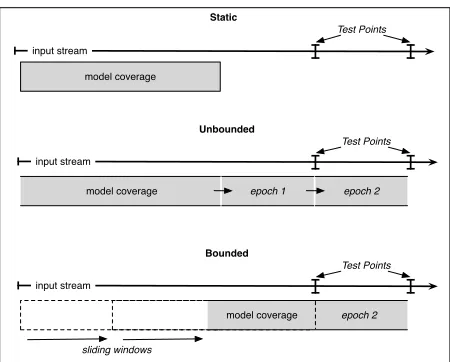
Figure 1: Streaming coverage conditions. In traditional batch based modeling the coverage of a trained model never changes. Unbounded coverage operates without any memory constraints so the model is able to contin-ually add data from the input stream. Bounded coverage uses just a fixed window.
constant space when processing unbounded streams. Standard suffix arrays are static, store a fixed corpus and do not support deletions. Nevertheless, a dy-namic variant of the suffix array does support dele-tions as well as inserdele-tions and therefore can be used in our stream-based approach (Salson et al., 2009). Using a dynamic suffix array, we can compactly represent the set of parallel sentences from which we eventually extract grammar rules. Furthermore, when incorporating new parallel sentences, we sim-ply insert them into the array and, to maintain con-stant space usage, we delete an equivalent number.
4 Experiments
In this section we describe the experiments con-ducted comparing various batch trained translation models (TMs) versus online incrementally retrained TMs in a full SMT setting with different conditions set on model coverage. We used publicly available resources for all our tests. We start by showing that recency motivates incremental retraining.
4.1 Effects of Recency on SMT
For language modeling, it is known that perfor-mance can be improved using the criterion of
re-cency where training data is drawn from times
chronologically closer to the test data (Rosenfeld,
0 0.5 1 1.5 2 2.5
5 10 15 20 25 30 35
Delta in BLEU scores
epochs
Figure 2: Recency effects to SMT performance. De-picted are the differences in BLEU scores for multiple test points decoded by a static baseline system and a sys-tem batched retrained on a fixed sized window prior to the test point in question. The results are accentuated at the end of the timeline when more time has passed con-firming that recent data impacts translation performance.
1995). Given an incoming stream of parallel text, we gauged the extent to which incorporating recent data into a TM affects translation quality.
We used the Europarl corpus5with the Fr-En lan-guage pair using French as source and English as tar-get. Europarl is released in the format of a daily par-liamentary session per time-stamped file. The actual dates of the full corpus are interspersed unevenly (they do not convene daily) over a continuous time-line corresponding to the parliament sessions from April,1996 through October, 2006, but for concep-tual simplicity we treated the corpus as a continual input stream over consecutive days.
As a baseline we aligned the first 500k sentence pairs from the beginning of the corpus timeline. We extracted a grammar for and translated 36 held out test documents that were evenly spaced along the re-mainder of the Europarl timeline. These test docu-ments effectively divided the remaining training data into epochs and we used a sliding window over the timeline to build 36 distinct, overlapping training sets of 500k sentences each.
We then translated all 36 test points again using a new grammar for each document extracted from only the sentences contained in the epoch that was before it. To explicitly test the effect of recency
5
[image:4.612.319.531.59.212.2]on the TM all other factors of the SMT pipeline re-mained constant including the language model and the feature weights. Hence, the only change from the static baseline to the epochs performance was the TM data which was based on recency. Note that at this stage we did not use any incremental retraining. Results are shown in Figure 2 as the differences in BLEU score (Papineni et al., 2001) between the baseline TM versus the translation models trained on material chronologically closer to the given test point. The consistently positive deltas in BLEU scores between the model that is never retrained and the models that are retrained show that we achieve a higher translation performance when using more up-to-date TMs that incorporate recent sentence pairs. As the chronological distance between the initial, static model and the retrained models increases, we see ever-increasing differences in translation perfor-mance. This underlines the need to retrain transla-tion models with timely material.
4.2 Unbounded and Bounded Translation Model Retraining
Here we consider how to process a stream along two main axes: by bounding time (batch versus incre-mental retraining) and by bounding space (either us-ing all the stream seen so far, or only usus-ing a fixed sized sample of it).
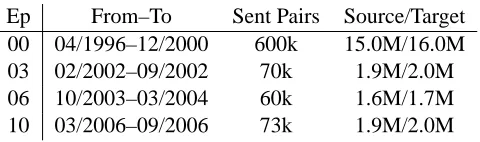
To ensure the recency results reported above were not limited to French-English, this time our paral-lel input stream was generated from the German-English language pair of Europarl with German as source and English again as target. For testing we held out a total of 22k sentences from 10 evenly spaced intervals in the input stream which divided the input stream into 10 epochs. Stream statistics for three example epochs are shown in Table 1. We held out 4.5k sentence pairs as development data to opti-mize the feature function weights using minimum error rate training (Och, 2003) and these weights were used by all models. We used Joshua (Li et al., 2009), a syntax-based decoder with a suffix array implementation, and rule induction via the standard
Hiero grammar extraction heuristics (Chiang, 2007)
for the TMs. Note that nothing hinges on whether we used a syntax or a phrase-based system.
We used a 5-gram, Kneser-Ney smoothed lan-guage model (LM) trained on the initial segment of
[image:5.612.316.556.55.126.2]Ep From–To Sent Pairs Source/Target 00 04/1996–12/2000 600k 15.0M/16.0M 03 02/2002–09/2002 70k 1.9M/2.0M 06 10/2003–03/2004 60k 1.6M/1.7M 10 03/2006–09/2006 73k 1.9M/2.0M
Table 1: Date ranges, total sentence pairs, and source and target word counts encountered in the input stream for example epochs. Epoch 00 is baseline data that is also used as a seed corpus for the online models.
the target side parallel data used in the first base-line as described further in the next subsection. As our initial experiments aim to isolate the effect of changes to the TM on overall translation system per-formance, our in-domain LM remains static for ev-ery decoding run reported below until indicated.
We used the open-source toolkit GIZA++ (Och and Ney, 2003) for all word alignments. For the online adaptation experiments we modified Model 1 and the HMM model in GIZA++ to use the sOEM algorithm. Batch baselines were aligned using the standard version of GIZA++. We ran the batch and incremental versions of Model 1 and HMM for the same number of iterations each in both directions.
4.3 Time and Space Bounds
For both batch and sOEM we ran a number of ex-periments listed below corresponding to the differ-ent training scenarios diagrammed in Figure 1.
1. Static: We used the first half of the in-put stream, approximately 600k sentences and 15/16 million source/target words, as parallel training data. We then translated each of the 10 test sets using the static model. This is the tradi-tional approach and the coverage of the model never changes.
Baseline Unbounded Bounded Epoch Test Date Test Sent. Train Sent. Rules Train Sent. Rules Train Sent. Rules
03 09/23/2002 1.0k 580k 4.0M 800k 5.0M 580k 4.2M
06 03/29/2004 1.5k 580k 5.0M 1.0M 7.0M 580k 5.5M
10 09/26/2006 3.5k 580k 8.5M 1.3M 14.0M 580k 10.0M
Table 2: Translation model statistics for example epochs and the next test dates grouped by experimental condition.
Test and Train Sent. is the number of sentence pairs in test and training data respectively. Rules is the count of unique
Hiero grammar rules extracted for the corresponding test set.
0.2 0.4 0.6 0.8 1 1.2 1.4 1.6
1 2 3 4 5 6 7 8 9 10
Delta in BLEU scores
epochs unbounded
[image:6.612.84.534.55.126.2]bounded
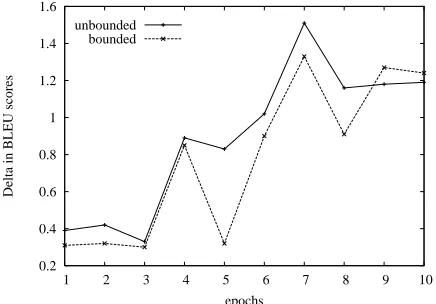
Figure 3: Static vs. online TM performance. Gains in translation performance measured by BLEU are achieved when recent German-English sentence pairs are auto-matically incorporated into the TM. Shown are relative BLEU improvements for the online models against the static baseline.
3. Bounded Space: Batch and incremental re-training with an enforced memory constraint. Here we batch or incrementally retrain using a sliding window approach where the training set size (the number of sentence pairs) remains constant. In particular, we ensured that we used the same number of sentences as the base-line. Each batch run of GIZA++ takes approxi-mately the same time.
The time for aligning in the sOEM model is unaf-fected by the bounded/unbounded conditions since we always only align the mini-batch of sentences encountered in the last epoch. In contrast, for batch EM we must realign all the sentences in our training set from scratch to incorporate the new training data. Similarly space usage for the batch training grows with the training set size. For sOEM, in theory mem-ory used is with respect to vocabulary size (which
grows slowly with the stream size) since we retain count history for the entire stream. To make space usage truly constant, we filter for just the needed word pairs in the current epoch being aligned. This effectively means that online EM is more mem-ory efficient than the batch version. As our exper-iments will show, the sufficient statistics kept be-tween epochs by sOEM benefits performance com-pared to the batch models which can only use infor-mation present within the batch itself.
4.4 Incremental Retraining Procedure
Our incremental adaptation procedure was as fol-lows: after the latest mini-batch of sentences had been aligned using sOEM we added all newly aligned sentence pairs to the dynamic suffix ar-rays. For the experiments where our memory was bounded, we also deleted an equal number of sen-tences from the suffix arrays before extracting the Hiero grammar for the next test point. For the un-bounded coverage experiments we deleted nothing prior to grammar extraction. Table 2 presents statis-tics for the number of training sentence pairs and grammar rules extracted for each coverage condition for various test points.
4.5 Results
[image:6.612.75.293.198.350.2]Static Baseline Retrained (Unbounded) Retrained (Bounded)
Test Date Batch Batch Online Batch Online
09/23/2002 26.10 26.60 26.43 26.19 26.40
03/29/2004 27.40 28.33 28.42 28.06 28.38
09/26/2006 28.56 29.74 29.75 29.73 29.80
Table 3: Sample BLEU results for all baseline and online EM model conditions. The static baseline is a traditional model that is never retrained. The batch unbounded and batch bounded models incorporate new data from the stream but retraining is slow and computationally expensive (best results are bolded). In contrast both unbounded and bounded online models incrementally retrain only the mini-batch of new sentences collected from the incoming stream so quickly adopt the new data (best results are italicized).
Table 3 gives results of the online models com-pared to the batch retrained models. For presentation clarity we show only a sample of the full set of ten test points though all results follow the pattern that using more aligned sentences to derive our gram-mar set resulted in slightly better performance ver-sus a restricted training set. However, for the same coverage constraints not only do we achieve com-parable performance to batch retrained models us-ing the sOEM method of incremental adaptation, we are able to align and adopt new data from the input stream orders of magnitude quicker since we only align the mini-batch of sentences collected from the last epoch. In the bounded condition, not only do we benefit from quicker adaptation, we also see that sOEM models slightly outperform the batch based models due to the online algorithm employing a longer history of count-based evidence to draw on when aligning new sentence pairs.
Figure 4 shows two example test sentences that benefited from the online TM adaptation. Trans-lations from the online model produce more and longer matching phrases for both sentences (e.g., “creation of such a”, “of the occupying forces”) leading to more fluent output as well as the improve-ments achieved in BLEU scores.
We experimented with a variety of interpolation parameters (see Algorithm 2) but found no signifi-cant difference between them (the biggest improve-ment gained over all test points for all parameter set-tings was less than 0.1% BLEU).
4.6 Increasing LM Coverage
A natural and interesting extension to the experi-ments above is to use the target side of the incoming stream to extend the LM coverage alongside the TM.
[image:7.612.126.484.56.125.2]Test Date Static Unbounded Bounded 09/23/2002 26.46 27.11 26.96 03/29/2004 28.11 29.53 29.20 09/26/2006 29.53 30.94 30.88
Table 4: Unbounded LM coverage improvements. Shown are the BLEU scores for each experimental conditional when we allow the LM coverage to increase.
It is well known that more LM coverage (via larger training data sets) is beneficial to SMT performance (Brants et al., 2007) so we investigated whether re-cency gains for the TM were additive with rere-cency gains afforded by a LM.
To test this we added all the target side data from the beginning of the stream to the most recent epoch into the LM training set before each test point. We then batch retrained6 and used the new LM with greater coverage for the next decoding run. Experi-ments were for the static baseline and online models.
Results are reported in Table 4. We can see that increasing LM coverage is complimentary to adapt-ing the TM with recent data. Comparadapt-ing Tables 3 and 4, for the bounded condition, adapting only the TM achieved an absolute improvement of +1.24 BLEU over the static baseline for the final test point. We get another absolute gain of +1.08 BLEU by al-lowing the LM coverage to adapt as well. Using an online, adaptive model gives a total gain of +2.32 BLEU over a static baseline that does not adapt.
6
Static: The commission is prepared, in the creation of a legal framework, taking account of four fundamental principles them.
Online: The commission is prepared to participate in the creation of such a legal framework, based on four fundamental principles. Reference: The commission is willing to cooperate in the creation of such a legal framework on the basis of four essential principles. Source: Die Kommission ist bereit, an der Schaffung eines solchen Rechtsrahmens unter Zugrundelegung von vier wesentlichen Prinzipien mitzuwirken.
Static: Our position is clear and we all know: we are against the war and the occupation of Iraq by the United States and the United Kingdom, and we are calling for the immediate withdrawal of the besatzungsmächte from this country.
Online: Our position is clear and well known: we are against the war and the occupation of Iraq by the United States and the United Kingdom, and we demand the immediate withdrawal of the occupying forces from this country .
Reference: Our position is clear and well known: we are against the war and the US-British occupation in Iraq and we demand the immediate withdrawal of the occupying forces from that country.
Source: Unser Standpunkt ist klar und allseits bekannt: Wir sind gegen den Krieg und die Besetzung des Irak durch die USA und das Vereinigte Königreich, und wir verlangen den unverzüglichen Abzug der Besatzungsmächte aus diesem Land.
Figure 4: Example sentences and improvements to their translation fluency by the adaptation of the TM with recent sentences. In both examples we get longer matching phrases in the online translation compared to the static one.
5 Related Work
5.1 Translation Model Domain Adaptation
Our work is related to domain adaptation for transla-tion models. See, for example, Koehn and Schroeder (2007) or Bertoldi and Federico (2009). Most tech-niques center around using mixtures of translation models. Once trained, these models generally never change. They therefore fall under the batch training regime. The focus of this work instead is on incre-mental retraining and also on supporting bounded memory consumption. Our experiments examine updating model parameters in a single domain over different periods in time. Naturally, we could also use domain adaptation techniques to further improve how we incorporate new samples.
5.2 Online EM for SMT
For stepwise online EM for SMT models, the only prior work we are aware of is Liang and Klein (2009), where variations of online EM were exper-imented with on various NLP tasks including word alignments. They showed application of sOEM can produce quicker convergence compared to the batch EM algorithm. However, the model presented does not incorporate any unseen data, instead iterating over a static data set multiple times using sOEM. For Liang and Klein (2009) incremental retraining is simply an alternative way to use a fixed training set.
5.3 Streaming Language Models
Recent work in Levenberg and Osborne (2009) pre-sented a streaming LM that was capable of adapt-ing to an unbounded monoladapt-ingual input stream in constant space and time. The LM has the ability to add or delete n-grams (and their counts) based on feedback from the decoder after translation points. The model was tested in an SMT setting and results showed recent data benefited performance. How-ever, adaptation was only to the LM and no tests were conducted on the TM.
6 Conclusion and Future Work
We have presented an online EM approach for word alignments. We have shown that, for a SMT system, incorporating recent parallel data into a TM from an input stream is beneficial to translation performance compared to a traditional, static baseline.
Our strategy for populating the suffix array was simply to use a first-in, first-out stack. For future work we will investigate whether information pro-vided by the incoming stream coupled with the feed-back from the decoder allows for more sophisti-cated adaptation strategies that reinforce useful word alignments and delete bad or unused ones.
Acknowledgements
Research supported by EuroMatrixPlus funded by the European Commission, by the DARPA GALE program under Contract Nos. HR0011-06-2-0001 and HR0011-06-C-0022, and the NSF under grant IIS-0713448.
References
Nicola Bertoldi and Marcello Federico. 2009. Do-main adaptation for statistical machine translation with monolingual resources. In WMT09: Proceedings of
the Fourth Workshop on Statistical Machine Transla-tion, pages 182–189, Morristown, NJ, USA.
Associa-tion for ComputaAssocia-tional Linguistics.
Thorsten Brants, Ashok C. Popat, Peng Xu, Franz J. Och, and Jeffrey Dean. 2007. Large language models in machine translation. In Proceedings of the 2007 Joint
Conference on Empirical Methods in Natural guage Processing and Computational Natural Lan-guage Learning (EMNLP-CoNLL), pages 858–867.
Peter F. Brown, Vincent J. Della Pietra, Stephen A. Della Pietra, and Robert L. Mercer. 1993. The mathemat-ics of statistical machine translation: parameter esti-mation. Computational Linguistics, 19(2):263–311. Chris Callison-Burch, Colin Bannard, and Josh
Schroeder. 2005. Scaling phrase-based statisti-cal machine translation to larger corpora and longer phrases. In Proceedings of the 43rd Annual Meeting
of the Association for Computational Linguistics (ACL’05), pages 255–262, Ann Arbor, Michigan,
June. Association for Computational Linguistics. Olivier Cappe and Eric Moulines. 2009. Online EM
al-gorithm for latent data models. Journal Of The Royal
Statistical Society Series B, 71:593.
David Chiang. 2007. Hierarchical phrase-based transla-tion. Computational Linguistics, 33(2):201–228. A. P. Dempster, N. M. Laird, and D. B. Rubin. 1977.
Maximum likelihood from incomplete data via the EM algorithm. Journal of the Royal Statistical Society.
Se-ries B (Methodological), 39:1–38.
Philipp Koehn and Josh Schroeder. 2007. Experiments in domain adaptation for statistical machine transla-tion. In Proceedings of the Second Workshop on
Sta-tistical Machine Translation, pages 224–227, Prague,
Czech Republic, June. Association for Computational Linguistics.
Abby Levenberg and Miles Osborne. 2009. Stream-based randomised language models for SMT. In
Pro-ceedings of the Conference on Empirical Methods in Natural Language Processing (EMNLP).
Zhifei Li, Chris Callison-Burch, Chris Dyer, Juri Gan-itkevitch, Sanjeev Khudanpur, Lane Schwartz, Wren
N. G. Thornton, Jonathan Weese, and Omar F. Zaidan. 2009. Joshua: an open source toolkit for parsing-based machine translation. In WMT09: Proceedings
of the Fourth Workshop on Statistical Machine Trans-lation, pages 135–139, Morristown, NJ, USA.
Associ-ation for ComputAssoci-ational Linguistics.
Percy Liang and Dan Klein. 2009. Online EM for unsu-pervised models. In North American Association for
Computational Linguistics (NAACL).
Adam Lopez. 2008. Tera-scale translation models via pattern matching. In Proceedings of the 22nd
Interna-tional Conference on ComputaInterna-tional Linguistics (Col-ing 2008), pages 505–512, Manchester, UK, August.
Coling 2008 Organizing Committee.
Udi Manber and Gene Myers. 1990. Suffix arrays: A new method for on-line string searches. In The
First Annual ACM-SIAM Symposium on Dicrete Algo-rithms, pages 319–327.
Franz Josef Och and Hermann Ney. 2003. A system-atic comparison of various statistical alignment mod-els. Computational Linguistics, 29(1):19–51, March. Franz Josef Och. 2003. Minimum error rate training
in statistical machine translation. In ACL ’03:
Pro-ceedings of the 41st Annual Meeting on Association for Computational Linguistics, pages 160–167,
Mor-ristown, NJ, USA. Association for Computational Lin-guistics.
Kishore Papineni, Salim Roukos, Todd Ward, and Wei-Jing Zhu. 2001. Bleu: a method for automatic evalua-tion of machine translaevalua-tion. In ACL ’02: Proceedings
of the 40th Annual Meeting on Association for Compu-tational Linguistics, pages 311–318, Morristown, NJ,
USA. Association for Computational Linguistics. Ronald Rosenfeld. 1995. Optimizing lexical and n-gram
coverage via judicious use of linguistic data. In In
Proc. European Conf. on Speech Technology, pages
1763–1766.
Mika¨el Salson, Thierry Lecroq, Martine L´eonard, and Laurent Mouchard. 2009. Dynamic extended suffix arrays. Journal of Discrete Algorithms, March. Stephan Vogel, Hermann Ney, and Christoph Tillmann.
1996. HMM-based word alignment in statistical trans-lation. In Proceedings of the 16th conference on
Com-putational linguistics, pages 836–841, Morristown,