Sub-barrier capture with quantum diffusion approach
V.V.Sargsyan1, R.A.Kuzyakin1, G.G.Adamian1,a, N.V.Antonenko1, W.Scheid2, and H.Q.Zhang3 1 Joint Institute for Nuclear Research, 141980 Dubna, Russia
2 Institut f¨ur Theoretische Physik der Justus–Liebig–Universit¨at, D–35392 Giessen, Germany 3 China Institute of Atomic Energy, Post Office Box 275, Beijing 102413, China
Abstract. With the quantum diffusion approach the behavior of capture cross sections and mean-square angular momenta of captured systems are revealed in the reactions with deformed and spherical nuclei at sub-barrier energies. With decreasing bombarding energy under the barrier the external turning point of the nucleus-nucleus potential leaves the region of short-range nuclear interaction and action of friction. Because of this change of the regime of interaction, an unexpected enhancement of the capture cross section is found at bombarding energies far below the Coulomb barrier. This effect is shown its worth in the dependence of mean-square angular momentum on the bombarding energy. From the comparison of calculated capture cross sections and experimental capture or fusion cross sections the importance of quasifission near the entrance channel is demonstrated for the actinide-based reactions and reactions with medium-heavy nuclei at extreme sub-barrier energies.
1 Introduction
The measurement of excitation functions down to the ex-treme sub-barrier energy region is important for studying the long range behavior of nucleus-nucleus interaction as well as the coupling of relative motion with other degrees of freedom [1–28]. The experimental data obtained are of interest for solving astrophysical problems related to nuclear synthesis. Indications for an enhancement of the
S-factor,S = Ec.m.σexp(2πη) [29,30], whereη(Ec.m.) =
Z1Z2e2
p
µ/(2~2E
c.m.) is the Sommerfeld parameter, at
en-ergiesEc.m.below the Coulomb barrier have been found in
Refs. [10,15,18]. Its origin is still under discussion. From the comparison of capture cross sections and fu-sion cross sections one can show a significant role of the quasifission channel in the reactions with various medium-light and heavy nuclei at sub-barrier energies. The com-petition between the complete fusion and quasifission can strongly reduce the value of the fusion cross section and, respectively, the value of the evaporation residue cross sec-tion [31–33]. This effect is especially crucial in the pro-duction of superheavy nuclei. It worth remembering that first evidences of hindrance for compound nucleus forma-tion in the reacforma-tions with massive nuclei at low energies near the Coulomb barrier were observed at GSI already long time ago [34].
To clarify the behavior of capture and fusion cross sec-tions at sub-barrier energies, a further development of the theoretical methods is required [33,35–37]. The conven-tional coupled-channel approach with realistic set of pa-rameters is not able to describe the fusion cross sections either below or above the Coulomb barrier [18]. The use of a quite shallow nucleus-nucleus potential [38] with an
ad-a e-mail:[email protected]
justed repulsive core considerably improves the agreement between the calculated and experimental data. Besides the coupling with collective excitations, the dissipation, which is simulated by an imaginary potential in Ref. [38] or by damping in each channel in Ref. [39], seems to be impor-tant. The quantum diffusion approach based on the quan-tum master-equation for the reduced density matrix has been suggested in Ref. [40] for the describing capture pro-cess. The collisions of nuclei are treated in terms of a single collective variable: the relative distance between the collid-ing nuclei. Our approach takes into consideration the fluc-tuation and dissipation effects in collisions of heavy ions which model the coupling with various channels. In the present paper the capture model [40] is applied.
2 Comparison with experimental data and
predictions
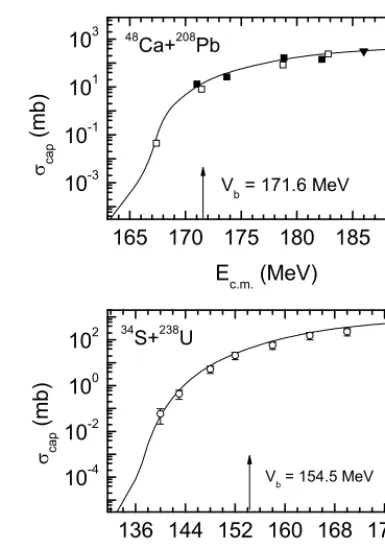
One can see in Figs. 1–4 that with decreasingEc.m.up to
about 3 - 18 MeV below the Coulomb barrier the regime of interaction is changed because at the external turning point the colliding nuclei do not reach the region of nuclear inter-action where the friction plays a role. As result, at smaller
Ec.m.the capture cross sectionsσcapfall with a smaller rate. Therefore, an effect of the change of fall rate of sub-barrier capture cross section should be in the data if we assume that the friction starts to act only when the colliding nuclei approach the barrier. Note that at sub-barrier energies the experimental data have still large uncertainties to make a firm experimental conclusion about this effect. The effect seems to be more pronounced in collisions of spherical nu-clei, where the regime of interaction is changed atEc.m.up
to about 3.5 - 5 MeV below the Coulomb barrier [40]. © Owned by the authors, published by EDP Sciences, 2011
10 -7 10
-5 10
-3 10
-1 10 1 10 3
c
a
p
(
m
b
)
V B
= 73.0 MeV 16
O+ 208
Pb
60 65 70 75 80 85 90 95 100 6
12 18 24 30 36
<
J
2
>
1
/
2
E c.m.
(MeV)
0 10 20 30 40 50 60 10
-7 10
-5 10
-3 10
-1 10 1
c
a
p
(
E
c
.m
.
,
J)
(
m
b
)
J
Fig. 1.The calculated (lines) capture cross section (upper part), average angular momenta of captured system (middle part) ver-susEc.m., and partial capture cross sections (lower part) versus
JatEc.m.=65 (dash-dot-dotted line), 69.5 (dash-dotted line), 73 (dotted line), 83 (dashed line), and 100 (solid line) MeV for the
16O+208Pb reaction with the spherical nuclei. The experimental
cross sections marked by closed squares, circles, rhombus, stars are from Refs. [18,8,11,5], respectively. The experimental values ofhJ2i(solid squares) are taken from Ref. [41]. The value of the
Coulomb barrierVbis indicated by arrow.
The calculated mean-square angular momentahJ2iof captured systems versusEc.m.are presented in Figs. 1 and 5
for the reactions16O+208Pb and16O+232Th,238U. At ener-gies below the barrierhJ2ihas a minimum. This minimum depends on the deformations of nuclei and on the factor
Z1×Z2. For the reactions16O+232Th,238U, these minima are about 7 – 8 MeV below the corresponding Coulomb barriers, respectively. The experimental data [41] indicate the presence of the minimum as well. On the left-hand side of this minimum the dependence ofhJ2ionE
c.m.is rather
weak. Note that the found behavior ofhJ2i, which is re-lated to the change of the regime of interaction between the colliding nuclei, would affect the angular anisotropy of the products of fission-like fragments following capture. Indeed, the values ofhJ2iare extracted from data on angu-lar distribution of fission-like fragments [25].
The agreement between the experimentalhJ2iand those calculated with Wong-type formula is rather bad. At en-ergies below the barrier thehJ2i has no a minimum (see Fig. 5). However, for the considered reactions the satura-tion values ofhJ2iare close to those obtained in our for-malism.
In Fig. 6 the calculated astrophysicalS–factor versus
Ec.m.is shown for the16O+238U reaction. TheS-factor has
165 170 175 180 185 190 10
-3 10
-1 10
1 10
3
c
a
p
(
m
b
)
E c.m.
(MeV) 48
Ca+ 208
Pb
V b
= 171.6 MeV
136 144 152 160 168 176 10
-4 10
-2 10
0 10
2
V b
= 154.5 MeV 34
S+ 238
U
c
a
p
(
m
b
)
E c.m.
(MeV)
Fig. 2. The calculated (solid lines) capture cross section ver-susEc.m.for the reactions48Ca+208Pb (upper part) and34S+238U (lower part). The experimental cross sections are taken from Refs. [42] (closed squares and triangle), [19] (open squares), and [26] (open circles). The value of the Coulomb barrierVb is
in-dicated by arrow. The static quadrupole deformation parameters are:β1(48Ca)=β2(208Pb)=0,β1(34S)=0.125, andβ2(238U)=0.286
[43].
a maximum which is seen in experiments [10,15,38]. Af-ter this maximumS-factor slightly decreases with decreas-ingEc.m.and then starts to increase. This effect seems to
be more pronounced in collisions of spherical nuclei. The same behavior has been revealed in Refs. [51] by extract-ing theS-factor from the experimental data.
In Fig. 6, the so-called logarithmic derivative,L(Ec.m.) = d(ln(Ec.m.σcap))/dEc.m., and the barrier distribution
d2(E
c.m.σcap)/dEc2.m.are presented for the16O+238U
reac-tion. The logarithmic derivative strongly increases below the barrier and then has a maximum atEc.m.≈Vborient
(sphe-re-pole)-3 MeV (atEc.m.≈Vb-3 MeV for the case of
66 72 78 84 90 96 102 108 10
-4 10
-2 10
0 10
2
c
a
p
(
m
b
)
E c.m.
(MeV) 16
O+ 232
Th
V b
=78.6 MeV
16 20 24 28 32 36 40
10 -2 10
-1 10
0 10
1 10
2 10
3 4
He+ 238
U
V b
=21.2 MeV
c
a
p
(
m
b
)
E c.m.
(MeV)
Fig. 3.The same as in Fig. 2, but for the reactions for the reac-tions16O+232Th and4He+238U. The experimental data in the upper part are taken from Refs. [44] (open triangles), [2] (closed triangles), [45] (open squares), [46] (closed squares), [6] (open stars) and [7] (closed stars). The fission cross sections from Refs. [9] and [47] are shown in the lower part by open circles and solid squares, respectively. The value of the Coulomb bar-rierVbfor the spherical nuclei is indicated by arrow. The dashed
curve represents the calculation with the Wong formula [48]. The static quadrupole deformation parameters are: β2(232Th)=0.261
β2(238U)=0.286 [43] andβ1(4He)=β1(16O)=0.
3 Capture cross sections in reactions with
large fraction of quasifission
In the case of large values ofZ1×Z2 the quasifission pro-cess competes with complete fusion at energies near bar-rier and can lead to a large hindrance for fusion, thus ruling the probability for producing superheavy elements in the actinide-based reactions [32,52]. Since the sum of the fu-sion cross sectionσf us, and the quasifission cross section σq f gives the capture cross section,
σcap=σf us+σq f,
andσf usσq ffor actinide-based reactions48Ca+232Th, 238U,244Pu,246,248Cm and50Ti+244Pu [32], we have
σcap≈σq f.
In a wide mass-range near the entrance channel, the quasifission events overlap with the products of deep-in-elastic collisions and can not be firmly distinguished. Be-cause of this the mass region near the entrance channel is taken out in the experimental analyses in Refs. [53,54].
66 72 78 84 90 96 102
10 -4 10
-3 10
-2 10
-1 10
0 10
1 10
2 10
c
a
p
(
m
b
)
E c.m.
(MeV) 16
O+ 238
U
V b
=80.0 MeV
136 144 152 160 168 176 184 10
-5 10
-4 10
-3 10
-2 10
-1 10
0 10
1 10
2 10
3
c
a
p
(
m
b
)
E c.m.
(MeV) 36
S+ 238
U
V b
=153.5 MeV
Fig. 4. The same as in Fig. 2, but for the reactions 16O + 238U and36S+238U. The experimental cross sections are taken from Refs. [13] (open triangles), [49] (closed triangles), [6] (open squares), [4] (closed squares), [47] (open stars), [24] (closed stars), and [20] (rhombuses). The dashed curve repre-sents the calculation with the Wong formula [48]. The static quadrupole deformation parameters are: β2(238U)=0.286 and
β1(16O)=β1(36S)=0.
Thus, by comparing the calculated and experimental cap-ture cross sections one can study the importance of quasi-fission near the entrance channel for the actinide-based re-actions leading to superheavy nuclei.
The capture cross sections for the quasifission reac-tions [53–55] are shown in Figs. 7 and 8. One can observe a large deviations of the experimental data of Refs. [53, 54] from the the calculated results. The possible reason is an underestimation of the quasifission yields measured in these reactions. Thus, the quasifission yields near the en-trance channel are important. Note that there are the exper-imental uncertainties in the bombarding energies.
68 72 76 80 84 88 100
200 300 400 500
V b
=78.6 MeV
<
J
2
>
E c.m.
(MeV) 16
O+ 232
Th
72 75 78 81 84 87 80
160 240 320 400
V b
=80.0 MeV
<
J
2
>
E c.m.
(MeV) 16
O+ 238
U
Fig. 5.The calculated mean-square angular momenta versusEc.m. for the reactions16O+232Th,238U are compared with
experimen-tal data [6]. The dashed curve represents the calculation by the Wong-type formula [48].
68 72 76 80 84 88 92 -150
0 150 300 450 600
E c.m .
(MeV)
d
2
(
E
c
.
m
.
c
a
p
)
/
d
E
2
c
.
m
.
(
m
b
/
M
e
V
)
0 1 2 3
L
(
M
e
V
-1
)
16 O+
238 U
10 3 10
4 10
5 10
6
S
e
-2
(
m
b
M
e
V
)
Fig. 6.The calculated values of the astrophysicalS-factor with
η0=η(Ec.m.=Vb) (middle part), the logarithmic derivativeL
(up-per part) and the fusion barrier distributiond2(E
c.m.σcap)/dE2c.m. (lower part) for the 16O+238U reaction. The value ofL
calcu-lated with the assumption of β1(16O)=β2(238U)=0 is shown by
a dashed line. The solid and dotted lines show the values of d2(E
c.m.σcap)/dE2c.m. calculated with the increments 0.2 and 1.2 MeV, respectively. The closed squares are the experimental data of Ref. [50].
162 168 174 180 186 192 198 10
-7 10
-5 10
-3 10
-1 10
1 10
3
ca
p
(
m
b
)
48 Ca+
232 Th
V b
=185.0 MeV
176 184 192 200 208 216 10
-5 10
-3 10
-1 10
1 10
3
ca
p
(
m
b
)
E c.m .
(MeV) 48
Ca+ 238
U
V b
=188.5 MeV 12 18 24 30 36 42 48 54
6 12 18 24 30 36
E *
CN (MeV)
Fig. 7.The same as in Fig. 4, but for the 48Ca +232Th,238U
reactions. The excitation energies E∗
CN of the corresponding
nuclei are indicated. The experimental data are taken from Refs. [53] (marked by squares) and [55] (marked by circles). The static quadrupole deformation parameters are: β2(238U)=0.286,
β2(232Th)=0.261, andβ1(48Ca)=0.
4 Origin of fusion hindrance in reactions
with medium-mass nuclei at sub-barrier
energies
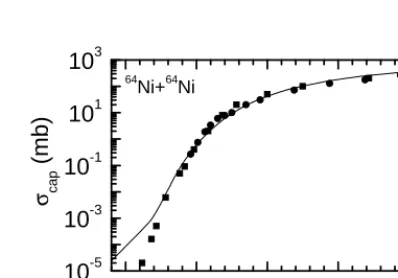
In Figs. 10 and 11 the calculated capture cross section are presented for the reactions 36S + 48Ca,64Ni and 64Ni + 64Ni. The values of V
b are adjusted to the experimental data for the fusion cross sections shown as well. For the systems mentioned above, the difference between the sub-barrier capture and fusion cross sections becomes larger with decreasing bombarding energy Ec.m.. The same
176 184 192 200 208 216 10
-2 10
-1 10
0 10
1 10
2 10
3
ca
p
(
m
b
)
48 Ca+
244 Pu
V b
=191.9 MeV
192 198 204 210 216 222 228 10
-2 10
-1 10
0 10
1 10
2 10
3
ca
p
(
m
b
)
E c.m.
(MeV) 50
Ti+ 244
Pu
V b
=211.5 MeV 15 20 25 30 35 40 45 50
15 20 25 30 35 40 45 50 55 E*
CN (MeV)
Fig. 8.The same as in Fig. 7, but for the indicated 48Ca,50Ti + 244Pu reactions. The experimental data are from Refs. [54] (squares) and [53] (circles). The static quadrupole deformation parameters are:β2(244Pu)=0.293, andβ1(48Ca)=β1(50Ti)=0.
20 30 40 50
10 -2 10
-1 10
0
c
a
p
e
x
/
c
a
p
t
h
E *
CN (MeV)
Fig. 9.The ratio of theoretical and experimental capture cross sections versus the excitation energy Ec.m. of the compound nucleus for the reactions 48Ca+238U (closed stars), 48Ca+244Pu
(closed triangles), 48Ca+246Cm (closed squares), 48Ca+248Cm
(closed circles), and50Ti+244Pu (closed rhombuses).
entrance channel. In this sense the quasifission is the gen-eral phenomenon which takes place in the reactions with the massive [31–34], medium-mass and, probably, light nuclei. For the medium-mass and light nuclei, this reaction mode has to be studied in the future experiments: from the mass (charge) distribution measurements one can show the distinct components due to quasifission. The low-energy experimental data would probably provide straight
infor-35 40 45 50 55
10 -3 10
-2 10
-1 10
0 10
1 10
2 10
3
c
a
p
(
m
b
)
E c.m.
(MeV) 36
S+ 48
Ca
V b
=42.1 MeV
50 52 54 56 58 60
10 -3 10
-2 10
-1 10
0 10
1 10
2 36
S+ 64
Ni
V b
=56.6 MeV
c
a
p
(
m
b
)
E c.m.
(MeV)
Fig. 10. The calculated capture cross sections versus Ec.m. for the indicated reactions. The experimental fusion cross sections marked by closed and open squares are taken from Refs. [21, 28], respectively. The values of the Coulomb barrier are indi-cated by arrows. The static quadrupole deformation parameters are:β1(36S)=β2(48Ca)=0 andβ2(64Ni)=0.087 [56].
85
90
95
100
105
10
-510
-310
-110
110
364
Ni+64Ni
σ ca
p
(
m
b
)
E
c.m.(MeV)
Fig. 11.The calculated capture cross sections versus Ec.m. for the indicated reaction. The experimental fusion cross sections marked by closed circles and squares are taken from Refs. [1, 14], respectively. Here,β1,2(64Ni)=0.087.
5 Summary
The quantum diffusion approach is applied to study the capture process in the reactions with deformed and spher-ical nuclei at sub-barrier energies. Due to a change of the regime of interaction (the turning-offof the nuclear forces and friction) at sub-barrier energies, the curve related to the capture cross section as a function of bombarding energy has smaller slope. This change is also reflected in the func-tionshJ2i,L(E
c.m.), andS(Ec.m.). The mean-square angular
momentum of captured system versusEc.m.has a minimum
and then saturates at sub-barrier energies. This behavior of hJ2iwould increase the expected anisotropy of the angular distribution of the products of fission and quasifission fol-lowing capture. The astrophysical factor has a maximum and a minimum at energies below the barrier. The max-imum ofL-factor corresponds to the minimum of the S -factor. The importance of quasifission near the entrance channel is shown for the actinide-based reactions at near barrier energies and reactions with medium-mass nuclei at extreme sub-barrier energies. One can suggest the experi-ments to check these predictions.
We thank H. Jia and D. Lacroix for fruitful discus-sions and suggestions. We are grateful to K. Nishio for pro-viding us his experimental data. This work was supported by DFG, NSFC, and RFBR. The IN2P3-JINR and Polish-JINR Cooperation programs are gratefully acknowledged.
References
1. M.Beckermanet al., Phys.Rev.C25, (1982) 837. 2. H.Q.Zhanget al., Phys.Rev.C42, (1990) 1086. 3. F.Scarlassaraet al., Z.Phys.A338, (1991) 171. 4. H.Q.Zhanget al., Phys.Rev.C49, (1994) 926.
5. Yu.Ts.Oganessianet al., JINR Rapid Communications
75, (1996) 123.
6. Z.Liuet al., Phys.Rev.C54, (1996) 761.
7. D.M.Nadkarniet al., Phys.Rev.C59, (1999) R580. 8. C.R.Mortonet al., Phys.Rev.C60, (1999) 044608. 9. M.Trottaet al., Phys.Rev.Lett.84, (2000) 2342. 10. C.L.Jianget al., Phys.Rev.Lett.89, (2002) 052701. 11. S.P.Tretyakova et al., Nucl.Phys.A 734, (2004) E33;
S.P.Tretyakovaet al., Nucl.Phys.A738, (2004) 487. 12. M.Dasgupta and D.J.Hinde, Nucl.Phys.A734, (2004)
148.
13. K.Nishioet al., Phys.Rev.Lett.93, (2004) 162701. 14. C.L.Jianget al., Phys.Rev.Lett.93, (2004) 012701. 15. C.L.Jianget al., Phys.Rev.C71, (2005) 044613. 16. K.Nishioet al., Eur.Phys.J.A29, (2006) 281.
17. W.Loveland et al., Phys.Rev.C 74, (2006) 044604; A.M.Vinodkumaret al., Phys.Rev.C78, (2008) 054608. 18. M.Dasguptaet al., Phys.Rev.Lett.99, (2007) 192701. 19. E.Prokhorovaet al., Nucl.Phys.A802, (2008) 45. 20. K.Nishioet al., Phys.Rev.C.77, (2008) 064607. 21. A.M.Stefaniniet al., Phys.Rev.C78, (2008) 044607. 22. D.J.Hindeet al., Phys.Rev.Lett.101, (2008) 092701. 23. A.Shrivastava et al., Phys.Rev.Lett. 103, (2009)
232702.
24. M.G.Itkiset al., Nucl.Phys.A834, (2010) 374c. 25. H.Q.Zhanget al., Phys.Rev.C81, (2010) 034611. 26. K.Nishioet al., Phys.Rev.C82, (2010) 024611. 27. C.Signoriniet al., Eur.Phys.J.A44, (2010) 63. 28. G.Montagnoli et al., Nucl.Phys.A 834, (2010) 159c;
Phys.Rev.C (2010)82064609.
29. K.Langanke and C.A.Barnes, Adv.Nucl.Phys. 22, (1996) 173.
30. A.Aprahamian, K.Langanke, and M.Wiescher, Prog.Part.Nucl.Phys.54, (2005) 535.
31. V.V.Volkov, Particles and Nuclei,35, (2004) 797. 32. G.G.Adamian, N.V.Antonenko, and W.Scheid,
Phys.Rev.C68, (2003) 034601.
33. G.Giardina et al., Nucl.Phys.A 671, (2000) 165; A.Nasirovet al., Nucl.Phys.A759, (2005) 342.
34. J.G.Kelleret al., Nucl. Phys.A452, (1986) 173. 35. A.B.Balantekin and N.Takigawa, Rev.Mod.Phys. 70,
(1998) 77; L.E.Canto, P.R.S.Gomes, R.Donangelo, and M.S.Hussein, Phys.Rep.424, (2006) 1.
36. V.V.Sargsyanet al., Phys. Rev. C80, (2009) 034606; ibid80, (2009) 047603.
37. G.Hupin and D.Lacroix Phys. Rev.C 81, (2010) 014609; S.Ayik, B.Yilmaz, and D.Lacroix, Phys. Rev.C
81, (2010) 034605.
38. H.Esbensen and C.L.Jiang, Phys. Rev.C 79, (2009) 064619; S.Misicu and H.Esbensen H, Phys. Rev.C75, (2007) 034606; H.Esbensen and S.Misicu, Phys. Rev. C
76, (2007) 054609.
39. K. Hagino and N.Rowley, AIP Conf. Proc. 1098, (2009) 18.
40. V.V.Sargsyanet al., Eur.Phys.J.A45, (2010) 125; ibid
47, (2011) 38.
41. R.Vandenbosch, Annu.Rev.Nucl.Part.Sci. 42, (1992) 447.
42. A.J.Pacheco et al., Phys.Rev.C 45, (1992) 2861; R.Bocket al., Nucl.Phys.A388, (1982) 334.
43. S.Raman, C.W.Nestor, Jr, and Tikkanen P, At.Data Nucl.Data Tables78, (2001) 1.
44. B.B.Backet al., Phys.Rev.C32, (1985) 195. 45. T.Murakamiet al., Phys.Rev.C34, (1986) 1353. 46. S.Kailaset al., Phys.Rev.C59, (1999) 2580.
47. V.E.Viola, Jr and T.Sikkeland, Phys.Rev.128, (1962) 767.
48. C.Y.Wong, Phys.Rev.Lett.31, (1973) 766. 49. J.Tokeet al., Nucl.Phys.A440, (1985) 327. 50. D.J.Hindeet al., Phys.Rev.Lett.74, (1995) 1295. 51. K.Langanke and S.E.Koonin, Nucl.Phys.A 410,
(1983) 334; A.Redderet al., Nucl.Phys.A 462, (1987) 385.
52. M.Trottaet al., Eur.Phys.J.A25, (2005) 615. 53. M.G.Itkiset al., Nucl.Phys.A787, (2007) 150c. 54. M.G.Itkiset al., Nucl.Phys.A734, (2004) 136c. 55. W.Q.Shenet al., Phys.Rev.C36, (1987) 115.
56. P.M¨oller et al., At.Data Nucl.Data Tables59, (1995) 185.
![Fig. 3. The same as in Fig. 2, but for the reactions for the reac-curve represents the calculation with the Wong formula [48]](https://thumb-us.123doks.com/thumbv2/123dok_us/8088855.1349983/3.595.49.245.88.368/fig-fig-reactions-curve-represents-calculation-wong-formula.webp)
![Fig. 5. The calculated mean-square angular momenta versus Ec.m.for the reactions 16O + 232Th,238U are compared with experimen-tal data [6]](https://thumb-us.123doks.com/thumbv2/123dok_us/8088855.1349983/4.595.49.216.394.650/calculated-square-angular-momenta-versus-reactions-compared-experimen.webp)