ABSTRACT
DESHOTELS, LUKE ALEC. Automated Evaluation of Access Control in the iPhone Operating System. (Under the direction of William Enck).
A decade long arms race between Apple and jailbreakers has forged iPhone OS (iOS) into a hardened, but complex operating system. As a modern operating system, iOS treats applications as security principals, which allows for fine-grained access control policies that prevent applications from having the same authority as the device owner. However, iOS and other modern operating systems use inter-dependent access control mechanisms (e.g., Unix permissions and sandboxing), and the policies on iOS may be closed-source, proprietary, or decentralized. This practice makes it difficult to model the actual privileges of an iOS process which is subject to various undocumented access control policies. Confusion regarding these privileges hides flaws in misconfigured iOS access control policies that attackers can exploit in order to invade user privacy or damage the system.
© Copyright 2018 by Luke Alec Deshotels
Automated Evaluation of Access Control in the iPhone Operating System
by
Luke Alec Deshotels
A dissertation submitted to the Graduate Faculty of North Carolina State University
in partial fulfillment of the requirements for the Degree of
Doctor of Philosophy
Computer Science
Raleigh, North Carolina
2018
APPROVED BY:
Bradley Reaves Alexandros Kapravelos
Matthias Stallmann William Enck
DEDICATION
BIOGRAPHY
ACKNOWLEDGEMENTS
I could have never made it this far on my own. In my darkest moments of paper rejections, technical setbacks, and bureaucratic nightmares, I was never alone. Along my journey there was always help in the forms of loving support, writing advice, and technical contributions. In addition to my committee members, Bradley Reaves, Alexandros Kapravelos, and Matthias Stallmann, I must thank my advisor, co-authors, labmates, and friends who have given so much and asked nothing in return.
First, I must thank my advisor, William Enck. I have been Will’s teaching assistant, student, and apprentice. As Will’s teaching assistant, he demonstrated his fairness and professionalism as we handled issues of academic integrity together. As his student, I learned exactly the information I would need to win and thrive in computer security internships. As an apprentice, I learned to write, design experiments, analyze results, present research, and collaborate with other universities. Will has been generous with his knowledge, time, and introductions, and at every stage of my academic career, Will has acted as my role model.
Second, I owe much to my co-authors, especially Razvan Deaconescu who has given so much more time and brilliance than I deserved. Razvan Deaconescu reversed the Apple sandbox, and made many other technical contributions. It was Razvan that found our first vulnerability and inspired the team to keep pursuing iOS access control. Mihai Chiroiu hosted me at Politehnica University of Bucharest and helped us keep an eye on the bigger picture beyond just iOS. Costin Carabas was instrumental to discovering the correct syntax to invoke NSXPC methods on iOS, and he contributed in many other ways to iOracle and Kobold. Iulia Manda contributed to our knowledge of mach-ports and sandbox extensions and was kind enough to find me during my brief visit to Romania. Lucas-Davi contributed his expertise of iOS and writing skill to SandScout. Ahmad-Reza Sadeghi hosted me at TU Darmstadt and provided significant insight and style to our papers. It was Ahmad that put our team together and introduced me to Razvan, Mihai, and Lucas. Finally, Ninghui-Li contributed his expertise of access control analysis to iOracle.
Elder provided wisdom and news from outside the lab. Sanghyun went to great lengths to make me feel at home during my trip to Korea. Kyle Martin gave me insights into fuzzing, crashes, and memory exploitation. I would like to thank the other current and past members of the WSPR lab for their company, advice, and hard work.
TABLE OF CONTENTS
LIST OF TABLES . . . ix
LIST OF FIGURES. . . x
Chapter 1 INTRODUCTION . . . 1
1.1 Thesis Statement . . . 2
1.2 Contributions . . . 5
1.3 Thesis Organization . . . 6
Chapter 2 Background . . . 9
2.1 Introduction . . . 9
2.2 iOS Basics . . . 11
2.3 Entitlements . . . 12
2.3.1 Policy . . . 12
2.3.2 Enforcement . . . 13
2.4 Sandboxing . . . 14
2.4.1 Policy . . . 14
2.4.2 Enforcement . . . 16
2.5 Privacy Settings . . . 17
2.5.1 Policy . . . 19
2.5.2 Enforcement . . . 20
2.6 Conclusions . . . 21
Chapter 3 Related Work . . . 22
3.1 Access Control Policy Design . . . 22
3.2 Access Control Policy Evaluation . . . 23
3.3 iOS Security . . . 24
3.3.1 Binary Analysis of iOS Apps . . . 24
3.3.2 Exploits for Third Party Apps . . . 25
3.3.3 In-Line Reference Monitors for Third Party Apps . . . 26
Chapter 4 SandScout: Automatic Detection of Flaws in iOS Sandbox Profiles. . . 28
4.1 Introduction . . . 28
4.2 Background . . . 30
4.2.1 iOS Security Mechanisms . . . 30
4.2.2 Sandbox Profile Language (SBPL) . . . 31
4.3 Overview . . . 33
4.4 Design . . . 35
4.4.1 Decompiling Sandbox Profiles . . . 36
4.4.2 Modeling Sandbox Profiles in Prolog . . . 37
4.4.3 Policy Analysis . . . 39
4.4.4 Attack Testing Application . . . 41
4.5.1 Prolog Query Results . . . 42
4.5.2 Verified Attacks . . . 44
4.6 Limitations . . . 48
4.7 Related Work . . . 49
4.8 Conclusions . . . 50
4.9 Acknowledgments . . . 51
Chapter 5 iOracle: Automated Evaluation of Access Control Policies in iOS . . . 53
5.1 Introduction . . . 53
5.2 Background . . . 55
5.3 Overview . . . 56
5.4 iOracle . . . 59
5.4.1 Policy and Context Extraction . . . 59
5.4.2 Knowledge Base Construction . . . 62
5.5 Case Study: iOS Jailbreaks . . . 66
5.5.1 Understanding iOS Jailbreaks . . . 66
5.5.2 Evaluating iOracle . . . 71
5.6 Previously Unknown policy flaws . . . 72
5.6.1 Self-Granted Capabilities . . . 72
5.6.2 Capability Redirection . . . 73
5.6.3 Write Implies Read . . . 74
5.6.4 Keystroke Exfiltration . . . 74
5.6.5 Chown Redirection . . . 75
5.7 Comparison of iOS Versions . . . 76
5.7.1 Access Control Complexity . . . 76
5.7.2 Detecting Responses to Jailbreaks . . . 76
5.8 Other Policy flaws . . . 78
5.8.1 Denial of Service . . . 78
5.8.2 Address Book Privacy Setting Bypass . . . 79
5.8.3 Symlink Restriction Bypass . . . 79
5.9 Limitations . . . 80
5.10 Related Work . . . 80
5.11 Conclusions . . . 82
5.12 Acknowledgments . . . 82
Chapter 6 A House of Many Doors: Evaluating Access Control for Remote NSXPC Meth-ods on iOS . . . 83
6.1 Introduction . . . 83
6.2 Background . . . 85
6.2.1 Mach IPC . . . 86
6.2.2 IPC Access Control . . . 87
6.3 Overview . . . 89
6.4 Kobold . . . 92
6.4.1 Identify Third Party Entitlements . . . 92
6.4.3 Evaluate Security Sensitivity of NSXPC Services . . . 95
6.5 Entitlement Survey Results . . . 97
6.5.1 Public Entitlements . . . 97
6.5.2 Semi-Private Entitlements . . . 98
6.6 Empirical Study . . . 100
6.7 Findings . . . 103
6.7.1 Confused Deputy Attacks . . . 103
6.7.2 Daemon Crashes . . . 104
6.8 Limitations . . . 105
6.9 Related Work . . . 106
6.10 Conclusion . . . 108
6.11 Acknowledgements . . . 108
Chapter 7 DIRECTIONS FOR IOS ACCESS CONTROL ANALYSIS . . . .112
7.1 Dissertation Summary . . . 112
7.2 Trends . . . 114
7.3 Future Work . . . 116
7.4 Concluding Remarks . . . 117
LIST OF TABLES
Table 2.1 tccd managed privacy settings for iOS 8. . . 19
Table 2.2 TCC database experiments. . . 21
Table 4.1 Logic for Match/Unmatch Edges∗ . . . 37
Table 4.2 Attack Verification Functions . . . 42
Table 4.3 Query Results for iOS 9.0.2 . . . 43
Table 5.1 Policy and Runtime Context Prolog Facts . . . 61
Table 5.2 Triage of Likely Attack Vectors and Confused Deputies Based on Known Jail-break Gadgets . . . 69
Table 5.3 Measuring the Increasing Complexity of iOS Access Control . . . 76
Table 6.1 Public Entitlements . . . 98
Table 6.2 Semi-Private Entitlements . . . 99
Table 6.3 Per Method Entitlement Requirements Based on Error Messages . . . 100
Table 6.4 Entitlement Requirements for Port Access Through Sandbox . . . 101
Table 6.5 Methods by Number of Arguments . . . 102
Table 6.6 Common Data Types in Extracted NSXPC Methods . . . 109
Table 6.7 Methods per Mach Port. Inconsistent Entitlement Requirements Highlighted. 110 Table 6.8 Confused Deputy Attacks . . . 110
LIST OF FIGURES
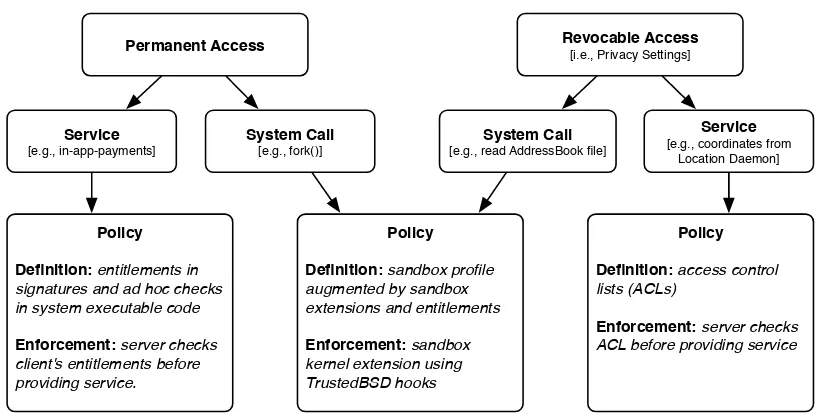
Figure 2.1 Overview of iOS access control according to access revocability and resource
being managed. . . 10
Figure 2.2 Sandbox Architecture . . . 17
Figure 2.3 Privacy Settings Policy Architecture . . . 18
Figure 2.4 Requesting access to a file-based resource through TCC . . . 20
Figure 4.1 Overview of SandScout. . . 31
Figure 4.2 Converting Graph to SBPL. . . 38
Figure 4.3 SBPL Context Free Grammar. . . 52
Figure 5.1 iOracle Overview . . . 57
Figure 5.2 Simplified Hierarchy of Prolog Rules . . . 63
Figure 5.3 Caption for LOF . . . 66
Figure 5.4 Name Resolution Based Jailbreak Steps . . . 78
Figure 5.5 Capability Based Jailbreak Steps . . . 78
Figure 6.1 Three Stages of NSXPC Access Control: 1) Sandbox Access to Port; 2) Entitle-ment Checks for Port; 3) EntitleEntitle-ment checks for Remote Method . . . 88
Figure 6.2 Kobold Overview . . . 90
CHAPTER
1
INTRODUCTION
The smartphone market is currently dominated by iOS (iPhone Operating System) and Android powered devices. Due to the closed source nature of iOS, the vast majority of mobile operating system security research has been focused on Android. While the academic community focused on Android, hackers frustrated with security restrictions in iOS sought exploits that could elevate their privileges. Since Apple’s restrictions were referred to as a jail, exploits that bypassed them were called jailbreaks. From iOS 1 and iOS 11, a decade long arms race between "jailbreakers" and Apple would harden iOS into one of the world’s most advanced operating systems. However, as the security features of iOS became more complex, they also became more difficult to validate.
device allows Apple to apply significantly more restrictive policies.
For the first version of iOS, Apple assumed developers would only write web applications. However, Apple quickly changed this policy and allowed for the creation of native third party applications that could be published on an App Store. As of January 2017, the Apple App Store contained over 2 million applications, and as of 2016 developers earned over 20 billion dollars in App Store revenue. With so many applications available on the App Store there is little need for iOS users to seek applications from any other source. This allows Apple to use the App Store as central point of control over third party software allowing Apple to set requirements for entry to the app store or remove any applications found to be malicious.
In the time from the first iPhone to August 2017, Apple sold over one billion iPhones. Many users of these devices trust them with financial credentials, personal photographs, location data, health records, and more sensitive information. Such information is of great value to advertisers, potential blackmailers, and surveillance states. This wealth of data on has led attackers to create weaponized jailbreaks that can bypass multiple layers of security mechanisms to gain elevated privileges, stealth, and persistance[Loo]. Simpler attacks allow malicious applications to bypass only the restrictions protecting user privacy[Wan13; Han13b]. Fortunately the access control mechanisms implemented in iOS can mitigate these attacks, if they are configured correctly.
In order for an operating system to provide finer grained access control and accomodate new features, multiple complex access control policies can be defined. However, as these policies increase in complexity and interdependence they become more difficult to manually evaluate. Even with a comprehensive model of each policy, the interactions between policies could produce unexpected results (e.g., one policy overriding another).
As we will show in Chapter 5 the complexity of iOS access control policies is increasing signifi-cantly over time. iOS also implments multiple access control mechanisms that have undocumented interactions with each other. These challenges and the closed source nature of iOS have led to a dearth of research in iOS security relative to an abundance of Android security research. However, the prevalence of jailbreaks exploiting multiple misconfigurations in iOS access control policies calls for better methods of evaluating these policies.
1.1
Thesis Statement
Before the works in this dissertation, existing tools and studies were not sufficient to model iOS access control policies. We attribute this inadequacy to the difficulty of extracting relevant policy and contextual data from iOS and the largely undocumented semantics of these policies. Prior work has modeled complex access control policies such as those of SELinux1. However, no prior work has applied these modeling techniques to the access control policies of iOS and they generally focus
on modeling access control mechanisms in isolation. While researchers had taken steps to reverse engineer the iOS sandbox, their tools could only provide a partial decompilation of sandboxes from iOS 7 and later. Other tools extracted security relevant data but could not integrate this data toward a comprehensive model.
To the best of our knowledge iOS uses the following access control mechanims: 1) Unix permis-sions; 2) POSIX ACLs; 3) Apple Sandbox/Seatbelt; 4) adhoc access control lists stored in files; and 5) mutable and immutable capabilities. Many of these mechanisms offer negative policies such as capabilities that remove privileges instead of providing them. This expressability can lead to conflicts within and between policies, and the system’s resolution of these conflicts seems to be based on adhoc patches built around features as opposed to a centralized metapolicy. For example, Unix permissions and sandboxing must agree to allow a process to access a file, but capabilities can override membership requirements in adhoc ACL files.
The goal of this dissertation is to model multiple iOS access control policies into a unified and queriable model, by converting extracted policy data and context into Prolog facts and representing policy semantics as Prolog rules, such that analysts can automatically evaluate security qualities of the system as a whole.
This goal is accomplished in three works. First, SandScout models iOS sandbox policies such that vulnerabilities in the policy used for third party applications can be found with simple queries. However, this is not sufficient to model jailbreaks or system processes with unknown context. Second, iOracle integrates Unix permissions, sandbox policies, and runtime context to provide a better model for detecting jailbreaks. iOracle lacks the ability to model access control for Inter-Process Communication (IPC) services, which are relevant to modeling jailbreaks but largely use adhoc capability checks instead of centralized policies. Third, we present Kobold, a framework for enumerating and evaluating IPC remote methods accessible to third party applications.
such as Android and macOS.
This dissertation addresses three research questions (RQ) regarding iOS access control.
• RQ1: What flaws in sandbox policies can third-party iOS applications exploit?Sandscout led us to identify seven types of vulnerability present in the sandbox policy for third party apps.
• RQ2: What flaws in iOS filesystem access control policies can jailbreak attacks exploit?iOracle detected flaws exploited by existing jailbreaks as well previously undisclosed vulnerabilities in iOS access control policies that can lead to privilege escalation attacks usable in jailbreaks.
• RQ3: Which third party accessible IPC remote methods provide security sensitive functionality? Kobold enumerates the set of IPC remote methods implemented using the NSXPC interface that are accessible to third party applications. Since access to IPC methods is regulated by both the sandbox and decentralized entitlement requirements, Kobold is designed to consider both policies. Kobold then dynamically tests these remote methods to detect daemon crashes and functionality that allows third party applications to invade user privacy or damage the system.
Many of the access control policies in iOS can override decisions made by other policies. These interactions among policies could lead to false assumptions when evaluating a policy in isolation. Therefore, to evaluate the overall security quality of access control policies on iOS, it is not only necessary to model each policy, but also necessary to model the interactions of these policies and the runtime context of the system, which leads us to the following thesis:
Platforms such as iOS with multiple access control mechanisms contain interdependent policy flaws that require analysis of the composite protection system.
vulnerabilities in access control policies. iOracle and SandScout limit their scope to the file system largely because many IPC mechanisms are regulated through adhoc checks for entitlements as opposed to the sandbox or Unix permissions. IPC is important for jailbreaks and exploits in general and can influence file system security if a service performs file manipulation. In order to expand our scope to IPC, we must perform an empirical analysis of entitlements and the IPC services they can provide access to.
The scope of this dissertation includes iOS access control policies and their influence on file system operations and inter-process communication. We restrict our scope to the file system and IPC for three reasons. First, unless the content of a file or IPC reply message is encrypted, we can perform manual analysis of the data to determine if it contains private or high integrity information and whether access to the file or reply message constitutes a security violation. Second, we can confirm that a subject has access to files and IPC without significant manual reverse engineering. Third, many of the jailbreaks we have studied must gain access to certain system files or IPC connections as part of their privilege escalation exploits.
Notable topics outside of our scope include software vulnerabilities, network access, driver ac-cess, and secure enclave. We assume that Apple assigns access control policies to those applications that Apple expects to become compromised. We also assume that if the application’s behavior is maliciously modified the access control policy is expected to mitigate harm and prevent privilege escalation. Therefore, we consider the details of attacks that cause modifications in an application’s behavior to be out of scope. Instead, we focus on flaws in access control policies that fail to mitigate damage caused by such a compromised application. Networks, drivers, shared memory, and other resources are also relevant to access control. However, without access to source code or official spec-ifications, it is intractable for us to determine the purpose of each of these resources and whether access to these resources is justified or safe.
1.2
Contributions
SandScout (CCS 2016):The SandScout work provides three contributions. First, we provide the first methods to automatically produce human readable SBPL policies. Prior work was unable to produce SBPL policies for human review or automated analysis. A component of SandScout called SandBlaster extracts and decompiles all sandbox profiles in firmwares for iOS 7, 8, and 92. Second, we formally model SBPL policies using Prolog. We create an SBPL to Prolog compiler based on a context free grammar we have defined for SBPL. Third, we perform the first systematic evaluation of the container sandbox profile for recent versions of iOS and discover vulnerabilities. We develop Prolog queries representing security requirements. When these queries were applied to the iOS 9.0.2
container sandbox profile, we discovered seven classes of security vulnerabilities.
iOracle (AsiaCCS 2018):iOracle also makes three contributions. First, we present the iOracle policy analysis framework. iOracle models iOS access control including sandbox policies, Unix permissions, policy semantics, and runtime context. Second, we demonstrate iOracle’s utility through an analysis of four recent jailbreaks. We show a significant reduction in the number of subjects and objects that need to be considered by security analysts. Finally, we identify new vulnerabilities in iOS access control policies. Exploiting these vulnerabilities may allow sandbox manipulation, keylogger data exfiltration, bypassing symlink restrictions, name resolution attacks, and denial of service. We have disclosed these vulnerabilities to Apple.
Kobold:Finally, Kobold has three contributions. First, Kobold provides the first framework for enumerating and evaluating NSXPC remote methods accessible to third party applications. Second, Kobold performs an automated survey of entitlement use among popular App Store applications. During this analysis we discover 17 semi-private entitlements possessed by third party applications that are not normally available to developers. Third, we identify previously unknown daemon crashes and access control policy flaws allowing third party applications to invade user privacy and disable system functionality.
1.3
Thesis Organization
This dissertation aims to address the four challenges associated with modeling overall access control for a closed-source system implementing multiple inter-dependent access control mechanisms. First, due to a lack of clear documentation and Apple’s closed source nature, iOS access control mechanisms are poorly understood. Second, Apple’s stores the built-in iOS sandbox policies in a proprietary format, and even when decompiled into their original human-readable language, these policies are impractical to query. Third, iOS sandbox policies rely significantly on runtime context and are supplemented by Unix permissions, which must also be extracted and merged with sandbox policy data in order to build a more comprehensive model. Fourth, IPC services may expose a significant attack surface, but this attack surface is difficult to measure due to a lack of source code, documentation, or centralized policies regulating access to these services.
Chapter 2:We provide background information and an analysis of relevant prior work on iOS and modeling of access control policies in Chapter 2. This chapter will introduce relevant terms including sandboxing, entitlements, privacy settings, and jailbreaking. The chapter will also provide a brief overview of relevant non-access control security features present in iOS. Next, Chapter 2 provides an overview of the prior work related to this dissertation.
to automatically evaluate access control policies. Finally, we survey iOS security research and demonstrate that most of the work is focused on the security of third party applications as opposed to access control and overall system security.
Chapter 4:Recent literature on iOS security has focused on the malicious potential of third-party applications, demonstrating how developers can bypass application vetting and code-level pro-tections. In addition to these protections, iOS uses a generic sandbox profile called “container” to confine malicious or exploited third-party applications. In Chapter 4, we present the first systematic analysis of the iOS container sandbox profile. We propose the SandScout framework to extract, decompile, formally model, and analyze iOS sandbox profiles as logic-based programs. We use our Prolog-based queries to evaluate file-based security properties of the container sandbox profile for iOS 9.0.2 and discover seven classes of exploitable vulnerabilities. These attacks were effective on non-jailbroken iOS devices. We have worked with Apple to resolve the attacks, and we expect that SandScout will play a significant role in the development of sandbox profiles for future versions of iOS.
Chapter 5:iOS security research has primarily focused on the security of third party applications. However, attackers can exploit access control flaws in system processes to create multi-stage attacks known as jailbreaks. A jailbreak can bypass and disable iOS security features, providing heightened privileges, stealth, and persistence. iOS access control policies have the potential to prevent such attacks, but manually verifying the correctness of such policies for hundreds of system executables is infeasible. In Chapter 5 we propose iOracle, a logical framework that models iOS access control semantics, policies, and runtime context. iOracle automatically extracts policies and runtime context from iOS firmware images, developer resources, and jailbroken devices. We evaluate iOracle by detecting flaws that allowed four recent jailbreaks. We then use iOracle to identify five types of previously unknown vulnerabilities in iOS access control policy including sandbox manipulation, keylogger data exfiltration, bypassing symlink restrictions, name resolution attacks, and denial of service attacks. By automating the evaluation of iOS access control, iOracle provides a scalable approach to hardening iOS security by identifying flaws before they are exploited.
ways. First, Kobold automates the collection of third party applications and the extraction of their entitlements and metadata. This extracted data allows us to determine which entitlements are available to third party applications on the App Store. Second, Kobold enumerates the remote methods accessible to third party applications through the NSXPC interface for IPC. While iOS uses several IPC interface types, the object-oriented nature of NSXPC makes it both popular and amenable to static analysis. Third, Kobold dynamically tests the enumerated remote methods by invoking them and observing system activity and reply messages. Kobold successfully causes several daemon crashes and identifies multiple confused deputy attacks.
CHAPTER
2
BACKGROUND
2.1
Introduction
Apple’s mobile devices are powered by an operating system called iOS (iPhone Operating System). With over one billion iPhones sold, iOS devices have become a fundamental part of modern life. Users trust their smartphones with financial, medical, and personal data. They also rely on their smartphones for navigation, accessing documents, and making mobile payments.
Unlike Android, which is open source and rigorously studied by researchers, iOS is largely a closed source system, and Apple reveals very little about how they secure iOS devices. However, we find that understanding iOS security leads researchers to discover flaws and improve overall system security. For example, Deshotels et al.[Des16], found several vulnerabilities by reverse engineering Apple’s obfuscated access control policies. These vulnerabilities could have been obvious to security researchers if the policies had been openly available. Despite the vulnerabilities discovered by reverse engineers, Apple has chosen to continue obfuscating their access control policies. Unfortunately, much of the existing iOS literature is fragmented, obsolete, or over-simplified. In order to make the field of iOS security research more accessible, we have written this article to provide a clear but technical overview of iOS access control.
This article will cover the three1primary mechanisms of iOS access control. For each mechanism,
1Unix permissions are used extensively in iOS, but we do not cover them in this chapter due to extensive existing
Permanent Access Revocable Access[i.e., Privacy Settings]
Service
[e.g., in-app-payments]
System Call
[e.g., fork()]
Service
[e.g., coordinates from Location Daemon]
System Call
[e.g., read AddressBook file]
Policy
Definition: entitlements in signatures and ad hoc checks in system executable code
Enforcement: server checks client's entitlements before providing service.
Policy
Definition: sandbox profile augmented by sandbox extensions and entitlements
Enforcement: sandbox kernel extension using TrustedBSD hooks
Policy
Definition: access control lists (ACLs)
Enforcement: server checks ACL before providing service
Figure 2.1Overview of iOS access control according to access revocability and resource being managed.
we will discuss its strengths and weaknesses as well as how the mechanism’s policies are defined and enforced. First, Apple provides immutable capabilities to an executable through a mechanism calledentitlements. Any enforcer can require that a process possess certain entitlements in order to access a protected resource. Second, system calls made by processes in iOS are regulated by a mechanism calledsandboxing. Sandbox profiles provide the policies that specify whether or not the sandbox kernel extension will allow the system call to proceed. Third, to allow users to dynamically control access to their private data, iOS provides a mechanism calledprivacy settings. The user can grant or revoke access to private data for each application and at any time.
2.2
iOS Basics
iOS was created by modifying Apple’s macOS operating system which powers their Macintosh computers. Both iOS and macOS expand upon an operating system called Darwin which runs a kernel called XNU. While the XNU kernel and the Darwin operating system are open source, the frameworks that make up iOS and macOS are proprietary. The XNU kernel consists of three components, the Mach microkernel, code from FreeBSD (Berkeley Software Distribution) , and a driver API called I/O Kit. We will show that these three components play a significant role in iOS access control.
To understand the role of access control in iOS we must consider other security mechanisms. iOS will only run executables signed by developers certified by Apple. In addition to the developer signature, applications on the Apple App Store must be vetted and signed by Apple. While the details of Apple’s vetting process remain a mystery, it is assumed that Apple uses a combination of static and dynamic analysis to detect malicious behavior. Apple supplements code signing with two other well-known exploit mitigation techniques, Data Execution Prevention (DEP) and Address Space Layout Randomization (ASLR). The former ensures that no code page is writable and executable at the same time to prevent code injection attacks. The latter technique randomizes code and data segments in memory to make code-reuse attacks such as Return-Oriented Programming (ROP) more cumbersome.
iOS implements Unix file permissions, which is a form of access control. However, we will not dedicate a section to this topic because it is already well documented, and iOS only uses them at a coarse level. While Android has each application running as a unique user, iOS runs all applications (e.g., third party apps) as a user calledmobile. There are several system processes that run asmobil eand a few that run as more specialized users. High integrity daemons on iOS run asroot. User data is also stored in files owned bymobile. Therefore, many of the files that need to be protected from third party apps running asmobileare already owned bymobile.
2.3
Entitlements
Entitlements are permanent attributes embedded in an executable’s signature. With respect to Figure 2.1, entitlements can regulate access to services, and they play a role in sandboxing, but they cannot be revoked or granted at runtime. For example, the Mobile Safari application has an entitlement that allows it to run unsigned code (for just in time compilation optimizations).
Strengths:If a malicious application tries to change its list of entitlements, this will violate its signature and prevent it from launching. The only way to change entitlements is for an application developer to release an updated version of the application with a new signature. Clear distinction between high risk and low risk entitlements makes it easy to prevent an untrusted application from acquiring a high risk entitlement. Entitlements do not always need to grant additional privileges, and they can be used to specifically mark untrusted applications which should not be allowed to perform certain actions. These attributes make entitlements ideal for per-application access control decisions that do not need to change.
Weaknesses:In addition to their strengths, entitlements have various weaknesses to consider. We must trust that developers are not pretending to require more entitlements than their application genuinely needs. In an effort to simplify entitlement decisions for developers and reviewers, Apple might make entitlements excessively coarse grained. Users cannot see or modify the entitlements of the applications they install. The decentralized nature of checking entitlements in multiple processes creates more points of failure where mistakes in implementation can occur. On a jailbroken device, the integrity of code signing is sacrificed, and malicious applications are able modify their signatures with forged entitlements.
2.3.1 Policy
Entitlement policy specification happens in three locations, the code signature, ad hoc checks in service providing processes, and sandbox profiles. First, developers request entitlements within Xcode and apply them to their application as part of the build process. Second, processes offering services can be configured to require a client to possess certain entitlements in order to access the service. Third, a process’s sandbox profile might allow it to perform certain actions if it possesses the relevant entitlements.
The entitlements embedded in the code signature can be found near the bottom of an app’s executable as plain text strings starting with the magic number0xFADE7171. They are stored as key-value pairs in a dictionary format. For example, the entitlement’s key could beplatform-app
licationwith a value oftrue. Informally, we might say that a process with this dictionary in its
Determining which entitlements are required for each service is specified in a decentralized fashion. Each process offering services must implement code that checks a client’s entitlements before offering services. This decentralized system makes it difficult to verify that all sensitive services require relevant entitlements.
The sandbox profile also influences entitlement policies. As we will show in the next section, sandbox profiles can implement rules that are conditioned on the entitlements possessed by the sandboxed application. This allows multiple applications to share the same sandbox profile. For example, all third party applications and many system applications share a single sandbox profile called container. However, this generic sandbox profile uses each process’s entitlements to determine which conditional rules to apply.
MetaPolicies:Some entitlement keys such astcc.allow,container-required, andseatbelt-pr
ofilesact as metapolicies for other forms of access control. Thetcc.allowkey lets an application
bypass the privacy settings system for resources specified by its entitlement value. For example, FaceTime can access the camera without permission from the user, and this access cannot be configured in the Privacy Settings menu. Thecontainer-requiredentitlement key forces a system application to use the container profile as its sandbox. The entitlement key,seatbelt-profiles, is paired with an entitlement value which specifies a sandbox profile to assign to the application.
2.3.2 Enforcement
Processes offering services, (e.g., Health Kit offers the user’s health data) enforce entitlements by only providing certain services to processes with the required entitlements. We will refer to the process offering the service as the server, and the process receiving the service as the client. To the best of our knowledge, Levin[Lev]was the first to reverse engineer entitlement enforcement on iOS.
To check that a client possesses an entitlement, a server needs two things, an audit token representing the client and the key of the entitlement to check for. The client’s audit token is provided through iOS’s inter-process communication system, XPC. The key for the entitlement is simply a string such asplatform-applicationin the previous example.
The server sends the audit token and entitlement key as parameters to theSecTaskAPI in iOS’s Security Framework.SecTaskthen makes system calls related to code signing that return the entitlement dictionary of the client.SecTaskthen finds the value in the entitlement dictionary corresponding to the key and returns this value to the server. If the key is not found in the dictionary,
SecTaskreturnsNULLto the server.
The server then allows or denies access to the service based on the value returned bySecTask. For example, a server could request a client’s value for the key,private.signing-identifier, and only provide the service if the value returned ismobilesafari.
sandbox rule requires the sandboxed process to possess a certain entitlement, the sandbox rule will only allow the operation if the entitlement is present.
2.4
Sandboxing
Sandboxes in iOS are access control mechanisms that allow or deny system calls made by the sandboxed process. The decision to allow or deny the operations is made by the sandbox kernel extension, which references a policy called a sandbox profile. Each sandboxed process is assigned one sandbox profile, but the same profile can be applied to multiple processes. For example, all third party applications and several system applications use a sandbox profile called container.
Strengths:Apple’s sandbox mechanism considers the context of system calls. For example, a pro-cess might be allowed to read files in a specific directory as opposed to being allowed to read any file. The conditional rules in sandbox profiles make them somewhat flexible. In addition to enti-tlements, Apple implements unforgeable, sharable tokens called Sandbox Extensions that can be granted dynamically in order to satisfy conditional sandbox rules. Applications with different sets of entitlements and sandbox extensions can effectively have different privileges despite using the same sandbox profile. Sandbox profiles are compiled into a directed acyclic graph, which is allows efficient queries when the sandbox kernel extension needs to allow or deny system calls. As of iOS 9, Apple began storing sandbox profiles inside the kernel, which makes it more difficult for malicious processes to tamper with them.
Weaknesses:Using a generic sandbox profile (i.e., the container profile) for multiple processes can lead to accidentally providing dangerous privileges if the conditional rules are not configured cor-rectly. It can be very difficult to make a sandbox profile more restrictive without breaking backward compatibility for existing applications. Apple does not provide a human readable format for built-in iOS sandbox profiles, which makes it more difficult for external security professionals to audit them. While the sandbox profile can specify file paths, it does not consider inode numbers. This may allow malware to bypass path based rules by abusing hard links (e.g., CVE-2015-7001), which allow access to the same file via different path names. Applications on jailbroken devices can still be sandboxed. However, the sandboxed application can forge entitlements to satisfy any conditional sandbox rules that grant additional privileges based on entitlements.
2.4.1 Policy
directed acyclic graphs for obfuscation and efficient queries. These binary blobs are stored in the sandbox kernel extension. Only the compiled sandbox profiles need to be present on the device. The human readable SBPL profiles are only known to Apple, and they are not stored on the iOS device. In Chapter 4 we present a sandbox decompiler that extracts profiles from iOS 7, 8, and 92. We found 121 different sandbox profiles that had been compiled and stored in the kernel in iOS 9.3.1. In Chapter 4 we also develop a framework for automatically auditing iOS sandbox profiles.
Each process can have zero or one assigned sandbox profile. A process without a sandbox profile is considered unsandboxed, and its system calls will only be restrained by other access control permissions such as Unix file permissions.
SBPL profiles are composed of a list of rules. These rules consist of decisions, operations, filters, and metafilters. Decisions (i.e., allow or deny) determine the decision made if the rule is applied to the current system call. Each profile will have a default decision that determines whether to allow or deny any system calls that do not match a rule in the profile. Operations specify the system call or calls the rule applies to (e.g., file-read-data, file-link, network-outbound). Filters allow the rule to consider the context of the system call (e.g., a file path, a port number, or the name of a service requested). Metafilters act as logical operations on filters (i.e., logical NOT, logical AND, logical OR).
By using metafilters, one can configure a rule to require two filters to be matched, where one filter is a required capability, and the other filter is the protected resource. Such conditional rules allow a generic profile called container to be applied to all third party applications as well as several system applications (e.g., Apple Maps and Mobile Safari).
Some sandbox profiles allow the sandboxed process to grant tokens called sandbox extensions. These sandbox extension tokens are consumed by other sandboxed processes in order to satisfy conditional rules that require sandbox extensions. For example, the container profile requires the sandboxed process to obtain a specific sandbox extension before accessing the user’s contact list. Aside from entitlements, conditional rules can also consider the sandbox extensions that have been granted to the sandboxed process. Note that sandbox extensions are an access control capability while app extensions are separate processes that augment applications. Consider the following simplified SBPL example:
(a l l o w f i l e - w r i t e *
(r e q u i r e - a l l
(s u b p a t h " / A d d r e s s B o o k ")
(e x t e n s i o n " A d d r e s s B o o k ") ) )
In this example,require-allacts as a logical AND operator requiring both filters to be matched in order for the allow decision to be applied. In other words, files in the/AddressBookdirectory can only be written, if the sandboxed process possesses theAddressBooksandbox extension.
Which Sandbox?:Each sandbox profile can offer different sets of privileges under different condi-tions. Many of the iOS sandbox profiles are named after the daemons they were designed to regulate. We identify three methods that iOS uses to determine which sandbox profile to apply to a process: 1) The file path of the executable being launched (e.g., this is how the container profile is applied to third party apps); 2) Entitlements in the executable’s signature; 3) The process assigns a sandbox to itself by calling a sandbox assignment function with a parameter indicating which sandbox profile to use.
2.4.2 Enforcement
Sandbox enforcement occurs in three stages. First, a sandbox profile is bound to a process during the process’s launch phase or when the program calls a function to voluntarily sandbox itself. Second, the system calls made by the process are hooked by the TrustedBSD Mandatory Access Control (MAC) Framework. Third, the sandbox kernel extension,Sandbox.kext, will reference the relevant sandbox profile before allowing or denying the hooked system calls. For more information on iOS sandbox enforcement we direct the reader to the iOS Hacker’s Handbook[Mil12].
A process can be forked and sandboxed before any of its code is executed. This allows iOS to sandbox untrusted code without risking the code from bypassing the sandbox application. Alterna-tively, some system processes apply sandboxes to themselved before processing any external input. Once a process has been sandboxed, it cannot remove the sandbox or apply a different sandbox profile to itself.
The TrustedBSD MAC (Mandatory Access Control) Framework enforces access control within the kernel. With TrustedBSD, some system calls can be checked for permission before being allowed, while others are allowed to skip the permission checks. For example, checking system calls made by non-sandboxed operations would incur an unnecessary performance cost. TrustedBSD hooks are distributed throughout the kernel for intercepting system calls that need to be evaluated by the sandbox kernel extension.
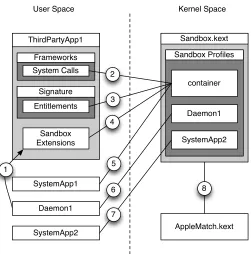
Figure 2.2 illustrates the role of the sandbox kernel extension,Sandbox.kext, in sandbox en-forcement. In step 1,Sandbox.kextacts as a centralized authority that approves or disapproves the granting of sandbox extension tokens. This prevents processes from forging sandbox extension tokens or giving them to processes that should not receive them. In step 2,Sandbox.kextapproves or denies hooked system calls by consulting the compiled decision tree representing the sandbox profile of the process making the call. In steps 3 and 4,Sandbox.kextalso considers the sandbox extensions and entitlements of the process making the system call. Steps 5, 6, and 7 show thatSand
box.kextmay use the same sandbox profile to evaluate multiple processes or it may reference a
ThirdPartyApp1
Signature
Entitlements Frameworks System Calls
Sandbox Extensions
User Space Kernel Space
SystemApp2 AppleMatch.kext
Sandbox.kext
Sandbox Profiles
container
Daemon1
SystemApp2
Daemon1 SystemApp1
1 5
4 3 2
6
7
8
Figure 2.2Sandbox Architecture
specify that read operations on file paths matching a given regular expression should be allowed.
XNU Components:In addition to BSD, the other components of XNU, Mach and I/O Kit, are evident in sandboxing. Mach-Lookups are IPC system calls from the Mach microkernel. Servers register services called mach-services that are associated with a string identifying the service. Clients then perform mach-lookups with specific strings to request access to mach-services. The sandbox profile determines which mach-lookups a process is allowed to perform. Even if a client can perform a mach-lookup, a server could deny the service based on other access control mechanisms discussed in this article (e.g., entitlements or privacy settings). I/O Kit clients provide interfaces between processes and drivers, but connecting to these interface is done through system calls that must be allowed by the sandbox. The role of XNU’s components in iOS access control is covered in more detail by Watson[Wat13].
2.5
Privacy Settings
File System
Privacy Settings Menu
TCC Framework
CoreLocation Framework
HealthKit Framework
tccd
(TCC Daemon)
locationd
(Location Daemon)
healthd
(HealthKit Daemon)
TCC.db
(TCC Storage)
clients.plist
(Location Storage)
healthdb.sqlite
(HealthKit Storage)
Preferences Application Address Space
Figure 2.3Privacy Settings Policy Architecture
entitlements, privacy settings can be changed at any time by the user.
Strengths:Privacy settings allow users to configure access to their private data at a user-friendly level of abstraction. Applications can continue to function even if the user revokes or never grants the privacy settings requested by the application. For example, Google Maps is less useful if it cannot track the user’s location, but it can still be used to find directions between two locations. Applications are able to explain why they want access to private data through a prompt when they request a privacy setting. This promotes transparency between developers and users.
Table 2.1tccd managed privacy settings for iOS 8. Resource Service
Contacts kTCCServiceAddressBook Calendar kTCCServiceCalendar Contacts kTCCServiceAddressBook Reminders kTCCServiceReminders Photos kTCCServicePhotos
Bluetooth kTCCServiceBluetoothPeripheral Microphone kTCCServiceMicrophone Camera kTCCServiceCamera HomeKit kTCCServiceWillow Twitter kTCCServiceTwitter Facebook kTCCServiceFacebook Sina Weibo kTCCServiceSinaWeibo Tencent Weibo kTCCServiceTencentWeibo
2.5.1 Policy
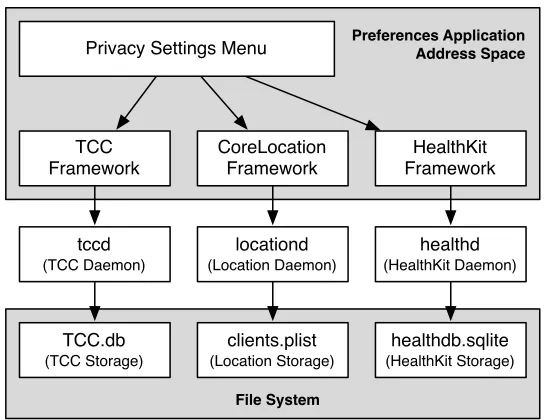
The Settings (also known as Preferences) application collects all privacy setting configurations into a convenient user interface. However, the internal management of privacy setting policies is much less centralized. Most per-application privacy settings are managed by the TCC (Transparency Consent Control) daemon, but iOS uses separate policy managers for location and health data. We find that the three per-application privacy setting managers all use access control lists to define policies as shown in Figure 2.3.
Table 2.1 enumerates the different services managed by the TCC daemon,tccd, as of iOS 8. Note that the last two services (Sina Weibo and Tencent Weibo) are only available to iOS users that enable the Chinese keyboard. Policies for TCC managed privacy settings are stored in theTCC.dbSQLite database file. Theaccesstable includes columns for 1) the name of the application, 2) the name of the service (shown in Table 2.1), 3) whether or not the user has been prompted for access, and 4) whether or not the application has access to the service.
Health privacy settings allow users to configure whether applications can read or write data regarding fitness activity, weight, or nutrient consumption. We speculate that this finer-grained configurability caused Apple to implement a separate privacy settings manager for health, rather than simply using TCC. The Health privacy settings management consists of: 1) the HealthKit Framework used to request access to information; 2) the health daemon (healthd), 3) the Health Privacy Service app which provides complex user prompts, and 4) the access control list (healthdb.
sqlite).
Third Party App Address Space Resource Framework App Code TCC Framework Invoke Request Access tccd (TCC Daemon) Request Access Prompt User First Use? Decision
TCC.db Update/
Query
Decision
1 2 4a
3 4b Kernel Token Issue Extension 5 Token 6 Consume Extension (Token) 7 Access File 9 Decision 8
Figure 2.4Requesting access to a file-based resource through TCC
ist. Theclients.plistcache can be displayed as XML using theplutilutility. The file itself contains an entry for each application that uses location privacy settings. For each application, the file maintains an integer value that represents “Never”, “Always”, or “While Using the App”.
2.5.2 Enforcement
Privacy settings use two forms of enforcement depending on the type of resource they protect. The photo album and address book are both files which are accessed via system calls. Therefore, the sandbox kernel extension enforces access control for the photo album and address book. The other privacy setting protected resources (e.g., camera, microphone, location) are services provided by servers (e.g., daemons). Therefore, these servers enforce privacy settings by only providing services to clients with appropriate entries in ACLs.
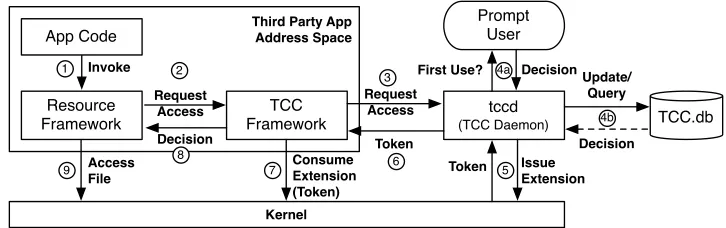
Figure 2.4 illustrates the role of sandbox extensions andtccdin enforcing a system call regulated by privacy settings. To provide a seamless user experience, sandbox extensions can be granted while the process is running. This allows the process to trigger a prompt to the user, and if the user accepts the prompt, the application gains a sandbox extension. The user’s decision is stored in the ACL to avoid prompting again. The container profile can then provide access to the resource that required the extension. Unless the sandboxed process acquires the appropriate sandbox extension, system calls to access the private resource will be denied.
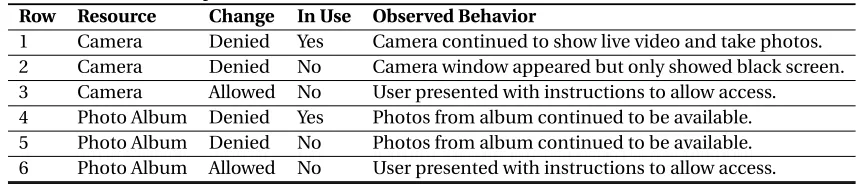
Table 2.2TCC database experiments.
Row Resource Change In Use Observed Behavior
1 Camera Denied Yes Camera continued to show live video and take photos. 2 Camera Denied No Camera window appeared but only showed black screen. 3 Camera Allowed No User presented with instructions to allow access.
4 Photo Album Denied Yes Photos from album continued to be available. 5 Photo Album Denied No Photos from album continued to be available. 6 Photo Album Allowed No User presented with instructions to allow access.
resource. We assume this process is similar for enforcement provided bylocationdandhealthd.
Enforcement Conflicts:By directly modifying the ACL inTCC.dbwithout restarting the affected application, we found that we could confuse various enforcement checks. These experiments should not be considered as attacks since privacy setting changes made in Settings do cause applications to restart. This experiment took place using version 47.0 of the “Messenger” application and Table 2.2 lists our observations. The “In Use” column indicates if we were using the resource at the time we modified the database (e.g., viewing photos or recording video). Based on these observations we make two conclusions. First, frameworks in the application’s address space provide explanations to the user if they believe access will be denied. Second, sandbox extensions for privacy settings are not revoked until the application is restarted.
2.6
Conclusions
CHAPTER
3
RELATED WORK
This dissertation seeks to automate the evaluation of overlapping access control policies in iOS. Therefore, it builds upon prior work in three areas: 1) access control policy design; 2) access control policy evaluation; and 3) iOS security.
3.1
Access Control Policy Design
An access control policy determines whether somesubjectcan perform someactionon someobject. In complex policies, this decision may also depend on thecontextof the system. Designing policies for complex systems can be a difficult and error prone process. However, several policy design techniques have been proposed that provide several useful tradeoffs.
Instead of defining specific security levels in order, access control policies can define rules for each subject and object. Lampson introduced the concept of an Access Control Matrix[Lam74], which represents the policy as a matrix in which each row represents a subject, each column represents an object, and each cell contains the actions the subject may perform on the object. Since these matrices may be very sparse, the same policy can be represented instead as lists. An Access Control List is attached to an object and lists the subjects that may access the object and the actions they can take on the object Alternatively, a capability list is attached to a subject, and lists the objects that subject may access and the actions the subject can take on them. iOS Entitlements are similar to capability lists in the way they are bound to the subject, but they do not directly contain the semantics of the actions and objects they allow access to.
Policies can be classified based on who can change them. A Mandatory Access Control (MAC) policy can only be modified by a system administrator. These policies are easier to the evaluate since unexpected policy changes are not possible, but MAC policies lack flexibility. A modern example of a MAC system is SELinux. SELinux is a modern example of a MAC system. A Discretionary Access Control (DAC) policy allows users to define the policy. This provides flexibility, but makes the system significantly more difficult to evaluate for safety[Har76]. An example of a DAC policy is Unix permissions which can be modified by subjects (e.g., chmod, chown). It is arguable whether the Apple Sandbox is MAC or DAC since it is built upon the TrustedBSD MAC framework, but it allows sandbox extensions to dynamically modify privileges.
Jaeger’s book on operating system security[Jae08]defines several terms relevant to this thesis. A Protection System is a combination of a Protection State and Protection State Operations. A Protection State determines the operations that subjects are allowed to perform on each object. Protection State Operations are those operations that modify the Protection State. Protection State Operations are especially important to jailbreaks, which must modify several layers of access control. Finally, a Protection Domain is the set of operations a process is allowed to perform on system objects. In complex systems such as iOS, Protection Domains can be difficult to estimate because a process can be comprised of multiple subjects subject to multiple access control policies.
3.2
Access Control Policy Evaluation
Gokyo[Jae02]introduces a concept called access control spaces, which are comprised of subject’s explicit permissions, constraints, and a set of “unknown” actions that are not listed among the constraints or permissions. The Gokyo tool allows automated detection of “unknown” or conflicting actions within an access control space.
VulSAN [Che09]allows for the comparison of policies from two different Linux security modules, SELinux and AppArmor. The comparison is based on the attack surface available to attackers in various configurations and the number of protection state transitions required to reach some attacker goal state. These protection state transitions are achieved when a process executes another process, and changes the protection state to adapt to the new process. VulSAN builds this model by converting the policies into Prolog facts, and modeling protection state transitions as edges between different policies.
Android shares many similarities with iOS as a modern, mobile operating system. However, as an open source system Android has attracted significantly more research including improvements on Android’s access control policies. SELinux is a kernel security module that provides Manda-tory Access Control for Linux, and it has been ported to Android in the form of SEAndroid[Sma]. EASEAndroid [Wan15]analyzes SEAndroid policies and uses semi-supervised machine learning to automatically refine those policies. SPOKE (SEAndroid Policy Knowledge Engine)[Wan17]uses dynamic testing to automatically identify unnjustified SEAndroid policy permissions that cause subjects to be over-privileged.
3.3
iOS Security
While much of the work on iOS security has been non-academic reverse engineering, there also exists a non-trivial amount of academic work.
3.3.1 Binary Analysis of iOS Apps
Han et al.[Han13a]adopt the PiOS technique to perform a cross-platform analysis of applications that exist on both iOS and Android. Their analysis seeks to determine if applications on one platform access more security sensitive APIs than on the other platform. They find that iOS applications tend to access more security sensitive APIs, and they speculate that this trend may be related to a lack of transparency in the “permissions” that will be required by iOS applications.
iRiS[Den15]improves upon the PiOS technique by combining dynamic analysis techniques with static analysis. iRiS first analyzes applications statically and resolves a majority of API calls from dispatch calls. Then, dispatch calls that cannot be resolved statically are analyzed with iRiS’s novel dynamic analysis technique. This dynamic analysis is implemented by porting1the Valgrind2 memory analysis tool to iOS.
Chen et al.[Che16]also perform a cross platform analysis of third party libraries present on iOS and Android. Their insight is that third party libraries can be analyzed more effectively on Android, and can be matched to corresponding libraries on iOS. For example, libraryAmight be found to be potentially harmful on Android, so any iOS application that contains the iOS version of libraryA
contains a potentially harmful library. Therefore, Chen et al. demonstrate that similarities between the two platforms (especially the app markets) can be effectively leveraged by researchers.
3.3.2 Exploits for Third Party Apps
Several iOS exploitation techniques have been proposed that motivate our investigation into access control. Improved iOS access control policies can mitigate the damage caused by the following attacks
As discussed in Section 2.1, iOS implements several code security mechanisms including Data Execution Prevention (DEP) and code signing. This prevents attackers from modifying code or inject-ing new code. However, Wang et al.[Wan13]propose a technique for creating malicious applications called Jekyll apps. These applications have benign behavior during the app vetting process. However, after publication to the App Store, an attacker can exploit preconfigured vulnerabilities in the Jekyll apps to deploy Return-Oriented Programming (ROP) attacks. ROP allows the attacker to maliciously modify the application’s behavior without violating DEP or code signing. The modified application could then call Private APIs that allowed the application to access resources that could potentially harm the user (e.g., abusing the camera, sending SMS messages, stealing device information).
Han et al.[Han13b]discovered an alternative method for accessing Private APIs and performing similar attacks as those demonstrated in Jekyll apps. Instead of ROP attacks, they were able to use simple obfuscation techniques to bypass the app vetting process, and then used function calls to dynamically load private frameworks and invoke private APIs. They used two strategies to
accomplish this. First, they use functionality in the objective-c runtime similar to Java reflection to pass a string as a parameter to a functions and have the functions dynamically return objects or selectors, which can represent methods in object. These objects and selectors are then used to dispatch messages to objects and could cause them to make private API calls. Second, they use thed
lopenfunction call to load a private library based on a string parameter passed to the function. Next,
they use thedlsymfunction to pass a string as a parameter and have the function return a function pointer for a private API call, which they then invoke. The actual strings used in the parameters for these attacks can be obfuscated to resist static analysis or dependent of hidden triggers to resist dynamic analysis.
Xing et al.[Xin15]investigate cross-app resource attacks that they refer to as XARA. They in-vestigate such attacks on macOS and iOS. Although the majority of their findings are specific to macOS, they did discover URL Scheme vulnerabilities on iOS. A URL Scheme allows an application to open another application with some context. For example,mailto:[email protected]
would open an application that had registered themailtoscheme, and send it the specified email address. Xing et al. demonstrate that an iOS application could register duplicate URL Schemes to intercept messages intended for other applications that had registered the same schemes. Ap-ple’s official stance on duplicate URL Schemes in multiple applications is as follows: "If more than one third-party app registers to handle the same URL scheme, there is currently no process for determining which app will be given that scheme."3
3.3.3 In-Line Reference Monitors for Third Party Apps
The closed source nature of iOS makes it difficult, but not impossible, for researchers to demonstrate the effectiveness of proposed defenses. Several solutions propose the use of in-line reference moni-tors to detect and prevent suspicious behavior in third party apps. Unfortunately for iOS users, these techniques have not been adopted by Apple, and suffer from limitations that may make deployment impractical.
A potential defense against ROP and other control-flow attacks is Control-Flow Integrity (CFI) enforcement. CFI prevents control from flowing to unexpected locations that would allow an attacker to modify program behavior. MoCFI[Dav12]provides a CFI implementation for ARM-based devices including iOS and Android. Unfortunately for iOS users, MoCFI was not officially adopted by Apple. Therefore, iOS users are required to jailbreak their devices if they would like to install MoCFI. However, jailbreaking the device is likely to sacrifice several security features such as code signing enforcement.
PSiOS[Wer13]is an In-Line Reference Monitor built upon MoCFI. PSiOS allows users to specify access control policies for which API calls that application should be allowed to make. It also
3https://developer.apple.com/library/content/documentation/iPhone/Conceptual/iPhoneOSProgrammingGuide/
provides the control flow integrity benefits offered by MoCFI. However, PSiOS suffers from the same deployment issues as MoCFI and requires a jailbreak in order to be used. It may also be difficult for users to define good access control policies without understanding the requirements of closed-source application or the functionality of undocumented API calls. Finally, Apple independently resolved some of PSiOS’s motivating issues through the implementation of Privacy Settings, which allow users to define coarse-grained access control policies for some types of private data.
CHAPTER
4
SANDSCOUT: AUTOMATIC DETECTION
OF FLAWS IN IOS SANDBOX PROFILES
4.1
Introduction
The sale of smartphones has out-paced the sale of PCs[Sal]. The two dominant platforms for these smart phones are Android and iOS[Mar]. There has been a significant amount of academic research on Android, in part, because of its open-source nature. In contrast, iOS is not open-source, and studies of iOS may require significant reverse engineering effort.
Prior research on iOS security has focused on the following three areas. First, works have demon-strated methods for creating iOS malware [Wan13; Buc15; Han13b; Xin15; Kur16; Wan14]. Sec-ond, others emphasize methods to detect malicious behavior either statically[Ege11]or dynam-ically[Den15]. Third, new security mechanisms[Buc15; Dav12; Wer13]have been proposed that hook into application code to provide additional security. All of these works rely on interacting with the code of third-party iOS applications.
flaws in the container sandbox profile can third-party iOS applications exploit?
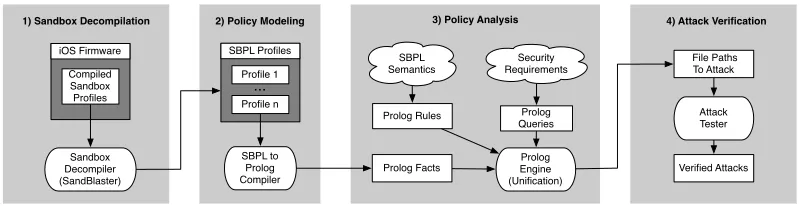
Goals and Contributions:In this paper, we present the SandScout framework to answer this research question. First, we create a tool, SandBlaster, which automatically extracts compiled profiles from a firmware image and decompiles them into their original SandBox Profile Language (SBPL). Second, we formally model sandbox profiles using Prolog by creating a compiler that automatically translates SBPL policies into Prolog facts. Third, we develop Prolog queries that test critical security properties of the container sandbox policy. The queries identify potential security vulnerabilities in the policy. Finally, we create an iOS application that provides assisted verification of potential vulnerabilities on iOS devices.
We use SandScout to evaluate the container sandbox profile for iOS 9.0.2. Sandbox profiles mediate all system calls including file access and inter-process communication (IPC). For this evaluation, we limit our security queries to file-based sandbox policy rules for two reasons. First, non-file-based sandbox policy rules require additional semantics that are not available in the policy. Second, we find significant security vulnerabilities within the file-based sandbox policy rules. We plan to expand our analysis to non-file-based policy rules in future work.
Our analysis of the file-based policy rules in the iOS 9.0.2 container sandbox profile identified seven broad vulnerabilities that are exploitable by third-party applications: (1) methods of bypass-ing iOS’s privacy settbypass-ings for Contacts; (2) methods of learnbypass-ing a user’s location search history; (3) methods of inferring sensitive information by accessing metadata of system files; (4) methods of obtaining the user’s name and media library; (5) methods of consuming disk storage space that cannot be recovered by uninstalling the malicious app; (6) methods of preventing access to system resources such as the AddressBook; (7) methods for colluding applications to communicate without using iOS sanctioned IPC. We have reported all of these vulnerabilities to Apple and are working with them to ensure they are fixed in future versions of iOS.
This paper makes the following contributions:
• We develop the first methods to automatically produce human readable SBPL policies.Prior work was unable to produce SBPL policies for human review or automated analysis. Our tool extracts and decompiles all sandbox profiles in firmwares for iOS 7, 8, and 9.
• We formally model SBPL policies using Prolog.We create an SBPL to Prolog compiler based on a context free grammar we have defined for SBPL.
• We perform the first systematic evaluation of the container sandbox profile for recent versions of iOS and discover vulnerabilities.We develop Prolog queries representing security requirements. When applied to the iOS 9.0.2 container sandbox profile, we discover seven classes of security vulnerabilities.
Section 4.3 provides an overview of SandScout. Section 4.4 discusses our design. Section 4.5 presents our results. Section 4.6 provides discussion of our limitations. Section 4.7 presents related work. Section 4.8 concludes.
4.2
Background
iOS is the operating system of the iPhone, iPod, iPad, and older versions of AppleTV (newer AppleTV devices run TVOS). iOS is based largely on Apple’s desktop operating system, OS X, and the two share many internal similarities.
4.2.1 iOS Security Mechanisms
iOS relies on four broad types of security mechanisms:application vetting,code signing,memory
protection, andsandboxing. When developers submit an application to the App Store[Appc]for
vetting, they sign the application using their developer key. While the specific details of the vetting process are only known to Apple, it is assumed that they use a combination of static and dynamic analysis to detect malicious behavior. If Apple approves of the application, it adds its own signature to the application and makes the application available on the App Store.
An iOS device will only execute code pages coming from binaries with valid signatures. Generally, having a valid signature means the application is signed by Apple. However, devices provisioned for developers or enterprises may also run applications signed by specific developer and enterprise keys. Finally, immutable capabilities called entitlements are stored inside an application’s signature. Apple grants developers a certificate that determines which entitlements they may apply to their applications.
In addition to code signing, iOS uses data execution prevention (DEP) and address space layout randomization (ASLR) to mitigate memory attacks. DEP prevents code injection attacks by ensuring that no code page is writable and executable at the same time. ASLR mitigates code-reuse attacks by randomizing code and data segments in memory. Interestingly, code signing complicates the ASLR design and limits its protection, because shuffling code regions may invalidate signatures[Essa]. Prior work[Wan13; Buc15; Mil12; Han13c]has demonstrated several techniques for bypassing application vetting and memory protections.