COMSY - A Software Tool for PLIM + PLEX with Integrated Risk-Informed
Approaches
André Zander1, Helmut Nopper1, Roland Roessner1
1) AREVA NP GmbH, Technical Center, P.O. Box 3220, 91050 Erlangen, Germany, [email protected]
Abstract
The majority of mechanical components and structures in a nuclear power plant is designed to experience a service life, which is far above the intended design life. In most cases, only a small percentage of mechanical components are subject to significant degradation which may affect the integrity or the function of the component.
If plant life extension (PLEX) is considered as an option, a plant specific PLIM strategy needs to be developed. One of the most important tasks of such a PLIM strategy is to identify those components which are
- relevant for the safety and/or availability of the plant and
- experience elevated degradation due to their operating and design conditions.
For these components special life management strategies need to be established to reliably monitor their condition.
AREVA NP has developed their COMSY software, which is designed to efficiently support a plant-wide lifetime management strategy for static mechanical components, providing the basis for plant life extension (PLEX) activities. COMSY provides the capability to establish a program guided technical documentation by utilizing a virtual plant model which includes information regarding thermal hydraulic operation, water chemical conditions and materials applied for mechanical components.
The objective is the economical and safe operation of power plants over their design lifetime - and beyond. It is also used for design studies related to the effect on degradation mechanisms in respect to e.g. water chemistry changes, material changes, design changes and considering various plant constraints for existing NPPs and new design NPPs (e.g. NPP Olkiluoto 3).
The software integrates engineering analysis functions and comprehensive material libraries to perform a lifetime analysis for various degradation mechanisms typically experienced in power plants (e.g. flow-accelerated corrosion, intergranular stress corrosion cracking, strain-induced cracking, material fatigue, cavitation erosion, droplet impingement erosion, pitting, etc.). A risk-based prioritization serves to focus inspection activities on safety or availability relevant locations, where a degradation potential exists. Trending functions support the comparison of the as-measured condition with the predicted progress of degradation while making allowance for measurement tolerances. The results of this comparison are used to improve the accuracy of future life expectancy predictions.
This systematic process ensures the generation of up-to-date plant documentation relating to the technical as-is status of the plant (know-how conservation). On the basis of reliable and degradation-relevant predictions, inspection management and plant availability can be optimized.
Introduction
Increased plant safety and improved costs require innovative maintenance management methods to guarantee safe operation, high availability and cost-effective utilization of a nuclear power plant over the longest possible time frame.
The prevention of damage to pressure-retaining piping and components is one of the key tasks of inspection management. Statistics show that most damage can be attributed to fatigue and a series of specific corrosion mechanisms (e.g. flow-induced corrosion). Special attention is given below to the aspect of "corrosion-specific damage" in service life management.
The purpose of a systematic service life management program is to enable planning of the useful life of the systems, structures and components of a plant or to reliably indicate when the technical limit of service life has been reached before any component failure. In addition, the service life management program should especially serve to maintain plant availability at a high level despite continued aging and to enable implementation of a targeted maintenance strategy in terms of its economic and technical objectives.
Detailed information regarding the condition as well as the operating conditions of the components is essential to successful implementation of this task. Building on this, knowledge of the effect of relevant degradation mechanisms enables prediction of the technical service life and the probability of damage. Modern software programs are required to manage this task on a system-wide scale with justifiable expenditure.
Implementation of the service life management strategy targets the following objectives:
- Prevention of damage with early detection of system areas and components which are at risk for degradation - Improving effectiveness of inspection programs by focusing activities on areas at risk for degradation which are
important for operating reliability or plant availability. This utilizes a combination of risk-based and condition-oriented methods.
- Know-how conservation through compilation of system and component-specific information (design, operation, inspection results) in a "live" documentation structure.
COMSY concept
The German regional division of the nuclear power company AREVA NP GmbH, 66% of which is owned by AREVA and 34% by Siemens, developed the COMSY (Condition Oriented Aging and Plant Life Monitoring System) software system for the aging and service life management of mechanical components in power plants. This knowledge-based system is used to track the overall service life of mechanical components, especially of piping and components, with emphasis on economic aspects. The concept is based on the extensive integration of modern calculation tools with powerful databases.
COMSY acquires, manages and evaluates plant data and operating parameters relevant to service life. Plant data pertaining to individual plant elements, piping systems and components are stored in a virtual power plant data model. Based on this data, the program conducts a condition-oriented service life analysis for various degradation mechanisms which typically occur in power plants, such as strain-induced corrosion cracking, material fatigue, erosion corrosion, cavitation erosion, water droplet erosion, stress corrosion cracking, pitting, crevice corrosion, creep, etc.
The concept is based on extensive experience, including data collected with the WATHEC and DASY programs in the performance of vulnerability analyses for flow-induced corrosion forms since 1987. Because of the complexity of the task, the development of COMSY placed special emphasis on a user-friendly interface and efficient handling. This was achieved by the implementation of an intelligent user interface with the following features:
- Integrated analysis functions (structural analysis, thermal hydraulic and flow analysis function, water chemistry cycle analysis),
- Comprehensive material libraries (e.g. material data catalog, pipe tables, fitting and flange catalog, etc.), - Interactive plausibility monitoring for manual inputs.
This enables a coarse evaluation of complex systems with little effort, which can then be refined and extended as necessary.
Service life limitation of mechanical components
The useful life of mechanical components is limited by aging and wear mechanisms. To assess the useful life of a component, the following questions must be addressed:
- Which degradation mechanisms are relevant to the material under the given mechanical, thermal hydraulic and water chemistry conditions?
- What rate of component degradation progression can be expected under the given conditions for the component? - Which limiting condition caused by the progression of the degradation places a restriction on the service life of the
component?
- The end of the service life of a component is heralded by conditions such as the following: - Violation of the allowable stress in the pressure-retaining enclosure
Plant diagnosis with regard to relevant degradation mechanisms
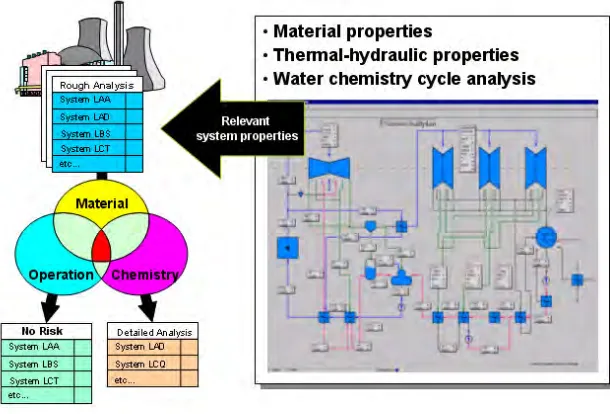
To determine the areas of a plant affected by the aging and degradation mechanisms in question, a first cost-effective step is the performance of a so-called rough analysis (Fig. 2).
In the rough analysis, the heat balance diagram of the water/ steam cycle in the power plant is modeled using graphical tools, and the system parameters (mass flow, pressure, temperature, steam quality etc.) are specified for each
subsection. In addition, any injection positions are defined by the type and concentration of alkalizing agents. This model establishes the basic data structure of the virtual power plant, and allows an analysis of the water chemistry cycle to be performed based on the thermal-hydraulic parameters. Taking into consideration the materials used in each case, the subsections are then examined with respect to the potential risk posed by degradation mechanisms. The results indicate which power plant systems have a limited service life based on their design and operating parameters. Systems which are definitively not at risk as indicated by the rough
Fig. 2: Rough analysis using COMSY
analysis need not be examined in future analyses.
In system areas in which the occurrence of a degradation mechanism is a possibility, the existing risk must be examined in a detailed analysis, including a service life prediction for each component. This second step, which is based on the information used in the performance of the rough analysis, requires detailed information about the elements in question in the relevant systems or components. Additional information (such as the number of cycles) is also needed for determining the physical and
chemical parameters for the implemented damage models, so as to enable automatic generation of service life predictions for each component (Fig. 3).
Service life prediction or calculation of the probability of occurrence of damage is the key function of a software system for aging and plant life management. Only on this basis can maintenance management and plant availability be optimized and the service life of investment-intensive components be extended. The damage predictions are compared
The preparation of degradation models necessitates a detailed understanding of the type of degradation concerned, as well as the functional interactions of the relevant parameters which influence the rate of damage progression. Laboratory tests and damage analyses have been conducted at Framatome ANP GmbH in Erlangen (formerly Siemens/KWU) for more than 25 years for this purpose. The results from these investigations have been summarized in analytical and semiempirical corrosion models for each degradation mechanism or have been taken from the pertinent procedures. To date, degradation models have been developed for the following types of corrosion:
Erosion corrosion (WATHEC model /1/,/2/), water droplet erosion (FANP model /3/,/4/ ), cavitation erosion
(Rockwell model /5/), material fatigue TrFG (TRD301, TRD508, AD-S2, KTA3211.2, ASME, Rainflow /6/, Cycling fatigue (CyFG), stratification fatigue (StFG)), strain-induced corrosion cracking (Chopra /8/), pitting (pitting model /9/) and creep. The probability of occurrence of damage can also be calculated for various forms of stress corrosion cracking
(IGSCC, TGSCC and PWSCC /10/) and for microbiologicallyinduced corrosion.
The assessment or early detection of weaknesses caused by corrosion mechanisms is presented below for the example of the pipe failure in the Japanese Mihama 3 nuclear power station.
Application of the service life analysis function in COMSY for the example of the
pipe failure in the Mihama 3 nuclear power station
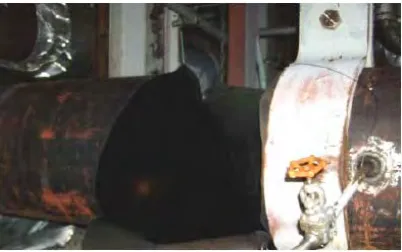
The failure of a condensate line which occurred in Mihama 3 was triggered by erosion corrosion (FAC), a degradation mechanism which can lead to thinning of the pipe inner wall over large areas. The wall thickness of the pipe had thinned at the affected area from the initial 10 mm to approx. 1.4 mm over 28 years of operation, resulting in a spontaneous pipe break.
Erosion corrosion is a damage mechanism which is difficult to pinpoint as it is dependent on various boundary conditions relating to the system, material and water chemistry. The process of erosion corrosion depends greatly on the behavior of corrosion product films on the metal surface. Erosion corrosion occurs only in unalloyed and low-alloyed ferritic materials. If the growth rate of a protective film is lower than the rate of removal by the flowing medium, the result is the occurrence of erosion corrosion and the associated wall thinning.
A vulnerability analysis was performed with the COMSY program to evaluate the cause of damage in Mihama 3.
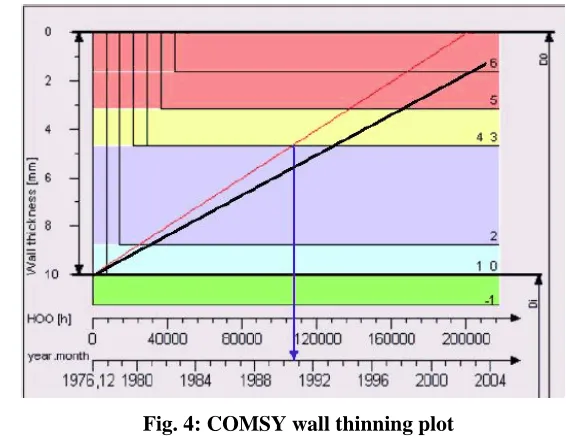
The wall thinning plot generated over the course of the service life analysis (Fig. 4) shows the predicted wall thinning (ordinate) over the operating time of the plant (abscissa). The horizontal lines indicate the strength limits in the pipe wall of the affected component. The plot shows the conservatively predicted progress of wall thinning red line) from COMSY as well as the actual progress (black line). The intersection with horizontal lines 3/4 represents the point at which the allowable minimum wall thickness of the pipe is reached and thus the recommended examination time,
Fig. 4: COMSY wall thinning plot
Risk-based selection of examination locations
Both the probability of occurrence of degradation as well as the safety risk or economic consequences of potential degradation must be accounted for in the
selection of examination locations. Safety classes or availability categories are specified for the individual system areas. The program uses these to calculate the consequences of degradation, which serves as the ordinate of the cluster diagram (Fig. 5).
The probability of degradation for the degradation mechanisms under consideration is plotted on the abscissa.
The specific selection of locations for inspection is performed interactively in a ranking table. A suitable examination method is also proposed for each relevant degradation
mechanism.
Fig. 5: Risk matrix
Feedback of information from component inspections
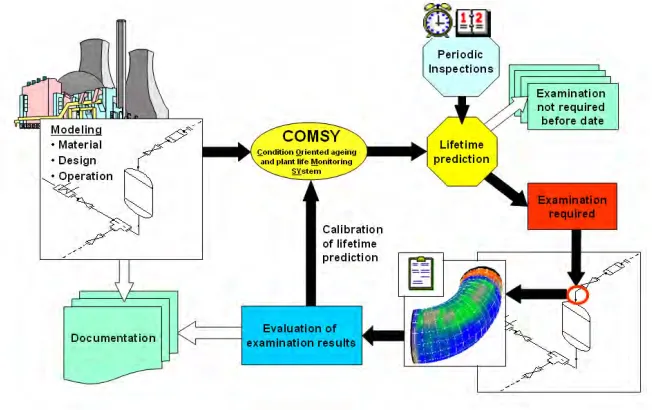
From the risk-based selection, components are prioritized for test programs and condition-oriented inspection plans are generated. The results of component inspections are fed back into the program system and are used for further optimization of the service life predictions over the life cycle of the component. This systematic process incorporating feedback guarantees that a database is built up which contains quantifiable, up-to-date information on the actual condition of the plant (Fig. 6).
Fig. 6: The closed loop process for PLIM
The virtual power plant data model
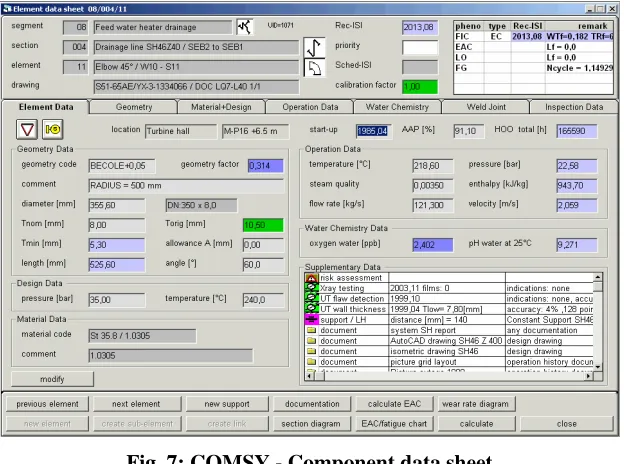
plant element type by clicking in a list with predetermined plant element symbols, selects the diameter, the wall thickness and the material from the integrated standards libraries and is then provided with a component data sheet (Fig. 7).
Fig. 7: COMSY - Component data sheet
The program uses the integrated analysis functions to determine the applicable implementation conditions for the component based on the prevailing thermal hydraulic and water chemistry data, such as flow geometry, degree of turbulence, pH and oxygen content of the medium. In a further step, the strength requirements of the component are calculated for the given design criteria in accordance with standards such as DIN or ASME and are entered in the component data sheet. A plausibility routine checks the component design for compliance with standards and informs the user of any input errors. The component data sheet generated in this way forms the basis for further parameters relevant to aging, which can be extended as necessary over the life cycle of the component. Depending on the requirement, this can be performed with an increased degree of detail.
Evaluation of examination results
The COMSY software system acquires and evaluates data from nondestructive component examinations (weld examination, wall thickness examination, ultrasonic examination, visual inspections etc.). The examination results are recorded in standardized formats and are
assigned to the examined component for documentation of the actual condition for the corresponding point in time in the operating history of the plant and integrated in the virtual power plant data model (Fig. 8).
The evaluation of component examinations is supported by interactive evaluation functions which greatly simplify tasks such as the geometry-specific evaluation of the data. A calibration function supports comparison of the as-measured condition with the predicted propagation of damage while making allowance for measurement tolerances. Results from this comparison are used to increase the accuracy of future service life predictions.
experience gained from evaluating examination data is fed back into the cycle for consideration in service life predictions. Examination data from in-service examinations are thus consistently used to generate a reliable and continuously updated database. This increases the meaningfulness of examination results and enables a standardized description of the actual condition of components and systems, the quality of which further increases with each year of use.
"Living" documentation for know-how conservation
A major requirement on plant management software is user friendless and clearly arranged data structure, the focus on preventing any
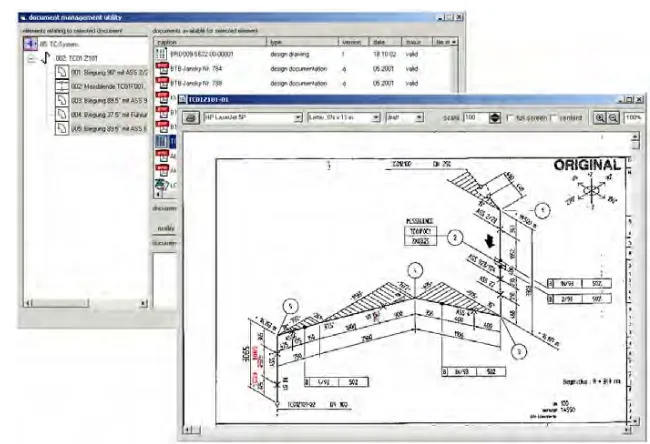
loss of competence in the event of personnel replacement in the plants. COMSY offers the possibility of systematic compilation of digitized documentation for describing the actual condition of the plant or of individual components or structures, with the capability to be used as "living documentation" in everyday applications. If necessary or desired, more detailed documents, such as memos from the time of plant construction or change procedures as well as personal notes and reports, can also be included in document management and assigned to the corresponding components or systems (Fig. 9).
Fig. 9: Documentation management
Summary
The core task of any service life management system is to maintain the integrity of systems, components and structures in a plant over extended operating periods. This is not possible unless a plant’s weak points are known. It is therefore essential that knowledge exists on the susceptibility of the various plant areas to specific degradation mechanisms. Once this information is available specific remedial action can be taken or items can be targeted for special monitoring.
AREVA NP GmbH, an AREVA and Siemens company, has developed the COMSY software for a knowledge-based service life management strategy. The software program allows system areas susceptible to specific degradation mechanisms to be pinpointed. It uses advanced computing tools and models to predict damage, contains a comprehensive material library and manages the results of inspections. Furthermore it allows risk- and condition-oriented service life assessments for components, piping systems and complete plant units. The results of tests already performed on specific plant elements are automatically used to optimize future service life assessments over the equipment service life.
This systematic process guarantees that a database is built up which contains quantifiable, up-to-date information on the actual condition of the plant, as well as preventing the loss of know-how. Reliable predictions of relevant degradation mechanisms provide the basis for sustainable optimization of maintenance management systems as well as of plant availability, while at the same time extending the useful life of cost-intensive systems and components.
References
[1] W. Kastner and K. Riedle
Experimentelle Untersuchungen zum Materialabtrag durch Erosionskorrosion VGB Kraftwerkstechnik 64 (1984) No. 5, pp. 452-465
[2] Kastner, W., Hofmann, P. Nopper, H. :
Erosionskorrosion in Kraftwerksanlagen - Entscheidungshilfe für Maßnahmen zur Schadensvermeidung.
VGB Kraftwerkstechnik 70 (1990) No. 11, pp. 939-948 [3] H. Keller
Erosion Corrosion Problems in Saturated-Steam Turbines AIM Conference, Liege, Belgium, May 22-28, 1978 [4] H. R.G. Keck, P. Griffith
Prediction and Mitigation of Erosive-Corrosive Wear in Secondary Piping Systems of Nuclear Plants
NUREC/CR-5007, R5, Sept. 1987 [5] M.J. Kirik, L.R. Driskell
Flow Manual for Quarter-Turn Valves Rockwell International Corporation, 1986 [6] Pär Johannesson
Rainflow Analysis of Switching Markov Loads Lund Institute of Technology, 1999
[7] H. Schlichting, K. Gersten Grenzschicht-Theorie
9th edition, Springer Verlag, 1997 [8] O. Chopra, W.J. Shack
Overview of Fatigue Crack Initiation in Carbon and Low Alloy Steels in Light Water Reactor Environments
Energy Technology Division Argonne National Laboratory, Illinois, 1999 [9] P.H. Effertz, J. Hickling, A. Heinz, G. Mohr
Die kombinierte Ammoniak-/Sauerstoff-Konditionierung von Wasser-/Dampfkreisläufen in Kraftwerken
Allianz Berichte für Betriebstechnik und Schadenverhütung, No. 23, 1985 [10] Renate Kilian, Armin Roth