
Sub-corpora Sampling with an Application to Bilingual
Lexicon Extraction
Ivan VULI´C Marie-Francine MOENS
Department of Computer ScienceKU Leuven Celestijnenlaan 200A
Leuven, Belgium
{ivan.vulic,marie-francine.moens}@cs.kuleuven.be
A
BSTRACTWe propose a novel associative approach for bilingual word lexicon extraction (BLE) from parallel corpora that relies on the paradigm of data reduction instead of data augmentation. The key insight of the approach is the effective usage of sub-corpora sampling and properties of low-frequency words in the task of lexicon induction, particularly in a setting where only limited parallel data are available. Word translation pairs are extracted from many smaller sub-corpora (sampled from the original corpus) according to several frequency-based criteria of similarity. We prove the validity of our data sampling approach, and show that this method outperforms IBM Model 1 and associative methods based on similarity scores and hypothesis testing in terms of precision and F-measure in the task of lexicon extraction. Additionally, we show that our sampling-based method can learn correct word translations from fewer data.
T
ITLE AND ABSTRACT IN ANOTHER LANGUAGE(C
ROATIAN)
Uzorkovanje Potkorpusa uz Primjenu u Ekstrakciji
Dvojeziˇcnih Rjeˇcnika
U radu se predlaže nov asocijativan pristup ekstrakciji dvojeziˇcnih rjeˇcnika iz usporednih kor-pusa koji se oslanja na paradigmu smanjivanja koliˇcine podataka umjesto njezinog pove´cavanja. Kljuˇcna je ideja pristupa uˇcinkovita uporaba uzorkovanja potkorpusa te svojstava niskofrekvent-nih rijeˇci u zadatku indukcije rjeˇcnika, posebice u situacijama kada je na raspolaganju ograniˇcen skup usporednih podataka. Prijevodni parovi rijeˇci ekstrahirani su iz ve´ceg broja manjih potkor-pusa (uzorkovanih iz izvornog korpotkor-pusa) temeljem nekoliko frekvencijski utemeljenih kriterija sliˇcnosti. U radu je pokazana ispravnost našeg pristupa temeljenog na uzorkovanju potkorpusa. Pokazano je da ovaj postupak u smislu F-mjere na zadatku ekstrakcije leksikona nadmašuje IBM-ov Model 1 te asocijativne postupke temeljene na ocjenama sliˇcnosti i testiranju hipoteze. Tako¯der je pokazano da naš postupak temeljen na uzorkovanju može nauˇciti ispravne prijevode rijeˇci iz manjih koliˇcina podataka.
K
EYWORDS:
bilingual lexicon extraction, empirical word translation, sub-corpora sampling, data reduction, low-frequency words.1 Introduction
Bilingual word lexicons serve as an invaluable and indispensable source of knowledge for both end users (as an aid for translators or other language specialists) and many natural language processing tasks, such as dictionary-based cross-language information retrieval (Carbonell et al., 1997; Levow et al., 2005) and statistical machine translation (Och and Ney, 2003).
In order to construct high quality bilingual lexicons for various domains, it is necessary to build such lexicons manually by hand or extract them automatically from parallel corpora. Compiling such lexicons manually is often a labor-intensive and time-consuming task, whereas parallel corpora either do not exist or are of limited size for most language pairs. Therefore the focus of the researchers has turned towards bilingual lexicon extraction (BLE) from comparable corpora (Rapp, 1995; Fung and Yee, 1998; Rapp, 1999; Diab and Finch, 2000; Fung and Cheung, 2004; Morin et al., 2007; Haghighi et al., 2008; Laroche and Langlais, 2010; Andrade et al., 2010; Shezaf and Rappoport, 2010; Vuli´c et al., 2011; Prochasson and Fung, 2011; Vuli´c and Moens, 2012; Tamura et al., 2012). However, such lexicons contain a great deal of noise and, moreover, the methods for BLE from comparable corpora typically rely on seed lexicons which are again hand-built or extracted from parallel corpora.
With respect to that observation, numerous systems for various applications trained on parallel or comparable data almost exclusively rely on knowledge from bilingual lexicons extracted from parallel texts. These lexicons are usually acquired from word translation probabilities of the IBM alignment models (Brown et al., 1993; Och and Ney, 2003) or obtained by associative methods such as the log-likelihood score or the Dice coefficient. They are then used in systems for extracting parallel sentences from non-parallel corpora (Fung and Cheung, 2004; Munteanu and Marcu, 2005), bilingual sentence alignment (Moore, 2002), estimating phrase translation probabilities (Venugopal et al., 2003), extracting parallel sub-sentential fragments from non-parallel corpora (Munteanu and Marcu, 2006), word-level confidence estimation (Ueffing and Ney, 2007), sub-sentential alignment for terminology extraction (Lefever et al., 2009), cross-lingual text classification and plagiarism detection (Pinto et al., 2009) and others. High accuracy of automatically constructed bilingual word lexicons is the top priority for these systems. Church and Mercer (1993) advocate a simple solution of collecting more data in order to utilize statistical and stochastic methods in a more effective way. However, these systems are typically faced with only limited parallel data for many language pairs and domains (Resnik and Smith, 2003).
In order to tackle these issues, we propose a novel approach built upon the idea ofdata reduction instead ofdata augmentation. The method is directed towards extraction of onlyhighly reliable translation pairsfromparallel data of limited size. It is based on the idea ofsub-corpora sampling from the original corpus. For instance, given an initial corpusCof 4 data items{I1,I2,I3,I4},
the construction of, say, a sub-corpusSC={I2,I4}may be observed as: (1) sampling items I2,I4∈ CforSC(hence the term sub-corpora sampling) or (2) removing data itemsI1,I3from
the original corpusC, so thatSC=C − {I1,I3}(hence the term data reduction). By reducing
newly built sub-corpus, and it is different from the fixed distribution in the original corpus. It allows us to identify different potential translation candidates in different sub-corpora and then form word translation tables by combining these evidences acquired from different sub-corpora. The key strength of the proposed algorithm is that it takes the entire initial corpus into account, regardless of its size, and at the same time it also benefits from the sampling of a vast number of different subsets/sub-corpora sampled from that initial corpus, and the evidences of potential word translation pairs coming from these sub-corpora.
In the remainder of the paper, we show that: (1) Bilingual lexicon extraction benefits from the concept of data reduction and sub-corpora sampling - the key intuitions, assumptions and the construction of the algorithm are provided in Section 2; (2) The proposed algorithm for BLE removes a lot of noise from the bilingual word lexicons by harvesting only the most accurate translation candidates, and it outscores other standard models for BLE from parallel data; (3) Due to the concept of data reduction, the proposed algorithm does not suffer from a problem of indirect associations; (4) Most importantly, the proposed algorithm outperforms other models for BLE when dealing with parallel data of limited size. The results are presented in Section 4. Finally, Section 5 lists conclusions and possible paths of future work.
2 Learning Translation Pairs Using Sub-Corpora Sampling
Section 1 has already provided a general intuition behind our method for mining translational candidates from aligned corpora. Now, we provide an in-depth description and analysis of our algorithm for bilingual word lexicon extraction. First, we explain the key reasoning that led us to our approach that relies ondata sampling. Second, we provide the criteria for extracting translation candidates that purely rely on their distributional features, but do not employ any similarity-based measure or hypothesis testing for word association, and finally, we present our algorithm for BLE that processes words of all frequencies in an uniform way.
2.1 Why Sampling Sub-corpora?
bring the words down to only a few occurrences in the sub-corpus. We will show that it is easier to establish translational equivalence for low-frequency words.
2.2 Criteria for Extraction of Translation Pairs
Given is a source languageS, a target languageT, and a corpusC ofNaligned item pairs C={(IS
1,I1T),(I2S,I2T), . . . ,(INS,INT)}, where, depending on the corpus type, item pairs may be
sentences, paragraphs, chunks, documents, etc. For parallel corpora, the item pairs are pairs of sentences. The goal is to extract potential translation candidates from the item-aligned set using onlyinternal distributional evidences. Internal evidences, according to Kay and Röscheisen (1993), represent information derived only from the given corpora themselves. Our criteria for establishing translational equivalence between words are derived from this trivial case: Imagine the scenario where a source wordwS
1occurs only once on the source side of the corpus
C, in a source itemIS
j. There is a target wordwT2occurring in a target itemITj (which is aligned
toIS
j) and the wordw2Talso occurs only once on the target side of the corpusC. Additionally,
there does not exist another source wordwS
asuch that it occurs only once on the source side of
the corpus and, at the same time, exactly in the itemIS
j, and there does not exist another target
wordwT
bthat occurs only once on the target side of the corpus and exactly in the itemIjT. Our
key assumption is that the wordswS
1andwT2should then be listed as translation candidates. We
can further generalize the intuition, that is, two words are extracted as translation candidates if they both satisfy the entire set of featuresF, and there are no other words that satisfy this set of features.1
The setFmay include various clues as features, but in our work we opt only for the internal, language-independent features that are related to the distributions of words over corpora. A source wordwS
1and a target wordwT2 are listed as potential translation candidates if they fulfil
the following criteria:
1. The overall frequency ofwS
1 on the source side of the corpus is equal to the overall
frequency ofwT
2on the target side of the corpus.
2. The overall frequency of both words is above some minimum frequency thresholdMf.
3.wS
1andwT2 occur only in aligned item pairs, and with exactly the same frequency.
4. The number of aligned item pairs in which the words occur is above some minimumMi.
5. There is no source wordwS
asuch that the pair(wSa,wT2)satisfies all the previous conditions,
and there is no target wordwT
b such that the pair(wS1,wTb)satisfies all the previous
conditions.1
For instance, if the French wordpluieoccurs 4 times in the whole corpus, 2 times in itemIS j,
1 time in itemIS
k, and 1 time in itemISl, and there is the English wordrainthat also occurs 4
times in total, 2 times in itemIT
j, 1 time in itemIkT, and 1 time in itemIlT, and there are no
other words with the same frequency distribution in the corpus, we claim(pluie, rain)to be a pair of translation candidates.
In our work, we have opted for the listed criteria/constraints, but we are free to adjust or add more criteria if we want to boost a certain behavior of the model, that is, if we want to focus
1This specifies one-to-one alignment constraint, but more relaxed criteria are also possible. For instance, we could
more on accuracy or on coverage of the lexicon. By imposing, for instance, stricter thresholds forMf orMi(e.g., accepting only candidates that occur in at least two items), we can direct
the algorithm for lexicon extraction towards higher accuracy, and, vice versa, by relaxing the thresholds, we boost the coverage of the lexicon.
In summary, the proposed criteria for extraction of translation candidates are not biased towards high-frequency or low-frequency words, as they treat all words the same, trying to find potential candidates according to the defined set of features. However, in practice, the majority of the matched candidates will be low-frequency words.
2.3 The Algorithm for Lexicon Extraction
By employing the aforementioned criteria for extraction of translation candidates on the initial corpusC, we are able to extract only a limited number of translation pairs, since distributional evidences for the large corpusCare fixed and unchangeable. But by sampling data fromC, we actually build a new corpus, a sub-corpusSC⊂ Cof sizeK<N, which now has a changed set of distributional evidences, which may lead to extracting additional translation candidates. The process of data reduction may be observed as a process ofsampling, i.e., we randomly pick a subset of item pairs fromC, and build a new sub-corpusSC. We can then repeat the process, sample another sub-corpus and try to detect more translation candidate pairs.
Having the large corpusC of a finite sizeN, the number of different sub-corpora is huge, but finite. The exact number of different sub-corpora that can be sampled fromC isMC =
PN
K=1 NK
. Since we are clearly unable to process all the possible sub-corpora, we need to design a smart strategy to: (1) cover the entire initial corpus and (2) detect translation pairs for both high-frequency and low-frequency words.
2.3.1 One Sampling Round with Fixed Sub-Corpora Size
Let us fix the size of sub-corpora to some valueK. We want to assure that every item pair from Cis taken into account in at least one sub-corpus of sizeK. Additionally, we want to be able to repeat the procedure and obtain more different sub-corpora of the same size. The procedure is as follows:
1. Initialize: Detect the number of sub-corpora for this round:bN Kc.
2. Randomly shuffle the item pairs inCto obtain a permutation of the item pairs inC. 3. SplitCinto sub-corpora of equal sizeKas follows:
• Fori=1, . . . ,bNKc−1, assign the item pairs from position(i−1)·K+1 until position i·Kto the sub-corpusSCi.
• Assign the remaining item pairs from position(bNKc−1)·K+1 until the end (position
N) to the sub-corpusSCbN Kc.
2.3.2 The Final Algorithm: SampLEX
Now, we have everything set for the construction of the algorithm. In order to capture words with different frequencies, we need to vary the sub-corpora sizeK. With respect to the Zipf’s law (Prochasson and Fung, 2011), we have decided to vary the values ofKfromNdown to 1, whereKis divided by 2 in each step of the loop (see the final algorithm). In that way, we ensure that all the words occur as low-frequency words in at least some sub-corpora of various sizes. Again, if we want to reduce frequencies of high-frequency words, we need samples of smaller sizes, so such words will typically learn its translation candidates from sampled sub-corpora consisting of only a few sentences. One pass of the algorithm from the valuesNto 1 is called aniteration.
We can detect potential translation candidates in many different sub-corpora (of various sizes). Additionally, we should assign more weight to translation pairs that fulfil the strict criteria in sub-corpora of larger sizeK. For instance, if we detect that two words have identical frequency distributions and have fulfilled all the criteria from Subsection 2.2 in a sub-corpus consisting of a few millions items, that evidence should be more important than detecting that the two words could be extracted from a sub-corpus comprising only a few sentences. Thus, for each potential translation pairti jwe assign a corresponding overall scorecti j. If we detect that the two words that form the translation pairti jcould be extracted from a sub-corpus of sizeK,
we update the scorecti j:=cti j+1·wei ghtK, wherewei ghtK=b
N
Kc. This way we assign more
importance when the pairs are extracted from larger sub-corpora. For instance, if we detect that two words from the potential translation pairti jare extracted as translation candidates
from the original corpusC, thenK=Nandcti j:=cti j+1. The final algorithm is as follows:
1.Input:The initial large corpusCof sizeN.
2.Initialize:(1) Define the criteria for extraction of translation candidates; (2) Initialize an empty lexiconL. Each entry in the lexiconLwill have the following form:(ti j,cti j), whereti jdenotes the extracted translation pair consisting of a source wordwSi and a
target wordwT
j, whilecti jis a variable that denotes the score for the translation pairti j. 3.Setinitial sub-corpora size:K:=N.
4.Performonesampling roundwith the current sub-corpora size set toK(Subsection 2.3.1). We obtainbNKcdifferent sub-corpora:SC1, . . . ,SCbN
Kc, all of sizeKexcept the last one (its size is alwaysK+NmodK).
5.Extracttranslation pairs from all sub-corpora obtained in Step 4. If a translation pairti j
is already present in the lexiconL, update the scorecti j:=cti j+1·wei ghtKfor that pair. Otherwise, add the translationti jtoLand set its current scorecti j:=1·wei ghtK. 6.Setnew sub-corpora size:K:=bK/2c.
7.IfK>0,goto Step 4. Otherwise, we have reached the end of oneiterationand we need tocheckthe stopping criteria (goto Step 8).
8.Checkthe stopping criteria: ifno new translation pairs were extracted after the end of one whole iterationorwe have reached the maximum or the predefined number of iterationsortimeout,goto Step 9. Otherwise,goto Step 3.
9.Output: The lexiconL.
opt for another strategy when deciding how to change the size of sub-corpora, skip already processed sub-corpora, remodel the criteria for extraction from Section 2.2, change stopping criteria, or employ a procedure for the sub-corpora sampling different from the one presented in Subsection 2.3.1. However, our main goal is to propose a general framework for lexicon extraction when the data sampling approach is employed, where other researchers could design their own algorithms built upon the same idea.
2.3.3 Properties of the Algorithm
Reducing corpora size provides several benefits. First, establishing associations between translation candidates is much easier when we deal with low-frequency words - we reduce our problem to abinary decision problem. According to the specified criteria for extraction, two words are simply considered to be a translation pair, or they are not. By employing the criteria that rely on raw frequency counts as distributional evidences, we remove the need of an association measure based on hypothesis testing such as theG2statistic (Dunning, 1993;
Agresti, 2002) or a similarity-based measure such as the Dice coefficient (Dice, 1945), which are often unreliable when dealing with low-frequency words (Manning and Schütze, 1999).
TheSampLEXalgorithm issymmetricandnon-directional. The final output of the algorithm provides translation pairs along with their counts obtained after training. We can easily transform them into word translation probabilities to build word translation tables similar to those of IBM Model 1. Since the algorithm is symmetric, we can obtain both source-to-target and target-to-source word translation probabilities after the algorithm run is completed:
P(w2T|wS1) = ct12 P
jct1j
P(w1S|w2T) = ct12 P
jctj2
(1)
Surprisingly, another modeling advantage lies inrandomnesswhen selecting sub-corpora. Namely, if we detect that two words constantly co-occur in aligned items randomly sampled from the large corpus, regardless of the surrounding context, it actually strengthens the confidence that those two words really constitute a translation pair. During the sampling procedure, sentences are moved from their "natural" surrounding of other sentences (the context in this case) and the new sub-corpus is built by randomly taking sentences from the entire corpus. If the same translational equivalence between the two words is encountered in more different sub-corpora, it also raises thesignificanceof that equivalence. Also, by building sub-corpora of smaller sizes from the original large corpus, we perform an implicitdisambiguation- a word occurring only once or twice in a small sub-corpus cannot bear more meanings in that sub-corpus, although it might have more meanings in the large superset corpus.
3 Experimental Setup
3.1 Training
3.1.1 Training Collections
We work with Europarl data (Koehn, 2005) for Dutch-English and Italian-English language pairs, retrieved from the website2of the OPUS project (Tiedemann, 2009). We use subsets of
the corpora, comprising the first 300, 000 sentence pairs. For Dutch-English, there are 76, 762 unique Dutch words, and 37, 138 unique English words. For Italian-English, there are 68, 710 unique Italian words and 37, 391 unique English words. The unbalance between the number of unique vocabulary words is mostly due to a richer morphological system in Italian and the noun compounding phenomenon in Dutch.
Since we also want to test and evaluate the behavior of our system in a setting where only limited parallel data are present, we construct additional subsets of Europarl data consisting of the first 2, 000, 10, 000 and 50, 000 sentence pairs from the corpora.
3.1.2 Training Setup of the SampLEX Method
Parameter values are set to the same values for all training datasets. We setMf =Mi=0,
which means that all words that occur in a sub-corpus at least once may be extracted. By setting some higher thresholdsMf andMi, we could move the algorithm towards extracting lexicons
of higher accuracy, but lower coverage. We stop our training procedure forSampLEXafter 1000 iterations for all corpora. The SampLEX algorithm converges quickly - many translations are found in the first few iterations. However, having more iterations implies obtaining more different evidences from different sub-corpora and assigning more significance for the extracted candidates (see Subsection 2.3.3). Therefore, we have decided to use 1000 iterations for safety. Other stopping criteria are also possible (see Step 8 in Subsection 2.3.2).
3.2 State-of-the-Art Models for BLE
In order to evaluate the performance of ourSampLEXalgorithm for bilingual lexicon extraction, we compare it with other models that constitute state-of-the-art for BLE, and are often used in real-life applications (see Section 1).
3.2.1 IBM Model 1
Our first baseline is IBM Model 1 (Brown et al., 1993) for word alignment, which is a purely lexical model, i.e, the only set of parameters employed by the model are word translation probabilities. We omit the exact generative story for IBM Model 1, but the curious reader may find all the details in (Brown et al., 1993) or (Och and Ney, 2003). Word translation probability P(wT
2|wS1)denotes a probability that a source wordwS1generates a target wordwT2. These
probabilities can then be used to decide upon translational equivalence between words and to build bilingual lexicons from parallel texts.3 That makes it comparable to ourSampLEX
model, which can also output word translation probabilities (Equation 1). IBM Model 1 is used in many systems as a primary tool for bilingual lexicon extraction from parallel data (e.g., Venugopal et al. (2003), Munteanu and Marcu (2005), Munteanu and Marcu (2006), Lefever et al. (2009)). We use standard GIZA++settings and train IBM Model 1 with 5 iterations
2http://opus.lingfil.uu.se/Europarl3.php
3We have also tried to use word translation probabilities from the higher order IBM Models, but we have not
(IBM1-i5) and 20 iterations (IBM1-i20) of the EM algorithm, as often found in the literature (Och and Ney, 2003; Moore, 2004a).
3.2.2 The Dice Coefficient
Another baseline model is a similarity-based model relying on the Dice coefficient (DICE):
DIC E(wS1,w2T) =
2·C(wS 1,w2T) C(wS1) +C(w2T)
(2)
whereC(wS1,w2T)denotes the co-occurrence count of wordsw1Sandw2Tin the aligned items
from the corpus.C(wS
1)andC(w2T)denote the count ofw1Son the source side of the corpus,
and the count ofwT
2 on the target side of the corpus, respectively. The Dice coefficient was used
as an associative method for word alignment by Och and Ney (2003), Tiedemann (2003) used it as one associative clue for his clue-based word alignment, and Melamed (2000) used it to measure the strength of translational equivalence.
3.2.3 Log-Likelihood Ratio
Another associative model that we use is based on the log-likelihood-ratio (LLR), that is derived from theG2statistic (Dunning, 1993). LLR is a more appropriate hypothesis testing method for
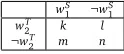
detecting word associations from limited data than theχ2test (Manning and Schütze, 1999) and was previously used as an effective tool for automatically constructing bilingual lexicons (Melamed, 2000; Moore, 2001; Munteanu and Marcu, 2006). Its definition is easily explained on the basis of a contigency table (Kilgarriff, 2001; Padó and Lapata, 2007), which is a four-cell matrix for each pair of words(wS1,w2T)(see Table 1).
wS
1 ¬w1S
wT
2 k l
¬wT
2 m n
Table 1: The contigency table for a pair of words(wS1,wT2).
The contingency table records that source wordwS
1and target wordwT2 co-occur inkaligned
item/sentences pairs, andwS
1occurs inmaligned pairs in whichw2Tis not present. Similarly, wT
2 occurs inlaligned pairs in whichwS1is not present, andnis the number of aligned pairs
that involve neitherwS
1norw2T. The final formula for the log-likelihood ratio is then defined as: L LR(wS1,wT2) =G2(k,l,m,n) =2(klogk+llogl+mlogm+nlogn
−(k+l)log(k+l)−(k+m)log(k+m)
−(l+n)log(l+n)−(m+n)log(m+n)
+ (k+l+m+n)log(k+l+m+n)) (3)
High LLR scores can indicate either a positive association or a negative one (Moore, 2004b). Since we expect translation pairs to be positively associated, we impose an additional con-straint: P(wS
1,wT2)> P(wS1)·P(w2T), whereP(wS1,w2T) = k+l+km+n, P(w1S) = k+kl++mm+n and P(w2T) =k+lk++ml+n. This constraint keeps only positively associated words in the lists of potential
3.3 Evaluation Methodology
3.3.1 Lists of Ground Truth Translation Pairs
In order to evaluate the BLE models, we have designed a set of ground truth translations - we have randomly sampled a set of Dutch content words that occur in the full corpus comprising 300, 000 sentences. Following that, we have used theGoogle Translatetool plus an additional annotator to translate those words to English. The annotator has manually revised the lists and has kept only words that have their corresponding translation in the English vocabulary. In order to build a one-to-one ground truth dataset of translations, only one possible translation has been annotated as correct. In case when more than 1 translation is possible, the annotator has marked as correct the translation that occurs more frequently in the English Europarl data. Finally, we have come up with a set of 1001 ground truth one-to-one translation pairs. We have followed the same procedure for Italian-English and have also constructed a set of 1001 ground truth translation pairs.4
3.3.2 Evaluation Metrics
All the methods under consideration actually retrieve ranked lists of translation candidates. Let us keep only the first translation candidate from each ranked list, and build a non-probabilistic lexicon of one-to-one word translations: Le. Assuming that we now have a setGof ground
truth one-to-one word translation pairs, we can evaluate the quality of our lexicon with respect to the ground truth setG. We use standard precision, recall and F-Measure (β=1) scores as our evaluation metrics: Since sometimes a word has more than one correct translation (e.g., Dutch wordverklaring can be translated as bothstatementanddeclaration), and the current evaluation setting cannot capture that phenomenon, we also evaluate the quality of the lexicon in a more lenient setting, where, instead of performing the hard cut-off, i.e., instead of keeping only the top candidate from the ranked list, we keep the ranked list of all the candidates from the list and calculate the mean reciprocal rank(MRR) (Voorhees, 1999). For a source wordwS
i,rank(wSi)denotes the
rank of its correct translation (as provided by the set of ground truth translation pairs) within the retrieved list of potential translation candidates. MRR of the lexicon is then defined by the following formula:
We conduct several experiments to measure the quality of the lexicon constructed using the SampLEXalgorithm: (1) we evaluate the lexicon obtained by SampLEX using the full corpus of 300, 000 sentences, and compare its accuracy with the accuracy of baseline systems from Section 3.2 trained on the same corpus, (2) after performing the error analysis, we carry out another set of experiments that prove that theSampLEXalgorithm, due to its modeling
properties, alleviates the problem ofindirect associationsand, finally, (3) we test our lexicon in a setting where only limited parallel data are available and show that theSampLEX-based lexicon outperforms other bilingual word lexicons in that setting in terms of quality provided by the F-measure and precision scores.
4.1 Experiment I: Testing the Quality of the Lexicon in Terms of Precision
Unlike our baseline state-of-the-art systems for BLE, theSampLEXalgorithm does not assure the full coverage of the source vocabulary, as it does not necessarily build ranked lists of translation candidates for all the words observed during training. However, our claim is that translation pairs obtained bySampLEXare of higher quality than those obtained by the baseline systems. Therefore, with this experiment we want to answer the following question: “Are translation pairs obtained by the SampLEX algorithm really more accurate than translation pairs obtained by other methods?”. In order to answer that question, we calculate the precision and MRR scores on our ground truth datasets for Italian-English and Dutch-English, where all the BLE methods have been trained on the full 300, 000 datasets. The obtained scores are presented in Tables 2 and 3.
Dutch-English
IBM1-i5 IBM1-i20 DICE LLR SampLEX
Prec(300k) 0.7113 0.7023 0.6963 0.7662 0.8221
MRR(300k) 0.8196 0.8045 0.7767 0.8542 0.9069
Table 2: Precision and MRR scores for all models trained on the first 300, 000 sentences of Dutch-English Europarl data, and evaluated on the sets of 1001 ground truth translation pairs for Dutch-English.
Italian-English
IBM1-i5 IBM1-i20 DICE LLR SampLEX
Prec(300k) 0.7912 0.7752 0.7932 0.8361 0.8771
MRR(300k) 0.8781 0.8588 0.8494 0.8945 0.9250
Table 3: Precision and MRR scores for all models trained on the first 300, 000 sentences of Italian-English Europarl data, and evaluated on the sets of 1001 ground truth translation pairs for Italian-English.
As previously shown by Moore (2004a), LLR serves as a better associative method than the Dice coefficient for the word alignment task. We obtain the same finding for bilingual lexicon extraction. Additionally, the model based on LLR is also better than IBM Model 1 when applied for BLE. Munteanu and Marcu (2006) drew the same conclusion, and they used the LLR-based lexicon in their system when a higher precision of the lexicon was paramount. However, the results reveal that the quality of the lexicon obtained by theSampLEXalgorithm is superior to the LLR-lexiconin terms of precisionand, consequently, to all other evaluated lexicons.
4.2 Experiment II: Investigating Indirect Associations
as defined by Melamed (2000), are associations between words that have a tendency to co-occur much more often than expected by chance, but are not mutual translations. Lexicon extraction models unaware of the indirect associations tend to give translational preference to higher-frequency words. Considering the fact that one key assumption of our model is sub-corpora sampling that causes decreasing frequencies of words in the obtained sub-corpora from which translation pairs are learned, our model should successfully mitigate the problem of indirect associations. Indeed, during the error analysis, we have detected that both IBM Model 1 and LLR provide a wrong translation of the Dutch wordbeschouwen (consider), since both models retrieve the English wordasas the first translation candidate (due to a very high frequency of the collocationconsider as). Other examples of the same type include the Dutch wordintegreren (integrate)which is translated asinto,betwijfelen (doubt)which is translated aswhether, or an Italian example of the verbentrare (enter)which is translated asinto. Our BLE model, on the other hand, provides correct translations for all these examples. Dagan et al. (1993) noted that collocates often tend to cause confusion among algorithms for bilingual lexicon extraction. More examples include the Dutch wordopinie (opinion), translated aspublicby IBM Model 1 and LLR (due to a high frequency of the collocationpublic opinion), the Dutch wordcirkels (circles), translated asconcentric, or the Italian wordpensionabile (pensionable), translated as age. All these examples are again correctly translated by our model for lexicon extraction. In order to test the hypothesis that our lexicon extraction model does not suffer from the problem of learning indirect associations, we have conducted a small experiment. For the purpose of the evaluation, we have constructed a small dataset of 219 Italian verbs in first person plural of the present tense. We have also constructed the set of ground truth translations in the same way as in Subsection 3.3.1. These verbs are easy to extract because they all have the same suffix-iamo(e.g., the verbrespiriamo, meaning(we) breathe). If the problem of indirect associations for a lexicon extraction method is prominent, the English wordwewill appear as the first translation for many of these verbs, instead of the word that really bears the content of the verb (e.g.,breathe). Table 4 shows precision and MRR scores for the lexicon extraction models evaluated on this toy dataset. As expected, due to its modeling property related to the
IBM1-i5 DICE LLR SampLEX
Prec(300k) 0.4475 0.4201 0.6119 0.8584
MRR(300k) 0.5575 0.5108 0.7300 0.9140
Table 4: Precision and MRR scores on our evaluation set consisting of Italian-iamoverbs (present tense, first person plural).
reduction of word frequencies, our BLE model does not suffer from the problem of indirect associations like other models. That property eventually has a positive impact on precision and MRR scores and the overall quality of the lexicons obtained by our SampLEX algorithm.
4.3 Experiment III: Experiments with a Limited Amount of Parallel Data
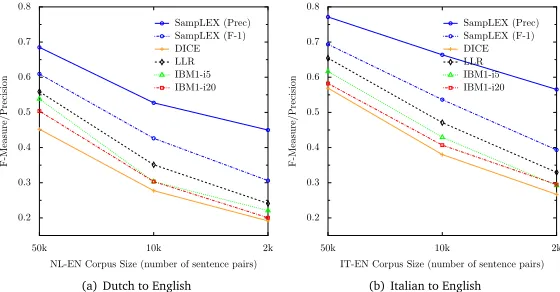
have only kept the words that occur at least once in the respective corpora as ground truth for evaluations (e.g., there are 444 words in the ground truth dataset for the corpus consisting of the first Dutch-English 2, 000 sentence pairs, and 931 words for the corpus consisting of the first 50, 000 Dutch-English sentence pairs). Our question is now: “Are lexicons extracted by SampLEX really of better quality than lexicons obtained by other methods when dealing with parallel corpora of limited size?” As mentioned before, theSampLEXalgorithm does not have a property to provide results in a form of ranked lists for the entire source vocabulary, but we claim thatSampLEXis directed towards extracting only highly reliable and precise candidates which, consequently, leads to lexicons of a higher quality. That claim is again supported by the findings presented in Figure 1(a) for Dutch-English, and in Figure 1(b) for Italian-English.
0.2
NL-EN Corpus Size (number of sentence pairs) SampLEX (Prec)
IT-EN Corpus Size (number of sentence pairs) SampLEX (Prec)
Figure 1: Precision and F-Measure scores over parallel corpora of different size (2k, 10k and 50k aligned sentence pairs). SinceSampLEXdoes not necessarily obtain the lists of translations for all words in a vocabulary, its precision scores are different than its F-measure scores. For all other models within this evaluation setting, it is valid:Precision=Recall=F-measure.
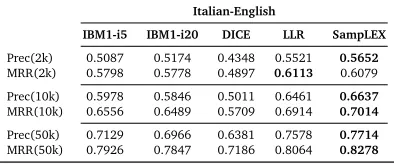
We have also performed an additional experiment to test whether the translation candidates for Dutch and Italian words that happen to be retrieved by theSampLEXalgorithm still display better overall precision and MRR scores than the translation candidates for the same Dutch and Italian words obtained by the other methods. If that is not true, we could useSampLEXonly to extract source words for which a translation might be found, but the particular translation for each extracted word could then be obtained by some other method. However, it is not the case, as the results in Tables 5 and 6 reveal. As noted in the literature (Manning and Schütze, 1999), we observe that, of all the baseline models for BLE, LLR suffers the least from data sparsity, but still performs worse than our method.
Dutch-English
IBM1-i5 IBM1-i20 DICE LLR SampLEX
Prec(2k) 0.3668 0.3624 0.3319 0.4323 0.4498
MRR(2k) 0.4206 0.4199 0.3968 0.4498 0.4836
Prec(10k) 0.4266 0.4306 0.3682 0.4889 0.5272
MRR(10k) 0.5071 0.5039 0.4513 0.5587 0.5848
Prec(50k) 0.6180 0.5952 0.5295 0.6621 0.6850
MRR(50k) 0.7067 0.6901 0.6183 0.7182 0.7429
Table 5: Precision and MRR scores for all models trained on the subsets of different sizes (2k, 10k and 50k sentences) from Dutch-English Europarl data. Only candidates retrieved by SampLEXhave been taken into account for this evaluation.
Italian-English
IBM1-i5 IBM1-i20 DICE LLR SampLEX
Prec(2k) 0.5087 0.5174 0.4348 0.5521 0.5652
MRR(2k) 0.5798 0.5778 0.4897 0.6113 0.6079
Prec(10k) 0.5978 0.5846 0.5011 0.6461 0.6637
MRR(10k) 0.6556 0.6489 0.5709 0.6914 0.7014
Prec(50k) 0.7129 0.6966 0.6381 0.7578 0.7714
MRR(50k) 0.7926 0.7847 0.7186 0.8064 0.8278
Table 6: Precision and MRR scores for all models trained on the subsets of different sizes (2k, 10k and 50k sentences) from Italian-English Europarl data. Only candidates retrieved by SampLEXhave been taken into account for this evaluation.
thatSampLEXtakes the best of both worlds - it benefits from the idea of data reduction, yet it provides better scores when more input data are available.
5 Conclusions and Future Work
In this paper, we have proposed a statistical framework for the construction of a bilingual word lexicon built upon the idea of sampling many smaller sub-corpora from an initial larger item-aligned corpus.
TheSampLEXalgorithm for bilingual lexicon extraction presented in the paper is directed towards extraction of only highly reliable word translation pairs. After comparisons with other models for BLE from parallel data, we have proved thatSampLEXbuilds word lexicons of higher accuracy and overall quality as revealed by the F-measure and precision scores, which is especially important in a setting where only a limited amount of parallel data is available. The proposed framework allows for many further experimentations and possible applications. The description of the framework provided in the paper is generic - it is language-independent and applicable to any corpus that provides some sort of alignment (at the sentence, paragraph or document level). In future work, we plan to design algorithms for mining word translations from comparable corpora based on the similar idea of sub-corpora sampling.
Acknowledgments
References
Agresti, A. (2002).Categorical Data Analysis, 2nd Edition. Wiley.
Andrade, D., Nasukawa, T., and Tsujii, J. (2010). Robust measurement and comparison of context similarity for finding translation pairs. InProceedings of the 23rd International Conference on Computational Linguistics (COLING), pp. 19–27.
Brown, P. F., Pietra, V. J. D., Pietra, S. A. D., and Mercer, R. L. (1993). The mathematics of statistical machine translation: parameter estimation.Computational Linguistics, 19(2):263– 311.
Carbonell, J. G., Yang, J. G., Frederking, R. E., Brown, R. D., Geng, Y., Lee, D., Frederking, Y., E, R., Geng, R. D., and Yang, Y. (1997). Translingual information retrieval: A comparative evaluation. InProceedings of the 15th International Joint Conference on Artificial Intelligence (IJCAI), pp. 708–714.
Church, K. W. and Mercer, R. L. (1993). Introduction to the special issue on computational linguistics using large corpora.Computational Linguistics, 19(1):1–24.
Dagan, I., Church, K. W., and Gale, W. A. (1993). Robust bilingual word alignment for machine aided translation. InProceedings of the Workshop on Very Large Corpora, pp. 1–8.
Diab, M. T. and Finch, S. (2000). A statistical translation model using comparable corpora. In Proceedings of the 6th Triennial Conference on Recherche d’Information Assistée par Ordinateur (RIAO), pp. 1500–1508.
Dice, L. R. (1945). Measures of the amount of ecologic association between species.Ecology, 26(3):297–302.
Dunning, T. (1993). Accurate methods for the statistics of surprise and coincidence. Computa-tional Linguistics, 19(1):61–74.
Fung, P. and Cheung, P. (2004). Mining very-non-parallel corpora: Parallel sentence and lexicon extraction via bootstrapping and EM. InProceedings of the Conference on Empirical Methods in Natural Language Processing (EMNLP), pp. 57–63.
Fung, P. and Yee, L. Y. (1998). An IR approach for translating new words from nonparallel, comparable texts. InProceedings of the 17th International Conference on Computational Linguistics (COLING), pp. 414–420.
Haghighi, A., Liang, P., Berg-Kirkpatrick, T., and Klein, D. (2008). Learning bilingual lexicons from monolingual corpora. InProceedings of the 46th Annual Meeting of the Association for Computational Linguistics (ACL), pp. 771–779.
Kay, M. and Röscheisen, M. (1993). Text-translation alignment.Computational Linguistics, 19(1):121–142.
Kilgarriff, A. (2001). Comparing corpora.International Journal of Corpus Linguistics, 6(1):1–37.
Laroche, A. and Langlais, P. (2010). Revisiting context-based projection methods for term-translation spotting in comparable corpora. InProceedings of the 23rd International Conference on Computational Linguistics (COLING), pp. 617–625.
Lefever, E., Macken, L., and Hoste, V. (2009). Language-independent bilingual terminology extraction from a multilingual parallel corpus. InProceedings of the 12th Conference of the European Chapter of the Association for Computational Linguistics (EACL), pp. 496–504. Levow, G.-A., Oard, D. W., and Resnik, P. (2005). Dictionary-based techniques for cross-language information retrieval.Information Processing and Management, 41:523–547. Manning, C. D. and Schütze, H. (1999).Foundations of Statistical Natural Language Processing. MIT Press, Cambridge, MA, USA.
Melamed, I. D. (2000). Models of translational equivalence among words. Computational Linguistics, 26:221–249.
Mihalcea, R. and Pedersen, T. (2003). An evaluation exercise for word alignment. InProceedings of the HLT-NAACL 2003 Workshop on Building and Using Parallel Texts: Data Driven Machine Translation and Beyond, pp. 1–10.
Moore, R. C. (2001). Towards a simple and accurate statistical approach to learning translation relationships among words. InProceedings of the Workshop on Data-Driven Methods in Machine Translation, pp. 1–8.
Moore, R. C. (2002). Fast and accurate sentence alignment of bilingual corpora. InProceedings of the 5th Conference of the Association for Machine Translation in the Americas on Machine Translation: From Research to Real Users (AMTA), pp. 135–144.
Moore, R. C. (2004a). Improving IBM word-alignment Model 1. InProceedings of the 42nd Annual Meeting of the Association for Computational Linguistics (ACL), pp. 518–525. Moore, R. C. (2004b). On log-likelihood-ratios and the significance of rare events. In Proceedings of the Conference on Empirical Methods in Natural Language Processing (EMNLP), pp. 333–340.
Morin, E., Daille, B., Takeuchi, K., and Kageura, K. (2007). Bilingual terminology mining -using brain, not brawn comparable corpora. InProceedings of the 45th Annual Meeting of the Association for Computational Linguistics (ACL), pp. 664–671.
Munteanu, D. S. and Marcu, D. (2005). Improving machine translation performance by exploiting non-parallel corpora.Computational Linguistics, 31:477–504.
Munteanu, D. S. and Marcu, D. (2006). Extracting parallel sub-sentential fragments from non-parallel corpora. InProceedings of the 21st International Conference on Computational Linguistics and the 44th Annual Meeting of the Association for Computational Linguistics (COLING-ACL), pp. 81–88.
Och, F. J. and Ney, H. (2003). A systematic comparison of various statistical alignment models. Computational Linguistics, 29(1):19–51.
Pinto, D., Civera, J., Barrón-Cedeòo, A., Juan, A., and Rosso, P. (2009). A statistical approach to crosslingual natural language tasks.Journal of Algorithms, 64(1):51–60.
Prochasson, E. and Fung, P. (2011). Rare word translation extraction from aligned comparable documents. InProceedings of the 49th Annual Meeting of the Association for Computational Linguistics: Human Language Technologies (ACL-HLT), pp. 1327–1335.
Rapp, R. (1995). Identifying word translations in non-parallel texts. InProceedings of the 33rd Annual Meeting of the Association for Computational Linguistics (ACL), pp. 320–322.
Rapp, R. (1999). Automatic identification of word translations from unrelated English and German corpora. InProceedings of the 37th Annual Meeting of the Association for Computational Linguistics (ACL), pp. 519–526.
Resnik, P. and Smith, N. A. (2003). The Web as a parallel corpus.Computational Linguistics, 29:349–380.
Shezaf, D. and Rappoport, A. (2010). Bilingual lexicon generation using non-aligned signatures. InProceedings of the 48th Annual Meeting of the Association for Computational Linguistics (ACL), pp. 98–107.
Tamura, A., Watanabe, T., and Sumita, E. (2012). Bilingual lexicon extraction from comparable corpora using label propagation. InProceedings of the Joint Conference on Empirical Methods in Natural Language Processing and Computational Natural Language Learning (EMNLP-CoNLL), pp. 24–36.
Tiedemann, J. (2003). Combining clues for word alignment. InProceedings of the 10th Conference of the European Chapter of the Association for Computational Linguistics (EACL), pp. 339–346.
Tiedemann, J. (2009). News from OPUS - A collection of multilingual parallel corpora with tools and interfaces. InRecent Advances in Natural Language Processing (RANLP), pp. 237–248.
Ueffing, N. and Ney, H. (2007). Word-level confidence estimation for machine translation. Computational Linguistics, 33(1):9–40.
Venugopal, A., Vogel, S., and Waibel, A. (2003). Effective phrase translation extraction from alignment models. InProceedings of the 41st Annual Meeting of the Association for Computational Linguistics (ACL), pp. 319–326.
Voorhees, E. M. (1999). The TREC-8 question answering track report. InProceedings of the Eighth TExt Retrieval Conference (TREC-8).
Vuli´c, I., De Smet, W., and Moens, M.-F. (2011). Identifying word translations from comparable corpora using latent topic models. InProceedings of the 49th Annual Meeting of the Association for Computational Linguistics: Human Language Technologies (ACL-HLT), pp. 479–484.
![Cost effectiveness of microendoscopic discectomy versus conventional open discectomy in the treatment of lumbar disc herniation: a prospective randomised controlled trial [ISRCTN51857546]](data:image/gif;base64,R0lGODlhAQABAIAAAP///wAAACH5BAEAAAAALAAAAAABAAEAAAICRAEAOw==)