THE EFFECT OF THE COUPLING SCHEME ON COUPLING EFFICIENCY AND TOLERANT MISALIGNMENT OF SEMICONDUCTOR OPTICAL
AMPLIFIERS MODULE
Jasman Zainal, Mohamed M. Fadhali, Jalil Ali and Rosly Abdul Rahman
Advanced Photonics Sciences Institute, Faculty o f Science University Teknologi Malaysia, 81310 UTM Skudai, Johor, M alaysia
Email: jbz@ dfiz2.fs.utm .m y
ABSTRACT
Analysis on three different coupling system s, i.e., butt, single ball lens, and tw o ball lenses was carried out to study their effect in pigtailing a semiconductor optical amplifier (SO A ) module. By placing the coupling system between the tips o f tw o coupled single m ode fiber parameters such as coupling efficiency and longitudinal tolerant with variation o f working distance can be investigated. Result o f the three schem es studied showed that tw o ball lenses is the most efficient for this application even with the assumption o f an elliptical beam profile for the source fiber. We also observed an optimum range for the separation between the tw o lenses at which the coupling efficiency is maximal.
K eyw ords: coupling system , coupling efficiency, single mode fiber
INTRODUCTION
lens and butt coupling schemes for a semiconductor optical amplifiers (SOA’s) which also can be applied to other photonic devices such as, isolators, circulators, attenuators, switches, and wavelength-division multiplexers/demultiplexers. Gaussian beam optics and ABCD ray tracing matrix are also employed to describe the mode field transforma tion between the to fiber tips. Coupling efficiency and misalignment tolerances are analyzed for better alignment. Laser welding is the powerful technique that makes the attachment o f the coupling components such as small ball lenses feasible and strong to resist aging and environmental variations. All the parameters o f the laser weld pulse have to be optimized for reliable weld yields
Semiconductor optical amplifiers (SOAs) are essentially laser diodes, without end mirrors, which have fiber attached to both ends. They amplify any optical signal that comes from either fiber and transmit an amplified version o f the signal out o f the second fiber. SOAs are typically constructed in a small package, and they work for 1310 nm and 1550 nm wavelength systems. In addition, they can transmit bidirectionally, making the reduced size o f the device an advantage over other amplifiers.
THEORY
The arrangement o f Figure 1, shows the source and receiver fibers as represented by SMF-1 and SMF-2 respectively, with the coupling system place between the two tips of the fibers.
^ 1 Coupling
|H— W M M a
...- ... ••—i S M F - 1
system
S M F - 2
Figure 1: Fiber to fiber coupling arrangement
For simplicity, consider a circular mode that field o f the laser diode is coupled into the source Therefore, the mode field o f the source fiber can be expressed as follows [1]
V, = exp
2 2
x + y
2 W ,
exp x + y
R r
(
1)
where; ws and Rs are the mode field waist and wavefront radii before the transformation
respectively. These parameters can be express in terms o f the minimum waist o f the mode field of the source fiber, ws0 as well as the distance to the coupling system between the
two fiber tips, d as follows
w = ws0 1 e \
l + (— r )
TtW
1 / 2
R . = d
1
+0
d k - rThe transformed mode field of the source fiber is given as:
(2)
(
3)
Vi , = exp exp . K, x + y
V ^ 2 s j
(
4)
where, K 2 = 2 m IA , n is the refractive index of the coupling medium.
The transformation can be expressed in terms of the ABCD elements o f the ray transfer matrix o f the specified coupling components. From the values o f A, B, C and D, one can calculate <o2s, R 2s in terms of their counterparts before the transformation.
The receiver fiber is also a single mode fiber which can be expressed as;
f 2 )Yi ! ( x + y2
Vr = -- — exp 2
/ \ Wr J
(
5)
wf is the spot size o f the mode field in the fiber given by
w, _ 1.619 2.879
—^ = 0.65 + --- —; h---- —
a r/K V
(
6)
where; a is the core radius of the fiber, V is the normalized frequency of the fiber, and for single mode fiber the value o f V is in the range[ 2]; 1.9 < V < 2.405
The coupling efficiency is expressed by the overlap integral [1,4]
I jjV2,
v 'r d x d y(
7)
T] depends on the degree o f matching between the spot sizes and distributions o f the
source and receiver fiber mode fields.
EXPERIMENTAL PROCEDURE
Figure 2: Dual beams Nd:YAG laser welding for butterfly modules
RESULTS AND DISCUSSION
Three coupling configurations have been analyzed for coupling a single mode fiber into a single mode fiber. For the direct coupling scheme, the variation o f the coupling efficiency with the working distance is shown in Figure 3. This figure illustrates that the coupling efficiency can be maximum if the ends of the two fibers brought to contact without any offset and tilts but it deceases dramatically with increasing the separation between the two
fibers (working distance). However, at a working distance o f 100 f i m , the coupling
efficiency reduced to around 40% o f its maximum value.
Figure 3: Coupling efficiency versus the separation between the two fiber ends
Single ball lens coupling scheme provides significant enhancements to both the coupling efficiency and the working distance, as shown in Figures 4 for two cases using ball lenses with similar radius (0.5 mm) and different refractive indices, i.e., 1.5 and 1.8313. Both cases provided high coupling efficiency and wide working distance. However, the ball lens with higher refractive index gave high coupling efficiency even at
zero working distance. Moreover, ball lenses with higher refractive indices are more preferred because they are suitable for minimizing the spherical aberration.
Figure 4 Variation of the coupling efficiency with the working distance using single ball lens with different refractive indices.
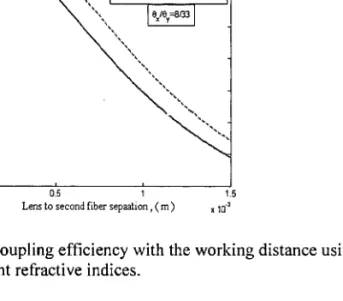
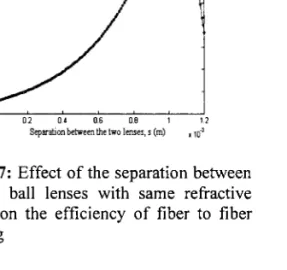
For the case o f two ball lenses with (0.5 mm) radii and the first has a refractive index of (1.5) whereas the second has a refractive index o f (1.8313) and keeping the distance between the source fiber and the first lens equal to its focal length (0.75 mm) , for different values o f lenses separation distances, it has been found that there is an optimum value o f 1 mm at which the coupling efficiency has a stable variation with the distance between the second lens and the receiver fiber (working distance) and it can reach unity at a working distance around (0.8 mm) as shown in Figure 6. Again considering the ball lenses to be o f same high refractive indices, i.e., 1.8313, shows a better variation of coupling efficiency with working distance at coupling distance (first fiber to first lens separation) o f 0.55 mm which is the focal length of the first lens. From the different values o f lenses separation distances, the optimum value is found to be also 1 mm. However, comparing to the first case, here the coupling efficiency is more than 50% even at a zero working distance.
The variation for some other values o f the separation between the two lenses is shown for the two cases, where the variation has large fluctuations despite that the coupling efficiency can reach unity at some points but it is not preferred because of this fluctuation that affects the reliability o f the coupled device.
Figure 5: Variation of coupling efficiency with the working distance in fiber to fiber coupling using two ball lens with different refractive indices
Figure 6 Variation of coupling efficiency with the working distance in fiber to fiber coupling using two ball lens with same refractive indices
Figure 7: Effect of the separation between the two ball lenses with same refractive indices on the efficiency of fiber to fiber coupling
Figure 8: Effect of the separation between the two ball lenses with different refractive indices on the efficiency of fiber to fiber coupling
CONCLUSIONS
Coupling and pigtailing processes o f a semiconductor optical amplifier module have been discussed for three different coupling configurations. Despite that the butt coupling is the simplest and can provide high coupling efficiency, but the working distance is very tight to allow the insertion o f the amplifier chip or other optical components. Single ball lens can provide enhancement to both the coupling efficiency and working distance but the problem of positioning the lens regarding to the amplifier chip between the two fiber tips arises. Because if the lens is before the chip the focusing to the second fiber will not be effective and if it is after the chip the collimation from the first fiber will not be effective. Therefore, a dual ball lenses coupling scheme is devised to solve that conflict by positioning the chip between the two lenses. Moreover, this coupling scheme provides a maximum coupling efficiency with wide misalignment tolerances that can be significantly controlled by the variation of lenses separations. The attachments o f all coupling components have been done using laser welding with dual Nd:YAG laser beams during
active alignment processes. The fibers tips have been metalized and encapsulated inside metallic ferrules to enable its weldability to the main substrate. Laser welding beam parameters have been optimized to get good and strong weld yields with less heat affected zone to prevent the damage that may happen to those components and at the same time achieving a very localized and strong weld yields.
REFERENCES
[1] A. Yariv and P. Yeh, Photonics; Optical Electronics in Modern Communications,
6th Ed., chap. 2, Oxford University Press, New York, 2007.
[2] Saleh and M. Teich, Fundamentals o f Photonics, John Wiley & Sons, USA &
Canada, 1991.
[3] M. Saruwatari and T. Sugie T.,” Efficient Laser Diode to Single-mode Fiber
Coupling Using a Combination o f Two Lenses in Confocal Condition,” J o f
Quantum Elec., Vol.QE-17, No.6, 1981.
[4] S. Sarker, K. Thyagaralan and A. Kumar, ’’Gaussian approximation o f the
fundamental mode in single mode elliptic core fibers,” Opt. Comm.Vol. 49, No.3,
pp. 178-183,1984.
[5] K. Holger and D. Karsten, ’’Loss Analysis o f Laser Diode to Single-Mode Fiber
Couplers with Glass spheres or Silicon Plano-Convex Lenses,” J. o f LightWave
Tech.,, Vol. 8, No.5, 1990.
[6] V. Shah L. Curtis, R. Vodhanel, D. Bour and W. Young,” Efficient Power
Coupling from 980nm, broad area laser to single-Mode Fiber Using a wedge-
Shaped Fiber Endac €" ,J o f Lightwave Tech., Vol.8, No.9, pp.1313-1318,1990.
[7] W. Joyce and B. Deloach, ’’Alignment o f Gaussian Beams,” J. Appl. Opt., Vol.
23, No. 23, p 4187-4196, 1984.
[8] L. Reith, W. Mann, G. Lalk, R Krchnavek, N. Andreadakis and C. Zah,
’’Relaxed-Tolerance Optoelectronic Device Packaging”, J. o f LightWave Tech.,
Vol. 9, No. 4, pp. 477-484, 1991.
[9] C. Edwards, H. Presby and C. Dragone, ’’Ideal microlenses for laser-to-fiber
coupling”, J. Lightwave Tech., V .l l, No. 2, pp. 252-257, 1993.
[iu] H.Yang, S Huang, C. Lee, T. Lay and W. Cheng, ’’High Coupling Tapered
Hyperbolic Fiber Microlens and Taper Assymetry Effect,” J. Lightwave Tech., Vol. 22, No. 5, pp.1395-1401, 2004.
[11] Y. Murakami, J. Yamada, J. Sakai, and T Kimura, “Microlens tipped on a single
mode fiber end in GaAsP laser coupling improvement,”. Electron. Lett., Vol. 16,
No.6, pp: 321-322, 1980.
[12] Y, Odagiri, M. Seki, H. Nomura, M. Sugimoto, and K. K obayashj/‘Practical 1.5
|nm LD-isolator-single-mode- fiber module using a V-grooved diamond heatsink,” in Proc. 6th Eur. Conf. Optical Communication, (York, U.K.), pp. 282- 285, 1980.
[13] E. Weidel, “New coupling method for GaAs laser-fiber coupling,” Electron Lett.,