MUSTAFA ALI M. ALBAREKI
A project report submitted in partial fulfillment of the requirements for the award of the degree of
Master of Science (Computer Science)
Faculty of Computer Science and Information System Universiti Teknologi Malaysia
v
ABSTRACT
ABSTRAK
CHAPTER1
INTRODUCTION
1.1 Introduction
Computer networks have become a very important aspect in today’s human world. Networking and internetworking are now very well known terminologies among specialists in every field of knowledge. For instance, hospitals use computer networks to link, store and share their patients’ data between doctors and other branches.
A wireless network is a flexible data communication system implementation as an extension to or as an alternative to a wired network. Using Radio Frequency (RF) technology, wireless networks transmit and receive data over the air, minimizing the need for wired connection. Thus, wireless networks combine data connectivity with user mobility. Wireless network are easy to assemble and configure, they provide user mobility without losing communication sessions and they are easy to break down when needed. On the other hand, wireless networks can suffer from many problems including higher collision rate and higher Bit Error Rate (BER). The wireless networks also suffer from problems facing wireless signals like signal blockage and weather effects. Security wise, the wireless networks are considered the most vulnerable because of the shared transfer medium (Tian, Xu and Ansari, 2005).
3
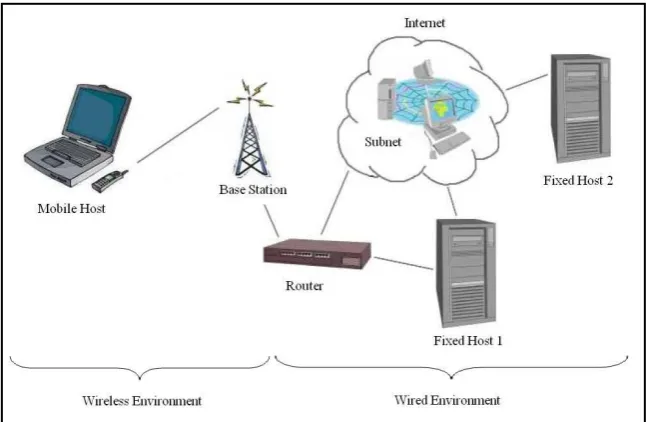
Figure 1.1: A Heterogeneous Network (Saarto, 2003).
1.2 Problem Background
The Transmission Control Protocol (TCP) was primarily designed for wired networks. In wired networks random BER is negligible, and congestion is the main cause of packet loss. Each TCP packet is associated with a sequence number. Only successfully received in-order packets are acknowledged to the sender by the receiver, by sending corresponding packets’ Acknowledgments (ACKs) with sequence numbers of the next expected packets. On the other hand, packet loss or reception of out-of-order packets indicates failures. To eradicate such failures, TCP implements flow control and congestion control algorithms (Shamakumar, et al. ,2001).
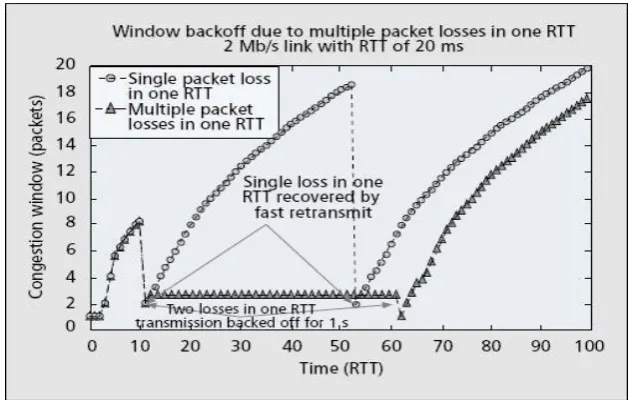
higher BERs than wired links. Also, limitations of radio coverage and user mobility require frequent handoffs, thus resulting in temporal disconnections and reconnections between the communicating end hosts during a communication session. A short disconnection event can actually stall the TCP transmission for a much longer period. Standard TCP cannot effectively handle high BER and frequent disconnections. Random packet losses are, therefore, inferred to network congestions rather than to the high BER effect that comes along with wireless networks. That would trigger the sender to execute congestions avoidance algorithms and unnecessarily reduces its sending rate. Short bursts of BERs may happen due to signal blockage or other signal quality affecting factors, such as noises and bad weather. That can lead to a high rate of random packet losses within a single Round Trip Time (RTT). The retransmission timer can experience an exponential back off if multiple packets were lost within one RTT. Two random packet losses within one RTT would cause the sender to stall transmission to up to one second. Figure 1.2 (Tian, Xu and Ansari, 2005), shows the difference between losing two packets within one RTT and losing two packets far apart. In the first scenario the graph shows that the sender had stalled the transmission for up to 50 RTTs or around 1 second. Standard TCP is unable to distinguish between congestive and random packet loss contributes to a drastic decrease of TCP’s throughput (Tian, Xu and Ansari, 2005).
5
The TCP assumes a relatively reliable underlying network where most packet losses are due to congestion. In a wireless network, however, packet losses will occur more often due to unreliable wireless links than due to congestions. When using standard TCP over wireless links, each packet loss on the wireless link results in congestion control measures being invoked at the source. This causes severe performance degradation. This made implementing standard TCP over wireless links unreliable. Thus, more wireless TCP schemes such as Freeze-TCP (Goff, Moronski and Phatak, 2000), I-TCP (Bakre and Badrinath, 1994) and ATCP (Liu and Singh, 2001), were required to solve the problems facing the TCP on wireless environments (Tian, Xu and Ansari, 2005).
1.3 Problem Statement
The different wireless network environments introduced different problems that face the standard TCP. Over the years several schemes were implemented to increase the performance of TCP over wired and wireless mediums.
This project mainly examines the question:
1.4 Project Objectives
With reference to the problem stated above, this study is attempting to achieve the following objectives:
(i) To review different available types and schemes of TCP protocol.
(ii) To analyze the negative effect of both wired and wireless network environments on the performance of TCP.
(iii) To compare the performance of various TCP schemes on wireless environments.
1.5 Project Scope
The scope of the project is to identify the limitations of several TCP schemes that are widely used over wireless links. The main points in this project are:
(i) The study will cover two wireless environments Ad-hoc and Cellular.
(ii) The study will focus on the performance of several TCP schemes in different wireless environments in terms of throughput, delays and TCP congestion window.
(iii) A simulation using Network Simulator 2 (NS2) will be carried out on six TCP schemes by sending packets FTP over TCP protocol.
(iv) An analysis study of the results will be carried out to understand effectiveness of each protocol when implemented on wireless environment.
7
1.6 Importance of Study
Most of the applications, platforms and networks implement TCP as the main protocol to communicate. The first step toward the design of a better transport protocol for wireless networks has to be a better understanding of the way TCP works over wireless links. This would reveal the reasons for the inefficiency of TCP over wireless links. Studying different wireless TCP schemes can help understand the improvement of such schemes on the TCP performance over wireless networks. Thus, some of these schemes can be recommended to be used on other studies or applications.
1.7 Thesis Structure
This project is organized as follows:
Chapter 1 introduces a brief and general idea about computer networks and specifically wireless networks. This chapter also briefly discusses the Transport Control Protocol (TCP) and the limitation it faces within the wireless network environment. The project objectives and scope are mentioned in this chapter.
Chapter 3 discusses the research methodology used in this study. In this chapter the operational framework is presented to show the steps that need to be done to achieve the objectives of this project. The Network Model also will be described in this chapter. The Network Model is designed as simple as possible to avoid unnecessary drawbacks, whether they are caused by the complexity of the design or the infrastructure of the network model. The Simulation Model that shows the metrics of the simulation also will be described in this chapter.
Chapter 4 discusses the simulation setups and scenarios. The codes that configure the simulation setup and extract the results from the trace files are discussed in this chapter. A brief description about the code is discussed for demonstration purposes.
Chapter 5 includes the results of the simulation along with a discussion section about the results. The different schemes will be compared together to better understand how they perform against each other.
Chapter 6 will conclude the study and the final discussion and findings will be briefly discussed in this chapter. The limitations which this project has faced will also be stated in this chapter. Finally some recommendations and future work that could be suggested will conclude the project.
1.8 Summary
REFERENCES
Anjum, F, and L Tassiulas. (2003). "Comparative Study of Various TCP Versions over a Wireless Link with Correlated Losses." IEEE/ACM Transactions on Networking.IEEE. 370-383.
Bakre, Ajay, and B R Badrinath. (1994). I-TCP: Indirect TCP for Mobile Hosts. Technical Report, Rutgers University, Piscataway.
Bakshi, Bikram S, P Krishna, N H Vaidya, and D K Pradhan. (1997). "Improving Performance of TCP over Wireless Network." International Conference on Distributed Computing Systems. 1-12.
Brakmo, Lawrence S., and Larry L. Peterson. (1995). "TCP Vegas: End to End Congestion Avoidance on a Global Internet." IEEE Journal on Selected Areas in Communications (IEEE) 13, no. 8: 1465-1480.
Casetti, Claudio, Mario Gerla, Saverio Mascolo, M. Y. Sanadidi, and Ren Wang. (2002)."TCPWestwood: End-to-End Congestion Control for Wired/Wireless Networks." Wireless Networks (Kluwer Academic Publishers.) 8: 467–479. Cerda, Llorenc, and Olga Casals. (2001). "Study of The TCP Unfairness in a Wireless Environment." 8th IEEE International Conference on
Telecommunications.. 1-10.
Cheng Peng, Fu. (2001). TCP VENO: End-to-End Congestion Control Over Heterogeneous Networks. PhD Thesis, The Chinese University of Hong Kong,. Chiu, D., and R. Jain. (1989). "Analysis of the Increase/Decrease Algorithms for Congestion Avoidance In Computer Networks." Journal of Computer Networks and ISDN 17, no. 1: 1-14.
Clark, David D. (1982). "Window and Acknowledgement Strategy in TCP." http://www.ietf.org/rfc/rfc813.txt.
Cui, Lin, Seok J. Koh, Xin Cui, and Yong Jin Kim. (2007). "Adaptive Increase and Adaptive Decrease Algorithm for Wireless TCP." Third International
Conference on Natural Computation (ICNC2007). IEEE, 392-398.
Da Costa, G M. T, and H R Sirisena. (2002). "Freeze TCP with Timestamps for Fast Packet Loss Recovery after Disconnections." Int. Symp. on Performance
Evaluation of Computer and Telecommunication Systems.
Fielding, R, et al. (1999). "Hypertext Transfer Protocol - HTTP/1.1." http://www.ietf.org/rfc/rfc2616.txt.
Fikouras, A, K El Malki, S Cvetkovic, and C Smythe. (1999). "Performance of TCP and UDP during Mobile IP Handoffs in Single-Agent Subnetworks." Wireless Communications and Networking Conference, WCNC 1999. IEEE, 1258-1262. Floyd, S. (2000).Congestion Control Principles. http://www.ietf.org/rfc/rfc2914.txt, IETF.
Forouzan, Behrouz A. (2006).TCP/IP Protocol Suite. 3rd. McGraw-Hill.
Goff, Tom, James Moronski, and D S Phatak. (2000). "Freeze-TCP: A True End-to- End TCP Enhancement Mechanism for Mobile Environments." 19th Annual Joint Conference of the IEEE Computer and Communications Societies (INFOCOM2000).537-1545.
Huston, G. (Mar/Apr 2001) "TCP in a Wireless World." IEEE Internet Computing (IEEE) 5, no. 2: 82-84.
Jacobson, Van. (1988). "Congestion avoidance and control." In Proceedings of SIGCOMM ’88. ACM, 314-329.
Liu, Jian, and Suresh Singh. (July 2001). "ATCP: TCP for Mobile Ad Hoc Networks." IEEE Journal on Selected Areas in Communications,: 1300-1315. McCanne, S., and S. Floyd. (accessed 1 30, 2008). Vers. 2.32. The Network Simulator – ns-2. http://www.isi.edu/nsnam/ns/.
Mo, Jeonghoon, Richard J. La, Venkat Anantharam, and Jean Walrand. (1999). "Analysis and Comparison of TCP Reno and Vegas." 18th Annual Joint Conference of the IEEE Computer and Communications Societies INFOCOM '99. IEEE,1556 -1563.
136
Nikitin, Pavel, Onur Celebioglu, and Volkan Kukrer. (2002). TCP Performance in Mobile Wireless Environment: Channel Modelling and Network Simulation. Pittsburgh: Carnegie Mellon University.
Postel, J. (1981)."Internet Protocol." http://www.ietf.org/rfc/rfc791.txt.
Postel, J. "Transmission Control Protocol." http://www.ietf.org/rfc/rfc793.txt, 1981. Postel, J, and J Reynolds. (1985). "File Transfer Protocol."
http://www.ietf.org/rfc/rfc959.txt,
Saarto, Jarno. (2003) WWW Traffic Performance in Wireless Environmnet. Master Thesis, University of Helsinki.
Shamakumar, Arathi, Ravi Kiran Kundeti, Srinivasan Krishnamurthy, and Srinivasa Rao Segu. (2001).TCP for Wireless Networks. Department of Computer Science, University of Texas, Dallas.
Simunic, T, W Qadeer, and G De Micheli. (2005). "Managing Heterogeneous Wireless Environments via Hotspot Servers." 12th Conference Multimedia Computing and Networking (MMCN '05). 143-154.
Stevens, W. (1997). "TCP Slow Start, Congestion Avoidance, Fast Retransmit, and Fast Recovery Algorithms." http://www.ietf.org/rfc/rfc2001.txt
The VINT Project. The ns Manual. Edited by Kevin Fall and Kannan Varadhan. (2008).
Tian, Ye, Kai Xu, and N Ansari. (March 2005)."TCP in Wireless Environments: Problems and Solutions." IEEE Communications Magazine (IEEE) 43, no. 3: S27-S32.
Tsaoussidis, Vassilis, and Ibrahim Matta. (2001). Open Issues on TCP for Mobile Computing. Boston: Boston University, Boston, MA, USA, 1-18.
Wheat, Jeffrey, Randy Hiser, Jackie Tucker, Alicia Neely, and Andy McCullough (2001). Designing a Wireless Network. Syngress Publishing, Inc.
Xylomenos, George, George C Polyzos, Petri Mahonen, and Mika Saaranen. (2001). "TCP Performance Issues over Wireless Links." IEEE Communications
Magazine. IEEE, 52-58.
Zhang, Ke, and Cheng Peng Fu. (2006)."The Performance Study of TCP Veno Under Different Recovery Schemes." Asia-Pacific Conference on Communications (APCC '06) . 1-5.