IJEDR1501008
International Journal of Engineering Development and Research (www.ijedr.org)36
A Novel Co-evolution based Particle Swarm
Optimization for Clustering in Wireless Sensor
Networks
1
Kritika Raj Sharma,
2Vartika Sharma,
3Naveesh Kant Sharma
Arni University, Kathgarh, (Indora), Distt Kangra, Himachal Pardesh, Pin.176401
________________________________________________________________________________________________________
Abstract - Wireless Sensor Networks has been a popular area of research in recent times and finds several applications in various industries. Along with its usefulness, it is inherited with several challenges which need to be addressed for efficient application in real time. One of the major concerns among them is energy optimization. Several researchers have approached this problem by using clustering techniques like divide and conquer, LEACH etc. This paper proposes a novel energy aware algorithm using a Co-evolution based Particle Swarm Optimization (C-PSO) technique. In our approach we have used two nested swarms, the outer swarm for cluster formation after each round, while the inner swarm is for selection of cluster head. A cost function based on distance, energy and number of re-transmissions has been proposed. Further, to solve the problem of energy exhaustion of nearby clusters, a criterion for relay node placement is proposed. Results show that the proposed scheme performs better than the existing ones in terms of total energy.
Keywords - Clustering, Co-evolution based PSO, Wireless Sensor Network, Relay nodes
I.INTRODUCTION
Wireless Sensor Network (WSN) is a set of sensor nodes which are deployed in a large area mainly for civil and military applications [1]. These sensor nodes are generally resource limited in terms of energy, computational ability and storage capacity. Due to the hazardous environments in which they are deployed, the batteries of these nodes are irreplaceable. Therefore, one of the main challenges of these wireless sensor networks is sensors low energy and this limits the sensors lifetime in the network [2].
So, wireless sensor networks optimization problems are formulated by optimization in node deployment, energy aware clustering, and data aggregation. Clustering in WSNs divides the network into number of clusters and a node is assigned the cluster head (CH) in each cluster. Nodes in the cluster send their data to the CH which forwards the data to base station (BS), instead of sending their own data directly to the BS [3]. The clusters can be formed by either homogenous nodes or heterogeneous ones. Clustering in WSNs can be categorized into: Dynamic clustering or Static clustering.
Traditional analytical optimization algorithms require enormous computational efforts, which also require a lot of power for the computations and grows exponentially as the size of the networks increases. Instead of using traditional analytical methods, a bio-inspired technique is much computational efficient. A multidimensional optimization technique, particle swarm optimization (PSO) [4,8], which gives high quality of solutions, easy to implement, has high speed of convergence and is computationally efficient.
II. LITERATURE STUDY
Clustering in WSNs can be divided into static and dynamic clustering. In static clustering the boundaries of the clusters are fixed and nodal deployment in the network is relatively easy while in dynamic clustering, a node or a sensor belong to one cluster at a particular time can be in different cluster at different time.
In literature many clustering algorithms have been proposed, out of which LEACH [5] is the most popular one. In Low Energy Adaptive Clustering Hierarchy (LEACH) the CH is chosen randomly and then the role is assigned to other nodes to maintain the energy balance in the node. Due to which many a times two CHs of different clusters are chosen which are in close vicinity to each other. Also due to the probabilistic nature of CH selection, a sensor node which is located far from the BS at the edge of the cluster is chosen as CH, and consumes more energy to transfer data to the BS. Similar to this a centralized CH selection algorithm, LEACH-C have been proposed [6] in which each node in the network send its residual energy and location information to the BS and then the BS decides which node has energy lower than threshold and finds the cluster using simulated annealing technique.
Few bio-inspired techniques were also proposed in the literature. Particle swarm optimization is a multidimensional optimization technique which models the social behavior of a flock of birds [4]. Suppose in search of global solution a swarm of s particles explores n-dimensional hyperspace, where n represents the number of optimal parameters. Each particle is evaluated
through an objective
IJEDR1501008
International Journal of Engineering Development and Research (www.ijedr.org)37
1 2 2
1
( ) * ( ) * * ( ( ) x ( )) * ( ( ) ( )),
( ) ( ) ( ) .
v ti dt w v ti c r pbest ti i t c r gbest t x ti
x ti dt x ti v t dti
The position of the particle where its cost is minimum is stored in pbestid . To find the best position of a particle gbesti , the equations are updated after each iteration until the best solution for gbest is obtained or t reached to its maximum value. The above equation can be modified to use in WSN.
For better search, acceleration vectors c1 and c2 should be kept small, which however decreases the convergence rate and has to be selectively chosen varying from application to application [11,12]. For a problem having large numbers of local extrema, the values of c1 and c2 should be kept low, so as to increase the chance of finding the global extrema at the cost of convergence time and vice-versa. Similarly, the inertial weight w is adjusted, depending on the amount of influence desired in a particle’s previous position on its current movement. This optimization algorithm is finally said to converge, when each particle reaches the global best or the preset extremum value of the cost function.
This technique is deployed in WSN so that the desired coverage, energy efficiency and connectivity can be achieved with less number of nodes [7]. The solutions using PSO in WSN node deployment are computed centrally using the BS.
III. PROBLEM FORMULATION
The problem of clustering has been dealt in this paper and a novel technique is proposed based on co-evolutionary PSO and relay nodes placement. The problem of energy optimization in WSN needs to be converted into an optimization problem and a framework needs to be built for the whole algorithm to be developed. A mathematical model needs to be developed for the co-evolution based PSO to optimize the mathematical function given by:
maximize 𝑥𝑖(𝑡) = ∑ 𝛼 ∗ 𝑅𝑒𝑖+ 𝛽 ∗ 𝐷2+ 𝑁𝑡𝑖 subject to the constraint:
xi≥0, ei≥0
where 𝛼, 𝛽are constants and 𝑁𝑡𝑖 is the number of retransmissions.
Clustering needs to be done after each round and once clustering is done, the problem of cluster head selection needs to be solved. Also, the energy of the clusters starts decreasing as rounds progress. The energy of the clusters nearby to the base stations starts diminishing at a pace greater than the clusters which are farther from the base station as they are involved in multi-hopping from outer clusters. Thus, if the energy of these clusters fall below a certain threshold, this can cause route breakage. This needs to be solved using relay nodes placement.
IV. PROPOSED METHODOLOGY
An improved PSO technique is proposed which uses the co-evolutionary technique for Clustering and CH selection. Firstly, the nodes are initialized and clusters are formed using divide and conquer approach. After the first round of data transmission from nodes to cluster head (CH) and CH to BS, there is a need of re-clustering. For that firstly, each cluster started capturing its neighboring cluster nodes and calculate the fitness factor for the cluster which is given by the formula
Fitness Factor (FF) = ∑( 𝛼. 𝐵𝑝 + 𝛽. 𝐷2)/ ∑ 𝑁
Where α and β are constants, Bp is the residual energy of each node, D is distance of nodes from Base station and N is the number of nodes in the cluster. This fitness factor is used as the weight or cost function to calculate the fitness level of the cluster for retransmission of data.
Inside each cluster, each and every node share the information related to its position and residual energy to every other node and the optimal value for the position and energy is given by the formula:
𝑒𝑖(𝑡 + 𝑑𝑡) = 𝑤 ∗ 𝑒𝑖 + 𝑐1∗ 𝑟1∗ (𝑝𝑏𝑒𝑠𝑡𝑖(𝑡) − 𝑥𝑖(𝑡)) + 𝑐2∗ 𝑟2∗ (𝑔𝑏𝑒𝑠𝑡(𝑡) − 𝑥𝑖(𝑡)) (1)
𝑥𝑖(𝑡 + 𝑑𝑡) = 𝑥𝑖(𝑡) + 𝑒𝑖(𝑡)𝑑𝑡 (2)
Here, pbesti is the best position obtained by ith particle and gbest is the best position obtained by any particle till current iteration.
c1, c2 are known as constants whereas r1, r2 are two random vectors uniformly distributed between ‘0’ and ‘1’ and w denotes
inertial weight.
From the equation given above the optimal energy e and the location x is calculated after ith iteration and the cluster is formed. Co-evolutionary algorithm is used for the improvement of PSO. According to this algorithm, another PSO used for CH selection co-evolutes inside the PSO used for clustering algorithm. The PSO used for CH selection is given by the formula:
IJEDR1501008
International Journal of Engineering Development and Research (www.ijedr.org)38
Fig 1: Proposed algorithm of C-PSO based clustering in WSNHere, Re is the residual energy of each node in the cluster, D is the distance of each node from BS (helps in finding the location with respect to BS) and Nt is the number of retransmissions of each node. Once the clusters and CH is fixed using the improved PSO, energy and location of each cluster is verified using fitness factor (FF). The conditions are given by: if FF is greater than threshold then cluster is ready for next round of data transmission and if the condition fails then location of CH is verified using condition CH(location) is greater than threshold then retransmission of data continues and if it is less than threshold then relay node is placed in that cluster and re-clustering by capturing the neighboring nodes and calculation of FF continues. Complete algorithm of C-PSO based clustering in WSN is depicted in Figure 1.
IJEDR1501008
International Journal of Engineering Development and Research (www.ijedr.org)39
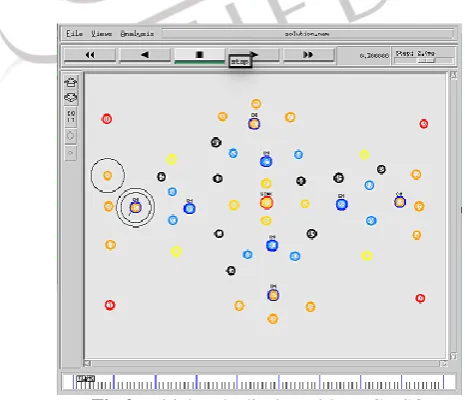
Fig 3: Node display in intermediate state after application of C-PSOV.RESULTS AND DISCUSSION
Our proposed methodology have been implemented and simulated for finding the optimal clustering and energy optimization. All simulations have been done in Network Simulator-2.35, on Linux Ubuntu platform and simulated for various results. Figure 4 shows the plot of energy of the inner nodes using our proposed scheme versus the earlier technique of static clustering. It is clearly observed that our proposed scheme outperforms the earlier existing scheme in terms of residual energy.
Fig 4: Energy of Inner Cluster
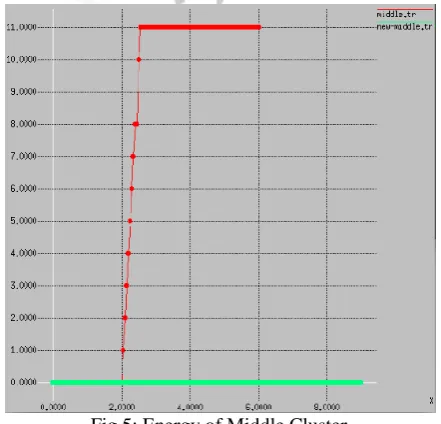
Similarly, figure 5 and figure 6 represents the energy plot of middle and outer clusters versus the earlier technique. It is observed that the our proposed scheme performs well as expected.
IJEDR1501008
International Journal of Engineering Development and Research (www.ijedr.org)40
VI. CONCLUSIONClustering problem in Wireless Sensors Networks have been solved using a novel co-evolution based Particle Swarm Optimization. Two swarms are acting in nested condition, first for the clustering problem while the second for the selection of cluster head. Further, to solve the problem of energy exhaustion of nodes nearby to the base station, relay nodes are proposed and a condition for the same is proposed. Results show significant improvement over the earlier method. In future, the algorithm would be studied for mobility of nodes and other evolutionary algorithm and machine learning techniques would be explored to solve the problem.
Fig 6: Energy of Outer Cluster Fig 7: Overall Energy
REFERENCES
[1] F. Hu, Y. Wang, and H. Wu, “Mobile telemedicine sensor networks with low-energy data query and network lifetime
considerations,” IE EE Trans . Mobile Computing, vol. 5, no. 4, pp. 404-417, Apr. 2006.
[2] S. Bandyopadhyay and E. J. Coyle, “Minimizing communication costs in hierarchically-clustered networks of wireless
sensors,” Computer Networks, vol. 44, no. 1, pp. 1-16, Jan. 2004.
[3] W. Heinzelman, A. Chandrakasan, and H. Balakrishnan, “An application-specific protocol architecture for wireless
microsensor networks,” IE E E Trans . Wireless Commun., vol. 1, no. 4, pp. 660-670, Oct. 2002.
[4] D. Estrin, et al., Next century challenges: scalable coordination in sensor networks, in: Proceedings of the Fifth Annual
International Conference on Mobile Computing and Networks (MobiCom ’99),
Seattle, Washington, August 1999.
[5] L. Li, J. Y. Halpern, P. Bahl, Y.-M. Wang, and R. Wattenhofer, “A cone-based distributed topology-control algorithm for
wireless multihop networks,” IE E E /ACM Trans . Networ king, vol. 13, no. 1, pp. 147- 159, Feb. 2005.
[6] X.-Y. Li, W.-Z. Song, and Y. Wang, “Localized topology control for heterogenous wireless sensor networks,” ACM Trans .
Sensor Networks, vol. 2, no. 1, pp. 129-153, Feb. 2006.
[7] M. Chatterjee, S.K. Das, D. Turgut, WCA: A Weighted Clustering Algorithm for mobile Ad Hoc networks, Cluster Computing 5 (2) (2002) 193–204.
[8] W. Heinzelman, A. Chandrakasan, H. Balakrishnan, Energy-efficient communication protocol for wireless microsensor
networks, in: Proceedings of the 33rd International Conference on System Science, HICSS’00, Hawaii, USA, Jan. 2000, pp.
1–10.
[9] Y. del Valle, G. K. Venayagamoorthy, S. Mohagheghi, J. C. Hernandez, and R. Harley, “Particle swarm optimization: Basic
concepts, variants and applications in power systems,” IEEE Trans. Evol. Comput., vol. 12, no. 2, pp. 171–195, Apr. 2008.
[10]R. Schaefer, Foundations of Global Genetic Optimization. New York: Springer-Verlag, 2007.
[11]R. Hassan, B. Cohanim, and O. de Weck, “A comparison of particle swarm optimization and the genetic algorithm,”
presented at the AIAA/ASME/ASCE/AHS/ASC 46th Struct., Struct. Dyn. Mater. Conf., Austin, TX, Apr. 2005.
[12]N. M. A. Latiff, C. C. Tsimenidis, and B. S. Sharif, “Performance comparison of optimization algorithms for clustering in