THE PROPOSITION OF CUSTOM DEVELOPMENT MODEL (CDM) FOR ACCOUNT PAYABLE (AP) IN INTEGRATED MANAGEMENT SYSTEM (IMS) AT INTEGRATED KNOWLEDGE AND CAMPUS MANAGEMENT
(IKCM)
MOHD ARIFFIN BIN NIZAR
A technical report submitted in partial fulfillment of the requirements for the award of the degree of
Master of Science (Computer Science - Real Time Software Engineering)
Centre for Advanced Software Engineering (CASE) Universiti Teknologi Malaysia
iv
ACKNOWLEDGEMENT
Assalamualaikum,
First of all, A highest gratitude to Allah the Almighty as his greatness blessing on giving me an effort to complete the technical report for “The proposition of Custom Development Method (CDM) for Account Payable (AP) in Integrated Management System (IMS) at Integrated Knowledge and Campus Management (IKCM)“.
I would like to express my highest appreciation to my academic mentor, En. Mohd Naz’ri Mahrin for his guidance, knowledge and encouragement for the entire duration of the industrial attachment until this technical report is produced. I would like to thanks also to IKCM for giving me an opportunity and cooperation to establish this project in their company, grateful appreciation especially on my industrial mentor, En. Amir Bin Ayub for his knowledge, opinions and experience on the project contribution and the trust for me on handling the project.
To IMS – Finance module development team, I would like to give my salutation for their teamwork, cooperation and opinion.
ABSTRACT
vi
ABSTRAK
TABLE OF CONTENTS
CHAPTER TITLE PAGE
1 INTRODUCTION 1
1.1 Introduction 1
1.2 Company Profile 1
1.3 Project background 4
1.4 Importance to company 8
2 OBJECTIVES 9
2.1 Objective 9
2.2 Project objectives 9
2.3 Project Scope 10
2.4 Project Plan 11
3 LITERATURE STUDY 12
3.1 The Importance of Account Payable (AP) system 12
viii 3.1.2 Negotiate More Favorable Supplier Contracts 12 3.1.3 Establish Prompt, Efficient Invoice Processing 13
3.1.4 Manage Cash Effectively 13
3.2 The Account Payable Problems 14
3.3 Selecting a Project's Methodology 17
3.4 Meta-Modeling 22
3.4.1 Meta-Process Modeling 23
3.4.2 Software Engineering Process System Establishment 26 3.4.3 Procedure to Derive a Software Project Process Model 27 3.4.4 Methods for Deriving a Software Project Process Model 28
3.4.5 The IMS Software Tools 30
3.4.6 Documentation Standard 39
3.5 The Overview of Evolutionary Delivery 45
3.6 Prototyping Process 47
3.6.1 Evolutionary Prototyping Process 47
3.6.2 Uses of system prototypes 48
3.6.3 Prototyping pros and cons 49
3.9 CDM Critical Success Factors 56
3.10 Quality Assurance in RAD-CDM 57
3.10.1 The Goals of Quality Assurance (QA) 57
3.10.2 The importance of quality 58
3.12 Entity Relationship Modeling of CASE Method. 66
3.12.1 Conceptual Modeling 66
3.12.2 Barker's Notation 67
3.13 Literature Study Conclusion 71
4 METHODOLOGY 71
4.0 Software Development Methodology of RAD-CDM 71
4.0.1 CDM phases. 73
4.1 AP Solving Methodology in IMS Financial System 79
5 PROJECT DISCUSSION 82
5.0 Industrial Attachment’s Objectives Driven. 82
5.0.1 Less costs. 82
5.0.2 Development time 83
5.0.3 Higher Quality 83
5.1 Rapid Application Development Suitability 84
5.2 RAD-CDM Issues and Difficulties 86
5.3 Recommendations 86
x
5.4 Personal Experience 89
6 CONCLUSION 92
REFERENCES 93
LIST OF TABLES
TABLE NO. TITLE PAGE
1.3 IMS Financial module functionalities 4 3.4.5.1 Comparison of RDMS between Oracle and Microsoft SQL 30
3.4.8 RAD-CDM DIDs Comparison 44
3.6.3 Prototyping pros and cons 49
3.7.2 Software Process Model Camparison 53
3.12.2.4 Attributes types 69
3.12.2.5 Relationship 70
xii
LIST OF FIGURES
FIGURE NO. TITLE PAGE
1.2 IKCM‘s Organization Chart 2
1.3: Overall architecture of IMS Financial System 7 3.2.1 The Account Payable (AP) Spectrum 14
3.2.2 The Invoice turn over time 15
3.3.4 Communication efficiency 20
3.4.1 Abstraction level for processes 23 3.4.2 Industrial Practices on Process-Based Software Engineering 24 3.4.3 Practices in process-based software engineering 25
3.6.1 Prototyping Process 48
3.11.1 Oracle ADF Application Architecture 61 3.11.1.1 The basic Model- View-Controller relationship 62 3.12.1 Barker's notation for Entity 68
3.13 Methodology elements. 71
4.0.1 RAD-CDM Process Model 72
4.0.2 Prototyping in IMS 74
4.0.3 Prototyping Process 75
LIST OF ACRONYMS
AP : Account Payable
ADF : Application Development Framework API : Application Programming Interface BPR : Business Process Engineering
CADM : CASE Application Development Method CASE : Centre of Advanced Software Engineering CASE : Computer-Aided Software Engineering CDM : Custom Development Model
CEO : Chief Executive Officer CMM : Capability Maturity Model. CTO : Chief Technology Officer DoD : Department of Defense DSO : Days Sales Outstanding EFT : Electronic Funds Transfers GUI : Graphical User Interface FI : Financial Institution
HTML : Hyper Text Markup Language
IKCM : Integrated Knowledge and Campus Management IDE : Integrated Development Environment
IMS : Integrate Management System ISO : International Standards Organization JAD : Joint Application Development J2EE : JAVA 2 Platform Enterprise Edition MVC : Model-View-Controller
xiv
LIST OF ACRONYMS con’t.
PTPM : Project's Tailored Process Model QA : Quality Assurance
RAD : Rapid Application Development
RDMS : Relational Database Management System SDLC : Software Development Life Cycle. SDP : Software Development Plan. SE : Software Engineering SQL : Structured Query Language
SR : Senior
SRS : Software Requirement Specification. UID : Unique Identifiers
LIST OF APPENDICES
APPENDIX. TITLE PAGE
A Gantt Chart 98
B AP ERD Diagram 99
C Process Flow of AP System 100
D Data Flow Diagram of AP System 101
CHAPTER 1
INTRODUCTION
1.1 Introduction
Built upon strong management and financial tools from budgeting and general ledger to vendor management and reporting, IMS Financial is a complete integrated financial solution enabling the deployment of effective financial processing to deliver convenient, secure and efficient campus supplementary services to students, faculty and staff. It enables reusability of forms and sharing of content, which can be easily and securely accessed from a central database.
1.2 Company Profile
Integrated Knowledge & Campus Management Berhad (IKCM) was incorporated in 2002 and located at Petaling Jaya, Selangor Darul Ehsan. IKCM instantly found its role in the education industry when it realized the opportunities present in the market of campus management systems.
Since its initiation, IKCM strives to develop a world-class, total integrated Campus and Knowledge Management System. Extensive research was conducted on the requirements for the management of campuses in Malaysia. Based on the research and the expertise of professionals in the education industry, IKCM developed IMS Education, the Integrated Management System (IMS) Education.
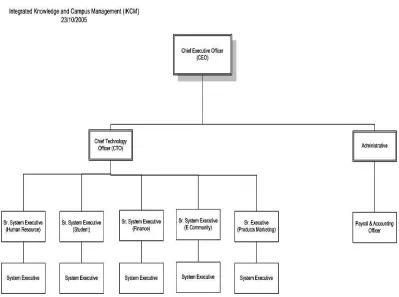
Figure 1.2 IKCM‘s Organization Chart
3 The above figure 1.2 (IKCM Organization Chart) shows that Chief Executive Officer or CEO is the highest ranking officer in IKCM. The CEO oversees the IKCM's finances and strategic planning. CEO reports to the board of directors and is responsible for carrying out the board’s policies. This executive officer has day-to-day management responsibility. Currently Mr. Richard Azlan Abas is appointing as CEO of IKCM.
The Chief Technology Officer (CTO) is the person responsible for accomplishing the project objectives. He is examining, evaluating, and assessing the impact of potential changes in the market. CTO is constantly evaluating ways to improve the skill set of the development team. That can be through the use of a new tool or technique, or additional training on fundamental skills that the team already knows but doesn't execute consistently. CTO also is often the cheerleader that pumps up the development team, encouraging them to remember the company vision, to be a part of greatness and competitive IT company player in the market. Currently Mr. Amir bin Ayub is appointing as CTO of IKCM.
Senior System Executive is the ones who delivers solutions develops functional requirements from business requirement specifications, coordinates user requirements, reports project progress to management, manages tasks, controls expenses and improves project quality results. He also participates in establishing organization-wide project standards and best practices including developing repeatable processes, policies and procedures, Develops detailed, realistic, and comprehensive plans that support the Software Development Life Cycle and organizational objectives. Each Oracle application will have a dedicated team assigned to design, build, test, deploy and stabilize the applications.
A Marketing Officer finding out what customers want then sets out to meet their needs, provided it can be done at a profit. Marketing officer making customers aware of products and services, attracting new customers to a product or service, keeping existing customers interested in a product or service, building and maintaining a customer base for a product or service.
Last but not least, Administrative officer works activities in IKCM relating to planning, organizing, directing, controlling, supervising and budgeting of day to day operations
1.3 Project background
IMS Education comprises of 5 complete integrated systems, which are designed to support both client and web based applications with a 3-tier
architectures: -
1.3.1 IMS e-Community
1.3.2 IMS Student Information System 1.3.3 IMS Integrated Financial System
1.3.4 IMS Human Resource & Administration System 1.3.5 IMS e-Learning
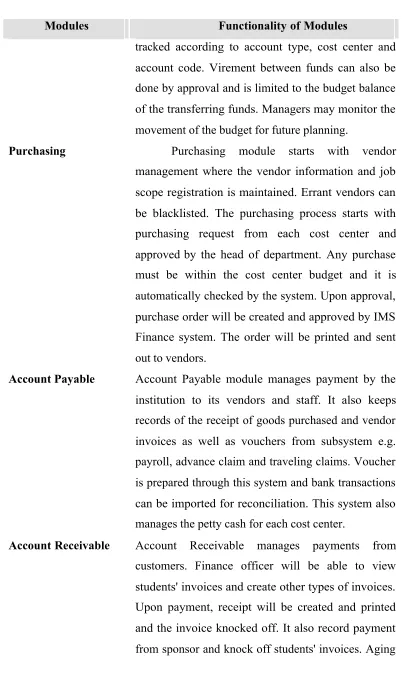
Table 1.3 IMS Financial module functionalities
Modules Functionality of Modules
5
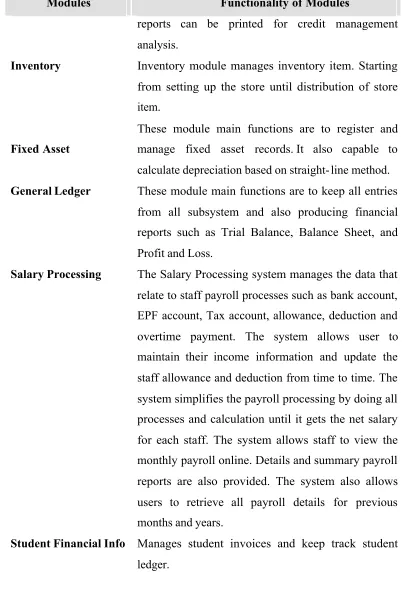
Table 1.3 IMS Financial module functionalities
Modules Functionality of Modules
tracked according to account type, cost center and account code. Virement between funds can also be done by approval and is limited to the budget balance of the transferring funds. Managers may monitor the movement of the budget for future planning.
Purchasing Purchasing module starts with vendor management where the vendor information and job scope registration is maintained. Errant vendors can be blacklisted. The purchasing process starts with purchasing request from each cost center and approved by the head of department. Any purchase must be within the cost center budget and it is automatically checked by the system. Upon approval, purchase order will be created and approved by IMS Finance system. The order will be printed and sent out to vendors.
Account Payable Account Payable module manages payment by the institution to its vendors and staff. It also keeps records of the receipt of goods purchased and vendor invoices as well as vouchers from subsystem e.g. payroll, advance claim and traveling claims. Voucher is prepared through this system and bank transactions can be imported for reconciliation. This system also manages the petty cash for each cost center.
Table 1.3 IMS Financial module functionalities
Modules Functionality of Modules
reports can be printed for credit management analysis.
Inventory Inventory module manages inventory item. Starting from setting up the store until distribution of store item.
Fixed Asset
These module main functions are to register and manage fixed asset records. It also capable to calculate depreciation based on straight- line method. General Ledger These module main functions are to keep all entries
from all subsystem and also producing financial reports such as Trial Balance, Balance Sheet, and Profit and Loss.
Salary Processing The Salary Processing system manages the data that relate to staff payroll processes such as bank account, EPF account, Tax account, allowance, deduction and overtime payment. The system allows user to maintain their income information and update the staff allowance and deduction from time to time. The system simplifies the payroll processing by doing all processes and calculation until it gets the net salary for each staff. The system allows staff to view the monthly payroll online. Details and summary payroll reports are also provided. The system also allows users to retrieve all payroll details for previous months and years.
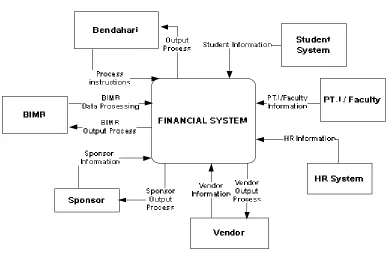
7 Besides the basic version of IMS Education, IKCM offers customization to meet different clients' needs. Apart from that, IKCM also provides extensive user training, ensuring clients of the fullest deployment of the system. Figure 1.3 below shows the overall architecture of IMS Financial System.
Figure 1.3: Overall architecture of IMS Financial System
payment terms, discounts, and cash management requires a flexible and adaptable system that optimizes the entire accounts payable process.
1.4 Importance to company
CHAPTER 6
CONCLUSION
First of all, being able to work in IKCM enabled the trainer to be exposed to the real software development and gain professional experience in software engineering area. As a software consultant for UPSI, not only knowledge in technical and business process is critical, having knowledge in software engineering is a must to every developer to ensure the system can be deliver on time, on budget and with high quality. Software developer must have a broad knowledge in a software process, software tools that support the process and the risk of using the software process. What is really important, the developer must know when to adapt the right software process at the right time.
The trainer also took the opportunity to contribute the good ideas and become active player in team of organization. This is shown with the methodology recommended for IKCM, RAD-CDM which is believed the appropriate methodology to develop iterative development of Account Payable module. RAD-CDM is a solution where a project is having problem with the changing of user requirements and thus will resulting project to be infinite period.
REFERENCES
Alistair Cockburn, 2000. Selecting a Project's Methodology. IEEE Software e-journal.
Andrew Odewahn (1999). Oracle Web Applications: PL/SQL Developer's Introduction, First Edition. O'Reily
ANSWERS Online, Website, http://answers.com
B. Boehm et al (1984). A Software Development Environment for Improving Productivity, Computer pp. 30-44.
Barker. R. (1990), CASE Method Entity Relationships Modelling. Oracle Corporation UK Limited, Addison-Wesley Publishing Company.
Barry Boehm and Alexander Egyed, 1998. Improving the Life-Cycle Process in Software Engineering Education. 24th Euromicro Conference. e-journal Beizer. Boris B (1995). Black Box Testing: Techniques for Functional Testing of Software Systems. New York: John Wiley and Sons.
Bell S and Wood-Harper T. (1998). Rapid Information Systems Development. Systems Analysis and Systems Design in an Imperfect World, 2nd edition, London: McGraw Hill.
Bell S and Alistair Cockburn, 2000. Selecting a Project's Methodology. IEEE Software e-journal.
94 Brian Henderson-Sellers, 2002. Process Metamodelling and Process Construction: Examples Using the OPEN Process Framework (OPF). Annals of Software Engineering 14, 341-362 e-journal, 2002
C. Rolland, 1998. A Comprehensive View of Process Engineering. Proceedings of the 10th International Conference CAiSE98, B. Lecture Notes in Computer Science 1413, Pernici, C. Thanos (Eds), Springer. Pisa, Italy. Charles Dye and John Beresniewicz. Steven Feuerstein (1998). Oracle Built-in Packages, First Edition. O'Reily
Chris Billings, Maria Billings, Julia Tower (1996). Rapid Application Development with Oracle Designer/2000, Addison-Wesley.
Dieter Scheithauer, Andrea Schindler, 2000, A Standardisation Concept for Non-Standard Development Projects, EUSEC 2000 journal.
Dr. Paul Dorsey, Dulcian (1997). Prototyping with Designer/2000 - Using CADM to Support RAD, Journal. E-journal
Dunn. Robert. Software Defect Removal. New York: McGraw-Hill. 1984. Eva Soderstrom, 2002. Towards a Framework for Comparing Process Modelling Languages. Stockholm University/Royal Institute of Technology F. P. Brooks. Jr (1975). The Mythical Man Month , Addison-Wesley p. 25. Fagan. M. E (1976). Design and Code Inspections to Reduce Errors in Program Development. IBM Systems Journal. Vol. 15. No. 3
GDPA Online. Website. http://www.informatik.uni-bremen.de/uniform/gdpa/ Gennick J. (1999). Oracle SQL*Plus - The Definitive Guide. Sebastopal. USA. Addison-Wesley.
Harlow: Addison-Wesley.Gennick J. (1999). Oracle SQL*Plus - The Definitive Guide. Sebastopal. USA: O'Reilly.
Haug Michael (2001). Software Quality Approaches: Testing. Verification. and Validation. Berlin: Springer-Verlag.
Ian Stevenson, Dave Ensor (1997). Oracle Design: The Definitive Guide, First Edition. O'Reily
IKCM Online. Website. http://www.ikcm.com.my
Insensee S. and Rudd J. (1996). The Art of Rapid Prototyping. London: Thompson Computer Press.
Integrated Knowledge and Campus Management (IKCM) Organization Chart June 2005
Jeffrey A. Hoffer (1998). Modern Systems Analysis and Design, 2nd Edition. Jonathan E. Cook Alexander L. Wolf, 1997. Software Process Validation: Quantitatively Measuring the Correspondence of a Process to a Model. University of Colorado e-journal
Jones Bridge, (2003). ROI through Electronic Invoice, Delivery and Payment (EIP) Improving a Key Business Process, i-Solutions Journal.
Kaner Cem. (1999). Testing Computer Software. Second Edition. New York: John Wiley Sons.
Krief P. (1996). Prototyping with Objectives, The Object-Oriented Series, Englewood Cliffs. NJ. USA: Prentice-Hall.
96 Pamela A. Sanders and Dr. John A.Hamilton, 2004. A Process for Interoperability. e-journal Auburn University
Perry. William (2000) Effective Methods for Software- Testing. New- York: John Wiley and Sons.
Redwood Shores(1998). Developer 2000, Form Builder, Vol. 1 and 2. CA. USA. Oracle Technical Press.
Reilly J. P. (1996). Rapid Prototyping, London: Thompson Computer
Roger S. Pressman (1997). Software Engineering. A Practitioner's Approach, 4th Edition.
Sikora Z. M. (1997). Oracle Database Principles, Basingstoke. Macmillan.Smith M. F. (1991). Software Prototyping. London: McGraw Hill Press.
Silvia T. acuÑa, 2000 Software Process Modelling. Universidad Nacional de Santiago del Estero. e-journal.
Stan Magee and Leonard L. Tripp (1997). Guide to Software Engineering Standards, Norwood, MA: Artech House.
Steven Feuerstein (1996). Advanced Oracle PL/SQL Programming with Packages, First Edition. O'Reily
Steven Feuerstein (1999). Oracle PL/SQL: Guide to Oracle8i Features, First Edition. O'Reily
Steven Feuerstein and Bill Pribyl (1997), Oracle PL/SQL Programming. Second Edition. O'Reily
Steven Feuerstein, Bill Pribyl and Chip Dawes (1999). Oracle PL/SQL Language Pocket Reference, First Edition. O'Reily
Wheeler. David A (1996) Software Inspection: An Industry Best Practice. Los Alamitos. CA: IEEE Computer Society Press.
Wiegers. Karl Eugene (2001) Peer Reviews in Software: A Practical Guide. Addison-Wesley
William E. Perry (2000). Effective Methods for Software Testing, New York: John Wiley Sorrs.
Wood-Harper T. (1998). Rapid Information Systems Development. Systems Analysis and Systems Design in an Imperfect World, 2nd edition, London: McGraw Hill.
Yingxu Wang and Antony Bryant, (2002). Process-Based Software Engineering: Building the Infrastructures. Annals of Software Engineering 14, 9-37 e-journal, 2002