Modelling Sentence Pairs with Tree-structured Attentive Encoder
Yao Zhou, Cong Liu∗ and Yan Pan
School of Data and Computer Science, Sun Yat-sen University
{liucong3, panyan5}@mail.sysu.edu.cn
Abstract
We describe an attentive encoder that combines tree-structured recursive neural networks and se-quential recurrent neural networks for modelling sentence pairs. Since existing attentive models exert attention on the sequential structure, we propose a way to incorporate attention into the tree topology. Specially, given a pair of sentences, our attentive encoder uses the representation of one sentence, which generated via an RNN, to guide the structural encoding of the other sentence on the dependency parse tree. We evaluate the proposed attentive encoder on three tasks: semantic similarity, paraphrase identification and true-false question selection. Experimental results show that our encoder outperforms all baselines and achieves state-of-the-art results on two tasks. 1 Introduction
Modelling a sentence pair is to score two pieces of sentences in terms of their semantic relationship. The applications include measuring the semantic relatedness of two sentences (Marelli et al., 2014), recognizing the textual entailment (Bowman et al., 2015) between the premise and hypothesis sentences, paraphrase identification (He et al., 2015), answer selection and query ranking (Yin et al., 2015) etc.
The approach of modelling a sentence pair based on neural networks usually consist of two steps. First, a sentence encoder transforms each sentence into a vector representation. Second, a classifier receives two sentence representations as features to make the classification. The sentence encoder can be regarded as a semantic compositional function which maps a sequence of word vectors to a sentence vector. This compositional function takes a range of different forms, including (but not limited to) sequential recurrent neural networks (Seq-RNNs) (Mikolov, 2012), tree-structured recursive neural networks (Tree-RNNs) (Socher et al., 2014; Tai et al., 2015) and convolutional neural networks (CNNs) (Kim, 2014).
We introduce an approach that combines recursive neural networks and recurrent neural networks with the attention mechanism, which has been widely used in the sequence to sequence learning (seq2seq) framework whose applications ranges from machine translation (Bahdanau et al., 2015; Luong et al., 2015), text summarization (Rush et al., 2015) to natural language conversation (Shang et al., 2015) and other NLP tasks such as question answering (Sukhbaatar et al., 2015; Hermann et al., 2015), classifica-tion (Rockt¨aschel et al., 2016; Shimaoka et al., 2016). In the machine translaclassifica-tion, the attenclassifica-tion mecha-nism is used to learn the alignments between source words and target words in the decoding phase. More generally, we consider that the motivation of attention mechanism is to allow the model to attend over a set of elements with the intention of attaching different emphases to each element. We argue that the attention mechanism used in a tree-structured model is different from a sequential model. Our idea is inspired by Rockt¨aschel et al. (2016) and Hermann et al. (2015). In this paper, we utilise the attention mechanism to select semantically more relevant child by the representation of one sentence learned by a Seq-RNNs, when constructing the head representation of the other sentence in the pair on a dependency tree. Since our model adopts the attention in the sentence encoding phase, we refer to it as an attentive
∗indicates the corresponding author.
Code is available athttps://github.com/yoosan/sentpair
This work is licensed under a Creative Commons Attribution 4.0 International License. License details: http:// creativecommons.org/licenses/by/4.0/
wa
1 wa2 wa3 wb3 w2b wb1
wa
2 wa3 wb3 wb2
wb
1 wa
1
Att Tree-RNNs
MLP
Seq-RNNs
sentenceSa
sentence Sb
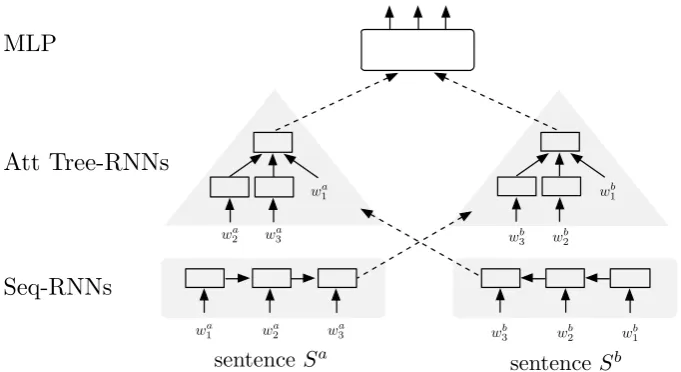
Figure 1: An overview of our tree-structured attentive encoder.
encoder. In this work, we implement this attentive encoder with two architectures: tree-structured LSTM and tree-structured GRU.
We evaluate the proposed encoder on three sentence pair modelling tasks: semantic similarity on the SICK dataset, paraphrase identification on the MSRP dataset and true-false question selection on the AI2-8grade science questions dataset. Experimental results demonstrate that our attentive encoder is able to outperform all non-attentional counterparts and achieves the state-of-the-art performance on the SICK dataset and AI2-8grade dataset.
2 Models
Let’s begin with a high-level discussion of our tree-structured attentive encoder. As shown in Figure 1An overview of our tree-structured attentive encoderfigure.1, given a sentence pair (Sa,Sb), our goal is to
score this sentence pair. Our tree-structured attentive model has two components. In the first component, a pair of sentences is fed to a Seq-RNNs, which encodes each sentence and results in a pair of sentence representations. In second component, the Attentive Tree-RNNs encodes a sentence again, aimed by the representation of the other sentence generated by the first component. Compared with the existing approaches of modelling sentence pairs, our attentive encoder consider not only the sentence itself but also the other sentence in the pair. Finally, the two sentence vectors produced by the second compo-nent are fed to the multilayer perceptron network to produce a distribution over possible values. These components will be detailed in the following sections.
2.1 Seq-RNNs
We first describe the RNN composer, which is the basic unit of Seq-RNNs. Given an input sequence of arbitrary length, an RNN composer iteratively computes a hidden statehtusing the input vectorxtand
its previous hidden stateht−1. In this paper, the input vectorxtis a word vector of the t-th word in a
sentence. The hidden statehtcan be interpreted as a distributed representation of the sequence of tokens
observed up to timet. Commonly, the RNN transition function is the following:
ht= tanh(W xt+Uht−1+b) (1)
ft
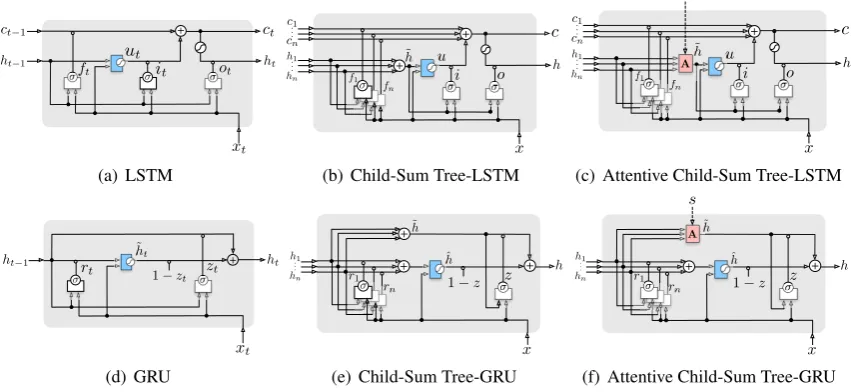
Figure 2: Illustrations of different recurrent architectures.
GRU (Figure 2(d)Subfigure 2(d)subfigure.2.4). The implementations of standard LSTM and GRU in this paper are same as (Luong et al., 2015) and (Chung et al., 2014). When we replace the standard RNN composer with LSTM or GRU, the Seq-RNNs becomes Seq-LSTMs or Seq-GRUs.
2.2 Standard Tree-RNNs
Compared with standard RNN composer, which computes its hidden state from the input at the current time step and the hidden state of previous time step, the Tree-RNN composer computes its hidden state from an input and the hidden states of arbitrarily many child units. We now describe theChild-Sum
Tree-LSTM andChild-Sum Tree-GRU architectures which are formed by applying theChild-Sumalgorithm
to LSTM and GRU respectively.
Child-Sum Tree-LSTM. In this paper, the implementation of Child-Sum Tree-LSTM is same as (Tai et al., 2015). We consider that a Child-Sum Tree-LSTM composer contains two parts: the external part and internal part. The external part consists of the inputs and outputs, and the internal part is the controllers and memory of the composer. As shown in Figure 2(b)Subfigure 2(b)subfigure.2.2, the inputs of the composer are: a input vectorx, multiple hidden statesh1, h2, . . . , hnand multiple memory cells
c1, c2, . . . , cn, wherenis the number of child units. The outputs consist of a memory cellcand a hidden
statehwhich can be interpreted as the representation of a phrase. The internal part aims at controlling the flow of information by an input gatei, an output gateoand multiple forget gatesf1, f2, . . . , fn. The
gating mechanisms used in the Child-Sum Tree-LSTM are similar to sequential LSTM. Intuitively, the sum of children’s hidden states˜his the previous hidden state, the forget gatefk controls the degree of
memory kept from that of the childk, the input gateicontrols how much the internal inputuis updated and the output gate controls the exposure of internal memoryc. We define the transition equations as follows:
the Tree-GRU removes the memory cell c and introduces an update gate z and multiple reset gates
r1, r2, . . . , rnthat allow the composer to reset the hidden states of the child units. The candidate hidden
stateˆh is computed similarly to the standard RNN (Equation 1Seq-RNNsequation.2.1) and the update gatez is used to control how much the previous hidden state˜h and the candidateˆhshould be passed. The transition equations of Tree-GRU are in the following:
˜
h=P1≤k≤nhk, rk=σ(W(r)x+U(r)hk+b(r)),
ˆ
h= tanh(W(h)x+U(h)Pn
k=1rkhk), z=σ(W(z)x+U(z)˜h+b(z))
h=z˜h+ (1−z)ˆh,
(3)
whereσdenotes the sigmoid function anddenotes element-wise multiplication.
We can easily apply the Child-Sum Tree-RNN to the dependency trees that have branching factors of arbitrary number and order-insensitive nodes. We refer to the model adopting the LSTM and Tree-GRU composer to the dependency tree as theDependency Tree-LSTMsandDependency Tree-GRUs. For simplicity, we also omit the prefix “Dependency” in the following sections.
2.3 Attentive Tree-RNNs
We now details how we extend the standard Tree-RNN. The idea that we incorporate the attention into the standard Tree-RNN comes from: (1) there will be semantic relevance between two sentences in the sentence pair modelling tasks; (2) the effect of semantic relevance could be implemented in the process of constructing the sentence representation by Tree-RNN where each child should be assigned a different weight; and (3) the attention mechanism is well suited for learning weights on a contextual collection where a guided vector is attending over.
Soft Attention Layer In this work, the attention mechanism is implemented by asoft attention layer A. Given a collection of hidden statesh1, h2, . . . , hn and an external vectors, the soft attention layer
produce a weightαkfor each hidden state as well as a weighted vectorgvia the Equations 4Soft Attention
Layerequation.2.4:
mk= tanh(W(m)hk+U(m)s), αk= exp(w
|m
k)
Pn
j=1exp(w|mj),
g=P1≤k≤nαkhk, (4)
Attentive Tree-LSTM and -GRU As illustrated in Figure 2(c)Subfigure 2(c)subfigure.2.3 and Fig-ure 2(f)SubfigFig-ure 2(f)subfigFig-ure.2.6, when the attention layer is embedded to the standard Tree-LSTM and Tree-GRU composer, these composers become the Attentive Tree-LSTM and Attentive Tree-GRU. The attention layer (notated withA) receives the children’s hidden states and an external vectors, produc-ing a weighted representationg(Equation 4Soft Attention Layerequation.2.4). In our implementation, the external vectorsis a vector representation of sentence learned by a Seq-RNNs. Specifically, if the tree composer is Attentive Tree-LSTM, then the Seq-RNNs is Seq-LSTMs. Instead of taking the sum of children’s hidden states as the previous hidden state˜hin the standard Tree-RNN, we compute a new hidden state by a transformation˜h= tanh(W(a)g+b(a)). Similar to the standard Tree-RNN, the atten-tive composers can also be easily applied to dependency trees. We refer to the model which applies the Attentive Tree-RNN composer to the dependency tree as the Attentive (Dependency) Tree-RNNs.
2.4 MLP
The multilayer perceptron network (MLP) receives a pair of vectors produced by the sentence encoder to compute a multinomial distribution over possible values. Given two sentence representationshLand
hR, we compute their componentwise producthLhRand their absolute difference|hL−hR|. These
hs, which is used to compute the probability distributionpˆθ. The equations are the following:
h×=hLhR, h+=|hL−hR|,
hs=σ(W(×)h×+W(+)h++b(h)),
ˆ
pθ =softmax(W(p)hs+b(p)),
(5)
3 Experiments and Results
Config Value Config Value
Word vectors Glove (Pennington et al., 2014) Dims of word vectors 300 OOV word vectors uniform(-0.05, 0.05) Dims of hidden state 150
Learning rate 0.05 Batch size 25
Regularization L2 withλ= 10−4 Dropout rate 0.5 Optim method Adagrad (Duchi et al., 2011) Num of epoch 10
Table 1: The training configs. We use the 300D Glove vectors as the initial word vectors. Out-of-vocabulary words are initialized with a uniform distribution. The model parameters are regularized with a per-minibatch L2 regularization strength of10−4. The dropout is used at the classifier with a dropout rate 0.5. All models are trained using Adagrad with a learning rate of 0.05. We train our models for 10 epochs, and pick the model that has the best results on the devlopment set to evaluate on the test set.
Our baselines In order to make a meaningful comparison between the sequential models, tree-structured models and attentive models, we present four baselines. They are: (i)Seq-LSTMs, learning two sentence representations by the sequential LSTMs; (ii)Seq-GRUs, like Seq-LSTMs but using GRU composer; (iii)Tree-LSTMs, learning two sentence representations by the Dependency Tree-LSTMs; and (iv) Tree-GRUs, like Tree-LSTMs but using Child-Sum Tree-GRU composer. The two sentence representations are fed to the MLP to produce a probability distribution.
3.1 Task 1: Semantic Similarity
First we conduct our semantic similarity experiment on the Sentences Involving Compositional Knowl-edge(SICK) dataset (Marelli et al., 2014)12. This task is to predict a similarity score of a pair of sentences,
based on human generated scores. The SICK dataset consists of 9927 sentence pairs with the split of 4500 training pairs, 500 development pairs and 4927 testing pairs. Each sentence pair is annotated with a similarity score ranging from 1 to 5. A high score indicates that the sentence pair is highly related. All sentences are derived from existing image and video annotation dataset. The evaluation metrics are Pearson’sr, Spearman’sρand mean squared error (MSE).
Recall that the output of MLP (Section 2.4MLPsubsection.2.4) is a probability distributionpˆθ. Our
goal in this task is to predict a similarity score of two sentences. Let r| = [1, . . . ,5] be an integer
vector, the similarity scoreyˆis computed byyˆ=r|pˆθ. We take the same setup as (Tai et al., 2015) that
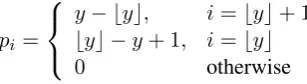
computes a target distributionpas a function of prediction scoreygiven by:
pi =
y− byc, i=byc+ 1
byc −y+ 1, i=byc
0 otherwise
The loss function of semantic similarity is the KL-divergence that measures the continuous distance between the predicted distributionpˆθand the distribution of the ground truthp:
J(θ) = 1
N
N
X
k=1
KL(p(k)pˆ(k)
Method r ρ MSE
ECNU (Zhao et al., 2014) 0.8414 -
-Dependency Tree-LSTMs (Tai et al., 2015) 0.8676 0.8083 0.2532 combine-skip+COCO (Kiros et al., 2015) 0.8655 0.7995 0.2561 ConvNet (He et al., 2015) 0.8686 0.8047 0.2606
Seq-GRUs 0.8595 0.7974 0.2689
Seq-LSTMs 0.8528 0.7911 0.2831
(Dependency) Tree-GRUs 0.8672 0.8116 0.2573 (Dependency) Tree-LSTMs(ours) 0.8664 0.8068 0.2610 +Attention
Attentive (Dependency) Tree-GRUs 0.8701 0.8085 0.2524 Attentive (Dependency) Tree-LSTMs 0.8730 0.8117 0.2426
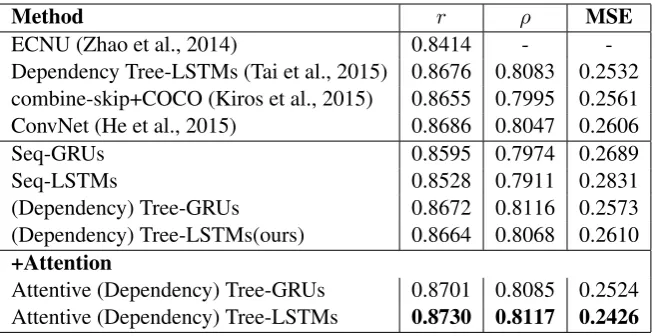
Table 2: Test set results on the SICK dataset. The first group is previous results, and remaining is ours.
The results are summarized in Table 2Test set results on the SICK dataset. The first group is pre-vious results, and remaining is ourstable.2. We first compare our results against the prepre-vious results. ECNU (Zhao et al., 2014), the best result of SemEval 2014 submissions, achieves a 0.8414r score by a heavily feature-engineered approach. Kiros et al. (2015) presents an unsupervised approach to learn the universal sentence vectors without depending on a specific task. Their Combine–skip+COCO model improve the Pearson’s r to 0.8655, but a weakness is that their sentence vectors are high-dimensional vectors (2400D). Training the skip-thoughts vectors needs a lot of time and space. He et al. (2015) show the effectiveness of convolutional nets with the similarity measurement layer for modelling sentence sim-ilarity. Their ConvNet outperforms ECNU with +0.027 Pearson’sr. We can observe that dependency Tree-LSTM, combine-skip+COCO and ConvNet almost achieve the same performance and our Atten-tive Tree-LSTMs outperforms these three methods around +0.005 points. Comparison to ECNU, our Attentive Tree-LSTMs gains an improvement of +0.032 and achieves the state-of-the-art performance. We find a phenomenon also appeared in (Tai et al., 2015) that tree-structured models can outperform se-quential counterparts. Comparison to the non-attentional baselines (such as Tree-LSTMs), the attention mechanism (such as Attentive Tree-LSTMs) gives us a boost of around +0.007. All results highlight that our attentive Tree-RNNs are well suited for the semantic similarity task.
3.2 Task 2: Paraphrase Identification
The next task we evaluate is paraphrase identification on the Microsoft Research Paraphrase Corpus (MSRP) (Dolan et al., 2004). Given two sentences, this task is to predict whether or not they are para-phrases. The dataset is collected from news sources and contains 5801 pairs of sentences, with 4076 for training and the remaining 1725 for testing. We randomly select 10% of training set and use them as our dev set. This task is a binary classification task, therefore we report the accuracy and F1 score.
Since that thepˆθ indicates the distribution over the possible labels, we takeargmax(ˆpθ) as the
pre-dicted label in the testing phase. The loss function for the binary classification is thebinary cross-entropy:
J(θ) =−N1 XN
k=1
(y(k)logpˆ(k)
θ + (1−y(k))log(1−pˆθ(k))) +λ2||θ||22 (7)
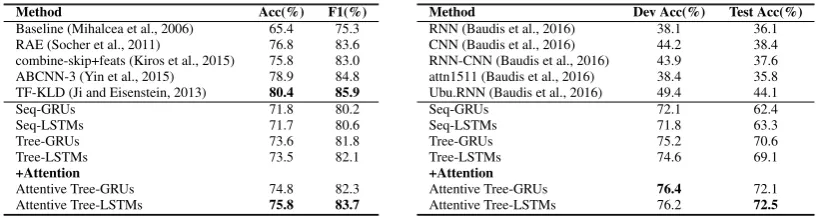
Table 3The test results of paraphrase identification on the Microsoft Paraphrase Corpus (Left) and true-false selection on the AI2-8grade dataset (Right)table.3 (left) presents our results on the MSRP dataset. The previous approaches are: (1) Baseline, cosine similarity with tf-idf weighting; (2) RAE,
1Dependency trees are parsed by the Stanford Parser package, http://nlp.stanford.edu/software/
lex-parser.html
Method Acc(%) F1(%) Baseline (Mihalcea et al., 2006) 65.4 75.3 RAE (Socher et al., 2011) 76.8 83.6 combine-skip+feats (Kiros et al., 2015) 75.8 83.0 ABCNN-3 (Yin et al., 2015) 78.9 84.8 TF-KLD (Ji and Eisenstein, 2013) 80.4 85.9
Seq-GRUs 71.8 80.2
Seq-LSTMs 71.7 80.6
Tree-GRUs 73.6 81.8
Tree-LSTMs 73.5 82.1
+Attention
Attentive Tree-GRUs 74.8 82.3 Attentive Tree-LSTMs 75.8 83.7
Method Dev Acc(%) Test Acc(%) RNN (Baudis et al., 2016) 38.1 36.1 CNN (Baudis et al., 2016) 44.2 38.4 RNN-CNN (Baudis et al., 2016) 43.9 37.6 attn1511 (Baudis et al., 2016) 38.4 35.8 Ubu.RNN (Baudis et al., 2016) 49.4 44.1
Seq-GRUs 72.1 62.4
Seq-LSTMs 71.8 63.3
Tree-GRUs 75.2 70.6
Tree-LSTMs 74.6 69.1
+Attention
Attentive Tree-GRUs 76.4 72.1 Attentive Tree-LSTMs 76.2 72.5
Table 3: The test results of paraphrase identification on the Microsoft Paraphrase Corpus (Left) and true-false selection on the AI2-8grade dataset (Right).
recursive autoencoder with dynamic pooling; (3) combine-skip+feats, skip-thought vectors with features; (4) ABCNN-3, attention-based convolutional nets; and (5) TF-KLD, matrix factorization with supervised reweighting. First, all our models are able to outperform the baseline. We only compare our models with the neural networks-based approaches, including RAE and ABCNN-3 for a fair comparison. We find that our models do not prove to be very competitive. After a careful analysis, we conclude that the reasons are (1) our models are pure neural networks-based, we don’t add any features to identify paraphrases while the other methods have used additional features; (2) The MLP is not very suitable in this task. We attempt to replace the MLP with the cosine distance and euclidean distance in our future work. Although our models have not yet matched the SOTA performance, we obtain an improvement of +2.3 accuracy by Attentive Tree-LSTMs when we incorporate the attention into the standard Tree-LSTM.
3.3 Task 3: True-False Question Selection
We last consider a challenging task: selecting true or false given a scientific question and its evidence. In this task, we use the AI2-8grade dataset built by (Baudis et al., 2016). This dataset is derived from
theAI2 Elementary School Science Questionsreleased by Allen Institute. Each sentence pair consists of
a hypothesis sentence processed by substituting thewh-word in the question by answer and its evidence sentence extracted from a collection of CK12 textbooks. The number of sample pairs in the training, development, and test set are 12689, 2483 and 11359 respectively. This dataset contains 626 words not appearing inGlove vectors, most of which are named entities and scientific jargons.
The loss function is the same as the paraphrase identification since this task is also a binary classifi-cation task. We reports the accuracy on development set and test set shown in Table 3The test results of paraphrase identification on the Microsoft Paraphrase Corpus (Left) and true-false selection on the AI2-8grade dataset (Right)table.3 (right). Since this dataset is a fresh and uncompleted dataset, we only compare our models with Baudis et al. (2016) who have evaluated several models on it. Comparison to (Baudis et al., 2016), all of our models gain a significant improvement. Specially, our best result achieved by the Attentive Tree-LSTMs is higher than the best of (Baudis et al., 2016) by +28 percents. It is observed that tree-structured models are more competitive than the sequential counterparts. As we expected, the attentive models can outperform all non-attentional counterparts.
4 Quantitative Analysis
4 6 8 10 12 14 16 18 20 22 c * (ngrams / mean_sent_length)
0.5
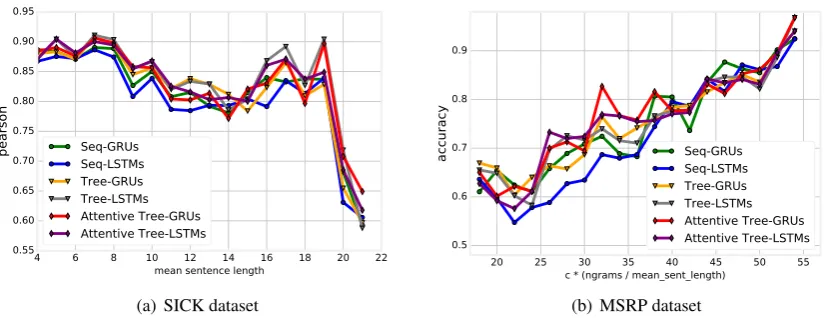
Figure 3: Qualities of different models based on mean sentence length andn-grams overlap
Dataset Sentence 1 Sentence 2 GT Pred
SICK The black dog is playing with the brown dog on the sandA brown dog and a black dog are playing in the sand A black dog is playing with a brown dog on the sandThe black dog is playing with the brown dog on the sand 4.85.0 4.84.2 A brown dog and a black dog are playing in the sand A black dog is attacking a brown dog on the sand 3.5 3.4 The study is being published today in the journal Science. Their findings were published today in Science. 1 1
MSRP The launch marks the start of a new golden age in Mars ex-ploration. The launch marks the start of a race to find life on anotherplanet. 1 1 Last year, Comcast signed 1.5 million new digital cable
sub-scribers. Comcast has about 21.3 million cable subscribers, many inthe largest U.S. cities. 0 1 Sunlight is the nutrient source for some fungi ? The main difference between plants and fungi is how they
obtain energy. 0 0
AI2
Sunlight is the nutrient source for some fungi ? Plants are autotrophs, meaning that they make their own
“food” using the energy from sunlight. 0 0 Sunlight is the nutrient source for some fungi ? Fungi are heterotrophs, which means that they obtain their
“food” from outside of themselves. 0 0 Dead organisms is the nutrient source for some fungi ? Most fungi live in soil or dead matter, and in symbiotic
rela-tionships with plants, animals, or other fungi. 1 0 Dead organisms is the nutrient source for some fungi ? Relate the structure of fungi to how they obtain nutrients. 1 0 Dead organisms is the nutrient source for some fungi ? From dead plants to rotting fruit. 1 1
Table 4: Example predictions from the test set. GT: ground truth,Pred: predicted score.
unless the evidence of question is very strong.
Effect of Sentence Length In order to analyse the effect of mean sentence length on the SICK dataset, we draw the Figure 3(a)Subfigure 3(a)subfigure.3.1. We observe that the Pearson score become lower as sentence become longer. Compared with the Seq-RNNs, the Tree-RNNs obtain a little improvements. Specially, the Attentive Tree-GRUs proves to be more effective than Tree-GRUs when the mean sentence length reaches to 20.
Effect of N-grams In the MSR paraphrase corpus, a hypothesis is that two sentence tend to be paraphrases when the value of their n-gram overlap is high. As a result we present the Fig-ure 3(b)SubfigFig-ure 3(b)subfigFig-ure.3.2, x-axis is the normalizedn-grams overlap whose value is computed byc∗(unigrammean sent length+bigram+trigram), wherecequals to 50, and y-axis is the accuracy. We can observe that the Attentive Tree-GRUs are more effective than Tree-GRUs when the value of normalizedn-grams overalp is less than 40. The results suggest that our attentive models are more general.
Th
Figure 4: Heatmap of attention weights.
something”.
5 Conclusion
In this paper, we introduced a way of incorporating attention into the Child-Sum LSTM and Tree-GRU that can be applied to the dependency tree. We evaluate the proposed models on three sentence pair modelling tasks and achieve state-of-the-art performance on two of them. Experiment results show that our attentive models are effective for modelling sentence pairs and can outperform all non-attentional counterparts. In the future, we will evaluate our models on the other sentence pair modelling tasks (such as RTE) and extend them to theseq2seqlearning framework.
Acknowledgements
This work was funded in part by the National Key Research and Development Program of China (2016YFB0201900), the National Science Foundation of China (grant 61472459, 61370021, U1401256, 61472453), Natural Science Foundation of Guangdong Province under Grant S2013010011905.
References
Dzmitry Bahdanau, Kyunghyun Cho, and Yoshua Bengio. 2015. Neural machine translation by jointly learning to align and translate. InInternational Conference on Learning Representations.
Petr Baudis, Silvestr Stanko, and Jan Sedivy. 2016. Joint learning of sentence embeddings for relevance and entailment. arXiv preprint arXiv:1605.04655.
Samuel R Bowman, Gabor Angeli, Christopher Potts, and Christopher D Manning. 2015. A large annotated corpus for learning natural language inference. InProceedings of the 2015 Conference on Empirical Methods in Natural Language Processing, pages 632–642.
Junyoung Chung, C¸alar G¨ulc¸ehre, Kyunghyun Cho, and Yoshua Bengio. 2014. Empirical evaluation of gated recurrent neural networks on sequence modeling. Technical Report Arxiv report 1412.3555, Universit´e de Montr´eal. Presented at the Deep Learning workshop at NIPS2014.
Bill Dolan, Chris Quirk, and Chris Brockett. 2004. Unsupervised construction of large paraphrase corpora: Ex-ploiting massively parallel news sources. InProceedings of the 20th international conference on Computational Linguistics, page 350. Association for Computational Linguistics.
John Duchi, Elad Hazan, and Yoram Singer. 2011. Adaptive subgradient methods for online learning and stochas-tic optimization. Journal of Machine Learning Research, 12(Jul):2121–2159.
Karl Moritz Hermann, Tomas Kocisky, Edward Grefenstette, Lasse Espeholt, Will Kay, Mustafa Suleyman, and Phil Blunsom. 2015. Teaching machines to read and comprehend. InAdvances in Neural Information Process-ing Systems, pages 1693–1701.
Sepp Hochreiter and J¨urgen Schmidhuber. 1997. Long short-term memory. Neural computation, 9(8):1735–1780. Sepp Hochreiter. 1998. The vanishing gradient problem during learning recurrent neural nets and problem
solu-tions. International Journal of Uncertainty, Fuzziness and Knowledge-Based Systems, 6(02):107–116.
Yangfeng Ji and Jacob Eisenstein. 2013. Discriminative improvements to distributional sentence similarity. In
Proceedings of the 2013 Conference on Empirical Methods in Natural Language Processing, pages 891–896. Nal Kalchbrenner, Edward Grefenstette, and Phil Blunsom. 2014. A convolutional neural network for modelling
sentences. InProceedings of the 52nd Annual Meeting of the Association for Computational Linguistics, pages 655–665.
Yoon Kim. 2014. Convolutional neural networks for sentence classification. InProceedings of the 2014 Confer-ence on Empirical Methods in Natural Language Processing (EMNLP), pages 1746–1751.
Ryan Kiros, Yukun Zhu, Ruslan R Salakhutdinov, Richard Zemel, Raquel Urtasun, Antonio Torralba, and Sanja Fidler. 2015. Skip-thought vectors. InAdvances in neural information processing systems, pages 3294–3302. Minh-Thang Luong, Hieu Pham, and Christopher D Manning. 2015. Effective approaches to attention-based
neural machine translation. InProceedings of the 2015 Conference on Empirical Methods in Natural Language Processing, pages 1412–1421.
Marco Marelli, Luisa Bentivogli, Marco Baroni, Raffaella Bernardi, Stefano Menini, and Roberto Zamparelli. 2014. Semeval-2014 task 1: Evaluation of compositional distributional semantic models on full sentences through semantic relatedness and textual entailment.SemEval-2014.
Rada Mihalcea, Courtney Corley, and Carlo Strapparava. 2006. Corpus-based and knowledge-based measures of text semantic similarity. InAAAI, volume 6, pages 775–780.
Tom´aˇs Mikolov. 2012. Statistical language models based on neural networks. Presentation at Google, Mountain View, 2nd April.
Jeffrey Pennington, Richard Socher, and Christopher D Manning. 2014. Glove: Global vectors for word rep-resentation. InProceedings of the 2014 Conference on Empirical Methods in Natural Language Processing, volume 14, pages 1532–43.
Tim Rockt¨aschel, Edward Grefenstette, Karl Moritz Hermann, Tom´aˇs Koˇcisk`y, and Phil Blunsom. 2016. Reason-ing about entailment with neural attention. InInternational Conference on Learning Representations.
Alexander M Rush, Sumit Chopra, and Jason Weston. 2015. A neural attention model for abstractive sentence summarization. InProceedings of the 2015 Conference on Empirical Methods in Natural Language Processing, pages 379–389.
Lifeng Shang, Zhengdong Lu, and Hang Li. 2015. Neural responding machine for short-text conversation. In Pro-ceedings of the 53rd Annual Meeting of the Association for Computational Linguistics and the 7th International Joint Conference on Natural Language Processing, pages 1577–1586.
Sonse Shimaoka, Pontus Stenetorp, Kentaro Inui, and Sebastian Riedel. 2016. An attentive neural architecture for fine-grained entity type classification. InProceedings of the 5th Workshop on Automated Knowledge Base Construction, San Diego, California, USA, June. to appear.
Richard Socher, Eric H Huang, Jeffrey Pennin, Christopher D Manning, and Andrew Y Ng. 2011. Dynamic pooling and unfolding recursive autoencoders for paraphrase detection. InAdvances in Neural Information Processing Systems, pages 801–809.
Richard Socher, Andrej Karpathy, Quoc V Le, Christopher D Manning, and Andrew Y Ng. 2014. Grounded compositional semantics for finding and describing images with sentences. Transactions of the Association for Computational Linguistics, 2:207–218.
Kai Sheng Tai, Richard Socher, and Christopher D Manning. 2015. Improved semantic representations from tree-structured long short-term memory networks. InProceedings of the 53rd Annual Meeting of the Association for Computational Linguistics and the 7th International Joint Conference on Natural Language Processing, pages 1556–1566.
Wenpeng Yin, Hinrich Sch¨utze, Bing Xiang, and Bowen Zhou. 2015. Abcnn: Attention-based convolutional neural network for modeling sentence pairs. arXiv preprint arXiv:1512.05193.