Decomposition Kernels for Natural Language Processing
Fabrizio Costa Sauro Menchetti Alessio Ceroni
Dipartimento di Sistemi e Informatica, Universit`a degli Studi di Firenze, via di S. Marta 3, 50139 Firenze, Italy
{costa,menchett,passerini,aceroni,p-f} AT dsi.unifi.it
Andrea Passerini Paolo Frasconi
Abstract
We propose a simple solution to the se-quence labeling problem based on an ex-tension of weighted decomposition ker-nels. We additionally introduce a multi-instance kernel approach for representing lexical word sense information. These new ideas have been preliminarily tested on named entity recognition and PP at-tachment disambiguation. We finally sug-gest how these techniques could be poten-tially merged using a declarative formal-ism that may provide a basis for the inte-gration of multiple sources of information when using kernel-based learning in NLP.
1 Introduction
Many tasks related to the analysis of natural lan-guage are best solved today by machine learning and other data driven approaches. In particular, several subproblems related to information extrac-tion can be formulated in the supervised learning framework, where statistical learning has rapidly become one of the preferred methods of choice. A common characteristic of many NLP problems is the relational and structured nature of the rep-resentations that describe data and that are inter-nally used by various algorithms. Hence, in or-der to develop effective learning algorithms, it is necessary to cope with the inherent structure that characterize linguistic entities. Kernel methods (see e.g. Shawe-Taylor and Cristianini, 2004) are well suited to handle learning tasks in structured domains as the statistical side of a learning algo-rithm can be naturally decoupled from any rep-resentational details that are handled by the ker-nel function. As a matter of facts, kerker-nel-based
weighted decomposition kernel (WDK) only small parts are matched, whereas the importance of the match is determined by comparing the sufficient statistics of elementary probabilistic models fit-ted on larger contextual substructures. Here we introduce a position-dependent version of WDK that can solve sequence labeling problems without searching the output space, as required by other re-cently proposed kernel-based solutions (Tsochan-taridis et al., 2004; Daum´e III and Marcu, 2005).
The paper is organized as follows. In the next two sections we briefly review decomposition ker-nels and its weighted variant. In Section 4 we in-troduce a version of WDK for solving supervised sequence labeling tasks and report a preliminary evaluation on a named entity recognition problem. In Section 5 we suggest a novel multi-instance ap-proach for representing WordNet information and present an application to the PP attachment am-biguity resolution problem. In Section 6 we dis-cuss how these ideas could be merged using a declarative formalism in order to integrate mul-tiple sources of information when using kernel-based learning in NLP.
2 Decomposition Kernels
An R-decomposition structure (Haussler, 1999; Shawe-Taylor and Cristianini, 2004) on a setX is a tripleR=hX~, R, ~kiwhereX~ = (X1, . . . ,XD) is a D–tuple of non–empty subsets of X, R is a finite relation on X1 × · · · × XD × X, and ~k = (k1, . . . , kD) is a D–tuple of positive defi-nite kernel functionskd:Xd× Xd7→IR.R(~x, x) is true iff ~x is a tuple of “parts” for x — i.e. ~x is a decomposition of x. Note that this defini-tion of “parts” is very general and does not re-quire the parthood relation to obey any specific mereological axioms, such as those that will be introduced in Section 6. For any x ∈ X, let R−1(x) = {(x
1, . . . , xD) ∈ X~ : R(~x, x)} de-note the multiset of all possible decompositions1 ofx. A decomposition kernel is then defined as themultiset kernelbetween the decompositions:
KR(x, x0) = X
~
x∈R−1(x)
~
x0∈R−1(x0)
D Y
d=1
κd(xd, x0d) (1)
1Decomposition examples in the string domain include
taking all the contiguous fixed-length substrings or all the possible ways of dividing a string into two contiguous sub-strings.
where, as an alternative way of combining the ker-nels, we can use the product instead of a summa-tion: intuitively this increases the feature space di-mension and makes the similarity measure more selective. Since decomposition kernels form a rather vast class, the relationR needs to be care-fully tuned to different applications in order to characterize a suitable kernel. As discussed in the Introduction, however, takingallpossible sub-parts into account may lead to poor predictivity be-cause of the combinatorial explosion of the feature space.
3 Weighted Decomposition Kernels
A weighted decomposition kernel (WDK) is char-acterized by the following decomposition struc-ture:
R=hX~, R,(δ, κ1, . . . , κD)i
whereX~ = (S, Z1, . . . , ZD),R(s, z1, . . . , zD, x) is true iffs∈Sis a subpart ofxcalled theselector
and~z= (z1, . . . , zD)∈Z1×· · ·×ZDis a tuple of subparts ofxcalled thecontextsofsinx. Precise definitions ofsand~z are domain-dependent. For example in (Menchetti et al., 2005) we present two formulations, one for comparing whole sequences (where both the selector and the context are subse-quences), and one for comparing attributed graphs (where the selector is a single vertex and the con-text is the subgraph reachable from the selector within a short path). The definition is completed by introducing a kernel on selectors and a kernel on contexts. The former can be chosen to be the exact matching kernel, δ, on S ×S, defined as δ(s, s0) = 1ifs=s0 andδ(s, s0) = 0otherwise. The latter, κd, is a kernel on Zd×Zd and pro-vides a soft similarity measure based on attribute frequencies. Several options are available for con-text kernels, including the discrete version of prob-ability product kernels (PPK) (Jebara et al., 2004) and histogram intersection kernels (HIK) (Odone et al., 2005). Assuming there are n categorical attributes, each taking on mi distinct values, the context kernel can be defined as:
κd(z, z0) = n X
i=1
ki(z, z0) (2)
kican be defined as a HIK or a PPK respectively:
ki(z, z0) = mi
X
j=1
min{pi(j), p0i(j)} (3)
ki(z, z0) = mi
X
j=1
q
pi(j)·p0i(j) (4)
This setting results in the following general form of the kernel:
K(x, x0) = X
(s, ~z)∈R−1(x)
(s0, ~z0)∈R−1(x0)
δ(s, s0)
D X
d=1
κd(zd, zd0) (5)
where we can replace the summation of kernels withQDd=11 +κd(zd, zd0).
Compared to kernels that simply count the num-ber of substructures, the above function weights different matches between selectors according to contextual information. The kernel can be after-wards normalized in [−1,1] to prevent similarity to be boosted by the mere size of the structures being compared.
4 WDK for sequence labeling and applications to NER
In a sequence labeling task we want to map input sequences to output sequences, or, more precisely, we want to map each element of an input sequence that takes label from a source alphabet to an ele-ment with label in a destination alphabet.
Here we cast the sequence labeling task into position specific classification, where different se-quence positions give independent examples. This is different from previous approaches in the lit-erature where the sequence labeling problem is solved by searching in the output space (Tsochan-taridis et al., 2004; Daum´e III and Marcu, 2005). Although the method lacks the potential for col-lectively labeling all positions simultaneously, it results in a much more efficient algorithm.
In the remainder of the section we introduce a specialized version of the weighted decompo-sition kernel suitable for a sequence transduction task originating in the natural language process-ing domain: the named entity recognition (NER) problem, where we map sentences to sequences of a reduced number of named entities (see Sec.4.1). More formally, given a finite dictionary Σ of words and an input sentencex∈Σ∗, our input ob-jects are pairs of sentences and indicesr = (x, t)
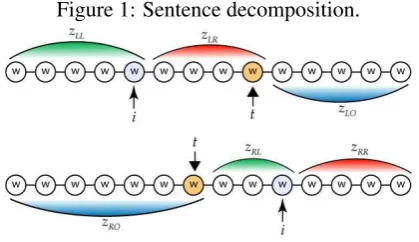
Figure 1: Sentence decomposition.
wherer ∈ Σ∗×IN. Given a sentencex, two in-tegersb≥ 1andb ≤ e≤ |x|, let x[b]denote the word at positionbandx[b..e]the sub-sequence of xspanning positions frombtoe. Finally we will denote byξ(x[b])a word attribute such as a mor-phological trait (is a numberorhas capital initial, see 4.1) for the word in sentencexat positionb.
We introduce two versions of WDK: one with four context types (D = 4) and one with in-creased contextual information (D = 6) (see Eq. 5). The relation R depends on two integers tandi ∈ {1, . . . ,|x|}, wheret indicates the po-sition of the word we want to classify and ithe position of a generic word in the sentence. The relation for the first kernel version is defined as: R = {(s, zLL, zLR, zRL, zRR, r)} such that the selectors=x[i]is the word at positioni, thezLL (LeftLeft) part is a sequence defined asx[1..i]if i < t or the null sequence ε otherwise and the zLR(LeftRight) part is the sequencex[i+ 1..t]if i < torεotherwise. Informally,zLL is the initial portion of the sentence up to word of position i, andzLR is the portion of the sentence from word at positioni+ 1 up to t (see Fig. 1). Note that when we are dealing with a word that lies to the left of the target wordt, itszRL andzRRparts are empty. Symmetrical definitions hold forzRL and zRRwheni > t. We define the weighted decom-position kernel for sequences as
K(r, r0)=
|x| X
t=1
|x0|
X
t0=1
δξ(s, s0) X
d∈{LL,LR,RL,RR}
κ(zd, zd0) (6)
where δξ(s, s0) = 1 if ξ(s) = ξ(s0) and 0 oth-erwise (that isδξchecks whether the two selector words have the same morphological trait) and κ is Eq. 2 with only one attribute which then boils down to Eq. 3 or Eq. 4, that is a kernel over the his-togram for word occurrences over a specific part.
of the entry we want to transduce and those to its right. The kernel computes the similarity for each sub-sequence by matching the corresponding bag of enriched words: each word is matched only with words that have the same trait as extracted by ξand the match is then weighted proportionally to the frequency count of identical words preceding and following it.
The kernel version with D=6 adds two parts calledzLO (LeftOther) andzRO (RightOther) de-fined asx[t+ 1..|r|]andx[1..t]respectively; these represent the remaining sequence parts so thatx=
zLL◦zLR◦zLOandx=zRL◦zRR◦zRO. Note that the WDK transforms the sentence in a bag of enriched words computed in a pprocessing phase thus achieving a significant re-duction in computational complexity (compared to the recursive procedure in (Lodhi et al., 2002)).
4.1 Named Entity Recognition Experimental
Results
Named entities are phrases that contain the names of persons, organizations, locations, times and quantities. For example in the following sentence:
[PER Wolff ] , currently a journalist in [LOC
Argentina ] , played with [PER Del Bosque ] in the
final years of the seventies in [ORG Real Madrid].
we are interested in predicting that Wolff and Del Bosque are people’s names, that Argentina is a name of a location and that Real Madrid is a name of an organization.
The chosen dataset is provided by the shared task of CoNLL–2002 (Saunders et al., 2002) which concerns language–independent named en-tity recognition. There are four types of phrases: person names (PER), organizations (ORG), loca-tions (LOC) and miscellaneous names (MISC), combined with two tags, B to denote the first item of a phrase and I for any non–initial word; all other phrases are classified as (OTHER). Of the two available languages (Spanish and Dutch), we run experiments only on the Spanish dataset which is a collection of news wire articles made available by the Spanish EFE News Agency. We select a sub-set of 300 sentences for training and we evaluate the performance on test set. For each category, we evaluate theFβ=1measure of 4 versions of WDK:
word histograms are matched using HIK (Eq. 3) and the kernels on various parts (zLL, zLR,etc) are combined with a summation SUMHIK or product PROHIK; alternatively the histograms are
com-Table 1: NER experiment D=4
CLASS SUMHIS PROHIS SUMPRO PROPRO
B-LOC 74.33 68.68 72.12 66.47
I-LOC 58.18 52.76 59.24 52.62
B-MISC 52.77 43.31 46.86 39.00
I-MISC 79.98 80.15 77.85 79.65
B-ORG 69.00 66.87 68.42 67.52
I-ORG 76.25 75.30 75.12 74.76
B-PER 60.11 56.60 59.33 54.80
I-PER 65.71 63.39 65.67 60.98
MICROFβ=1 69.28 66.33 68.03 65.30
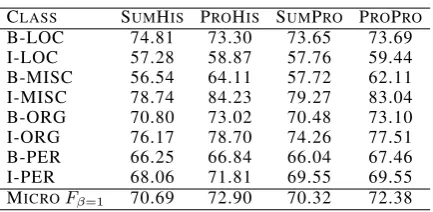
Table 2: NER experiment with D=6
CLASS SUMHIS PROHIS SUMPRO PROPRO
B-LOC 74.81 73.30 73.65 73.69
I-LOC 57.28 58.87 57.76 59.44
B-MISC 56.54 64.11 57.72 62.11
I-MISC 78.74 84.23 79.27 83.04
B-ORG 70.80 73.02 70.48 73.10
I-ORG 76.17 78.70 74.26 77.51
B-PER 66.25 66.84 66.04 67.46
I-PER 68.06 71.81 69.55 69.55
MICROFβ=1 70.69 72.90 70.32 72.38
bined with a PPK (Eq. 4) obtaining SUMPPK,
PROPPK.
The word attribute considered for the selector is a word morphologic trait that classifies a word in one of five possible categories: normal word, number, all capital letters, only capital initial and contains non alphabetic characters, while the con-text histograms are computed counting the exact word frequencies.
Results reported in Tab. 1 and Tab. 2 show that performance is mildly affected by the different choices on how to combine information on the var-ious contexts, though it seems clear that increasing contextual information has a positive influence.
Note that interesting preliminary results can be obtained even without the use of any refined lan-guage knowledge, such as part of speech tagging or shallow/deep parsing.
5 Kernels for word semantic ambiguity
Parsing a natural language sentence often involves the choice between different syntax structures that are equally admissible in the given grammar. One of the most studied ambiguity arise when deciding between attaching a prepositional phrase either to the noun phrase or to the verb phrase. An example could be:
The resolution of such ambiguities is usually per-formed by the human reader using its past expe-riences and the knowledge of the words mean-ing. Machine learning can simulate human experi-ence by using corpora of disambiguated phrases to compute a decision on new cases. However, given the number of different words that are currently used in texts, there would never be a sufficient dataset from which to learn. Adding semantic in-formation on the possible word meanings would permit the learning of rules that apply to entire cat-egories and can be generalized to all the member words.
5.1 Adding Semantic with WordNet
WordNet (Fellbaum, 1998) is an electronic lexi-cal database of English words built and annotated by linguistic researchers. WordNet is an exten-sive and reliable source of semantic information that can be used to enrich the representation of a word. Each word is represented in the database by a group ofsynonym sets(synset), with each synset corresponding to an individual linguistic concept. All the synsets contained in WordNet are linked by relations of various types. An important relation connects a synset to itshypernyms, that are its im-mediately broader concepts. The hypernym (and its oppositehyponym) relation defines a semantic hierarchy of synsets that can be represented as a directed acyclic graph. The different lexical cat-egories (verbs, nouns, adjectives and adverbs) are contained in distinct hierarchies and each one is rooted by many synsets.
Several metrics have been devised to compute a similarity score between two words using Word-Net. In the following we resort to a multiset ver-sion of the proximity measure used in (Siolas and d’Alche Buc, 2000), though more refined alterna-tives are also possible (for example using the con-ceptual density as in (Basili et al., 2005)). Given the acyclic nature of the semantic hierarchies, each synset can be represented by a group of paths that follows the hypernym relations and finish in one of the top level concepts. Two paths can then be com-pared by counting how many steps from the roots they have in common. This number must then be normalized dividing by the square root of the prod-uct between the path lengths. In this way one can accounts for the unbalancing that arise from dif-ferent parts of the hierarchies being difdif-ferently de-tailed. Given two paths π andπ0, letl andl0 be
their lengths and n be the size of their common part, the resulting kernel is:
k(π, π0) = √n
l·l0 (7)
The demonstration thatkis positive definite arise from the fact that n can be computed as a posi-tive kernel k∗ by summing the exact match ker-nels between the corresponding positions inπand π0 seen as sequences of synset identifiers. The lengthslandl0 can then be evaluated ask∗(π, π)
and k∗(π0, π0) and k is the resulting normalized version ofk∗.
The kernel between two synsets σ andσ0 can then be computed by the multi-set kernel (G¨artner et al., 2002a) between their corresponding paths. Synsets are organized into forty-five lexicogra-pher files based on syntactic category and logical groupings. Additional information can be derived by comparing the identifiersλandλ0 of these file associated toσandσ0. The resulting synset kernel is:
κσ(σ, σ0) =δ(λ, λ0) + X
π∈Π
X
π0∈Π0
k(π, π0) (8)
whereΠis the set of paths originating fromσand the exact match kernelδ(λ, λ0)is1ifλ≡λ0 and
0 otherwise. Finally, the kernel κω between two words is itself a multi-set kernel between the cor-responding sets of synsets:
κω(ω, ω0) = X
σ∈Σ
X
σ0∈Σ0
κσ(σ, σ0) (9)
whereΣare the synsets associated to the wordω.
5.2 PP Attachment Experimental Results
The experiments have been performed using the Wall-Street Journal dataset described in (Ratna-parkhi et al., 1994). This dataset contains20,800
training examples and 3,097 testing examples. Each phrasex in the dataset is reduced to a verb xv, its object nounxn1 and prepositional phrase
formed by a prepositionxp and a nounxn2. The
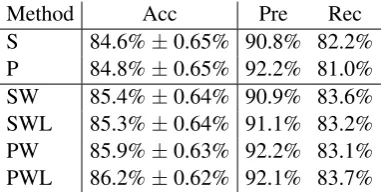
Method Acc Pre Rec S 84.6%±0.65% 90.8% 82.2% P 84.8%±0.65% 92.2% 81.0% SW 85.4%±0.64% 90.9% 83.6% SWL 85.3%±0.64% 91.1% 83.2% PW 85.9%±0.63% 92.2% 83.1% PWL 86.2%±0.62% 92.1% 83.7%
Table 3: Summary of the experimental results on the PP attachment problem for various kernel pa-rameters.
Results of the experiments are reported in Tab. 3 for various kernels parameters: S or P denote if the sum or product of the kernels between words are used, W denotes that WordNet semantic infor-mation is added (otherwise the kernel between two words is just the exact match kernel) and L denotes that lexicographer files identifiers are used. An ad-ditional gaussian kernel is used on top ofKpp. The C and γ parameters are selected using an inde-pendent validation set. For each setting, accuracy, precision and recall values on the test data are re-ported, along with the standard deviation of the es-timated binomial distribution of errors. The results demonstrate that semantic information can help in resolving PP ambiguities. A small difference ex-ists between taking the product instead of the sum of word kernels, and an additional increase in the amount of information available to the learner is given by the use of lexicographer files identifiers.
6 Using declarative knowledge for NLP kernel integration
Data objects in NLP often require complex repre-sentations; suffice it to say that a sentence is nat-urally represented as a variable length sequence of word tokens and that shallow/deep parsers are reliably used to enrich these representations with links between words to form parse trees. Finally, additional complexity can be introduced by in-cluding semantic information. Various facets of this richness of representations have been exten-sively investigated, including the expressiveness of various grammar formalisms, the exploitation of lexical representation (e.g. verb subcategoriza-tion, semantic tagging), and the use of machine readable sources of generic or specialized knowl-edge (dictionaries, thesauri, domain specific on-tologies). All these efforts are capable to address language specific sub-problems but their
integra-tion into a coherent framework is a difficult feat. Recent ideas for constructing kernel functions starting from logical representations may offer an appealing solution. G¨artner et al. (2002) have pro-posed a framework for defining kernels on higher-order logic individuals. Cumby and Roth (2003) used description logics to represent knowledge jointly with propositionalization for defining a ker-nel function. Frasconi et al. (2004) proposed kernels for handling supervised learning in a set-ting similar to that of inductive logic programming where data is represented as a collection of facts and background knowledge by a declarative pro-gram in first-order logic. In this section, we briefly review this approach and suggest a possible way of exploiting it for the integration of different sources of knowledge that may be available in NLP.
6.1 Declarative Kernels
The definition of decomposition kernels as re-ported in Section 2 is very general and covers al-most all kernels for discrete structured data de-veloped in the literature so far. Different kernels are designed by defining the relation decompos-ing an example into its “parts”, and specifydecompos-ing kernels for individual parts. In (Frasconi et al., 2004) we proposed a systematic approach to such design, consisting in formally defining a relation by the set of axioms it must satisfy. We relied on mereotopology (Varzi, 1996) (i.e. the theory of parts and places) in order to give a formal def-inition of the intuitive concepts of parthood and connection. The formalization of mereotopolog-ical relations allows to automatmereotopolog-ically deduce in-stances of such relations on the data, by exploit-ing the background knowledge which is typically available on structured domains. In (Frasconi et al., 2004) we introduceddeclarative kernels(DK) as a set of kernels working on mereotopological relations, such as that of proper parthood (≺P) or more complex relations based on connected parts. A typed syntax for objects was introduced in order to provide additional flexibility in defining kernels on instances of the given relation. A basic kernel on partsKP was defined as follows:
KP(x, x0) = X
s≺Px s0≺Px0
δT(s, s0) κ(s, s0)+KP(s, s0)
(10)
Declarative kernels were tested in (Frasconi et al., 2004) on a number of domains with promising results, including a biomedical information extrac-tion task (Goadrich et al., 2004) aimed at detecting protein-localization relationships within Medline abstracts. A DK on parts as the one defined in Eq. (10) outperformed state-of-the-art ILP-based systems Aleph and Gleaner (Goadrich et al., 2004) in such information extraction task, and required about three orders of magnitude less training time.
6.2 Weighted Decomposition Declarative
Kernels
Declarative kernels can be combined with WDK in a rather straightforward way, thus taking the ad-vantages of both methods. A simple approach is that of using proper parthood in place of selec-tors, and topology to recover the context of each proper part. A weighted decomposition declara-tive kernel (WD2K) of this kind would be defined as in Eq. (10) simply adding to the attribute ker-nelκa context kernel that compares the surround-ing of a pair of objects—as defined by the topol-ogy relation—using some aggregate kernel such as PPK or HIK (see Section 3). Note that such defini-tion extends WDK by adding recursion to the con-cept of comparison by selector, and DK by adding contexts to the kernel between parts. Multiple con-texts can be easily introduced by employing differ-ent notions of topology, provided they are consis-tent with mereotopological axioms. As an exam-ple, if objects are words in a textual document, we can define l-connection as the relation for which two words arel-connected if there are consequen-tial within the text with at most l words in be-tween, and obtain growingly large contexts by in-creasingl. Moreover, an extended representation of words, as the one employing WordNet semantic information, could be easily plugged in by includ-ing a kernel for synsets such as that in Section 5.1 into the kernel κ on word attributes. Additional relations could be easily formalized in order to ex-ploit specific linguisitc knowledge: a causal rela-tion would allow to distinguish between preceding and following context so to take into consideration word order; an underlap relation, associating two objects being parts of the same super-object (i.e. pre-terminals dominated by the same non-terminal node), would be able to express commanding no-tions.
The promising results obtained with declarative
kernels (where only very simple lexical informa-tion was used) together with the declarative ease to integrate arbitrary kernels on specific parts are all encouraging signs that boost our confidence in this line of research.
References
Roberto Basili, Marco Cammisa, and Alessandro
Mos-chitti. 2005. Effective use of wordnet
seman-tics via kernel-based learning. In 9th Conference
on Computational Natural Language Learning, Ann Arbor(MI), USA.
S. Ben-David, N. Eiron, and H. U. Simon. 2002. Lim-itations of learning via embeddings in euclidean half spaces.J. of Mach. Learning Research, 3:441–461.
M. Collins and N. Duffy. 2002. New ranking algo-rithms for parsing and tagging: Kernels over dis-crete structures, and the voted perceptron. In Pro-ceedings of the Fortieth Annual Meeting on Associa-tion for ComputaAssocia-tional Linguistics, pages 263–270, Philadelphia, PA, USA.
C. Cortes, P. Haffner, and M. Mohri. 2004.
Ratio-nal kernels: Theory and algorithms. J. of Machine
Learning Research, 5:1035–1062.
A. Culotta and J. Sorensen. 2004. Dependency tree kernels for relation extraction. InProc. of the 42nd Annual Meeting of the Association for Computa-tional Linguistics, pages 423–429.
C. M. Cumby and D. Roth. 2003. On kernel meth-ods for relational learning. InProc. Int. Conference on Machine Learning (ICML’03), pages 107–114, Washington, DC, USA.
H. Daum´e III and D. Marcu. 2005. Learning as search optimization: Approximate large margin methods for structured prediction. In International Confer-ence on Machine Learning (ICML), pages 169–176, Bonn, Germany.
C. Fellbaum, editor. 1998. WordNet: An Electronic
Lexical Database. The MIT Press.
P. Frasconi, S. Muggleton, H. Lodhi, and A. Passerini. 2004. Declarative kernels. Technical Report RT 2/2004, Universit`a di Firenze.
T. G¨artner, P. A. Flach, A. Kowalczyk, and A. J. Smola. 2002a. Multi-instance kernels. In C. Sammut and
A. Hoffmann, editors, Proceedings of the 19th
In-ternational Conference on Machine Learning, pages 179–186. Morgan Kaufmann.
T. G¨artner. 2003. A survey of kernels for structured
data. SIGKDD Explorations Newsletter, 5(1):49–
58.
M. Goadrich, L. Oliphant, and J. W. Shavlik. 2004. Learning ensembles of first-order clauses for recall-precision curves: A case study in biomedical infor-mation extraction. InProc. 14th Int. Conf. on Induc-tive Logic Programming, ILP ’04, pages 98–115.
D. Haussler. 1999. Convolution kernels on discrete
structures. Technical Report UCSC-CRL-99-10,
University of California, Santa Cruz.
T. Horv´ath, T. G¨artner, and S. Wrobel. 2004. Cyclic pattern kernels for predictive graph mining. In Pro-ceedings of the Tenth ACM SIGKDD International Conference on Knowledge Discovery and Data
Min-ing, pages 158–167. ACM Press.
T. Jebara, R. Kondor, and A. Howard. 2004. Proba-bility product kernels. J. Mach. Learn. Res., 5:819– 844.
H. Kashima and T. Koyanagi. 2002. Kernels for
Semi–Structured Data. InProceedings of the
Nine-teenth International Conference on Machine Learn-ing, pages 291–298.
H. Kashima, K. Tsuda, and A. Inokuchi. 2003.
Marginalized kernels between labeled graphs. In
Proceedings of the Twentieth International Confer-ence on Machine Learning, pages 321–328, Wash-ington, DC, USA.
C. S. Leslie, E. Eskin, and W. S. Noble. 2002. The spectrum kernel: A string kernel for SVM protein
classification. InPacific Symposium on
Biocomput-ing, pages 566–575.
H. Lodhi, C. Saunders, J. Shawe-Taylor, N. Cristian-ini, and C. Watkins. 2002. Text classification us-ing strus-ing kernels.Journal of Machine Learning Re-search, 2:419–444.
S. Menchetti, F. Costa, and P. Frasconi. 2005.
Weighted decomposition kernels. InProceedings of
the Twenty-second International Conference on Ma-chine Learning, pages 585–592, Bonn, Germany.
Alessandro Moschitti. 2004. A study on convolution kernels for shallow semantic parsing. In42-th Con-ference on Association for Computational Linguis-tic, Barcelona, Spain.
F. Odone, A. Barla, and A. Verri. 2005. Building
ker-nels from binary strings for image matching. IEEE
Transactions on Image Processing, 14(2):169–180.
A Ratnaparkhi, J. Reynar, and S. Roukos. 1994. A maximum entropy model for prepositional phrase
attachment. In Proceedings of the ARPA Human
Language Technology Workshop, pages 250–255, Plainsboro, NJ.
C. Saunders, H. Tschach, and J. Shawe-Taylor. 2002. Syllables and other string kernel extensions. In Pro-ceedings of the Nineteenth International Conference on Machine Learning, pages 530–537.
B. Sch¨olkopf, J. Weston, E. Eskin, C. S. Leslie, and W. S. Noble. 2002. A kernel approach for
learn-ing from almost orthogonal patterns. In Proc. of
ECML’02, pages 511–528.
J. Shawe-Taylor and N. Cristianini. 2004. Kernel
Methods for Pattern Analysis. Cambridge Univer-sity Press.
G. Siolas and F. d’Alche Buc. 2000. Support vector machines based on a semantic kernel for text
cate-gorization. InProceedings of the IEEE-INNS-ENNS
International Joint Conference on Neural Networks, volume 5, pages 205 – 209.
A.J. Smola and R. Kondor. 2003. Kernels and regular-ization on graphs. In B. Sch¨olkopf and M.K.
War-muth, editors, 16th Annual Conference on
Compu-tational Learning Theory and 7th Kernel Workshop, COLT/Kernel 2003, volume 2777 ofLecture Notes in Computer Science, pages 144–158. Springer.
J Stetina and M Nagao. 1997. Corpus based pp attach-ment ambiguity resolution with a semantic
dictio-nary. InProceedings of the Fifth Workshop on Very
Large Corpora, pages 66–80, Beijing, China.
J. Suzuki, H. Isozaki, and E. Maeda. 2004. Convo-lution kernels with feature selection for natural lan-guage processing tasks. InProc. of the 42nd Annual Meeting of the Association for Computational Lin-guistics, pages 119–126.
I. Tsochantaridis, T. Hofmann, T. Joachims, and Y. Al-tun. 2004. Support vector machine learning for in-terdependent and structured output spaces. InProc. 21st Int. Conf. on Machine Learning, pages 823– 830, Banff, Alberta, Canada.
A.C. Varzi. 1996. Parts, wholes, and part-whole
re-lations: the prospects of mereotopology. Data and
Knowledge Engineering, 20:259–286.