280
Multi-Objective Optimization of WEDM Machining
Parameters on SS-317 Using Grey Integrated Fuzzy
B. Yashwanth 1, T. Pratheep Reddy 2, Dr. M. Chandra Sekhar Reddy
Department of Mechanical Engineering 1,2,3, Student 1 , Asst. Professor,2 , Professor & HOD3 Email: [email protected]1
Abstract- The present study applied Grey integrated Fuzzy technique to optimize the Multi-objectives of Wire Electrical Discharge Machining parameters of SS 317. Process parameters viz., Pulse-on time, Pulse-off time and Peak Current and L9 orthogonal array is adopted for design of experiments. The objectives selected are of maximum material removal rate and minimum surface roughness. The optimal process parameters results in the lower roughness and more metal removal.
Index Terms-Wire EDM, SS 317, L9 Array, Multi-Objective, Grey Fuzzy
1. INTRODUCTION
In the field of structural and engineering applications, advanced metals and alloys [1] with lower density, higher strength and better properties compared to the existing one are the prior requirement. To fulfill the requirement, intense research of new Alloys and Composites [2] are in study at present research field.
SS 317 stainless steel is an advanced steel to SS 316 with the increase in nickel and molybdenum, which increases strength and corrosion resistance. SS 316 is used in numerous applications like heat exchangers, fittings & valves, vessels, desalination plants, piping, fasteners, and constructions as a replacement to identification of the suitable parameters and their ranges. Optimization methodology plays a vital role in fulfilling the needs of the industries.
Wire Electric Discharge Machining (WEDM) is an advanced machining process using in many industries all over the world for rapid machining with better has multi objectives for a single product. Optimization of multiple objectives by Grey integrated Fuzzy [4] is one of the best technique adopted among many other techniques. Grey relational analysis converts multi response into single.response as Grey relational grades.
Fuzzy logic was performed to the Grades to achieve optimal parameters and determined [5].
2. LITERATURE REVIEW
2.1 Single objective – Surface Roughness (Ra)
Raju et al. [6] studied the effect of Pulse on time, Peak current, Servo voltage and Wire tension on SS 316L and observed that Pulse on time is the most significant factor followed by peak current, servo voltage and wire tension respectively. Faiyaz et al. [7] conducted experiments on EN36 steel and found that Peak current plays important role than Pulse on time, Pulse off time and servo voltage.
Vijaya babu et al. [8] conducted experiments on AISI 316L steel and found that Pulse on time is a significant factor. Rajesh Khanna et al. [9] also studied and observed that Pulse off time has the most influent parameter on determining response characteristics of SS316.
2.2 Multi- objective – MRR and Ra
Rajmohan et al. [10] investigated on SS 304L using taguchi integrated Grey relational analysis, and observed that Pulse off time is the most significant factor that affects the Grey relational grade. Shunmuga Priyan et al. [11] observed that Pulse on, Pulse off, Servo Voltage and Wire feed has the effect on the Ra in the order and Pulse off time has opposite effect to pulse on time, in machining of SS 304 using GRA. MRR decrease with increase of pulse off time, while surface roughness reduces.
281 mostly affected by pulse-on time (Ton ) , Pulse off
time (TOff ) and Servo Voltage (SV) and Ra is mostly
affected by the peak current (Ip ), pulse-on time (Ton) , Pulse off time (TOff ) and Servo Voltage (SV).
Debasish Mohanty et al. [13] observes that all the WEDM Parameters plays significant role on MRR and Ra individually on machining of EN 31 steel.
Chandra Sekhar [14] investigated on SS 317 using grey relational analysis and observed that Pulse on time found to be the most significant factors influencing all responses and the grey relational grade is increased by 30% with the optimal parameters which improves the MRR and SR.
It is noted, from the literature review that most of the research work has been carried out using Grey relational analysis. In the present investigation, an attempt is made to determine and confirm the optimal process parameters using Grey integrated fuzzy. Minimizing surface roughness (Ra) and Maximizing material removal rate (MRR) are chosen as objectives. Pulse on, Pulse off and Peak Current are chosen as the machining parameters with a L9 array of DOE.
3. EXPERIMENTAL DETAILS:
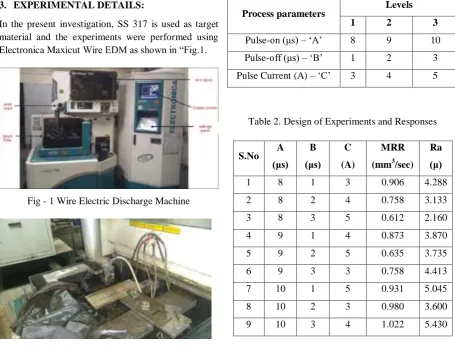
In the present investigation, SS 317 is used as target material and the experiments were performed using Electronica Maxicut Wire EDM as shown in “Fig.1.
Fig - 1 Wire Electric Discharge Machine
Fig - 2 Material in Fixture
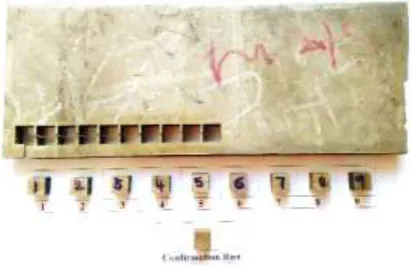
A brass wire of 0.25 mm dia was used as electrode to erode the metal under distilled water, maintaining a small gap of 0.025 mm to 0.05 between the wire and work-piece. The dimensions of 10 * 10 * 10 mm3 of the work piece selected for machining. Experiments were performed as per the DOE in Table 2 by setting the process parameters in the WEDM machine. A stopwatch is used to measure the time required for material removal of workpiece and talysurf instrument is used to measure surface roughness, and the results were tabulated in Table 2.
In the present study, three machining parameters with three levels were chosen for experimentation, which have more influence on material removal rate and surface roughness. The parameters and its levels are tabulated in Table 1, with L9 (3
3-1
= 32 = 9 runs) orthogonal array of DOE instead of L27
array (33 = 27 runs) to minimize the cost of experimentation.
Table 1. Machining parameters and levels
Process parameters Levels
1 2 3
Pulse-on (μs) – „A‟ 8 9 10 Pulse-off (μs) – „B‟ 1 2 3 Pulse Current (A) – „C‟ 3 4 5
Table 2. Design of Experiments and Responses
S.No A
(μs) B (μs)
C
(A)
MRR
(mm3/sec) Ra (μ)
1 8 1 3 0.906 4.288
2 8 2 4 0.758 3.133
3 8 3 5 0.612 2.160
4 9 1 4 0.873 3.870
5 9 2 5 0.635 3.735
6 9 3 3 0.758 4.413
7 10 1 5 0.931 5.045
8 10 2 3 0.980 3.600
282 Fig -3 Specimens after machining.
4. GREY INTEGRATED FUZZY
4.1 Grey relational analysis:
Grey relational analysis methodology is used by many researchers in solving complicated interrelationships among the multiple response characteristics problems. In this system the complete information will be in between black and white. If the information is known partially, the system is grey, and the relationship among factors in the system are uncertain. In a white system, the relationships among factors in the system are certain.
The analysis includes the following steps:
1. Conduct the experiments as per DOE.
2. Convert the experimental results into signal-to-noise (S/N) ratio. 3. Normalize the values of S/N ratio.
4. Calculate the grey relational coefficient.
5. Calculate the grey relational grade by averaging the grey relational coefficient.
4.1.1 Normalization:
Convert the original sequences to a set of comparable sequences by normalizing the data. Depending upon the response characteristic, three main categories for normalizing the data is as follows:
. (1)
4.1.2 Grey relational coefficient and grey relational grade
Grey relational coefficient and grey relational grade: Grey relation coefficient (αij) is calculated for each of
the performance characteristics, which expresses the relationship between ideal and actual normalized experimental results, as shown in “Eq.(4).”
Grey relational grade can be calculated by taking the average of is the weighted grey relational coefficient and defined as follows:
Table 3. Grey Relational Grades
Expt.
No
Normalized values Grey Relational Coefficients
Grey
Relational
Grades
MRR Ra MRR Ra
1 0.7157 0.3494 0.637 0.435 0.536 2 0.3545 0.7023 0.437 0.627 0.532 3 0.0000 1.0000 0.333 1.000 0.667 4 0.6348 0.4771 0.578 0.489 0.533 5 0.0569 0.5183 0.346 0.509 0.428 6 0.3545 0.3112 0.437 0.421 0.429 7 0.7773 0.1177 0.692 0.362 0.527 8 0.8974 0.5596 0.830 0.532 0.681
9 1.0000 0.0000 1.000 0.333 0.667
4.2 Determination of fuzzy grade
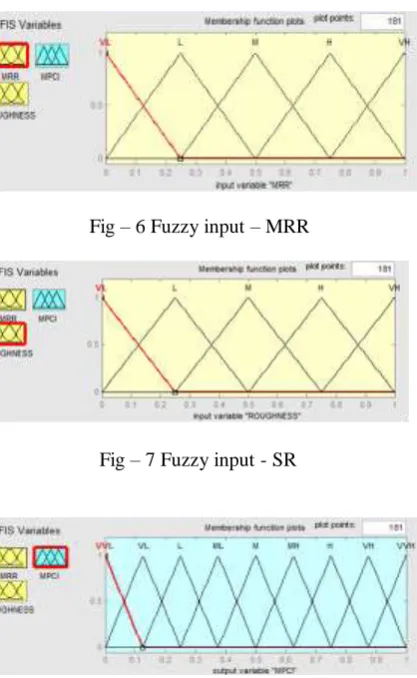
Fuzzy defines the relationship between system input and desired outputs in linguistic form. A fuzzy logic unit comprises a fuzzifier, membership functions, a fuzzy rule base, an inference engine and a defuzzifier as shown in “Fig. 1”.
283 desired output is targeted on maximizing grey relation fuzzy grade. The fuzzy inputs are uniformly assigned into five fuzzy subsets – very low (VL), low (L), medium (M), High (H) and very High (VH) grade, as shown in “Fig. [4-5]”. Unlike the input variables, the output variable is assigned into relatively nine subsets i.e., very very low (VVL), very low (VL), Low (L), medium low (ML), medium (M), medium high (MH), high (H), very high (VH), very very high (VVH), as
Table 5. MPCI (Grey Fuzzy Grades)
284 Table 6. Response table for Grey-Fuzzy grade
LEVEL PULSE
5. ANALYSIS OF VARIANCE (ANOVA)
ANOVA is performed to identify the contribution of process parameters of WEDM on MPCI‟s. An ANOVA table as shown in Table 7. consists of degrees of freedom, sums of squares and the percentage of contribution.
Table 7. Analysis of Variance
Source DF Seq SS Adj SS % Pulse on and Pulse off have the most influence on the MPCI, which coincides with the results of Table 6. It is observed that the Pulse On (55.16%) is most significant factor followed by Pulse off (6.62%), and Pulse current (2.96%).
Fig - 9 Optimal Parameters – MPCI
6. CONFIRMATION TEST
After determining the optimal combination of parameters, the last phase is to verify the MRR, surface roughness by conducting the confirmation experiment. The A3B3C2 is an optimal parameter
combination of the machining process by Grey Fuzzy Methodology. The confirmation test is carried out with the optimal parameter combination A3B3C2, and the
results are tabulated in Table.8 and the grey fuzzy grade is increased by 31%. It is clear that the MRR and SR increased greatly with the optimal parameters.
Table 8. Confirmation test results
Type Optimal / significance of process parameters for each response variable has been investigated using ANOVA.
• Pulse on time found to be the most significant factors influencing all responses investigated for both the experiment sets.
• The A3B3C2 is an optimal parameter
combination of the machining process by Grey Fuzzy Methodolgy.
• The grey relational grade is increased by 31%. It is clear that the MRR and SR increased greatly with the optimal parameters.
REFERENCES
285 [2] Narasimha, G.B., Krishna, M.V. and Xavior,
A.M., (2014). A Comparative Study on Analytical and Experimental Buckling Stability of Metal Matrix Composite Columns with Fixed & Hinged Ends. International Journal of Applied Engineering Research, 9(2), pp.191-196.
[3] Narasimha, G.B., Krishna, M.V. and Sindhu, R., (2014). Prediction of Wear Behaviour of Almg1sicu Hybrid MMC Using Taguchi with Grey Rational Analysis. Procedia Engineering, 97, pp.555-562.
[4] Krishna, M.V., Narasimha, G.B., Rajesh, N. and Xavior, A.M., (2015). Optimization of Influential Parameters on Mechanical Behaviour of AlMg1 SiCu Hybrid Metal Matrix Composites using Taguchi Integrated Fuzzy Approach. Materials Today: Proceedings, 2(4-5), pp.1464-1468. [5] Munuswamy, U. and Reddy, T.P., 2016.
Multiobjective Optimization of WEDM Process Parameters on Al5052/Sic/Gr Hybrid MMC Using Grey Fuzzy. International Research Journal of Engineering and Technology, 3, p.8..
[6] Raju, P., Sarcar, M.M.M. and Satyanarayana, B., (2014). Optimization of Wire Electric Discharge Machining Parameters for Surface Roughness on 316 L Stainless Steel Using Full Factorial Experimental Design. Procedia Materials Science, 5, pp.1670-1676.
[7] Faiyaz, K; Ajay Sharma, S K; Md Azam; Amit, S; Suman, S (2015): Optimization of Machining Parameter for Surface Roughness on wedm of En36 Alloy Steel, IOSR Journal of Mechanical and Civil Engineering, 12, (6), 101-104.
[8] Vijaya Babu, T; Soni, J.S: Optimization of wedm parameters for surface roughness on aisi 316 l stainless steel using anova”, International Journal of Latest Trends in Engineering and Technology 8(1), pp.212-215.
[9] Rajesh Kanna, S K; Sethuramalingam P, (2017): Stainless Steel 316 Wire EDM Process Parameter Optimization by Using Taguchi Method, International Journal of Emerging Research in Management &Technology, 6(2), pp. 69 -73.
[10]Rajmohan, T; Gopi Krishna; Ankit Kumar Singh; A.P.V. Swamy Naidu (2015): Multiple Performance Optimization in WEDM Parameters using Grey Relational Analysis, Applied Mechanics and Materials, 813-814, pp 357-361. [11]Shunmuga Priyan, M; W. Willbert Swin; Anand,
V., P. Kelvin; V. Sai Siva (2016): Investigation of Surface Roughness and MRR on Stainless Steel Machined by Wire EDM, International Journal of Engineering Research & Technology, 5(3), pp 66-71.
[12]Manish Saini; Rahul Sharma; Abhinav, Gurupreet Singh; Prabhat Mangla; Amit Sethi (2016): Optimizations of machining parameter in wire edm for 316L stainless steel by using taguchi method, anova, and grey analysis, International
Journal of Mechanical Engineering and Technology, 7(2) pp. 307–320.
[13]Debasish Mohanty; Narayan C. Nayak (2016): Effect of Process Parameters on Performance of EN-31 Steel using WEDM Experimentation and optimization, International Journal of Engineering Research & Technology, 5(7).