RESOLVING COMMUNICATION CONCERNS AND EXPLORING THE
EMERGENCE OF SOCIAL NETWORKS IN COLLABORATIVE
SOFTWARE DEVELOPMENT
S MD HAROON, D. KHADAR HUSSAIN
M.Tech. M.Tech,CSE Dept,
JNTUA College of Engineering,
Anantapur-515002, A.P.
C. NAGARJUNA J. SHILPA
M.Tech,CSE Dept, M.Tech,CSE Dept,
JNTUA College of Engineering, JNTUA College of Engineering,
Anantapur-515002, A.P. Anantapur-515002, A.P.
ABSTRACT
Collaborative software development is very important as the developers in a team might be
located in various geographical areas. There are groupware products that accommodate the
needs of the developers who collaborate. Formal and technical communication among the team
members is crucial for the success of the endeavor in this regard.Towards this end Treude and
Storey explored work item tagging in which they consider a scenario where multipleparties or
developers can involve in technical communication. Tagging a work item and updating it as the
work progresses can provide useful knowledge to team members so that they can avoid lengthy
technical discussions. Here Developa prototype application is designed and built in order to
facilitate multiple users of the development team who collaborate from different geographical
Technical communication among the three users is provided by the prototype besides
allowingthem to have informal communication. The experimental result reveals that the
prototype is useful to support communications among the members of collaborative software
development team.
Introduction
Software development has gone through many phases over a period of time. From the initial “trial and error” kind of development, it went to the software process models that can help in
systematic software development. The latest development is that the team members need not be
located in particular geographical area. It is possible to have collaborative software development
that helps team members to work a software product without time and geographical restrictions.
With these provisions in place, humans can solve very complex problems as well [1]. Computer
Aided Software Engineering (CASE) is the discipline that helps developers to utilize the
computerized software development which increases the productivity. With the help of CASE
tools available, it is possible to achieve smooth communication across the stakeholders of a
project. Though individuals are involved in software development, an individual is not doing it
alone. It is the combined effort of many users and now it is also possible for a team of members
to collaborate from various geographical locations across the globe.
The tools that are existed for collaborative software development include Jazz [2] and
INCOME/START [2]. The former is from IBM. These tools help the communication process of
the team members. However, these tools do not have any communication procedures with
respect to social aspects [4]. Thus there is possible necessity for such tools to have
communication provisions for social networking as well among the software team members. The
formal and informal communications can help to built relationships among the team members
besides solving problem in technical communication. The Jazz tool is used to have light weight
communication in the form of tagging. Tagging work items help in communication scenarios of
projects being done in collaborative fashion. In [5] the Jazz tool was explored in collaborative
environment. Here built a prototype application with web interface that helps people from many
development. A prototype application is built in order to facilitate multiple users of the
development team who collaborate from different geographical regions. The users involved
include tag authors, work item authors and work item owners. Technical communication among
the three users is provided by the prototype besides allowing them to have informal
communication.
The rest of this paper is designed as charts. Section 2 analysesrelatedworks. Section 3 focuses on
Jazz tool as described in [5]. Section 4 provides information about the proposed design and
implementation of web based prototype. Section 5 presents the experimental results while the
section 6 concludes this paper.
Related Works
This section reviews literature on prior works pertaining to collaborative computing and work
item tagging. Human beings saw the software development as a challenging task for many years
[1]. Traditionally the software development is carried out by group of people forming a team. As
part of software engineering there are many process models came into existence. As the task of
software development is not simply writing some programs, a systematic approach and
systematic communication process is required in the development process [6]. There are
necessary mechanisms to bring about coordination among the members of a team [7]. There are
many challenges and cultural issues involved in the team which is made up of people with
diverse skills [8]. When colleagues are there in different countries, they might be facing
difficulties to have collaborative access to software being developed [9]. In this case there should
a tool to achieve this kind of communication among team members.
The success of projects in collaborative environment depends on the proper communication
facilities provided by tools [10], [11]. Configuration management tools are also in place that help
in providing communication and resolve communication conflicts as explored in [12]. The
CASE tools such as Bugzilla can help developer to work faster and improve productivity in
software development [13]. A light weight social computing phenomenon such as tagging can be
used with social dimension. Many software tools used tagging for supporting technical
developers can have control technical communication that helps in collaborative computing
scenarios [14]. Another technique is annotations [15] which can be used for additional and
important communication in software development. Recent tool named Tag SEA [16] is used for
tagging in collaborative software development environment. Other tools which are in use include
concern Graphs [17] etc. Here build a tool that helps collaborative members to have formal and
informal communications.
JAZZ Tool EI Case Studies
In this section two tools which are already existed are studied. They are Jazz and EI. They
provided collaborative software development provisions and also resolve communication
problems among the team members. The Jazz tool supports integration of various phases in the
software development. Work items of various categories can be organized in it. Jazz has merit in
having tool support for collaborative software development. On the other hand EI is another tool
[image:4.612.205.409.402.506.2]that also supports collaboration. It also helps the teams in using work item tagging.
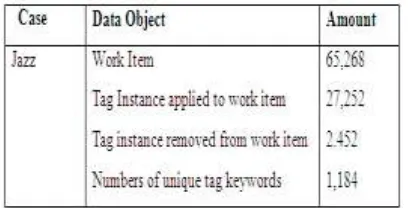
Table 1 shows the data extracted from various sources.
As shown in table 1, the data related to Jazz tool is taken from repositories. The count of work
items, the work item tagging used for work items and the instances of tags, number of keywords
used for tagging is shown in table 1.
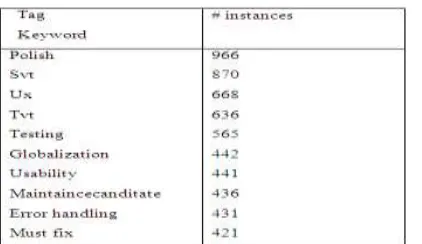
As seen in table 2, the frequency of tag instances of Jazz tool is presented in descending order by
the count of tag instances. Table 3 provides tag keywords that are most frequently shared in Jazz
[image:5.612.205.416.84.206.2]tool.
Table 3- Most Frequently Shared Tag Keywords in Jazz
As seen in table 3, it shows tag keywords, the number of instances and the number of users who used those tag instances.
Proposed System
The proposed system is modeled after the concepts provided in [5]. The aim of the proposed
system is to support collaborative software development in terms of work item tagging which
work item owner, work item author and tag author. Each user has specific role to play in the
application. All users can have collaborative communication with little effort. There will be no
lengthy discussions required as the tags can carry sufficient meaning that can be understood by
the team members. The communication concerns are taken care of by the tool that helps smooth
communication among the team members. The proposed tool is also compared with other tools
such as Jazz. The proposed application also supports limited social networking among the team
members to have informal communications. Thus the tool proposed can support both formal and
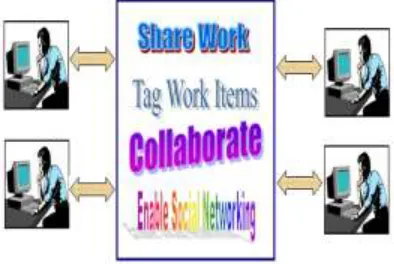
informal communications among the team members. Figure 1 shows the schematic overview of
[image:6.612.208.405.353.485.2]the proposed application.
Fig. 1 – Schematic Overview of the Proposed System
As shown in Figure 1, it is evident that the application has many provisions. They include
sharing of work, tagging the work items, collaborative communication and limited social
networking for informal communications among the team members.
Experimental Results
The environment used for the tool implementation includes a PC with 2GB of RAM and Core 2
Dual processor. JDK 1.7 and Tomcat 7.0 and Net Beans are used for the development of the tool.
First of all Jazz and EI tools were studied before implementing the proposed application. The
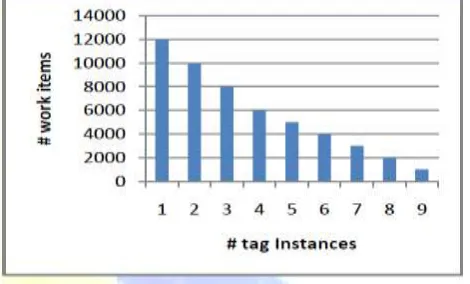
Fig. 2 – Distribution of Tag Instances to Work Items with respect to Jazz
As can be seen in fig. 2, it is evident that the horizontal axis represents tag instances while the
vertical axis represents number of work items. As the work items are increased the tag instances
[image:7.612.200.411.408.603.2]are also increased.
Fig. 3 – Number of instances and tag keywords (Jazz)
As Figure 3 shows there are number keywords and number of instances represented by
horizontal and vertical axes. The tag keywords include tooling, unclassified, testing, planning,
environment, documentation, cross cutting, collaboration, component, architecture etc.
As Figure 4 shows there are number keywords and number of instances represented by
horizontal and vertical axes. The tag keywords include tooling, unclassified, testing, planning,
environment, documentation, cross cutting, collaboration, component, architecture etc.
Conclusion
This paper focuses on studying the need for collaborative software development and the tools
available for the same. Here build a prototype application or a tool that can help a group of
people to collaborate and have technical communication among them. The users who use this
application include work item owners, work item authors and tag authors. The tagging concept
helps them to have purely technical communication among them. The tagging eliminates the
need for complex interactions unnecessarily. Moreover the tool also facilitates to have informal
communication among the team members in order to have limited social networking capabilities.
Thus the tool became important communication medium for both formal and information
communications among the team members who participate in collaborative software
development. The empirical results are encouraging.
References
[2] R. Frost, “Jazz and the Eclipse Way of Collaboration,” IEEE Software, vol. 24, no. 6, pp. 114-117, Nov. /Dec. 2007.
[3] S. Golder and B.A. Huber man, “Usage Patterns of Collaborative Tagging Systems,” J. Information Science, vol. 32, no. 2, pp. 198-208, 2006.
[4] H. Kagdi, J.I. Maletic, and B. Sharif, “Mining Software Repositories for Traceability Links,” Proc. 15th IEEE Int‟l Conf. Program Comprehension, pp. 145-154, 2007.
[5] Christoph Treude and Margaret-Anne Storey, “Work Item Tagging: Communicating Concerns in Collaborative Software Development”, IEEE TRANSACTIONS ON SOFTWARE ENGINEERING, VOL. 38, NO. 1, JANUARY/FEBRUARY 2012
[6] T. Ostrand and E. Weyuker, “A Tool for Mining Defect- Tracking Systems to Predict Fault-Prone Files,” IEE Seminar Digests, vol. 2004, no. 917, pp. 85-89, 2004
[7] M. Cataldo, M. Bass, J.D. Herbsleb, and L. Bass, “On Coordination Mechanisms in Global Software Development,” Proc. Int‟l Conf. Global Software Eng., pp. 71-80, 2007.
[8] J.D. Herbsleb and D. Moitra, “Guest Editors‟ Introduction: Global Software Development,” IEEE Software, vol. 18, no. 2, pp. 16-20, Mar. /Apr. 2001.
[9] J.D. Herbsleb, A. Mockus, T.A. Finholt, and R.E. Grinter, “An Empirical Study of Global Software Development: Distance and Speed,” Proc. 23rd Int‟l Conf. Software Eng., pp. 81-90, 2001.
[10] S. Faraj and L. Sproull, “Coordinating Expertise in Software Development Teams,” Management Science, vol. 46, no. 12, pp. 1554-1568, 2000.
[11] C. Gut win, R. Penner, and K. Schneider, “Group Awareness in Distributed Software Development,” Proc. ACM Conf. Computer Supported Cooperative Work, pp. 72-81, 2004.
[13] J.B. Ellis, S. Wahid, C. Danis, and W.A. Kellogg, “Task and Social Visualization in Software Development: Evaluation of a Prototype ,”Proc. SIGCHI Conf. Human Factors in Computing Systems ,pp. 577-586, 2007.
[14] C. Treude and M.-A.Storey, “How Tagging Helps Bridge the Gap between Social and Technical Aspects in Software Development,” Proc. 31st Int‟l Conf. Software Eng., pp. 12-22, 2009.
[15] A.E. Hassan and R.C. Holt, “Using Development History Sticky Notes to Understand Software Architecture,” Proc. 12th Int‟l Workshop Program Comprehension, pp. 183-192, 2004.
[16] M.-A. Storey, J. Ryall, J. Singer, D. Myers, L.-T. Cheng, and M. Muller, “How Software Developers Use Tagging to Support Reminding and Refinding,” IEEE Trans. Software Eng., vol. 35,no. 4, pp. 470-483, July/Aug. 2009.