Multiword Expressions in the Context of Statistical Machine
Translation
Mahmoud Ghoneim
Mona Diab
Center for Computational Learning Systems Department of Computer Science
Columbia University George Washington University
475 Riverside Drive MC 7717 801 22nd Street NW
New York, NY 10115 Washington DC 20052
[email protected] [email protected]
Abstract
Incorporating semantic information in the Statistical Machine Translation (SMT) framework is starting to gain some populari-ty in both the semantics and translation communities. In this paper, we present en-couraging results obtained from experi-ments conducted on English to Arabic SMT system using static, dynamic, and hybrid in-tegration of fine-grained Multiword Expres-sion (MWE). We achieve an improvement up to 0.82 absolute BLEU score by integrat-ing MWEs over a vanilla SMT system. We empirically show that different MWE types require different integration methods in the SMT framework.
1 Introduction
Multiword expressions (MWEs) are roughly de-fined by (Sag et al., 2002) as “idiosyncratic con-cepts that cross word boundaries (spaces).” MWEs are widely used, 41% of the entries in WordNet 1.7 (Fellbaum, 1998) are MWEs, but unfortunately they have proved to be hard to model in natural language processing applica-tions. Typical statistical machine translation (SMT) systems, in particular, do not explicitly model MWEs. This might indicate that state of the art SMT systems are doing well without hav-ing any knowledge of whether a given phrase is a multiword expression or not. However, recent research (Carpuat and Diab 2010, Bouamor et al., 2012) show that explicitly modeling MWEs in the SMT framework yields non-negligible gains depending on the integration method.
In this paper we study explicit modeling of the diverse kinds of MWEs in a phrase-based SMT framework for the English-Arabic language pair. This paper is organized as follows: section 2 overviews the different types of MWEs, section
3 reviews the previous work related to MWEs and SMT. Section 4 details our approach fol-lowed by the results in section 5. Our discussion of the results is presented in section 6 and finally the conclusions are in section 7.
2 Multiword Expressions Classification
According to (Sag et al., 2002), MWEs are broadly classified into institutionalized phrases and lexicalized phrases based on the varying de-gree of lexical rigidity and semantic composi-tionality.
Institutionalized phrases are conventional-ized phrases that are syntactically and semanti-cally compositional, but statistically idiosyncratic (e.g. “traffic light”, “to kindle ex-citement”.)
Lexicalized phrases have at least in part idio-syncratic syntax or semantics. They can be fur-ther broken down into:
(a) Fixed expressions which undergo neither morphosyntactic variation, nor internal modifica-tion (e.g. “by and large”, “every which way”) [AV, AJ],
(b) Semi-fixed expressions such as (1) non-decomposable idioms (e.g. “kick the bucket”) [VNC], (2) compound nominal (e.g. “car park”, “part of speech”) [NNC], and (3) proper names and named entities (e.g. “New York”) [NE].
(c) Syntactically-flexible expressions such as (1) verb particle construction (e.g. “write up”, “look up”) [VPC], (2) light verb constructions (e.g. “make a decision”) [LVC], and (3) decom-posable idioms (e.g. “sweep under the rug”) [VNC].
3 Related Work
Previous work has focused on automatically learning and integrating translations of very spe-cific MWE categories, such as, for instance, idi-omatic Chinese four character expressions (Bai
et al., 2009.) MWEs have also been defined not from a lexical semantics perspective but from a SMT error reduction perspective, as phrases that are hard to align during SMT training (Lambert and Banchs, 2005). For each of these particular cases, translation quality improved by augment-ing the SMT translation lexicon with the learned bilingual MWEs either directly or through im-proved word alignments.
Ren et al. (2009) described a method integrat-ing an in-domain bilintegrat-ingual MWE to Moses by introducing an additional feature that identifies whether or not a bilingual phrase contains bilin-gual MWEs. This approach was generalized in Carpuat and Diab (2010) who replaced the binary feature by a count feature representing the num-ber of MWEs in the source language phrase. They present results on a large data set of Eng-lish to Arabic SMT. They introduce two ways of integrating MWE knowledge in the SMT frame-work: Static and Dynamic integration. For Static integration, MWE tokens in the source data are grouped together with an underscore. While in Dynamic integration, the MWEs are identified in the phrase table and an additional weighted fea-ture, as a soft constraint, is added to the phrase translation table. Carpuat and Diab (2010) focus only on MWEs as identified in WordNet (Fellbaum, 1998) with no explicit distinction be-tween the different types of MWEs. Accordingly, the MWEs are considered a single type with no attention to various POS information. Our work here is taking a much fine grained approach and deeper study and analysis.
4 Approach
We adopt a Phrase-based SMT framework, Mo-ses (Koehn et al., 2007). In the following subsec-tions, we address the issue of representation of MWE in our SMT pipeline and then we investi-gate the manner in which the MWE information is integrated in the SMT framework.
4.1Data Sets
For training the translation models, we use LDC GALE newswire parallel Arabic-English corpus (LDC2007E103) (a total of 474299 sentence pairs / about 10M un-tokenized words / 12M to-kenized words). The Log-Linear model features weights are tuned using the newswire part of NIST MT06 (765 sentence pairs) as the tuning dataset and BLEU (Papineni et al., 2002) as the objective function. For training the language model (LM), we use the LDC Arabic
GIGAWORD 4th edition (LDC2009T30) (about 850M un-tokenized words).
We use the newswire part of NIST-MT04 (707 sentences) as our development test-set to com-pare performance and select combinations of dif-ferent conditions. We report results using two blind test-sets; NIST-MT05 (1056 sentences) and the newswire part of NIST-MT08 (813 sentenc-es). These standard test sets are originally de-signed to test Arabic to English translation systems thus it consists of one Arabic source set and four English human reference translation sets. To use these test sets for testing English to Arabic translation systems, we created new test sets where the source set is constructed by con-catenating the four English human translations of the original standard test set, and the reference set is constructed by duplicating the original standard test set Arabic source four times. This means that the new test sets have four times the number of sentences of the original standard test sets. Increasing the test set size enhances the reli-ability of the evaluation scores as reported by (Zhang and Vogel 2010).
4.2MWEs lists
We need a mechanism by which to identify MWE in the source English text. We rely on two identification sources depending on the type of MWE: an MWE list extracted from a wide cov-erage lexical database and a named entity recog-nition tool. As mentioned earlier in section 2, we consider several types of MWEs for this study: Verb-based MWEs (VNC, VPC, and LVC), Noun-based MWEs (NNC, and NE), Adjective (AJ) and Adverb (AV) based MWE.
WordNet Extracted MWEs Lists:
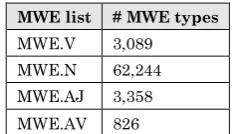
For the VPC, VNC, LVC, NNC and AJ and AV categories of MWE, we extract an extensive list from the wide coverage English WordNet data-base 3.0. (Fellbaum,1998). Table 1 shows the number of MWEs extracted from WordNet 3.0 dictionaries. It is worth noting that the MWE.V list comprises all three types of verbal MWEs (VNC, VPC, LVC), moreover the MWE.N in-cludes NNC and some NEs as listed in WordNet.
MWE list # MWE types
MWE.V 3,089
MWE.N 62,244
MWE.AJ 3,358
MWE.AV 826
Named Entities Tagging:
We consider Named Entities (NEs) as another type of MWE. To construct our NEs list, we ex-ploit a named entity tagger, the Stanford NER [SNER] (Finkel et al., 2005). SNER tags named entities in a given English text into three catego-ries: 1) Person 2) Organization and 3) Location.
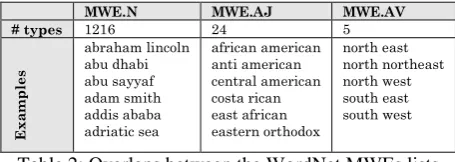
There are some overlaps between the NEs list and the MWE lists extracted from WordNet as
Table 2: Overlaps between the WordNet MWEs lists and the NEs list
Matching Algorithm:
In order to identify the MWE in the source Eng-lish side of the parallel data, we use a Maximum Forward Matching algorithm that finds the long-est matching MWE in the text. The algorithm matches over the tokenized version of the data and if no match, it backs-off to the lemmatized version to account for the different inflectional forms of the MWE (e.g. “take place” and “took place”.) Our current matching algorithm doesn’t handle gap flexibility like in the phrasal verbs MWEs (i.e. “break up” is handled while “break it up” is not.)
4.3SMT System
Data preprocessing and models generation:
The Arabic side of the train, tune, development and test data sets and the language model train-ing data sets are tokenized ustrain-ing AMIRA 2.1 toolkit (Diab 2009, Diab et al., 2007) into the Arabic TreeBank tokenization scheme. The Ara-bic side of the training data is further processed to generate a lemmatized version used in the alignment stage of the SMT pipeline. We use the undiacritized version (both tokenized and lem-matized) in all our experiments.
The English side is tokenized using Tree Tag-ger (Schmid, 1994). It is then tagged using the selected MWE list according to the condition under investigation. The English lemmatized version of the training data is also generated for use in alignment.
We used SRILM toolkit (Stolcke, 2002) to create a 5-gram Arabic LM modified using Kneser-Ney smoothing.
In all our experimental conditions, the parallel corpus is word-aligned using GIZA++ in both translation directions using the lemmatized ver-sion of both sides to decreases data sparseness, and phrase translations of up to 10 words are ex-tracted from the tokenized version of both sides using the grow-diag-final-and heuristic (Koehn et al., 2007).
We optimized log-linear model feature weights using Minimum Error Rate Training (MERT) (Och, 2003). To account for the
insta-In Static integration of MWEs in SMT, MWEs in English training, tuning and testing data are un-derscored as a preprocessing step based on a pat-tern match to the WN list entries and NER results. Hence static integration is a manipulation on the data representation, the SMT system is kept intact.
(b) Dynamic Integration (D)
Dynamic integration is a soft constraint strategy that adds a new feature into the log linear model of phrase-based SMT. It is a count feature indi-cating the number of MWEs in the English phrase in the phrase table, thereby biasing the system, at decoding time, towards using phrases that do not break MWEs. The training, tuning, development and test data do not undergo any MWEs annotation (no underscoring).
(c) Zone Integration (Z)
boundaries can be used in translation hypotheses without breaking the reordering constraint.
(d) Hybrid Integration
Motivated by the development-set results of the previous integration methods and MWEs schemes, we carried out a set of experiments in-vestigating combining the best performing condi-tions.
MWEs Schemes:
We created 7 MWEs schemes combining the various types of WordNet-based MWE lists and NEs list. They are listed in Table 3, along with the number of types and tokens of MWEs found in the training data according to each of the MWE Schemes.
We combine MWEs schemes and integration methods to get the different experimental condi-tions listed in Table 4. Here is some example input preprocessing for the same sentence ac-cording to different conditions:
-Baseline (and all dynamic integration):
invading iraqis kurdistan is no longer an easy task .
-S_VAA1:
invading iraqis kurdistan is no_longer an easy task .
-S_NN:
invading iraqis_kurdistan is no longer an easy task .
-Z_VAA+NN:
invading <zone> iraqis kurdistan </zone> is <zone> no longer </zone> an easy task .
5 Evaluation Results
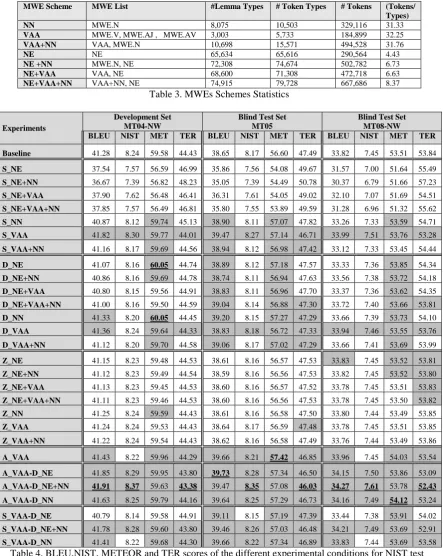
We used four standard MT metrics2; BLEU (Papineni et al., 2002), NIST (Doddington, 2002), METEOR3 (Banerjee and Lavie, 2005), and TER (Snover et al., 2006), to report and compare performance of different experimental conditions. Table 4, summarizes the results.
The results show that, for the three integration methods (S, D and Z), the only conditions that help across all test-sets are S_VAA and D_VAA. S_VAA gives the best results except for METEOR where D_NN and D_NE are outper-forming S_VAA.
1
We use the convention: IntegrationMethod_MWEScheme [-IntegrationMethod_MWEScheme]* to label different con-ditions: e.g “S_VAA-D_NE+NN” refers to a hybrid integra-tion where the “VAA” MWEs are statically integrated and the “NE+NN” MWEs are dynamically integrated.
2 We report case-sensitive scores as our system output is in
Buckwalter transliteration.
3
For METEOR scores, we used “exact” module only.
We want to investigate which part of the SMT pipeline does S_VAA condition help, so we car-ried another experiment (A_VAA) where the VAA is used in the alignment stage of the pipe-line only. We simply removed underscores from the input phrases in the phrase table and the lexi-cal reordering table and used the new tables as A_VAA tables. The tune and test data-sets are the same as the normal baseline (no underscor-ing). The results show that the major part of the S_VAA configuration enhancement is actually coming from the alignment stage.
Motivated by the development set results of S_VAA, A_VAA and the enhancement of METEOR scores by D_NN and D_NE, we car-ried out a couple of experiments investigating hybrids of the integration methods.
S_VAA-*: In these configurations we use stat-ic integration for VAA and dynamstat-ic integration for NE and/or NN. For example, for S_VAA-D_NE the input phrases in the phrase table have VAA MWEs underscored and the probabilities have the added extra feature counting NEs in the input phrase. The train, tune and test data for this configuration has VAA MWEs underscored.
A_VAA-*: In these configurations we use the phrase tables of the S_VAA and remove under-scores from the input phrases. We then add the extra feature indicating the counts of the NE and/or NN MWEs found in the input phrase.
Table 4 shows that A_VAA-D_NE+NN gives the best overall consistent performance with ab-solute BLEU score improvement of 0.63 for MT04-NW, 0.82 for MT05 and 0.45 for MT08-NW.
6 Discussion
created the new token “iraqis_kurdistan” which is not in the training data.
Dynamic integration helps solving this data sparsity issue by introducing a new feature that is weighted globally using all evidences belonging
to the same category to favor phrase pairs with unbroken MWE of that category. That’s why we see some improvements for NEs and NNs in ad-dition to VAA.
MWE Scheme MWE List #Lemma Types # Token Types # Tokens (Tokens/
Types)
NN MWE.N 8,075 10,503 329,116 31.33
VAA MWE.V, MWE.AJ , MWE.AV 3,003 5,733 184,899 32.25
VAA+NN VAA, MWE.N 10,698 15,571 494,528 31.76
NE NE 65,634 65,616 290,564 4.43
NE +NN MWE.N, NE 72,308 74,674 502,782 6.73
NE+VAA VAA, NE 68,600 71,308 472,718 6.63
NE+VAA+NN VAA+NN, NE 74,915 79,728 667,686 8.37
Table 3. MWEs Schemes Statistics
Experiments
Development Set MT04-NW
Blind Test Set MT05
Blind Test Set MT08-NW
BLEU NIST MET TER BLEU NIST MET TER BLEU NIST MET TER
Baseline 41.28 8.24 59.58 44.43 38.65 8.17 56.60 47.49 33.82 7.45 53.51 53.84
S_NE 37.54 7.57 56.59 46.99 35.86 7.56 54.08 49.67 31.57 7.00 51.64 55.49
S_NE+NN 36.67 7.39 56.82 48.23 35.05 7.39 54.49 50.78 30.37 6.79 51.66 57.23
S_NE+VAA 37.90 7.62 56.48 46.41 36.31 7.61 54.05 49.02 32.10 7.07 51.69 54.51
S_NE+VAA+NN 37.85 7.57 56.49 46.81 35.80 7.55 53.89 49.59 31.28 6.96 51.32 55.62
S_NN 40.87 8.12 59.74 45.13 38.90 8.11 57.07 47.82 33.26 7.33 53.59 54.71
S_VAA 41.82 8.30 59.77 44.01 39.47 8.27 57.14 46.71 33.99 7.51 53.76 53.28
S_VAA+NN 41.16 8.17 59.69 44.56 38.94 8.12 56.98 47.42 33.12 7.33 53.45 54.44
D_NE 41.07 8.16 60.05 44.74 38.89 8.12 57.18 47.57 33.33 7.36 53.85 54.34
D_NE+NN 40.86 8.16 59.69 44.78 38.74 8.11 56.94 47.63 33.56 7.38 53.72 54.18
D_NE+VAA 40.80 8.15 59.56 44.91 38.83 8.11 56.96 47.70 33.37 7.36 53.62 54.35
D_NE+VAA+NN 41.00 8.16 59.50 44.59 39.04 8.14 56.88 47.30 33.72 7.40 53.66 53.81
D_NN 41.33 8.20 60.05 44.45 39.20 8.15 57.27 47.29 33.66 7.39 53.73 54.10
D_VAA 41.36 8.24 59.64 44.33 38.83 8.18 56.72 47.33 33.94 7.46 53.55 53.76
D_VAA+NN 41.12 8.20 59.70 44.58 39.06 8.17 57.02 47.29 33.66 7.41 53.69 53.99
Z_NE 41.15 8.23 59.48 44.53 38.61 8.16 56.57 47.53 33.83 7.45 53.52 53.81
Z_NE+NN 41.12 8.23 59.49 44.54 38.59 8.16 56.56 47.53 33.82 7.45 53.52 53.80
Z_NE+VAA 41.13 8.23 59.45 44.53 38.60 8.16 56.57 47.52 33.78 7.45 53.51 53.83
Z_NE+VAA+NN 41.11 8.23 59.46 44.53 38.60 8.16 56.56 47.53 33.78 7.45 53.50 53.82
Z_NN 41.25 8.24 59.59 44.43 38.61 8.16 56.58 47.50 33.80 7.44 53.49 53.85
Z_VAA 41.24 8.24 59.53 44.43 38.64 8.17 56.59 47.48 33.78 7.45 53.51 53.85
Z_VAA+NN 41.22 8.24 59.54 44.43 38.62 8.16 56.58 47.49 33.76 7.44 53.49 53.86
A_VAA 41.43 8.22 59.96 44.29 39.66 8.21 57.42 46.85 33.96 7.45 54.03 53.54
A_VAA-D_NE 41.85 8.29 59.95 43.80 39.73 8.28 57.34 46.50 34.15 7.50 53.86 53.09
A_VAA-D_NE+NN 41.91 8.37 59.63 43.38 39.47 8.35 57.08 46.03 34.27 7.61 53.78 52.43
A_VAA-D_NN 41.63 8.25 59.79 44.16 39.64 8.25 57.29 46.73 34.16 7.49 54.12 53.24
S_VAA-D_NE 40.79 8.14 59.58 44.91 39.11 8.15 57.19 47.39 33.44 7.38 53.91 54.02
S_VAA-D_NE+NN 41.78 8.28 59.60 43.80 39.46 8.26 57.03 46.48 34.21 7.49 53.69 52.91
S_VAA-D_NN 41.41 8.22 59.68 44.30 39.66 8.22 57.34 46.89 33.83 7.44 53.69 53.58
Table 4. BLEU,NIST, METEOR and TER scores of the different experimental conditions for NIST test sets MT04-NW, MT05 and MT08-NW*4
4
Zone integration is not helping (except non-significantly5 for NEs on MT08-NW), this is due to the fact that marking MWEs as zones and en-forcing decoder to respect these zones does not prevent the decoder from translating MWEs compositionally. While the decoder is not al-lowed to translate out of zone phrases unless it fully finishes translating the words in the zone, it is permissible to divide the zone into any combi-nation of phrases and translate these phrases in-dividually and in any order.
Following are the translation of our sample test sentence for selected conditions:
-Ref:
vm An gzw krdstAn AlErAq lm yEd mhmp shlp .
-Baseline:
gzw ErAqy krdstAn lm yEd shlA .
-S_VAA:
gzw ErAqy krdstAn lys mhmp shlp .
-S_NN:
gzw iraqis_kurdistan lm yEd shlA .
-S_VAA+NN:
gzw iraqis_kurdistan lm tEd mhmp shlp .
-Z_VAA+NN:
gzw ErAqy krdstAn lm yEd shlA .
7 Conclusion
Our study indicates that, at least for our language pair, different MWE types require different inte-gration methods in the SMT pipeline where the more flexible an MWE is, the more the dynamic the integration needs to be. Therefore, for NE and NN, dynamic integration yields the best re-sults. While for VAA, which tend to be more rigid, we gain the most from static integration.
Our results strongly suggest that explicit mod-eling for MWE and their various types definitely impact SMT performance positively. This is
im-portant since the number of MWE
(VAA+NN+NE) tokens in the text only amounts to a total of 5.3% of the data, even though in terms of type ratio, MWEs (VAA+NN+NE) ac-count for 46% of the types (indicating that we see a lot of variability in type but with very low frequency), yet we see gains of up to 0.82 abso-lute BLEU points (for A_VAA-D_NE+NN MT05). We anticipate such effects to be even
5
Statistical significance tests use bootstrapping methods as detailed in (Zhang and Vogel, 2010)
more pronounced in other more nuanced data sets such as blogs and broadcast conversations where the use of MWEs is pervasive compared to Newswire.
For future work, we plan to extend our match-ing algorithm to account for syntactically flexible MWEs by allowing gaps within MWE. We also plan to enhance feature engineering of the dy-namic integration by assigning each MWE type a dedicated feature in the model. Finally we plan to extend our study to different language pairs and for MWEs in both source and target languages.
Acknowledgments
We would like to thank the feedback provided by three anonymous reviewers.
This work was partially supported by the DARPA BOLT program.
References
Bai, M.H., You, J.M., Chen, K.J., and Chang, J. 2009. Acquiring translation equivalences of multiword expressions by normalized correlation frequencies. In Proceedings of the 2009 Conference on Empiri-cal Methods in Natural Language Processing, Sin-gapore, 478–486.
Banerjee, S., and Lavie, A. 2005. METEOR: An au-tomatic metric for MT evaluation with improved correlation with human judgments. In Proceedings of the ACL 2005 Workshop on Intrinsic and Ex-trinsic Evaluation Measures for MT and/or Summarization, Ann Arbor, MI, USA, 65–73. Bouamor, D., Semmar, N., Zweigenbaum, P. 2012.
Identifying bilingual Multi-Word Expressions for Statistical Machine Translation. In Proceedings of the Eight International Conference on Language Resources and Evaluation (LREC'12), Istanbul, Turkey
Carpuat, M., and Diab, M. 2010. Task-based evalua-tion of multiword expressions: a pilot study in sta-tistical machine translation. In Human Language Technologies: The 2010 Annual Conference of the North American Chapter of the Association for Computational Linguistics (HLT '10). Association for Computational Linguistics, Stroudsburg, PA, USA, 242-245.
Diab, M. 2009. Second Generation Tools (AMIRA 2.0): Fast and Robust Tokenization, POS tagging, and Base Phrase Chunking. MEDAR 2nd Interna-tional Conference on Arabic Language Resources and Tools, April, Cairo, Egypt
Diab, M., Hacioglu, K., and Jurafsky, D. 2007. Auto-matic Processing of Modern Standard Arabic Text.
In Arabic Computational Morphology:
Doddington, G. 2002. Automatic evaluation of MT quality using n-gram co-occurrence statistics. In Proceedings of Human Language Technology Con-ference 2002, San Diego, CA, USA, 138–145. Fellbaum, C. 1998. WordNet: An Electronic Lexical
Database. MIT Press.
Finkel, J., Grenager, T., and Manning C. 2005. Incor-porating non-local information into information extraction systems by Gibbs sampling. In Proceed-ings of the 43rd Annual Meeting on Association for Computational Linguistics (ACL '05). Associa-tion for ComputaAssocia-tional Linguistics, Stroudsburg, PA, USA, 363-370.
Koehn, P., Hoang, H., Birch, A., Callison-Burch, C., Federico, M., Bertoldi, N., Cowan, B., Shen, W., Moran, C., Zens, R., Dyer, C., Bojar, O., Constan-tine, A., and Herbst, E. 2007. Moses: open source toolkit for statistical machine translation. In Pro-ceedings of the 45th Annual Meeting of the ACL on Interactive Poster and Demonstration Sessions (ACL '07). Association for Computational Linguis-tics, Stroudsburg, PA, USA, 177-180.
Lambert, P., and Banchs, R. 2005. Data inferred mul-tiword expressions for statistical machine transla-tion. In Proceedings of Machine Translation Summit X, Phuket, Thailand, 396–403.
Och, F., 2003. Minimum error rate training for statis-tical machine translation. In Proceedings of the 41th Annual Meeting of the Association for Com-putational Linguistics (ACL), Sapporo, July Pal, S., Supin, K.N., Pavel, P., Sivaji, B., and Way, A.
2010. Handling Named Entities and Compound Verbs in Phrase-Based Statistical Machine Trans-lation. In Proceedings of the 2010 Workshop on Multiword Expressions: from Theory to Applica-tions (MWE 2010). Association for Computational Linguistics, Stroudsburg, PA, USA, 45-53.
Papineni, K., Roukos, S., Ward, T., and Zhu, W.J. 2002. BLEU: a method for automatic evaluation of machine translation. In Proceedings of the 40th Annual Meeting on Association for Computational Linguistics (ACL '02). Association for Computa-tional Linguistics, Stroudsburg, PA, USA, 311-318.
Ren, Z., LÜ, Y., Cao, J., Liu, Q., and Huang, Y. 2009. Improving statistical machine translation using domain bilingual multiword expressions. In Pro-ceedings of the Workshop on Multiword Expres-sions: Identification, Interpretation, Disambiguation and Applications (MWE '09). As-sociation for Computational Linguistics, Strouds-burg, PA, USA, 47-54.
Sag, I., Baldwin, T., Bond, F., Copestake, A., and Flickinger, D. 2002. Multiword Expressions: A Pain in the Neck for NLP. In Proceedings of the Third International Conference on Computational Linguistics and Intelligent Text Processing (CICLing '02), Alexander F. Gelbukh (Ed.). Springer-Verlag, London, UK, UK, 1-15.
Schmid, H. 1994. Probabilistic part–of–speech tag-ging using decision trees. In Proceedings of Inter-national Conference on New Methods in Language Processing, Manchester, UK, 44–49.
Snover, M., Dorr, B., Schwartz, R., Makhoul, J., and Micciula, L. 2006. A study of translation error rate with targeted human annotation. In Proceed-ings of the Association for Machine Translation in the Americas Conference 2006, Boston, MA, USA, 223–231.