Multilingual Parallel Corpus for Global Communication Plan
Kenji Imamura and Eiichiro Sumita
National Institute of Information and Communications Technology 3-5 Hikaridai, Seika-cho, Soraku-gun, Kyoto 619-0289, Japan
{kenji.imamura,eiichiro.sumita}@nict.go.jp
Abstract
In this paper, we introduce the Global Communication Plan (GCP) Corpus, a multilingual parallel corpus being developed as part of the GCP. The GCP Corpus is intended to be develop speech translation systems; thus, it primarily consists of pseudo-dialogues between foreign visitors and local Japanese people. The GCP Corpus is sentence-aligned and covers four domains and ten languages, including many Asian languages. In this paper, we summarize the GCP and the current status of the GCP Corpus. Then, we describe some of the corpus’ basic characteristics from the perspective of multilingual machine translation and compare direct, pivot, and zero-shot translation techniques.
Keywords:Multilingual Parallel Corpus, Global Communication Plan, Asian Languages, Pivot/Zero-shot Translation
1.
Introduction
In 2014, the Ministry of Internal Affairs and Communi-cations in Japan implemented the Global Communication Plan (GCP; c.f., Sec. 2.), whose mission is to eliminate global “language barriers.” An important aspect of this plan is the public demonstration of multilingual speech trans-lation technologies. With this in mind, we are improving the usability of the multilingual speech translation system by improving translation quality and developing user inter-faces that enable it to be used in various places, such as hospitals, malls/stores, and tourist spots.
Multilingual translation corpora are required to develop multilingual speech translation systems, and the GCP in-cludes a corpus development program for machine transla-tion (MT).
In this paper, we summarize the GCP and the current status of the GCP Corpus, which is a multilingual parallel corpus used for public demonstration1. This corpus primarily con-sists of pseudo-dialogues between foreign visitors and local Japanese people. (It also includes some isolated utterances, such as phrases frequently associated with travelling.) The utterances in the dialogues are translated into ten languages (including Japanese) targeted by the GCP. Therefore, the corpus is sentence-aligned. The target domains are medical care, disaster prevention, shopping, and tourism.
Although the GCP Corpus is being developed for use in speech translation systems, it could also be used in various other research fields because it has the following character-istics.
1. It is a multilingual sentence-aligned corpus that cov-ers ten languages, including Asian languages. There-fore, this allows 90 different MT systems to be con-structed. Furthermore, it can also be applied in com-parative studies of pivot translation (Utiyama and Isa-hara, 2007; Cohn and Lapata, 2007) and zero-shot translation (Johnson et al., 2016).
1
We are also developing speech corpora for speech recognition and synthesis tasks; however, we only describe the parallel corpus in this paper.
2. It covers four domains, namely, medical care, disas-ter prevention, shopping, and tourism. It can be ap-plied to domain adaptation studies (e.g., (Imamura and Sumita, 2016)).
3. It consists of pseudo-dialogues. Therefore, it can also be applied to discourse studies that consider long-distance contexts. Note that such contexts are simpler than those of real dialogues because the dialogue never breaks down (Higashinaka et al., 2016).
In this paper, we focus on the first characteristic. We use the GCP Corpus to confirm MT qualities between Japanese and other languages. Furthermore, we compare the qualities of direct, pivot, and zero-shot translations.
Europarl (Koehn, 2005), a collection of European Parlia-ment proceedings, is a well-known multilingual parallel corpus. The characteristics of the GCP Corpus are simi-lar to those of the Europarl. However, the GCP Corpus has different applications because it includes Asian languages and pseudo-dialogues that are being developed for use in speech translation systems.
The reminder of this paper is organized as follows. Sec-tions 2. and 3. summarize the GCP and discuss the cur-rent status of the GCP Corpus, respectively. In Section 4., we construct a neural machine translation system using the GCP Corpus and evaluate the quality of its translations. In Section 5., we compare direct, pivot, and zero-shot transla-tions. We discuss current problems and future directions in Section 6. and present our conclusions in Section 7.
2.
Global Communication Plan
Global Communication Plan was proposed in 2014 by Yoshitaka Shindo, who was Minister of Internal Affairs and Communications of Japan. The mission of the GCP is to eliminate global “language barriers” by targeting the fol-lowing goals.1. Realizing global and open communications
2. Enhancing Japanese presence in the world
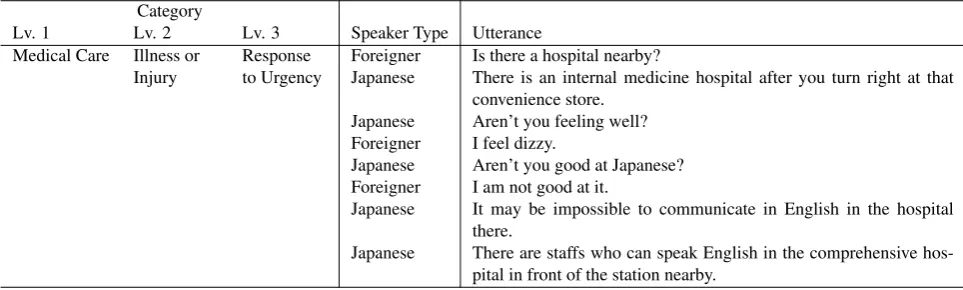
Category
Lv. 1 Lv. 2 Lv. 3 Speaker Type Utterance
Medical Care Illness or Injury
Response to Urgency
Foreigner Is there a hospital nearby?
Japanese There is an internal medicine hospital after you turn right at that convenience store.
Japanese Aren’t you feeling well? Foreigner I feel dizzy.
Japanese Aren’t you good at Japanese? Foreigner I am not good at it.
Japanese It may be impossible to communicate in English in the hospital there.
Japanese There are staffs who can speak English in the comprehensive hos-pital in front of the station nearby.
Table 1: Example Pseudo-dialogue for Medical Care Domain
Based on this plan, the Global Communication Develop-ers’ Group 2 was formed in collaboration with industry, academia, and the government. This group performs the following tasks: 1) research and development of multilin-gual speech translation to extend target languages and do-mains, and 2) public demonstrations of speech translation at hospitals, malls/stores, and tourist spots.
The GCP focuses on the following four domains.
• Medical care
This domain includes dialogues between patients and medical staff (doctors, nurses, etc.) at hospitals.
• Disaster prevention
This domain involves local governments dealing with disasters and providing information to foreigners.
• Shopping
This domain includes dialogues between store clerks and foreign visitors who are shopping.
• Tourism
This domain includes dialogues that provide travel in-formation to visitors, e.g., inin-formation about accom-modations, transportation, and tourist spots.
The ten target languages are as follows: Japanese (Ja), En-glish (En), Simplified Chinese (Zh), Korean (Ko), Thai (Th), Vietnamese (Vi), Indonesian (Id), Myanmar (My), Spanish (Es), and French (Fr). These languages were se-lected taking into account the number of visitors to Japan who spoke these languages.
3.
GCP Corpus
The GCP Corpus is being developed to help create speech translation systems for the GCP. In this paper, we focus on the translation component rather than the speech compo-nent.
The corpus targets four domains defined by the GCP. We assume situations where foreign visitors are speaking with local Japanese people because the goal of the corpus is to realize speech translation in such situations. Therefore, the corpus primarily consists of dialogues. However, these are not real dialogues that have been recorded and transcribed
2
http://gcp.nict.go.jp/about/index.html
but pseudo-dialogues written by scenario writers imagin-ing possible situations. Pseudo-dialogues are more suitable from the perspective of early development of speech trans-lation systems because actual dialogues contain many un-grammatical utterances that require cleaning during tran-scription and are difficult for human translators to under-stand.
Table 1 shows an example pseudo-dialogue in the medi-cal care domain. Here, each dialogue is categorized into three levels, and each utterance contains speaker type in-formation (Japanese or foreigner). We also include isolated utterances, such as greetings and common expressions. Since the GCP Corpus involves conversations between Japanese people and foreign visitors, we first created pseudo-dialogues in Japanese and then translated them into the other nine target languages. Table 2 shows the size of the corpora for each language at the end of 2017. The Japanese, English, Chinese, and Korean corpora are larger than the other languages because these languages are given first preference.
4.
Quality of MTs Based on GCP Corpus
The GCP Corpus is being developed to help realize speech translation systems. In this section, we evaluate MT qual-ity by training a neural MT (NMT) system using the GCP Corpus.4.1.
Experimental Settings
Language Pairs The GCP Corpus is a parallel corpus and includes ten languages; therefore, we can construct up to
10×9 = 90 different MT systems. Here, we only eval-uate the quality of MTs between Japanese and the other languages (Ja↔X; a total of 18 systems) due to resource limitations.
Datasets The corpora (Table 2) were divided into train-ing, development, and test sets. Initially, we set aside some sentences from each corpus (held-out data) and used the re-maining sentences as the training set. From the held-out data, we uniformly selected two 2,000 sentence sets as de-velopment and test sets.
No. of Sentences (Utterances)
Language Abbr. Total Medical Care Disaster Prevention Shopping Tourism Other Japanese Ja 2,029,111 (25.2 chars. / sent.) 420,270 249,495 355,429 527,056 476,861
English En 2,029,111 (11.2 words / sent.) 420,270 249,495 355,429 527,056 476,861
Chinese Zh 2,026,608 420,270 249,495 355,429 527,056 474,358
Korean Ko 2,026,608 420,270 249,495 355,429 527,056 474,358
Thai Th 1,150,070 145,054 117,636 180,843 232,179 474,358
Vietnamese Vi 1,150,070 145,054 117,636 180,843 232,179 474,358
Indonesian Id 1,150,070 145,054 117,636 180,843 232,179 474,358
Myanmar My 1,150,070 145,054 117,636 180,843 232,179 474,358
Spanish Es 337,654 145,054 117,636 9,512 18,944 46,508
French Fr 340,499 145,054 117,636 9,867 19,593 48,349
Table 2: GCP Corpora Sizes as of Summer 2017
The number of sub-word types (corresponding to the vo-cabulary size) was approximately 16 thousand per lan-guage.
We used OpenNMT (Klein et al., 2017) 3 as the neural translation system with the following settings.
• We used a two-layer bi-directional LSTM (long short-term memory) encoder with500+500units. The word embedding was 500 units.
• We used a two-layer LSTM decoder with 1,000 units. The word embedding was 500 units.
• The stochastic gradient descent (SGD) was used for optimization with a learning rate of 1.0 for the first fourteen epochs, followed by annealing of six epochs while decreasing the learning rate by half. The mini-batch size was 64.
• During translation, 10-best translation was performed with a beam width of 10. Furthermore, we applied reranking using the following formula and selected the best translation (Morishita et al., 2017; Oda et al., 2017).
lllen(y|x) = ∑
t
logP r(yt|x,y<t) +W P·T, (1)
wherelllen denotes the log-likelihood that considers
translation length, the first term of the right side de-notes the log-likelihood,W P denotes a word penalty (W P ≥ 0), andT denotes the word number of the translation.
Equation 1 corrects a translation length using the word penalty because NMTs typically generate short trans-lations. The word penalty is optimized using a devel-opment set to make the translation length and refer-ence length nearly equal. By correcting the translation length, we can compute the BLEU scores regardless of the brevity penalty.
4.2.
Translation Quality
Table 3 shows the quality of the MTs as measured by BLEU (Papineni et al., 2002).
3
http://opennmt.net/
No. of Training BLEU Score Language Sentences from Japanese to Japanese
English 1,954,477 27.20 31.01
Chinese 1,952,475 35.82 42.34
Korean 1,952,475 52.87 58.13
Thai 1,110,232 25.64 27.64
Vietnamese 1,110,232 30.32 30.64
Indonesian 1,110,232 22.16 25.94
Myanmar 1,110,232 23.90 30.82
Spanish 326,433 22.28 24.82
French 329,160 22.05 23.39
Table 3: Quality of MTs between Japanese and other Lan-guages
Languages Ja→En En→Ja
General 27.20 31.01
Medical Care 26.53 30.69
Disaster Prevention 27.23 33.01
Shopping 26.09 29.96
Tourism 32.47 33.22
Other 23.89 27.05
Table 4: Translation Quality of Each Domain
First, the BLEU scores are significantly different for each language, ranging from 22.05 to 52.87 for translation from Japanese and from 23.39 to 58.13 for translation to Japanese. However, the score tended to increase with an increasing number of training sentences.
Next, by comparing translations from Japanese with lations to Japanese, it was found that the scores when trans-lating to Japanese were higher than those when transtrans-lating from Japanese for all language pairs. This phenomenon shows that translating from Japanese was more difficult than translating to Japanese. For example, the subjects of Japanese sentences are sometimes not present, and MT sys-tems translating to other languages must generate such sub-jects.
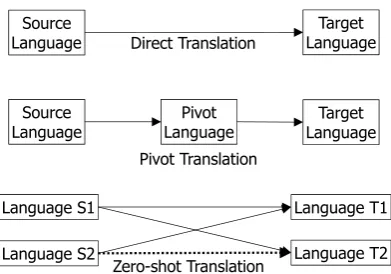
Source
Language S1 Language T1
Language S2 Language T2
Zero-shot Translation
Figure 1: Direct, Pivot, and Zero-shot Translations
Table 4 shows the translation quality of each domain be-tween Japanese and English. ’General’ represents the scores of the general test sets described in Section 4.1. The test sets for the domains were extracted by selecting 1,000 sentences from the held-out data described in Section 4.1. The same models used in Table 3 were used for all do-mains (i.e., no domain adaptation was employed). This ta-ble shows that BLEU scores that are comparata-ble to the gen-eral test sets were obtained in the target domains of GCP, although there are some variations.
5.
Pivot and Zero-shot Translation
We can directly construct translators between all possible language pairs from multilingual parallel corpora (i.e., di-rect translation). However, if we do not have such parallel corpora, we use pivot translation, which involves translat-ing source sentences into target sentences via a resource-rich language known as a pivot (Utiyama and Isahara, 2007; Cohn and Lapata, 2007).In NMT, another approach known as the zero-shot trans-lation can be used to construct MT systems without using directly-translated corpora (Johnson et al., 2016). Here, an encoder that recognizes the source language and a decoder that generates the target language are trained using the cor-pora of indirect language pairs. Figure 1 illustrates the re-lationship among these three approaches.
Both the pivot and zero-shot translation generally assume that bilingual corpora covering the source language and those that cover the target language are obtained from the different texts. However, comparative analysis is difficult to perform under this setting because the vocabulary differs and we cannot construct a direct translator.
Using multilingual parallel corpora, we can compare these three translation methods. By regarding the quality of the direct translation as the upper bound, we can evaluate im-provements in pivot and zero-shot translations by compar-ing them to the direct translation. Note that the experimen-tal settings can be shared for all three methods; for example, identical vocabularies can be used.
In this section, we compare direct, pivot, and zero-shot translation using four languages, i.e., Japanese, English, Chinese, and Korean.
Figure 2: Training Data for Zero-shot Translation (Ja-En)
5.1.
Experimental Settings
Data From approximately two million sentences that were common among the four languages, we created train-ing, development, and test sets using the same method in Section 4.1. The sentences were segmented into fifty thou-sand sub-word types using byte-pair encoding trained from all training sentences (i.e., joint encoding). Note that the same vocabulary set was used for all experiments discussed in this section.
Direct Translation Models for the 12 language pairs were trained using the system described in Section 4.
Pivot Translation The qualities of six translations among English, Chinese, and Korean were measured using Japanese as the pivot language. In other words, we mea-sured the BLEU scores for(En|Zh|Ko)→Ja →(En| Zh | Ko)using the Ja ↔ (En | Zh | Ko)models trained for direct translation tasks. In each case we used the 1-best translations from the source language to the pivot lan-guages.
Zero-shot Translation We constructed (En | Zh | Ko) → (En | Zh | Ko)translators using the Ja ↔ (En| Zh|Ko)corpora similar to the pivot translation.
First, we added a target language tag at the beginning of each source sentence in the Ja ↔(En| Zh| Ko)corpora (Figure 2). Then, a unified model was trained using a com-bined corpus containing all these language pairs. In this experiment, 12 million sentences were used for training. During testing, the target language tags were added to the source sides of the test sentences, and translation was per-formed using the unified model. Then, appropriate target sentences were generated based on the tags even though that particular language pair had not been learned.
5.2.
Results
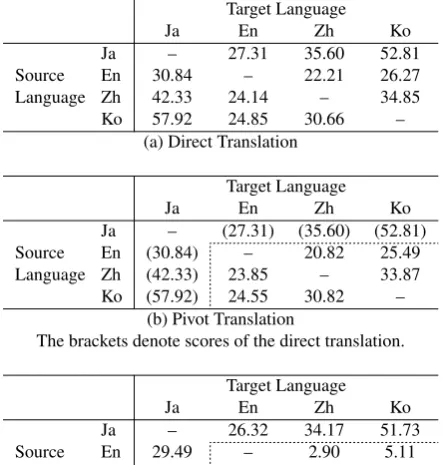
Table 5 shows the results of the (a) direct, (b) pivot, and (c) zero-shot translations. With the pivot translations, the BLEU scores for most language pairs were worse than those for direct translation. However, the score for the Ko
→Zh pair improved; thus, we can conclude that the pivot translation can achieve quality close to that of direct trans-lation.
Target Language
The brackets denote scores of the direct translation. Target Language
(c) Zero-shot Translation (En, Zh, and Ko)
Table 5: Comparison among Direct, Pivot, and Zero-shot Translation
6.
Future Directions
First, we intend to further increase the size of the corpus to improve translation quality. Because the amount of the current corpus spreads various range among languages, we especially complement Asian languages, which is a feature of our corpus.
One current problem is context-dependent translation. We consider that there are two types of context-dependent translation.
• One type of context-dependent translation depends on external knowledge, such as domain knowledge. Such translations use special words and expressions depending on the domain. For example, there are two English translations of the following Japanese sen-tence in the disaster prevention domain.
Ja1 Youyaku yure-ga osamari-mashita. finally shaking-SUBJ finish-POLITE En1-1 The shaking finally has calmed down. En1-2 The earthquake is now stopped.
En1-1is a literal translation ofJa1.En1-2can only be used when shaking is caused by an earthquake, and it is a particular translation within the disaster prevention domain.
• The other type of context-dependent translation de-pends on previous utterances. Here, the information of a source sentence is complemented or eliminated in a translation. For example, one translation ofJa2 is
En2-2in the GCP Corpus.
Ja2 Moyori eki-wa doko-desuka? nearest station-TOP where-POLITE En2-1 Where is the nearest station?
En2-2 What is the station closest to the park?
“The park” inEn2-2are extra words ofJa-2. How-ever, the speaker also spoke “I’ve never heard Tetsug-akudo Park.” in the preceding utterance, so it is correct in this context.
Human translators tend to translate literally between lan-guages of the same family, such as English and French. In contrast, with language pairs for which it is difficult to make literal translations, such as English and Japanese, profes-sional translators elaborately generate context-dependent translations to make the translations natural and the mean-ing of the dialogue identical.
Most MTs assume that the translation unit is a sentence. Therefore, it is harmful if a training corpus contains bilin-gual sentences with extra or missing words. The first type of context-dependent translation, which refers to external knowledge, is being solved by domain adaptation tech-niques. The second type, which depends on previous ut-terances, has not been solved using a sentence as the trans-lation unit.
In the GCP Corpus, we attempt to apply the follow-ing counterapproach to maintain fluency and reduce ex-tra/missing words. 4 First, utterances in a dialogue are shuffled and human translators translate them. This pro-cess breaks context in a dialogue; however, translators can refer to external knowledge if they read the entire dialogue. Then, the utterance order is restored, and the translations are checked to maintain the fluency of the dialogue.
7.
Conclusion
In this paper, we have introduced the GCP Corpus, which is being developed as part of Global Communication Plan. The GCP Corpus is a multilingual sentence-aligned corpus that is being developed to help realize speech translation. The GCP Corpus has the following characteristics.
• It covers ten languages: Japanese, English, Chi-nese, Korean, Thai, Vietnamese, Indonesian, Myan-mar, Spanish, and French. Notably, it includes Asian languages.
• It supports four target domains, i.e., medical care, dis-aster prevention, shopping, and tourism.
• It primarily consists of pseudo-dialogues between for-eign visitors and local Japanese people.
Here, we have focused on the first of these characteristics and have investigated the corpus by evaluating the quality of different MT systems. In addition, we have compared direct, pivot, and zero-shot translations by taking advantage of the fact that the GCP Corpus is a parallel corpus.
4
As we work toward the 2020 Tokyo Olympic and Para-lympic Games, we will increase the size of the GCP Cor-pus, use it to develop speech translation systems, and dis-tribute these systems widely5.
8.
Acknowledgments
This work was supported by “Promotion of Global Com-munications Plan — Research and Development and Social Demonstration of Multilingual Speech Translation Tech-nology,” a program of the Ministry of Internal Affairs and Communications, Japan.
9.
Bibliographical References
Cohn, T. and Lapata, M. (2007). Machine translation by triangulation: Making effective use of multi-parallel cor-pora. InProceedings of the 45th Annual Meeting of the Association of Computational Linguistics, pages 728– 735, Prague, Czech Republic, June.
Imamura, K. and Sumita, E. (2016). Multi-domain adap-tation for statistical machine translation based on feature augmentation. InProceedings of the 12th Conference of the Association for Machine Translation in the Americas (AMTA-2016): Volume 1’ MT Researchers’ Track, pages 79–92, Austin, Texas, USA, October.
Johnson, M., Schuster, M., Le, Q. V., Krikun, M., Wu, Y., Chen, Z., Thorat, N., Vi´egas, F., Wattenberg, M., Corrado, G., Hughes, M., and Dean, J. (2016). Google’s multilingual neural machine translation sys-tem: Enabling zero-shot translation. ArXiv e-prints. 1611.04558.
Klein, G., Kim, Y., Deng, Y., Senellart, J., and Rush, A. M. (2017). OpenNMT: Open-source toolkit for neural ma-chine translation. InProceedings of ACL 2017, System Demonstrations, pages 67–72, Vancouver, Canada, July. Morishita, M., Suzuki, J., and Nagata, M. (2017). NTT neural machine translation systems at WAT 2017. In Proc. of WAT2017, pages 89–94.
Oda, Y., Sudoh, K., Nakamura, S., Utiyama, M., and Sumita, E. (2017). A simple and strong baseline: NAIST-NICT neural machine translation system for WAT2017 English-Japanese translation task. InProc. of WAT2017, pages 135–139.
Papineni, K., Roukos, S., Ward, T., and Zhu, W.-J. (2002). Bleu: a method for automatic evaluation of machine translation. InProceedings of the 40th Annual Meeting of the Association for Computational Linguistics (ACL), pages 311–318, Philadelphia, Pennsylvania, USA. Sennrich, R., Haddow, B., and Birch, A. (2016). Neural
machine translation of rare words with subword units. InProceedings of the 54th Annual Meeting of the Asso-ciation for Computational Linguistics (Volume 1: Long Papers), pages 1715–1725, Berlin, Germany.
Utiyama, M. and Isahara, H. (2007). A comparison of pivot methods for phrase-based statistical machine trans-lation. In Human Language Technologies 2007: The Conference of the North American Chapter of the As-sociation for Computational Linguistics; Proceedings of
5
We are providing the VoiceTra system. http://voicetra.nict.go.jp/
the Main Conference, pages 484–491, Rochester, New York, April.
10.
Language Resource References
Higashinaka, R., Funakoshi, K., Kobayashi, Y., andIn-aba, M. (2016). The dialogue breakdown detection chal-lenge: Task description, datasets, and evaluation metrics. In Proceedings of the Tenth International Conference on Language Resources and Evaluation (LREC 2016), Paris, France, May.