Post-Processing Techniques for Improving Predictions of Multilabel
Learning Approaches
Akshay Soni, Aasish Pappu, Jerry Chia-mau Ni* and Troy Chevalier Yahoo! Research, USA
*Yahoo! Taiwan
akshaysoni, aasishkp, jerryni, [email protected]
Abstract
InMultilabel Learning(MLL) each train-ing instance is associated with a set of labels and the task is to learn a func-tion that maps an unseen instance to its corresponding label set. In this paper, we present a suite of—MLL algorithm independent—post-processing techniques that utilize the conditional and directional label-dependences in order to make the predictions from any MLL approach more coherent and precise. We solve a con-straint optimization problem over the out-put produced by any MLL approach and the result is a refined version of the input predicted label set. Using proposed tech-niques, we show absolute improvement of 3% on English News and 10% on Chinese E-commerce datasets for P@K metric. 1 Introduction
The Multiclass Classificationproblem deals with learning a function that maps an instance to its one (and only one) label from a set of possible labels while in MLL each training instance is associated with aset of labelsand the task is to learn a func-tion that maps an (unseen) instance to its corre-sponding label set. Recently, MLL has received a lot of attention because of modern applications where it is natural that instances are associated with more than one class simultaneously. For in-stance, MLL can be used to map news items to their corresponding topics in Yahoo News, blog posts to user generated tags in Tumblr, images to category tags in Flickr, movies to genres in Net-flix, and in many other web-scale problems. Since all of the above mentioned applications are user-facing, a fast and precise mechanism for automati-cally labeling the instances with their multiple
rel-evant tags is critical. This has resulted in the de-velopment of many large-scale MLL algorithms.
The most straightforward approach for MLL is
Binary Relevance that treats each label as an in-dependent binary classification task. This quickly becomes infeasible if either the feature dimension is large or the number of labels is huge or both. Modern approaches either reduce the label dimen-sion, e.g., PLST, CPLST (Chen and Lin, 2012), Bayesian CS (Kapoor et al., 2012), LEML (Yu et al., 2014), RIPML (Soni and Mehdad, 2017), SLEEC (Bhatia et al., 2015), or feature dimension or both (such as WSABIE and DocTag2Vec (Chen et al., 2017)). The inference stage for all of these approaches produce a score for each potential la-bel and then a set of top-scored lala-bels is given as the prediction.
A potential problem with the above mentioned algorithms is that they lack the knowledge of cor-relation or dependency between the labels. Let us look at a toy example: our training data is such that whenever the labelmountainis active then the la-beltreeis also active. Therefore MLL algorithm should take advantage of this correlation embed-ded in the training data to always infer the label
tree when mountain is one of the label. On the other hand, iftreeis an active label thenmountain
may not be a label. Exploiting this directional and conditional dependency between the labels should allow us to predict a more coherent set of labels. It would—to some extend—also save the MLL al-gorithm from making wrong predictions since if some wrong labels (say we predict a wrong la-bel politics) are predicted along with correct la-bels (when true lala-bels aretreeandmountain) then the overall set of predicted labels would not be co-herent. Inclusion of this external knowledge about labels shows significant improvements when there is a lack of training data for some labels.
There have been many attempts (Dembszynski
et al., 2010) of using hierarchies or label-correlation information as part of the MLL train-ing process. For instance, the label-correlation in training data is used in (Tsoumakas et al., 2009); (Guo and Gu, 2011) uses conditional dependen-cies among labels via graphical models. Some of the other relevant works that use this information as part of the training are (Huang and Zhou, 2012; Kong et al., 2013; Younes et al., 2008) and refer-ences therein. Since these approaches use label de-pendency information as part of the training stage, we foresee following issues:
• Using pre-trained model: In some cases we want to use a pre-trained MLL model that did not use the label-dependency information during training and retraining a new model is not an option. The use of pre-trained models has become very common since not everyone has the hardware capability to train complex models using large amounts of data.
• Label-dependency information not available during training or else one may want to use updated or new label-dependency informa-tion after the model is trained.
• Expensive training and inference: Almost all algorithms that utilize the label-dependence as side-information are either expensive dur-ing traindur-ing, or inference, or both.
In this paper, we present a suite of post-processing techniques that utilize the conditional and directional label-dependences in order to make the predictions from any MLL approach more coherent and precise. It is to be noted that the proposed techniques are algorithm indepen-dent and can even be applied over the predictions produced by approaches that use this or any other label-dependency information as part of the train-ing. Our techniques involve solving simple con-straint optimization problems over the outputs pro-duced by any MLL approach and the result is a re-fined version of the input prediction by removing spurious labels and reordering the labels by utiliz-ing the additional label-dependency side informa-tion. We show benefits of our approach on Chinese e-commerce and English news datasets.
2 Problem Description and Approaches MLL is the problem of learning a function f : I →2Lthat maps an instance inI to one of
the sets in the power set2LwhereL is the set of all possible labels. For a specific instance, MLL predicts a subset S ⊂ L. Our goal is to learn a subsetL⊂Ssuch thatLis a refined version ofS. Given a set of constraints on input labels, one can define an objective function that would poten-tially minimize inconsistencies between the final set of labels. Intuitively, labels may be interde-pendent, thus certain subsets are more coherent than the others. Label dependency can manifest either through human-curated label taxonomy or conditional probabilities. We propose two post-processing techniques in this paper to improve predicted outputs of any MLL algorithm. In the following subsections, we present details of each technique.
2.1 Steiner Tree Approximation
We formulate label coherence problem as a Steiner Tree Approximation problem (Gilbert and Pollak, 1968). Consider the following: input is a set of predicted labels S = R ∪O, where R is a set of coherent (required) labels andO is a set of in-coherent (optional) labels. Labels are connected by directed weighted edges, thus form a graphG. The goal is to find a treeT = (L, E, W)where L is a set of labelsR ⊂ L ⊂ S that includes all of the coherent labels and may include some of the optional labelsO, E is the set of directed edges connecting nodes inLandW is set of weights as-signed to the edges. For faster and approximate so-lutions, one can reduce Steiner tree problem to di-rected minimum spanning tree (MST) (Mehlhorn, 1988) and can be solved using Edmond’s algo-rithm (Edmonds, 1967). MST has been applied in several previous works on document summariza-tion (Varadarajan and Hristidis, 2006), text detec-tion in natural images (Pan et al., 2011), and de-pendency parsing (McDonald et al., 2005). In this work, we first construct a directed graph of labels and then apply MST to obtain a tree of coherent labels. On applying MST, we choose vertices with top-Kedge weights. Our goal is to find a tree that minimizes the following objective function:
costd(T) :=
X
(u,v)∈E
d(u, v),
following criterion:
(
Li→Lj, Pr(Li|Lj)≤Pr(Li|Lj)
Li←Lj, otherwise,
wherePr(Li|Lj)is the probability that labelLiis
active given labelLj is active.
Once the directed graph is constructed based on above criterion, Edmond’s algorithm recursively eliminates edges between a root node and one of the other nodes with minimum edge weights. In case of cycles, the edges are eliminated randomly. In essence, this algorithm selects highest-value connected-component in the directed graph. Thus, we are left with coherent labels.
2.2 0-1 Knapsack
Assigning labels to an instance with a budget can be considered as a resource allocation problem. 0-1 Knapsack is a popular resource allocation problem where capacity of the knapsack is limited and it can be filled with only a few valuable items. Items are added to the knapsack by maximizing the overall value of the knapsack subject to the combined weight of the items under budget. Many previous works in NLP have used Knapsack for-mulation, particularly in summarization (Lin and Bilmes, 2010; Ji et al., 2013; Hirao et al., 2013; McDonald, 2007). We formulate label assignment problem as a resource allocation problem, where we maximize total value of assigned labels. We determine individual value of a label based on the log likelihood of the label and its dependent labels. Intuitively, a label is included in the knapsack only when its dependent labels increase the overall log-likelihood.
maximize X
k∈S
X
i∈Dk
log(Pr(Lk|Li))
s.t. X
k∈S
|Dk| ≤C,
where Dk ⊂ S −Lk is a subset of input labels
Sthat are conditionally dependent on labelLki.e.
Pr(Lk|Li) >0fori∈Dk. To include a labelLk
in the knapsack (i.e., inL), we optimize the total sum of the log conditional probabilities of labels Lk under the constraint that the total number of
dependent labels are within the budget C—total number of permissible labels. The problem can be understood as a maximization of values of as-signed labels. This problem is solved using a dy-namic programming algorithm that runs in poly-nomial time (Andonov et al., 2000).
3 Experiments
The goal of this section is to emphasize on the fact that our post-processing techniques are MLL algorithm independent. For that we apply our approaches over the predictions from mul-tiple MLL algorithms for two datasets: Yahoo News dataset in English and Chinese E-commerce dataset. Since MLL is generally used in applica-tions where precision of predicapplica-tions are important, we use Precision@K for K = 1,2 and3 as our metric.
3.1 Datasets
• Yahoo News MLL Dataset (English)1: This
is one of the few publicly available large scale datasets for MLL. It contains38968 Ya-hoo News articles in English for training and 10000 for testing. These are manually beled with their corresponding category la-bels; overall, there are413possible labels.
• Chinese E-commerce MLL dataset: This is a propriety dataset that contains product descriptions of230364e-commerce products in Chinese for training and49689for testing. Each product is tagged with labels about the product categories; overall there are240tags.
3.2 MLL Approaches
Since our post-processing techniques are MLL al-gorithm independent, we picked three MLL ap-proaches to apply our post-processing techniques: Naive Bayes, CNN, and DocTag2Vec. From our perspective, we can treat these approaches as black-box that for a given instance generate the set of predicted labelsS⊂ L.
• Naive Bayes (NB) MLL: Given a sequence of words, the probability of a tag is evaluated by multiplying the prior probability of the tag and the probabilities of observing the words given the tag, pre-computed from the training data.
• CNN MLL (Kim, 2014): Originally de-signed for text classification tasks, the model views sequence of word embeddings as a ma-trix and applies two sequential operations:
convolutionandmax-pooling. First, features 1available publicly via Webscope: https://webscope.sandbox.yahoo.com/catalog.php?
Dataset MLL Approach P@K Default Highest PriorsBaseline-1 Baseline-2Greedy MST Knapsack
Yahoo News DocTag2Vec
1 0.6821 0.6277 0.5927 0.6942 0.6976(+1.5%)
2 0.6461 0.6132 0.5836 0.6689(+2.2%) 0.6568
3 0.6218 0.6052 0.5750 0.6485(+2.6%) 0.6203
Chinese Ecom DocTag2Vec
1 0.5309 0.5718(+4.0%) 0.5563 0.5510 0.5331
2 0.5454 0.5748(+2.9%) 0.5664 0.5716 0.5442
3 0.4813 0.4928 0.5802 0.5820(+10%) 0.4884
Chinese Ecom CNN
1 0.8554 0.7658 0.6898 0.8483 0.8479
2 0.7387 0.7164 0.6545 0.7814(+4.2%) 0.7450
3 0.6095 0.5921 0.6646 0.7249(+11.5%) 0.6287
Chinese Ecom NB
1 0.8752 0.8526 0.7545 0.8982 0.9057(+3.0%)
2 0.8481 0.8167 0.6738 0.8456 0.8538(+0.5%)
3 0.7913 0.7519 0.7129 0.8101(+1.8%) 0.7385
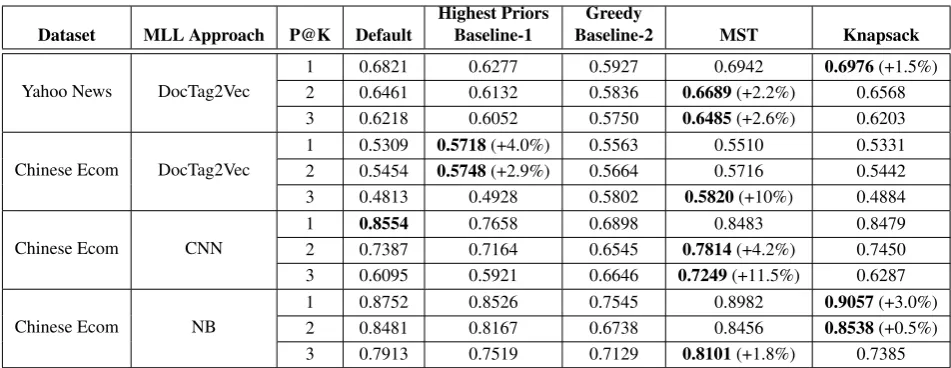
Table 1: P@K for various values of K for the two datasets considered and for different MLL algorithms. Here default means not using a coherence stage. In brackets are shown the improvements in precision over default by the best performing coherence approach.
are extracted by a convolution layer with sev-eral filters of different window size. Then the model applies a max-over-time pooling operation over the extracted features. The features are then passed through a fully con-nected layer with dropout and sigmoid acti-vations where each output node indicates the probability of a tag.
ail
• DocTag2Vec (Chen et al., 2017): Re-cently proposed DocTag2Vec embeds in-stances (documents in this case), tags, and words simultaneously into a low-dimensional space such that the documents and the tags associated with them are embedded close to each other. Inference is done via a SGD step to embed a new document, followed by k-nearest neighbors to find the closed tags in the space.
3.3 Post-Processing Techniques
• Highest Priors(Baseline-1): Given the train-ing data, compute the prior probabilities of each label and re-rank labels inS according to the decreasing order of these prior proba-bilities to produce the new setL.
• Greedy (Baseline-2): Given the pairwise conditional probabilities among the output la-bels, select most probable pairs above certain thresholdτ; we experimented with values in range[0.01, 0.1]and usedτ = 0.06in the final experiments.
• MST: Steiner Tree Approximation via MST. The edge weights are computed via the con-ditional co-occurrence of the labels in the training data and the directionality is en-forced via the criterion described in Section 2.1.
• 0-1 Knapsack: We set C = 15 and solve the optimization problem described in Sec-tion 2.2.
3.4 Results
The P@K values are shown in Table 1 for the two datasets and for various coherency algorithms ap-plied over multiple MLL approaches. The two baselines—highest priors and greedy—work rea-sonably well but the best performing approaches are MST and Knapsack. For most of the cases MST works well and even in the scenarios where Knapsack beats MST, they both are close in per-formance. By using a post-processing step for co-herency we generally see a lift of around2−4% in most of the cases and sometimes a lift of more than 10%is observed. We note that one can de-sign the problem with more deeper conditions i.e., P(L1|L2, L3. . . Lk) but only single label
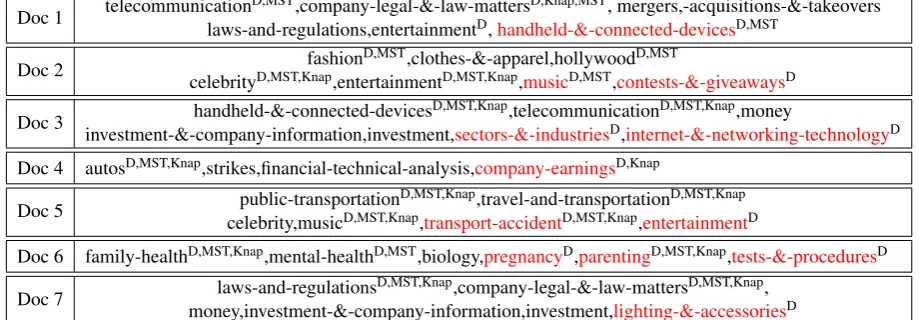
Table 2: Example tags for various Yahoo News articles. Tags highlighted in red did not appear in true labels. Superscripts on the tags denote following D: Output from DocTag2Vec system (Default in Table 1), Knap: Output from Knapsack, MST: Output from Steiner Tree Approximation. Tags without superscript were not predicted at inference.
Doc 1 telecommunicationlaws-and-regulations,entertainmentD,MST,company-legal-&-law-mattersD,handheld-&-connected-devicesD,Knap,MST, mergers,-acquisitions-&-takeoversD,MST
Doc 2 celebrityD,MST,Knapfashion,entertainmentD,MST,clothes-&-apparel,hollywoodD,MST,Knap,musicD,MST,contests-&-giveawaysD,MST D
Doc 3 investment-&-company-information,investment,sectors-&-industrieshandheld-&-connected-devicesD,MST,Knap,telecommunicationD,internet-&-networking-technologyD,MST,Knap,money D
Doc 4 autosD,MST,Knap,strikes,financial-technical-analysis,company-earningsD,Knap
Doc 5 celebrity,musicpublic-transportationD,MST,KnapD,MST,Knap,transport-accident,travel-and-transportationD,MST,Knap,entertainmentD,MST,KnapD
Doc 6 family-healthD,MST,Knap,mental-healthD,MST,biology,pregnancyD,parentingD,MST,Knap,tests-&-proceduresD
Doc 7 money,investment-&-company-information,investment,lighting-&-accessorieslaws-and-regulationsD,MST,Knap,company-legal-&-law-mattersD,MST,Knap, D
4 Discussion and Conclusion
Table 2 illustrates MLL output of sample docu-ments from Yahoo News corpus. We observed Knapsack algorithm is more conservative at sub-set selection compared toMST. Tags predicted by
Defaultsystem include tags that are related to true tags but do not appear in the true tag subset e.g., in Doc 1 handheld-&-connected-devices is related totelecommunications, similarlyDoc 2andDoc 5has one related tag and one spurious tag — in both cases MST and KNAPSACK prune the spu-rious tags. In Doc 2 music is related/coherent and contest-&-giveaways is spurious/incoherent. In Doc 5 transport-accident is related/coherent andentertainmentis a spurious tag.
In this paper we presented two post-processing techniques to improve precision of any MLL algo-rithm. In addition to experiments discussed in the paper, we conducted experiments with other com-binatorial optimization algorithms as used in pre-vious works viz., facility location (p-median) (Al-guliev et al., 2011; Ma and Wan, 2010; Cheung et al., 2009; Andrews and Ramakrishnan, 2008) and other graph-based centrality methods (Wolf and Gibson, 2004; Li et al., 2006; Guinaudeau and Strube, 2013). However, we did not observe sig-nificant improvement over default (unprocessed) output. While many approaches exist that utilize the label-correlation and dependency information during training, to the best of our knowledge, this is the first work that uses this knowledge as part of a post-processing step that is independent of MLL algorithms.
Acknowledgements
We are grateful to TC Liou, Chasel Su, Yu-Ting Chang, Brook Yang for their contributions to this project. We also wish to thank Kapil Thadani, Parikshit Shah and the anonymous reviewers for their feedback.
References
Rasim M Alguliev, Ramiz M Aliguliyev, and Chin-giz A Mehdiyev. 2011. psum-sade: a modi-fied p-median problem and self-adaptive differen-tial evolution algorithm for text summarization. Ap-plied Computational Intelligence and Soft Comput-ing2011:11.
Rumen Andonov, Vincent Poirriez, and Sanjay Ra-jopadhye. 2000. Unbounded knapsack problem: Dynamic programming revisited. European Journal of Operational Research123(2):394–407.
Nicholas Andrews and Naren Ramakrishnan. 2008. Seeded discovery of base relations in large cor-pora. InProceedings of the Conference on Empiri-cal Methods in Natural Language Processing. ACL, pages 591–599.
Kush Bhatia, Himanshu Jain, Purushottam Kar, Prateek Jain, and Manik Varma. 2015. Locally non-linear embeddings for extreme multi-label learning. CoRR
abs/1507.02743.
Yao-nan Chen and Hsuan-tien Lin. 2012. Feature-aware label space dimension reduction for multi-label classification. InAdvances in NIPS 25, pages 1529–1537.
Jackie Chi Kit Cheung, Giuseppe Carenini, and Ray-mond T Ng. 2009. Optimization-based content se-lection for opinion summarization. InProceedings of the 2009 Workshop on Language Generation and Summarisation. ACL, pages 7–14.
Krzysztof Dembszynski, Willem Waegeman, Weiwei Cheng, and Eyke H¨ullermeier. 2010. On label dependence in multilabel classification. In ICML Workshop on Learning from Multi-label data. Jack Edmonds. 1967. Optimum branchings. Journal
of Research of the National Bureau of Standards B
71(4):233–240.
EN Gilbert and HO Pollak. 1968. Steiner mini-mal trees. SIAM Journal on Applied Mathematics
16(1):1–29.
Camille Guinaudeau and Michael Strube. 2013. Graph-based local coherence modeling. InACL (1). pages 93–103.
Yuhong Guo and Suicheng Gu. 2011. Multi-label clas-sification using conditional dependency networks. InIJCAI. volume 22, page 1300.
Tsutomu Hirao, Yasuhisa Yoshida, Masaaki Nishino, Norihito Yasuda, and Masaaki Nagata. 2013. Single-document summarization as a tree knapsack problem. InEMNLP. volume 13, pages 1515–1520. Sheng-Jun Huang and Zhi-Hua Zhou. 2012. Multi-label learning by exploiting Multi-label correlations lo-cally. InTwenty-Sixth AAAI Conference on Artificial Intelligence.
Heng Ji, Benoit Favre, Wen-Pin Lin, Dan Gillick, Dilek Hakkani-Tur, and Ralph Grishman. 2013. Open-domain multi-document summarization via infor-mation extraction: Challenges and prospects. In
Multi-source, Multilingual Information Extraction and Summarization, Springer, pages 177–201.
Ashish Kapoor, Raajay Viswanathan, and Prateek Jain. 2012. Multilabel classification using bayesian com-pressed sensing pages 2645–2653.
Yoon Kim. 2014. Convolutional neural net-works for sentence classification. arXiv preprint arXiv:1408.5882.
Xiangnan Kong, Michael K Ng, and Zhi-Hua Zhou. 2013. Transductive multilabel learning via label set propagation. IEEE Transactions on Knowledge and Data Engineering25(3):704–719.
Wenjie Li, Mingli Wu, Qin Lu, Wei Xu, and Chunfa Yuan. 2006. Extractive summarization using inter-and intra-event relevance. InProceedings of the 21st
International Conference on Computational Lin-guistics and the 44th annual meeting of the Associa-tion for ComputaAssocia-tional Linguistics. Association for Computational Linguistics, pages 369–376.
Hui Lin and Jeff Bilmes. 2010. Multi-document sum-marization via budgeted maximization of submod-ular functions. InHuman Language Technologies: The 2010 NAACL. ACL, pages 912–920.
Tengfei Ma and Xiaojun Wan. 2010. Multi-document summarization using minimum distortion. InData Mining (ICDM), 2010 IEEE 10th International Con-ference on. IEEE, pages 354–363.
Ryan McDonald. 2007. A study of global infer-ence algorithms in multi-document summarization. In European Conference on Information Retrieval. Springer, pages 557–564.
Ryan McDonald, Fernando Pereira, Kiril Ribarov, and Jan Hajiˇc. 2005. Non-projective dependency pars-ing uspars-ing spannpars-ing tree algorithms. InProceedings HLT and EMNLP. ACL, pages 523–530.
Kurt Mehlhorn. 1988. A faster approximation algo-rithm for the steiner problem in graphs. Information Processing Letters27(3):125–128.
Yi-Feng Pan, Xinwen Hou, and Cheng-Lin Liu. 2011. A hybrid approach to detect and localize texts in natural scene images. IEEE Transactions on Image Processing20(3):800–813.
Akshay Soni and Yashar Mehdad. 2017. Ripml: A re-stricted isometry property based approach to multil-abel learning. arXiv preprint arXiv:1702.05181. Grigorios Tsoumakas, Anastasios Dimou, Eleftherios
Spyromitros, Vasileios Mezaris, Ioannis Kompat-siaris, and Ioannis Vlahavas. 2009. Correlation-based pruning of stacked binary relevance models for multi-label learning.
Ramakrishna Varadarajan and Vagelis Hristidis. 2006. A system for query-specific document summariza-tion. InProceedings of the 15th ACM international conference on Information and knowledge manage-ment. ACM, pages 622–631.
Florian Wolf and Edward Gibson. 2004. Paragraph-, word-, and coherence-based approaches to sentence ranking: A comparison of algorithm and human per-formance. In Proceedings of the 42nd ACL. page 383.
Zoulficar Younes, Fahed Abdallah, and Thierry Denœux. 2008. Multi-label classification algorithm derived from k-nearest neighbor rule with label de-pendencies. InSignal Processing Conference, 2008 16th European. IEEE, pages 1–5.