116
Human Face Recognition Using Feature Extraction and
Logical Measurements
John Paulraj.C
1, Ganesh Karthikeyan.V
2 PG Student of CSE1, Assistant Professor of CSE2Adithya Institute of Technology, Coimbatore [email protected],[email protected]
Abstract—In tradition our ID cards, and Password based Systems are been violated in forms of theft, robbery. In order to overcome these causes the approach introduced is the first step toward the design in the metrological characterization using Face Recognition where systems depending is based on the functionality features of ISO-GUM. Face based recognition systems which has been gradually used in many diverse applications platforms in today’s society, starting from surveillance and access control to the validation for banking activities. So, in the latter few years an increasing interest shown in the performance and improvement of such systems can be found to bemethodicalshared. The improvement of the policies for testing the performance of such systems are based on the evaluation of recognition trustworthiness indexes that are generally related to the chance of a false positive and/or of a false negative. The feature is extracted from the obtained image caught from the Biometric. In addition, compared with other technologies (e.g., based on iris, fingerprints, retinal scans), FR requires a lower degree of cooperation with respect to the subject is recognized and hence it’s been classified as follows.
Index term
—
Face recognition, face retrieval, Image classification, Insecurity Measurement, Canonical correlation analysis, face marks.1. INTRODUCTION
Human beings are very capable and good in recognizing faces and related patterns. The approach of face detection and recognition in mobile phones as well as in Biometrics is not mean to produce the results as so far obtained in computers. [4][6]It is clear, the main problem that is been caused for the development of computer applications for mobiles concerning the usage of memory and CPU resources in order to store the face models and the intermediate calculations purposes. Ensuring security caught in surveillance cameras included with face recognition system, Detecting theft children's by using the images received from the cameras fitted in public areas, Knowing VIP’s entering the secured areas, Identifying criminals in public areas. The problem caused during identifying a person by taking an input image of the face captured in Biometric and matching with the well-known face images in the Training Database is very hard to match. This is caused as a reason of illumination, Aging In case where errors like the false acceptance rate (FAR) that the probability in which the systems incorrectly accept unauthorized person and the false rejection rate (FRR) is that the probability in systems wrongly reject an authorized person.
Linear Discriminant Analysis (LDA) which is also called fisherface is an appearance-based technique used for the dimensionality reduction and recorded a great performance in face recognition.[7] This method works on the same principle as the eigenface method (PCA).it performs dimensionality reduction while
preserving as much of the class discriminatory information as possible. LDA makes use of projections of training images into a subspace defined by the fisher faces known as fiherspace. Recognition is performed by projecting a new face onto the fisher space.
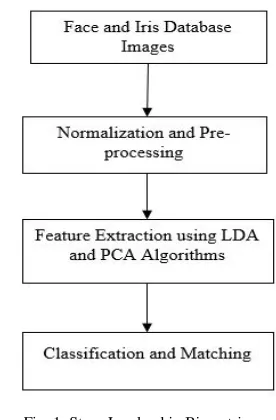
117 Fig. 1. Steps Involved in Biometric
2. LITERATURE SURVEY
Kyong I. Chang, KevinW. Bowyer, Patrick J.Flynn[1], describes about the Multimodal by 2D and 3D Face recognition by comparing the 2D and 3D face data for biometric recognition. The (PCA) approach hence forth which is been designed separately for the purpose of 2D and 3D. Using this the certainity for weighted difference can be found using the sum and mean value for the obtained 2D and 3D face images. Finally, this results in finding the Multimodal Rank-one recognition significantly. This study deals with face recognition using multiple sensors (CCD and range finder). The Methods and
Material involve:
2Dand3DFaceRecognitionUsingPCA, Normalization, DataCollection, Distance Metrics, and Data Fusion results in experimental analysis of Original 2D face versusprojected 2Dface and Single-modal bio-metricsversusmulti-modalbiometrics.
Xiaobo Zhang, Zhenan Sun, and Tieniu Tan[2], describes about the fusion of Face and Iris in order to improve the quality of the image. The Hierarchical fusion scheme process in the low Quality image under uncontrolled situation. [14][6] The Canonical correlation Analysis (CCA), is adopted to construct a statistical mapping in Face and Iris in pixel level. The original and the sparse representation level features can be done with the help of the fusion process. Finally, the Score level fusion for the Min-Max normalization is made for the final decision. The pixel level and Score level fusion are processed for the evaluation of the Fusion of Face and Iris. The construction of the regression model between two data sets is done by considering its canonical correlation analysis (CCA) from its efficient and
effective results align to form mapping between two multidimensional variables.[3][11]The Score level fusion identification process is done, one by: Representing the Face and Iris and Fusion of those components results in the similarity measure between the problem sample and the gallery sample canbedescribedbytheresidualbetweentheoriginalsampl e and the reconstructed one.
Nagesh Kumar M, Mahesh.pk and M Shanmukha swamy[3], describes the Score level fusion. The biometrics based personal authentication which is considered as an effective technique for automatically recognizing user data, with a large assurance for person’s identity. The purpose of a multimodal biometric systems is been introduced is to integrate the indication presented by multiple biometric sources and typically better recognition performance equal to system based on a single biometric modality system. This paper proposes an authentication technique for a multimodal biometric system identification using two traits i.e. face and palmprint biometrics. [13]Multimodal biometric system is developed through fusion of face and palm print recognition. The canonical correlation analysis and Principle Component Analysis (PCA) method are used to extract the feature data.so it gives better performance and better accuracy for both traits (face & palmprint).but the palm-print biometrics data can acquired is difficult so the recognition some time.
Brendan F. Klare, Mark J. Burge, Joshua C. Klontz, Richard W. Vorder Bruegge, and Anil K. Jain[4], describes about the study and influence of demographic on the performance of face recognition Algorithms. The analysis of the face are categorised in to three types namely: Race, Gender, Age. These analysis are done in order to find out whether the above three suits better for the demographic process. Feature extraction generally relies on an offline training stage that utilizes example data to learn improved feature combinations.The several Face recognition techniques used in this process: Commercial Face Recognition, Non-Trainable Face Recognition, and Trainable Face Recognition Algorithms Respectively. [12]The advantage are concerned for the easy access to process, and Security. Operationally, this leads to a scenario, called
dynamic face matcher
selection,wheremultiplefacerecognitionalgorithmsare available for a biometric system operator to select based on the demographic information extracted from a problem image.
118 respectively. Also, the two models in order to
describe, extract and compare the skin color region and hair color region with respective with Head-Shape Models.Thus the candidates are been detected with the similar properties as like: Frontal view, Left side view, Right side view. Detecting Skin and Hair Color includes Perceptual Uniform Color (PUC) space. [7][5][6]Here the Skin and Hair representation
is similar to the human eye. Thus, the obtained image is been extracted and obtained with the features extracted simultaneously. The Skin Color Distributed Model (SCDM) is used for extracting the hair color model also called as (HCDM). Therefore the Feature extracted describes the resultant coordinates region of the image captured with illumination, Projection, Camera Pose angel.
Table 1.Literature Survey Algorithmic Comparison
S.NO METHODS MERITS DEMERITS APPLICATIONS
1.
Principle Component Analysis (PCA).
It provides faster rate of efficiency in 2D than 3D.
Access make difficult during training data base in
use.
Military zone, ID Card issue, Access Privilege.
2.
Canonical Correlation Analysis (CCA).
Improving its performance by good quality images under controlled
environments
Variation of face is large when the appearance
change.
Security in Bio Systems, Government sectors.
3.
Principle Component Analysis (PCA) and Score level technique
Robustness of the person during authentication
Fails sometimes while verifying the person
Investigation purpose (FBI, CBI)
4.
Local binary patterns (LBP), Gabor features
Facial features are features that encode the structure and shape of the
face, and are critical to Face Recognition
Doesn’t give an approximate o/p, since
time delay is more.
Used in Biometric Systems.
5.
Fuzzy pattern matching, Finding Skin colour
Similarity.
Locating the face region. Detecting the facial features.
Noise, change of facial Expression
Security, ATM, purposes.
3. RELATED WORK
For Recent past years we have seen a huge amount of evaluation in field of multi-biometrics. Here this section let begin with an overall introduction on iris and face biometric methods
3.1.Performance Evaluation
Image Quality Measurement (IQM) is been studied as a dynamic in the improvement of image processing processes such as enhancement, deblurring, removing the noise. It is used to calculate the performances in terms providing a good quality of managed image. The Mean Square Error (MSE) and the Peak Signal to Noise Ratio (PSNR) are the two important aspect considered in order to measure error metrics which is used to compare image quality during compression. The MSE signifies the growing error between the compressed and the original image, however PSNR denotes a portion of the peak error. The performance of PSNR, the block is done by using the first equation:
MSE=
∑
∑
,
−
,
(1)
Xand Yare the number of rows and columns of the given input images, respectively. Additional, the block thus computes the Peak Signal to Noise Ratio using the second equation:
PSNR=
10 log
(2)
TheNormalized Cross-Correlation (NCC) is the techniquesapparently used for pattern matching, a process used for finding incidences of a pattern or object within an image is done using:
NCC=
∑ , , .! " , "#∑ , ! " ,$"
(3)
The Normalized Absolute Error (NAE) is the difference among the original and reconstructed image. The value of NAE means that image obtained is of poor quality is there by defined as:
NAE=
∑ ∑ | , |& '( ) *(
∑) ∑&+(| , |
,(
(4)
3.2.Face and Iris Biometric Identification
A Biometric is said to be Process or a Characteristics, where Process means the method of recognizing an individual based on its behaviour and characteristics is of physiological process done with the automated recognition. Human beings find easy to identify the familiar faces easily. But to identify the unfamiliar faces it’s been difficult. In order to avoid such convenience they introduced biometric for the purpose of security.
119 The “eigenface” algorithm was represented by
Turk and Pent. In the eigenface algorithm, a training set of face images is first aligned according to some standard landmarks. Principal component analysis (PCA) is then applied to the training set to extract a set of eigen-faces. The Face biometric which also includes: Image Acquisition, Image Segmentation, Normalization, Feature Extraction and Matching. These eigenfaces describe the primary directions of variation in the training set. When a new probe face is obtained, it is first aligned with the training set.
FD=
|- . ⊕.-| 1 2 -∩ 1 2!⋂ 1 2 ⋂ 1 2! |-! |(5)
3.4.Detection of Iris
The major tenders in this skill so far have been: substituting for passports in automated border crossing; advancing security screening atairports; controlling restriction to access areas; Children's Identification and Location Databases (CHILD). The technology combines computer vision, pattern recognition, arithmetical inference, and optics. Its functions as the purpose in real-time, high confidence recognition of a person's identity by mathematical analysis of the random patterns that are visible within the iris of an eye from some distance.
5 6, 7 = ∑C"@/BD C @/B9: ; + ∑?"@/B> ? @/B9= >
(6)
4. PROPOSED WORK
The Problem that has been faced in Multi-model Biometric both Face and Iris during the existing premises in most systems are due to: 1) Illumination cause 2) Pose problem cause. Recognition is carried out by finding a local representation of the facial appearance at each of the anchor points. The representation scheme used here is a vector of Gabor wavelet responses. The pose problem is illustrated where the same face appears differently due to changes in viewing condition. These approaches can be broadly divided into four types: heuristic methods including discarding the leading principal components, Image comparison methods where various image representations and distance measures are applied, Class based methods where multiple images of one face under a fixed pose but different lighting conditions are available and Model based approaches where 3D models are introduced.
4.1.Heuristic Approach
To handle the clarificationcaused towards the
problem researchers have proposed
variousprocedures. Within the eigen-subspace domain, it has been suggested that by discarding the
three most significant principal components variations (PCV) due to lighting can be reduced. And it has been experimentally verified in that discarding the first few principal components seems to work reasonably well for images under variable lighting.
4.2.Image Comparison Approach
The statistical approaches based on image comparison have been evaluated. The reviewed methods used different image representations and distance measures. The image representations usedare: edge maps, derivatives of the gray level, imagesfiltered with 2D Gabor like functions, and a representation that combines a log function of the intensity with these representations. The different distance measures used arepoint wise distance, regional distance, affineGL (gray level) distance, local affine GL distance and LOG point.
4.3.Class Based Approach
[image:4.595.331.498.424.686.2]By using Principal Component Analysis (PCA) as a tool for solving the parametric shape from shading problem to obtain the eigen head approximation of a real 3D head after training on about 300 laser scanned range data of real human heads. Though the ill posed SFS problem is transformed into a parametric problemthey still assume constant albedo
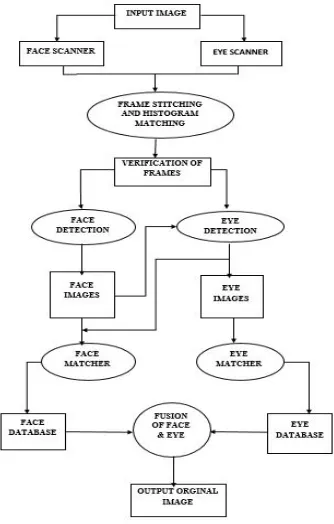
Fig. 2.System Architecture
.
120 This method is an extension of the 2D linear
subspace method and hence needs three aligned training images acquired under different lightings. One drawback to using this method is that we need more than three aligned images per person. More recently a new method based on a quotient image has been introduced. The advantage of this approach over existing similar approaches is that it only use a small set of sample images.
5. EXPERIMENTAL SETUP
This method is executed out on Matlab V 6.0 with the hardware platform used during the experiments was based on a Intel Core i3-2370M CPU @ 2.40 GHz processor, 4 GB of DDR3 RAM.. Camera or a Biometric sensors is been used for the purpose to acquire a good quality image. The face detectioncan process an image of size 1280 x 1024 within 20 s.The facial feature detection takes about 15 s to locateall facial features in a face. The following parameter for the given algorithm LDA and PDA for the performance is given in Table 2.
Parameter Description
EF⊕ EB Overall performance of the face recognition G6H The face vector distance from the orgin G6H The vector distance from the obtained Mask
ratio
[image:5.595.315.511.112.226.2]5 6, 7 Finding out the distance from the point 9: ; Average distance from the Iris to the detector 9= > Average length of the curve
Table 2.Parameters and Description
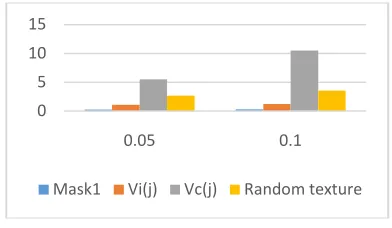
Table 3 shows the exact calculation of the obtained face image by Detecting the face and the Iris distance and the value for the above is been discussed here.
EF I, J KILMF 9: ; 9= > Random texture
[image:5.595.75.291.377.456.2]0.05 0.25 1.1 5.5 2.65 0.1 0.28 1.2 10.5 3.55
Table 3. Calculation to obtain texture
Table 4. Image Quality Measurement
6. PERFORMANCE ANALYSIS
The Performance evaluation of the following Multi-Model face recognition algorithm is been found:
1) Linear Discriminant Analysis(LDA):
In Figure 3 where each block represents a class, there are large variances between classes, but little variance within classes. When allocating with high dimensional face data, this technique faces the small sample size unruly that arises where there are a small
quantity of available training samples compared to the dimensionality of the sample space.
Fig. 3.Demographic Evaluation
2) Elastic Bunch Graph Matching(EBGM):
EBGM relies on the concept that real face images have many non-linear characteristics that are not addressed by the linear analysisMethods discussed earlier, such as variations in illumination (outdoor lighting vs. indoor fluorescents), pose (standing
straight vs. leaning over) and expression(smile vs. frown).
Fig. 4.Training and Test Data
7. CONCLUSION
Thus the focused attention on the first step and was a contribution toward the design of biometric applications based on FR provided with self-capability of evaluating the measurement uncertainty and then the results reliability according ISO-GUM. Thus an original method for the uncertainty evaluation in face based recognition system was presented. From the uncertainty point of view, the problem was split into two main serial steps: 1) is propagation of extrinsic and intrinsic causes of uncertainty up to the score, which provided a level of similarity between the biometric parameters of the
0 5 10 15
0.05 0.1
Mask1 Vi(j) Vc(j) Random texture
0 10 20 30 40 50 60
NAE NCC PSNR
DWT DCT
Performance DWT DCT
[image:5.595.307.524.382.573.2]121 input image and each training image, the 2) is
Propagation of uncertainty up to the final classification result. Future developments will concern with two main tasks: one is the analysis, implementation and characterization of the methods for the measurement of the quantities of influence and the second is analysis of the uncertainty propagation up to the final classification result.
REFERENCES
[1]. Abate A.F., Ricciardi S., and Sabatino G., “3D face recognition in an ambient intelligence environment scenario,” in Face Recognition, Austria: I-Tech, 2012. [2]. Betta G., Capriglione D., Crenna F., Rossi G.B., Gasparetto M., Zappa E., Liguori C., and Paolillo A., “Face-based recognition techniques: Proposals for the metrological characterization of global and feature based approaches,” Meas. Sci. Technol., vol. 22, p. 10, Nov. 2011.
[3]. Brendan F. Klare, Mark J. Burge, Joshua C. Klontz, Richard W. Vorder Bruegge, and Anil K. Jain, “Face Recognition Performance: Role of Demographic Information,” IEEE Transactions on Information
Forensics and Security, Vol.7, No.6, December 2012.
[4]. Grudin M., “On internal representations in face recognition,” Pattern Recognition., vol. 39, no. 7, pp. 1161–1177, July. 2009.
[5]. Haiyuan Wu, Qian Chen, and Masahiko Yachida, “Face detection from color image using Fuzzy pattern matching method,” IEEE TRANSACTIONS ON
PATTERN ANALYSIS AND MACHINE INTELLIGENCE, VOL 21, NO 6.Jun 1999.
[6]. He Y., Zhao L., and Zou C., “Face recognition using common faces method,” Pattern Recognition, vol. 39, pp. 2218–2222, Nov. 2008.
[7]. Kyong I. Chang, KevinW. Bowyer, Patrick J.Flynn, “Multi-Modal 2D and 3D Biometrics for Face Recognition,” IEEE International Workshop on
Analysis and Modelling of Faces and Gestures, 0-7695-2010-3/03, 2003.
[8]. Liu C., “A Bayesian discriminating features method for face detection,” IEEE Transactions on Pattern
Analysis and Machine Intelligence 25 (6), pp. 725–
740, 2011.
[9]. S. Z. Li and A. K. Jain, Eds., Handbook of Face Recognition, SpringerVerlag, New York, 2005.
[10]. Mahoor M.H. and Abdel M. Mottaleb, “Face recognition based on 3D ridge images obtained from range data,” Pattern Recognition, vol. 42, no. 3, pp. 445–451, 2009.
[11].Ming-Hsuan Yang, D. J. Kriegman, and N. Ahuja, “De- tecting faces in images: a survey,” IEEE Transactions on Pattern Analysis and Machine Intelligence, vol. 24, pp. 34–58, 2002
[12]. Nagesh Kumar m, Mahesh.pk and M Shanmukha swamy, “An Efficient Secure Multimodal Biometric Fusion Using Palmprint and Face Image,” IJCSI
International Journal of Computer Science Issues,
Vol. 2, 2009.
[13]. Phillips P.J, Flynn P.J, Scruggs T., Bowyer K.W., Chang J., Hoffman K., Marques J., Min J., and Worek W. “Overview of the face recognition grand
challenge,” in Proc. IEEE Computer Vision
PatternRecognition Conf., pp. 947–954, Jun. 2010.
[14]. Wang P., Ji Q., and Wayman J.L., “Modelling and predicting face recognition system performance based on analysis of similarity scores,” IEEE Trans. Pattern
Anal. Mach. Intell., vol. 9, no. 4, pp. 665–670,
Apr.2008.