Testing SDRT’s Right Frontier
Stergos D. Afantenos and Nicholas Asher Institut de recherche en informatique de Toulouse (IRIT),
CNRS, Université Paul Sabatier
{stergos.afantenos, nicholas.asher}@irit.fr
Abstract
The Right Frontier Constraint (RFC), as a constraint on the attachment of new con-stituents to an existing discourse struc-ture, has important implications for the in-terpretation of anaphoric elements in dis-course and for Machine Learning (ML) ap-proaches to learning discourse structures. In this paper we provide strong empirical support for SDRT’s version of RFC. The analysis of about 100 doubly annotated documents by five different naive annota-tors shows that SDRT’s RFC is respected about 95% of the time. The qualitative analysis of presumed violations that we have performed shows that they are either click-errors or structural misconceptions.
1 Introduction
A cognitively plausible way to view the construc-tion of a discourse structure for a text is an incre-mental one. Interpreters integrate discourse con-stituent n into the antecedently constructed dis-course structureDfor constituents1ton−1by linking n to some constituent in D with a dis-course relation. SDRT’s Right Frontier Constraint (RFC) (Asher, 1993; Asher and Lascarides, 2003) says that a new constituentncannot attach to an arbitrary node in D. Instead it must attach to ei-ther the last node entered into the graph or one of the nodes that dominate this last node. Assuming that the last node is usually found on the right of the structure, this means that the nodes available for attachment occur on the right frontier (RF) of the discourse graph orSDRS.
Researchers working in different theoretical paradigms have adopted some form of this con-straint. Polanyi (1985; 1988) originally pro-posed the RFC as a constraint on antecedents to
anaphoric pronouns. SDRT generalizes this to a condition on all anaphoric elements. As the at-tachment of new information to a contextually given discourse graph in SDRTinvolves the reso-lution of an anaphoric dependency,RFCfurnishes a constraint on the attachment problem. (Webber, 1988; Mann and Thompson, 1987; 1988) have also adopted versions of this constraint. But there are important differences. While SDRT and RST both takeRFC as a constraint on all discourse at-tachments (in DLTAG, in contrast, anaphoric dis-course particles are not limited to finding an an-tecedent on theRF), SDRT’s notion of RF is sub-stantially different from that ofRST’s or Polanyi’s, because SDRT’s notion of a RF depends on a 2-dimensional discourse graph built from
coordinat-ing and subordinatcoordinat-ing discourse relations.
Defin-ing RFC with respect to SDRT’s 2-dimensional graphs allows the RF to contain discourse con-stituents that do not include the last constituent entered into the graph (in contrast toRST). SDRT also allows for multiple attachments of a con-stituent to theRFC.
defi-nition ofRFC, and because ofSDRT’s greater the-oretical reliance on the constraint for making se-mantic predictions.SDRTalso makes theoretically clear why the RFC should apply to discourse re-lation attachment, since it treats discourse struc-ture construction as a dynamic process in which all discourse relations are essentially anaphors. The analysis of about 100 doubly annotated docu-ments by five different naive annotators shows that this constraint, as defined in SDRT, is respected about 95% of the time. The qualitative analysis of the presumed violations that we have performed shows that they are either click-errors or structural misconceptions by the annotators.
Below, we give a formal definition of SDRT’s RFC; section 3 explains our annotation procedure. Details of the statistical analysis we have per-formed are given in section 4, and a qualitative analysis is provided in section 5. Finally, sec-tion 6 presents the implicasec-tions of the empirical study for MLtechniques for the extraction of dis-course structures while sections 7 and 8 present the related work and conclusions.
2 The Right Frontier Constraint inSDRT
In SDRT, a discourse structure or SDRS (Seg-mented Discourse Representation Structure) is a tuple < A,F,LAST >, where A is the set of labels representing the discourse constituents of the structure, LAST ∈ Athe last introduced label andF a function which assigns each member of
A a well-formed formula of the SDRS language (defined (Asher and Lascarides, 2003, p 138)). SDRSs correspond toλexpressions with a contin-uation style semantics. SDRT distinguishes coor-dinating and suborcoor-dinating discourse relations us-ing a variety of lus-inguistic tests (Asher and Vieu, 2005),1 and isolates structural relations (Parallel and Contrast) based on their semantics.
TheRFis the set of available attachment points
1
The subordinating relations ofSDRTare currently: Elab-oration (a relation defined in terms of the main eventualities of the related constituents), Entity-Elaboration (E-Elab(a,b) iff b says more about an entity mentioned in a that is not the main eventuality of a) Comment, Flashback (the reverse of Narration), Background, Goal (intentional explanation), Ex-planation, and Attribution. The coordinating relations are: Narration, Contrast, Result, Parallel, Continuation, Alterna-tion, and Conditional, all defined in Asher and Lascarides (2003).
to which a new utterance can be attached. What this set includes depends on the discourse relation used to make the attachment. Here is the defini-tion from (Asher and Lascarides, 2003, p 148).
Suppose that a constituentβis to be attached to a constituent in theSDRSwith a discourse relation other than Parallel or Contrast. Then the avail-able attachment points forβare:
1. The labelα=LAST; 2. Any labelγsuch that:
(a) i-outscopes(γ, α) (i.e. R(δ, α) or R(α, δ) is a conjunct in F(γ) for someRand someδ); or
(b) R(γ, α) is a conjunct in F(λ) for some labelλ, whereRis a subordi-nating discourse relation.
We gloss this asα < γ. 3. Transitive Closure:
Any labelγ that dominatesαthrough a sequence of labelsγ1, γ2, . . . γnsuch that
α < γ1< γ2< . . . γn< γ
We can represent an SDRS as a graph G, whose nodes are the labels of theSDRSs constituents and whose typed arcs represent the relations between them. The nodes available for attachment of a new elementβ inGare the last introduced nodeLAST and any other node dominatingLAST, where the notion of domination should be understood as the transitive closure over the arrows given by
sub-ordinating relations or those holding between a
complex segment and its parts. Subordinating re-lations like Elaboration extend the vertical dimen-sion of the graph, whereas coordinating relations like Narration expand the structure horizontally. The graph of every SDRS has a unique top label for the whole structure or formula; however, there may be multiple <paths defined within a given SDRS, allowing for multiple parents, in the ter-minology of (Wolf and Gibson, 2006). Further-more,SDRTallows for multiple arcs between con-stituents and attachments to multiple concon-stituents on theRFC, making for a very rich structure.
SDRT’sRFC is restricted to non-structural rela-tions, because structural relations postulate a par-tial isomorphism from the discourse structure of the second constituent to the discourse structure of the first, which provides its own attachment possibilities for subconstituents of the two related structures (Asher, 1993). Sometimes such paral-lelism or contrast, also known as discourse
distance way by repeating the same wording in the two constituents.
RFChas the name it does because the segments that belong on this set (the γs in the above def-inition) are typically nodes on a discourse graph which are geometrically placed at the RF of the graph. Consider the following example embel-lished from Asher and Lascarides (2003):
(1) (π1) John had a great evening last night. (π2) He first
had a great meal at Michel Sarran. (π3) He ate
profiterolles de foie gras, (π4) which is a specialty of
the chef. (π5) He had the lobster, (π6) which he had
been dreaming about for weeks. (π7) He then went
out to a several swank bars.
The graph of theSDRSfor 1 looks like this:
(2) π1
Elaboration π
π2
ElaborationN arration π7
π
π3
E-elabN arration
π5
Background
π4 π6
where π and π represent complex segments. Given that the last introduced utterance is repre-sented by the node π7, the set of nodes that are
on theRFareπ7(LAST),π(the complex segment that includesπ7) andπ1(connected via a
subordi-nating relation toπ). All those nodes are geomet-rically placed at theRFof the graph.
SDRT’s notion of a RF is more general than RST’s or DLTAG’s. First, SDRSs can have com-plex constituents with multiple elements linked by coordinate relations that serve as arguments to other relations, thus permitting instances of
shared structure that are difficult to capture in a
pure tree notation (Lee et al., 2008). In addi-tion, in RST the RF picks out the adjacent con-stituents, LAST and complex segments including LAST. Contrary to RST, SDRT, as it uses 2-dimensional graphs, predicts that an available at-tachment point forπ7is the non local and non
ad-jacentπ2, which is distinct from the complex
con-stituent consisting of π2 to π6.2 This difference
is crucial to the interpretation of the Narration:
2
The 2-dimensionality ofSDRSs also allows us to
rep-Narration claims a sequence of two events; mak-ing the complex constituent (essentially a sub-SDRS) an argument of Narration, as RST does, makes it difficult to recover such an interpreta-tion. Danlos’s (2008) interpretation of the Nu-clearity Principle provides an interpretation of the Narration([2-4],5) that is equivalent to the SDRS graph above.3 But even an optional Nuclearlity Principle interpretation won’t help with discourse structures like (2) where the backgrounding ma-terial inπ4 and the commentary inπ6 do not and
cannot figure as part of the Elaboration for seman-tic reasons. In our corpus described below, over 20% of the attachments were non adjacent; i.e. the attachment point for the new material did not in-cludeLAST.
A further difference between SDRT and other theories is that, as SDRT’s RFC is applied re-cursively over complex segments within a given SDRS, many more attachment points are available inSDRT. E.g., consider theSDRSfor this example, adapted from (Wolf and Gibson, 2006):
(3) (π1) Mary wanted garlic and thyme. (π2) She also
needed basil. (π3) The recipe called for them. (π4)
The basil would be hard to come by this time of year.
π Explanation
π1
P arallel π2
E-elab
π3
π4
Because π is the complex segment consisting ofπ1 andπ2, attachment toπ with a
subordinat-ing discourse relation permits attachmentπ’s open constituents as well.4
3 Annotated Corpus
Our corpus comes from the discourse structure an-notation project ANNODIS5 which represents an on going effort to build a discourse graph bank for French texts with the two-fold goal of test-ing various theoretical proposals about discourse
resent many examples with Elaboration that involve cross-ing dependencies in Wolf and Gibson’s (2006) representation without violation of theRFC.
3
Baldridge et al. (2007), however, show that the Nuclear-ity Principle does not always hold.
4This part of the
RFCwas not used in (Asher and Las-carides, 2003).
structure and providing a seed corpus for learning discourse structures using ML techniques. ANN -ODIS’s annotation manual provides detailed in-structions about the segmentation of a text into Elementary Discourse Units (EDUs). EDUs corre-spond often to clauses but are also introduced by frame adverbials,6 appositive elements, correla-tive constructions ([the more you work,] [the more
you earn]), interjections and discourse markers
within coordinated VPs [John denied the charges]
[but then later admitted his guilt]. Appositive
ele-ments often introduce embeddedEDUs; e.g., [Jim
Powers, [President of the University of Texas at Austin], resigned today.], which makes our
seg-mentation more fine-grained than Wolf and Gib-son’s (2006) or annotation schemes for RST or the PDTB.
The manual also details the meaning of dis-course relations but says nothing about the struc-tural postulates ofSDRT. For example, there is no mention of the RFC in the manual and very little about hierarchical structure. Subjects were told to put whatever discourse relations from our list above between constituents they felt were appro-priate. They were also told that they could group constituents together whenever they felt that as a whole they jointly formed the term of a discourse relation. We purposely avoided making the man-ual too restrictive, because one of our goals was to examine how wellSDRTpredicts the discourse structure of subjects who have little knowledge of discourse theories.
In total 5 subjects with little to no knowledge of discourse theories that use RFC participated in the annotation campaign. Three were under-graduate linguistics students and two were grad-uate linguistics students studying different areas. The 3 undergraduates benefitted from a completed and revised annotation manual. The two gradu-ate students did their annotations while the anno-tation manual was undergoing revisions. All in all, our annotators doubly annotated about 100 French newspaper texts and Wikipedia articles. Subjects first segmented each text intoEDUs, and then they were paired off and compared their
seg-6
Frame adverbials are sentence initial adverbial phrases that can either be temporal, spatial or “topical" (in
Chem-istry).
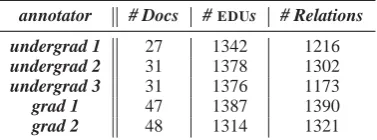
mentations, resolving conflicts on their own or via a supervisor. The annotation of the discourse re-lations was performed by each subject working in isolation. ANNODIS provided a new state of the art tool, GLOZZ, for discourse annotation for the three undergraduates. WithGLOZZannotators could isolate sections of text corresponding to sev-eral EDUs, and insert relations between selected constituents using the mouse. Though it did por-tray relations selected as lines between parts of the text, GLOZZdid not provide a discourse graph or SDRS as part of its graphical interface. The rep-resentation often yielded a dense number of lines between segments that annotators and evaluators found hard to read. The inadequate interline spac-ing inGLOZZ also contributed to certain number of click errors that we detail below in the paper. The statistics on the number of documents,EDUs and relations provided by each annotator are in ta-ble 1.
annotator # Docs #EDUs # Relations
[image:4.595.318.507.352.422.2]undergrad 1 27 1342 1216 undergrad 2 31 1378 1302 undergrad 3 31 1376 1173 grad 1 47 1387 1390 grad 2 48 1314 1321
Table 1: Statistics on documents,EDUs and Rela-tions.
4 Experiments and Results
Using ANNODIS’s annotated corpus, we checked for allEDUs π, whetherπ was attached to a con-stituent in theSDRSbuilt from the previousEDUs in a way that violated theRFC. Given a discourse as a series ofEDUsπ1, π2, . . . , πn, we constructed
for eachπi the corresponding sub-graph and
cal-culated the set of nodes on the RF of this sub-graph. We then checked whether the EDU πi+1 was attached to a node that was found in this set. We also checked whether any newly created com-plex segment was attached to a node on theRFof this sub-graph.
4.1 Calculating the Nodes at theRF
im-plied relations left out by the annotators.7
Disconnected Graphs While checking theRFC
for the attachment of a node n, the SDRS graph at this point might consist of 2 or more disjoint subgraphs which get connected together at a later point. Because we did not want to decide which way these graphs should be connected, we defined a right frontier for each one using its own LAST. We then calculated the RF for each one of them and set the set of available nodes to be those in the union of the RFs of the disjoint subgraphs. If the subgraphs were not connected at the end of the incremental process in a way that conformed toRFC, we counted this as a violation. Annotators did not always provide us with a connected graph.
Postponed Decisions SDRT allows for the at-tachment not only of EDUs but also of subgraphs to an available node in the contextually given SDRS. For instance, in the following example, the intended meaning is given by the graph in which the Contrast is between the first label and the com-plex constituent composed of the disjunction ofπ2
andπ3.
(π1) Bill doesn’t like sports. (π2) But Sam does.
(π3) Or John does.
π1
Contrast π
π2
Altern. π3
Naive annotators attached subgraphs instead of EDUs to theRFwith some regularity (around 2%). This means that anEDUπi+1could be attached to
a node that was not present in the subgraph pro-duced by π1, . . . , πi. There were two main
rea-sons for this: (1)πi+1 came from a syntactically
fronted clause, a parenthetical or apposition in a sentence whose main clause produced πi+2 and πi+1 was attached toπi+2; (2)πi+1was attached
to a complex segment [. . . , πi+1, . . . , πi+k, . . .]
which was not yet introduced in the subgraph. Since the nodes to which πi+1 is attached in
such cases are not present in the graph, by
def-inition they are not in the RF and they could be counted as violations. Nonetheless, if the nodes
7
In similar work on TimeML annotations, Setzer et al. (2003; Muller and Raymonet (2005) add implied relations to annotated, temporal graphs.
which connect nodes likeπi+1 eventually link up
to the incrementally builtSDRS in the right way,
πi+1might eventually end up linked to something
on theRF. For this reason, we postponed the de-cision on nodes likeπi+1until the nodes to which
they are attached were explicitly introduced in the SDRS.
The Coherence of Complex Segments In an
SDRS, severalEDUs may combine to form a com-plex segment α that serves as a term for a dis-course relationR. The interpretation of theSDRS implies that all of α’s constituents contribute to the rhetorical function specified by R. This im-plies that the coordinating relation Continuation holds between the EDUs insideα, unless there is some other relation between them that is incom-patible with Continuation (like a subordinating relation). Continuations are often used in SDRT (Asher, 1993; Asher and Lascarides, 2003). Dur-ing the annotation procedure, our subjects did not always explicitly link theEDUs within a complex segment. In order to enforce the coherence of those complex segments we added Continuation relations between the constituents of a complex segment unless there was already another path be-tween those constituents.
Expanding Continuations Consider the
fol-lowing discourse:
(4) [John,[who owns a chain of restaurants]π2,[and is a
director of a local charity organization,]π3wanted to
sell his yacht.]π1[He couldn’t afford it anymore.]π4
Annotators sometimes produced the following SDRT graph for the first three EDUs of this dis-course:
(5) π1
E-Elab
π2
Continuation π3
In this case the only open node is π3 due to
the coordinating relation Continuation. Nonethe-less, π4 should be attached to π1, without
vi-olating the RFC. Indeed, SDRT’s definition of the Continuation relation enforces that if we have
R(π1, π2) and Continuation(π2, π3) then we
ac-tually have the complex segment [π2, π3] with R(π1,[π2, π3]). So there is in fact a missing
(6) π
1
E-Elab
π
π2
Continuation π3
which makes π1 an available attachment site for π4. Such implied constituents have been added to
theSDRSgraphs.
Factoring Related to the operation of
Ex-pansion, SDRT’s definition of Continuation and various subordinating relations also requires that if we have R(a,[π1, π2, . . . , πn]) where
[π1, π2, . . . , πn] is a complex segment with
π1, . . . πnlinked by Continuation andRis
Elabo-ration, Entity-ElaboElabo-ration, Frame, Attribution, or Commentary, then we also haveR(a, πi)for each
i. We added these relations when they were miss-ing.
4.2 Results
With the operations just described, we added sev-eral inferred relations to the graph. We then cal-culated statistics concerning the percentage of at-tachments for which the RFC is respected using the following formula:
RF CEDU=
# E D Us attached to the RF
# E D Us in total
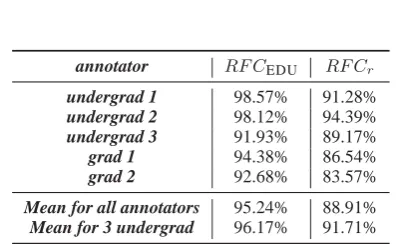
As we explained, an EDU can be attached to an SDRTgraph directly by itself or indirectly as part of a bigger complex segment. In order to calcu-late the nominator we determine first whether an EDUdirectly attaches to the graph’sRF, and if that fails we determine whether it is part of a larger complex segment which is attached to the graph’s RF. The results obtained are shown in the first two columns of table 2. The RFC is respected by at least some attachment decision 95% of the time— i.e., 95% of theEDUs get attached to another node that is found on theRF. The breakdown across our annotators is given in table 2.
SDRT allows for multiple attachments of an EDUto various nodes in an SDRS; e.g. while an EDUmay be attached via one relation to a node on the RF, it may be attached to another node off theRF. To take account of all the attachments for a givenEDU, we need another way of measuring the
percentage of attachments that respects the RFC. So we counted the ways eachEDUis related to a node in the SDRS for the previous text and then divided the number of attachment decisions that respect theRFCby the total number of attachment decisions—i.e. :
RF Cr=
# RF attachment decisions
# Total attachment decisions
.
annotator RF CEDU RF Cr
undergrad 1 98.57% 91.28% undergrad 2 98.12% 94.39% undergrad 3 91.93% 89.17% grad 1 94.38% 86.54% grad 2 92.68% 83.57%
[image:6.595.311.512.186.308.2]Mean for all annotators 95.24% 88.91% Mean for 3 undergrad 96.17% 91.71%
Table 2: The % with which each annotator has re-spectedSDRT’sRFCusing theEDUand attachment decision measures.
The third column of table 2 shows that having a stable annotation manual andGLOZZ improved the results across our two annotator populations, even though the annotation manual did not say anything about RFC or about the structure of the discourse graphs. Moreover, the distribution of vi-olations of theRFCfollows a power law and only 4.56% of the documents contained more than 5 vi-olations. This is strong evidence that there is little propagation of violations.
5 Analysis of Presumed Violations
Although 95% of EDUs attach to nodes on the RF of an SDRT graph, 5% of EDUs don’t. SDRT experts performed a qualitative analysis of some of these presumed violations. In many cases, the experts judged that the presumed violations were due to click-errors: sometimes the annotators sim-ply clicked on something that did not translate into a segment. Sometimes, the experts judged that the annotators picked the wrong segment to attach a new segment or the wrong type of relation during the construction of theSDRTgraph. For example, in the graph that follows the relation between seg-ments 74 and 75 is not a Comment but an
As expected, there were also “structural” er-rors, arising from a lack or a misuse of complex segments. Here is a typical example (translated from the original French):
[Around her,]_74 [we should mention Joseph Racaille]_75 [responsible for the magnificent ar-rangements,]_76 [Christophe Dupouy]_77 [reg-ular associate of Jean-Louis Murat responsi-ble for mixing,]_78 [without forgetting her two guardian angels:]_79 [her agent Olivier Gluz-man]_80 [who signed after a love at first sight,]_81 [and her husband Mokhtar]_82 [who has taken care of the family]_83
Here is the annotated structure up toEDU78:
74
Comment 75
E-elab Cont
77
E-elab
76 78 (LAST)
Note that the attachment of 77 to 75 is non-local and non-adjacent. The annotator then attaches EDU79 to 75 which is blocked from theRFdue to the Continuationcoordinating relation. By not having created a complex segment due the enu-meration that includesEDUs 75 to 78, the annota-tor had no option but to violate theRF. Here is the properSDRT graph for segments 74 to 79 (where the attachment of 79 to 74 is also both non-local and non-adjacent):
74 ElabElab
π 79
75
E-elabContinuation
77
E-elab
76 78
In this case, before the introduction of EDU 79, EDU78 isLASTand by consequence77, πand 74 are on the RF. Attaching 79 to 74 is thus legiti-mate.
We also found more interesting examples of right frontier violations. One annotator produced a graph for a story which is about the attacks of 9/11/2001 and is too long to quote here. A sim-plified graph of the first part of the story is shown below. EDU4 elaborates on the main event of the story but it is not on the RFfor 19. However, 19 is the first recurrence of the complex definite de-scription le 11 septembre 2001 since the title and the term’s definition inEDU4.
4
E-elab
Continuation
7
Result[11-13]Result[14-16] Comment 19
This reuse of the full definite description could be considered a case ofSDRT’s discourse subordina-tion.
6 RFCand distances of attachment
Our empirical study vindicates SDRT’s RFC, but it also has computational implications. Using the RFC dramatically diminishes the number of at-tachment possibilities and thus greatly reduces the search space for any incremental discourse pars-ing algorithm.8 The mean of nodes that are open on the RF at any given moment on ourANNODIS data is 16.43% of all the nodes in the graph.
Our data also allowed us to calculate the dis-tance of attachment sites fromLAST, which could be an important constraint on machine learning algorithms for constructing discourse structures. Given a pair of constituents (πi, πj) distance is
calculated either textually (the number of inter-veningEDUs betweenπi andπj) or topologically
(the length the shortest path betweenπi andπj).
Topological distance, however, does not take into account the fact that a textually further segment is cognitively less salient. Moreover, this measure can give the same distance to nodes that are textu-ally far away between them due to long distance pop-ups (Asher and Lascarides, 2003). A purely textual distance, on the other hand, gives the same distance to an EDU πi and a complex segment [π1, . . . , πi] even if π1 and πi are textually
dis-tant (since both have the same span end). We used a measure combining both. The distance scheme that we used assigns to each EDUits textual dis-tance fromLASTin the graph under consideration, while a complex segment of rank 1 gets a distance which is computed from the highest distance of their constituentEDUs plus 1. For a constituentσ of ranknwe have:
Dist=M ax{dist(x) :xinσ}+n
8
The distribution of attachment follows a power law with 40% of attachments performed non-locally, that is on segments of distance 2 or more (figure 1). This implies that the distance between candidate attachment sites that are on theRFis an important feature for anMLalgorithm. It is impor-tant to note at this point that following the baseline approach of always attaching on theLASTmisses 40% of attachments. We also have 20.38% of the non-local, non-adjacent attachments in our anno-tations. So an RST parser using Marcu’s (2000) adjacency constraint as do duVerle and Prendinger (2009) would miss these.
0 10 20 30 40 50 60
0 2 4 6 8 10 12 14 16 18 20 P
e r c e n t a g e
Attachment distance
[image:8.595.85.282.265.386.2]
Figure 1: Distribution of attachment distance
7 Related Work
Several studies have shown that the RFC may be violated as an anaphoric constraint when there are other clues, content or linguistic features, that determine the antecedent. (Poesio and di Euge-nio, 2001; Holler and Irmen, 2007; Asher, 2008; Prévot and Vieu, 2008), for example, show that anaphors such as definite descriptions and com-plex demonstratives, which often provide enough content on their own to isolate their antecedents, or pronouns in languages like German which must obey gender agreement, might remain felicitous although the discourse relations between them and their antecedents might violate the RFC. Usually there are few linguistic clues that help find the appropriate antecedent to a discourse relation, in contrast to the anaphoric expressions mentioned above. Exceptions involve stylistic devices like direct quotation that license discourse subordina-tion. Thus, SDRTpredicts that RFCviolations for
discourse attachments should be much more rare than those for the resolution of anaphors that pro-vide linguistic clues about their antecedents.
As regards other empirical validation of var-ious versions of the RFC for the attachment of discourse constituents, Wolf and Gibson (2006) show an RST-like RFC is not supported in their corpus GraphBank. Our study concurs in that some 20% of the attachments in our corpus can-not be formulated in RST.9 On the other hand, we note that because of the 2 dimensional nature ofSDRTgraphs and because of the caveats intro-duced by structural relations and discourse sub-ordination, the counterexamples from GraphBank against, say,RSTrepresentations do not carry over straightforwardly to SDRSs. In fact, once these factors are taken into account, theRFC violations in our corpus and in GraphBank are roughly about the same.
8 Conclusions
We have shown thatSDRT’sRFChas strong empir-ical support: the attachments of our 3 completely naive annotators fully comply withRFC91.7% of the time and partially comply with it 96% of the time. As a constraint on discourse parsingSDRT’s RFC, we have argued, is both empirically and computationally motivated. We have also shown that non-local attachments occur about 40% of the time, which implies that attaching directly on the LASTwill not yield good results. Further, many of the non local attachments do not respectRST’s ad-jacency constraint. We needSDRT’sRFCto get the right attachment points for our corpus. We believe that empirical studies of the kind we have given here are essential to finding robust and useful fea-tures that will vastly improve discourse parsers.
9
One other study we are aware of is Sassen and Kühn-lein (2005), who show that in chat conversations, theRFC
does not always hold unconditionally. Since this genre of discourse is not always coherent, it is expected that theRFC
References
Asher, N. and A. Lascarides. 2003. Logics of
Con-versation. Studies in Natural Language Processing.
Cambridge University Press, Cambridge, UK.
Asher, N. and L. Vieu. 2005. Subordinating and co-ordinating discourse relations. Lingua, 115(4):591– 610.
Asher, N. 1993. Reference to Abstract Objects in
Dis-course. Kluwer Academic Publishers.
Asher, N. 2007. A large view of semantic content.
Pragmatics and Cognition, 15(1):17–39.
Asher, N. 2008. Troubles on the right frontier. In Benz, A. and P. Kühnlein, editors, Constraints
in Discourse, Pragmatics and Beyond New Series,
chapter 2, pages 29–52. John Benjamins Publishing Company.
Baldridge, J., N. Asher, and J. Hunter. 2007. An-notation for and robust parsing of discourse struc-ture on unrestricted texts. Zeitschrift fur
Sprachwis-senschaft, 26:213–239.
Danlos, L. 2008. Strong generative capacity of rst, sdrt and discourse dependency dags. In Benz, A. and P. Kühnlein, editors, Constraints in Discourse, Pragmatics and Beyond New Series, pages 69–95. John Benjamins Publishing Company.
duVerle, D. and H. Prendinger. 2009. A novel dis-course parser based on support vector machine clas-sification. In Proceedings of ACL, pages 665–673, Suntec, Singapore, August.
Hardt, D. and M. Romero. 2004. Ellipsis and the structure of discourse. Journal of Semantics, 21:375–414, November.
Hardt, D., N. Asher, and J. Busquets. 2001. Discourse parallelism, scope and ellipsis. Journal of
Seman-tics, 18:1–16.
Holler, A. and L. Irmen. 2007. Empirically assessing effects of the right frontier constraint. In Anaphora:
Analysis, Algorithms and Applications, pages 15–
27. Springer, Berlin/Heidelberg.
Lascarides, A. and N. Asher. 1993. Temporal interpre-tation, discourse relations and commonsense entail-ment. Linguistics and Philosophy, 16(5):437–493.
Lee, A., R. Prasad, A. Joshi, and B. Webber. 2008. Departures from tree structures in discourse: Shared arguments in the penn discourse treebank. In
Con-straints in Discourse (CID ’08), pages 61–68.
Mann, W. and S. Thompson. 1987. Rhetorical struc-ture theory: A framework for the analysis of texts. Technical Report ISI/RS-87-185, Information Sci-ences Institute, Marina del Rey, California.
Mann, W. and S. Thompson. 1988. Rhetorical struc-ture theory: Towards a functional theory of text or-ganization. Text, 8(3):243–281.
Marcu, D. 2000. The Theory and Practice of
Dis-course Parsing and Summarization. The MIT Press.
Muller, P. and A. Raymonet. 2005. Using inference for evaluating models of temporal discourse. In
12th International Symposium on Temporal Repre-sentation and Reasoning, pages 11–19. IEEE
Com-puter Society Press.
Poesio, M. and B. di Eugenio. 2001. Discourse struc-ture and anaphoric accessibility. In Proc. of the
ESSLLI Workshop on Discourse Structure and In-formation Structure, August.
Polanyi, L. 1985. A theory of discourse structure and discourse coherence. In Kroeber, P. D., W. H. Eil-fort, and K. L. Peterson, editors, Papers from the
General Session at the 21st Regional Meeting of the Chicago Linguistics Society.
Polanyi, L. 1988. A formal model of the structure of discourse. Journal of Pragmatics, 12:601–638.
Prévot, L. and L. Vieu. 2008. The moving right fron-tier. In Benz, A. and P. Kühnlein, editors,
Con-straints in Discourse, Pragmatics and Beyond New
Series, chapter 3, pages 53–66. John Benjamins Publishing Company.
Sassen, C. and P. Kühnlein. 2005. The right fron-tier constraint as conditional. In Computational
Linguistics and Intelligent Text Processing, Lecture
Notes in Computer Science (LNCS), pages 222– 225.
Setzer, A., R. Gaizauskas, and M. Hepple. 2003. Using semantic inferences for temporal annotation comparison. In Proceedings of the Fourth
Interna-tional Workshop on Inference in ComputaInterna-tional Se-mantics (ICoS-4).
Webber, B. 1988. Title discourse deixis and discourse processing. Technical Report MS-CIS-88-75, Uni-versity of Pennsylvania, Department of Computer and Information Science, September.
Wolf, F. and E. Gibson. 2006. Coherence in Natural
Language: Data Stuctures and Applications. The