Converting Mikrokosmos frames into Description Logics
P.J. Beltr´an-Ferruz and P.A. Gonz´alez-Calero and P.Gerv´asGAIA - Applied Artificial Intelligence Group Dep. Sistemas Inform´aticos y Programaci´on
Universidad Complutense de Madrid C/ Juan del Rosal, 8. 28040 Madrid (Spain)
[email protected], {pedro,pgervas}@sip.ucm.es
Abstract
Mikrokosmos contains an ontology plus a number of lexicons in different languages that were origi-nally developed for machine translation. The under-lying representation formalism for these resources is an ad-hoc frame-based language which makes it difficult to inter-operate Mikrokosmos with state-of-the-art knowledge-based systems.
In this paper we propose a translation from the frame-based representation of Mikrokosmos into Description logics. This translation allows us to automatically transform Mikrokosmos sources into OWL and thus provide a powerful ontology in the formalism of the semantic web. Furthermore, the reasoning mechanisms of Description Logics may also support knowledge acquisition and mainte-nance as well as its application in natural language processing systems.
1 Introduction
The Mikrokosmos project was originally an interlin-gual system for Knowledge-Based Machine Trans-lation (KBMT) (Nirenburg, 1987) developed in the Computing Research Laboratory from New Mexico State University. Although KBMT was conceived for translation of domain specific texts, no further restrictions are imposed in the contents of the text. Therefore the creators of Mikrokosmos built a rich ontology that contains a lot of general concepts, more than 4.700 concepts that are connected with an average of other 14 concepts using attributes and relations (de Quesada, 2001).
KBMT is an expensive approach that requires a big effort on knowledge acquisition, and it has been considered impractical by some authors. For that reason, the creators of Mikrokosmos were es-pecially concerned about developing real-size sys-tems that would demonstrate the feasibility of their approach. Generating contents for the ontology was their first concern, while the use of a rigorous for-malism for knowledge representation was not con-sidered a priority (Moreno-Ortiz et al., 2002).
The work presented here is an effort to port Mikrokosmos into Description Logics (DL) in or-der to incorporate this resource into the systems we are developing. Our work on natural language gen-eration integrates ontologies and case-based reason-ing (CBR) (Diaz-Agudo et al., 2002), an approach that heavily relies on classification-based reasoning from DL.
Representing Mikrokosmos in DL should bring several benefits. Since DL is the underlying knowl-edge representation approach in the Semantic Web, a big number of supporting tools are being de-veloped for acquiring and maintaining ontologies represented in some version of DL, such as OWL (Bechhofer et al., 2004). Giving a well-founded formal representation to Mikrokosmos should im-prove its quality by uncovering inconsistencies. Fi-nally, porting Mikrokosmos to a formalism as pop-ular as OWL will definitively increase its potential user community.
There are other efforts that convert ontologies from different representations to Description Log-ics languages. OntoMap is a web-site that pro-vides access to upper-level ontologies and hand-crafted mappings between them (Kiryakov et al., 2001). The initial set of ontologies contains Cyc, EuroWordnet and Mikrokosmos ontology, but it only deals with the top-level hierarchy. In case of Mikrokosmos it only contains 13 concepts. Their main effort involves the mapping between differ-ent ontologies. They also provide the resources in DAML+OIL. The project’s goal is to facilitate easy access, understanding, and reuse of general-purpose ontologies and upper-level models.
Concept Slot Facet Filler(s)
REPLACEMENT-FOR DEFINITION VALUE ”when x is a replacement for y”
IS-A VALUE PHYSICAL-OBJECT-RELATION, EVENT-RELATION INVERSE VALUE REPLACED-BY
DOMAIN SEM EVENT, OBJECT
RANGE SEM EVENT, OBJECT
Table 1: Example frame: REPLACEMENT-FOR
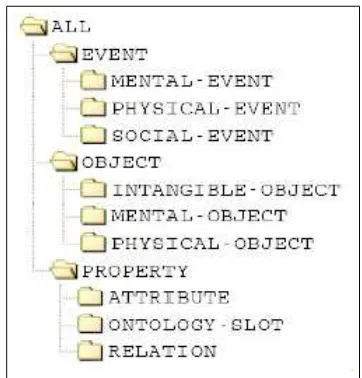
Figure 1: Mikrokosmos top hierarchy
2 Mikrokosmos ontology
In Mikrokosmos, ontology lists the definitions of concepts that are understood as corresponding to classes of thing and events in the world. Concepts are primitive symbols of a world model which in-cludes objects, events and properties organized in a complex hierarchy of language-independent con-cepts (See top hierarchy of Mikrokosmos in Figure 1). The concepts are constructed following super or-dinates, or hyponymy relations (IS-A links). In ad-dition to its organization into a taxonomy via IS-A links, the ontology contain numerous other links be-tween concepts, such as links using properties (Lon-ergan, 2001). For example DECEMBER has a rela-tion with WINTER using the property PART-OF-OBJECT.
Each concept that makes up the ontology is lan-guage independent and is represented using frames. For example we can see the frame for concept REPLACEMENT-FOR in Table 1.
The format of Mikrokosmos Ontology is de-scribed in detail in (Nirenburg and Raskin, 2004). It formally introduces the syntax and the semantics of the ontology using a BNF grammar. We are most interested in how we can access to this information. Ontology is saved in a text file using Spencer no-tation that is based on XML. There is another nota-tion called Beale notanota-tion that is based on Lisp, but
we will focus on Spencer notation.
In the XML based format we have the whole on-tology represented in a list of RECORD entries. Definition of one CONCEPT requires one or more of these RECORD entries. Each entry contains four fields, that are: CONCEPT, SLOT, FACET, and FILLER.
The CONCEPT field can be filled by anyName
of a concept of the ontology.
The second field in each entry is SLOT. This field can be filled with PROPERTY or any of its subclasses using IS-A links. There are two kind of slot fillers. One type are descendants of AT-TRIBUTE or RELATION, that represent links be-tween concepts in the hierarchy. The other type are descendants of ONTOLOGY-SLOT. We will call themspecial slots, and all of them have the sense of determining the structure of the ontology. Possible descendants of ONTOLOGY-SLOT are: DEFINI-TION, DOMAIN, INSTANCES, INVERSE, IS-A, RANGE, SUBCLASSES and some others that are less important; later in this section we will explain them in detail.
The third field is FACET, and it describes some finer distinctions between the possible fillers of the slot. Possibles FACET fillers are: VALUE, SEM, DEFAULT, INV, NOT, DEFAULT, DEFAULT-MEASURE and RELAXABLE-TO.
The last field is FILLER, and its value depends on the other fields, but generally it contains either a
Nameof a concept of the ontology or an instance. Initially we can think that there are no restrictions in these representations, but there are some spe-cial slots that limit expressiveness. All CONCEPT frames have non-special and special slots. Special slots for all kinds of concepts are:
• DEFINITION: Definition in English of the
concept.
• IS-A: It is used for asserting parents in the hi-erarchy.
• SUBCLASSES: It is used for listing concept children.
• INSTANCES, SPANISH1, ENGLISH1: They
EVENT, and contains words of the dictionary. Special slots which can only be present in all PROPERTY and only in PROPERTY concept frames are:
• DOMAIN: It has fillers usually filled with
EVENTs1 and/or OBJECTs and it determines
whether a CONCEPT can have it as a SLOT.
• RANGE: It is used in RELATIONs and
AT-TRIBUTEs. In RELATIONs the RANGE slot has only the SEM facet. The fillers of the SEM facet are the names of concepts that are in the range of this RELATION. In ATTRIBUTEs the RANGE slot has only a VALUE facet. The VALUE facet is filled by all the possible literal or numerical values permissible for that AT-TRIBUTE. The filler can also be a numerical range specified using appropriate mathemati-cal comparison operators (such as>,<, ...).
• INVERSE: It is defined only for RELATIONs.
It is mandatory for all RELATION frames. The INVERSE slot has only the Value facet which is filled by the name of the RELATION which is the Inverse of the given RELATION.
• MEASURED-IN: It is defined only for the
de-scendants of the SCALAR-ATTRIBUTE con-cept frame. The MEASURED-IN slot is used to add a measuring unit for the number or scalar range that fills facets of the RANGE slot in SCALAR-ATTRIBUTE concept frames. The facet fillers of the MEASURED-IN slot are the daughters of the MEASURING-UNIT concept. The MEASURED-IN slot is used only in those SCALAR-ATTRIBUTE frames where MEASURING-UNIT has physi-cal sense (e.g. for SIZE, AGE, etc.).
3 Description logics language:SHIQ DL are a family of logical formalisms that origi-nated in the field of artificial intelligence as a tool for representation of conceptual knowledge. Since then, DLs have been successfully used in a wide range of application areas such as knowledge repre-sentation, reasoning about class-based formalisms (e.g. conceptual database models and UML dia-grams), and ontology engineering in the context of the semantic web. The basic syntactic entities of DL are concepts, which are constructed from concept 1In this paper when we say a concept name in plural we are refering to this concept and his children, using links IS-A defined in the ontology.
names (unary predicates) and role names (binary predicates) using the set of concept and role con-structors provided by a particular DL (Lutz, 2003).
Our interest in Mikrokosmos ontology is to map its contents to a DL language. We have chosen
ALCQHIR+ also known as SHIQ (Horrocks et al., 2000).
SHIQis the basic logic ALC augmented with
qualifying number restrictions, role restrictions, role hierarchies, inverse roles, and transitive roles.
ALC comprises concepts —denoting sets— as
well as roles —denoting binary relations. Unlike roles, concepts can be compound. Compound con-cepts are constructed by the following operators: in-tersectionu, uniont, complementation¬—taking concepts as arguments—, and the value restrictions
∀, and∃—taking a role and a concept as their
ar-guments. Formally,ALC is given by the following formation rules, wherecdenotes a concept symbol andra role symbol (Schild, 1991):
C, D−→c| > |CuD | ¬C| ∀R.C R−→r
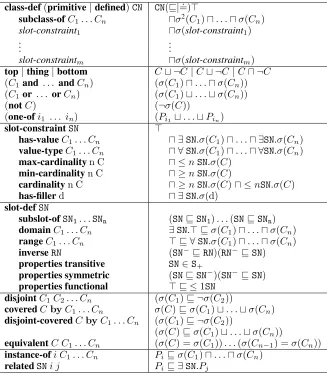
DL SHIQis implemented in the RACER sys-tem (Haarslev and Moller, 2003). This makes it a desirable target representation for our ontology. For describing our ontology in SHIQwe will use the notation explained in Table 2, that contains denota-tional semantics for our language translation.
4 Mikrokosmos mapping toSHIQ
Once we have identified DL language we want to use —SHIQ— and we have described the
Mikrokosmos ontology, we can proceed to map it. The first step is to determine whether a concept is a class or a slot. Although in the Mikrokosmos ontology everything is a concept we need to dis-tinguish between Mikrokosmos concepts that cor-respond to unary predicates —which map to DL classes— and Mikrokosmos concepts that corre-spond to binary predicates —which map to DL rela-tions. EVENT, OBJECT and all of their subclasses will be unary predicates so they will be classes. Meanwhile PROPERTY and all its hierarchy ex-cept ONTOLOGY-SLOTs (see Figure 1) will be bi-nary predicates so they will be slots. There are a few exceptions: concept ALL is topin DL and ONTOLOGY-SLOT and all of their subclasses are not mapped to DL language because they have the
class-def(primitive|defined)CN CN(v|=). >
subclass-ofC1. . . Cn uσ2(C1)u. . .uσ(Cn)
slot-constraint1 uσ(slot-constraint1)
... ...
slot-constraintm uσ(slot-constraintm)
top|thing|bottom Ct ¬C|Ct ¬C|Cu ¬C
(C1and . . . andCn) (σ(C1)u. . .uσ(Cn)) (C1or . . . orCn) (σ(C1)t. . .tσ(Cn))
(notC) (¬σ(C))
(one-ofi1 . . . in) (Pi1t. . .tPin)
slot-constraintSN >
has-valueC1. . . Cn u ∃SN.σ(C1)u. . .u ∃SN.σ(Cn) value-typeC1. . . Cn u ∀SN.σ(C1)u. . .u ∀SN.σ(Cn) max-cardinalityn C u ≤nSN.σ(C)
min-cardinalityn C u ≥nSN.σ(C)
cardinalityn C u ≥nSN.σ(C)u ≤nSN.σ(C)
has-fillerd u ∃SN.σ(d)
slot-defSN
subslot-ofSN1. . .SNn (SNvSN1). . .(SNvSNn) domainC1. . . Cn ∃SN.> vσ(C1)u. . .uσ(Cn) rangeC1. . . Cn > v ∀SN.σ(C1)u. . .uσ(Cn)
inverseRN (SN−vRN)(RN−vSN)
properties transitive SN∈S+
properties symmetric (SNvSN−)(SN−vSN) properties functional > v ≤1SN
disjointC1C2. . . Cn (σ(C1)v ¬σ(C2))
coveredCbyC1. . . Cn σ(C)vσ(C1)t. . .tσ(Cn) disjoint-coveredCbyC1. . . Cn (σ(C1)v ¬σ(C2))
(σ(C)vσ(C1)t. . .tσ(Cn))
equivalentC C1. . . Cn (σ(C) =σ(C1)). . .(σ(Cn−1) =σ(Cn)) instance-ofi C1. . . Cn Pivσ(C1)u. . .uσ(Cn)
relatedSNi j Piv ∃SN.Pj
Table 2: Denotational semantics for language definition
sense of structuring the ontology. ONTOLOGY-SLOT and all of their subclasses encode the struc-ture of the Mikrokosmos ontology. They are not mapped as DL classes or slots. Instead they are in-corporated into the DL definition of the Mikrokos-mos concepts that they refer to.
Mikrokosmos has some information that can not be mapped to a DL language. We will address this problem in two ways. First we will make some an-notations to class and slots that are not supported by DL language, but which could be provided by RDFS based languages. Second, extra information about slots that is not supported by DL language will be stored in special concepts created from the corresponding slots.
4.1 Building DL classes
Now we will discuss how we extract information stored in the XML based file to build classes in DL language.
The information that has to be extracted is:
class-def(primitive|defined)CN
subclass-ofC1. . . Cn
slot-constraint1
...
slot-constraintm
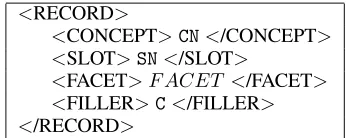
Having identified the set of DL classes we need to identify their superclasses and slot-constraints. Information about superclasses is encoded in XML records of the form shown in Figure 2. Additional sources of information about superclasses —such as RECORDs whereCNappears as FILLER and SUB-CLASSES appears as SLOT— actually encode re-dundant information and are therefore discarded.
<RECORD>
<CONCEPT>CN</CONCEPT> <SLOT>IS-A</SLOT>
<FACET>VALUE</FACET> <FILLER>Ci</FILLER>
</RECORD>
Information about slot-constraints is encoded in records having PROPERTYs as a slot. But there are also some ONTOLOGY-SLOT used in class defini-tion and we will assign them a representadefini-tion.
We collect information about slot-constraints
from XML records of the form shown in Figure 3:
<RECORD>
<CONCEPT>CN</CONCEPT> <SLOT>SN</SLOT>
<FACET> F ACET </FACET> <FILLER>C</FILLER> </RECORD>
Figure 3: XML encoding forslot-constraints
We obtain different information depending on the value ofFACET
• IfFACET= DEFAULT-MEASURE
CNslot-constraintSNvalue-typeCis added to the corresponding class definition.
• If FACET = DEFAULT. This information is
stored as an annotation
• IfFACET= INV. This information comes from
another slot, that it is inverse toSN. There is no need to handle this information here because DL has automatic handling for such type of in-formation.
• IfFACET= NOT. This entry appears when we restrict inheritance of one SLOT in the hier-archy. Information contained in Mikrokosmos about these is affirmative information and neg-ative information, DL only uses affirmneg-ative in-formation to handle it, so we do nothing with this information.
• IfFACET= RELAXABLE-TO. This
informa-tion is stored as an annotainforma-tion
• IfFACET= SEM
CNslot-constraintSNvalue-typeCis added.
• IfFACET= VALUE
CNslot-constraintSNhas-valueCis added.
Additional information encoded in terms of records with ONTOLOGY-SLOTS —as slots—, must be handled and incorporated into the corre-sponding class definitions.
The ONTOLOGY-SLOTs to be identified are DEFINITION, SPANISH1 and ENGLISH1.
• If SLOT = DEFINITION. We will make an
an-notation in class definition.
• If SLOT = SPANISH1 or ENGLISH1. We
create two SLOTs called SPANISH1 and EN-GLISH1, so we can assert:
slot-constraintEN GLISH1has-fillerd. 3
4.2 Building DL relations
Information required to build DL relations is en-coded in XML records with ONTOLOGY-SLOTS in their SLOT field of the form shown in Figure 4
<RECORD>
<CONCEPT>SN</CONCEPT> <SLOT>SLOT</SLOT> <FACET>FACET</FACET> <FILLER>X</FILLER> </RECORD>
Figure 4: XML encoding of slot information
Possible relevant fillers of the ONTOLOGY-SLOTS are:
• DEFINITION, IS-A and SUBCLASSES: This
information is handled for DL relations in the same way as for DL classes.
• INVERSE: It can be used with SEM and
VALUEFACETand represents inverse slots.
slot-defSNinversesXis added.
• DOMAIN: As before when there is a restric-tion in inheritance Mikrokosmos asserts affir-mative and negative information so there is a FACET NOT that is rejected, and has no translation to DL language. There are more possibilities for filling the FACET: VALUE, DEFAULT, RELAXABLE-TO and SEM, we make no distinction among them:
slot-def SN domain disjoint X1. . .Xn is
added.
• RANGE: FACET NOT is treated as above. When we have other FACETs there are two possible kinds of FILLERs: CONCEPTS or numeric ranges. For CONCEPTS
slot-def SN range disjoint X1. . .Xn is added.
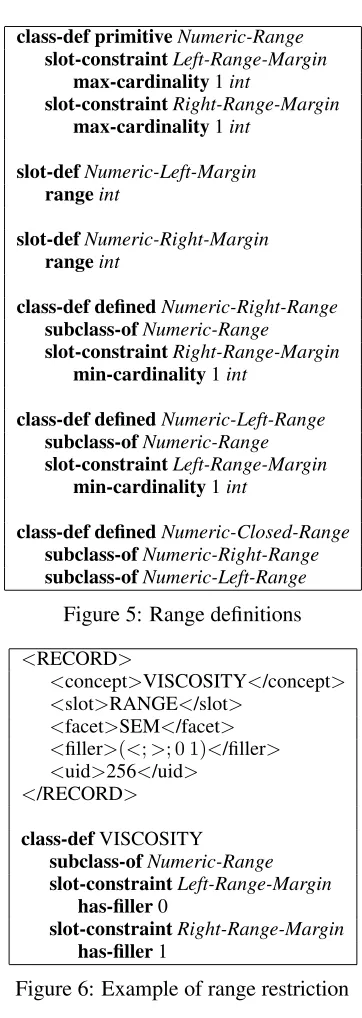
For numeric range we create a subclass of Numeric-Range (See Figure 5 and example in Figure 6).
• MEASURED-IN: This information is
consid-ered the same as RANGE. It can only have SEM or DEFAULT FACETs.
slot-defSNrangeXis added.
class-def primitiveNumeric-Range slot-constraintLeft-Range-Margin
max-cardinality1int
slot-constraintRight-Range-Margin max-cardinality1int
slot-defNumeric-Left-Margin rangeint
slot-defNumeric-Right-Margin rangeint
class-def definedNumeric-Right-Range subclass-ofNumeric-Range
slot-constraintRight-Range-Margin min-cardinality1int
class-def definedNumeric-Left-Range subclass-ofNumeric-Range slot-constraintLeft-Range-Margin
min-cardinality1int
class-def definedNumeric-Closed-Range subclass-ofNumeric-Right-Range subclass-ofNumeric-Left-Range
Figure 5: Range definitions
<RECORD>
<concept>VISCOSITY</concept> <slot>RANGE</slot>
<facet>SEM</facet> <filler>(<;>; 0 1)</filler> <uid>256</uid>
</RECORD>
class-defVISCOSITY
subclass-ofNumeric-Range slot-constraintLeft-Range-Margin
has-filler0
slot-constraintRight-Range-Margin has-filler1
Figure 6: Example of range restriction
4.3 Building Mikrokosmos PROPERTYs as DL classes
As we have seen in previous subsection, not all in-formation about PROPERTYs can be mapped easily to slots. Because of that we have decided to include an extra hierarchy of concepts created from PROP-ERTYs.
For each slot we create a class that inherits from CLASS-SLOT called CLASS-< PROPERTY-NAME>. These classes contain all information about the PROPERTYs that we could not represent in a DL relation.
For each SLOT applied to a CONCEPT we will create a class that inherits from
CLASS-SLOT-CONCEPT called CLASS-<PROPERTY-NAME >-<CONCEPT-NAME>. These classes have slot-constraints in order to define information not cap-tured in the respective concept.
With this structure of classes we do not lose any information about slots and slot-constraints but al-most all information stored in that way is not useful for reasoning in current tools like RACER (Haarslev and Moller, 2001).
5 Evaluation of the translation process DL provide the way to carry out complex inference and reasoning tasks. In order to achieve this goal our DL language is less expressive than Mikrokos-mos. Among all restrictions in the expressiveness of DL languages we will mention two. DL languages are not able to reason with default values for the re-strictions. And they do not manage finite domains such as enumerates or sets.
These differences in expressivity between Mikrokosmos and our DL language has as a result some interesting points in the translation process. There were two possible solutions to this problem. First one was to discard all information that has not a direct mapping to our DL language. And second one —which we have chosen— is to make some artifices in order to preserve all information, but obviously we cannot reason with this information.
There are two places where we have made this kind of artifices:
• Default values: Mikrokosmos is able of
man-aging default values for restrictions while DL is not. So we have decided to store it as an annotation.
• Numeric restrictions: For example in Mikrokosmos we can restrict the age of a person to be plus than 0 and minus that 120, but our DL language is not capable. Because of that we have created the complex structure ofNumeric-Rangeconcepts.
So we can say that we have no loss of information in the translation process. But we were incapable to use all information contained in Mikrokosmos for reasoning and inference tasks.
6 Applications of Mikrokosmos and future work
ALL
EVENT
MENTAL-EVENT
PASIVE-COGNITIVE-EVENT
REMEMBER KNOW
EMOTIONAL-EVENT
ACTIVE-COGNITIVE-EVENT
CONSIDER SOCIAL-EVENT
CHANGE-EVENT
DIVIDE ABSTRACT-SOCIAL-ABILITY
ELIMINATE PHYSICAL-EVENT
APPLY-FORCE CHANGE-LOCATION
CUT JUMP CHANGE-POSITION
CLIMB
MOUNT
SALTAR
CORTAR SABER PENSAR
WORRY
Figure 7: Mikrokosmos ontology with some instances
that was associated with those concepts for realiza-tion in a particular language. This peculiarity al-lowed relatively easy bidirectional translation be-tween different languages via an intermediate con-ceptual representation.
Subsequent uses and/or transformations of these resources must take into account this peculiarity. In our case, the work carried out so far in transport-ing the Mikrokosmos ontology to OWL has been restricted to the part of the ontology concerned with the conceptual representation. Although this transformation already opens up avenues of re-search for knowledge representation for problem solving (D´ıaz-Agudo and Gonz´alez-Calero, 2002), the number of useful applications of the results of this process in the field of natural language process-ing will increase greatly once the correspondprocess-ing lex-icons —there are currently versions in Spanish and English— are also transformed into OWL.
For instance, use of this resource provides the means for intelligently substituting a given word for a different one - as required for example in our po-etry generation system (Diaz-Agudo et al., 2002) during the adaptation of the structure of poem from the case base to obtain a verse approximation of a user query. Assuming that a structure such as:
Sabed que en mi perfecta edad y armado con mis ojos abiertos me he rendido al ni˜no que sab´eis ciego y desnudo.
needs to be adapted, and the adaptation requires the substitution of the verb “sabed” for a related one out of a list of candidates - possibly obtained from the given user query - such as “pensad”, “cortad” and “saltad”. By conuslting the structure of the ontology —see extract in Figure 7 for illustration— the sys-tem may correctly select “pensad” as a preferable candidate in view of its proximity in the ontology to the original word.
Our future lines of research in this field will focus in a deeper study of which concepts are primitive and which ones are defined. Now we have decided that all concepts having any restriction are defined concepts. This decission was taken in orden to rea-son with the ontology but it is necessary to examine it in detail.
7 Conclusions
Mikrokosmos ontology is a rich and extensive knowledge resource that was developed with a pro-prietary formalism, with a weak theoretical founda-tion. We have analysed the contents of the ontology which have lead us to propose a possible translation into description logics.
All this effort of understanding Mikrokosmos ontology and mapping it to a description logics language has resulted in a concrete implementa-tion. We have chosen OWL —an RDFS based language—, in its version idOWL DL. This version implements reasoning using JENA (McBride, 2001) and the DIG interface (Bechhofer et al., 2003). There are two inference engines that implement the DIG interface: RACER and FaCT4. As part of this
implementation we have developed animport plu-ginfor Prot´eg´e 2.0 (See Figure 7).
With this work we can profit from all the knowl-edge stored in the Mikrokosmos ontology for other tasks related to Artificial Intelligence. These tasks are Natural Language Processing and Knowledge-Intensive Case-Based Reasoning. We still have to translate the Mikrokosmos lexicon in order to fully exploit the original resource.
Acknowledgements
The first author is supported by a FPI Predoctoral Grant form Universidad Complutense, Madrid. The
Figure 8: Screen capture of Prot´eg´e 2.0 with Mikrokosmos ontology.
work was partially funded by the Spanish Commit-tee of Science & Technology (TIC2002-01961). References
Sean Bechhofer, Ralf Moller, and Peter Crowther. 2003. The DIG description logic interface. In
Description Logics 2003, CEUR Workshop Pro-ceedings.
Sean Bechhofer, Frank van Harmelen, Jim Hendler, Ian Horrocks, Deborah L. McGuinness, Pe-ter F. Patel-Schneider, and Andrea Stein. 2004. Owl web ontology language reference, February. W3C http://www.w3.org/TR/2004/REC-owl-ref-20040210/.
Mercedes Garc´ıa de Quesada. 2001. Estructura definicional terminogrfica en el subdominio de la oncologa cl´ınica. In Estudios de Linguistica Espa˜nola, volume 14.
Bel´en D´ıaz-Agudo and Pedro Antonio Gonz´alez-Calero. 2002. CBROnto: a task/method ontol-ogy for CBR. In S. Haller and G. Simmons, edi-tors, Procs. of the 15th International FLAIRS’02 Conference (Special Track on CBR), pages 101– 106. AAAI Press.
B. Diaz-Agudo, P. Gerv´as, and P A. Gonzalez-Calero. 2002. Poetry generation in COLIBRI. In S. Craw and A. Preece, editors, ECCBR 2002, Advances in Case Based Reasoning, pages 73– 102. Springer. Lecture Notes in Artificial Intelli-gence.
Volker Haarslev and Ralf Moller. 2001. Descrip-tion of the RACER system and its applica-tions. InProceedubgs International Workshop on Description Logics (DL-2001), pages 132–142, Stanford, USA.
Volker Haarslev and Ralf Moller, 2003. RACER
User s Guide and Reference Manual Version 1.7.7. Concordia University and Univ. of Appl. Sciences in Wedel, November. http://www.sts.tu-harburg.de/∼ r.f.moeller/racer/racer-manual-1-7-7.pdf.
I. Horrocks, U. Sattler, and S. Tobies. 2000. Rea-soning with individuals for the description logic SHIQ. In David MacAllester, editor, Proceed-ings of the 17th International Conference on Au-tomated Deduction (CADE-17), number 1831, pages 482–496, Germany. Springer Verlag. Atanas K. Kiryakov, Marin Dimitrov, and
Kiril Iv. Simov. 2001. Ontomap - the guide to the upper-level. In Proceedings of SWWS’01, The first Semantic Web Work-ing Symposium, Stanford University, Cal-ifornia, USA, July 30 - August 1, 2001. http://www.ontotext.com/publications/swws01.pdf. E. Lonergan. 2001. Lexical knowledge
engineer-ing: Mikrokosmos revisited. In PACLING2001 - Pacific Association for Computational Linguis-tics 2001, Kitakyushu, Japan.
C. Lutz. 2003. Description logics with concrete domains—a survey. InAdvances in Modal Log-ics Volume 4. King’s College Publications. Brian McBride. 2001. Jena: Implementing the rdf
model and syntax specification. In Proceedings of the Second International Workshop on the Se-mantic Web - SemWeb’2001. Hongkong, China, May 1, 2001. http://SunSITE.Informatik.RWTH-
Aachen.de/Publications/CEUR-WS/Vol-40/mcbride.pdf.
Antonio Moreno-Ortiz, Victor Raskin, and Sergei Nirenburg. 2002. New developments in onto-logical semantics. In Proceedings of LREC-02, Spain, June.
Sergei Nirenburg and Victor Raskin, 2004. On-tological Semantics, chapter 7, pages 159–207. The MIT Press, September.
S. Nirenburg. 1987. Knowledge-based machine translation, the cmu approach. InMachine Trans-lation: theoretical and methodological issues, Studies in Natural Language Processing, pages 68–69, Cambridge. Cambridge University Press. Klaus Schild. 1991. A correspondence theory