Experimental Evaluation of a Lexicon- and Corpus-based Ensemble for
Multi-way Sentiment Analysis
∗Minh Duc Cao
School of Chemistry and Molecular Biosciences The University of Queensland
St Lucia, QLD 4072, Australia
Ingrid Zukerman
Clayton School of Information Technology Monash University
Clayton, VIC 3800, Australia
Abstract
We describe a probabilistic approach that combines information obtained from a lexi-con with information obtained from a Na¨ıve Bayes (NB) classifier for multi-way sen-timent analysis. Our approach also em-ploys grammatical structures to perform ad-justments for negations, modifiers and sen-tence connectives. The performance of this method is compared with that of an NB classifier with feature selection, and MCST – a state-of-the-art system. The results of our evaluation show that the performance of our hybrid approach is at least as good as that of these systems. We also exam-ine the influence of three factors on per-formance: (1) sentiment-ambiguous sen-tences, (2) probability of the most proba-ble star rating, and (3) coverage of the lexi-con and the NB classifier. Our results indi-cate that the consideration of these factors supports the identification of regions of im-proved reliability for sentiment analysis.
1 Introduction
A key problem in sentiment analysis is to deter-mine the polarity of sentiment in text. Much of the work on this problem has considered binary sentiment polarity (positive or negative) at gran-ularity levels ranging from sentences (Mao and Lebanon, 2006; McDonald et al., 2007) to docu-ments (Wilson et al., 2005; Allison, 2008). Multi-way polarity classification, i.e., the problem of inferring the “star” rating associated with a re-view, has been attempted in several domains, e.g., restaurant reviews (Snyder and Barzilay, 2007)
*The majority of this work was done while the first author
was at Monash University.
and movie reviews (Bickerstaffe and Zukerman, 2010; Pang and Lee, 2005). Star ratings are more informative than positive/negative ratings, and are commonly given in reviews of films, restaurants, books and consumer goods. However, because of this finer grain, multi-way sentiment classification is a more difficult task than binary classification. Hence, the results for multi-way classification are typically inferior to those obtained for the binary case.
Most of the research on sentiment analysis uses supervised classification methods such as Maxi-mum Entropy (Berger et al., 1996), Support Vec-tor Machines (SVMs) (Cortes and Vapnik, 1995) or Na¨ıve Bayes (NB) (Domingos and Pazzani, 1997). The sentiment expressed in word pat-terns has been exploited by considering wordn -grams (Hu et al., 2007), applying feature selec-tion to handle the resultant proliferaselec-tion of fea-tures (Mukras et al., 2007). In addition, when per-forming multi-way classification, approaches that consider class-label similarities (Bickerstaffe and Zukerman, 2010; Pang and Lee, 2005) generally outperform those that do not.
Lexicon-based methods for sentiment analy-sis have been investigated in (Beineke et al., 2004; Taboada et al., 2011; Andreevskaia and Bergler, 2008; Melville et al., 2009) in the con-text of binary, rather than multi-way, sentiment classifiers. These methods often require inten-sive labour (e.g., via the Mechanical Turk service) to build up the lexicon (Taboada et al., 2011) or use a small, generic lexicon enhanced by sources from the Internet (Beineke et al., 2004). An-dreevskaia and Bergler (2008) and Melville et al. (2009) employ a weighted average to combine information from the lexicon with the
cation produced by a supervised machine learn-ing method. Their results demonstrate the effec-tiveness of these methods only on small datasets, where the contribution of the machine-learning component is limited.
This paper examines the performance of a hybrid lexicon/supervised-learning approach and two supervised machine learning methods in multi-way sentiment analysis. The hybrid ap-proach combines information obtained from the lexicon with information obtained from an NB classifier with feature selection. Information is obtained from a lexicon by means of a novel func-tion based on the Beta distribufunc-tion. This funcfunc-tion, which employs heuristics to account for nega-tions, adverbial modifiers and sentence connec-tives, combines the sentiment of words into the sentiment of phrases, sentences, and eventually an entire review (Section 2). The supervised learn-ing methods are: an NB classifier with feature se-lection, and MCST (Bickerstaffe and Zukerman, 2010) – a state-of-the-art classifier based on hi-erarchical SVMs which considers label similar-ity (MCST outperforms Pang and Lee’s (2005) best-performing methods on the Movies dataset described in Section 5.1).
We also investigate the influence of three factors on sentiment-classification performance: (1) presence of sentiment-ambiguous sentences, which we identify by means of a heuristic (Sec-tion 4); (2) probability of the most probable star rating; and (3) coverage of the lexicon and the NB classifier, i.e., fraction of words in a review being “understood”.
Our results show that (1) the hybrid approach generally performs at least as well as NB with feature selection and MCST; (2) NB with feature selection generally outperforms MCST, highlight-ing the importance of chooshighlight-ing strhighlight-ingent baselines in algorithm evaluation; (3) the performance of sentiment analysis algorithms deteriorates as the number of sentiment-ambiguous sentences in a review increases, and improves as the probability of the most probable star rating of a review in-creases (beyond 50%), and as the coverage of the lexicon and the NB classifier increases (between 50% and 80%).
In the next section, we present our lexicon-based approach. Section 3 describes the combi-nation of the lexicon with an NB classifier, fol-lowed by our heuristic for identifying
sentiment-ambiguous sentences. Section 5 presents the re-sults of our evaluation, and Section 6 offers con-cluding remarks.
2 Harnessing the Lexicon
In this section, we present our framework for rep-resenting information from a lexicon, and com-bining this information into phrases, sentences and entire reviews, and our heuristics for modi-fying the sentiment of a word or phrase based on grammatical information. We report on the re-sults obtained with the lexicon collected by Wil-son et al. (2005), which contains8221 sentiment-carrying words (most are open-class words, but there are a few modals, conjunctions and preposi-tions); each word is identified as positive, negative or neutral, and either strong or weak.1
The numeric rating of a review is inferred from the sentiment of the words in it, while taking into account the uncertainty arising from (1) the ambiguous sentiment of individual words, and (2) our ignorance due to the lack of understand-ing of the sentiment of some words. Instead of committing to a particular star rating for a review, we assign a probability to each star rating and re-turn the most probable star rating. This probabil-ity is modelled by aunimodaldistribution, as the rating of a review is likely to be centered around the most probable star rating. For example, if a review is most likely to be in the 4-star class, the probability of this review having 3 stars should be higher than the probability of 2 stars.
We chose the Beta distribution to represent sen-timent information because (1) its parameters α andβ, which encode the positiveness and
nega-tivenessof the distribution respectively, are well-suited to represent the sentiment of every linguis-tic entity (i.e., word, phrase, sentence or review); and (2) it has appealing computational properties which facilitate the combination of the Beta dis-tributions of those entities. The combination of the distributions of the words in a sentence yield a Beta distribution for the sentence, and the com-bination of the distributions for the sentences in a review yield a Beta distribution for the review.
To fully exploit the grammatical structure of a sentence, we first parse the sentence using the Stanford parser (Klein and Manning, 2003). We
1We also considered SentiWordNet (Baccianella et al.,
then map the sentiment values of a word from the lexicon to theαandβparameters of the Beta dis-tribution for the word, while maintaining the con-straintα +β = 1(this constraint is relaxed for
phrases, sentences and the entire review). Specifi-cally,α= 1for a strong positive word, andβ = 1
for a strong negative word; a weak positive word is assignedα = 0.75, and a weak negative word β = 0.75; andα=β= 0.5for a neutral word.
We employ the function⊕to combine the dis-tributions of individual words into disdis-tributions of successively higher-level segments in the parse tree, until we obtain the distribution of a whole sentence and then an entire review. For example, given review R = {(w1w2).(w3(w4w5))} com-prising two main sentencesw1w2andw3(w4w5), its density functionfis defined asf(R) = (w1⊕ w2)⊕(w3⊕(w4⊕w5)). Unless otherwise spec-ified, ⊕ multiplies the probabilities of consecu-tive segments. This is conveniently equivalent to adding the α andβ values of the segments, i.e., f(α1, β1)f(α2, β2) =f(α1+α2, β1+β2).
The probability that reviewRhas a ratingkis
Pr(rating(R) =k) =
� bk
bk−1
f(y)dy (1)
where bi is the upper boundary of rating i(0 =
b0 < b1 < . . . < bN = 1), and N is the highest
star rating. These boundaries were determined by a hill-climbing algorithm that maximizes classifi-cation accuracy on the training set.
Special operators, such as negations, adverbial modifiers and sentence connectives, alter the def-inition of the⊕function as follows (our identifi-cation of negations and modifiers resembles that in (Taboada et al., 2011), but our mappings are probabilistic).
Negations. Negations often shift the sentiment of a word or a phrase in the opposite direction (rather than inverting its polarity), e.g., “not out-standing” is better than “not good” (Taboada et al., 2011). This idea is implemented by adjusting theαandβparameters so that the new parameters α� andβ� obey the constraintα� +β� = α+β, and the new mean of the distribution is
α� α�+β� =
α α+β +λ
whereλ = −0.5for positive words/phrases and +0.5 for negative ones. For instance, based on
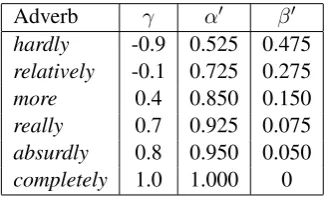
Table 1: Sample modifications of the wordpolite(α= 0.75andβ = 0.25)
Adverb γ α� β�
hardly -0.9 0.525 0.475
relatively -0.1 0.725 0.275
more 0.4 0.850 0.150
really 0.7 0.925 0.075
absurdly 0.8 0.950 0.050
completely 1.0 1.000 0
the lexicon,αgood = 0.75 (βgood = 0.25), which yieldsα�not good = 0.25 (βnot good� = 0.75). This
procedure is also applied to antonyms of words in the lexicon, which are identified by removing a negation prefix from an input word (e.g.,un-, in-, il-, im-, de-, ab-, non-, dis-), and matching with the lexicon, e.g., “unable” shifts the sentiment of “able”. The combination of a negation and a phrase, e.g., “I don’t think (the staff is friendly and efficient enough)”, has the same effect. Adverbial modifiers. Adverbs normally change the intensity of adjectives or verbs (e.g., “very” is an intensifier, while “hardly” is a diminisher). Like Taboada et al. (2011), we increase or de-crease the sentiment level of a word based on the meaning of its modifier. This is done by adjusting theα� andβ�of weak adjectives and verbs as fol-lows (currently, we leave strong words unchanged as it is unusual to apply adverbial modifiers to such words, e.g., “somewhat excellent”): α� =
α±±±γβ and β� = β∓∓∓γβ, where the sign is de-termined by the polarity of the word, andγ is de-termined by the adverb. For example,γ = −0.2
for “fairly” andγ = 0.5for “very”. Thus, “fairly
polite” moves “polite” fromα= 0.75(β = 0.25)
toα= 0.7(β = 0.3). Table 1 shows the intensity
levelγ of several adverbs, and their effect on the polarity of the adjective “polite”.
Dealing with uncertainty. When reading a text, the number of words a reader understands af-fects his/her confidence in his/her comprehension. The fewer words are understood, the higher the reader’s uncertainty. We estimatewi, the level of
comprehension of sentence si, by means of the
understood to carry a lower weight than the sen-tence that is better understood. To implement this idea, we adjust the probability of the star rating of a sentence by a function of the certainty of un-derstanding it. We employ an exponential func-tion as follows, where the exponents are the above weightswi.
Pr(y|s1, s2)∝Pr(y|s1)w1Pr(y|s2)w2 (2)
Since0≤wi ≤1, a low certainty forwiyields a
value close to 1, which has relatively little effect on the outcome, while a high certainty has a large effect on the outcome.
Sentence connectives. When we have little con-fidence in our understanding of a sentence, sen-tence connectives, such as adversatives (e.g., “but”, “however”) or intensifiers (e.g., “further-more”), may prove helpful. Assume that sentence s1 has an adversative relation with sentence s2, and w.l.o.g., assume thats1 is better understood than s2 (i.e., w1 > w2, where wi is the level
of comprehension of sentencesi). We model the
idea that in this case, the sentiment ofs2 is likely to contradict that of s1 by shifting the sentiment ofs2 closer to that of s¯1 (the negation ofs1) in proportion to the difference between the weights of these sentences.
Pr�(y|s
2) = Pr
(y|s2)w2+Pr(y|s¯1)(w1−w2) w1
(3) In addition, owing to the interaction between s2 ands1, w2 increases tow2� = 12(w1 +w2)to indicate thats2is now better understood. For ex-ample, consider a situation where the probability that sentences1conveys a 4-star rating is0.2with w1 = 0.8(four fifths of the words ins1 were un-derstood), and the probability that s2 conveys a 4-star rating is 0.4 with w2 = 0.2. Further, as-sume that there is an adversative relation between s1 and s2, e.g., “s1. However, s2”. After ap-plying Equation 3 to adjust the probability of the less understood sentence, s2, we obtain Pr�(y =
4stars|s2) = (0.4×0.2 + 0.6 (0.8−0.2))/0.8 = 0.55, andw2� = 0.5(the0.6is obtained by
negat-ing s1). Thus, the probability that s2 conveys a 4-star rating has increased, as has the certainty of this assessment.
Parameterization and heuristics. The values of the different parameters (α, β, γ, δ, λ) were man-ually determined. We tried several combinations,
but the effect was negligible, arguably due to the low coverage of the lexicon (Section 5). Fur-ther, we employ different types of heuristics, e.g., the modification of the probabilities of individ-ual sentences is additive, while sentence combina-tion is multiplicative (as per the Beta distribucombina-tion). The application of machine learning techniques or a hill-climbing procedure to determine param-eter values that yield improved performance, as well as the consideration of different heuristics for negations, adverbial modifiers, sentence connec-tives and dealing with uncertainty, may be a prof-itable avenue of investigation after lexicon cover-age is increased.
3 Combining the Lexicon with a Na¨ıve Bayes Classifier
Beineke et al. (2004) combined a lexicon with an NB classifier by sourcing from a large cor-pus words that co-occur with known sentimental “anchor” words, and employing these words to train the classifier. In contrast, like Andreevskaia and Bergler (2008) and Melville et al. (2009), we combine information from a lexicon with the classification produced by a supervised machine learning method. However, in their systems, the weights assigned to each contributing method are based on this method’s performance on the train-ing set, while our weights represent a method’s coverage of the current text. In addition, we em-ploy much larger datasets in our experiments than those used in (Andreevskaia and Bergler, 2008) and (Melville et al., 2009), and unlike them, we take into account negations, adverbial modifiers and sentence connectives to modify the sentiment of lexicon words.
Our system incorporates corpus-based infor-mation by training an NB classifier with unigrams and bigrams as features, and applying information gain (Yang and Pedersen, 1997) to select the top K(= 4000) features.2 This version of NB is de-notedNB4000. The probability obtained from the classifier for a review is combined with that ob-tained from the lexicon by means of a weighted average.3
2According to our experiments, NB classifiers trained
us-ing unigrams and bigrams, combined with feature selection, are among the best sentiment classifiers.
3We also applied this combination procedure at the
PrCOM B(D|s) = (4)
PrN B(D|s)wN B+PrLEX(D|s)wLEX
wN B+wLEX
whereD is a document; wLEX is the fraction of
open-class and lexicon words in the review that appear in the lexicon; and wN B represents the
fraction ofallthe words in the review that appear in the NB features (this is because unigrams and bigrams selected as NB features contain both open- and closed-class words).
4 Identifying Bimodal Sentences
Sentiment analysis is a difficult problem, as opin-ions are often expressed in subtle ways, such as irony and sarcasm (Pang and Lee, 2008), which may confuse human readers, creating un-certainty over their understanding. In Section 2, we discussed the incorporation of uncertainty into the lexicon-based framework. Here we of-fer a method for identifying reviews that contain sentiment-ambiguous sentences, which also affect the ability to understand a review.
As mentioned above, the probability distribu-tion of the sentiment in a review is likely to be unimodal. The Beta distribution obtained from the lexicon guarantees this property, but the multi-nomial distribution used to train the NB classifier does not. Further, the combination of the distribu-tions obtained from the lexicon and the NB clas-sifier can lead to a bimodal distribution due to in-consistencies between the two input distributions. We posit that such bimodal sentences are unreli-able, and propose the following heuristic to iden-tify bimodal sentences.4
The sentiment distribution in a sentence is bimodal if (1) the two most probable classes are not adjacent (e.g., 2-star and 4-star rating), and (2) the probability of the second most probable class is more than half of that of the most probable class. Examples of sentences identified by this heuris-tic are “It is pretty boring, but you do not worry because the picture will be beautiful, and you have these gorgeous stars too” (NB⇒1, Lexicon⇒3, actual = 1) and “ ‘The Wonderful, Horrible Life of Leni Riefenstahl’ is a excellent
4A statistical method for identifying bi-modality is
de-scribed in (Jackson et al., 1989).
film, but it needed Riefenstahl to edit it more” (NB⇒2&4,Lexicon⇒3, actual=4). The impact of bimodal sentences on performance is examined in Section 5.2.
5 Evaluation
5.1 Datasets
Our datasets were sourced from reviews in vari-ous domains: movies, kitchen appliances, music, and post office. These datasets differ in review length, word usage and writing style.
• Movies5: This is theSentiment Scaledataset collected and pre-processed by Pang and Lee (2005), which contains movie reviews col-lected from the Internet. They separated the dataset into four sub-corpora, each written by a different author, to avoid the need to calibrate the ratings given by different au-thors. The authors, denoted A, B, C and D, wrote 1770, 902, 1307 and 1027
re-views respectively. Each author’s rere-views were grouped into three and four classes, de-notedAuthorX3andAuthorX4respectively, whereX ∈ {A, B, C, D}.
• Kitchen6: This dataset was sourced from a large collection of kitchen appliance reviews collected by Blitzer et al. (2007) from Ama-zon product reviews. We selected 1000
re-views from each of the four classes consid-ered by Blitzeret al., totalling4000reviews.
The resultant dataset is denotedKitchen4.
• Music7: We selected 4039 text samples of music reviews from the Amazon product re-view dataset compiled by Jindal and Liu (2008). To obtain a dataset with some de-gree of item consistency and reviewer relia-bility, we selected reviews for items that have at least 10 reviews written by users who have authored at least 10 reviews. The original reviews are associated with a 5-point rating scale, but we grouped the reviews with low ratings (≤3stars) into one class due to their
low numbers. The resultant dataset, denoted
5http://www.cs.cornell.edu/home/llee/data/ 6
http://www.cs.jhu.edu/˜mdredze/datasets/ sentiment/
7http://www.cs.uic.edu/˜liub/FBS/
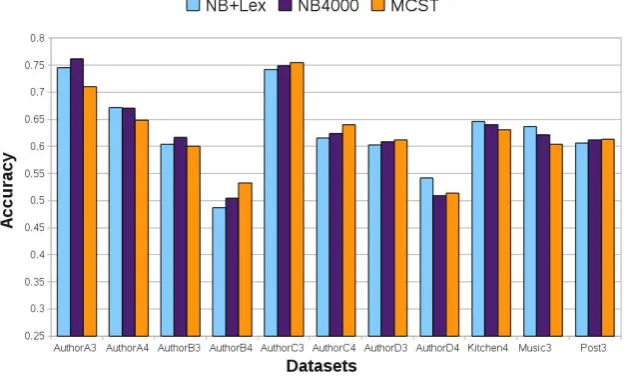
Figure 1: Average classification accuracy for NB+Lex, compared with NB4000 and MCST; all datasets.
Music3, contains three classes: 860 low re-views (≤3stars), 1409 medium (4 stars) and
1770 high (5 stars).
• PostOffice: contains3966 reviews of post-office outlets written by “mystery shoppers” hired by a contractor. The reviews are very short, typically comprising one to three sen-tences, and focus on specific aspects of the service, e.g., attitude of the staff and cleanli-ness of the stores. The reviews were orig-inally associated with a seven-point rating scale. However, as for the Music dataset, ow-ing to the low numbers of reviews with low ratings (≤ 5 stars), we grouped the reviews
into three balanced classes denoted Post3: 1277 low reviews (≤5stars), 1267 medium (6 stars), and 1422 high (7 stars).
5.2 Results
Figure 1 shows the average accuracy obtained by the hybrid approach (NB+Lex using NB4000),8 compared with the accuracy obtained by the best-performing version of MCST (Bickerstaffe and Zukerman, 2010) (which was evaluated on the Movies dataset, using the algorithms presented in (Pang and Lee, 2005) as baselines), and by NB4000 (NB plus feature selection with4000
fea-tures selected using information gain). All tri-als employed 10-fold cross-validation. For the
8We omit the results obtained with the lexicon alone, as
its coverage is too low.
NB+Lex method, we investigated different com-binations of settings (with and without nega-tions, modifiers, sentence connectives, and inter-sentence weighting). However, these variations had a marginal effect on performance, arguably owing to the low coverage of the lexicon. Here we report on the results obtained with all the options turned on. Statistical significance was computed using a two-tailed pairedt-test for each fold with p = 0.05 (we mention only statistically
signifi-cant differences in our discussion).
• NB+Lex outperforms MCST on three datasets (AuthorA3, AuthorA4 and Mu-sic3), while the inverse happens only for AuthorB4. NB+Lex also outperforms NB4000 on AuthorD4 and Music3. No other differences are statistically significant.
• Interestingly, NB4000 outperforms MCST for AuthorA3 and Music3, with no other sta-tistically significant differences, which high-lights the importance of judicious baseline selection.
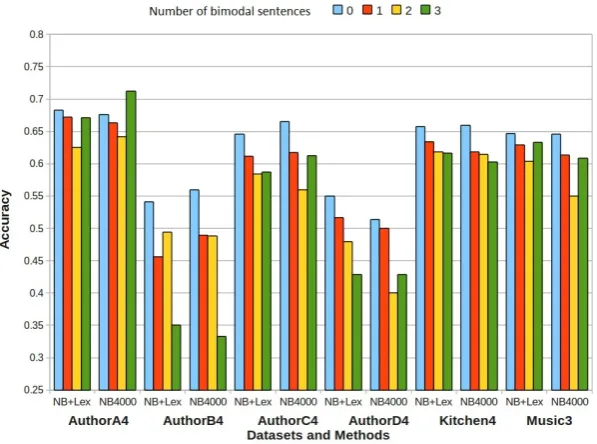
Figure 2: Effect of bimodal sentences on performance (average accuracy): NB+Lex and NB4000; datasets AuthorA4-D4, Kitchen4, Music3.
fraction of the words in our datasets is covered by the lexicon (between 5.5%for AuthorC and 7%
for PostOffice), compared with the NB4000 cov-erage (between 31% for AuthorA3 and67% for
PostOffice). Further, as indicated above, the for-mulas for estimating the influence of negations, adverbial modifiers and sentence connectives are ratherad hoc, and the parameters were manually set. Different heuristics and statistical methods to set their parameters warrant future investigation.
It is interesting to note that the overlap between the words in the corpora covered by the lexicon and the words covered by the4000features used by NB is rather small. Specifically, in all datasets except PostOffice, which has an unusually small vocabulary (less than3000words), between half and two thirds of the lexicon-covered words are
notcovered by the set of4000features. This
dis-crepancy in coverage means that the unigrams in the lexicon have a lower information gain, and hence are less discriminative, than many of the
4000features selected for the NB classifier, which
include a large number of bigrams.
We also analyzed the effect of the presence of sentiment-ambiguous (bimodal) sentences on the predictability of a review, using the method described in Section 4 to identify bimodal sen-tences. Figure 2 displays the accuracy obtained by NB+Lex and NB4000 on the datasets Authors4A-D, Kitchen4 and Music3 as a function of the
number of bimodal sentences in a review (the Authors3A-D datasets were omitted, as they are “easier” than Authors4A-D, and Post3 was omit-ted because of the low number of sentences per re-view). We display only results for reviews with 0 to 3 bimodal sentences, as there were very few re-views with more bimodal sentences. As expected, performance was substantially better for reviews with no bimodal sentences (with the exception of NB4000 on AuthorsA4 with 3 bimodal sentences per review). These results suggest that the iden-tification of bimodal sentences is worth pursuing, possibly in combination with additional lexicon coverage, to discriminate between reviews whose sentiment can be reliably detected and reviews where this is not the case. Further, it would be interesting to ascertain the views of human anno-tators with respect to the sentences we identify as bimodal.
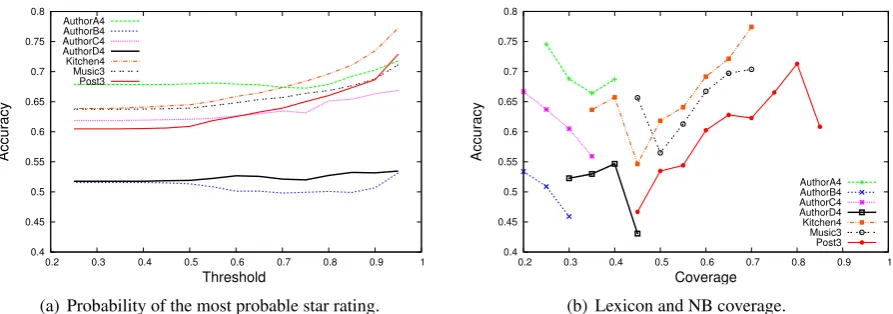
In the context of identifying difficult reviews, we also investigated the relationship between pre-diction confidence (the probability of the most probable star rating in a review) and performance (Figure 3(a)), and between the coverage provided by both the lexicon and the NB classifier and per-formance (Figure 3(b)9). As seen in Figure 3(a), for all datasets, except AuthorB4, accuracy im-proves as prediction confidence increases. This
9We do not display results for less than50documents
0.4
(a) Probability of the most probable star rating.
0.4
(b) Lexicon and NB coverage.
Figure 3: Relationship between probability of the most probable star rating and accuracy, and between lexi-con/NB coverage and accuracy; datasets AuthorsA4-D4, Kitchen4, Music3 and Post3.
improvement is steadier and sharper for Kitchen4, Music3 and Post3, which as seen in Figure 3(b), have a higher lexicon and NB coverage than the Authors datasets. As one would expect, perfor-mance improves for the first three datasets as cov-erage increases from 50% to 80%. However, out-side this range, the results are counter-intuitive: overall, accuracy decreases between 20% and 50% coverage, and also drops for Post3 at 85% coverage (a level of coverage that is not obtained for any other dataset); and a high level of accu-racy is obtained for very low levels of coverage (≤25%) for AuthorA4 and AuthorC4. These ob-servations indicate that other factors, such as style and vocabulary, should be considered in conjunc-tion with coverage, and that the use of coverage in Equations 2 and 4 may require fine-tuning to take into account the level of coverage.
6 Conclusion
We have examined the performance of three methods based on supervised machine learning applied to multi-way sentiment analysis: (1) sen-timent lexicon combined with NB with feature selection, (2) NB with feature selection, and (3) MCST (which considers label similarity). The lexicon is harnessed by applying a probabilistic procedure that combines words, phrases and sen-tences, and performs adjustments for negations, modifiers and sentence connectives. This infor-mation is combined with corpus-based informa-tion by taking into account the uncertainty arising from the extent to which the text is “understood”. Our methods were evaluated on seven datasets of different sizes, review lengths and writing
styles. The results of our evaluation show that the combination of lexicon- and corpus-based infor-mation performs at least as well as state-of-the-art systems. The fact that this improvement is achieved with a small contribution from the lex-icon indicates that there may be promise in in-creasing lexicon coverage and improving the do-main specificity of lexicons. At the same time, the observation that NB+Lex (with a small lexicon), NB4000 and MCST exhibit similar performance for several datasets leads us to posit that pure n-gram based statistical systems have plateaued, thus reinforcing the point that additional factors must be brought to bear to achieve significant per-formance improvements.
The negative result that an NB classifier with feature selection achieves state-of-the-art perfor-mance indicates that careful baseline selection is warranted when evaluating new algorithms.
Finally, we studied the effect of three factors on the reliability of a sentiment-analysis algo-rithm: (1) number of bimodal sentences in a re-view; (2) probability of the most probable star rating; and (3) coverage provided by the lexicon and the NB classifier. Our results show that these factors may be used to predict regions of reli-able sentiment-analysis performance, but further investigation is required regarding the interaction between coverage and the stylistic features of a review.
References
B. Allison. 2008. Sentiment detection using lexically-based classifiers. InProceedings of the 11th
Inter-national Conference on Text, Speech and Dialogue,
A. Andreevskaia and S. Bergler. 2008. When special-ists and generalspecial-ists work together: Overcoming do-main dependence in sentiment tagging. InACL’08 – Proceedings of the 46th Annual Meeting of the
Association for Computational Linguistics, pages
290–298, Columbus, Ohio.
S. Baccianella, A. Esuli, and F. Sebastiani. 2010. SentiWordNet 3.0: An enhanced lexical resource for sentiment analysis and opinion mining. In N. Calzolari, K. Choukri, B. Maegaard, J. Mariani, J. Odijk, S. Piperidis, M. Rosner, and D. Tapias, ed-itors,LREC’10 – Proceedings of the 7th Conference on International Language Resources and Evalua-tion, Valletta, Malta.
P. Beineke, T. Hastie, and S. Vaithyanathan. 2004. The sentimental factor: Improving review classifi-cation via human-provided information. InACL’04 – Proceedings of the 42nd Annual Meeting of the
Association for Computational Linguistics, pages
263–270, Barcelona, Spain.
A.L. Berger, Stephen A. Della Pietra, and Vincent J. Della Pietra. 1996. A maximum entropy approach to natural language processing. Computational Lin-guistics, 22(1):39–71.
A. Bickerstaffe and I. Zukerman. 2010. A hierarchical classifier applied to multi-way sentiment detection.
InCOLING’2010 – Proceedings of the 23rd
Inter-national Conference on Computational Linguistics,
pages 62–70, Beijing, China.
J. Blitzer, M. Dredze, and F. Pereira. 2007. Bi-ographies, Bollywood, boom-boxes and blenders: Domain adaptation for sentiment classification. In
ACL’07 – Proceedings of the 45th Annual Meeting
of the Association for Computational Linguistics,
pages 440–447, Prague, Czech Republic.
C. Cortes and V. Vapnik. 1995. Support Vector Net-works. Machine Learning, 20(3):273–297.
P. Domingos and M. Pazzani. 1997. On the optimal-ity of the simple Bayesian classifier under zero-one loss. Machine Learning, 29:103–130.
Y. Hu, R. Lu, X. Li, Y. Chen, and J. Duan. 2007. A language modeling approach to sentiment anal-ysis. InICCS07 – Proceedings of the 7th Interna-tional Conference on ComputaInterna-tional Science, Part II, pages 1186–1193, Beijing, China.
P.R. Jackson, G.T. Tucker, and H.F. Woods. 1989. Testing for bimodality in frequency distribu-tions of data suggesting polymorphisms of drug metabolism-hypothesis testing. British Journal of
Clinical Pharmacology, 28:655–662.
N. Jindal and B. Liu. 2008. Opinion spam and analy-sis. InWSDM-2008 – Proceedings of the 1st Inter-national Conference on Web Search and Web Data Mining, pages 219–230, Palo Alto, California. D. Klein and C.D. Manning. 2003. Accurate
unlex-icalized parsing. In ACL’03 – Proceedings of the
41st Annual Meeting of the Association for
Com-putational Linguistics, pages 423–430, Sapporo,
Japan.
Y. Mao and G. Lebanon. 2006. Isotonic conditional random fields and local sentiment flow. In NIPS 2006 – Proceedings of the 20th Annual Conference
on Neural Information Processing Systems, pages
961–968, British Columbia, Canada.
R. McDonald, K. Hannan, T. Neylon, M. Wells, and J. Reynar. 2007. Structured models for fine-to-coarse sentiment analysis. In ACL’07 – Proceed-ings of the 45th Annual Meeting of the Associa-tion for ComputaAssocia-tional Linguistics, pages 432–439, Prague, Czech Republic.
P. Melville, W. Gryc, and R.D. Lawrence. 2009. Sentiment analysis of blogs by combining lexical knowledge with text classification. In KDD’09 – Proceedings of the 15th ACM SIGKDD Inter-national Conference on Knowledge Discovery and Data Mining, pages 1275–1284, Paris, France. R. Mukras, N. Wiratunga, R. Lothian, S. Chakraborti,
and D. Harper. 2007. Information gain feature se-lection for ordinal text classification using probabil-ity re-distribution. InProceedings of the IJCAI-07
TextLink Workshop, Hyderabad, India.
B. Pang and L. Lee. 2005. Seeing stars: Exploit-ing class relationships for sentiment categorization with respect to rating scales. InACL’05 – Proceed-ings of the 43rd Annual Meeting of the Association
for Computational Linguistics, pages 115–124, Ann
Arbor, Michigan.
B. Pang and L. Lee. 2008. Opinion mining and senti-ment analysis.Foundations and Trends in Informa-tion Retrieval, Vol. 2(1-2):pp. 1–135.
B. Snyder and R. Barzilay. 2007. Multiple as-pect ranking using the Good Grief algorithm. In
NAACL-HLT 2007 – Proceedings of Human Lan-guage Technologies: The Annual Conference of the North American Chapter of the Association
for Computational Linguistics, pages 300–307,
Rochester, New York.
M. Taboada, J. Brooke, M. Tofiloskiy, K. Vollz, and M. Stede. 2011. Lexicon-based methods for sentiment analysis. Computational Linguistics, 37(2):267–307.
T. Wilson, J. Wiebe, and P. Hoffmann. 2005. Rec-ognizing contextual polarity in phrase-level senti-ment analysis. InEMNLP’2005 – Proceedings of the Conference on Empirical Methods in Natural
Language Processing, pages 347–354, Vancouver,
Canada.
Y. Yang and J.O. Pedersen. 1997. A comparative study on feature selection in text categorization. In
ICML’97 – Proceedings of the 14th International
Conference on Machine Learning, pages 412–420,