Dependency-based Sentence Alignment for Multiple Document
Summarization
Tsutomu HIRAO and Jun SUZUKI and Hideki ISOZAKI and Eisaku MAEDA
NTT Communication Science Laboratories, NTT Corp. 2-4 Hikaridai, Seika-cho, Soraku-gun, Kyoto, 619-0237 Japan
hirao,jun,isozaki,maeda @cslab.kecl.ntt.co.jp
Abstract
In this paper, we describe a method of automatic sentence alignment for building extracts from
ab-stracts in automatic summarization research. Our
method is based on two steps. First, we introduce the “dependency tree path” (DTP). Next, we calcu-late the similarity between DTPs based on the ESK (Extended String Subsequence Kernel), which con-siders sequential patterns. By using these proce-dures, we can derive one-to-many or many-to-one correspondences among sentences. Experiments us-ing different similarity measures show that DTP consistently improves the alignment accuracy and that ESK gives the best performance.
1 Introduction
Many researchers who study automatic summariza-tion want to create systems that generate abstracts of documents rather than extracts. We can gener-ate an abstract by utilizing various methods, such as sentence compaction, sentence combination, and paraphrasing. In order to implement and evalu-ate these techniques, we need large-scale corpora in which the original sentences are aligned with summary sentences. These corpora are useful for training and evaluating sentence extraction systems. However, it is costly to create these corpora.
Figure 1 shows an example of summary sentences and original sentences from TSC-2 (Text Summa-rization Challenge 2) multiple document summa-rization data (Okumura et al., 2003). From this ex-ample, we can see many-to-many correspondences. For instance, summary sentence (A) consists of a part of source sentence (A). Summary sentence (B) consists of parts of source sentences (A), (B), and (C). It is clear that the correspondence among the sentences is very complex. Therefore, robust and accurate alignment is essential.
In order to achieve such alignment, we need not only syntactic information but also semantic infor-mation. Therefore, we combine two methods. First, we introduce the “dependency tree path” (DTP) for
Source(A): !
"!#$
%&'(*)+-, . / 0 1 2 3 4 5 0 6 7 8 9 : ; < = >? @ A B C D E F G H I J K L M N O P Q
L
0 1 2 3 R S T U V W X Y Z []\_^_`ba c d e f
T g hijklnmpo!qrmtsvuw*xyzb {|}-~_
* W X 9 N
+ First, we stop the new investment of 64-Mega bit
memory from competitive companies, such as in
Korea or Taiwan, and we begin the investment
for development of valuable system-on-chip or 256-Mega bit DRAM from now on.
Source(B): ** _ ¡ ¢ £ H ¤
T ¥
>
¦ R £
: ; < =
_§v¨ ©ª\
+b¬«¯®-
On a long-term target, we plan to reduce the rate of
general-purpose semiconductor enterprises that pro-duce DRAM for personal computers.
Source(C): ^`*±°²_
: ; < =
³ ´ 0 3 µ 3 ¶ · ¸ ¹ º »
«¯®-
From now on, we will be supplied with DRAM from
Taiwan.
Summary(A): xyz
~¼½¿¾v}À~-Á uÂ
**ÄÃÆÅ Ç_È_É_ÊË#
°²!Ì_Í ÎÏÐ!\ѯÒÓÏ
~¼]½±¾Ô
Õ
Ö×_Ø_Ù¨Ú Û_
We stopped the new investment of 64-Mega bit DRAM.
Summary(B): ÜÝÞ!)!+-ßàØÙ!á*i_âbÂã\¿äåæ
á*açèé qêëëìê
a-~¾í¾
î_ïðv%ñ
We begin the investment for valuable development and will be supplied with general-purpose DRAMs for per-sonal computers from Taiwan in the long run.
Figure 1: An example of summary sentences and their source sentences from TSC-2 multiple docu-ment summarization data. Underlined strings are used in summary sentences.
syntactic information. Second, we introduce the “Extended String Subsequence Kernel” (ESK) for semantic information.
Sentence 1: ò #óô
õöá÷ø\ù¯¨úû*ü
watashi ga kinjo no keisatsu ni otosimono wo todoke ta.
Sentence 2: ó_ô
õöá÷b\ù¯¨ò
#
úû*ü
kinjo no keisatsu ni otoshimono wo watashi ga todoke ta.
Figure 2: Examples of sentences that have the same meaning.
2 Related Work
Several methods have been proposed to realize au-tomatic alignment between abstracts and sentences in source documents.
Banko et al. (1999) proposed a method based on sentence similarity using bag-of-words (BOW) representation. For each sentence in the given
ab-stract, the corresponding source sentence is
deter-mined by combing the similarity score and heuristic rules. However, it is known that bag-of-words rep-resentation is not optimal for short texts like single sentences (Suzuki et al., 2003).
Marcu (1999) regards a sentence as a set of “units” that correspond to clauses and defines sim-ilarity between units based on BOW representa-tion. Next, the best source sentences are extracted in terms of “unit” similarity. Jing et al. (Jing and McKeown, 1999) proposed bigram-based similarity using the Hidden Markov Model. Barzilay (Barzi-lay and Elhadad, 2003) combines edit distance and context information around sentences. However, these three methods tend to be strongly influenced by word order. When the summary sentence and the source sentences disagree in terms of word or-der, the methods fail to work well.
The supervised learning-based method called SimFinder was proposed by Hatzivassiloglou et al. (Hatzivassiloglou et al., 1999; Hatzivassiloglou et al., 2001). They translate a sentence into a feature vector based on word counts and proper nouns, and so on, and then sentence pairs are classified into “similar” or not. Their approach is effective when a lot of training data is available. However, the hu-man cost of making this training data cannot be dis-regarded.
3 An Alignment Method based on Syntax
and Semantics
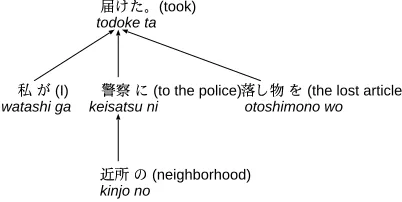
For example, Figure 2 shows two sentences that have different word order but the same meaning. The English translation is “I took the lost article to the neighborhood police.”
ý-þ¿ÿ (took) todoke ta
(I) watashi ga
(to the police) keisatsu ni
(the lost article) otoshimono wo
(neighborhood) kinjo no
Figure 3: An example of a dependency tree.
Since conventional techniques other than BOW are strongly influenced by word order, they are frag-ile when word order is damaged.
3.1 Dependency Tree Path (DTP)
When we unify two sentences, some elements be-come longer, and word order may be changed to improve readability. When we rephrase sentences, the dependency structure does not change in many cases, even if word order changes. For example, the two sentences in Figure 2 share the same depen-dence structure shown in Figure 3. Therefore, we transform a sentence into its dependency structure. This allows us to consider a sentence as a set of de-pendency tree paths from a leaf to the root node of the tree.
For instance, the two sentences in Figure 2 can be transformed into the following DTPs.
(I took)
watashi ga todoke ta
"!$#&%'(
(took to the neighbor-hood police)
kinjo no keisatsu ni todoke ta
*)"+-,/."0
(took the lost article)
otoshimono wo todoke ta.
3.2 An Alignment Algorithm using DTPs
In this section, we describe a method that aligns source sentences with the summary sentences in an
abstract.
Our algorithm is very simple. We take the corre-sponding sentence to be the one whose DTP is most similar to that of the summary sentence. The algo-rithm consists of the following steps:
Step 0 Transform all source sentences into DTPs.
Step 1 For each sentence “1 ” in the abstract, apply Step 2 and Step 3.
=?>A@:B?C
(=Subsequence) Value Component(=Subsequence) Value Component(=Subsequence) Value
Figure 4: ESK with node sequence.
Step 3 For eachegf 3ihj2435176i6 , we align an optimal source sentence as follows:
We define sim3 ekfgl 8S9;6
defm
max sim3 ekfnlJe 6 . Here,e h*243i8:956,
where, forenf , we align a source sentence that satisfiesoqpirstoquwvixzy?{}|i~q} Vs 3 e f l 8
9
6 .
The above procedure allows us to derive many-to-many correspondences.
3.3 Similarity Metrics
We need a similarity metric to rank DTP similar-ity. The following cosine measure (Hearst, 1997) is used in many NLP tasks.
simcos3i texts l N , respectively. Note that syntactic and se-mantic information is lost in the BOW representa-tion.
In order to solve this problem, we use similarity measures based on word co-occurrences. As an ex-ample of it s application, N-gram co-occurrence is used for evaluating machine translations (Papineni et al., 2002). String Subsequence Kernel (SSK) (Lodhi et al., 2002) and Word Sequence Kernel (WSK) (Cancedda et al., 2003) are extensions of n-gram-based measures used for text categorization.
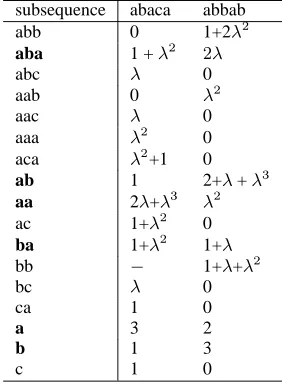
In this paper, we compare WSK to its extension, the Extended String Subsequence Kernel (ESK). First, we describe WSK. WSK receives two se-quences of words as input and maps each of them into a high-dimensional vector space. WSK’s value is just the inner product of the two vectors.
Table 1: Components of vectors corresponding to ‘abaca’ and ‘abbab.’ Bold letters indicate common subsequences.
subsequence abaca abbab
abb 0 1+2
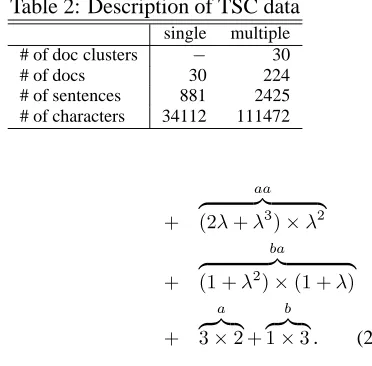
For instance, the WSK value for ‘abaca’ and ‘abbab’ is determined as follows. A subsequence whose length is three or less is shown in Table 1. Here, is a decay parameter for the number of skipped words. For example, subsequence ‘aba’ ap-pears in ‘abaca’ once without skips. In addition, it appears again with two skips, i.e., ‘ab**a.’ There-fore, abaca’s vector has “1+
” in the component corresponding to ‘aba.’ From Table 1, we can cal-culate the WSK value as follows:
wskAXiiL ¢¡q£5iA ¥¤§¦
¨i©Y¨
Table 2: Description of TSC data single multiple
# of doc clusters 30
# of docs 30 224
# of sentences 881 2425
# of characters 34112 111472
«
In this way, we can measure the similarity be-tween two texts. However, WSK disregards syn-onyms, hypsyn-onyms, and hypernyms. Therefore, we introduce ESK, an extension of WSK and a simplifi-cation of HDAG Kernel (Suzuki et al., 2003). ESK allows us to add word senses to each word. Here, we do not try to disambiguate word senses, but use all possible senses listed in a dictionary. Figure 4 shows an example of subsequences and their values. The use of word sense yields flexible matching even when paraphrasing is used for summary sentences.
Formally, ESK is defined as follows.
À
çèêéìë5íiînïqð is defined as follows. é;ë andîkï are nodes of ñ and ò , respectively. The function óõôHö
èi÷í5é?ð returns the number of attributes common to given nodes÷ andé .
çáèêéìë;í5îkïLð is defined as follows:
À àà
Table 3: The distribution of aligned original sen-tences corresponding to one summary sentence.
# of org. sents. 1 2 3
Table 4: The distribution of aligned summary sen-tences corresponding to one original sentence.
# of sum. sents. 1 2 3
Finally, we define the similarity measure by nor-malizing ESK. This similarity can be regarded as an extension of the cosine measure.
simesküËÿ
4 Evaluation Settings
4.1 Corpus
We used the TSC2 corpus which includes both sin-gle and multiple document summarization data. Ta-ble 2 shows its statistics. For each data set, each of three experts made short abstracts and long ab-stracts.
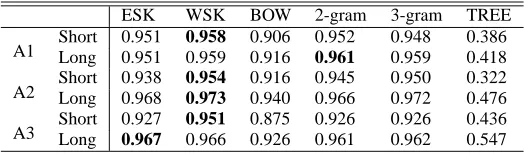
Table 5: Evaluation results w/o DTP (single documents).
ESK WSK BOW 2-gram 3-gram TREE
A1 ShortLong 0.9510.951 0.9580.959 0.9060.916 0.9520.961 0.9480.959 0.3860.418
A2 ShortLong 0.9380.968 0.9540.973 0.9160.940 0.9450.966 0.9500.972 0.3220.476
A3 ShortLong 0.9270.967 0.9510.966 0.8750.926 0.9260.961 0.9260.962 0.4360.547
Table 6: Evaluation results with DTP (single documents).
DTP(ESK) DTP(WSK) DTP(BOW) DTP(2-gram) DTP(3-gram)
A1 ShortLong 0.966 (2,1.00)0.960 (4,0.20) 0.957 (2,0.10)0.957 (2,0.20) 0.9550.960 0.9520.951 0.9520.949
A2 ShortLong 0.973 (3,0.60)0.977 (4,0.20) 0.957 (2,0.10)0.974 (2,0.95) 0.9590.972 0.9570.973 0.9560.975
A3 ShortLong 0.962 (3,0.70)0.967 (3,0.70) 0.962 (3,0.50)0.969 (2,0.20) 0.9640.962 0.9620.960 0.9600.960
Table 7: Effectiveness of DTP (single documents).
ESK WSK BOW 2-gram 3-gram
A1 Short
%'&() *+$(& %,$(- .+ %+/(0
Long %+$(- *+$(1 %,$(, +/(& *2&3(+
A2 Short
%4$() %+$(4 %,$(4 %'&(1 %+/(5
Long %+$(- %+$(& %4$(1 %+$(6 %+/(4
A3 Short
%4$() %'&(& %0$(- %4$(5 %4/(,
Long .+ %+$(4 %4$(5 *+$(& *+/(1
very complex correspondence because various sum-marization techniques such as sentence compaction, sentence combination, and sentence integration are used.
4.2 Comparison of Alignment Methods
We compared the proposed methods with a baseline algorithm using various similarity measures.
Baseline
This is a simple algorithm that compares sentences to sentences. Each summary sentence is compared with all source sentences and the top7 sentences that have a similarity score over a certain threshold value8 are aligned.
DTP-based Method
This method was described in Section 3.2. In order to obtain DTPs, we used the Japanese morpholog-ical analyzer ChaSen and the dependency structure analyzer CaboCha (Kudo and Matsumoto, 2002).
4.2.1 Similarity Measures
We utilized the following similarity measures.
BOW BOW is defined by equation (1). Here, we
use only nouns and verbs.
N-gram This is a simple extension of BOW. We
add n-gram sequences to BOW. We exam-ined “2-gram” (unigram + bigram) and “3-gram,”(unigram + bigram + trigram).
TREE The Tree Kernel (Collins and Duffy, 2001)
is a similarity measure based on the number of common subtrees. We regard a sentence as a dependency structure tree.
WSK We examined 9;:=< , > , and ? , and @A: BCDBE
í
BCDF
í
BGCHFIEKJLJLJ
í
F
.
ESK We used the Japanese lexicon Goi-Taikei
(Ikehara et al., 1997), to obtain word senses. The parameters,9 and@ , were changed on the same Conditions as above.
4.3 Evaluation Metric
Each system’s alignment output was scored by the average F-measure. For each summary sentence, the following F-measure was calculated.
F-measure
Ç
Þ NM
O
Á
Ì
Precision PM O Ì
RecallÆ
(8)
Here, Precision :RQTS
ô
and Recall :RQUSIV , where
ô
is the number of source sentences aligned by a system for the summary sentence. Q is the number of correct source sentences in the output. V is the number of source sentences aligned by the human expert. We setW to 1, so this F-measure was aver-aged over all summary sentences.
5 Results and Discussion
5.1 Single Document Summarization Data
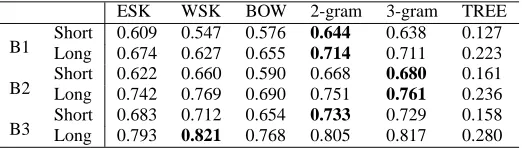
Table 8: Evaluation results w/o DTP (multiple documents).
ESK WSK BOW 2-gram 3-gram TREE
B1 ShortLong 0.6090.674 0.5470.627 0.5760.655 0.6440.714 0.6380.711 0.1270.223
B2 ShortLong 0.6220.742 0.6600.769 0.5900.690 0.6680.751 0.6800.761 0.1610.236
B3 ShortLong 0.6830.793 0.7120.821 0.6540.768 0.7330.805 0.7290.817 0.1580.280
Table 9: Evaluation results with DTP (multiple documents).
DTP(ESK) DTP(WSK) DTP(BOW) DTP(2-gram) DTP(3-gram)
B1 ShortLong 0.746 (2,0.85)0.802 (3,0.85) 0.734 (2,0.55)0.797 (2,0.65) 0.7190.784 0.7250.797 0.7280.797
B2 ShortLong 0.726 (2,0.65)0.808 (2,0.55) 0.741 (3,0.25)0.800 (3,0.05) 0.7100.797 0.7200.797 0.7210.794
B3 ShortLong 0.790 (2,0.55)0.845 (3,0.60) 0.786 (3,0.05)0.861 (2,0.40) 0.7480.828 0.7680.835 0.7600.830
Table 10: Effectiveness of DTP (multiple docu-ments).
ESK WSK BOW 2-gram 3-gram
B1 Short
%'&4/(6 %'&0/(6 %'&,/(4 %0/(& %-$(5
Long %'&1/(0 %'&63(+ %'&1/(- %0/(4 %0$(5
B2 Short
%'&+/(, %0/(& %'&1/(+ %)/(1 %,$(&
Long %)/(5 %4/(& %'&+/(6 %,/(5 %4$(4
B3 Short
%'&+/(6 %'63(, %-/(, %4/() %4$(&
Long %)/(1 %,/(+ %5/(+ %4/(+ %'&(4
the results of using DTPs with the best 9 and @ , which are shown in brackets. From the results, we can see the effectiveness of DTPs because Table 6 shows better performance than Table 5 in most cases. Table 7 shows the difference between Tables 5 and 6. DTPs improved the results of BOW by about five points. The best result is DTP with ESK. However, we have to admit that the improvements are relatively small for single document data. On the other hand Tree Kernel did not work well since it is too sensitive to slight differences. This is known as a weak point of Tree Kernel (Suzuki et al., 2003).
According to the tables, BOW is outperformed by the other methods except Tree Kernel. These results show that word co-occurrence is important. More-over, we see that sequential patterns are better than consequential patterns, such as the N-gram.
Without DPTs, ESK is worse than WSK. How-ever, ESK becomes better than WSK when we use DTPs. This result implies that word senses are dis-ambiguated by syntactic information, but more ex-amination is needed.
5.2 Multiple Document Summarization Data
Table 8 shows the results of the baseline method with the best8 for multiple document data while Ta-ble 9 shows the result of using DTPs with the best9 and@ , (in brackets). Compared with the single doc-ument summarization results, the F-measures are low. This means that the sentence alignment task is more difficult in multiple document summariza-tion than in single document summarizasummariza-tion. This is because sentence compaction, combination, and integration are common.
Although the results show the same tendency as the single document summarization case, more im-provements are noticed. Table 10 shows the differ-ence between Tables 8 and 9. We see improvements in 10 points in ESK, WSK, and BOW. In multiple document summarization, sentences are often reor-ganized. Therefore, it is more effective to decom-pose a sentence into DTP sets and to compute simi-larity between the DTPs.
Moreover, DTP(ESK) is once again superior to DTP(WSK).
5.3 Parameter Tuning
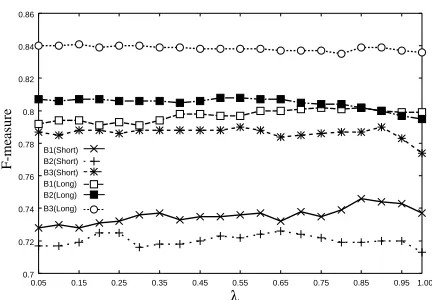
For ESK and WSK, we have to choose parameters,
0.7 0.72 0.74 0.76 0.78 0.8 0.82 0.84 0.86
0.05 0.15 0.25 0.35 0.45 0.55 0.65 0.75 0.85 0.95 B1(Short)
B2(Short) B3(Short) B2(Long) B1(Long) B3(Long)
λ
F-measure
1.00
Figure 5: F-measures with various@ values(9X:Y< ).
6 Conclusion
This paper introduced an automatic sentence align-ment method that integrates syntax and semantic in-formation. Our method transforms a sentence into a DTP set and calculates the similarity between the DTPs by using ESK. Experiments on the TSC (Text Summarization Challenge) corpus, which has com-plex correspondence, showed that the introduction of DTP consistently improves alignment accuracy and that ESK gave the best results.
References
M. Banko, V. Mittal, M. Kantrowitz, and J. Gold-stein. 1999. Generating Extraction-Based Sum-maries from Hand-Written SumSum-maries by Align-ing Text Spans. Proc. of the 4th Conference of
the Pacific Association for Computational Lin-guistics.
R. Barzilay and N. Elhadad. 2003. Sentence Alignment for Monolingual Comparable Cor-pora. Proc. of the Empirical Methods for Natural
Language Processing 2003, pages 25–32.
N. Cancedda, E. Gaussier, C. Goutte, and J-M. Ren-ders. 2003. Word-Sequence Kernels. Journal of
Machine Learning Research, 3(Feb):1059–1082.
M. Collins and N. Duffy. 2001. Convolution Ker-nels for Natural Language. In Proc. of Neural
In-formation Processing Systems (NIPS’2001).
V. Hatzivassiloglou, J.L. Klavans, and E. Eskin. 1999. Detecting Text Similarity over Short Pas-sages: Exploring Linguistic Feature Combina-tions via Machine Learning. Proc. of the
Empir-ical Methods for Natural Language Processing 1999, pages 203–212.
V. Hatzivassiloglou, J.L. Klavans, M.L. Holcombe, R. Barzilay, M-Y. Kan, and K. R. McKeown. 2001. SimFinder: A Flexible Clustering Tool for
Summarization. Proc. of the Workshop on
Auto-matic Summarization 2001, pages 41–49.
M-A. Hearst. 1997. TextTiling: Segmenting Text into Multi-paragraph Subtopic Passages.
Compu-tational Linguistics, 23(1):33–64.
S. Ikehara, M. Miyazaki, S. Shirai, A. Yokoo, H. Nakaiwa, K. Ogura, Y. Ooyama, and Y. Hayashi. 1997. Goi-Taikei – A Japanese
Lex-icon (in Japanese). Iwanami Shoten.
H. Jing and K. McKeown. 1999. The Decom-position of Human-Written Summary Sentences.
Proc. of the 22nd Annual International ACM-SIGIR Conference on Research and Development in Information Retrieval, pages 129–136.
T. Kudo and Y. Matsumoto. 2002. Japanese De-pendency Analysis using Cascaded Chunking.
Proc. of the 6th Conference on Natural Language Learning, pages 63–69.
H. Lodhi, C. Saunders, J. Shawe-Taylor, N. Cris-tianini, and C. Watkins. 2002. Text Classifica-tion using String Kernel. Journal of Machine
Learning Research, 2(Feb):419–444.
D. Marcu. 1999. The Automatic Construction of Large-scale Corpora for Summarization Re-search. Proc. of the 22nd Annual International
ACM-SIGIR Conference on Research and Devel-opment in Information Retrieval, pages 137–144.
M. Okumura, T. Fukusima, and H. Nanba. 2003. Text Summarization Challenge 2 - Text Sum-marization Evaluation at NTCIR Workshop 3.
HLT-NAACL 2003 Workshop: Text Summariza-tion (DUC03), pages 49–56.
S. Papineni, S. Roukos, T. Ward, and W-J Zhu. 2002. Bleu: a Method for Automatic Evalua-tion of Machine TranslaEvalua-tion. Proc. of the 40th
Annual Meeting of the Association for Computa-tional Linguistics, pages 62–66.
J. Suzuki, T. Hirao, Y. Sasaki, and E. Maeda. 2003. Hierarchical Directed Acyclic Graph Ker-nel: Methods for Structured Natural Language Data. Proc. of the 41st Annual Meeting of the
Association for Computational Linguistics, pages