INVESTIGATING THE RELATIONSHIP BETWEEN
PRO-ENVIRONMENTAL BEHAVIOUR AND PRO-ENVIRONMENTAL
PERFORMANCE THROUGH DEVELOPMENT AND APPLICATION OF
A MODEL FOR CATEGORISING ENVIRONMENTAL MANAGEMENT
SYSTEM IMPLEMENTATION FACTORS
Constance Omawumi KOLA-LAWAL
INVESTIGATING THE RELATIONSHIP BETWEEN
PRO-ENVIRONMENTAL BEHAVIOUR AND PRO-ENVIRONMENTAL
PERFORMANCE THROUGH DEVELOPMENT AND APPLICATION OF
A MODEL FOR CATEGORISING ENVIRONMENTAL MANAGEMENT
SYSTEM IMPLEMENTATION FACTORS
Constance Omawumi KOLA-LAWAL
School of Environment and Life Sciences,
College of Science and Technology,
University of Salford, Salford, UK
i
TABLE OF CONTENTS
SECTION ONE
Contents i
List of tables ii
List of figures iii - iv
Acknowledgements v - vii
Abbreviations viii - ix
Glossary xii - xv
Abstract x - xi
SECTION TWO
Chapter 1 – Research Background 1
1.1 Introduction 1
1.2 Research aims and objectives 3
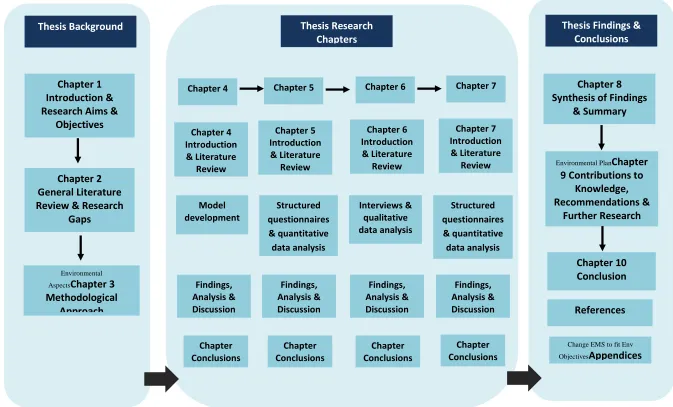
1.3 Structure of the thesis 4
Chapter 2 – General Review of the Literature and Research Gaps 8
2.1 Introduction 8
2.2 Managing the environment in organisations 9
2.3.Environmental management and performance through EMSs 10
2.4 Levels of environmental management 12
2.5 How are EMSs implemented? A focus on ISO 14001 13
2.6 EMS implementation drivers 18
2.7 What do EMSs offer organisations? 20
2.8 EMS implementation benefits 21
2.9 EMS implementation barriers 22
2.10 How do EMSs affect environmental performance? 23
2.11 The uneven economic and geographical certification to EMSs 26
2.12 Statement of need 30
ii SECTION THREE
Chapter 3 – Methodological Approach, Philosophical Assumptions and Methods 33
3.1 Introduction 33
3.2 Research problem 33
3.3 Research philosophy 34
3.4 Research strategy 36
3.5 Introduction to research methods 38
3.6 Systematic reviews 38
3.7 Systematic review strategies used 41
3.8 Use of questionnaires 49
3.9 Quantitative data analysis methods 55
3.10 Qualitative data analysis methods 59
SECTION FOUR
Chapter 4 – Development of a New Model for Categorising Factors Influencing
Pro-environmental Behaviour (EMSIFs)
62
4.1 Introduction 63
4.2 Research objectives 63
4.3 Review of the literature 63
4.4 Methods used 83
4.5 Findings and results 84
4.6 Discussion 105
4.7 Research limitations and opportunities 110
4.8 Summary 110
Chapter 5 – Identification and analysis of Factors Influencing Pro-environmental
Behaviour (EMSIFs) Using the FACES Model: a developing country context
112
5.1 Introduction 113
5.2 Research objectives 114
5.3 Review of the literature 114
5.4 Methods used 128
5.5 Findings 131
iii
5.7 Research limitations, gaps and future research opportunities 159
5.8 Summary 161
Chapter 6 – Organisational Perceptions of Environmental Performance 162
6.1 Introduction 163
6.2 Research objective 164
6.3 Review of literature 164
6.4 Methods used 169
6.5 Findings and discussion 171
6.6 Research limitations, gaps and future research opportunities 177
6.7 Summary 178
Chapter 7 – Suitability of Indicators for Measuring Environmental Performance 179
7.1 Introduction 180
7.2 Research objectives 181
7.3 Review of the literature 182
7.4 Methods used 188
7.5 Findings 189
7.6 Discussion 196
7.7 Research limitations, gaps and future research opportunities 202
7.8 Summary 202
SECTION FIVE
Chapter 8 - Synthesis of Findings and Research Summary 204
Chapter 9 – Contribution to Knowledge, Recommendations and Further Research 209
9.1 Contribution of the study to knowledge 209
9.2 Potential beneficiaries of the research 210
9.3 Recommendations 211
9.4 Further research work 214
Chapter 10 - Conclusion 216
10.1 Objectives 1, 2, 3, 4 & 5 216
10.2 Objectives 6, 7 & 8 216
Appendices 218
iv
LIST OF TABLES
Table No. Table Title Page No.
Table 1.1 Alignment of research objectives with thesis chapters 6 Table 2.1 Environmental driver classification groups 18 Table 2.2 Environmental behaviour driver classification models 19 Table 3.1 Structural elements of the first broad research question 42
Table 3.2 Systematic review search words/terms 42
Table 3.3 Organisations involved in questionnaire pre-testing 53 Table 3.4 Questionnaire distribution according to Nigerian geographical
zones
55
Table 4.1 Relationship between EMS implementation factors 77 Table 4.2 EMS driver classification models from previous studies 80 Table 4.3 EMS benefit classification models from previous studies 81 Table 4.4 EMS barrier categorisation models from previous studies 82
Table 4.5 EMS studies world regions 91
Table 4.6 Distribution of different EMSIF types across FACES model categories
93
Table 4.7 Classification of EMS drivers from previous studies using the FACES model
94
Table 4.8 Classification of EMS benefits from previous studies using the FACES model
95
Table 4.9 Classification of EMS barriers using the FACES model 97 Table 4.10 Results of EMSIF categorisations using the FACES and other
models – primary researcher
100
Table 4.11 Summary of EMSIF categorisations done by primary and independent researchers
v
Table 4.12 Breakdown of EMSIFs by geographical region using FACES model
103
Table 4.13 Analysis of EMSIFs by geographical region showing study ratios
104
Table 4.14 Countries economic development status 106
Table 4.15 Analysis of EMSIFs by economic status using FACES Model 106 Table 5.1 Nigeria’s environmental problems as a result of natural
phenomena
119
Table 5.2 Nigeria’s environmental problems as a result of human activity 120 Table 5.3 Environmental regulatory body functions and jurisdiction 127 Table 5.4 Pro-environmental behaviour variables and levels of
measurement
131
Table 5.5 Frequencies - geographical zone 132
Table 5.6 Frequencies - organisation turnover 133
Table 5.7 Frequencies - organisation corporate structure 133
Table 5.8 Frequencies - organisation size 134
Table 5.9 Frequencies - organisation ownership structure 134 Table 5.10 Frequencies – level of environmental management 135 Table 5.11 Summary frequencies of drivers to pro-environmental
behaviour
136
Table 5.12 Summary frequencies of benefits to pro-environmental behaviour
137
Table 5.13 Summary frequencies of barriers to pro-environmental behaviour
137
Table 5.14 Pearson’s Chi-square p-values and measure of association for significant variable relationships
142
Table 6.1 Detailed description of qualitative analysis codes 173 Table 7.1 Environmental performance indicators common to international
performance indicator frameworks
188
Table 7.2 Showing summary statistics for questionnaire response variables
vi
Table 7.3 Chi-Square analysis results 193
Table 7.4 Level of environmental management R x C frequency ratios 194 Table 7.5 Organisational size R x C frequency ratios 194 Table 7.6 Level of environmental management frequency ratios 195 Table 7.7 Assessment of suitability of EPIs for measuring environmental
performance
197
Table 3A-1 Literature search - Tier 1 219
Table 3A-2 Grey literature sources 220
Table 3B-1 Showing data collection methods for previous studies on EMS implementation
221
Table 3B-2 Showing data collection methods for previous studies on EMS performance
222
Table 3D-1 Details of draft questionnaire review 225
vii
LIST OF FIGURES
Figure No. Figure Title Page No.
Figure 1.1 Thesis structure 7
Figure 2.1 Levels of environmental management (Adapted from Webb et al., 2006)
13
Figure 2.2 ISO 14001 EMS implementation model (adapted from: Bansal and Bogner 2002)
15
Figure 2.3 ISO 14001 EMS implementation model (adapted from: Hughey et al., 2005; Radonjic and Tominc, 2007)
16
Figure 2.4 ISO 14001 EMS implementation model (adapted from: Boiral, 2011)
17
Figure 2.5 ISO 14001 world certification levels (Source: The ISO Survey, 2013)
29
Figure 2.6 World share of ISO 14001 certifications (Source: ISO, 2013) 30 Figure 3.1 Sociological paradigms (adapted from Burrell and Morgan,
1979)
35
Figure 3.2 Research methodological approach (adapted from Remenyi et al., 1998)
37
Figure 3.3 Research methods used 39
Figure 3.4 Combination of search terms with Boolean operators 43 Figure 3.5 Map of Nigeria showing geo-political zones 52 Figure 3.6 Industry sector distribution of respondents 55 Figure 4.1 The neoclassical efficient choice-social institutional divide
(adapted from Tomer, 1992 and Neumayer and Perkins, 2005)
87
Figure 4.2 The internal-external categorisation divide (adapted from Heras et al., 2011)
87
Figure 4.3 New FACES model 89
viii
Figure 4.5 EMSIF types reported in 22 previous studies 92 Figure 4.6 Breakdown of EMSIFs by geographical region using FACES
model
103
Figure 5.1 Map of West Africa showing Nigeria 116
Figure 5.2 A chronological overview of major federal environmental legislative, regulatory and policy instruments in Nigeria
122
Figure 5.3 EMSIFs in research questionnaire showing positive and negative axes
130
Figure 5.4 Industry sector distribution of respondents 132
Figure 5.5 Top 5 EMSIFs shown within FACES model 138
Figure 6.1 Qualitative analysis themes within the FACES model 172 Figure 6.2 Respondents views on environmental performance 174 Figure 7.1 Model for measuring environmental performance (adapted from
Tam et al., 2005)
183
Figure 7.2 Environmental performance indicator definitions 185 Figure 7.3 Percentage of organisations that use EPIs (OPIs and MPIs)
frequently or occasionally
191
Figure 7.4 Scatter diagram showing trends in EPI use in different industry sectors
192
ix
ACKNOWLEDGEMENTS
I am grateful to my Father in heaven. All this is nothing compared to the privilege of being your child.
Thank you, Mike Wood, for showing me what it takes to be a thorough and seasoned researcher. Your sheer drive and energy helped to take me through a very long process.
Thank you, Andrew Clark, for your subject matter expertise. Your patient review of my work gave me the confidence to put it forward.
Thank you, Professor Babajide Alo, for providing the support to enable me meet the challenges associated with a split-site program. And thank you for your ever prompt feedback!
I would also like to thank my husband, Kola for being a great encouragement, a very objective sounding board and for selflessly providing the moral and domestic support I needed to conduct academic work.
And thank you Mummy, for your valuable editorial contribution.
x
ABBREVIATIONS
Afr&WAsia Africa and West Asia Aus&NZ Australia and New Zealand
CAC Corporate Affairs Commission (Nigeria) CEE Collaboration for Environmental Evidence C&SAm Central and South America
DPR The Department of Petroleum Resources
EEA European Environmental Framework of the European Environmental Agency
EGASPIN Environmental Guidelines and Standards for the Petroleum Industry
EMS Environmental Management System
EMAS Eco Management and Audit Scheme
EMSIF Environmental Management System Implementation Factor ENEC External Neoclassical Efficient Choice Factor
EPI Environmental Performance Indicator EPIx Environmental Performance Index ESI External Social Institutional Factor
EU European Union
Eur Europe
FACES Factors Affecting Corporate Environmental Systems
FarE Far East
FEPA Federal Environmental Protection Agency (Nigeria) FMEnv Federal Ministry of Environment (Nigeria)
HDI Human Development Index
xi
ISO International Organisation for Standardization LASEPA Lagos State Environmental Protection Agency
NAm North America
NCF Nigerian Conservation Foundation
NESREA The Nigerian Environmental Standards Regulatory Agency
NC North Central zone
NE North East zone
NW North West zone
PDCA Plan-Do-Check-Act
RSEPA Rivers State Environmental Protection Agency
SA Social Accountability
SE South East zone
SME Small Medium Enterprise
SR Systematic Review
SS South South zone
SW South West zone
UN United Nations
UNCED United Nations Council for Environment and Development UNEP United Nations Environment Program
USA United States of America
USAID United States Agency for International Development
VSME Very small medium enterprise
xii GLOSSARY
Best Practice Practices and procedures generally agreed to be efficient and effective and help as a model for others to copy (Dictionary of Business and Management – (Witzel, 1999, p.27).
Certification A formal evaluation of a set of processes. Cleaner
Production/Clean Technologies
The use of environmentally friendly processes to produce environmentally friendly products, a route to sustainable development, reducing the risk to the environment of industrial activities in the most cost effective way. The term includes, inter alia, waste minimization, pollution prevention, process modification and energy efficiency (Gilpin, 1997, p.40).
Competitive Advantage Advantage which one competing firm enjoys over its rivals, such as superior products or distribution (Dictionary of Business and Management – (Witzel, 1999, p.55).
Command and Control Mechanisms
Command and control consists of two elements: (1) Command – imposed by the regulator as a set of standards or rules e.g. in a permit or set down as offences in law; (2) Control – mechanisms to secure compliance with standards or rules and to enforce the law e.g. fines, penalties, enforcement notices, inspections and audits.
Compliance Obeying a statutory requirement or a legal obligation (Concise Dictionary of Business and Management – (Statt, 1999, p.28).
Consultant Outside specialist brought into a company to advise on or help solve a particular problem (Dictionary of Business and Management – (Witzel, 1999, p.59).
xiii
consistent with the organisation's environmental policy (ISO 14001:2004 - Environmental Management Systems – Requirements with Guidance for Use).
Corporate To do with a corporation or organisation.
Corporate Organisation Any company, corporation, firm, enterprise, authority or institution, or part or combination thereof, whether incorporated or not, public or private, that has its own functions and administration. (ISO, 2004).
Developing Countries This refers to the relatively poorer nations of the world, also often referred to as the Third World. Taken as a group the developing nations of the world account for over three-quarters of the world’s population (Gilpin, 1997, p.58).
Eco-efficiency The creation of more goods and services with the use of fewer resources (WBCSD, 2000).
Eco-design Sometimes known as ‘Design for the Environment’, eco-design has been defined as the ‘systematic integration of environmental considerations into product and process design (Knight & Jenkins, 2009).
Environment The sum total of external influences acting on an organism (Lawrence, Jackson & Jackson, 1998, p.136). All the surroundings of an organism, including other living things, climate, soil etc. In other words, the conditions for development or growth (Porteous, 1996, p.198).
A concept which includes all aspects of the surroundings of humanity, affecting individuals and social groupings (Gilpin, 1997, p.74).
Environmental Aspect Element of an organisation's activities or products or services that can interact with the environment (ISO, 2004).
xiv
system, protect the organisation against external criticism, assess risks generally, or assist in planning for future improvements in environmental protection and pollution control (Gilpin, 1997, p.74).
Environmental Control Mechanisms
These control mechanisms include but are not limited to (1) Cleaner Production – ’The use of environmentally friendly processes to produce environmentally friendly products, a route to sustainable development, reducing the risk to the environment of industrial activities in the most cost effective way. The term includes, inter alia, waste minimization, pollution prevention, process modification and energy efficiency (Gilpin,1997) Environmental Impact The changes in the total environment, both in terms of the ecology and the
social impact, caused by human activities (Lawrence, Jackson & Jackson, 1998, p.137).
Environmental Management
A concept of care applied to localities, regions, catchments, natural resources, areas of high conservation value, cleaner processing and recycling systems, waste handling and disposal, pollution control generally, landscaping and aesthetics, enhancement of amenities. In general it means the efficient administration of environmental policies and standards (Gilpin, 1997, p.80).
Environmental Management System
Management system used in environmental management, which generate data used in environmental reporting (Statt, 1999, p.101).
Environmental Management System Implementation Factor
Or EMSIF. A component or element of pro-environmental behaviour demonstration. An EMSIF can be a driver, benefit or barrier.
EMSIF Categorisation Model
A prototype used for the classification and grouping of EMSIFs
Environmental Performance
xv
Environmental Pollution
The contamination of the physical and biological components of the earth/atmosphere system to such an extent that normal environmental processes are adversely affected (Kemp, 1998, p.129).
Environmental Regulation
The control of environmental activities through the use of regulatory tools.
Implementation Putting a plan or concept into practice; carrying out a plan (Witzel, 1999, p.144).
Industry A particular sector where companies are involved in broadly similar business, such as the mining industry, the pharmaceutical industry and so on (Witzel, 1999, p.149).
International Standard Standards developed by standards organisations worldwide. Life Cycle
Analysis/Assessment
A method for evaluating the whole life of a product, that is all the stages involved, such as raw material acquisition, manufacturing, distribution and retail, use and re-use and maintenance, recycling and waste management, in order to create less environmentally harmful products (Porteous, 1996, p.328).
Management General term for the coordination and direction of resources, capital and labor to ensure the organisation meets its goals; also used to refer to the body of managers and executives responsible for management (Witzel, 1999, p.184).
Market Geographical of other defined area in which there exist a number of potential customers for a product or service or the sum of potential demand for a product or service (Witzel, 1999, p.189).
Market demand Total or potential demand for a product within a particular market (Witzel 1999, p.189).
xvi
command and responsibility, and definition of particular roles and tasks (Witzel, 1999, p.221).
PDCA Plan-DoCheck-Act is an iterative four-step management method used in business for the control and continuous improvement of processes and product. The PDCA cycle had its origins with Dr. W Edwards Deming’s lecture in Japan in 1950 (Moen & Norman, 2011). Deming is considered to be the father of modern quality control.
Pollution Any direct or indirect alteration of the physical, chemical, biological, thermal or radioactive properties of any part of the environment by discharging, emitting or depositing wastes or substances so as to affect any beneficial use adversely (Gilpin, 1997, p.177).
Pollution Control The term for administrative mechanisms for control and the various technical processes and devices available for reducing emissions of waste streams (Porteous, 1996, p.430).
Pro-environmental Behaviour
Behaviour in the interest of environmental preservation and protection.
Pro-environmental Driver
A factor that motivates an organisation to act in the interest of environmental preservation and protection.
Pro-environmental Benefit
A benefit derived by an organisation for an action taken in the interest of environmental preservation and protection.
Pro-environmental Barrier
A factor that prevents an organisation from acting in the interest of environmental preservation and protection.
Regulator/Regulatory Body
An institution or agency making, upholding and enforcing environmental regulations, laws and stipulations.
xvii
Standard Norm or behaviour to which people are expected to adhere; the level of quality required in a product or service (Witzel, 1999, p.290).
Standardization The elimination of variance (Witzel, 1999, p.291).
Supplier Company or individual supplying materials, goods or services to another company (Witzel, 1999, p.298).
Sustainable Development
Development that provides economic, social and environmental benefits in the long term, having regard to the needs of living and future generations (Gilpin, 1997, p.206).
xviii ABSTRACT
Country specificities, national cultures and socio-economic contexts have been found to influence factors influencing pro-environmental behaviour in organisations (Darnall et al., 2008). Different categorisation models have been used to describe these factors (Tomer, 1992; Powell and DiMaggio, 1991; Bansal & Howard, 1997; Jiang & Bansal, 2003; Neumayer & Perkins, 2005; Gavronski et al., 2008; Matzsuzak & Flejsman, 2008; Heras & Arana, 2010; Zorpas, 2010 Curkovic & Sroufe, 2011). Though commonalities exist between models, differences in model structure and terminology have created variations in interpretation of factors, and introduced repetition and disparity in description. The uneven distribution of studies across world regions also limits the applicability of factors. A better representation of research studies and the development of a more efficient categorisation model will lead to a clearer description of factors influencing pro-environmental behaviour.
Organisations adopt pro-environmental behaviour to bring about a change (improvement) in environmental performance. However, there is little consensus about the meaning of environmental performance (Perotto et al., 2007; Casadesus et al., 2008; Comoglio & Botta, 2011), indicating that organisations may interpret it differently and use inappropriate indices for measuring performance. A lack of understanding (or variations in understanding) of the intended outcome of pro-environmental behaviour creates further difficulty in the description and interpretation of factors influencing it. Studies focusing on investigating and describing organisations’ interpretation of environmental performance are rare. There is need for a better knowledge of organisations’ interpretation of environmental performance and a determination of the indicators used to measure performance.
xix
Questionnaire responses from 200 organisational respondents in the developing country setting of Nigeria were collated, and the FACES model was used to analyse and describe EMSIFs. In order to determine trends in organisational pro-environmental behaviour, identified EMSIFs were compared with those reported in previous studies. Results showed that EMSIFs influencing pro-environmental behaviour differed in organisations in different geographical and economic world regions.
1
CHAPTER ONE
RESEARCH BACKGROUND
1.1 Introduction
The adoption of pro-environmental behaviours by organisations has led to an increasing number of studies focusing on the factors i.e. the drivers, benefits and barriers that influence this behaviour across organisations in a range of industry sectors and world regions (Bansal & Bogner, 2002; Boiral, 2011; Delmas, 2002; Heras & Arana, 2010; Kehbila, 2009; Massoud, Fayad, El-Fadel & Kamleh, 2010a; Nawrocka & Parker, 2008; Zorpas, 2010; Zutshi & Sohal, 2004a).
Studies reporting on factors influencing pro-environmental behaviour use different models to describe and categorise these behaviours, introducing variations in terminology, interpretation and functionality. Though commonalities exist between models, there are differences in terminologies used to describe these factors, as well as differences in organisation types, geographic locations and economic realities in which studies are done. This creates disparity and limits the categorisation, description and usefulness of these factors (Darnall, Henriques, Sadorsky, 2008). It is anticipated that an inclusive categorisation model with common terminologies would facilitate research on factors influencing pro-environmental behaviour, by enabling analysis and comparison across geographical, economic and industry boundaries.
Organisations have different motivations for exhibiting pro-environmental behaviours like environmental management system (EMS) implementation. This includes, but is not limited an attempt to control environmental impacts (Bansal & Bogner, 2002). In general, organisations are motivated by performance and are likely adopt pro-environmental behaviour in order to improve environmental performance (Casadesus et al., 2008; Comoglio & Botta, 2011). It can be said that organisations demonstrate pro-environmental behaviour, such as EMS implementation because they want to gain an improvement in environmental performance.
2
perceived benefits, and therefore expect to experience returns on investment (Cashore, van Kooten, Vertinsky, Auld & Affolderbach, 2005; Gavronski, Ferrer & Paiva, 2008; Heras-Saizabitoria, Arana-Landin & Molina-Azorin, 2011). As such, the motivations for pro-environmental behaviour and its expected benefits are linked, indicating that an organisation’s pro-environmental behaviour is linked to its expected environmental performance, and is an indication of benefits accruing from its actions (Zutshi & Sohal, 2004a; Gavronski et al., 2008). However, there have been few studies specifically focusing on causality between drivers, benefits, outcomes and pro-environmental behaviour (Gavronski et al., 2008; Hertin, Berkhout, Wagner & Tyteca, 2008; Nawrocka and Parker, 2008). The results of these studies have been inconclusive, making causal relationships difficult to establish. Subsequently, there is an increasing interest in improving the understanding of pro-environmental behaviours by establishing their actual impact on organisational outcomes. Research interest also lies in determining if pro-environmental demonstration brings about changes in environmental performance (Lopez-Fernandez and Serrano-Bedia, 2007; Hertin et al., 2008; Heras & Arana, 2010).
Environmental performance is a complex and multidimensional issue, and determining changes in performance (improvement) is difficult as a result. This is particularly true because different organisations have differing operations and regulatory environments, and each has inherent measures and values of performance (Bellesi et al., 2005; Hertin et al., 2008). Environmental performance may also be difficult to understand and determine if is interpreted differently by organisations. Results of studies, such as Hamschmidt (2000), indicate that organisations' interpretation of environmental performance is influenced by their original motivations for adopting pro-environmental behaviour. Environmental performance may therefore only be completely defined in the light of individual organisations’ motivations, be they purely ‘environmental’ or not. Continued investigation of causality between drivers, outcomes and environmental performance is necessary. Interpretation of results based on the investigation of causal relationships should be undertaken taking individual organisational views on environmental performance into consideration.
3
2008). Studies on factors influencing pro-environmental behaviour such as EMS implementation in different countries have shown recognizable differences when compared (Jabbour, Maria da Silva, Paiva & Almada-Santos, 2012), increasing the likelihood of notable variations between results of studies conducted in different world regions. This is true when comparing studies from regions/countries with different cultures and socio-economic status. For instance, according to Delmas, (2002), certain EMS barriers are likely to be more prevalent in developing economies which often lack a regulatory and economic environment conducive to promoting implementation. Conversely, pro-environmental behaviour may yield immediate benefits (such as short term improved environmental quality) in the same developing economies where environmental problems are serious and government intervention is minimal, giving organisations a greater responsibility to effect environmental change.
Organisations, especially those with operations across a number of world regions, would benefit from understanding the link between pro-environmental behaviour and its outcomes as it is affected by different geographical factors (Paulraj & deJong, 2011). Such studies will facilitate the critical evaluation of pro-environmental behaviour across geographical regions and aids the comparison of research results with those of similar studies conducted in other regions. A deepened understanding of factors influencing pro-environmental behaviour categories will also aid policymakers in the formulation of policies which could provide the enabling conditions for fostering pro-environmental behaviours (Njoku and Orabuchi, 2010).
1.2 Research aims and objectives
4
1. To develop a new model for the categorisation of factors affecting pro-environmental behaviour (EMSIFs) across geographical and economic boundaries;
2. To apply, test and critically evaluate the newly developed model by comparing it with existing models for categorising EMSIFs;
3. To identify factors affecting pro-environmental behaviour (EMSIFs) in a developing country context, and to categorise and analyse them using the developed model;
4. To determine patterns in pro-environmental behaviour by exploring the relationship between organisational characteristics and EMSIFs;
5. To identify geographic and economic patterns in pro-environmental behaviour by comparing EMSIFs identified from this research with EMSIFs identified by previous studies in other world regions;
6. To identify organisational views on environmental performance and critically analyse perceptions of environmental performance in a developing country context;
7. To identify and analyse objective means for measuring environmental performance, by determining environmental performance indicators in use by organisations in a developing country context, and by analyzing patterns in the use of environmental performance indicators;
8. To critically evaluate the extent to which environmental performance indicators being measured by organisations are suitable for measuring environmental performance (as it is perceived by organisations).
1.3 Structure of the thesis
5
A new categorisation model for EMSIF classification is presented within Chapter 4. The chapter critically reviews the main EMSIF classification divides and groups that have been presented in previous literature, and uses this review to inform the development of a new model. The new model’s ability to successfully categorise a broad range of EMSIFs was tested by comparing it with other models, using EMSIFs reported from studies conducted in other world regions (Europe, North, Central and South America, Australia/New Zealand, Asia and the Far East). In Chapter 5 the identification (through a structured survey method) of EMSIFs in organisations within the developing country context of Nigeria is presented. Categorisation and analysis of identified EMSIFs was done using the newly developed model. EMSIFs from this research were compared with those identified by previous studies in other world regions (Europe, North, Central and South America, Australia/New Zealand, Asia and the Far East).
Chapter 6 addresses environmental performance as being the major expected outcome of organisational pro-environmental behaviour. This chapter identifies and analyses organisational respondents’ perceptions of environmental performance by identifying individual organisational views. Respondent views were analysed, using qualitative data analysis methods, to identify major themes in the interpretation of environmental performance.
Chapter 7 addresses the measurement of environmental performance by identifying objective means for measurement (environmental performance indicators or EPIs) used by organisations in Nigeria. Patterns in EPI use in respondent organisations were analysed and relationships between organisational characteristics and EPI use were identified. The appropriateness of EPIs being measured by organisations for assessing environmental performance (in particular as is perceived by respondent organisations) is discussed in this chapter.
6
Table 1.1 – Alignment of research objectives with thesis chapters
Research Chapters Research Objectives
Chapter Four To develop a new model for the categorisation of factors affecting pro-environmental behaviour (EMSIFs) across geographical and economic boundaries;
To apply, test and critically evaluate the newly developed model by comparing it with existing models for categorising EMSIFs;
Chapter Five To identify factors affecting pro-environmental behaviour (EMSIFs) in a developing country context, and to categorise and analyse them using the developed model;
To determine patterns in pro-environmental behaviour by exploring the relationship between organisational characteristics and EMSIFs;
To identify geographic and economic patterns in pro-environmental behaviour by comparing EMSIFs identified from this research with EMSIFs identified by previous studies in other world regions;
Chapter Six To identify organisational views on environmental performance and critically analyse perceptions of environmental performance in a developing country context;
Chapter Seven To identify and analyse objective means for measuring environmental performance, by determining environmental performance indicators in use by organisations in a developing country context, and by analyzing patterns in the use of environmental performance indicators;
7
Figure 1.1 – Thesis structure Chapter 1 Introduction & Research Aims &
Objectives
Chapter 2 General Literature Review & Research
Gaps
Environmental
AspectsChapter 3 Methodological
Approach
Chapter 8 Synthesis of Findings
& Summary
Environmental PlanChapter 9 Contributions to
Knowledge, Recommendations & Further Research Chapter 10 Conclusion References
Change EMS to fit Env
ObjectivesAppendices
Chapter 4 Chapter 5 Chapter 6 Chapter 7
Model development Structured questionnaires & quantitative data analysis Interviews & qualitative data analysis Structured questionnaires & quantitative data analysis Findings, Analysis & Discussion Findings, Analysis & Discussion Findings, Analysis & Discussion Findings, Analysis & Discussion Chapter 4 Introduction & Literature Review Chapter 5 Introduction & Literature Review Chapter 6 Introduction & Literature Review Chapter 7 Introduction & Literature Review Chapter Conclusions Chapter Conclusions Chapter Conclusions Chapter Conclusions
Thesis Background Thesis Research
Chapters
8
CHAPTER TWO
GENERAL REVIEW OF THE LITERATURE
2.1 Introduction
The environmental impact of human activities only began receiving substantial attention in the 1970s. Environmental issues have subsequently received increasing consideration in corporate management and decision making internationally (Quazi, Khoo, Tan & Wong, 2001). A philosophy underpinning environmental concerns is that of the concept of sustainable development – the idea that consumption and development can only be ‘sustainable’ if they meet the needs (material, resource, energy) of the present generation whilst ensuring that the needs of future generations can also be met. This was the position of the Brundtland Report titled “Our Common Future” published by the World Commission on Environment and Development (WCED, also popularly called the Brundtland Commission). The WCED was created by the United Nations General Assembly in 1983 for the purpose of examining conflicts between environmental protection and economic growth, and developing strategies for their reconciliation. The sustainable development stance places pressure on organisations, as being the most obvious and therefore readily culpable perpetrators of resource mismanagement and environmental decline. Pivotal publications from the WCED and the United Nations Council on Environment and Development (UNCED), to the United Nations Conference on Sustainable Development (popularly called Rio 20+) highlight the role of industry in the pursuit of sustainable development and the need for industry to be accountable for its adverse environmental impacts (UNCED, 1992; UNCED, 2012; WCED, 1987).
9
advancement in a different light – that of environmental protection and preservation (Alemagi, Oben & Ertel, 2006; Quazi et al., 2001).
2.2 Managing the environment in organisations
The concern for the natural environment has led to an increasing interest in the way organisations manage environmental issues (Bansal & Bogner, 2002; Oliveira et al., 2010).As such, organisations operating worldwide are increasingly being held accountable for their actions, especially as a result of their direct connection with activities that could lead to negative environmental impacts. According to Henri & Journeault (2008), this conferred accountability is evidenced by the on-going development of environmental laws, regulations and repercussions put into effect by governments and regulatory bodies, together with the various innovative forms of formal and informal environmental control mechanisms in use within industry worldwide.
Organisations are now expected, as a matter of course, to assess, control and even publicly disclose information relating to their environmental interactions. Those organisations that do not take careful account of and subsequently manage the impact of their products and services on the environment may become unpopular or irrelevant in their respective markets (Babakri, Bennet & Franchetti, 2003; Bansal & Bogner, 2002; Bellesi, Lehrer & Tal, 2005; Darnall et al., 2008; Franchetti, 2011; Gonzalez-Benito & Gonzalez-Benito, 2008; Nawrocker & Parker, 2008, Nishitani, 2010; Oliveira et al., 2010; Quazi et al., 2001; Rao, la O’Castillo, Intal & Sajid et al., 2006; Tam, 2006; Zorpas, 2010). According to Nishitani (2010), the continued survival of the corporate organisation is linked to its on-going consideration of the natural environment surrounding company operations.
10
been both formal and informal, and appear to be internally or externally motivated. Though corporate environmental protection and control maybe a recognized need, the degree of sincerity with which environmental issues are managed within organisations, and their motivations for doing so remains an issue for concern to stakeholders (Gavronksi et al., 2008; Gonzalez et al., 2008).
2.3 Environmental management and performance through EMSs
A term that has been increasingly used in the past two decades, and which has evolved with the advent of environment concern is ‘environmental management’. Environmental management refers to the disciplined approach by which organisations ensure that their processes and operations have a minimal (or even positive) impact on the environment (Paulraj & de Jong, 2011). The term encompasses the application of innovative systems and tools throughout an organisation, with the aim of increasing environmental sustainability while increasing competitive advantage and improving organisational social standing. This is achieved through managing a system of on-going organisational learning and knowledge enhancement, and is guided by the setting and attainment of objective environmental goals and targets (Jabbour et al., 2012). Such systems are referred to as environmental management systems or EMSs. Environmental management works much like the mechanism for any other organisational function, such as operations, human resources and finance management, where resources are pooled together to control intended aspects and achieve planned results.
11
categories of studies which attempt to prove relationships between EMSs and environmental performance. One category concludes that EMSs do improve environmental performance (Sroufe, 2003; Hamschmidt, 2000; Potoski and Prakash, 2005 & Andrews et al., 2003), and the other category does not (Hertin et al., 2004 & King and Lenox, 2000). This leaves an unestablished relationship between pro-environmental behaviours such as EMS implementation, and environmental performance. A lack of understanding or agreement on the intended outcome of pro-environmental behaviour (environmental performance improvement) creates a challenge for organisations with regards to performance measurement and assessment.
Effective environmental management, because it creates viable advantages for many organisations, is considered an important competitive priority for them (Jimenez & Lorente, 2001). Effective management signifies proactivity in the handling of environmental issues. This is of particular importance to organisations as they become increasingly aware that environmental proactivity may contribute to the reduction of unwanted accidents and simultaneously improve economic bottom lines (Quazi et al., 2001).
That some organisations consider environmental management to be a competitive priority indicates that their motivation for managing the environment may not stem solely from a concern for the preservation of nature. There are different opinions on this premise, as not all organisations consider corporate environmental management an advantage. For instance, an excessive emphasis on environmental issues may present a deterrent to pro-environmental behaviour, as the direct focus of environmental management initiatives on prevention and eco-efficiency may also prevent it from being viewed as a competitive priority for some organisations (Jabbour et al., 2012). It may also be that some organisations feel that their focus on environmental management distracts them from their core business objective of profit-making. These opposing positions appear to be simultaneously held by different organisations to differing degrees.
12
of these tools may then bring about differing levels of environmental performance. Though there are disagreements on the degree of actual competitive advantage that may be gained, the concept of environmental management still appears to have received widespread acceptance, as evidenced by the continued and increasing adoption of certified and non-certified EMSs by organisations worldwide (ISO, 2013). The environmental management concept is most demonstrably detailed in the implementation of the EMS, which formally surfaced in the 1990s as a tool for moving organisations towards the goal of sustainable development (WCED, 1987; ISO, 2004). Management systems in general, generically based on the Deming plan-do-check-act model, represent the organisational structures put in place to control the process of transforming company resources into product or service outputs, in order to achieve internal or external company objectives (ISO, 2004). Management systems may be focused on any aspect of company operations and aim to plan, organize and control related elements of a particular aspect to produce pre-determined outcomes which are usually articulated as specific goals and objectives.
Aptly defined by Bellesi et al. (2005, p.1945) as “a set of internal rules that managers use to standardize behaviour in order to help satisfy organisation’s environmental goals”, an EMS is a subset of an organisation’s larger management system. It comprises human, economic and infrastructural components which control the environmental interactions brought about by company activities, products and services, and which harness the organisation’s capabilities for achieving set environmental objectives (Chan & Hawkins, 2010; Link & Naveh, 2006; Yin & Schmeidler, 2009; Zorpas, 2010). Though EMSs by their structure are designed to provide advantageous value to organisations, there is some debate about the value that they offer (Bansal & Bogner 2002; Babakri et al., 2004). This raises a pertinent issue about whether environment management tools such as EMSs actually affect organisations positively.
2.4 Levels of environmental management
13
externally recognized environmental certification (such as EMAS or ISO 14001) to having no system of managing environmental issues at all. The first of the seven levels represents organisations which have been certified to the Eco Management and Audit Scheme (EMAS) standard. It is not clear why the Webb et al (2006) framework rates EMAS certified organisations on a higher level of environmental management than ISO 14001 certified organisations. This may be because EMAS is generally considered to place more stringent requirements, such as environmental reporting on certifying organisations. The second level represents organisations which have been externally certified to the ISO 14001 standard, but which also show additional voluntary displays of pro-environmental behaviour. The third level represents organisations that have been externally certified to the ISO 14001 standard, and the fourth level represents organisations that claim adherence to the ISO 14001 standard, although having no certification. The fifth level represents organisations with an EMS that is recognized geographically and also by their industry sector, and the sixth level represents organisations that operate some elements of an EMS. The seventh level represents organisations with no EMS at all. Figure 2.1 shows the framework presented by Webb et al (2006).
The existence of levels in environmental management in organisations raises the issue of whether there are also corresponding levels in environmental performance i.e. returns on environmental management efforts. Stratified levels of environmental management may imply that organisations also display different levels of pro-environmental behaviour.
EMAS
ISO14001 accredited certified PLUS (ISO 14001 AC PLUS) ISO14001 accredited certified (ISO 14001 AC)
ISO14001 non-accredited certified (ISO 14001 non AC) Formal EMS
Informal EMS No EMS
Figure 2.1 – Levels of environmental management (Adapted from Webb et al., 2006) Most advanced
EMS
14
2.5 How are EMSs implemented? A focus on ISO 14001
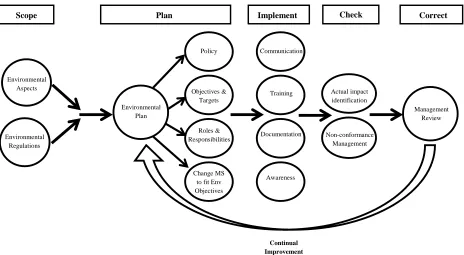
EMS implementation is an important aspect of environmental management and a form of pro-environmental behaviour. A number of studies and publications provide guidance and evaluate EMS implementation from an academic standpoint. The ISO 14001:2004 EMS implementation standard provides a useful foundation for discussing the practicalities of EMS implementation, and establishes the tasks that need to be undertaken (as distinct clauses) to achieve certification. ISO 14001, through a plan-do-check-act (PDCA) framework, details requirements for the setting up of an environmental management system geared at achieving set organisational environmental objectives.
15
checking stage requires that the control of actual environmental impacts is regularly checked, and non-conformances or deviations from set levels addressed. The final stage involves a regular review by the organisation’s management, and the effecting of any necessary changes to continually improve EMS efficiency and the ability of the EMS policy, processes and structures to meet set environmental objectives and targets.
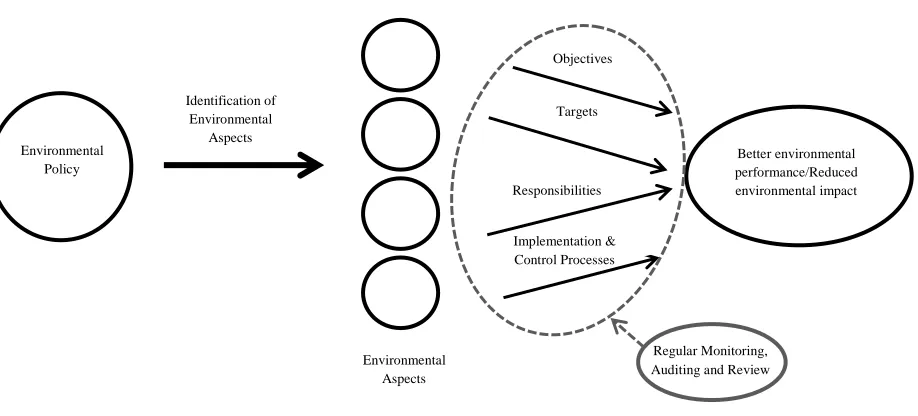
[image:36.612.88.552.391.646.2]According to Hughey et al (2005) and Radonjic and Tominc (2007), an ISO 14001 EMS is based on the development and implementation of an environmental policy, which should lead the organisation to the identification of the environmental aspects of all its operations, products or services. The organisation should subsequently identify its environmental priorities and set objectives, targets and implementation processes related to its environmental aspects for planning and controlling activities and impacts. These processes are regularly monitored and audited, with the execution of preventive and corrective actions, and the entire system is regularly reviewed to ensure continual improvement. This interpretation of ISO 14001 EMS implementation is shown in the model in Figure 2.3.
Figure 2.2 – ISO 14001 EMS implementation model (adapted from: Bansal and Bogner 2002)
Plan Implement Check Correct
Scope
Environmental Regulations Environmental
Aspects
Environmental Plan
Change MS to fit Env Objectives Roles & Responsibilities
Objectives & Targets
Policy
Management Review
Awareness Documentation
Training Communication
Non-conformance Management Actual impact identification
16
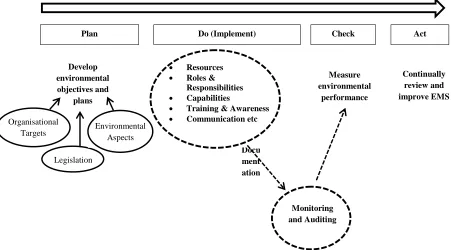
According to a third implementation model explained by Boiral (2011), the ISO 14001 EMS involves planning activities for environmental management, including the setting of objectives and development of plans, the implementation of plans through the use of resources, development of capabilities, allocation of responsibilities and other control processes, the checking of environmental performance through measurement and finally acting by demonstrating management commitment to continually improve the management system. This implementation mode is detailed in Figure 2.4.
Figure 2.3 – ISO 14001 EMS implementation model (adapted from: Hughey et al., 2005; Radonjic & Tominc, 2007)
Though differences exist in the structures of different EMS implementation models, there are similarities between them and they all retain a generic nature. Implementation models propose specific requirements for organisations intending to adopt an EMS but do not explicitly refer to any particular action or impose specific performance or technology standards (Rondinelli & Vastag, 2000). Although EMS models and the ISO 14001 standard achieve greater environmental commitment and a consistent, well-documented EMS, they do not reveal the extent to which organisations have control over environmental impacts, and may not
Environmental Policy
Identification of Environmental
Aspects
Objectives
Implementation & Control Processes Responsibilities
Better environmental performance/Reduced environmental impact Targets
Regular Monitoring, Auditing and Review Environmental
[image:37.612.91.550.239.447.2]17
necessarily bring about a profound environmental revolution of the organisation’s operations (Bellesi et al., 2005; Gonzalez-Benito and Gonzalez-Benito; 2008; Lopez-Fernandez & Serrano-Bedia, 2007; Oliveira et al., 2010).
[image:38.612.89.540.148.398.2]
Figure 2.4 – ISO 14001 EMS implementation model (adapted from: Boiral, 2011)
EMS implementation models are structured to work within organisations’ systems and integrate environmental considerations into the way that operations function. They are intended to improve environmental performance by mitigating, controlling or reducing negative impacts. However it appears that the overriding aim of the ISO 14001 standard is to simply ensure that EMS objectives and programs exist. A reason for this assumption is that there are no explicit environmental performance assessment aspects within the ISO 14001 standard. Determining whether these objectives and programs are sufficient to achieve the organisation’s environmental goals and improve performance remains the responsibility of the organisation itself. This makes it difficult to link EMSs with performance and leads to a situation where organisations may be unaware of the actual impact of EMS implementation on their environmental performance. This has been a criticism of many EMS implementation
Docu ment ation Develop
environmental objectives and
plans Organisational
Targets
Legislation
Environmental Aspects
Resources Roles &
Responsibilities Capabilities
Training & Awareness Communication etc
Monitoring and Auditing
Measure environmental
performance
Continually review and improve EMS
18
models. Organisations may wrongly equate external EMS certification with improved environmental performance, leading them to assume that their performance has improved because they have implemented an EMS. Lopez-Fernandez and Serrano-Bedia, (2007) have suggested that commitment to EMS implementation must be maintained over time, if notable environmental improvement is to be achieved. This implies that the mere existence of a formal means of managing environmental impacts does not guarantee improved environmental performance in an organisation.
2.6 EMS implementation drivers
What drives organisations to exhibit pro-environmental behaviour?
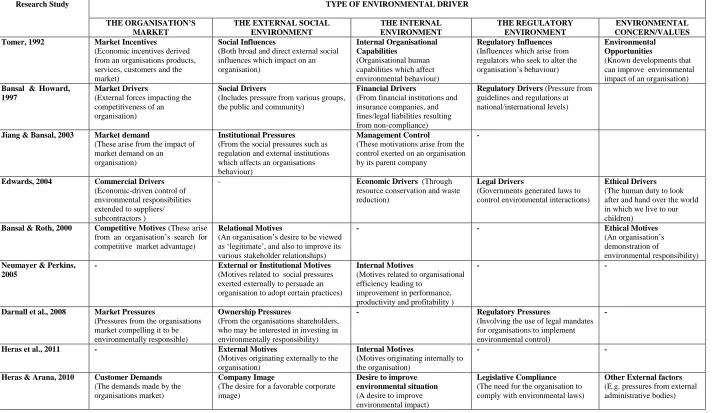
Studies including Darnall et al (2008), Gonzalez, Sarkis & Adenso-Diaz (2008) and Heras & Arana (2010) provide explanations for drivers which motivate organisations toward pro-environmental behaviours. Pro-pro-environmental motivations are interchangeably referred to as ‘drivers’ or ‘incentives’ by the studies researching them. According to research, environmental drivers can be categorised into groups of closely related motivating factors (Heras & Arana, 2010). As a large number of drivers are presented by these studies, it is useful to categorise them into related groups. Table 2.1 gives details of driver classification groups as presented by a review of 9 previous EMS studies. Table 2.2 gives details of each study’s findings.
Table 2.1 Environmental driver classification groups
Type of driver Definition
The Organisation’s Market Drivers that stem from customers, suppliers and competitors The Organisation’s External Social
Environment
Drivers that arise from communities and other institutions surrounding the organisation
The Organisation’s Internal Environment Drivers that stem from the organisation’s need to operate efficiently and improve its performance
The Organisation’s Regulatory Environment
Drivers coming directly from environmental regulatory agents
The Organisation’s Environmental Concern/Values
19 Table 2.2 – Environmental behaviour driver classification models
Research Study TYPE OF ENVIRONMENTAL DRIVER
THE ORGANISATION’S MARKET
THE EXTERNAL SOCIAL ENVIRONMENT THE INTERNAL ENVIRONMENT THE REGULATORY ENVIRONMENT ENVIRONMENTAL CONCERN/VALUES Tomer, 1992 Market Incentives
(Economic incentives derived from an organisations products, services, customers and the market)
Social Influences
(Both broad and direct external social influences which impact on an organisation)
Internal Organisational Capabilities
(Organisational human capabilities which affect environmental behaviour)
Regulatory Influences (Influences which arise from regulators who seek to alter the organisation’s behaviour)
Environmental Opportunities
(Known developments that can improve environmental impact of an organisation) Bansal & Howard,
1997
Market Drivers
(External forces impacting the competitiveness of an organisation)
Social Drivers
(Includes pressure from various groups, the public and community)
Financial Drivers
(From financial institutions and insurance companies, and fines/legal liabilities resulting from non-compliance)
Regulatory Drivers (Pressure from guidelines and regulations at national/international levels) Jiang & Bansal, 2003 Market demand
(These arise from the impact of market demand on an organisation)
Institutional Pressures (From the social pressures such as regulation and external institutions which affects an organisations behaviour)
Management Control
(These motivations arise from the control exerted on an organisation by its parent company
-
Edwards, 2004 Commercial Drivers (Economic-driven control of environmental responsibilities extended to suppliers/ subcontractors )
- Economic Drivers (Through
resource conservation and waste reduction)
Legal Drivers
(Governments generated laws to control environmental interactions)
Ethical Drivers (The human duty to look after and hand over the world in which we live to our children)
Bansal & Roth, 2000 Competitive Motives (These arise from an organisation’s search for competitive market advantage)
Relational Motives
(An organisation’s desire to be viewed as ‘legitimate’, and also to improve its various stakeholder relationships)
- - Ethical Motives
(An organisation’s demonstration of
environmental responsibility) Neumayer & Perkins,
2005
- External or Institutional Motives (Motives related to social pressures exerted externally to persuade an organisation to adopt certain practices)
Internal Motives
(Motives related to organisational efficiency leading to
improvement in performance, productivity and profitability )
- -
Darnall et al., 2008 Market Pressures
(Pressures from the organisations market compelling it to be environmentally responsible)
Ownership Pressures
(From the organisations shareholders, who may be interested in investing in environmentally responsibility)
- Regulatory Pressures
(Involving the use of legal mandates for organisations to implement environmental control)
-
Heras et al., 2011 - External Motives
(Motives originating externally to the organisation)
Internal Motives
(Motives originating internally to the organisation)
- -
Heras & Arana, 2010 Customer Demands (The demands made by the organisations market)
Company Image
(The desire for a favorable corporate image)
Desire to improve environmental situation (A desire to improve environmental impact)
Legislative Compliance (The need for the organisation to comply with environmental laws)
Other External factors (E.g. pressures from external administrative bodies)
20
2.7 What do EMSs offer organisations?
Despite the fact that the link between EMSs and environmental performance remains unclear, there appears to be a general consensus from previously published research that EMSs offer value, and a number of studies have elaborated the usefulness of EMSs as a means of effective environmental management for organisations (Bansal & Bogner, 2002; Boiral, 2011; Curkovic & Sroufe, 2005).
EMSs help to actualize and implement an environmental policy and specific objectives, as well as effectively managing organisational elements which interact with the natural environment, in other words, environmental aspects (Perotto, Canziani, Marchesi & Butelli, 2008). EMSs act as an additional assurance for stakeholders, both internal and external, reflecting: that environmental policies, objectives and stakeholder expectations are being addressed; that regulatory compliance is an integral part of business operations; that emphasis is placed on preventing rather than curing potential environmental damage; and that there is a systematic approach to supporting and ensuring continual improvement in environmental profitability performances.
Implementing EMSs effectively transforms a company’s approach to the environment from being a traditionally reactive, ad-hoc and end-of-pipe one to a more proactive and forward looking approach, which integrates the precautionary and polluter pays principles into operations (Curkovic & Sroufe, 2011; Massoud et al., 2010a). The pollution prevention objective of EMSs produces mechanisms within the organisation for reducing resource consumption (Matuszak-Flejsman, 2009). These outputs of EMS implementation are closely linked to organisational performance and are therefore likely to have a degree of impact on environmental performance. However, the existence of a direct, consistent and positive impact on environmental performance has not been undisputedly proven.
21
organisations to systematically evaluate internal processes and activities with regards to interactions with the environment (Matuszak-Flejsman, 2009; Massoud, Fayad, Kamleh & El-Fadel, 2010b; Perotto et al., 2008; Sambasivan & Fei, 2008).
Many aspects of EMS implementation, especially system verification/certification are obvious, outward demonstrations of environmental stewardship, readily observable by interested external parties. The focus on EMSs affords organisations not only the benefits that may be gained by managing environmental impacts but also the public exposure and confidence that they are paying attention to an issue of widespread concern. However, not all stakeholders either understand or demonstrate interest in the theoretical details of an organisation’s environmental effort. Non-technical stakeholders such as surrounding communities in particular, may weigh environmental effort by the direct impact made on specific environmental problems they face as a result of organisations’ operations. This may be especially true when organisations are operating in areas where the public’s level of literacy is low, such as in many developing countries. In this instance, the organisation will only be viewed favorably if the specific environmental problem is resolved, and this is dependent on the public’s level of understanding of that problem. Attempting to manage public opinion makes it even more difficult for organisations to focus solely on the environmental performance improvement potential of EMSs. The issue of publicizing environmental efforts is apparent in the case of organisations certified to EMS standards such as ISO 14001:2004, which requires the public availability of the organisation’s environmental policy. Although the environmental policy details organisational environmental management intents, the public aspect of EMS implementation can lead organisations to become distracted from achieving the intended objective of displaying pro-environmental behaviour, which is the improvement of environmental performance.
2.8 EMS implementation benefits
What do organisations gain from implementing EMSs?
22
impacts, increased efficiency/reduced costs, raising employee awareness, compliance with legislation, improved competitiveness, improving in-house practices based on recognized management principles, better management control, promoting social legitimacy and improving integration between environmental issues and organisational performance (Bansal & Bogner, 2002; Boiral, 2011; Gavronski et al., 2008; Massoud et al., 2011; Zorpas, 2010). Furthermore, EMS implementation has also been found to bring about less common, more situation-dependent benefits such as improving sustainability in supply chains, enabling organisational response to specific external pressures, reducing solid waste in operations, increasing the attractiveness of an organisation to investors, enabling technological innovation, improving employee safety protection, and enabling better preventive maintenance of equipment (Boiral, 2011; Curkovic & Sroufe, 2011; Franchetti, 2011; Oliveira et al., 2010).
However, there is disagreement on the existence of benefits resulting from EMS implementation. This may be because the results of EMS studies have continually provided divergent findings making it difficult to determine the actual impact, whether positive or negative, of EMS implementation on an organisation. For instance, studies have reported results demonstrating that implementing EMSs has produced tangible results for implementers, while others strongly contradict this position, reporting that implementation has produced no change, or in some cases, negative change. This divergence of findings has resulted in the continual criticism of EMS implementation in general, and a difficulty in linking it with environmental performance (Brouwer & van Koppen, 2008; Comoglio & Botta, 2012; Curkovic et al., 2005; Massoud et al., 2010b; Potoski & Prakash, 2005; Rondinelli & Vastag, 2000; Yin & Schmeidler, 2009). The existence of benefits in EMS implementation has in fact been considered as a subjective reality, being only realistic to organisations with sufficient motivation to implement EMSs (Turk, 2009).
2.9 EMS implementation barriers