ISSN(Online): 2320-9801 ISSN (Print) : 2320-9798
I
nternational
J
ournal of
I
nnovative
R
esearch in
C
omputer
and
C
ommunication
E
ngineering
(An ISO 3297: 2007 Certified Organization)
Vol. 4, Issue 2, February 2016
A Comparative Study of Different
Technologies for Electronic Toll Collection
System
Deepashree Mehendale, Reshma Masurekar
Assistant Professor, Dept. of Computer Science, Dr. D. Y. Patil ACS College, Pimpri, Pune, India
ABSTRACT: A toll road, also known as a turnpike or tollway, is a public or private roadway for which a fee (or toll) is assessed for passage. It is a form of road pricing typically implemented to help regain the cost of road construction and maintenance, which (on public roads) amounts to a form of taxation. The Manual Toll collection system is tedious and time consuming. It requires stopping the vehicle at the toll, collecting cash, giving the acknowledgment and then allowing the vehicle to pass by. The Electronic Toll Collection system is a new system which is designed to enhance the convenience of the driver by cashless transaction. ETC enables reducing the traffic congestion, fuel consumption of vehicles and thus enabling speedy flow. ETC determines whether the cars passing are enrolled in the program, alerts enforcers for those that are not, and electronically debits the accounts of registered car owners without requiring them to stop. There are various technologies used for implementing ETC system. In this paper we focus on RFID technology, Barcode Technology and Quick Response code technology. It aims at comparing the advantages, usesand their features.
KEYWORDS: Toll, ETC (Electronic Toll Collection), RFID technology, Barcode Technology, Quick Response code technology
I. INTRODCTION
Electronic toll collection (ETC) is a technology enabling the electronic collection of toll payments. It is a universally and rapidly accepted technology. This system is capable of determining if the vehicle is registered or not, and then informing the authorities of toll payment for the violations if any. The most obvious advantage of this technology is the opportunity to eliminate congestion in tollbooths; especially during festive seasons or during week off when traffic tends to be heavier than normal, it also reduces operating cost for toll authorities, reduces fuel consumption. Other than this obvious advantage, applying ETC could also benefit the toll operators by better audit control ofcentralized user accounts.
Toll collection can be done electronically by using various methods like RFID, Barcode, QR code technology etc. RFID is a term used to identify vehicles automatically with the help of radio waves which passes through the toll booth. A vehicle holds an RFID tag which contains unique identification number assigned by RTO or traffic governing authority. Whenever the vehicle passes the toll booth, the tax amount will be deducted from his prepaid balance.
A barcode can be mounted on the side mirror of vehicle and barcode reader scans that barcode and then it checks that the user and vehicle is registered or not. A barcode is a series of parallel black bars and white spaces, both of varying widths. Bars and spaces together are called elements. Different combinations of the bars and spaces represent different characters, such as numbers or letters. Each combination or sequence of bars and spaces is a code that can be translated into information related to the vehicle. A barcode reader is required to read a barcode. Barcode readers may be fixed, portable batch, or portable RF.
ISSN(Online): 2320-9801 ISSN (Print) : 2320-9798
I
nternational
J
ournal of
I
nnovative
R
esearch in
C
omputer
and
C
ommunication
E
ngineering
(An ISO 3297: 2007 Certified Organization)
Vol. 4, Issue 2, February 2016
Major Steps involved in Electronic Toll Collection:-
Automatic Vehicle Identification (AVI):- The AVI system is used to determine the identity of the vehicle which is passing through ETC tollbooth for charging the toll to the corresponding customer. While passing through toll lane, a receiver communicates with the tag installed on the rear-windshield of the vehicle and reads the vehicle information.
Automatic Vehicle Classification (AVC):- AVC system contains sensors installed at the toll lanes which are used to identify the type and class of vehicle for charging proper toll. Charge depends upon vehicles’ weight and size. The vehicle type may include light vehicles or the heavy vehicles. A vehicle class can be determined by the physical attributes of the vehicle, number of occupants in the vehicle, number of axles in the vehicle.
Violation Enforcement Systems (VES):- VES captures images of the license plates of vehicles that pass through an ETC tollbooth without a valid ETC tag. To identify and record violations, special cameras are used to take photographs from the violating vehicle’s license plate. VES helps in tracking of theft vehicle.
II. LITERATUREREVIEW
In the era of technology development most of the conventional systems are modified as automated system. Due to automation minimum human interference is required and thus increasing the overall efficiency of the system. In 1959 the Noble Prize Winner William Vickery was the first to propose a system for Electronic tolling for Washington Metropolitan Area. In 1960’s and 1970’a free flow tolling was tested with fixed transponders at the undersides of the vehicles and readers, which were located under the surface of the highway.ETC was first introduced in Bergen in 1986 operating together with traditional tollbooth. Electronic Toll collection (ETC) system is basically designed for an uninterrupted toll collection, which has become an important part of intelligent transportation system. There are various technologies which can be adapted for this system; each technology has its own principles, advantages and limitation. Basically three technologies are discussed in this paper ETC using RFID, Barcode and Quick Response Technology.
The drawbacks of Manual toll collection are discussed in research article [1]; the article focuses on use of RFID technology which makes use of radio frequency waves for detecting a vehicle. Further the article proposes the process of automatically debiting the customer’s account as and when vehicle passes through the tollgate without stopping the vehicle and thus making the process work more efficient.
In research article [2] the components involved in ETC using RFID i.e.:- RFID tag, RFID reader and their working is focused. Further it also adds that this technology is able to offer reliable and effective data collection even in harsh environment. This method provides new capabilities for collection, management, dissemination, storing, and analyzing information.
The research article [3] the principles, advantages and limitation of using RFID technology is discussed, also the article strongly agrees that RFID’s potential benefits are large. The use of this technology will help to improve the traffic abilities at toll road.TheData information are also easily exchanged between the motorists and toll authorities, thereby enabling a more efficient toll collection by reducing traffic and eliminating possible human errors.The research article [4] supports the efficiency of the technology and adds saying that it is a highly stable and convincing technology.
With reference to article [5] we know that ETC can also be implemented using Barcode laser technology, in which the barcode tag is attached to the number plate of the vehicle and can be read by barcode scanner. The barcode can have several information related to the vehicle, the most important being the bank account number and RC details which enables to have a check of forged vehicle. The article [6] further adds on the benefits of using barcode technology also the different features like security, accuracy, cost involved of RFID and barcode technology are compared.
ISSN(Online): 2320-9801 ISSN (Print) : 2320-9798
I
nternational
J
ournal of
I
nnovative
R
esearch in
C
omputer
and
C
ommunication
E
ngineering
(An ISO 3297: 2007 Certified Organization)
Vol. 4, Issue 2, February 2016
In research article “An Advanced Technology Selection Model using Neuro Fuzzy Algorithm for Electronic Toll Collection System”[10] the focus is on selecting the optimum technology which makes the process efficient and simple. Technology selection is a complex process, and requires the understanding of the stages prior and stages after the implementation. It is a multi-dimensional process requiring the analysis of a wide range of internal and external factors.
Although there are different technologies selection of appropriate technology is a challenging task. Accordingly for selecting the optimum technology a comparative study has been done on RFID, Barcode and QR code technology, various features are considered for the comparison.
III.WORKINGOFDIFFERENTTECHNOLOGOES
A. RFID Technology
An ETC system commonly utilizes radio frequency identification (RFID) technology. Radio frequency identification (RFID) is a generic term that is used to describe a system that transmits the identity (in the form of a unique serial number) of an object or person wirelessly, using radio waves. The waves coming from the RFID reader are not dangerous and are similar to those waves coming from car radio.
RFID is an automated data-capture technology that can be used to identify, track, and store information contained on a tag. A radio frequency reader scans the tag for data and sends the information to a database, which stores the data contained on the tag. A complete RFID system consists of a transponder (tag), reader/writer, antenna, and database.
RFID Tag: An RFID tag, or transponder, consists of a chip and an antenna. A chip can store a unique serial number or other information based on the tag’s type of memory, which can be read-only, read-write, or write once read-many (WORM). The antenna, which is attached to the microchip, transmits information from the chip to the reader. These tags are classified as either active or passive tags. Active tags have internal batteries that allow a longer reading range, while Passive tags are powered by the signal from its reader and thus have shorter reading range.
ISSN(Online): 2320-9801 ISSN (Print) : 2320-9798
I
nternational
J
ournal of
I
nnovative
R
esearch in
C
omputer
and
C
ommunication
E
ngineering
(An ISO 3297: 2007 Certified Organization)
Vol. 4, Issue 2, February 2016
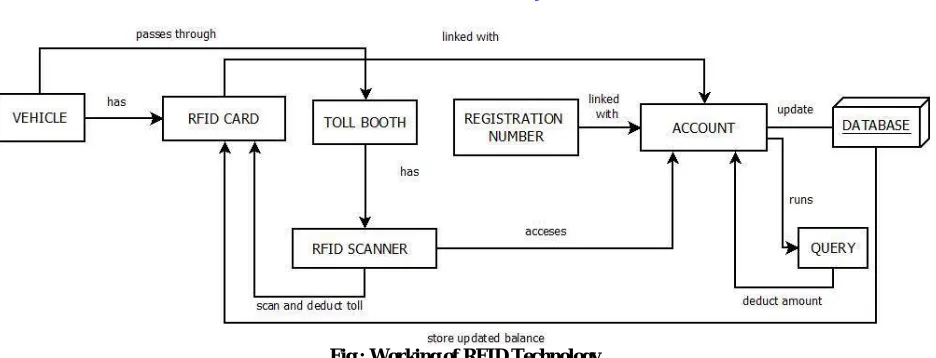
Fig : Working of RFID Technology
Whenever any person buys a vehicle, one first needs to get his or her vehicle registered at the RTO office. RTO officials will not only assign a number plate to it but also will give a RFID enabled tag. This card will have a unique ID feasible to use with that vehicle only. They will also create an account for the use of that particular smart card and maintain transaction history in database. User needs to deposit some minimum amount to this account. Every time a registered vehicle approaches the toll booth, first the Infrared sensors will detect the presence of the vehicle. It will in turn activate the RFID circuit to read the RFID enable tag fixed on the rear-windshield of the vehicle. Transaction will begin; depending upon the balance available toll will be deducted directly from the user’s account. The software further updates the details in the Centralized database server. It also triggers mechanism to generate the bill and will be sent to user as a text message.
B. Barcode Technology
A barcode is a series of parallel black bars and white spaces, both of varying widths. The barcode simply provides a reference number that tells a computer to access information. A barcode reader is required to read a barcode. Barcode readers may be fixed, portable batch, or portable RF. Fixed readers are attached to a host computer and terminal, and transmit one item at a time as the data is scanned. Barcodes are simple to use, accurate, and quick.
Barcode Tag can be installed on the front number plate of vehicle. This system depends on four devices. Tag Barcode
Barcode Reader : Laser Traffic controller system Central Server
Traffic controller system is computer system which manages the traffic in single row or line by using traffic signals. The Central server stores the data which comes from different toll plaza. A local computer of every toll plaza is connected to central server through Internet. Every barcode contains the following details of owner RC (Registered Challan) which includes vehicle number, vehicle type, owners name, owners address, date of purchase, Account number and Mobile number.
Working of Barcode Technology
ISSN(Online): 2320-9801 ISSN (Print) : 2320-9798
I
nternational
J
ournal of
I
nnovative
R
esearch in
C
omputer
and
C
ommunication
E
ngineering
(An ISO 3297: 2007 Certified Organization)
Vol. 4, Issue 2, February 2016
C. QR code technology
QR code (abbreviated from Quick Response Code) is the trademark for a type of matrix barcode (or two-dimensional barcode) first designed for the automotive industry in Japan. A barcode is a machine-readable optical label that contains information about the item to which it is attached. A QR code uses four standardized encoding modes (numeric, alphanumeric, byte/binary, and kanji) to efficiently store data; A QR code consists of black modules (square dots) arranged in a square grid on a white background, which can be read by an imaging device (such as a camera, scanner, etc.) and processed using Reed–Solomon error correction until the image can be appropriately interpreted. The required data are then extracted from patterns that are present in both horizontal and vertical components of the image.
Fig : QR Code image
Theabove figure shows QR code image as we see the QR code is a two dimensional image and it is a trademark of a matrix type. The system has become popular due to fast readability and large storage capacity.
Working of QR code technology
The format information records two things: the error correction level and the mask pattern used for the symbol. Masking is used to break up patterns in the data area that might confuse a scanner, such as large blank areas or misleading features that look like the locator marks. The mask patterns are defined on a 6×6 grid that is repeated as necessary to cover the whole symbol. Modules corresponding to the dark areas of the mask are inverted.
The Automatic Number Plate Recognition system using QR code consists of two major blocks as shown a. Lane level
b. Software Level
At the lane level, the CCTV (Closed Circuit Television) cameras take a snapshot of the car in such a way that the QR code is also included in the image. Otherwise a small optical QR code scanner can be installed for on spot recognition. As vehicles pass under the camera/scanner their QR codes are digitally recorded. The image/video/QR code embedded information is sent along with the date and time stamp to the remote computer.
The QR code recognition technique is performed at the software level and consists of the following step. If direct information is sent from lane level it is forwarded for searching the record in database. Else if image/video feed is received then focus the QR code recognition software component on to the QR code received to retrieve the information and then search for the record in database.
IV.BENEFITSOFETC
1. Reduction of fuel consumption as no stopping is required at the toll.
2. No Traffic congestion as the process is fast and does not allow congestion of traffic.
3. As fuel consumption is less it reduces air pollution.
4. Reducing the number of personnel required for toll collection.
5. Making the process easier and faster.
6. Fewer and shorter queues at toll plazas by increasing toll booth service rates.
ISSN(Online): 2320-9801 ISSN (Print) : 2320-9798
I
nternational
J
ournal of
I
nnovative
R
esearch in
C
omputer
and
C
ommunication
E
ngineering
(An ISO 3297: 2007 Certified Organization)
Vol. 4, Issue 2, February 2016
V. COMPARISONOFRFID,BARCODEANDQRCODETECHNOLOGIES
The table below shows the comparision of various features for the 3 technologies discussed above.
Features RFID Barcode QR code
Line of site Not required Required Required
Read range Passive RFID -Up to 30 feet Active RFID -Up to 100s feet
Several inches to feet Several inches to feet
Technology used Radio frequency Optical Optical
Automation Fixed scanner don’t need human labor
It needs human labor It needs human labor
Read/ Write Read write Only read Only read
Information capacity More than QR and barcode Very less Less
Ability to withstand to weather conditions
A durable hard case protects these RFID tags from impacts, heat, moisture, and changing weather conditions.
Poor readability sensitive to weather and dirt
It has the ability to do error correction, data in QR code can be recovered even if parts of it are damaged or destroyed by dust
Orientation dependent No Yes No
Cost Expensive Cheap Cheap
Decoder device RFID reader Barcode reader PC, mobile which has decoder software
Reusability Rewritable Has to be reprinted each time
Has to be reprinted each time
VI. CONCLUSION
This research paper focuses on the use of Electronic toll collection system. ETC has several advantages so if it is implemented will benefit the travelers as well as the drivers. ETC can be implemented by making use of different technologies. RFID, barcode and quick response code are the techniques discussed in this paper. According to the analysis done considering various attributes we conclude that RFID is a better technology compared to barcode and QR code technology because RFID can store more information as compared to the other technology, both reading as well as writing data can be done on RFID tags, RFID can be tagged from a long distance. If Government takes proper steps in implementing ETC then it would lead to a faster process of toll collection leading to a seamless movement of traffic.
REFERENCES
1. Aniruddha Kumawat, Kshitija Chandramore, “AUTOMATIC TOLL COLLECTION SYSTEM USING RFID” International Journal of Electrical and Electronics Research ISSN 2348-6988 (online)
2. Pranoti Salunke, Poonam Malle, Kirti Datir, Jayshree Dukale, “Automated Toll Collection System Using RFID” IOSR Journal of Computer Engineering (IOSR-JCE)e-ISSN: 2278-0661, p- ISSN: 2278-8727Volume 9, Issue 2 (Jan. - Feb. 2013), PP 61-66www.iosrjournals.org
3. Mandeep Kaur, Manjeet Sandhu, Neeraj Mohan and Parvinder S. Sandhu, “RFID Technology Principles, Advantages, Limitations & Its Applications” International Journal of Computer and Electrical Engineering, Vol.3, No.1, February, 2011 1793-8163
4. Khadijah Kamarulazizi, Dr. Widad Ismail, “Electronic Toll Collection System Using Passive RFID Technology” Journal of Theoretical and Applied Information Technology © 2005 - 2010 JATIT & LLS. All rights reserved.
5. Sanchit Agarwal, Shachi Gupta, Nidheesh Sharma, “Electronic Toll Collection System Using Barcode Laser Technology” 6. Devika Mhatre, Rohan Kamble, Sayali Pimple, Prof. Amruta Sankhe, “Electronic Toll Collection Using Barcode Reader” 7. Shital Y Gaikwad, Chandrakant S Audhutwar , “Automatic Toll Collection by Using QR Code Capturing”
8. Bhupendra Moharil, Vijayendra Ghadge, Chaitanya Gokhale, Pranav Tambvekar, “An Efficient Approach for Automatic Number Plate Recognition System Using Quick Response Codes”
ISSN(Online): 2320-9801 ISSN (Print) : 2320-9798
I
nternational
J
ournal of
I
nnovative
R
esearch in
C
omputer
and
C
ommunication
E
ngineering
(An ISO 3297: 2007 Certified Organization)
Vol. 4, Issue 2, February 2016
10. D.R.Kalbande , Nilesh Deotale, Priyanka Singhal,Sumiran Shah, “An Advanced Technology Selection Model using Neuro Fuzzy Algorithm for Electronic Toll Collection System”
11. Barcode scanners. (2007). Wasp Technologies. Retrieved 5th March 2007 from http://www.waspbarcode.com/scanners/
12. www.flick2know.com/Qrcode
BIOGRAPHY
Mrs. Deepashree Mehendale is a Assistant Professor in Computer Science Department, Dr. D.Y. Patil ACS college, Pimpri, Pune. She received M.C.S., degree in the year 2002 from Pune University and also cleared the UGC-NET Exam in the year 2009, Pune, India. Her research interests are Image Processing, Cryptography and Information Security.