Network Sampling of Hard-to-Reach Population: An Application to the Substance Abuse Problem Among Tertiary Education Students in Nigeria
Ismaila Adeleke (Department of Actuarial Science and Insurance, University of Lagos) Ade Ibiwoye (Department of Actuarial Science and Insurance, University of Lagos)
Introduction
Using conventional sampling techniques for sampling certain populations of interest, such as hard-to-reach or elusive populations can be futile because of the difficulty of choosing a sampling frame. In the literature these elusive populations are commonly referred to as hidden or rare population. As outlined by Salganik and Heckathorn (2004) classical techniques require the analyst to select sample members with a known probability of being selected. In other words there is the need for the analyst to have a sampling frame and a list of all the members of the population. In reality there are quite a number of groups for which such a list does not exist. They include crime victims (Czaja and Blair,1988), injection drug users or HIV infected people (Frost et al. 2006; Stormer et al. 2006 and Abramovitz et al. 2009) and pregnant women (Sanders and Kalsbeek, 1990). The nature of these populations is such that the costs and time of locating them could be substantial.
Underscoring the role of sampling frame, Wejnert and Heckathorn (2008) describe hidden populations as those for which there exists no sampling frame, or for which constructing a sampling frame would be infeasible because of the population’s small size relative to the general population and because of the presence of either
stigma or networks that are hard for outsiders to penetrate. The major problem with using traditional techniques in surveys of rare populations is that they give rise to large sample sizes and substantial reporting errors (Czaja and Blair, 1988). The recurring nature of the problem led to the search for alternative sampling methods by researchers and the introduction of Network Sampling (Sirken, 1988).
As expounded by Katzoff et al (2008), network sampling techniques are adaptive sampling techniques which have been studied by Sirken and his colleagues since the early 1960’s. In this study we identify a network to be the collection of the seeds and the samples that these seeds generate, that is, the collection of members of a population that shared the same social linkage. The network sampling approach begins with some small number of initial respondents, or seeds, who in turn provide researchers with information leading to other members of the population with the characteristics of interest. These connections then form the pool from which the second set of respondents is drawn, and then to the next set, and so on. Expatiating, Sirken (1998) drew out the advantage of network sampling over classical survey methods noting that while the latter uses unitary counting rules; network sampling capitalizes on duplicate Network Sampling of Hard-to-Reach Population: An Application to the Substance Abuse Problem Among Tertiary Education Students in Nigeria
Abstract
Author (s)
Ismaila Adeleke Department of Actuarial Science and Insurance, University of Lagos E-mail: [email protected]
Ade Ibiwoye Department of Actuarial Science and Insurance, University of Lagos E-mail: [email protected]
Key Words: Network Sampling, Hidden Population, Substance Abuse, Horvitz-Thomson Estimator, Students in Tertiary Institutions.
counting of population elements by using multiplicity rules.
Use of network sampling in Nigeria is not widespread either because the study of rare populations is not common or because classical techniques are applied. The single application found in the literature is that of Nafiu and Adewara (2007). However, there are certain populations such as victims of abuse, cocaine carriers and abusers of substance for which scientific methodologies about their operations are lacking and which are better sampled using network sampling. The case of substance users in tertiary institutions in Nigeria is of considerable interest and calls for urgent attention because of the presumed link between abusers and the incidence of cultism which has attained alarming proportions in these institutions. Most of the earlier studies are descriptive in nature as they tend to concentrate on frequency analysis of the use or abuse of substances. The emphasis in this study is, however, different as it seeks to produce some quantitative measure of the magnitude of the involvement of students in abuse of substance. Succinctly, the paper attempts to estimate the percentage of students in tertiary institutions in Lagos who partake in substance abuse, using the Horvitz-Thompson estimator.
The remainder of this article is organized as follows: Section 2 describes the contextual setting while Section 3 describes the study area. The method of analysis is discussed in Section 4. Results of the analysis are presented in Section 5, while Section 6 concludes.
2. Contextual Setting
Nigeria, a country located in West Africa, with a population of over 140 million people (National Population Commission, 2006) is the most populous country in Africa. Since the early 1980s Nigeria’s industrial sector had been in decline and income per capital had fallen sharply (Obot, 2001). With persistent economic depression and unrelenting downward slide in corruption index (Transparency International, 2010) what could have been a source of strength in terms of, say, labour availability has become a threat as traditional values are eroded in the inevitable scramble for survival. A tragic example of the erosion of values was given by Gureje (1999) in the attitude of local traders who, seeing an opportunity for quick monetary
gain in sales of liquor, have changed trade from the sale of items of societal value, like books, to liquor so that essential books have now become largely unavailable for most students. The impact on the future development of the country is obvious.
A number of factors appear to have aggravated the substance abuse problem in Nigeria. First, despite the downward trend in the economy, production of liquor had been on the increase and a very active commerce in the breweries sector is sustained (Obot, 1988). Second, like many other countries in sub-Saharan Africa that are located mid-way between two major drug producing zones, Asia and South America, Nigeria has become increasingly vulnerable to illicit drug production, trafficking, and consumption (Needle et al. 2006), a trend that has been facilitated by globalization. Consequent upon the increased exposure and abuse has been the attendant rise in crime. Nigeria is reported to have one of the highest per capita rates of road accidents in the world many of which are linked with alcohol abuse (Gureje, 1988).
Many of the previous studies have dwelt on the use and abuse of substance among secondary school students in Nigeria (Pela, 1989; Fatoye and Morakinyo, 2002; Obot et al. 2003; Shehu and Idris, 2008, Igwe and Ojinnaka, 2010). Attention to tertiary level students is sparse (Adelekan, 2000; Okoza et al. 2009; Egbochuku et al. 2009). The need to prevent substance use at an early age possibly explains much of the attention to secondary level students. But we consider that at the secondary level adult supervision of the students by the school authorities is still considerable. The same is not true in tertiary institutions where students are assumed to have attained universal adult suffrage. Here, the control is a lot more relaxed. Not surprising, therefore, the substance abuse problem and its consequences assume a much larger dimension in tertiary institutions; more drunk driving, cultism, more violence, absenteeism, to mention a few.
Data and Methods
Lagos State College of Education, Ijanikin and Michael Otedola College of Primary Education, Epe. The first three are owned by the federal government while the rest are owned and financed by the Lagos State government. The State owned University and Polytechnic operate a multi-campus system. Many of the satellite campuses are operated on part time basis. We are, however, concentrating on the regular students, as we surmise that these are the ones whose major pre-occupation is learning and who have direct communal relationship with other members of the community. Combined regular students’ population in all the seven institutions is more than one hundred thousand. More importantly, because of the small land size of the study area, the high student population density and the contiguity of the institutions, events in one institution easily spill-over to the others.
Alcohol, one of the characteristics of interest in this study, is sold in bottles in Nigeria. Although the brewers insist that they sell only the liquid content, very often the empty bottles are converted to improvised weapons during scuffles that by and large develop in gatherings of adolescents. In some cases the violent encounters lead to permanent disabilities or at times mortalities. At the height of the crisis, authorities in most institutions of higher learning, whose management styles are similar by the way, have proscribed the sales of liquor in students’ common rooms. This is unlike what was the practice in the first three decades of higher education in Nigeria, a period spanning 1962 to about 1980. With the embargo on consumption of alcohol by students within the institutions it is rare to see a student consuming alcohol in public and we can therefore regard excessive alcohol consumers among the students as a ‘hidden population’. For a working definition we consider the consumption of more than four drinks a day by a male student and more than three drinks a day by a female student as being excessive. Also we defined excessive cigarette smoking as smoking more than six sticks of cigarettes per day (Ibiwoye and Adeleke, 2011).
It was an uphill task identifying a productive initial seed as students do not own up to being partakers of substance abuse. Fortunately for the study, the institutions under study maintain a security unit. From this organ the names of students who had at one point or another, in the past, fallen foul of the institution’s regulations served as useful hints. From this class we were
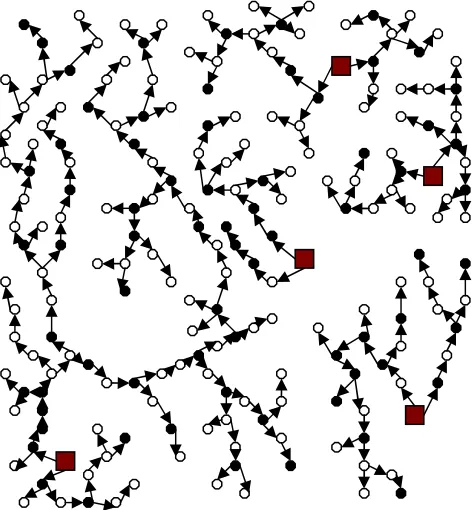
able to get the initial seeds. As distinct from snowball sampling approach where the seeds are then identified to an investigator, in our investigation the seeds recruit their peers. The procedure we followed was that outlined by Johnston and Sabin (2010) whereby those recruited by the initial seeds recruit their own peers and so on such that recruitments continue far beyond the initial seed and his recruits. As in all chain-referral methods, larger and larger chains are obtained with each subsequent stage. An illustration of the recruitment profile that results is shown in Fig 1.
Figure 1: Network sampling illustration with recruitment chains of 5 productive seeds.
Here we begin with an initial seed of five participants. These five seeds then lead to the larger sample shown in the network with the dark spots representing the male samples while the blank spots stand for female samples.
Table 1: Demographic characteristics of the respondents in the final sample
Age Seed Sample
18 21 24
19 11 11
20 17 82
>20 713
Gender
Male 38 535
Female 11 295
Level of Studies
100 58
200 157
300 221
400 330
500 46
Others 18
Monthly Allowance
Less than 10,000 Naira 263
Between 10,001 and 20,000 Naira 247
Between 20,001 and 30,000 Naira 143
Between 30,001 and 40,000 Naira 84
More than 40,000 Naira 92
Source of Income
Part time Employment 281
Parents or Guardians 549
Occupation of Parent
Civil Service 209
Private Sector 305
Business/Others 316
Source: Survey Data
Estimation
We propose the adaptation of the Horvitz-Thompson estimator to estimate the total population of students involved in the use or abuse of substance. This estimation technique which is a design-based approach to survey inference is commonly used for many designs (Adeleke, Esan and Okafor, 2007). The technique has a number of strengths that make it
attractive to practitioners. For one, it takes into account the features of the survey design and further, it provides reliable inferences in large samples with lesser need for strong modeling assumptions (Godambe and Thompson, 1986).
with positive probability of inclusion for every
The Horvitz-Thompson estimator would be
This estimator is design unbiased for as
The estimator (Adeleke, et al 2008, Dryver and Thompson, 1999) is denoted by . Letting K equals the number of distinct and
non-intersecting networks in the population, is the
set of units in the ith network
and is the number of units that make up network . Then, the sum of the -values in network i is:
where is either equal to 1 when object (student) possesses the characteristics of interest (i.e., engaged in substance abuse) or equal zero otherwise.
For the inclusion probability of network i
Letting be the indicator variable which equals one if the initial sample intersects the ith network, we have
The estimator of the total number of students that possess the characteristics of interest is
We note that from this estimate percentages are easily generated. This is the basis used in the computation of the figures in Table 2.
The joint probability of two distinct networks, g and h being in the initial sample is
Let , an unbiased estimator of the variance of is
Discussion
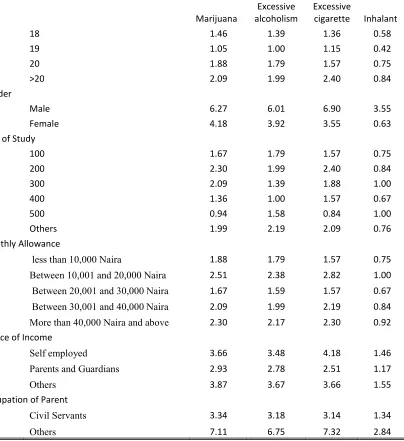
Seven initial seeds were identified in each of the seven institutions. The study thus commenced with a total initial sample of 49 seeds. The sampling procedure generated 781 members within the two months earmarked for the survey. The result of the estimation indicated in Table 2 shows that 10.45 per cent of the students take marijuana, 9.93 per cent engage in excessive alcoholism, 10.45 per cent consume excess cigarette and 4.18 per cent take inhalant. Further, for all the different kinds of abuse under study, the outcome in Table 2 shows that the percentage
(4)
(5)
(6)
(1)
Table 2: Estimates of the percentage of students involved in substance abuse
Age Marijuana
Excessive alcoholism
Excessive
cigarette Inhalant
18 1.46 1.39 1.36 0.58
19 1.05 1.00 1.15 0.42
20 1.88 1.79 1.57 0.75
>20 2.09 1.99 2.40 0.84
Gender
Male 6.27 6.01 6.90 3.55
Female 4.18 3.92 3.55 0.63
Year of Study
100 1.67 1.79 1.57 0.75
200 2.30 1.99 2.40 0.84
300 2.09 1.39 1.88 1.00
400 1.36 1.00 1.57 0.67
500 0.94 1.58 0.84 1.00
Others 1.99 2.19 2.09 0.76
Monthly Allowance
less than 10,000 Naira 1.88 1.79 1.57 0.75
Between 10,001 and 20,000 Naira 2.51 2.38 2.82 1.00
Between 20,001 and 30,000 Naira 1.67 1.59 1.57 0.67
Between 30,001 and 40,000 Naira 2.09 1.99 2.19 0.84
More than 40,000 Naira and above 2.30 2.17 2.30 0.92
Source of Income
Self employed 3.66 3.48 4.18 1.46
Parents and Guardians 2.93 2.78 2.51 1.17
Others 3.87 3.67 3.66 1.55
Occupation of Parent
Civil Servants 3.34 3.18 3.14 1.34
Others 7.11 6.75 7.32 2.84
Source: Computed from Survey
of students whose parents are not civil servants is more than twice the percentage of those whose parents are engaged with one government employment or another. Financial background does not seem to influence the risk behavior of the students in the tertiary institutions that were included in the study. The percentage of students engaged in substance abuse appears to be similar across parental income distribution. The import of this is that peer influence rather than parental background is the factor to be bothered about. With respect to age distribution 3.2 per cent of those that consume marijuana are 16 years of
abuse. As soon as the student settles down to his/her study, the figures in Table 2 show that the percentage of students that uses marijuana moves from 1.67 for Year I students, to 2.30 for Year II students and then declines until it reaches 1.36 for Year IV students. The pattern is also discernible for excessive alcohol consumption and excessive smoking. The Year of Study therefore exerts considerable influence on abuse of substance. In particular, the second Year is a period requiring special attention as the degree of participation in the various substances is highest at this level. Although the percentage of males connected with substance abuse is much higher than that for females, the percentage recorded for females is alarmingly high.
Conclusion
The study has demonstrated the use of the Horvitz-Thompson approach for sampling hard-to-reach population of abusers of substance among students in tertiary institutions in Lagos. It is clear from the results that the percentage of students involved is high indeed. If, as it is feared, there is some relationship between those who abuse drugs and those who participate in cultism then the outward appearance of the absence of cultism in these institutions may be a misleading illusion. Deliberate effort must be stepped up to reduce the participation of students in substance abuse. Since the study shows that the self employed students seemed to be more exposed than those with parental support improved government financial support for students will go a long way to reduce the incidence of substance abuse. The outcome of the study is also significant in respect of factors that relate to peer influence like Year of Study. The counseling program of the institutions must be directed at helping the student to be able to resist pressure, both subtle and obvious, from peers. This may be achieved through enlightenment about the consequences of substance abuse right from the student’s first day in the institution. Particular attention must be paid to the Second Year where the study revealed that the level of participation has been rising for all the different substances of abuse. In most institutions of higher learning in Nigeria, this is the period that students reside off-campus. The off-campus policy may need to be reviewed.
References
Abramovitz, Daniela; Steffanie, A. Strathdee, Thomas L. Patterson, Alicia Vera and Simon D. W. Frost (2009) “Using Respondent-Driven Sampling in a Hidden Population at Risk of HIV Infection: Who do HIV Positive Recruiters Recruit” Sex Transm Dis. Vol. 36, No. 1, pp. 750-756.
Adeleke, I.A., Okafor, R.O., Esan, E.O. (2007) “Horvitz-Thompson Theorem as a tool for Generalization of Probability Sampling Technique” Journal of Scientific research and development Vol. 10, pp.125-134.
Adeleke, I.A, Okafor, R.O., Esan, E.O., Opara, A.I., Olayinka, O.K., Oyeyiola, A.O. (2008) “An adaptive sampling procedure for estimating heavy metal pollutants of ground water from soil” Journal of Model Assisted and Statistical Applications Vol. 3, pp.353-360
Bulus, Ibrahim and Damian Z. Rimfat (2001) “Drug and Alcoholism in Nigerian Schools: Ameliorating through Guidance & Counselling Strategies” The Nigerian Academic Forum,Vol. 1, No. 2, pp.115-118.
Czaja, Ronald and Johnny Blair (1988) “Using Network Sampling for Rare Populations: An Application to Local Crime Victimization Surveys” American Statistical Association Proceedoings on Survey Research Methods,’ pp. 38-43.
Dryver, A. L. and Thompson, S. K. (1999) “Improving unbiased estimators in Adaptive Cluster Sampling, in: The Validity of Self-Reported Drug Use: Improving the Accuracy of Survey Estimates” NIDA Research Monograph 167. Harrison and A. Hughes, eds, Rockville, MD: National Institute of Drug Abuse, pp. 727-731
Egbochuku, E. O. (2009) “Secret Cult activities in Institutions of Higher Learning: Lessons from the Nigerian Situations” Stud Tribes Tribal, Vol. 7, No. 1, pp. 17-25.
Undergraduates” Anthropologist Vol. 11, No. 3, pp. 213-218.
Fatoye, F. O. and Morakinyo, O. (2002) “Substance Use Amongst Secondary Students in Rural and Urban Communities in south Western Nigeria” East African Medical Journal, Vol. 79 No. 6, pp. 299-305
Frost, S. D.; Brouwer, K. C.; Firestone, Cruz M. A.; Ramos, R.; Ramos, M. E.; Lozada, R. M.; Magis-Rodriguez, C and Strathdee, S. A. (2006) “Respondent-Driven Sampling of Injection Drug Users (IDU) in two U. S.-Mexico Border Cities: Recruitment Dynamics and Impact on Estimates of HIV and Syphilis Prevalence” J. Urban Health Vol. 83, pp. 83-97.
Godambe, V.P. and Thompson, M.E. (1986) “Parameters of Superpopulations and Survey Population: Their relationship and Estimation” International Statistical review vol. 15, pp. 37-59.
Gureje, Oye (1999) “Country Profile on Alcohol in Nigeria, in Alcohol and Public Health in Eight Developing Countries” Leanne Riley and Mac Marshall (eds.), Substance Abuse
Department, Geneva, World Health
Organization, pp. 95-114.
Horvitz, D.G., and Thompson, D.J. (1952) “A
Generalization of Sampling without
Replacement from a Finite Universe” Journal of the American Statistical Association, Vol.47, pp. 663-685
Ibiwoye, Ade and I. A. Adeleke (2011) “Estimating the proportion of under-graduates in Lagos at Risk of substance Abuse” European Journal of Scientific Research Vol. 48, No.3, pp. 505-515.
Igwe, Wilson C. and Ngozi C. Ojinnaka (2010) “Mental Health of Adolescents who Abuse Psychoactive Substances in Enugu, Nigeria – A Cross-sectional Study” Italian Journal of Paediatrics Vol. 36, No. 53, pp. 1-5. Available at http://www.ijponline.net/content/36/1/53, accessed December 2 2010.
Katzoff, M.J., Sirken, M.G., Thompson, S.K., (2008) “Proposals for Adaptive and Link-Tracing Sampling Designs in Health Surveys” Joint Statistical Meetings proceedings of the
American Statistical Association, Section on Survey Research Methods. pp. 1772-1775.
Nafiu, L. A. and Adewara, A. A. (2007) “On the Use of Network Sampling in Diabetic Surveys” Journal of Research in National Development Vol. 5, No. 2, pp. 5-9
National Population Commission (2006) “Final Census Report” http://www.population. gov.ng/ accessed December 12 2010.
Needle Richard H. ; Karen Kroeger, Hrishikesh Belani and Jennifer Hegle (2006) “Substance Abuse and HIV in Sub-Saharan Africa: Introduction to the Special Issue” African Journal of Drug and Alcohol Studies, Vol. 5, No. 2, pp. 83-94.
Obot, I. S. (1988) “Social Science and Medicine Education in Nigeria” Social Science and Medicine, Vol. 26, No. 12, pp. 1191-1196.
Obot, I. S. (2001) “Household Survey of Alcohol Use in Nigeria” in R. Room, A. Demers and C. Bourgault (eds.), Surveys of Drinking Patterns and Problems in Seven Developing Countries, pp. 63-77, Geneva, World Health Organization.
Obot, I. S.; Karuri, G. S. and Ibanga, A. J. (2003) “Substance Use and other Risky Behaviours of Secondary School Students in a Nigerian Urban Area” African Journal of Drug and Alcohol Studies 2 (1&2), pp. 57-65.
Odejide, A. O. (2006) “Status of Drug Use/Abuse in Africa: A Review” International Journal of Mental Health and Addiction Vol. 4, No. 2, pp. 87-102.
Okoza, Jolly; Oyaziwo Aluede, Samuel Fajoju and Idonijie Okhiku (2009) “Drug Abuse Among Students of Ambrose Alli University, Ekpoma, Nigeria” European Journal of Social Sciences, Vol. 10, No. 1, pp. 85-92.
Oshikoya, K. A. and A. Alli (2006) “Perception
of Drug Abuse Amongst Nigerian
Undergraduates” World Journal of Medical Sciences Vol. 1 No. 2, pp. 133-139.
Sanders, Linda L. and William D. Kalsbeek (1990) “Network Sampling as an Approach to Sampling Pregnant Women” www.amstat.org/s ections/srms/proceedings, pp. 326-331, accessed December 2 2010.
Salganik, Mathew J. and Douglas D. Heckathorn (2004) “Sampling and Estimation in Hidden Populations Using Respondent – Driven Sampling” Sociological Methodology Vol. 34, pp. 193 - 239
Shehu, A. U. and S. H. Idris (2008) “Marijuana Smoking Among Secondary School Students in Zaria, Nigeria: Factors Responsible and Effects on academic Performance” Annals of African Medicine Vol. 7, No. 4, pp. 175-179.
Stormer A.; Tun W.; Guli, L; Harxhi A.; Bodanoskaia Z.; Yakovleva A.; Rusakova, M.; Levina, O.; Bani, R.; Rjepaj, K. and Bino S. (2006) “An Analysis of Respondent-Driven Sampling with Injection Drug Users (IDU) in Albania and the Russian Federation” J. Urban Health Vol. 83, pp. 73-82
Thompson, S. (1992) Sampling,John Wiley and Sons, Inc. New York
Thompson, Steven K, and George A.F. Seber (1996) Adaptive Sampling. John Wiley and Sons, Inc., New York.
Transparency International (2010) “Corruption perception Index” http://www. transparency.org/policy_research/surveys_indice s/cpiaccessed October 14, 2010.