Optical Birefringence Studies on Cholesteric
and Induced Smectic Phases of Ternary
Mixture of Liquid Crystalline Materials
Dr T.N. Govindaiah1*, B. N. Ramakrishna2 and Dr Manju M3
Research Centre, P.G. Dept. of Physics, Govt. College (Autonomous), Mandya, India
.
1*
Department of Physics, Government College for Women, Mandya, India2
Department of Chemistry, Sri Krishna Institute of Technology, Bangalore, India3
ABSTRACT: In the present work, our investigation is to study on the optical and thermal properties of multi-component system of Cholesteryl oleate (CO), Sodium oleate (Naol) and Glacial acetic acid (GAA). Mixtures of these molecules exhibits Cholesteric, SmA, SmC and SmG phases sequentially when the specimen cooled from its isotropic phase. These phases have been characterized by using microscopic technique. The temperature variations of optical anisotropic measurements have also been discussed.
KEYWORDS: Ternary mixture; Molecular orientation; Optical textures;
I.INTRODUCTION
Many of materials showing liquid crystalline behaviour belong to two general classes: lyotropic materials, in which fluid anisotropy results from interactions between anisotropic aggregates of amphiphilic molecules and thermotropic materials, in which the orientational order arises from interactions among partially rigid anisotropic molecules. Amphiphilic compounds can form a variety of thermotropic liquid crystalline phases as a function of temperature by themselves and lyotropic liquid crystalline phases upon addition of some solvent, such as water or diethylene glycol [1]. Thermotropic liquid-crystalline systems composed of amphiphilic molecules can exhibit smectic phases with layered structure [2] or nematic (eventually cholesteric) phases. Lyotropic systems usually form a lamellar liquid-crystalline mesophase, i.e., a lyotropic analogue of the thermotropic orthogonal smectic A (SmA) phase [3] and more rarely nematic, columnar and cubic mesophases [4, 5]. Combination of thermotropic and lyotropic properties for materials with definite molecular structure has been intensively studied so far and is of high importance in particular for developing new types of functional LC materials [6].
II. LITERATURE SURVEY
ISSN (Online) : 2319 - 8753
ISSN (Print) : 2347 - 6710
International Journal of Innovative Research in Science, Engineering and Technology
An ISO 3297: 2007 Certified Organization Volume 7, Special Issue 7, June 2018
One Day National Conference on “Recent Trends in Mechanical Engineering & Applied Sciences 2018” (RTME & AS-2018)”
17th May 2018
Organized by
Department of Mechanical Engineering and Applied Science, Sri Krishna Institute of Technology, Bangalore, India
textures of these concentrations were measured with the help of a Gippon-Japan-polarizing microscope in conjunction with a hot stage. The samples were sandwiched between the slide and cover slip and were sealed for microscopic observations. Refractive indices in the optical region are determined at different temperatures by employing the techniques described by the earlier investigators [7].
IV. SIMULATION RESULTS
OPTICAL TEXTURE STUDIES:
Molecular orientations of optical textures exhibited by the samples were observed and recorded using the Gippon-Japan-polarizing microscope in conjunction with hot stage. The specimen was taken in the form of thin film and sandwiched between the slide and cover glass. The concentrations from 10% to 80% of ternary mixture of CO in (Naol+GAA) have been considered for the experimental studies. When the specimen of 50% CO in (Naol+GAA) is cooled from its isotropic melt and hence it exhibits cholesteric, SmA, SmC and SmG phases sequentially. While the sample is cooled from its isotropic phase, the genesis of nucleation starts in the form of small bubbles growing radially, which are identified as spherulitic textures of cholesteric phase. On further cooling the specimen, the texture slowly transform to focal conic fan texture of SmA phase in which the molecules are arranged in layers and the texture is as shown in Figure1(a). On further cooling the specimen, the unstable SmA phase changes over to schlieren texture of SmC phase and it as shown in Figure1(b). Sequentially on cooling the specimen, SmC phase slowly changes over to SmG phase and then it remains stable at room temperature [8].
b) Schlieren texture of SmC phase (250X).
OPTICAL ANISOTROPY:
ISSN (Online) : 2319 - 8753
ISSN (Print) : 2347 - 6710
International Journal of Innovative Research in Science, Engineering and Technology
An ISO 3297: 2007 Certified Organization Volume 7, Special Issue 7, June 2018
One Day National Conference on “Recent Trends in Mechanical Engineering & Applied Sciences 2018” (RTME & AS-2018)”
17th May 2018
Organized by
Department of Mechanical Engineering and Applied Science, Sri Krishna Institute of Technology, Bangalore, India
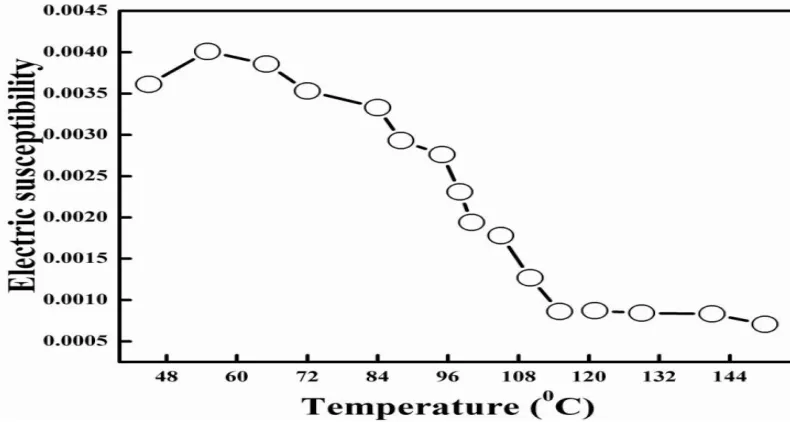
Figure 4. Temperature variation of electrical susceptibility for the mixture of 50% CO in (Naol+GAA).
V. CONCLUSION
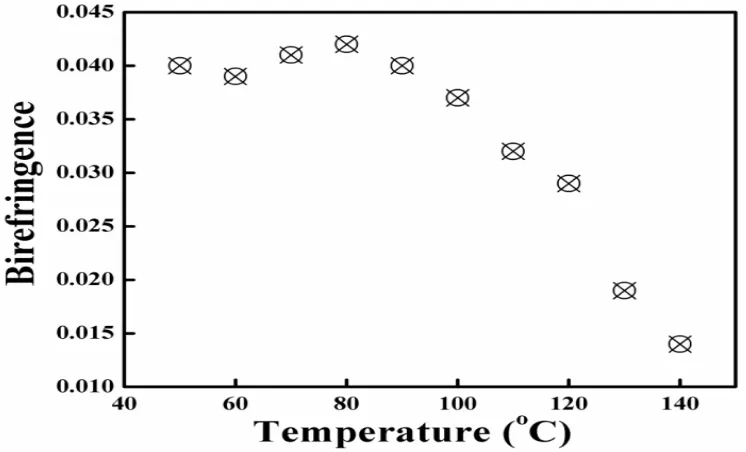
Microscopic investigation of the multi-component system of CO in (Naol+GAA) shows existence of cholesteric, SmA, SmC and SmG phases for all concentrations of the given mixture. The drastic changes in optical anisotropic measurements values unambiguously correspond to different liquid crystalline phases: respectively at different concentrations and temperature.
REFERENCES
[1] Demus, D., Goodby, J., Gray, G. W., Spiess, H. W. and Vill, V. (1998). Eds. Handbook of LiquidCrystals; Wiley-VCH: Weinheim, Germany, Vol. 3. Chapter VI and VII.
[2] Ujiie, S. and Yano, Y. Chem. (2000).Commun.79-80.
[3] Bonicelli, M. G., Ceccaroni, G. F. and La Mesa, C. (1998).Colloid Polym. Sci.276, 109-116. [4] Sakya, P., Seddon, J. M. and Vill, V. (1997). Liq. Cryst., 23, 409-424.
[5] Smits, E., Engberts, J. B. F. N., Kellogg, R. M., Van Doren, H. A. (1997). Liq. Cryst.23, 481-488. [6] Garamus, V. M., Milkereit, G. E., Willumeit, R. and Vill, V.J. (2005). Therm. Anal. Calorim. 82, 477–481. [7] Nagappa, Nataraju, S. K. and Krishnamurthy, D. (1986). Mol. Cryst. Liq. Cryst.133, 31.