ISSN(Online): 2320-9801
ISSN (Print): 2320-9798
I
nternational
J
ournal of
I
nnovative
R
esearch in
C
omputer
and
C
ommunication
E
ngineering
(An ISO 3297: 2007 Certified Organization)
Vol. 3, Issue 8, August 2015
A QoS- Oriented Strewn Course-Plotting
Protocol for Fusion Wireless Networks
A.Radhalakshmi 1, V.Vetriselvi 2
Research Scholar, Dept. of CS, Shrimati Indira Gandhi College, Trichy, India1
Assistant Professor, Dept. of IT, Shrimati Indira Gandhi College, Trichy, India2
ABSTRACT: The escalating intensity of wireless communication in today’s environment, individuals often mandatory
QOS for sharing their data between the nodes. A wireless hybrid network that join together a Mobile Wireless Ad hoc Network (MANET) and a wireless infrastructure network has been proven to be a better alternative for the next generation wireless networks. By directly approve resource hesitation based QOS routing for MANET in a hybrid network Inherit invalid hesitation and race condition problems in MANET. To propose a Neighbor selection algorithm, in that an intermediate node assigns the highest priority to the packet with the closest deadline and forwards the packet with the highest priority first. The propose Packet Scheduling for packet routing. This algorithm assigns earlier generated packets to forwarders with higher queuing delays and scheduling feasibility, while assigns more recently generated packets to forwarders with lower queuing delays and scheduling Feasibility, so Data redundancy elimination algorithm that the transmission delay of an entire packet stream can be reduced. A mobility-based segment resizing algorithm that adaptively adjusts segment size according to node mobility in order to reduce transmission time based transmission algorithmic rule eliminates the redundant data to boost the QoS of the packet transmission. A traffic redundant elimination algorithm to increase the transmission throughput. To propose a QoS Oriented Distributed Routing Protocol (QOD) for hybrid networks to provide QoS services in a highly dynamic scenario.The advantage of the unique features of hybrid networks. The proposed is an efficient secure distributed QOS protocol that addresses some issues specific to Hybrid wireless networks which are communication delay, cost, mobility, and link unreliability.
KEYWORDS: Neighbor selection, Packet Scheduling, Data redundancy elimination, QoS Oriented Distributed
Routing Protocol (QOD).
I.INTRODUCTION
A hybrid wireless network is an extension to an infrastructure network, where a mobile host may connect to an Access Point (AP) using multi hop wireless routes via other mobile hosts. The APs are configured to operate on one of multiple available channels. Mobile hosts and wireless routers can select their operating channels dynamically through channel switching. Hybrid wireless networks (i.e., multihop cellular networks) have been proven to be a better network structure for the next generation wireless networks. It can help to tackle the stringent end-to end QoS requirements of different applications. Hybrid networks synergistically combine infrastructure networks and MANETs to leverage each other. For example it integrates a Mobile Wireless Ad Hoc Network (MANET) and wireless infrastructure has proved a
better alternative next generation wireless networks.It is the overall performance of a computer network, particularly
ISSN(Online): 2320-9801
ISSN (Print): 2320-9798
I
nternational
J
ournal of
I
nnovative
R
esearch in
C
omputer
and
C
ommunication
E
ngineering
(An ISO 3297: 2007 Certified Organization)
Vol. 3, Issue 8, August 2015
II. LITERATURE SURVEY
A majority of QoS routing protocols are based on resource reservation, in which a source node sends probe messages to a destination to discover and reserve paths satisfying a given QoS requirement. Perkins extended the AODV routing protocol by adding information of the maximum delay and minimum available bandwidth of each neighbor in a node’s routing table. Jiang proposed to reserve the resources from the nodes with higher link stability to reduce the effects of node mobility. Liao proposed an extension of the DSR routing protocol by reserving resources based on time slots. Venataramanan et al. proposed a scheduling algorithm to ensure the smallest buffer usage of the nodes in the forwarding path to base stations. These works focus on maximizing network capacity based on scheduling but fail to guarantee QoS delay performance. Some works consider providing multipath routing to increase the robustness of QoS routing. Conti proposed to use nodes’ local knowledge to estimate the reliability of routing paths and select reliable routes. The works in and balance traffic load among multiple routes to increase routing reliability. Shen proposed to let a source node fetch the lost packets from its neighbors to recover the multicast traffic. Shen and Thomas proposed a unified mechanism to maximize both the QoS and security of the routing. Li proposed a centralized algorithm to optimize the QoS performance by considering cross-layer design among the physical layer, MAC layer, and network layer. QOD aims to provide QoS guaranteed routing. QOD fully takes advantage of the widely deployed APs, and novelly treats the packet routing problem as a resource scheduling problem between nodes and Access Points.
III. EXISTINGSYSTEM
Reservation-based QoS routing protocols have been proposed for MANETs that create routes formed by nodes and links that reserve their resources to fulfill QoS requirements. Although these protocols can increase theQoS of the MANETs to a certain extent.
Disadvantages of existing system:
Continuously changing network topology makes conventional wireless routing protocols incapable of
providing satisfactory performance in the data transaction environment.
IV. PROPOSED SYSTEM
With the improvement of the wireless network for solving the QOS issues, of hybrid networks, to propose a QoS-Oriented Distributed routing protocol (QOD). To propose protocol adopts the resource reservation based QOS routing scheme.The proposal a QOS Oriented Distributed Optimal Routing Protocol (Q-ORP) to enhance the QoS support capability of hybrid networks.
ADVANTAGES OF PROPOSED SYSTEM:
A QoS-guaranteed neighbour selection algorithm to meet the transmission delay requirement. A distributed packet scheduling algorithm to further reduce transmission delay. A mobility-based segment resizing algorithm that adaptively adjusts segment size according to node mobility in order to reduce transmission time. A traffic redundant elimination algorithm to increase the transmission throughput and a data redundancy elimination-based transmission algorithm to eliminate the redundant data to further improve the transmission QoS.
V. ARCHITECTURE
ISSN(Online): 2320-9801
ISSN (Print): 2320-9798
I
nternational
J
ournal of
I
nnovative
R
esearch in
C
omputer
and
C
ommunication
E
ngineering
(An ISO 3297: 2007 Certified Organization)
Vol. 3, Issue 8, August 2015
Fig 1 The network model of the hybrid networks.
VI. ALGORITHM
Neighbor selection algorithm:
In this algorithm select qualified neighbors and employs deadline-driven scheduling mechanism to ensure QoS routing. Since short delay is the major real-time QoS requirement for traffic transmission, QOD incorporates the Earliest Deadline First Scheduling Algorithm (EDF), which is a deadline driven scheduling algorithm for data traffic scheduling in intermediate nodes. In this algorithm, an intermediate node assigns the highest priority to the packet with the closest deadline and forwards the packet with the highest priority first. The source node selects the replied neighbor nodes that can meet its QoS deadline for packet forwarding based on the calculated queuing delay.
QoS deadline for packet forwarding based on the calculated queuing delay.
Distributed packet scheduling algorithm:
After qualified neighbors are known, this algorithmic program schedules packet routing. It assigns earlier generated packets to forwarders with higher queuing delays, while assigns a lot of recently generated packets to forwarders with lower queuing delays to decrease total transmission delay. In order to further reduce the stream transmission time, a distributed packet scheduling algorithm is propose for packet routing. This algorithm assigns earlier generated packets to forwarders with higher queuing delays and scheduling feasibility, while assigns more recently generated packets to forwarders with lower queuing delays and scheduling Feasibility, so that the transmission delay of an entire packet stream can be reduced
Mobility based segment resizing algorithm:
The source node adaptively resizes every packet in its packet stream for every neighbor node in line with the neighbor’s quality so as to extend the programming feasibility of the packets from the source node. In a highly dynamic mobile wireless network, the transmission link between two nodes is frequently broken down. The delay generated in the packet retransmission degrades the QoS of the transmission of a packet flow. On the other hand, a node in a highly dynamic network has higher probability to meet different mobile nodes and Access Points, which is beneficial to resource scheduling. As the space utility of an intermediate node that is used for forwarding a packet p is Sp / Wi. That is, reducing packet size can increase the scheduling feasibility of an intermediate node and reduces packet dropping probability. It cannot make the size of the packet too small because it generates more packets to be transmitted, producing higher packet overhead.
Traffic redundant elimination algorithm:
ISSN(Online): 2320-9801
ISSN (Print): 2320-9798
I
nternational
J
ournal of
I
nnovative
R
esearch in
C
omputer
and
C
ommunication
E
ngineering
(An ISO 3297: 2007 Certified Organization)
Vol. 3, Issue 8, August 2015
the deadlines of some packets must be missed, EDF forwards out the packets with the closest deadlines but may delay the packets with the farthest deadlines. Therefore, EDF is suitable for hard-deadline driven applications (e.g., online conferences) where packets must be forwarded before their deadlines but may not be fair to all arriving packets in soft-deadline driven applications (e.g., online TV), where the soft-deadline missing is sometimes acceptable.
Data redundancy elimination based transmission algorithm:
Due to the broadcasting feature of the wireless networks, the access point and mobile nodes will cache packets. This algorithmic rule eliminates the redundant data to boost the QoS of the packet transmission. The mobile nodes set their NAV values based on the overhearing message’s transmission duration time. A large NAV leads to a small available bandwidth and a small scheduling feasibility of the mobile nodes based on packet schedule. Therefore, by reducing the NAV value, It can increase the scheduling feasibility of the intermediate nodes and sequentially increase the QoS of the packet transmission. Due to the broadcasting feature of the wireless networks, in a hybrid network, the APs and mobile nodes can overhead and cache packets,to use an End-To-End Traffic Redundancy Elimination (TRE) algorithm to eliminate the redundancy data to improve the QoS of the packet transmission in QOD. TRE uses a chunking scheme to determine the boundary of the chunks in a data stream. The source node caches the data it has sent out and the receiver also caches its received data. In QOD with TRE, the Access Point and mobile nodes overhear and cache packets. From the overhearing, the nodes know who have received the packets. When a source node begins to send out packets, it scans the content for duplicated chunks in its cache. If the sender finds a duplicated chunk and it knows that the Access Point receiver has received this chunk before, it replaces this chunk with its signature (i.e., SHA-1 hash value). When the Access Point receives the signature, it searches the signature in its local cache. If the Access Point caches the chunk associated with the signature, it sends a confirmation message to the sender and replaces the signature with the matched data chunk. Otherwise, the Access Point requests the chunk of the signature from the sender.
VII. RESULT ANALYSIS
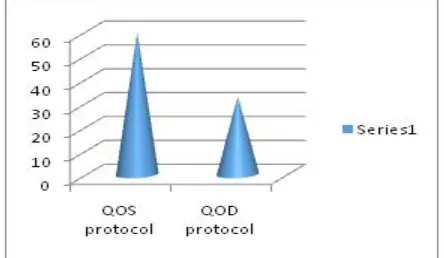
Fig 2: Packet Delivery ratio comparison
The packet delivery ratio of the QoS oriented Distributed Routing protocol is higher than the existing QoS protocol.
ISSN(Online): 2320-9801
ISSN (Print): 2320-9798
I
nternational
J
ournal of
I
nnovative
R
esearch in
C
omputer
and
C
ommunication
E
ngineering
(An ISO 3297: 2007 Certified Organization)
Vol. 3, Issue 8, August 2015
VIII. CONCLUSION AND FUTURE WORK
Hybrid wireless networks that integrate MANETs and infrastructure wireless networks have proven to be a
better network structure for the next generation networks. It little effort has been devoted to supporting QoS routing in hybrid networks. Direct adoption of the QoS routing techniques in MANETs into hybrid networks inherits their drawbacks. It propose a QoS Oriented Distributed Routing Protocol (QOD) for hybrid networks to provide QoS services in a highly dynamic scenario. Taking advantage of the unique features of hybrid networks, i.e., anycast transmission and short transmission hops, QOD transforms the packet routing problem to a packet scheduling problem. In QOD, a source node directly transmits packets to an Access Point if the direct transmission can guarantee the QoS of the traffic. Otherwise, the source node schedules the packets to a number of qualified neighbor nodes. Specifically, QOD incorporates five algorithms. The QoS-guaranteed neighbor selection algorithm chooses qualified neighbors for packet forwarding. The distributed packet scheduling algorithm schedules the packet transmission to further reduce the packet transmission time. The mobility-based packet resizing algorithm resizes packets and assigns smaller packets to nodes with faster mobility to guarantee the routing QoS in a highly mobile environment. The traffic redundant elimination-based transmission algorithm can further increase the transmission throughput. Experimental results show that QOD can achieve high mobility-resilience, scalability, and contention reduction.
By exchanging the TIT among the nodes, the topology is discovered. When the source node wants to forward the data packet to the destination, it utilizes the reactive route discovery technique where the multiple paths are established using multi-path Dijkstra algorithm. When any intermediate node does not recognize the next 2-hop information from TIT towards destination, the new multi-path route discovery is performed. By simulation results, it is shown that the proposed approach reduces the overhead.
REFERENCES
1. Dr. Shuchita Upadhayaya and Charu Gandhi “Quality of service routing in Mobile ad hoc networks using Location and energy parameters”, International Journal of Wireless & Mobile Networks (IJWMN), Vol 1, No 2, November 2009
2. Sunil Taneja and Ashwani Kush “A Survey of Routing Protocols in Mobile Ad Hoc Networks” International Journal of Innovation, Management and Technology, Vol. 1, No. 3, August 2010 ISSN: 2010-0248.
3. V.G.Muralishankar et al, “Routing Protocols for MANET:A Literature Survey”, International Journal of Computer Science and Mobile Applications, Vol.2 Issue. 3, March- 2014, pg. 18-24
4. H. Luo, R. Ramjeey, P. Sinhaz, L. Liy, and S. Lu, “UCAN: A Unified Cell and Ad-Hoc Network Architecture,” Proc. ACM MobiCom, 2003. 5. P.K. Mckinley, H. Xu, A. Esfahanian, and L.M. Ni, “Unicast-Based Multicast Communication in Wormhole-Routed Direct Networks,” IEEE
Trans. Parallel Data and Distributed Systems, vol. 5, no. 12, pp. 1252-1265, Dec. 1992.
6. H. Wu, C. Qiao, S. De, and O. Tonguz, Integrated Cell and Ad Hoc Relaying Systems: iCAR,” IEEE J. Selected Areas in Comm., vol. 19, no. 10, pp. 2105-2115, Oct. 2001.
7. J. Zhou and Y.R. Yang, “PAR CelS: Pervasive Ad-Hoc Relaying for Cell Systems,” Proc. IFIP Mediterranean Ad Hoc Networking Workshop (Med-Hoc-Net), 2002.
8. R. Braden, D. Clark, and S. Shenker, Integrated Services in the Internet Architecture: An Overview, IETF RFC 1633, 1994.
9. Z. Li and H. Shen, “A QoS-Oriented Distributed Routing Protocol for Hybrid Networks,” Proc. IEEE Seventh Int’l Conf. Mobile Adhoc and Sensor Systems, 2010.
10. J. Li, C. Blake, S. Douglas, H. Lee, and R. Morris, “Capacity of Ad Hoc Wireless Networks,” Proc. ACM MobiCom, 2001. 11. E. Crawley, R. Nair, B. Rajagopalan, and H. Sandick, Resource Reservation Protocol RSVP, IETF RFC 2205, 1998.
12. I. Jawhar and J. Wu, “Quality of Service Routing in Mobile Ad Hoc Networks,” Network Theory and Applications, Springer, 2004.
13. T. Reddy, I. Karthigeyan, B. Manoj, and C. Murthy, “Quality of Service Provisioning in Ad Hoc Wireless Networks: A Survey of Issues and Solutions,” Ad Hoc Networks, vol. 4, no. 1, pp. 83-124, 2006.
14. X. Du, “QoS Routing Based on Multi-Class Nodes for Mobile Ad Hoc Networks,” Ad Hoc Networks, vol. 2, pp. 241-254, 2004.
15. S. Jiang, Y. Liu, Y. Jiang, and Q. Yin, “Provisioning of Adaptability to Variable Topologies for Routing Schemes in MANETs,” IEEE J. Selected Areas in Comm., vol. 22, no. 7, pp. 1347-1356, Sept. 2004.
16. M. Conti, E. Gregori, and G. Maselli, “Reliable and Efficient Forwarding in Ad Hoc Networks,” Ad Hoc Networks, vol. 4, pp. 398-415, 2006. 17. G. Chakrabarti and S. Kulkarni, “Load Balancing and Resource Reservation in Mobile Ad Hoc Networks,” Ad Hoc Networks, vol. 4, pp.
186-203, 2006.
18. A. Argyriou and V. Madisetti, “Using a New Protocol to Enhance Path Reliability and Realize Load Balancing in Mobile Ad Hoc Networks,” Ad Hoc Networks, vol. 4, pp. 60-74, 2006.
19. C. Shen and S. Rajagopalan, “Protocol-Independent Multicast Packet Delivery Improvement Service for Mobile Ad Hoc Networks,” Ad Hoc Networks, vol. 5, pp. 210-227, 2007.
ISSN(Online): 2320-9801
ISSN (Print): 2320-9798
I
nternational
J
ournal of
I
nnovative
R
esearch in
C
omputer
and
C
ommunication
E
ngineering
(An ISO 3297: 2007 Certified Organization)
Vol. 3, Issue 8, August 2015
BIOGRAHY
Mrs.A.Radhalakshmi has born on 25.07.1988 in Tamilnadu,India.she received B.Sc., degree
from Shrimati Indira Gandhi college, affiliated to Bharathidasan university,
Tiruchirapalli(2006-2009). Tamilnadu(India). She received B.Ed., in 2010 from Shree college of Education,Namakkal Affiliated to Tamilnadu university , India. She received M.Sc., in 2012 from Imayam Arts and science college, Thuraiyur, Tiruchirapalli Affiliated to Bharathidasan university, Tamilnadu, India. She received M.Ed., in 2013 from Esther college of Education,Namakkal Affiliated to Tamilnadu university, India. She is pursuing M.Phil(full time) from Shrimati Indira Gandhi college in Bharathidasan university, Tiruchirapalli, Tamilnadu, India. Her interested area is mobile computing.