MULTIPARENTAL POPULATIONS
Multiple Quantitative Trait Analysis Using
Bayesian Networks
Marco Scutari,*,1Phil Howell,†David J. Balding,* and Ian Mackay† *Genetics Institute, University College London (UCL), London WC1E 6BT, United Kingdom, and†National Institute of Agricultural Botany (NIAB), Cambridge CB3 0LE, United Kingdom
ABSTRACTModels for genome-wide prediction and association studies usually target a single phenotypic trait. However, in animal and plant genetics it is common to record information on multiple phenotypes for each individual that will be genotyped. Modeling traits individually disregards the fact that they are most likely associated due to pleiotropy and shared biological basis, thus providing only a partial, confounded view of genetic effects and phenotypic interactions. In this article we use data from a Multiparent Advanced Generation Inter-Cross (MAGIC) winter wheat population to explore Bayesian networks as a convenient and interpretable framework for the simultaneous modeling of multiple quantitative traits. We show that they are equivalent to multivariate genetic best linear unbiased prediction (GBLUP) and that they are competitive with single-trait elastic net and single-trait GBLUP in predictive performance. Finally, we discuss their relationship with other additive-effects models and their advantages in inference and interpretation. MAGIC populations provide an ideal setting for this kind of investigation because the very low population structure and large sample size result in predictive models with good power and limited confounding due to relatedness.
U
NDERSTANDING the behavior of complex traits in-volves modeling a web of interactions among the effects of genes, environmental conditions, and other covariates. Ignoring one or more of these factors may substantially affect the accuracy and the generality of the conclusions that can be drawn from the model (Liet al.2006; Hartleyet al.2012; Alimi et al. 2013), both in the context of genome-wide association studies (GWAS) and genomic selection (GS). Indeed a lot of attention has been devoted in recent liter-ature to improving traditional additive genetic models, which were originally defined using only allele counts (e.g., Meuwissenet al.2001), by supplementing them with additional information. Some examples include marker-based kinship coefficients (Speedet al.2012), spatial het-erogeneity and dominance (Finley et al.2009), and gene expression data (Drukaet al.2008).However, most studies in plant and animal genetics still focus on a single phenotypic trait at a time despite the availability of a set of simultaneously measured traits for each genotyped individual. Models for analyzing multiple
traits have been available since Henderson and Quaas (1976) introduced the multivariate extension of the genetic best linear unbiased prediction (GBLUP) models, and have been investigated as recently as Stephens (2013) in the context of GWAS. More recent additions include structural equa-tion models (SEM; Liet al.2006), a Bayesian extension of seemingly unrelated regression (SUR; Banerjeeet al.2008), the MultiPhen ordinal regression (O’Reillyet al. 2012), and spatial models (Banerjeeet al.2012).
In this article we use Bayesian networks (BNs; Pearl, 1988; Koller and Friedman, 2009) to build a multivariate depen-dency model that accounts for simultaneous associations and interactions among multiple single nucleotide polymorphisms (SNPs) and phenotypic traits. BNs have been applied to the analysis of several kinds of genomic data such as gene expres-sion (Friedman 2004), protein–protein interactions (Jansen
et al. 2003; Sachset al. 2005), pedigree analysis (Lauritzen
and Sheehan 2004), and the integration of heterogeneous genetic data (Chang and Mcgeachie 2011). Their modular nature makes them ideal for analyzing large marker
pro-files. As far as SNPs are concerned, BNs have been used to investigate linkage disequilibrium (LD; Mouradet al.2011; Morotaet al.2012) and epistasis (Hanet al.2012) and to determine disease susceptibility for anemia (Sebastiani
et al. 2005), leukemia (Chang and Mcgeachie, 2011),
Copyright © 2014 by the Genetics Society of America doi: 10.1534/genetics.114.165704
Manuscript received April 28, 2014; accepted for publication July 7, 2014 1Corresponding author: UCL Genetics Institute (UGI), University College London,
and hypertension (Malovini et al. 2009). The same BN can simultaneously highlight SNPs potentially involved in determining a trait (e.g., for association purposes) and be used for prediction (e.g., for selection purposes): a network capturing the relationship between genotypes and phenotypes can be used to compute the probability that a new individual with a particular genotype will have the phenotype of interest (Lauritzen and Sheehan 2004; Cowell et al.2007).
Materials and Methods
A BN is a probabilistic model in which a directed acyclic graphGis used to define the stochastic dependencies quan-tified by a probability distribution (Pearl 1988; Koller and Friedman 2009). The variablesX= {Xi} under investigation
in this context include T traits Xt1;. . .;XtT and S SNPs Xs1;. . .;XsS, each of which is associated with a node in G. The arcs between the nodes represent direct stochastic de-pendencies and determine how theglobal distribution ofX decomposes into a set oflocal distributions,
PðXÞ ¼YPðXijPXiÞ; (1)
one for each variableXi, depending only on its parentsPXi. This modular representation can capture direct and in-direct associations between SNPs and phenotypes and associations between SNPs due to linkage and population structure.
In the spirit of commonly used additive genetic models for quantitative traits (e.g., Meuwissenet al.2001), we make some further assumptions on the BN:
1. each variable Xiis normally distributed, andXis
multi-variate normal;
2. stochastic dependencies are assumed to be linear; 3. traits can depend on SNPs (i.e., Xsi/Xtj) but not vice
versa (i.e., notXtj/Xsi), and they can depend on other traits (i.e.,Xti/Xtj;i6¼j); and
4. SNPs can depend on other SNPs (i.e.,Xsi/Xsj;i6¼j).
We also assume that dependencies between traits broadly follow the temporal order in which they are measured; for instance, traits that are measured when a plant variety is harvested can depend on those that are measured while it is still in thefield (and obviously on the markers as well), but not vice versa. In other words, assumptions 3 and 4 define BNs that describe the dependencies of phenotypes on genotypes in aprognosticmodel, as opposed to adiagnostic model in which genotypes depend on phenotypes. The latter is often preferred over the former because it results in sim-pler models when the Xiare discrete (Sebastiani and Perls
2008); in that setting, the number of parameters grows ex-ponentially with the number of parents of each node. How-ever, this is not the case here due to assumptions 1 and 2. Under these assumptions, the local distributionPðXtijPXtiÞof each trait is a linear model of the form
Xti ¼mtiþPXtibtiþeti
¼mtiþXtjbtjþ. . .þXtkbtk |fflfflfflfflfflfflfflfflfflfflfflfflfflfflfflfflfflffl{zfflfflfflfflfflfflfflfflfflfflfflfflfflfflfflfflfflffl}
traits
þXslbslþ. . .þXsmbsm |fflfflfflfflfflfflfflfflfflfflfflfflfflfflfflfflfflfflffl{zfflfflfflfflfflfflfflfflfflfflfflfflfflfflfflfflfflfflffl}
SNPs
þeti; eti N
0;s2t
iI
;
(2)
whereIis the identity matrix. SNPs will typically be coded using their allele counts (0, 1, 2), although extensions to multiallelic SNPs and to account for dominance are trivial. Similarly, the local distribution PðXsijPXsiÞof each SNP is
Xsi ¼msiþXslbslþ. . .þXsmbsm
|fflfflfflfflfflfflfflfflfflfflfflfflfflfflfflfflffl{zfflfflfflfflfflfflfflfflfflfflfflfflfflfflfflfflffl} SNPs
þesi; esi N
0;s2siI
:
(3)
Therefore, each parent adds only one parameter to a local distribution.
The regression parameters in (2) and (3) can be estimated in different ways. WhenGis sparse, ordinary least squares (OLS) are often used because each local distribution is estimated independently and contains few regressors. Otherwise, penalized estimators such as ridge regression (RR; Hoerl and Kennard 1970) can be used whenGis dense. The resulting BN can then be considered aflexible implemen-tation of multivariate ridge regression, which has a number of of desirable properties over OLS (Brown and Zidek 1980).
Equivalently, we can describe a BN using its global distribution, denoted with P(X) in (1). Following assump-tion 1, X has a multivariate normal distribution, say X N(m,S). In addition, by definition graphical separation of two nodesXiandXjinGimplies the conditional independence of
the corresponding variables given the rest. As a result, some elements of the precision matrix V=S21will be equal to zero and some will be strictly positive according to the struc-ture ofG. The link with the parameterization based on the local distributions arises from the fact that in eachPðXijPXiÞ the regression coefficient associated with Xj will be bj = 2Vij/Vii; sobj= 0 if and only if the (i,j) element ofV is
itself equal to zero (Cox and Wermuth 1996, pp. 68–69). It is interesting to note that this formulation defines BNs that are equivalent to multivariate GBLUP models (Henderson and Quaas 1976). For simplicity of notation, assume we are modeling only two traitsXt1andXt2with a common set of SNP genotypesXS. In this case a multivariate GBLUP model has the
form
Xt1
Xt2
¼
mt1 mt2
þ
ZS O
O ZS
ut1 ut2
þ
et1 et2
; (4)
et1;et2 are independent of each other and distributed as mul-tivariate normals with zero mean and covariance matrices
COV
ut1 ut2
¼
G
t1t1 Gt1t2 GT
t1t2 Gt2t2
and
COV
et1 et2
¼
" s2
t1I s
2
t1t2I s2
t2t1I s
2
t2I #
:
(5)
The covariance matrixGt1t2 models the pleiotropic effects of the SNPs on traits, potentially increasing the accuracy of multivariate GBLUP compared to a single-trait model.
As was the case in (2), each traitXti;i¼1;2 has a popu-lation mean mti and an error term eti that is normally dis-tributed and independent of the SNP effects. The residual variance s2
ti is also specific to each trait. The two traits de-pend directly on each other because of the covariances
s2
t1t2;s 2
t2t1 and indirectly through the covariance structure of the SNP effects Gt1t2. If we denote COVð½ut1ut2
TÞ
as G and COVð½et1et2
TÞ
asR, we can write
S¼COV
0 B B @ 2 6 6 4 Xt1 Xt2 ut1 ut2
3 7 7 5 1 C C A¼ Z
SGZTSþR ZSG
ðZSGÞT G
; (6)
which is the covariance matrix of the global distribution. The structure of the BN defined over X¼ fXt1;Xt2;ut1;ut2g and corresponding to the multivariate GBLUP in (4) arises fromV=S21as discussed above. Finally, it is important to note that even though GBLUP does not model the SNP effects using the allele counts directly as in (2) and (3), whenGt1;t1 andGt2;t2 have the formXSX
T
Sthe linear
depen-dence on ZSuti can be equivalently expressed as a random regression in the allele counts (Piepho 2009; Piepho et al. 2012). The form of Gt1;t1;Gt2;t2 determines how the allele counts are scaled or weighted in the regression. This formu-lation of GBLUP results in a more natural interpretation of SNP effects, which is in fact analogous to the interpretation they are given in a BN (Scutariet al.2013).
Another interesting property of the BN defined above is that the covariance matrix of the SNP genotypes, which is a submatrixSSSofS(the global covariance matrix), is used in computing V and determines which arcs are present in G between the SNPs. Furthermore, SSS encodes the LD pat-terns between the SNPs as measured by the squared allelic correlationr2. This has been shown to be useful in exploring complex LD patterns in an inbred Holstein cattle population, albeit with a discrete BN (Morotaet al.2012) and measuring LD in a way that is closer toDandD9(Falconer and Mackay 1995). Such patterns are reflected in the BN throughV, pro-viding an intuitive representation of LD as well as of genetic effects on phenotypes as a single, coherent whole.
BNs present two other advantages over classic multivar-iate regression models such as multivarmultivar-iate GBLUP and ridge regression. First, there is a vast literature on performing causal modeling with BNs from both experimental and
observational data (Pearl 2009). Given the lack of a formal distinction between response and explanatory variables in BNs, the same algorithms can be used for inference on the traits based on the genotypes and vice versa. The former includes the estimation of phenotypic EBVs, which is the basis of genomic selection; the latter can be used for asso-ciation mapping in polygenic traits and when the desired phenotype is a combination of conditions on several traits. Second, the fundamental properties of BNs do not depend on the distributional assumptions of the data. Therefore, accommodating heterogeneous traits (discrete, ordinal,and continuous) in the model requires only specifying the form of the local distributions.
Estimating a BN from data are typically performed as a two-step process. The first step consists in finding the graph Gthat encodes the conditional independencies pres-ent in the data and is calledstructure learning. This can be achieved using conditional independence tests
(constraint-based learning), goodness-of-fit scores (score-based learning),
or both (hybrid learning) to identify statistically significant arcs. The second step is calledparameter learningand deals with the estimation of the parameters of the local distribu-tions;Gis known from the previous step and defines which variables are included in each one. In addition, we propose using structure learning to retain in the BN only those SNPs that are required to make inference on the traits and that make the remaining SNPs redundant. For each trait, such a subset is called the Markov blanket (BðXtiÞ; Pearl 1988) and includes the parents, the children, and the other nodes that share a child with the trait. Therefore, we can disregard all the SNPs that are not part of any such Markov blanket and reduce drastically the dimension of the model. We have shown in previous work (Scutari et al.2013) how Markov blankets are effective when used in this setting.
From these considerations, we used the R packages bnlearn (Scutari 2010) and penalized (Goeman 2012) to implement the following hybrid approach to BN learning.
Structure Learning
a. For each traitXti, use the SI-HITON-PC algorithm (Aliferis
et al.2010) to learn the parents and the children of the
trait; this is sufficient to identifyBðXtiÞbecause the only nodes that can share a child with Xti are other traits or SNPs that are parents of other traits due to assump-tion 3. The choice of SI-HITON-PC is motivated by its similarity to single-SNP analysis, which is improved on with a subsequent backward selection to remove false positives. Dependencies are assessed with Student’s
t-test for Pearson’s correlation (Hotelling 1953) and
a= 0.01, 0.05, 0.10.
b. Drop all the markers that are not in anyBðXtiÞ.
c. Learn the structure of the BN from the nodes selected in the previous step, setting the directions of the arcs accord-ing to assumptions 3 and 4. We identify the optimal struc-ture as that which maximizes the Bayesian information
Parameter Learning
Learn the parameters of the local distributions using OLS and RR. For comparison, we alsofitted an elastic net (ENET) model (Zou and Hastie 2005) and a univariate GBLUP in-dividually on each trait and on all the available SNPs using the glmnet (Friedman et al.2010) and synbreed (Wimmer
et al. 2012) R packages. Since we have shown BNs to be
equivalent to a multivariate GBLUP, we did notfit the latter as a separate model. We investigated the properties of the resulting models using, in each case, 10 runs of 10-fold cross-validation. Predictive power was assessed by averag-ing the cross-validated correlations arisaverag-ing from the 10 runs and computing confidence intervals as in Hooper (1958). In the case of BNs, predictions in the cross-validation folds were performed jointly on all traits and in two different ways: by conditioning only on the SNPs in the BN, to provide a measure ofgenetic predictive ability(rG) and a fair comparison with single-trait models, and by conditioning on the parents of each trait, which may in turn be traits them-selves, to provide a tentative measure of causal predictive ability(rC).
To perform inference, we produced an averaged BN using the 100 networks we obtained in the course of cross-validation. First, we created an averaged network structure using their graphs as in Scutari and Nagarajan (2013): we kept only those arcs that appear with a frequency higher than a threshold estimated from the graphs themselves. SNPs that ended up as isolated nodes (i.e., they were not connected to any other SNP or trait) were dropped. We then estimated the parameters of the averaged BN with RR using the whole data set. We used the resulting BN to generate samples of 106 random observations from the conditional distributions of various traits and SNPs with either logic sampling or likelihood weighting (Koller and Friedman 2009) to explore their properties and interplay under differ-ent conditions. Statistics estimated from such a big sample are very precise and can capture even small differences reliably.
We based our analysis on a winter wheat population produced by the UK National Institute of Agricultural Botany (NIAB) comprising 15877 SNPs for 720 genotypes. Seven traits were measured: yield (YLD; tonnes per hectare),
flowering time (FT; 6–54, aggregate offive scores taken at 3- to 7-day intervals), height (HT; centimeters), yellow rust in the glasshouse (YR.GLASS; 1–9) and in the field (YR.FIELD; 1–9),Fusarium(FUS; 1–9), and mildew (MIL; 1–9). Disease scores from 1 to 9 reflect increasing level of infection, andflowering time scores from 6 to 54 increasing lateness in flowering. The population was created using a multiparent advanced generation inter-cross (MAGIC) scheme. Such a scheme is designed to produce a mapping population from several generations of intercrossing among eight founders and has the potential to improve quantitative trait loci (QTL) mapping precision (for more details and to
access the data see Mackayet al.2014). The use of multiple founder varieties results in a population that is segregating for more QTL and traits than a biparental population, and the balanced crossing used in each generation reduces LD and family structure by ensuring that each founder has an equal opportunity to contribute to each genotype.
SNPs were preprocessed by removing those with minor allele frequencies,1% and those with.20% missing data. Missing data in the remaining SNPs were imputed using the impute R package (Hastie et al. 2013). Other widely used imputation methods in genetics, such as that implemented in MaCH (Liet al.2010), could not be used because of the lack of precise mapping information at the time of the anal-ysis; a 90K consensus map has just been submitted for pub-lication (Wanget al.2014). Subsequently, we removed one SNP from each pair whose allele counts have correlation .0.95 to increase the numerical stability of the models. In the end, 3164 SNPs were left for analysis. Phenotypes were adjusted for kinship using a univariate BLUP model for each trait based on pedigree information, thus accounting for population structure. Individuals with missing pedigree in-formation or phenotypes were dropped from the analysis, leaving 600 individuals with complete records.
Results
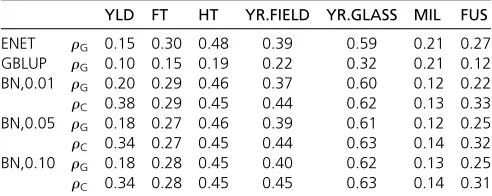
Table 1 shows genetic predictive correlations (rG) and causal predictive correlations (rC) for single-trait ENET, sin-gle-trait GBLUP, and BNsfitted with a= 0.01, 0.05, 0.10. Only the results for BNs whose parameters are estimated with RR are reported, because using OLS provides essen-tially the same performance. The averagerGobtained with RR across all traits is 0.324 fora= 0.01, 0.327 fora= 0.05, and 0.331 for a= 0.10, all with a standard deviation of 60.004; with OLS we obtain 0.322 for a = 0.01, 0.325 fora= 0.05, and 0.324 fora= 0.10, again with a stan-dard deviation of 60.004. Similar considerations can be made for rC.
First, we note that BNs and single-trait ENET have comparable predictive power forrG: BNs are best for YLD, YR.GLASS, and YR.FIELD, while ENET is best for FT, HT, MIL, and FUS. Overall, the averagerGacross all seven traits is 0.34360.004 for ENET and 0.33160.004 for BNs with
a= 0.10. Therefore, while ENET outperforms BNs on aver-age, BNs still provide the best rG in three traits of seven. In addition, both ENET and BNs outperform single-trait GBLUP, which hasrG= 0.18660.005 overall. As expected, the choice of the kinship matrix used in GBLUP does not significantly affect rG because we accounted for the effect of family structure on the traits as a preliminary step. Using different marker-based estimates of kinship such as allele sharing (Habier et al. 2007) or allelic correlation (Astle and Balding 2009) provides no benefit over not using a kin-ship matrix at all.
larger BNs, the small increase in predictive power is not worth the longer time required to estimate the model un-der cross-validation. On average, we learned BNs with 47 nodes (including the 7 traits) in a few seconds for a = 0.01, with 75 nodes in 20 min fora= 0.05, and with 89 nodes in 2.5 hr for a = 0.10. Further increasing aas in Scutariet al.(2013) only exacerbates the problem (24 days fora= 0.15, results not shown). Of all the SNPs included in BNs, few are not parents of any trait and thus appear to be false positives: 1 of 40 (2.5%) for a = 0.01, 2 of 68 (2.9%) fora= 0.05, and 4 of 82 (4.8%) fora= 0.10. The dimension of the BNs is in stark contrast with the average number of nonzero SNP effects in the ENET models: 110 nonzero coefficients for YR.GLASS, 2661 for YLD, 55 for HT, 105 for YR.FIELD, 333 for FUS, 1725 for MIL, and 24 for FT.
As far as causal predictive correlationsrCare concerned, we observe a distinct improvement compared torGfor three traits: YLD, YR.FIELD, and FUS. As for the other four traits, the difference between rG and rC is not as marked, even though it is statistically significant in all cases exceptfl ower-ing time. Overall,rC= 0.37360.004, which is higher than both BN’srG= 0.33160.04 fora= 0.10 and the ENET’s
rG= 0.34360.004.
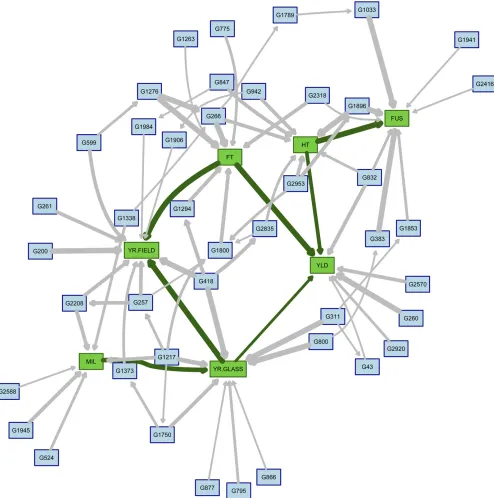
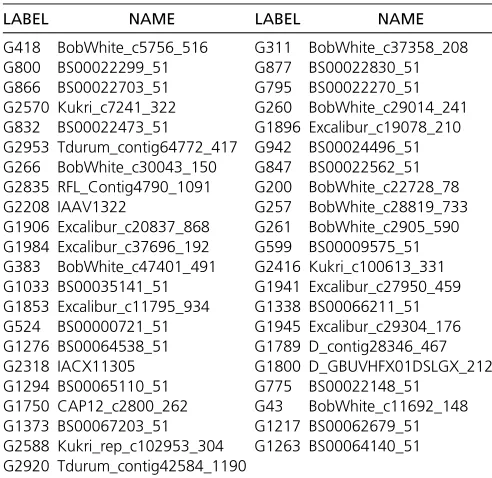
The averaged BN fora= 0.10 is shown in Figure 1; it has 50 nodes and 78 arcs. For ease of plotting, the SNP names corresponding to the labels used in thefigure are reported in Table 2. The dimension of the BN is comparable to that obtained for a = 0.01 (30 nodes, 44 arcs) anda = 0.05 (44 nodes, 66 arcs). In all three cases the threshold for arc inclusion estimated as in Scutari and Nagarajan (2013) is 0.49, which is close to the intuitive choice of including in the averaged BN those arcs that appear in more than half of the BNs obtained during cross-validation. All SNPs in the aver-aged BN are linked with at least one trait, with the exception of G1789 (D_contig28346_467). Their minor allele frequen-cies range from 0.02 (G2208; IAAV1322) to 0.47 (G1945; Excalibur_c29304_176). Furthermore, the BN is small enough that RR and OLS parameter estimates are practically equivalent.
As far as phenotypic traits are concerned, the averaged BN captures several known relationships. YR.FIELD is infl u-enced by FT (FT/YR.FIELD in Figure 1); earlyflowering genotypes will have their leaves exposed to the pathogens for a longer time than later genotypes, resulting in higher yellow rust scores even if they have the same level of true disease resistance. This is substantiated by the posterior distribution of the disease score conditional onflowering time being in the bottom quartile ([21.0, 29.7]) or in the top quartile ([33.8, 42.0]): it has mean 2.54 in the first case and 2.33 in the second. Standard deviation is 0.47 in both cases. The same is true for YR.GLASS, which has means 2.50 and 2.48 for early and late flowering genotypes; standard deviation is 0.43. The network structure suggests that the YR.GLASS is not influenced directly by FT (i.e., there is no FT / YR. GLASS arc). The two yellow rust scores (YR.GLASS /YR. FIELD) are positively correlated (0.34), likely because of dura-ble resistance. In addition, we note that YR.FIELD summarizes adult resistance to a mixed population of pathotypes, which may include the specific pathotype used to measure juvenile resistance in YR.GLASS.
We can also see from Figure 1 that YLD depends directly on both HT (HT / YLD) and FT (FT / YLD), but it is affected only indirectly by all the disease scores except YR. GLASS. Conditional on the combinations of bottom and top quartiles for FT and HT ([64.3, 74.5] and [79.5, 87.7]), the expected yield is 7.54, 7.71, 7.15, and 7.33, respectively. Standard deviation is 0.47 in all four scenarios. Therefore, we observe a marginal increase in YLD of0.15 when com-paring short and tall genotypes, and a marginal decrease of 0.4 when comparing early and late flowering genotypes; this is consistent with Flinthamet al.(1997) and Snapeet al. (2001). The interplay between HT and FT appears to be negligible in determining yield. Conditioning on the bottom and top quartiles of the disease scores, we see a difference in the mean YLD of +0.08 (FUS), 20.02 (MIL), 20.01 (YR.GLASS), and20.10 (YR.FIELD).
The apparent increase in YLD associated with high FUS scores is the result of the confounding effect of HT, which is directly linked to both variables in the BN (FUS)HT/ YLD). This is expected because susceptibility toFusariumis known to be positively related to HT (Srinivasacharyet al. 2009), which in turn affects YLD. Conditional on each quar-tile of HT, FUS has a negative effect on YLD ranging from 20.04 to20.06.
The last interaction between phenotypes in the BN is between MIL and YR.GLASS (MIL /YR.GLASS). This can be explained by the increased susceptibility to one disease in genotypes that are weakened by the onset of the other, by disease resistance being controlled by shared regions in the genome (Spielmeyeret al.2005; Lillemoet al.2008), and to a lesser extent by the influence of weather conditions (Beest
et al.2008). The BN in Figure 1 identifies 9 SNPs that are
linked to at least one of MIL and YR.GLASS and may be tagging pleiotropic QTL for disease resistance. By contrast-ing low and high level of both diseases (scores #1.5 and
Table 1 Genetic (rG) and causal (rC) predictive correlations for the 7 traits and for single-trait elastic net (ENET), single-trait GBLUP and BNs estimated witha= 0.01, 0.05, 0.10 and RR
$3.5, respectively), we can infer which allele may be linked with resistance to both diseases using the conditional expected allele counts,nLOWandnHIGH. For three of the nine genes, the difference between the two is marked: G418 (BobWhite_c5756_516; nLOW = 0.5, nHIGH = 1.9), G311 (BobWhite_c37358_208; nLOW = 1.1, nHIGH = 1.7), and G1217 (BS00062679_51; nLOW = 0.8, nHIGH = 1.7). The 90K consensus map in Wanget al.(2014) locates G418 in
chromosome 2D along with other SNPs conferring resistance to YR.GLASS. The same is true also for G311 in chromosome 2B and for G2127 in chromosome 2A. As for the other six SNPs, |nLOW2nHIGH|,0.5, which suggests that their in-dividual effects are small and that they might work in con-cert with other genes producing polygenic effects.
Similar analyses on the other traits identify two more SNPs with |nLOW 2 nHIGH| # 0.5 that may be tagging
known genes. G1896 (Excalibur_c19078_210) hasnLOW=
0.3,nHIGH= 1.2 when contrasting top and bottom quartiles
for HT and hasnLOW= 0.2,nHIGH= 1.7 when contrasting the bottom quartile of HT and FUS $ 3.5 with the top quartile of HT and FUS #1.5. The latter pair of scenarios is motivated by the fact that taller plants are less susceptible
toFusariumthan shorter plants. The LD analysis in Mackay
et al. (2014) suggests that this SNP is located in
chromo-some 4D in this population and that it may be tagging
Rht-D1b, a dwarfing gene that is also closely associated with
resistance toFusarium(Srinivasacharyet al.2009). In addi-tion, G266 (BobWhite_c30043_150) appears to be located in chromosome 2D and to be taggingPpd-D1, which controls photoperiod response. Contrasting the bottom quartiles of both FT and HT with the top quartiles we have nHIGH = 0 andnLOW= 0.8.
Discussion
Modeling multiple quantitative traits simultaneously has been known to result in better predictive power than targeting one trait at a time in the context of additive genetic models (Henderson and Quaas 1976). BNs provide a general framework in which to estimate and analyze such models. They also provide an accompanying graphical rep-resentation that is intuitive yet rigorous; a plot such as that in Figure 1 can be very useful for exploratory analysis, to disseminate results and to motivate further quantitative and qualitative analyses in GWAS and GS studies.
From a theoretical point of view, BNs are more versatile than additive models in common use. By assuming that variables are normally distributed, we have shown that
BNs are in fact equivalent to multivariate GBLUP and, by extension, to single-trait GBLUP. Furthermore, the separa-tion between structure and parameter learning makes it possible to accommodate different parametric assumptions with relatively few changes and subsume models such as univariate and multivariate ridge-regression (Hoerl and Kennard 1970; Brown and Zidek 1980). As far as inference is concerned, several established methods from the litera-ture can be used to predict traits from SNPs and vice versa; two examples are logic sampling and likelihood weighting (Koller and Friedman 2009). Both allow exploration of complex scenarios of practical relevance by estimating in-formative statistics from the corresponding conditional dis-tributions of traits and SNPs. This is made easier by the lack of a formal distinction between response and explanatory variables in the BN, which is central in traditional linear models. As a result, BNs can be used for association studies as well as genomic prediction. In the former, we can condition on some complex combination of traits and predict the expected allele counts of SNPs. Such an approach has the potential of detecting which SNPs tag relevant QTL and which of their alleles are favorable. In the latter, we have shown that BNs are competitive with a state-of-the-art model such as sin-gle-trait ENET when predicting traits from SNPs and that they outperform single-trait GBLUP for the population analyzed in this article. As evidenced by the difference betweenrGandrC, using BNs as a multitrait model and performing predictions based on those variables identified as putative causal for each trait outperforms ENET as well by leveraging pleiotropic effects (Hartleyet al.2012). This shows that it is possible to improve genomic selection for traits that are expensive to measure by incorporating cheaper ones in the predictions. Clearly, the impact of correlated phenotypes on the predictive power of BNs depends on the strength of their correlation.
Based on the BN in Figure 1, we can also observe some interesting properties of BNs as genetic models. First, the difference in the number of SNPs included in the BNs com-pared to the ENET models can be attributed to the limited ability of BNs to capture small epistatic effects (Han et al. 2012). Consider, for instance, a polygenic effect in which two SNPs are jointly associated with a trait but in which each SNP is not significant on its own. Such an effect will not be captured because both SNPs will be discarded by the single-SNP screening performed at the beginning of feature selection. As observed in other studies, this does not have a significant impact on predictive ability if a large enougha threshold is used, as Markov blankets are very effective at feature selection (Chang and McGeachie 2011; Scutariet al. 2013). Second, SNPs with pleiotropic effects are included in the BN even when association with a single phenotype is detected; at that point they can be linked to all relevant phenotypes. This is the case of the SNPs controlling resis-tance to both mildew and yellow rust discussed above. Fur-thermore, direct and indirect effects of such SNPs and of traits are correctly separated for the observed traits, as in the case of theFusarium effect on yield.
Table 2 SNPs included in the averaged BN
LABEL NAME LABEL NAME
G418 BobWhite_c5756_516 G311 BobWhite_c37358_208 G800 BS00022299_51 G877 BS00022830_51 G866 BS00022703_51 G795 BS00022270_51 G2570 Kukri_c7241_322 G260 BobWhite_c29014_241 G832 BS00022473_51 G1896 Excalibur_c19078_210 G2953 Tdurum_contig64772_417 G942 BS00024496_51 G266 BobWhite_c30043_150 G847 BS00022562_51 G2835 RFL_Contig4790_1091 G200 BobWhite_c22728_78
G2208 IAAV1322 G257 BobWhite_c28819_733
G1906 Excalibur_c20837_868 G261 BobWhite_c2905_590 G1984 Excalibur_c37696_192 G599 BS00009575_51 G383 BobWhite_c47401_491 G2416 Kukri_c100613_331 G1033 BS00035141_51 G1941 Excalibur_c27950_459 G1853 Excalibur_c11795_934 G1338 BS00066211_51 G524 BS00000721_51 G1945 Excalibur_c29304_176 G1276 BS00064538_51 G1789 D_contig28346_467
G2318 IACX11305 G1800 D_GBUVHFX01DSLGX_212
G1294 BS00065110_51 G775 BS00022148_51 G1750 CAP12_c2800_262 G43 BobWhite_c11692_148 G1373 BS00067203_51 G1217 BS00062679_51 G2588 Kukri_rep_c102953_304 G1263 BS00064140_51 G2920 Tdurum_contig42584_1190
The labels are those used in Figure 1, while the SNP names are from Mackayet al.
MAGIC populations provide an ideal starting point for
fitting BNs. On the one hand, the particular pattern of crosses used to produce a MAGIC population results in a very low population structure. This reduces the confounding effect of relatedness on the estimation of SNP effects (Astle and Balding 2009) and on mapping approaches based on LD (Mackayet al. 2014). On the other hand, the size of of the population is large enough to detect weak associations and associations with rare variants. Both are in fact present in the averaged BN, which includes SNPs with minor allele frequencies as low as 0.02 and SNPs that are significant (e.g., for MIL and YR.GLASS) only when considering multiple traits at the same time.
Finally, SNPs of interest can be made to segregate in the population by choosing the founders appropriately, since balanced crosses ensure opportunities for recombination among the founders. This is particularly important in model-ing multiple phenotypes, as we need to ensure that as many relevant QTL and genes as possible are tagged to correctly dissect their genetic layout.
Acknowledgments
The work presented in this article forms part of the Molecular Improvement of Disease Resistance in Barley project, which is funded by the UK Technology Strategy Board (TSB) and Biotechnology & Biological Sciences Research Council (BBSRC), grant TS/I002170/1. The MAGIC population was developed within BBSRC Crop Science Initiative project BB/E007201/1. Field trials and SNP genotyping were funded by the NIAB Trust.
Literature Cited
Aliferis, C. F., A. Statnikov, I. Tsamardinos, S. Mani, and X. D. Xenofon, 2010 Local causal and Markov blanket induction for causal dis-covery and feature selection for classification part I: algorithms and empirical evaluation. J. Mach. Learn. Res. 11: 171–234.
Alimi, N. A., M. C. A. M. Bink, J. A. Dieleman, J. J. Magán, A. M. Wubset al., 2013 Multi-trait and multi-environment QTL anal-yses of yield and a set of physiological traits in pepper. Theor. Appl. Genet. 126(10): 2597–2625.
Astle, W., and D. J. Balding, 2009 Population structure and cryp-tic relatedness in genecryp-tic association studies. Stat. Sci. 24(4): 451–471.
Banerjee, S., B. S. Yandell, and N. Yi, 2008 Bayesian quantitative trait loci mapping for multiple traits. Genetics 179: 2275–2289. Banerjee, S., A. O. Finley, P. Waldmann, and T. Ericsson, 2012 Hierarchical spatial process models for multiple traits in large genetic trials. J. Am. Stat. Assoc. 105(490): 506–521. Beest, D. E. T., N. D. Paveley, M. W. Shaw, and F. van den Bosch,
2008 Disease–weather relationships for powdery mildew and yellow rust on winter wheat. Phytopatology 98: 609–617. Brown, P. J., and J. V. Zidek, 1980 Adaptive multivariate ridge
regression. Ann. Stat. 8(1): 64–74.
Chang, H.-H., and M. McGeachie, 2011 Phenotype prediction by integrative network analysis of SNP and gene expression micro-arrays, pp. 6849–6852 inProceedings of the 33rd Annual Inter-national Conference of the IEEE Engineering in Medicine and Biology Society (EMBC). IEEE Press, New York.
Cowell, R. G., A. P. Dawid, S. L. Lauritzen, and D. J. Spiegelhalter, 2007 Probabilistic Networks and Expert Systems. Springer-Verlag, New York.
Cox, D. R., and N. Wermuth, 1996 Multivariate Dependencies:
Models, Analysis and Interpretation, Chapman & Hall, Boca Raton, FL.
Druka, A., I. Druka, A. Centeno, H. Li, Z. Sunet al., 2008 Towards systems genetic analyses in barley: integration of phenotypic, expression and genotype data into GeneNetwork. BMC Genet. 9(1): 73.
Falconer, D. S., and T. F. C. Mackay, 1995 Introduction to Quan-titative Genetics, Ed 4. Prentice Hall, Harlow, UK.
Finley, A. O., S. Banerjee, P. Waldmann, and T. Ericsonn, 2009 Hierarchical spatial modeling of additive and dominance genetic variance for large spatial trial datasets. Biometrics 61(2): 441–451.
Flintham, J. E., A. Börner, A. J. Worland, and M. D. Gale, 1997 Optimizing wheat grain yield: effects of Rht (Gibberellin-insensitive) dwarfing genes. J. Agric. Sci. 128(1): 11–25. Friedman, J. H., T. Hastie, and R. Tibshirani, 2010 Regularization
paths for generalized linear models via coordinate descent. J. Stat. Softw. 33(1): 1–22.
Friedman, N., 2004 Inferring cellular networks using probabilistic graphical models. Science 303(5659): 799–805.
Goeman, J. J., 2012 penalized R package. R package version 0.9–41. Habier, D., R. L. Fernando, and J. C. M. Dekkers, 2007 The impact of genetic relationship information on genome-assisted breeding values. Genetics 177: 2389–2397.
Han, B., X. Chen, Z. Talebizadeh, and H. Xu, 2012 Genetic studies of complex human diseases: characterizing SNP-disease associ-ations using Bayesian networks. BMC Syst. Biol. 6(Suppl. 3): S14.
Hartley, S. W., S. Monti, C.-T. Liu, M. H. Steinberg, and P. Sebastiani, 2012 Bayesian methods for multivariate modeling of pleiotropic SNP associations and genetic risk prediction. Front. Genet. 3(176): 1–17.
Hastie, T., R. Tibshirani, B. Narasimhan, and G. Chu, 2013 impute: imputation for microarray data. R package ver-sion 1.36.0.
Henderson, C. R., and R. L. Quaas, 1976 Multiple trait evaluation using relatives’records. J. Anim. Sci. 43: 1188–1197.
Hoerl, A. E., and R. W. Kennard, 1970 Ridge regression: biased estimation for nonorthogonal problems. Technometrics 12(1): 55–67.
Hooper, J. W., 1958 The sampling variance of correlation coeffi -cients under assumptions offixed and mixed variates. Biome-trika 45(3/4): 471–477.
Hotelling, H., 1953 New light on the correlation coefficient and its transforms. J. R. Stat. Soc., B 15(2): 193–232.
Jansen, R., H. Yu, D. Greenbaum, Y. Kluger, N. J. Krogan et al., 2003 A Bayesian networks approach for predicting protein– protein interactions from genomic data. Science 302(5644): 449–453.
Koller, D., and N. Friedman, 2009 Probabilistic Graphical Models: Principles and Techniques. MIT Press, Cambridge, MA.
Lauritzen, S. L., and N. A. Sheehan, 2004 Graphical models for genetic analysis. Stat. Sci. 18: 489–514.
Li, R., S.-W. Tsaih, K. Shockley, I. M. Stylianou, J. Wergedalet al., 2006 Structural model analysis of multiple quantitative traits. PLoS Genet. 2(7): e114.
Li, Y., C. J. Willer, J. Ding, P. Scheet, and G. R. Abecasis,
2010 MaCH: using sequence and genotype data to estimate
haplotypes and unobserved genotypes. Genet. Epidemiol. 34: 816–834.
to powdery mildew in bread wheat line Saar. Theor. Appl. Genet. 116: 1155–1166.
Mackay, I., P. Bansept-Basler, T. Barber, A. Bentley, and J. Cockram et al., 2014 An eight-parent multiparent advanced generation in-tercross population for winter-sown wheat: creation, properties and
first results. G3 (Bethesda) 4: 1603–1610.
Malovini, A., A. Nuzzo, F. Ferrazzi, A. Puca, and R. Bellazzi,
2009 Phenotype forecasting with SNPs data through
gene-based Bayesian networks. BMC Bioinformatics 10(Suppl. 2): S7. Meuwissen, T. H. E., B. J. Hayes, and M. E. Goddard, 2001 Prediction of total genetic value using genome-wide dense marker maps. Genetics 157: 1819–1829.
Morota, G., B. D. Valente, G. J. M. Rosa, K. A. Weigel, and D. Gianola, 2012 An assessment of linkage disequilibrium in hol-stein cattle using a Bayesian network. J. Anim. Breed. Genet. 129(6): 474–487.
Mourad, R., C. Sinoquet, and P. Leray, 2011 A hierarchical Bayes-ian network approach for linkage disequilibrium modeling and data-dimensionality reduction prior to genome-wide association studies. BMC Bioinformatics 12(1): 16.
O’Reilly, P. F., C. J. Hoggart, Y. Pomyen, F. C. F. Calboli, P. Elliott et al., 2012 MultiPhen: joint model of multiple phenotypes can increase discovery in GWAS. PLoS ONE 7(5): e34861. Pearl, J., 1988 Probabilistic Reasoning in Intelligent Systems:
Net-works of Plausible Inference. Morgan Kaufmann, San Francisco. Pearl, J., 2009 Causality: Models,Reasoning and Inference, Ed 2.
Cambridge University Press, Cambridge, UK.
Piepho, H.-P., 2009 Ridge regression and extensions for genome-wide selection in maize. Crop Sci. 49(4): 1165–1176.
Piepho, H.-P., J. O. Ogutu, T. Schulz-Streeck, B. Estaghvirou, A. Gordilloet al., 2012 Efficient computation of ridge-regression best linear unbiased prediction in genomic selection in plant breeding. Crop Sci. 52(3): 1093–1104.
Sachs, K., O. Perez, D. Pe’er, D. A. Lauffenburger, and G. P. Nolan, 2005 Causal protein-signaling networks derived from multipa-rameter single-cell data. Science 308(5721): 523–529. Schwarz, G. E., 1978 Estimating the dimension of a model. Ann.
Stat. 6(2): 461–464.
Scutari, M., 2010 Learning Bayesian networks with the bnlearn R package. J. Stat. Softw. 35(3): 1–22.
Scutari, M., and R. Nagarajan, 2013 On identifying significant edges in graphical models of molecular networks. Artif. Intell. Med. 57(3): 207–217.
Scutari, M., I. Mackay, and D. J. Balding, 2013 Improving the efficiency of genomic selection. Stat. Appl. Genet. Mol. Biol. 12(4): 517–527.
Sebastiani, P., and T. T. Perls, 2008 Complex genetic models, pp. 53–72 inBayesian Networks: a Practical Guide to Applications, edited by O. Pourret, P. Naïm, and B. Marcot. Wiley, Hoboken, NJ.
Sebastiani, P., M. F. Ramoni, V. Nolan, C. T. Baldwin, and M. Steinberg, 2005 Genetic dissection and prognostic modeling of overt stroke in sickle cell anemia. Nat. Genet. 37(4): 435– 440.
Snape, J. W., K. Butterworth, E. Whitechurch, and A. J. Worland, 2001 Waiting for fine times: genetics of flowering time in wheat. Euphytica 119(1–2): 185–190.
Speed, D., G. Hermani, M. R. Johnson, and D. J. Balding,
2012 Improved heritability estimation from genome-wide
SNPs. Am. J. Hum. Genet. 91(6): 1011–1021.
Spielmeyer, W., R. A. McIntosh, J. Kolmer, and E. S. Lagudah, 2005 Powdery mildew resistance and Lr34/Yr18 genes for du-rable resistance to leaf and stripe rust cosegregate at a locus on the short arm of chromosome 7D of wheat. Theor. Appl. Genet. 111: 731–735.
Srinivasachary, N. Gosman, A. Steed, T. W. Hollins, R. Bayleset al., 2009 Semi-dwarfing Rht-B1 and Rht-D1 loci of wheat differ significantly in their influence or resistance to fusarium head blight. Theor. Appl. Genet. 118: 695–702.
Stephens, M., 2013 A unified framework for association analysis with multiple related phenotypes. PLoS ONE 8(7): e65245.
Wang, S., D. Wong, K. Forrest, A. Allen, S. Chao et al.,
2014 Characterization of polyploid wheat genomic diversity using a high-density 90,000 SNP array. Plant Biotech. J. 12: 787–796.
Wimmer, V., T. Albrecht, H.-J. Auinger, and C.-C. Schön,
2012 synbreed: framework for the analysis of genomic prediction data using R. Bioinformatics 18(15): 2086–2087.
Zou, H., and T. Hastie, 2005 Regularization and variable selection via the elastic net. J. R. Stat. Soc. B 67(2): 301–320.