Anus,Rectum
andColon
http://journal-arc.jpOriginal Research Article
Clinical Results of One-stage Restorative Proctocolectomy with
J-pouch Anal Anastomosis in 300 Ulcerative Colitis Patients
Ryuichi Kuwahara, Hiroki Ikeuchi, Toshihiro Bando, Hirohumi Sasaki, Yoshiko Goto, Yuki Horio, Tomohiro Minagawa and Motoi Uchino
Department of Gastroenterology, Division of Inflammatory Bowel Disease, Hyogo College of Medicine, Nisinomiya, Japan
Abstract
Objectives: Restorative proctocolectomy and ileal pouch anal anastomosis (IPAA), with diverting ileostomy, are established ulcerative colitis (UC) treatments. The routine use of diverting ileostomy is con-troversial because of the risk of stoma closure and stoma related complications. In our institution, procto-colectomy and IPAA, with mucosectomy and handsewn anastomosis without diversion (one-stage IPAA), were performed for select patients with UC. The present study aimed to evaluate the clinical and functional outcomes of patients undergoing one-stage IPAA.
Methods: Between April 1999 and July 2017, 300 patients underwent one-stage IPAA in our institution. The clinical notes and prognosis were reviewed retrospectively.
Results: Postoperative complications (Clavien-Dindo classification grade !III) occurred in 18 patients (6.0%). The most common complication was anastomotic leakage (n = 9, 3%). There were 15 patients (5.0%) who required a defunctioning ileostomy. However, 13 patients successfully underwent ileostomy closure and achieved acceptable pouch function. Finally, two patients (0.6%) required pouch excision in this series. The cumulative pouch functional rate was 99.6% / 5 years and 99.2% / 10 years.
Conclusions:One-stage IPAA is a good strategy for carefully selected patients with UC. Keywords
ulcerative colitis, restorative proctocolectomy, without diverting ileostomy
J Anus Rectum Colon 2020; 4(4): 181-185
Introduction
Restorative proctocolectomy and ileal pouch anal anasto-mosis (IPAA) with diverting ileostomy is a suitable proce-dure for treating ulcerative colitis (UC). Patients with UC are at a higher risk for anastomotic leakage due to colon in-flammation and the use of medications, including steroids and biological agents[1,2]. Pelvic sepsis is the most severe IPAA complication. Anastomotic leakage is one of the lead-ing causes of pouch failure; therefore, most surgeons estab-lish a temporary loop ileostomy proximal to the ileal pouch. However, some authors have noted that, while ileostomy
prevents some complications, reversal and the ileostomy it-self may be sources of morbidities[3,4]. Another surgeon has recommended proctocolectomy and IPAA without diver-sion as the best strategy because defunctioning ileostomy is not associated with reduced leakage[5].
We performed a one-stage restorative proctocolectomy with mucosectomy and handsewn anastomosis to treat 300 selected patients with UC. This study was designed to assess the long-term outcomes, complications, and hospital stay du-ration of patients undergoing restorative proctocolectomy with mucosectomy without diverting ileostomy.
Corresponding author: Ryuichi Kuwahara, [email protected] Received: April 22, 2020, Accepted: June 25, 2020
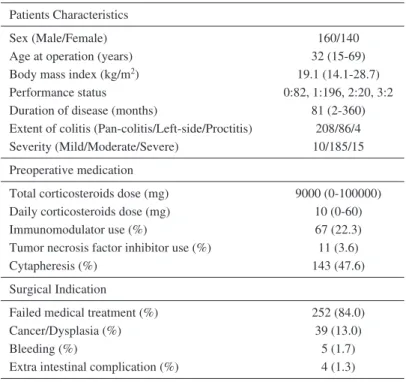
Table 1. Patient Background. Patients Characteristics
Sex (Male/Female) 160/140
Age at operation (years) 32 (15-69)
Body mass index (kg/m2) 19.1 (14.1-28.7)
Performance status 0:82, 1:196, 2:20, 3:2 Duration of disease (months) 81 (2-360) Extent of colitis (Pan-colitis/Left-side/Proctitis) 208/86/4 Severity (Mild/Moderate/Severe) 10/185/15
Preoperative medication
Total corticosteroids dose (mg) 9000 (0-100000) Daily corticosteroids dose (mg) 10 (0-60)
Immunomodulator use (%) 67 (22.3)
Tumor necrosis factor inhibitor use (%) 11 (3.6)
Cytapheresis (%) 143 (47.6)
Surgical Indication
Failed medical treatment (%) 252 (84.0)
Cancer/Dysplasia (%) 39 (13.0)
Bleeding (%) 5 (1.7)
Extra intestinal complication (%) 4 (1.3)
The background information of the patients undergoing one-stage restorative procto-colectomy for UC (n = 300). The data are shown as the median and range.
Methods
Patients
From April 1999 through July 2017, 300 patients with UC who underwent one-stage IPAA were included in this study. Within the same period, 1409 cases met the preopera-tive criteria for one-stage IPAA (excluding Crohn’s disease and fulminant colitis). The rate of one-stage IPAA was 21.2% (300/1409) because most patients wished to receive two-stage surgery after the informed consent process or did not meet the intraoperative conditions. All patients under-went open abdominal surgery. The clinical notes and prog-noses were reviewed retrospectively. Table 1 summarizes the patients’ background information.
Ethical considerations
The Institutional Review Board of the Hyogo College of Medicine (No.202004-437) approved all study protocols. Each participating patient provided informed consent for participation in the clinical trial.
Selection of patients for one-stage procedure
The decision to omit ileostomy was based on operative and preoperative considerations. Patients were selected for one-stage IPAA if they had been diagnosed previously with UC with no fistulas (excluding those with Crohn’s disease). Additionally, patients with fulminant colitis, including toxic
megacolon, were considered unsuitable for the one-stage procedure because of the high rate of postoperative compli-cations in this population. Also, if tension was applied to the anastomotic part during surgery, then the ileostomy was per-formed. If these conditions were achieved, a loop ileostomy was not performed[6].
Operative techniques
We have already described our surgical techniques[7]. The patient underwent the procedure in the Lloyd-Davies posi-tion, and two separate teams performed the abdominal and perineal portions of the procedure. Mucosal dissection began circumferentially from the dentate line using harmonic scal-pels (Johnson & Johnson Medical, Ethicon Endo-Surgery, Tokyo, Japan) to preserve the internal sphincter muscle fi-bers; 2-3 cm from the dentate line, the levator muscle and rectal wall were resected gradually. The dissected rectum was pushed upward into the abdominal cavity with clean gauze pads. An abdominal proctocolectomy was performed from the cecum in the usual manner. A 15 cm ileal J-pouch was created from the terminal 30 cm of the ileum. The pouch was stapled proximally and distally with 3-row sta-plers inserted at the mid-portion of the J-pouch. The septum at the pouch’s apex was transected with a linear stapler to prevent apical pouch bridge syndrome[8]. After cleaning the pelvic floor with 4 liters of physiological saline, the pouch was delivered into the rectal muscular cuff.
Table 2. Surgical Parameters (n = 300).
n = 300
Operation time (min) 200 (136-570)
Blood loss (ml) 195 (10-1190)
Transfusion 5
Postoperative hospital stay (days) 22 (12-84)
Re-operation 18
The data are shown as the median and range.
Table 3. Early Postoperative Complica-tions (Clavien-Dindo grade ≥III, n = 18).
n %
Leakage (ileoanal anastomosis) 9 3.0
Leakage (pouch) 4 1.3
Bowel obstruction 2 0.7
Pelvic bleeding 2 0.7
Pelvic abscess 1 0.3
In total, 15 patients (5%) required a de-functioning
ileostomy after the operation.
pouch apex came to the dentate line most easily. That por-tion of the pouch apex was opened with an electrical scal-pel. The IPAA was handsewn with 24 stitches using 3-0 ab-sorbable sutures. After the surgeons completed anastomosis, the pouch was decompressed transanally with a 28-French transanal catheter. Table 2 summarizes the surgical details.
Postoperative management
Broad-spectrum antibiotics were continued for 24 hours postoperatively.
An anesthesiologist removed nasogastric decompression in the operating room. The patient began progressive feeding when bowel function returned.
On the third day postoperatively, the medical staff re-moved the urinary catheter after detaching the epidural catheter. The transanal catheter was removed on the eighth to tenth day postoperatively after performing contrast pouchography and checking for leakage.
Definitions
Patients had a functional pouch if their anastomotic leak-age healed during the follow-up period, and they could un-dergo stoma closure. Patients with pouch failure, assigned to the nonfunctional group, were defined as those who required pouch removal or repeat ileostomy for several reasons, in-cluding pelvic sepsis and pouchitis. At the time of the final confirmation, the cases without ileal pouch resection were called the functional pouch group, and the ratio was the functional pouch rate. Even if a stoma was constructed, a pouch with a subsequently closed stoma was considered a functional pouch. Early postoperative complications were defined as those occurring within 30 days after surgery and classified as Clavien-Dindo grade III or higher[9,10].
Statistical analysis
Data were collected retrospectively onto a dedicated data-base from a review of the medical and nursing notes. The grouped data are expressed as the median and range. The cumulative incidences of nonfunctional pouches were esti-mated using the Kaplan-Meier method. JMP ver. 12 (SAS Institute, Inc., Cary, North Carolina, USA) was used to per-form the analyses.
Results
Early postoperative complications
Table 3 presents the early postoperative complications (Clavien-Dindo grade !III). Eighteen patients (6%) devel-oped postoperative complications; the common complica-tions were pouch leakage (9, 3%) and anastomotic leakage (1.3%).
Fifteen patients required a defunctioning ileostomy after the operation. However, 13 patients successfully underwent ileostomy closure and achieved acceptable pouch function. Finally, two patients in this series required pouch excision with conversion to eternal ileostomy due to anastomotic leakage and a change in the diagnosis to a CD.
Postoperative long-term outcomes
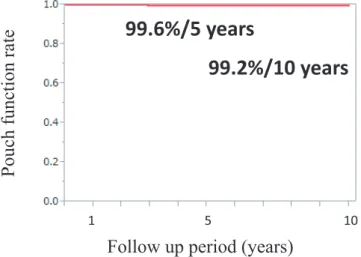
At our hospital, 182 patients were followed, and 118 pa-tients were followed at other hospitals. We also confirmed the pouch functional rate for cases under observation at other hospitals. The cases without a stoma at the time of fi-nal confirmation were considered part of the functiofi-nal pouch group. The cumulative five-year pouch functional rate was 99.6%, and the cumulative 10-year pouch functional rate was 99.2% (Figure 1).
Tao patients underwent pouch resection; in one case, the patient’s diagnosis changed from UC to CD. In the other case, repeated refractory fistulas occurred at the anastomotic site.
Discussion
UC patients have a high risk of anastomotic leakage due to the inflammatory state of the colon, the use of steroids and biological agents, and malnutrition[1,2]. In fact, some studies have claimed that IPAA without diversion increases the incidence of septic complications[9-11]. Pelvic sepsis leads to pouch function failure because of anastomotic fibro-sis, decreased pouch compliance, dysmotility, and impaired pelvic floor activity. For that reason, preventing leakage is extremely important in one-stage IPAA for UC patients.
Figure 1. Cumulative Pouch Functional Rate.
The cumulative five-year pouch functional rate was 99.6%, and the cumulative 10-year pouch functional rate was 99.2%.
Follow up period (years)
Pouch
function
rate
1 5 1099.2%/10 years
99.6%/5 years
Therefore, we performed one-stage IPAA for select cases that satisfied preoperative and intraoperative conditions.
Preoperatively, we excluded patients with acute colitis, in-cluding toxic megacolon and UC with fistulas (exin-cluding those with Crohn’s disease) because postoperative complica-tions occur at a high rate in this population.
The important term at the time of operation is tension-free anastomosis. To achieve affordable anastomosis, we mobilized the small bowel mesentery to the duodenum and carefully opened a mesenteric window to maintain blood flow. Then, we confirmed that the pouch tip reached 2 cm from the pubic symphysis. Especially in cases of obese men, the narrow pelvic cavity and thick mesentery prevent tension-free anastomosis. If they did not satisfy the preop-erative and intraoppreop-erative conditions, the pouch was estab-lished covering the stoma. The procedure was decided at the time of operation; therefore, sufficient preoperative explana-tion is necessary for all patients.
Postoperative anal function is also a significant problem. IPAA with mucosectomy was difficult to perform in the first session without covering stoma because of the damage to the internal anal sphincter. The early problem occurred fre-quently after one-stage IPAA. Anal pain and soiling are im-portant complications that make it difficult for patients to be eligible for one-stage IPAA. Therefore, we administered lop-eramide hydrochloride and zinc oxide ointment mixed with dimethyl isopropylazulene ointment. We previously reported that the anal pain disappeared approximately two months af-ter surgery[12], but these issues are directly linked to the quality of life and are obstacles for patients to make deci-sions. For that reason, stapled IPAA can be performed in the first session because this procedure does not hurt the inter-nal ainter-nal sphincter and provides good postoperative ainter-nal function. In recent years, improvements in mucosal
resec-tion, using harmonic scalpels, have made it possible to mini-mize the damage for anal function. Due to various prob-lems, IPAA has been performed as a multistage surgery. However, the disadvantage of this procedure is the risk of a stoma related complication at the time of closure. In particu-lar, stoma outlet obstruction occurs in 13∼27% of cases[7,13,14]. In addition, Mennigen[15] claimed that the overall morbidity rate of ileostomy closure was 16.5%. The overall morbidity rate of ileostomy reversal reduces the benefit of temporary fecal diversion.
The cumulative five-year pouch functional rate was 99.6%, and the cumulative 10-year pouch functional rate was 99.2%. The pouch failure rate was 0.8% / 10 years. A previous report from Udo[16] indicated that the cumulative pouch failure rate reached 3.5% / 2.2 years, which is higher than our result in this report. The difference may be caused by patients with suspected indeterminate colitis (IDC) or CD. Many surgeons have reported that a significant pouch failure risk factor is a change in the diagnosis from UC to CD or IDC[17-19]. In Japan, there is a consensus that IPAA is contraindicated if CD or another inflammatory bowel dis-ease (IBD, excluding UC) is suspected[20]. We excluded such patients from this study; therefore, the smaller number of patients with unclassified diagnoses might have led to a lower rate of pouch failure.
Recently the incidence of colitis-associated colorectal cer has been increasing, and it is often associated with can-cer and dysplasia in the anal canal mucosa. In these cases, IPAA with mucosal resection is recommended over IACA with anal canal mucosa[21]. Bratsis reported a case of ade-nocarcinoma in the anal canal after ileal pouch-anal canal anastomosis using a double-stapling technique[22]. We have had similar case experiences[23]. Most cases of colitis-associated colorectal cancer are early stage. These patients often have chronic inflammation of the intestinal tract, and their general condition is relatively good because there are few severe cases of UC. Therefore, it is considered to be a good indication of one-stage IPAA. In this study, 13% of the surgical indications in this study were cancer or dyspla-sia. In the future, if the number of cancer and dysplasia cases increases, there is a possibility that the one-stage IPAA will increase.
Conclusion
One-stage IPAA with mucosectomy is an excellent proce-dure for patients who have achieved these three points: (1) elimination of Crohn’s disease, (2) elimination of the fulmi-nant type of colitis, including TMC, and (3) easy access of the ileal pouch to the anastomosis site. To the best of our knowledge, this study involves the largest series of patients undergoing restorative proctocolectomy and IPAA with mu-cosectomy and without ileostomy.
Conflicts of Interest
There are no conflicts of interest. Author Contributions
Conception and design: H Ikeuchi, R Kuwahara
Data acquisition: R Kuwahara, M Uchino, T Bando, H Sasaki, Y Goto, Y Horio, T Minagawa
Data analysis and interpretation: R Kuwahara, M Uchino Drafting the article: R Kuwahara, H Ikeuchi
Critical revision of the article: R Kuwahara, M Uchino, H Ikeuchi, T Bando, H Sasaki, Y Goto, Y Horio, T Minagawa
Final approval of the article: R Kuwahara, M Uchino, H Ikeuchi, T Bando, H Sasaki, Y Goto, Y Horio, T Minagawa
Approval by Institutional Review Board (IRB)
All study protocols were approved by the Institutional Re-view Board of the Hyogo College of Medicine (No. 202004-437).
References
1.Ferrante M, D’Hoore A, Vermeire S, et al. Corticosteroids but not infliximab increase short-term postoperative infectious complica-tions in patients with ulcerative colitis. Inflamm Bowel Dis. 2009 Jul; 15(7): 1062-70.
2.Yang Z, Wu Q, Wang F, et al. Meta-analysis: effect of preopera-tive infliximab use on early postoperapreopera-tive complications in patients with ulcerative colitis undergoing abdominal surgery. Aliment Pharmacol Ther. 2012 Nov; 36(10): 922-8.
3.Gunnarsson U, Karlbom U, Raab Y, et al. Proctocolectomy and pelvic pouch--is a diverting stoma dangerous for the patient? Col-orectal Dis. 2004 Jan; 6(1): 23-7.
4.Chow A, Tilney HS, Purkayastha S, et al. The morbidity surround-ing reversal of defunctionsurround-ing ileostomies: a systematic review of 48 studies including 6,107 cases. Int J Colorectal Dis. 2009 Jun; 24(6): 711-23.
5.Sahami S, Buskens CJ, D’Hoore A, et al. Defunctioning ileostomy is not associated with reduced leakage in proctocolectomy and il-eal pouch anastomosis surgeries for IBD. J Crohns Colitis. 2016 Jul; 10(7): 779-85.
6.Ikeuchi H, Shoji Y, Yamamura T, et al. Clinical results after re-storative proctocolectomy without diverting ileostomy for ulcera-tive colitis. Int J Colorectal Dis. 2004 May; 19(3): 234-8. 7.Ikeuchi H, Nakano H, Yamamura T, et al. Safety of one-stage
re-storative proctocolectomy for ulcerative colitis. Dis Colon Rectum. 2005 Aug; 48(8): 1550-5.
8.Kusunoki M, Okamoto T, Ikeuchi H, et al. Apical pouch bridge syndrome after ileal J pouch-anal anastomosis. Dig Surg. 1996; 13: 474-7.
9.Clavien PA, Barkun J, Makuuchi M, et al. The Clavien-Dindo classification of surgical complications: five-year experience. Ann Surg. 2009 Aug; 250(2): 187-96.
10.Dindo D, Demartines N, Clavien PA. Classification of surgical
complications: a new proposal with evaluation in a cohort of 6336 patients and results of a survey. Ann Surg. 2004 Aug; 240(2): 205-13.
11.Mennigen R, Senninger N, Rijcken E, et al. Impact of defunction-ing loop ileostomy on outcome after restorative proctocolectomy for ulcerative colitis. Int J Colorectal Dis. 2011 May; 26(5): 627-33.
12.Ikeuchi H, Uchino M, Matsuoka H, et al. Surgery for ulcerative colitis in 1,000 patients. Int J Colorectal Dis. 2010 Aug; 25(8): 959-65.
13.Okada S, Hata K, Nozawa H, et al. Elevated risk of stoma outlet obstruction following colorectal surgery in patients undergoing il-eal pouch-anal anastomosis: a retrospective cohort study. Surg To-day. 2018 Dec; 48(12): 1060-7.
14.Shellito PC. Complications of abdominal stoma surgery. Dis Co-lon Rectum. 1998 Dec; 41(12): 1562-72.
15.Mennigen R, Sewald W, Rijcken E, et al. Morbidity of loop ileostomy closure after restorative proctocolectomy for ulcerative colitis and familial adenomatous polyposis: a systematic review. J Gastrointest Surg. 2014 Dec; 18(12): 2192-200.
16.Heuschen UA, Hinz U, Allemeyer EH, et al. One- or two-stage procedure for restorative proctocolectomy. Ann Surg. 2001 Dec; 234(6): 788-94.
17.Tulchinsky H, Hawley PR, Nicholls J. Long-term failure after re-storative proctocolectomy for ulcerative colitis. Ann Surg. 2003 Aug; 238(2): 229-34.
18.Dayton MT, Larsen KR, Christiansen DD. Similar functional re-sults and complications after ileal pouch-anal anastomosis in pa-tients with indeterminate vs ulcerative colitis. Arch Surg. 2002 Jun; 137(6): 690-4.
19.Delaney CP, Remzi FH, Gramlich T, et al. Equivalent function, quality of life and pouch survival rates after ileal pouch-anal anas-tomosis for indeterminate and ulcerative colitis. Ann Surg. 2002 Jul; 236(1): 43-8.
20.Uchino M, Ikeuchi H, Sugita A, et al. Pouch functional outcomes after restorative proctocolectomy with ileal-pouch reconstruction in patients with ulcerative colitis: Japanese multi-center nationwide cohort study. J Gastroenterol. 2018 May; 53(5): 642-51.
21.Uchino M, Ikeuchi H, Matsuoka H, et al. Surgical procedure for sporadic colorectal cancer in patients with mild ulcerative colitis. Case Rep Gastroenterol. 2012 Sep; 6(3): 635-42.
22.Baratsis S, Hadjidimitriou F, Lariou K, et al. Adenocarcinoma in the anal canal after ileal pouch-anal anastomosis for ulcerative co-litis using a double stapling technique: report of a case. Dis Colon Rectum. 2002 May; 45(5): 687-91.
23.Hirata A, Ikeuchi H, Uchino M. [Adenocarcinoma in the anal ca-nal after restorative proctocolectomy with Ileal J-pouch for ulcera-tive colitis]. Nippon Shoukakigeka Gakkai Zassi (J Jpn Surg As-soc). 2017; 50(6): 499-505. Japanese with English abstract.
Journal of the Anus, Rectum and Colon is an Open Access journal distributed under the Creative Commons Attribution-NonCommercial-NoDerivatives 4.0 In-ternational License. To view the details of this license, please visit (https://creativ ecommons.org/licenses/by-nc-nd/4.0/).