Embedded Wheelchair Controller
Rakesh1, Dr.P.S. Ramkumar2, Balasubramanya Vasista3, Sunitha Lasrado4
PG Student, Dpt. of Electronics and Communication, NMAMIT, Nitte, Udupi District, Karnataka, India.1
Director, Applied Cognition Systems Pvt. Ltd, Bangalore, Karnataka, India.2
System Engineer, Applied Cognition Systems Pvt. Ltd, Bangalore, Karnataka, India.3
Assistant Professor, Dpt. of Electronics and Communication, NMAMIT, Nitte, Udupi District, Karnataka, India.4
ABSTRACT: Work presented in this paper is about IOT based wireless control of motorised wheelchair used by patients both for self-use as well as remote control by third party. Wheelchair is moved in different directions based on the differential voltage applied to the two wheels. Digital control techniques are superior however, it is very appropriate given the trends of utility is being made on top of android mobile phone to use a mobile phone based wireless control for such purposes. This enables the common people to use the system since there is no significance learning curve and it gives the digital stability to the system which is not dependent much on environmental variations and user interface is made much simpler.
KEYWORDS: IOT, Android, wireless control
I. INTRODUCTION
Since the beginning of man’s existence, the life of a human being is the most valuable and essential factor. This life has gotten to be more complicated and more perplexed with so little time left to watch and deal with old individuals or those who have specific physically challenged. The number of elderly people living alone in their homes is permanently growing in the whole world. Because of the deteriorating capabilities to sense and interact with the environment such as week memory, memory loss, eight sight, hearing and mobility, the aging population often live with significantly degraded life quality. By referring to a study conducted by World Health Organization,Jayesh et al. concluded that nearly every one person in fifty is suffering from paralysis due to damaging of nervous system. Spinal cord injury, strokes and cerebral palsy are the main causes of paralysis [1]. The paralysed person gets restricted to wheelchair and become dependent on other humans for their movement and daily needs. Many attempts have been made to customize the wheelchair by adding accessories to the wheelchair. According to Archana et al. the existing wheelchair in market like joystick control wheelchair and head control wheelchair have some or other drawbacks such as environmental disturbances, mechanical problems or expensive [2].
Suryawanshi et al. proposed “Voice Operated Intelligent Wheelchair”, ARM Processor LPC2138 was used to control
the movement of wheel chair by controlling the DC motors [3]. Matlab software was used for input signal processing, input to Matlab was provided with the help of headphone according to input signal, controller would decide the operations of two DC motors.
Figure 1: Motorised wheel chair with joystick control
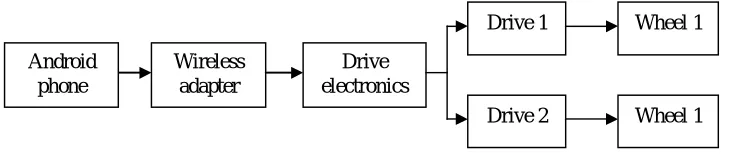
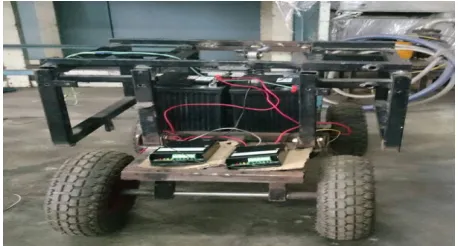
In this paper joystick control is replaced with an android cell phone as user interface to control the system digitally. Wireless adapter to receive the command from mobile phone Figure 2 shows the motorised wheelchair with mobile phone control.
Figure 2: Motorised wheelchair with mobile phone control
More development in field of internet of things, IOT devices are available at low cost and are compatible to standard mobile phone architecture. lot of control at home are being transformed to IOT moving to simplicity at the user interface side. IOT devices encompass earlier standard which were used in home such as Bluetooth and Zigbee are overlaid by IOT device such that one can control just by an IP address from anywhere. Similarly a device at home can be controlled within a cell phone at home without having to use the internet by using the same thing in Wi-Fi as an intranet. This paper provides both modes of working an intranet where it’s an internal LAN network through Wi-Fi can be used or the command can also go to the web and comeback if it is a remote control from somewhere else if it was not within the range also. However for a wheelchair, self-use purpose internet may not use but protocol remains same for both internet and intranet control. Both internet and intranet uses same TCP/TP protocol the difference is local IP address for intranet and internet IP address for internet.
II. SYSTEM OVERVIEW
Android phone is used as an input and an application is developed in android platform which acts as virtual joystick. ESP8266 microcontroller which has an inbuilt Wi-Fi is used for wireless communication. Two 24V DC drives are used to drive two different DC motor. Microcontroller operates on 5V supply which is provided with the help of LM7805 which is a 5V regulator IC by converting 24V into 5V. Two 24V DC motors are used for the movement of the wheel chair in Forward, Reverse, Left, and Right Direction. The speed and direction of these two DC motors are controlled
Drive electronics Joystick
Wheel 1 Drive 1
Drive 2 Wheel 1
Drive electronics Wireless adapter Wheel 1 Drive 1
Drive 2 Wheel 1
III. WORKING PRINCIPLE
Initially Service Set Identification (SSID) and password for the ESP8266 Wi-Fi module is assigned so that when the Wi-Fi module is broadcasted using Access Point mode (AP mode), stations nearby device can find the AP. SSID is used an identifier for WLAN, and is inteded to be unique. It is often a human-readable string and thus commonly called the network name. Start ESP8266 in server mode so that Wi-Fi module starts listening for incoming connections. If server is available client (Android Phone) can connect to server (ESP8266) when client is connected ESP8266 will assign an IP address to the Android phone. ESP8266 will continuously check for command from client, the command sent from the client is received as a string by the server and stored in a variable. Based on the string received from client required operation is done in ESP8266.
IV. TEST AND RESULTS
V. CONCLUSION
A cost effective embedded wheelchair controller system using ESP8266 controller is developed and is moved in different directions with different speed using an android mobile phone. For future scope the system can voice controlled and obstacle sensing technique can be adapted to same wheelchair therefore it is a valuable tool for physically challenged and elder people.
REFERENCES
[1] Jayesh K Kokate and A.M.Agarkar, “Voice Operated Wheelchair”, International Journal of Research in Engineering and technology, 2014, Vol. 4, pp. 1370-1373.
[2] Archana Hule, Rekha Bandage, Pratik Shah and Rashmi Mahajan, ”Android based application for wireless control of wheelchair”, International Journal of Research in Engineering and Technology, 2015, Vol 4, pp. 406-408.
[3] S. D. Suryawanshi , J. S. Chitode and S. S. Pethakar “Voice Operated Intelligent Wheelchair”, International Journal of Advanced Research in Computer Science and Software Engineering, 2013, Vol 3, pp. 487-490.
[4] Nirmal T M, “Wheelchair for Physically and Mentally Disabled People”, International Journal of Electrical and Electronics Research, 2014, Vol 2, pp. 112-118.
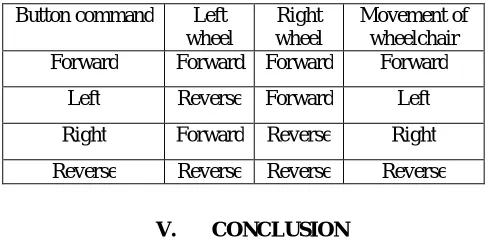
Button command Left
wheel
Right wheel
Movement of wheelchair
Forward Forward Forward Forward
Left Reverse Forward Left
Right Forward Reverse Right