ABSTRACT
MOSES, MYRA GAIL. Knowledge Contribution in a Non-Formal Virtual Setting through a Social Constructionist Approach: A Case Study of an Online Learning Community. (Under the direction of Dr. Ellen Vasu.)
This study explored an online learning community in a non-formal educational setting and the process participants used in order to share, create, and construct knowledge through their interactions in the online community. Participants in the study were college interns who were part of a grant that focused on providing professional development for interns through training them to implement leadership and lifeskills activities. The activities were conducted with youth in military families who were dealing with deployment issues.
Knowledge Contribution in a Non-Formal Virtual Setting through a Social Constructionist Approach: A Case Study of an
Online Learning Community
by
Myra Gail Moses
A dissertation submitted to the Graduate Faculty of North Carolina State University
in partial fulfillment of the requirements for the Degree of
Doctor of Philosophy
Curriculum and Instruction
Raleigh, North Carolina 2012
APPROVED BY:
_____________________________ _____________________________ Kevin Oliver R. Dale Safrit
_____________________________ _____________________________
Ellen Vasu Meghan Manfra
BIOGRAPHY
Myra Gail Moses was born in the Appalachian mountains of North Carolina. She
began her higher education at NC State University where she earned a bachelor’s degree in
English. She taught high school English for four years before returning to obtain her
master’s degree in technical communication. She taught professional communication for
engineering students at NC State, where she became interested in instructional technology
and teaching online. She also became interested in youth leadership development and civic
engagement, which led to her work with the General Shelton Leadership Center. Myra’s
interest in connections between instructional technology, youth development, and civic
engagement led her to seek her doctorate in Curriculum and Instruction and focus on
ACKNOWLEDGEMENTS
I have been fortunate to have numerous supporters who made this study possible. I
thank my committee who made this an enjoyable, rewarding journey. My advisor, Dr. Ellen
Vasu provided constant support and wise counsel through many of my shifting ideas and
life circumstances. My co-‐chair Dr. Meghan Manfra helped keep my writing focused and
taught me a great deal through her enthusiasm for qualitative research. Dr. Kevin Oliver
helped ground my study in practical application and supported me from my first doctoral
class all the way through my defense. Dr. Dale Safrit shared his expertise with non-‐formal
education and professional development and was an inspiration in his student-‐centered
approach to his work.
I thank the Project YES interns without whom this study could not have happened.
The study participants whole-‐heartedly helped in so many ways throughout the research.
All of the interns in Cohorts 1-‐3 and the Project YES staff encouraged me and shared so
many aspects of my doctoral journey. I am proud of, and grateful for, the work we do
together and look forward to continuing.
I thank the staff and students of the General Shelton Leadership Center. I am grateful
to Dr. Mike Davis for his serendipitous phone call that ultimately led to this doctoral study
and for his unfailing kindness and support. I appreciate the encouragement from all the
past and present students and staff. Your interest and support have meant more than I
could ever express. It is an honor to work with a group that truly exemplifies values-‐based
I thank my friends and colleagues, Dr. Kathy Lohr and Dr. Debbie Acker who were
never too busy to listen and who always provided timely advice and support. Thank you for
helping me keep things in perspective and maintain a semblance of balance in my life
through this journey.
I thank my family – my mother for stressing the importance of education, and my
siblings for always believing in me and loving me. I am especially grateful to my sister, Julie
Moses who is always there. And, I thank James and Noah Starrette for their love and
TABLE OF CONTENTS
LIST OF TABLES ... viii
LIST OF FIGURES ... ix
CHAPTER ONE: INTRODUCTION ...1
Background ...5
Statement of Problem ...8
Purpose of the Study ...9
Research Questions ...11
Definition of Terms ...12
Theoretical Framework ...14
Significance of the Study ...15
CHAPTER TWO: LITERATURE REVIEW ...17
Theoretical Framework ...19
Review of Literature ...19
Summary ...44
CHAPTER THREE: RESEARCH DESIGN AND METHODS ...46
Rationale for Qualitative Research ...46
Rationale for Research Approach/Genre ...48
Data Collection ...50
Introduction and Overview ...50
Research Sample ...52
Data Collection ...55
Placement of Data, Storage of Data ...58
Ethical Considerations ...59
Data Analysis ...60
Data Display ...63
Researcher and Subjectivity Statement ...64
Veracity and Trustworthiness ...67
Summary ...68
CHAPTER FOUR: FINDINGS ...69
Perceptions of Place ...71
Sense of Self ...91
Purpose and Values ...105
Summary ...120
CHAPTER FIVE: DISCUSSION AND IMPLICATIONS ...121
Overview and Significance of Findings ...122
Implications for Practice ...134
Recommendations for Future Research ...142
Conclusion ...145
REFERENCES ...148
APPENDICES ...158
Sample Schedule from Project YES Event ...158
IRB Request for Exemption ...164
Recruitment Email ...170
Consent Form ...171
Interview Protocol ...174
LIST OF TABLES
Table 1: Connections Between Data Sources and Research Questions ...61
Table 2: Themes and Subcategories ...70
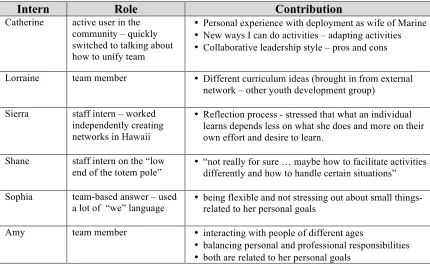
Table 3: Perceptions about Roles and Contributions ...94
Table 4: Knowledge Contribution Across the Event Phases ...106
Table 5: Technologies Used in Project YES ...114
Table 6: Technology Preferences ...115
Table 7: Levels of Awareness and Knowledge Contribution ...126
LIST OF FIGURES
Figure 1: Kolb’s Learning Cycle ...40
Figure 2: Timeline of Project YES Study ...55
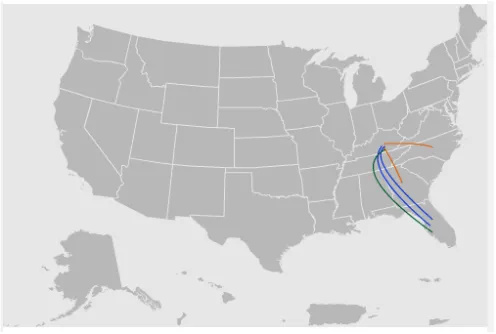
Figure 3: Catherine’s Subnetwork – California ...76
Figure 4: Lorraine’s Subnetwork – North Carolina ...76
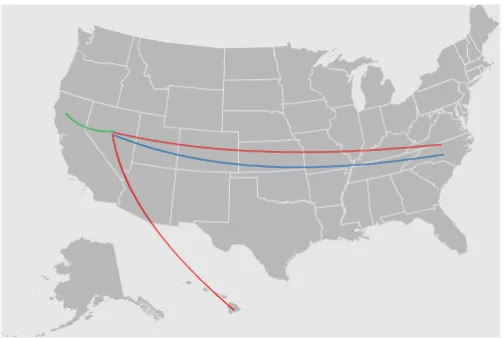
Figure 5: Sierra’s Subnetwork – Hawaii ...77
Figure 6: Shane’s Subnetwork – Kentucky ...77
Figure 7: Sophia’s Subnetwork – Nevada ...78
Figure 8: Amy’s Subnetwork – Wisconsin ...86
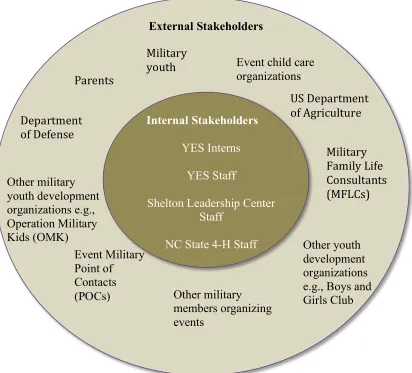
Figure 9: Project YES Stakeholders ...86
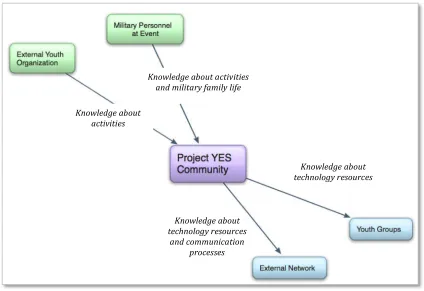
Figure 10: External Networks and Knowledge Flow ...89
Figure 11: Convergence of Themes and Knowledge Contribution ...124
Figure 12: Knowledge Providers and Knowledge Seekers ...131
Figure 13: Potential Bi-directional External Knowledge Flow Networks ...141
CHAPTER 1: INTRODUCTION
Project YES is a virtual community of learning and practice that trains college interns to deal with issues military youth whose families are being impacted by deployment may face. Recent studies are showing that due to increases in deployment, longer deployment, and inadequate family support systems, many youth in military families are experiencing
increases in symptoms of depression, symptoms of uncertainty and loss, boundary ambiguity, and relationship conflict (Houston et al, 2009; Huebner et. al 2007). The interns in the Project YES program are trained, primarily through online training, to support military youth and sometimes have to be prepared to handle sensitive issues that may potentially have serious consequences for military youth if not handled appropriately; therefore, it is
imperative that they receive proper training and share what they are learning about effective ways of working with military youth. The following story is an example of when a Project YES intern had to deal with such a situation.
At a military youth event on the West Coast in the spring of 2011, a 14-‐year-‐old young woman (Aubrey1) whose father had just returned from a long deployment was refusing to participate in the leadership activities being facilitated by Project YES interns. One of the female interns (Sophia), a college junior, at the event is considering a career in family counseling or clinical psychology, possibly working with young people. The intern noticed Aubrey had distanced herself from the group and seemed resentful about
everything she was asked to do. Sophia gradually began talking to Aubrey one-‐on-‐one between the activities until she built up enough trust that Aubrey began explaining what was bothering her. She was having a difficult time dealing with her father’s reintegration with the family after his deployment. She felt that her parents were not listening to what she needed or wanted and were deliberately trying to sabotage the things she wanted to accomplish. She talked about dealing with her father’s differences in personality and actions, the anger, the distance and uncertainty, since he had returned and the stress that was putting on the entire family. She shared how she kept getting in trouble at school and
making her parents and teachers angry, even though she wanted to succeed and go to college. She explained feeling out of control of what was happening in her life, at home, at school… and having nowhere or no one to turn to.
Sophia talked with Aubrey and shared some of her personal background from times when her life had not been easy. She talked about options and suggested people Aubrey could talk to who might be willing to help her. At the end of the event, she told Aubrey that if she ever felt like no one cared for her, she would be wrong, because she cared. She gave Aubrey her personal contact information and told her it was okay to call at any time. Aubrey kept in touch occasionally with updates about school.
One day about three months after the event, Sophia received a call from Aubrey who talked about how things had gotten worse and how she was thinking of “escaping.” The conversation continued and Sophia realized Aubrey was talking about committing suicide. She begged Aubrey not to hurt herself and to stay in touch. Aubrey agreed, but soon stopped responding to calls, texts, Facebook, or emails. Sophia did not want to get Aubrey in trouble, but she was concerned. She lived several states away and could do no more personally. She contacted Project YES staff and together they worked with military personnel to get someone involved who could get in touch with Aubrey. Fortunately, Aubrey was still alive, although she had engaged in some self-‐harming behaviors. The military personnel were able to work with Aubrey to try to get her some help.
Currently, Aubrey is too upset to talk with Sophia; and, due to confidentiality regulations, Sophia does not know details about what happened, but she knows Aubrey has a support system now that she did not have before. At a minimum, Sophia was instrumental in getting Aubrey help…on a larger level, she may have helped save her life. In reflecting on the experience, Sophia has come to realize how much it has helped her personally and professionally. She wants to work with people but struggles to accept her ability to connect emotionally with young people about serious issues. This has been a personal development experience that built her confidence. It has also been a professional development opportunity where she learned more about issues that are considered a “duty to report” and how to use her resources to help someone several states away.
appropriately in a situation where her decision may have been one of life or death. Since the incident with Aubrey, Sophia has also engaged in online discussions with some of her peers about how she may have been able to handle the situation better, and how she can be more prepared in the future. She has shared her experiences about the procedural steps that have to be taken so that other interns may be better prepared if they should ever face similar
situations in the future. Together, the interns are engaging in sharing knowledge about how to engage more effectively in their work with military youth. When she was asked about how to do engage in sharing knowledge and helping peers online through a technology-mediated community, Sophia said:
It’s knowing how to make lifelong friendships or lifelong connections, or having
someone inspire you to want to change. And how you can inspire them as well. So,
yeah, that’s how technology works. You have those connections to people who
don’t live where you live, or don’t experience the same things you experience or
have the same culture as you. You have different ways of communicating and have
different ways of showing them…letting them inside your world or your life for
just a little bit.
In addition to impacting interpersonal connections like Sophia described, as social media and e-learning technology continues to evolve, students are engaging with each other more frequently in online settings to create and explore meaning associated with academic concepts, as well as other areas of interest connected to their research or projects. Education professionals are attempting to facilitate the interaction of students in online learning
communities can provide a forum to facilitate knowledge sharing and encourage reflective practice (Clarke, 2009; Gannon-Leary & Fontainha, 2007; Hylton, 2007). Online learning communities can also serve as an effective venue for ongoing professional development in academic settings such as teacher education (Duncan-Howell, 2010; Yang & Liu, 2004) and healthcare education (Bryan, 2009; Reilly, 2009; Richards, 2008). Some corporate fields, such as health-care organizations (Billings, & Kowalski, 2005), and technology-based organizations (Bouhnik, Giat & Sanderovitch, 2009; Johnson & Senges, 2010), also use online learning communities as part of their continuing professional educational strategy.
Continuing professional development for learners in non-formal learning
environments, such as staff and volunteers working in 4-H and other Extension and youth development areas is often identified as a critical programmatic component (Diem, 2009; Fox, Herbert, Martin, & Bairnsfather, 2009; Huebner, Walker, & McFarland, 2009; Schmitt-McQuitty, Smith, & Young, 2011). Due to recent budget cuts, professional development for students and staff in non-formal learning environments is often limited (Fox et al., 2009; Huebner et al., 2009). Moving toward online training is a way to address the increased need for training despite budget decreases (McCann, 2007; Kaslon, Lodl, & Greve, 2005;
Senyurekli et al., 2006).
community. Some scholars, such as Kaslon, Lodl, and Greve (2005) have posited that offering professional development training in non-formal educational settings would have similar benefits as offering online training in academic settings. However, there seem to be few instances where professional development training is conducted as part of an ongoing virtual learning community and participants interact regularly in a non-formal learning environment.
Background
In order to address this gap regarding professional development training, this study examines a non-formal, virtual learning community that provides professional development through training interns to plan and implement youth development leadership activities. The online learning community is comprised of college interns who are part of Project YES. Project YES is a relatively new grant program that uses an online learning community with college interns from around the country. The online community provides ongoing training and a space for interns to collaborate on event planning and share their experiences with the team. Project YES interns learn professional development skills while working with youth between the ages of 6-18 who are members of military families being impacted by
deployment. The college interns travel to military youth events in different states and implement interactive, hands-on activities focused on leadership, life skills, and Science, Technology, Engineering and Mathematics (STEM).
program has a vested interest in providing effective, ongoing professional development for its interns. The purpose of the grant is two-fold: it is a workforce development program for college interns who are interested in careers in Extension, Military Family Life Support Services, or non-profits; and it is a program to support military youth whose families are being impacted by deployment issues. The college interns are involved in ongoing professional development, and they practice their skills by coordinating and conducting youth development programs with military youth at military family events. Due to the geographic distribution of the interns, the training is delivered through a blended model. There is an initial face-to-face meeting followed by online professional development training, much of which occurs online As the training coordinator, I am committed to creating an online learning community where interns can be involved in professional development as both participants and facilitators.
implemented at an event.) The training also included logistical training of what is expected from a Project YES intern, such as travel procedures, budget information, professionalism, and technical equipment training, such as how to use their flipcams and portable projectors. After the initial training, ongoing training and interaction with staff and fellow interns is conducted in some face-to-face settings, but the majority of the training occurs in online settings.
After the initial training, the interns are typically sent to military youth events in two to four-person teams. The makeup of each team depends on how many military youth are projected to attend an event and the availability of the interns. Each event is different, but generally during the school year an event occurs from a Friday night through Sunday at lunch time. The interns arrive at the location Friday afternoon. Any activities Friday night are casual and short. Saturday morning the interns begin a full day of activities with the youth. The day usually runs from around 7:30 am-4:30 pm. The interns work with the youth while their parents are in military briefing sessions. On Sunday the interns work with the youth from 7:30 am – 11:30 am.
Although some groups of staff and interns meet occasionally at events, overall, the intern teams are rarely comprised of the same people, so face-to-face meetings between any particular interns or staff are fairly infrequent and are unpredictable. Consequently, the majority of ongoing training and interactions among the interns, and between the interns and the staff, have occurred in an online environment. I am engaged in this study because I am interested in connections between instructional technology, professional development, youth
development curriculum, and civic engagement. My current position as the training and
curriculum coordinator with Project YES allows me to develop online trainings and
curriculum for college interns and military youth. My study will include analyzing the
effectiveness of the online learning community created by the interns. I am very curious
about ways to create online learning communities that successfully go beyond merely
delivering content online. The study is not officially part of my job, but it will be beneficial
in helping me better understand many factors of my job, and may assist in making
improvements to the program. Both knowledge sharing and reflection are important activities to enhance the individual and collective progress of programs as Project YES; therefore, the study may also help other teachers and students engaged in similar non-formal, online
learning environments.
Statement of Problem
Some corporate fields, such as health-care organizations (Billings, & Kowalski, 2005), and technology-based organizations (Bouhnik, Giat, & Sanderovitch, 2009; Johnson & Senges, 2010), also discuss using online learning communities. However, few sources discussed whether and how other extension and youth development programs, similar to Project YES, incorporate online training and distance education. The majority of the materials found that related to this topic were from the Journal of Extension addressing the need for continuing professional development in general; and descriptions of specific technologies and
technology integration methods being used in Extension contexts. Articles from other Extension journals, if they addressed the topic, usually focused on the use of technology in an academic course, as opposed to technology being used in training and professional development settings. Therefore, there seem to be few instances discussed in the literature where training is conducted as part of an ongoing online learning community and participants interact regularly in a non-formal learning environment like Project YES.
Purpose of the Study
educational settings. The findings might help future participants and facilitators of online communities create more effective learning environments. The Project YES study collected data about experiences the YES interns had in their online learning community in order to analyze how the interns create and explore knowledge in an online learning community; and to analyze how technology contributes to or hinders creating, constructing, and sharing knowledge within the virtual learning community.
The purpose of the Project YES study parallels the purpose of case study and qualitative research overall. Case studies are generally presented as one of the common qualitative research methods (Creswell, 2007). Based on definitions from different
apparent that the knowledge contribution happened in part because of the personal
relationships among the interns. Therefore it became important for the study to look at some aspects of the existing relationships and explore what factors of the relationships encouraged and supported knowledge contribution.
Bogdan and Bilken (1998) discuss other purposes of qualitative research that relate to case studies and Project YES. They state that one potential purpose is description.
Description was relevant, because one objective of this study was to describe the process of knowledge contribution and the factors that contribute to and hinder it. Bogdan and Bilken discuss another purpose of qualitative research, which is to “better understand human behavior and experience. They seek to grasp the processes by which people construct meaning and to describe what those meanings are” (p. 38). The Project YES study also incorporated these purposes: the study is attempting to better understand the behavioral aspects of how the participants interact online as they work together and share their experiences.
Research Questions
This study focused on exploring how participants in an online learning community interacted with each other using technology to build and share knowledge as part of their ongoing professional development. The participants enhanced their skills while working with military youth. The overall research question for this study was: To what extent do
Subquestions:
• What patterns of interaction emerge among the interns that foster knowledge sharing, construction, and creation?
• How do the technology tools facilitate the various modes of knowledge contribution?
• When does knowledge sharing, construction, and creation occur in the online setting? • What impact does the knowledge sharing, construction, and creation process have on
the professional development goals of the interns?
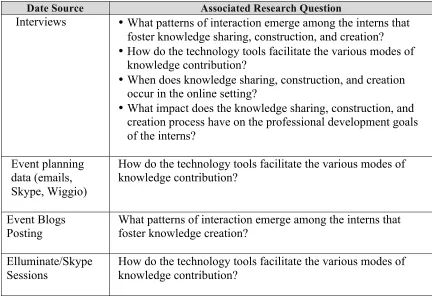
(See Appendix B for connections between the interview questions and the subquestions.)
Definition of Terms
Several terms about subtle differences in variations in online community and concepts of knowledge building were important to this study. It was important to consider the terms within the context of the scholarship and how they applied to the Project YES study. The terms included:
meet their own requirements.
• Formal education – Coombs (1973) defines formal education as “the hierarchically structured, chronologically graded educational system running from primary school through the university and including, in addition to general academic studies, a variety of specialized programs and institutions for full-time technical and professional training” (p. 11).
• Informal Education – Informal education occurs when an elder or a peer explains unplanned or unorganized activities to a participant (Kleis et al., 1973).
• Knowledge construction - Van Aalst (2009) defines knowledge construction as “the processes by which students solve problems and construct understanding of concepts, phenomena, and situations, considered within cognitive psychology,” (p. 261-262). • Knowledge creation – Knowledge creation is defined as the process of developing
the ideas needed to sustain innovation” (Van Aalst, 2009, p. 261-262). • Knowledge sharing – Knowledge sharing is defined as the “transmission of
knowledge between people” and notes that only information can be shared, and it only is knowledge if the sender or receiver understands it (Van Aalst, 2009, p. 260). • Non-formal Education –Non-formal education is defined as: “Any intentional and
• Social Constructionism – Social Constructionism has similarities to a constructivist perspective; however, as Papert (1991) explains it adds a social dimension about the context where learning occurs.
• Virtual Community of Practice - Gannon-Leary and Fontainha (2007) define a Virtual Community of Practice (CoP) as a “network of individuals who share a domain of interest about which they communicate online” (p. 98). Chen, Chen, and Kinshuk (2009), define a virtual learning community as a cyberspace community driven by information technology where people from different geographic areas work to accomplish e-learning objectives.
• Wiggio – According to their website, Wiggio is designed to be a “free, online toolkit that makes it easy to work in groups” (Wiggio, 2012). Wiggio provides a platform for group tasks such as conference calls, to-do lists, event management, shared files, group polls, emails, texts, and voice messages.
Theoretical Framework
This study was guided by the concept of Social Constructionism. Constructionism has similarities to a constructivist perspective; however, as Papert (1991) explains in his
own prior knowledge and the environment where the idea will be used (von Glaserfeld, 1995). Piaget (1978) emphasized that learning occurs through actively constructing knowledge instead of passively receiving it. This concept is directly related to notions undergirding experiential learning and the learner’s development. Vygotsky (1978) posited that cognitive development does not occur when an individual learns to do something new. Instead, it occurs when someone can do something on their own that they have previously been doing with the support of someone else.
Elements of constructivism are evident throughout Project YES. For example, the learning model of the entire internship is based on experiential learning, which has connections to constructivism and Kolb’s Experiential Learning Cycle (Kolb, 1984). However, constructionism is more relevant to the Project YES virtual learning community because of its perspective that learning occurs within social interaction and is extremely effective when the learners are constructing an entity for the purpose of having others experience it (Papert 1991). The tenets of social constructionism that can be associated with Project YES are discussed in detail in chapter 2.
Significance of the Study
CHAPTER 2: LITERATURE REVIEW
In the Project YES online learning community, the interns work on professional development goals and interact with each other in creating and sharing knowledge about working with military youth. Some interactions occur in face-to-face settings at training sessions, or military events; however, the majority of the interactions occur in an online environment. The Project Yes online community integrates a variety of technologies including: Skype, email, a social networking platform, Elluminate, and Dropbox. The purpose of the online community is to provide space for interns to: discuss their experiences and share tips and strategies with each other; present and track logistical information; participate in additional training; and enhance their professional development skills.
This case study used social constructionism (Papert, 1991; Lock and Strong, 2010) as the theoretical framework to analyze how interns interacted with each other and the
technology regarding the purposes of their online learning community. Additional areas of literature that were significant to the study are: Online communities (learning communities and virtual communities of practice); knowledge sharing, construction, and creation; and professional development in a non-formal learning environment.
The overall research question for this study is: To what extent do participants of an educational online learning community in a non-formal setting engage in sharing,
constructing, and creating knowledge? Subquestions:
• How do the technology tools facilitate the various modes of knowledge contribution?
• When does knowledge sharing, construction, and creation occur in the online setting? • What impact does the knowledge sharing, construction, and creation process have on
the professional development goals of the interns?
The study explored elements of these themes and how they connected to and influenced the actions and impacts of the online learning community. To keep an online learning
community vibrant and evolving, it is important to examine how people interact within a community and how the community changes over time (Laghos, 2010). The Project YES online community functions as a community of practice and learning in face-to-face and virtual capacities as they plan and implement leadership development, life skills, and
Science, Technology, Engineering, and Mathematics (STEM) activities with military youth. Project YES is a relatively new grant program that trains college students to facilitate activities designed to help military youth deal with issues associated with their family
work with each other in teams to plan the youth development events and to conduct activities with the youth. In addition to helping plan curriculum necessary for conducting youth events, the team interactions also support the interns in learning leadership skills, such as situational leadership styles, conflict management, and project management skills.
Much of their interaction occurs online since the interns are geographically dispersed throughout the United States. In looking at blended groups that combine online and face-to-face elements, Arnold and Paulus (2010) questioned “[w]hat happens when a group of learners has two venues for community building available…? Does this create two separate communities or do they overlap? Which tools do they choose to use and for which aspects of community building?” (p. 195). These questions were relevant for the Project YES case study in examining the various dimensions of the community, and while the primary focus of the study was centered on dimensions of the virtual community, the research addressed how the face-to-face dimension impacted the online interactions.
Theoretical Framework
In the Project YES community, the interns are constructing an experience for the military youth through working together in teams to plan and facilitate leadership
development activities onsite at a military youth event. (See Appendix A for a sample of activities that the interns implement with the youth.) The interns create knowledge for each other and the military youth through their interactions in the learning community; therefore, the aspect of Social Constructionism that learning occurs within social interaction is
…shares constructivism’s connotation of learning as ‘building knowledge structures’ irrespective of the circumstances of the learning” then adds the ideas that this happens especially felicitously in a context where the learner is consciously engaged in
constructing a public entity, whether it’s a sand castle on the beach or a theory of the universe (p. 1).
The “public entity” that Project YES interns are constructing is a body of knowledge and experiences that can support them and enhance their impact as they work with military youth if they share the knowledge and create it together.
Papert (1991) claimed even the definition of constructionism must be constructed conceptually since it may be different for each particular environment. Lock and Strong (2010) stated, “…there is no one school of social constructionism….There are, though, some expansive tenets that hold it together” (p. 6). They provide the following five tenets to describe social constructionism:
• It is concerned with meaning and understanding as the central feature of human activities.
• The view that meaning and understanding have their beginnings in social interaction, in shared agreements as to what these symbolic forms are to be taken to be.
• Ways of meaning-making, being inherently embedded in socio-cultural processes, are specific to particular times and places. Thus the meaning of particular events, and our ways of understanding them, vary over different situations.
delineate but, rather, our ways of making sense to each other are constructed to yield quite different ways of being selves.
• The adoption of a critical perspective to the topics at hand, that is, a concern with revealing the operations of the social world, and the political apportioning of power that is often accomplished unawares, so as to change these operations and replace them with something that is more just.
(p. 6-9).
Aspects of Lock and Strong’s tenets were incorporated into the Project YES study. The principles in the tenets are a part of how the interns interact and define themselves and each other are important to how they work to create youth develop programs that will help mitigate the impacts of deployments on military youth. The purpose of the work to offset negative impacts of deployment links to the fifth tenet regarding social justice. While it was not the focus of the study, [art of the evaluation for Project YES could have included
analyzing whether indications of a social justice awareness of the program and their work is overtly present in the community. While this is not a primary concern of the study, it is another example of how a social constructionism perspective is relevant to Project YES.
Perhaps the most significant relevance of social constructionism to Project YES is that constructionism does not have a prescribed format and that leaves room for communities and learners to evolve in the ways they need. Hibberd (2005) notes that “[f]or many, social constructionism enables an unconstrained and unlimited outlook …nothing fixed or
community will need that kind of unconstrained attitude in order to adapt, sometimes quickly, based on the changing needs of both the interns and the military youth. It is
important that interns have the flexibility to refresh and revise curriculums and approaches as they learn more about the military youth and their needs. The same flexibility will also be important as the interns become more deeply involved in their professional development and as a result, have to make changes to the knowledge held by the community as well as
processes they use to interact with each other.
Review of Literature Online communities.
Several scholars discuss the differences between learning communities and communities of practice (Ardichvili, 2008; Wenger, 1998). In a learning community, participants are intentionally focused on learning information or skills and may engage in sharing that information (Wenger, 2006) In a community of practice, learning may be intentional, or it may be a byproduct of the community, but the community engages in activities that support their practice (Wenger, 1998). Jean Lave and Etinne Wenger were the first to use the term “community of practice” in their 1991 work “Situated Learning:
The Project YES online community is a learning community and a community of practice. Learning within the community is intentional in that experiences and activities are designed to facilitate the interns learning about themselves, about interacting with each other, youth, and people in professional settings. They are also sharing that knowledge with each other as they engage in professional development activities. They develop knowledge that informs their own individual practice and that of other interns. Wenger (2006) defines
communities of practice as “groups of people who share a concern or a passion for something they do and learn how to do it better as they interact regularly. The Project YES interns fit this definition in that they share a passion for working in areas of youth development, and a larger responsibility of being an intern is to continually improve their facilitation and curriculum implementation skills with the youth.
Virtual communities of practice.
Since most of their interaction occurs online, the Project Yes interns are members of a virtual community of practice. Chen, Chen, and Kinshuk (2009), define a virtual learning community as “the information technology based cyberspace in which individuals and groups of geographically dispersed learners accomplish their e-learning goals” (p. 136). Just as with face-to-face communities of practice, virtual communities of practice share the same distinction of building knowledge in additional to learning and sharing. Wenger (2001) states:
develop their shared practice by interacting around problems, solutions, and insights, and building a common store of knowledge (para 2).
Chiiu et al. (2006) define a professional virtual community as “an online social network in which people with common interests, goals, or practices interact to share information and knowledge, and engage in social interaction” (p. 1873). The social interaction is facilitated in part by the technology, which impacts the interaction. Wenger, White, and Smith (2009) examine how technology and people’s interaction with it has changed how communities engage with each other. They discuss how technology is currently “incorporated more deeply and broadly into the regular life of communities,” and [t]he boundaries between tool
selection, configuration, facilitation, and design are increasingly blurred (p. xii). They also examine how communities use tools in new ways based upon their purposes and the tasks they want to accomplish. Arnold and Paulus (2010) also discuss the phenomenon of communities using tools in different ways, which impacts the communities’ interactions in that “[p]eople often appropriate technology, reinventing it for their own uses – uses which may different from the designers intentions” (p. 194). In the first year, Project YES interns have used technology differently than the training and curriculum coordinator had originally intended and some of the changes have improved the community and their online
interactions. It was important to evaluate how the interns used technology in the second year and how their use of technology impacted their participation in the community.
they initially participated. They wanted to be prepared for their events and they participated in the online community in order to do so. However, this reason for participating may only have led them to do the required activities. The sense of responsibility to the team and to each other individually led to differing levels of participation. Chiu, Want, Shih, and Fan (2011) relate this sense of responsibility to social exchange theory and claims “when an individual participates in a virtual community, a psychological contract is being made with them that the other members will fairly discharge their obligations to reciprocate” but that if the participants perceive the contract to have been violated, they experience feelings of dissatisfaction (p. 139). This has been relevant to the Project YES interns in the first year when interns have not responded to team forums and have missed Skype calls. The study for year two analyzed these perceptions of responsibility that the interns felt towards each other and how it impacted the teams when others did not uphold those expectations. This was significant because satisfaction with the community increased the likelihood that participants engaged in positive interactions within the community, such as responding to others, or voluntarily providing useful information (Rusbult & Buunk, 1993).
spaces visible to all participants. This sense of enjoyment does not seem to have evolved for all of the interns. It was important to include in the evaluation why the interns participated and interacted the way they did because higher levels of interaction would be beneficial to the online community.
Another characteristic that impacts participation in an online community is how they integrate new members (Ardichvili et al., 2006). In their theory of legitimate peripheral participation, Lave and Wenger (1991) describe the expectation that new members of the community learn from their social interactions with the experienced members and then from their interactions with each other and then how new members begin to contribute to the community. In an online learning community, newcomers may engage in what Arnold and Paulus term “pedagogical lurking.” This is invisible interaction, such as participants reading forum postings but not replying and looking at work posted by other participants but not contributing any of their own. Some studies have examined ways to track lurking behavior and whether it contributes to participants’ learning, or if it has a negative impact on
Scholars discuss additional characteristics of communities of practice that apply to both face-to-face and online communities. Wenger (1998) describes communities of practice as being “[p]laces of identity to the extent that they make trajectories possible – that is, to the extent they offer a past and a future that can be experiences as a personal trajectory” (p. 215). This idea of a developmental trajectory is relevant to the professional development aspects of Project YES. The interns should be able to track their progress as they work on developing and enhancing their leadership skills. The evaluation of Project YES looked for instances where the interns documented or discussed their progression and how it was or was not facilitated by the technology.
Best practices.
Some of the best practices for learning communities and communities of practice identified by scholars and practitioners include:
• Conducting face-to-face meetings if possible before embarking on a virtual
community of practice (Ardichvili, 2008). Project YES currently does this through the face-to-face orientation at the beginning of each year. Interns also get to see some of the peers at the military events. However, it would be beneficial if a mid-year face-to-face meeting could be arranged.
• Teaching learners how to interact online. The community will not just happen by itself, so learners must be taught how to form online learning communities
• Promoting personal knowledge-based trust and institution-based trust in order to promote participate in virtual communities (Ardichvili, 2008). Addressing
knowledge-based trust in particular will be important because several of the interns during year one expressed discomfort and uncertainty regarding their competence when they were asked to take on responsibility individually.
• Providing spaces for optional, informal learning (Clarke, 2009). Based on shared stories, some informal learning occurred on Facebook outside of the official community space. Including a way to capture how the interns interact outside the community will be important to the evaluation, but creating an informal space within the community may also be important.
• Integrating the functions and tools of the online community with how the participants already use technology in their lives (Clarke, 2009). The most significant area for this is the interns’ use of Facebook. Project YES should integrate a formal use of Facebook to promote community building.
• Creating and maintaining core set of members (Wasko and Faraj, 2005). Project YES is attempting to do this by allowing participants to return for consecutive years and by encouraging returnees to volunteer for additional leadership roles. It will be important to evaluate the differences in participation between the
Challenges.
Several scholars noted challenges that may impact projects, such as Project YES and should be considered in the course of the study. The challenges include:
• Participants often prefer face-to-face meetings for group projects. In their study, Arnold and Paulus (2010) found that students viewed the online chat feature as inauthentic and that they preferred meeting in-person. In Project YES, it is not possible for all the interns to hold face-to-face meetings when they are planning their events because of their geographic locations. However, the study examined whether there was a preferred technology for this type of planning meeting. It was also important to determine whether interns who live in close geographic
proximity choose to meet face-to-face.
• Creating an effective community of practice takes time and sustained interaction (Wenger, 2006). The study examined how much time the interns spent and categorized intensity levels of interaction based on the patterns the interns follow. • Participants tend to interact only enough to complete the required tasks (Arnold &
• Adapting when the technology does not work (Arnold & Paulus, 2010). This has been a major challenge for Project YES during the first year due to issues with the social networking platform the community was using. The study looked at
whether the technologies in year two decreased the amount of adaptation due to technical issues. It also looked at how the interns adapted when technology issues arose.
Overall, the purpose of incorporating best practices and addressing challenges is to facilitate the efforts of the interns as they share, construct, and create knowledge in order to improve the practice of working with military youth and enhancing the professional
development of the interns. In this type of “knowledge-creation model students contribute ideas, on which the community works and which thus become its “intellectual artifacts” (Van Aalst, 2009). Although the artifacts become part of the community’s shared repository of knowledge, Wenger (1998) implies that the participants retain ownership over their own ideas and the community’s response to their ideas can impact what type of identity individual participants have within the community. The connections between the constructs of ideas and identity will be important during the study’s evaluation of the knowledge contribution
processes the interns use within the community.
Professional Development in a Non-formal Learning Environment
McFarland, 2009; Schmitt-McQuitty, Smith, & Young, 2011). However, in many instances the training is lacking in various ways, including being limited to initial skill development without providing an ongoing component (Fox et al., 2009; Huebner et al., 2009). According to Borden and Perkins (2006), challenges associated with such training can result in a system where “community youth development professionals are often ill-prepared to meet the growing needs of today’s young people and have to learn on the job” (p. 106). They noted that one challenge was a lack of standards for consistent training across the field, and issued a call to action for the “professionalization of the youth development field” to address the issue.
Another challenge referenced by several articles is impacts on training due to budget-related aspects associated with budget cuts and changes in fiscal accountability (Borden & Perkins, 2006; McCann, 2007; Radhakrishna, 2001; Senyurekli, Dworkin, & Dickinson, 2006). Radhakrishna (2001) lists budget reductions as one of the issues that has strongly affected roles and responsibilities of Extension specialists. Budget decreases can lead to a reduction in staff and create a situation where the remaining staff members are then required to do more work. This could lead to a need for additional training, often at a time when training budgets have been cut as well. Senyurekli, Dworkin, and Dickinson (2006) note “budget decreases can mean limited funds are available for Extension educators to participate in face-to-face training (p. 2). Responsibilities of staff members also shift as funding sources change. Borden and Perkins (2006) discuss how “as public investments in youth
youth development field….Organizations once labeled “fun and recreation” are now embracing larger missions and experiencing greater public accountability, thus placing greater demands on staff” (p. 103). This can type of shift in mission, responsibilities, and performance accountability to funders can result in a need for additional professional development.
Online professional development.
In addition to financial benefits, authors also discussed performance and convenience benefits of providing online training. Kaslon, Lodl, and Greve (2005) posit that benefits related to online education in academic settings, such as providing access to learning during peak time, allowing individuals to work at their own pace, and to have more access to information would also be relevant to online training offered to Extension and youth development volunteers and staff. Another benefit is that online delivery of coursework for youth development workers would be beneficial (Diem, 2009). Diem (2009) conducted a nationwide assessment with 4-H program leaders and other youth development leaders to explore how to better improve youth development program training offered by a university. Eighty-eight percent of 4-H program leaders and seventy-one percent of leaders of other youth development organizations surveyed stated that online delivery of degree course work would be “very beneficial” or “beneficial.” Diem focuses on benefits of youth development workers having a formal youth development leadership degree. Some benefits are that it would decrease some of the need for organizations to offer so much initial training, and provide a more focused approach to understanding the profession and enhance effectiveness of meeting the developmental needs of youth.
used in online training or with youth programming, and c) examples of online training. The majority of the articles also made connections to generalized processes, benefits, and
challenges associated with staff development that may or may not be relevant specifically to online training, but may impact how the technology would be integrated. The relevant observations about more general aspects of training are included in the following sections whenever it is appropriate.
General and technological methods/strategies.
Competency-based approaches.
Some of the calls for action to increase training, especially those calling for the
professionalization of the field suggested that training be based on competencies. In his discussion of Youth Development Leadership degrees and coursework offered by Clemson University for youth development professionals, Diem (2009) mentioned positive impacts of linking the training to 4-H’s Professional Research, Knowledge, and Competencies (PRKC) model. He stated, “the PRKC model provides a good basis for considering the most valuable competencies need by youth development professionals according to leaders of prominent nationwide youth development organizations” (p. 2). Another attempt at standardization in response to lack of training and minimal educational opportunities for youth development professionals was the Build Exemplary Systems for Training Youth Workers (BEST) Initiative, which was started in 1996. The purpose of the BEST Initiative is to help “local communities establish professional development systems for their youth workers, so that youth workers are trained for their profession and connected to an array of programs,
policies, and resources that can help institutionalize the youth development approach in their organizations and communities” (Center for Youth Development and Policy Research, 2002). Program information about the BEST Initiative is now located on the Youth Work Central website.
Competency-based, blended model approach.
science, engineering, and technology (SET) mission. They stress that developing
competencies is important in developing the needed skills, attitudes, and knowledge to work with the SET curriculum. The connection to competencies is relevant to general training regardless of delivery format. However, the authors present the 4-H SET Volunteer
Competences Training Module as a blended model approach that includes both face-to-face and online training. The SET volunteer competencies are the foundation for the training and are delivered/obtained through face-to-face training as well as online modules, self-directed learning, and monthly web meetings. The face-to-face training is short; online modules are accessible at any time; and web meetings occur synchronously through Adobe Connect. This model is fairly similar to that being developed and used with Project YES except the initial face-to-face training is more involved. The authors do not provide any evaluation of the blended, competency-training module but note that it is being tested and that it may have implications for blended models in the future.
Multidisciplinary approach.
Another approach that multiple authors described is a multidisciplinary or multi-faceted approach. Borden & Perkins (2006) believe this is necessary because “In order for these programs to meet the complex and varied needs of today’s youth, a range of educated and experienced community youth development professionals and adequately trained volunteers are needed” (p. 103). In their study, Borden and Perkins indicated their findings
pointed “to a need for a comprehensive, multidimensional educational system to provide
community youth development professionals with the necessary knowledge and skills
his study on participants’ perceptions, Diem found that sixty-six percent of all participants indicated that a multi-disciplinary approach would be better than single-disciplinary approaches. The multidisciplinary approach can be implement regardless of the delivery format, whether it is face-to-face or online.
Virtual communities of practice approach.
Integration technology strategy.
Kotrlik, Redmann, and Douglas (2003) present a strategy that could be useful
regardless of which technological strategy trainers decided to use. In their article, Technology Integration by Agriscience Teachers in the Teaching/Learning Process, Kotrlik et al. discuss how to integrate technology in a formal education setting to train agriscience teachers; however, the strategy could be used in any of the three categories described by Borden and Perkins. Kotrlik et al. suggest implementing technology in training in four separate, stand-alone phases: Exploration, Experimentation, Adoption, and Advanced Integration. The authors suggest that having participants go through these four models could be useful in addressing concerns participants or trainers may have about how the technology fits into the training and how they will learn the new technology.
Specific technologies.
Using the four phases presented by Kotrlik et al. could also be useful when
implementing specific technologies in the training process. Murphrey and Coppernoll (2006) and Coppernoll, Jahedkar, and Murphrey (2006) discuss how to incorporate online
conferencing systems into training. The articles list some of the benefits mentioned earlier, such as reducing travel time and cost and caution that implement conferencing systems must be doing intentionally and with directive guidance for the participants. Murphrey and
and Murphrey caution that the conferencing technology does not replicate a face-to-face setting, so adjustments have to be made in expectations and implementation. They reiterate the need to plan how the technology will be used and stress the importance of instructional design and effective facilitation, which are also points that relate to use of any technology in online training.
reading other people’s posts helped them think about how they would respond. However, seventy-six percent stated they did not think it was a good way to work together, and there was some indication that students may have felt blogs were outdated and instead preferred more instantaneous ways of communicating electronically.
Knowledge Sharing, Construction, and Creation
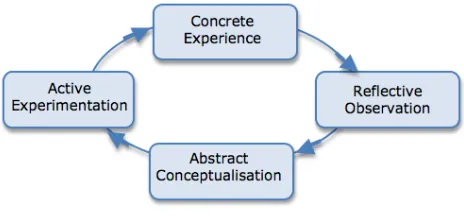
The concepts of knowledge creation and sharing are important to the Project YES community because the internship was designed for participants to engage in an activity, learn from it through reflection, and then implementthe lessons they learned during the next activity. This process follows the phases of Kolb’s Experiential Learning Model (Figure 1),
which was founded in experiential learning theory from a constructivist perspective (Kolb, 1984). Kolb defined experiential learning as “the process whereby knowledge is created through the transformation of experience. Knowledge results from the combination of grasping and transforming experience” (p. 41).
In this model, learners can enter the cycle at any point and continue through the cycle multiple times. In one example for Project YES interns, the concrete experience would be the
youth development events with military youth. Reflective observation occurs during the event, as interns are trained to be reflective in action, and after the event. Abstract
conceptualization occurs when interns create general guidelines for improvement based on what occurred and their subsequent reflection. Then the interns engage in active
experimentation when they apply what they have learned in another setting. This process is one way the interns engage in knowledge-creation.
Modes of knowledge contribution.
The Project YES case study looked at how the interns contributed to the community through sharing, constructing, and creating knowledge. While some scholars and
practitioners may use the words interchangeably, there are theoretical distinctions between the three modes, which Van Aalst (2009) identifies as:
• knowledge sharing –transmission theory of communication • knowledge construction – cognitive psychology (constructivism)
• knowledge creation – interactive learning mediated by shared objects. He defines knowledge sharing as the “transmission of knowledge between people” and notes that only information can be shared, and it only is knowledge if the sender or receiver
different modes throughout their interactions. Part of the Project YES study will examine which modes the interns use and whether there is one mode that is used more consistently than the others. This type of evaluation is important because a community “needs to be able to identify gaps in its collective knowledge, map out ways to fill those gaps, design and manage inquiries, manage social processes, and evaluate progress” (Van Aalst, 2009, p. 263). Understanding what modes of knowledge discourse a community uses can help determine how to fill in the gaps. Van Aalst work on knowledge discourse has its roots in the
Knowledge Building Theory of Carl Bereiter and Marlene Scardamalia.
Best practices and challenges of knowledge contribution.
Several best practices and challenges related to knowledge building within a community were important to the Project YES study. The study evaluated whether the Project YES virtual community contained relevant characteristics and utilized best practices; how well they were implemented and their impact; as well as what challenges arose and how they are addressed. One strategy that Van Aalst stresses is the importance of supporting discourse in knowledge creation, which he says is required “to determine the limits of knowledge in the community, set goals, investigate problems, promote the impact of new ideas, and evaluate whether the state of knowledge in the community is advancing” (p. 260). He identifies the benefits of discourse as helping to determine priorities and goals, deepening inquiry, supporting existing ideas, and helping newcomers integrate into the community.
assets that exist within the community. This would be useful to do this with YES interns. Some interns have done it informally as they have discovered interns who have different skills. For example, interns find out in various ways about interns who have skills with computers, or with adapting lessons for younger children. It would be beneficial to do this asset mapping in a more formal way as many interns have expertise in areas that would support the interactions with military youth. Sippings also mentioned that some participants might be willing to share personal interests, such as hobbies, as a way of knowledge sharing for community building. While this could be beneficial, it may also be a distraction. The study on Project YES examined when this type of knowledge was shared and the resulting perceptions and impacts.
Another successful approach mentioned by several scholars is finding ways to
motivate sharing (Hew & Hara, 2007; Hou, Sung, & Chang, 2009; Sippings, 2007). Hew and Hara state, “motivators for sharing knowledge in online environments may be generally categorized into six types: reciprocity, personal gain, altruism, commitment to the group, ease of technology use, and external goals” (p. 2311). With the Project YES study, it was useful to determine how the interns viewed their participation in relation to these motivators because understanding why they are contributing can help shape activities designed to encourage them to participate in the knowledge building aspects of the community.
appropriate ways to share. He believes that some reasons people do not share are because they may not understand how it is important to them and the community, or do not know the best ways of sharing knowledge. Some scholars mention troublesome technology as a barrier. Chen, Chen, and Kinshuk (2009) cite poor quality of community websites, and some
participants’ lack of capability in using community websites as challenges. Hew and Hara also cite lack of familiarity and a lack of access to technology as potential problems.
Evaluating the role of technology will be part of the Project YES study. During the first year of the program there were several problems with technology that impacted the interactions of the community. The social networking system had numerous technical glitches and some of the interns were confused about using technical tools such as wikis and blogs. In spite of the challenges, the technology was fairly useful and helped support the interns in sharing
knowledge gained from their experiences.
Summary
The Project YES case study focused primarily on how knowledge building and professional development occurred within the virtual community of practice. Since all of the themes, online communities, professional development, knowledge sharing, construction, and creation, and social construction have related constructs, focusing the study on those areas of convergence may yield rich data for research. Exploring the overlaps between the themes, was also beneficial for the learning community as analyzing how a social
CHAPTER 3: RESEARCH DESIGN and METHODS
Online learning communities provide a platform for professional development of participants in a non-formal educational setting through individual interactions and
knowledge contribution. The purpose of the Project YES case study was to explore an online learning community in a non-formal educational setting and the process participants used in order to create and explore knowledge through their interactions in the online community. The following research questions frame the exploratory case study of the Project YES online learning community: To what extent do participants of an educational online learning community in a non-formal setting engage in sharing, constructing, and creating knowledge? Subquestions:
• What patterns of interaction emerge among the interns that foster knowledge sharing, construction, and creation?
• How do the technology tools facilitate the various modes of knowledge contribution?
• When does knowledge sharing, construction, and creation occur in the online setting? • What impact does the knowledge sharing, construction, and creation process have on
the professional development goals of the interns?
Rationale for Qualitative Research
This study was conducted as a case study because it was based on a “bounded system” of the Project YES interns’ online learning community (Creswell, 2007, p. 73). The study explored the experiences of Project YES interns as they interacted in an online