Phishing Analysis in URL Using Machine
Learning
M. Bhuvaneshwari, G.Divya, V. Mageshwari, K. Pavithra Devi, G.V.Dinesh
Department of Computer Science and Engineering, Vi Institute of Technology, Sirunkundram, Kancheepuram,
Tamilnadu, India
ABSTRACT: Malicious Web sites largely promote the growth of Internet criminal activities and constrain the development of Web services. As a result, there has been strong motivation to develop systemic solution to stopping the user from visiting such Web sites.We propose a learning based approach to classifying Web sites into 3 classes: Benign, Malicious and Malware. Our mechanism only analyses the Uniform Resource Locator (URL) itself without accessing the content of Web sites. Thus, it eliminates the run-time latency and the possibility of exposing users to the browser based vulnerabilities.
I. INTRODUCTION
Phishing has become one among the most deadly attacks.
There are various approaches to thwarting phishing attacks from Associate in nursing infrastructure viewpoint such as Phish net, lexical-based on-line learning, and a proactive phishing identification approach. In addition, traditional ways to discourage phishing e-mails square measure through the use of vendor-based solutions like acanthopterygian Email Security entree and Symantec electronic communication entree, but each systems need e-mail traffic redirection to every security appliance. Though trafficker solutions could determine phishing e-mails, they are doing not stop Associate in Nursing user from clicking on a malicious link inside a flagged e-mail which will lead to compromising a computer system.
Considering the massive data existed in network traffic, the primary problem of traffic classification is raised by big data which can be illustrated with three characteristics — volume, variety, and velocity [4], [2]. Traffic classification is facing three
key challenges, which respectively corresponds to real-time classification, unknown traffic classification, and the efficiency
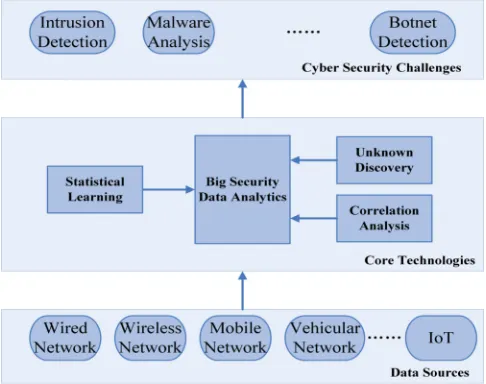
of automatic classification. In terms of real-time classification, statistical-based classification is more suitable than the port-based and payload-based approaches. Statistical-based classification considers the flow traffic as the unit object in analysis, whilst the other two methods build the classifier analyzing the packet information [1]. As for the unknown traffic problem, both supervised learning and unsupervised learning cannot solve the problem alone [5]. Therefore, Zhang et al. [5] proposed a robust network traffic classification with the combination of unsupervised learning and supervised learning to resolve this problem. Lastly correlation technique is often used to improve the classification performance [6], [7]. In summary, the core concepts mentioned above is depicted in Figure 1 with the relationship among data sources, core technologies and cyber security challenges.
II. CYBER SECURITY APPLICATIONS WITH TRAFFIC ANALYTICS
Most cyber security systems rely on the deep understanding of network traffic characteristics. In this section, we illustrate three typical applications of cyber security involving traffic analytics including intrusion detection, malware analysis, and botnet detection.
A. Intrusion detection
An intrusion detection system (IDS) aims at recognizing malicious traffic from normal traffic. To achieve this goal, IDS scans current traffic before rerouting. Because of the hetero-geneous nature of the attacks, the malicious traffic is often embedded in botnet traffic, DoS attack traffic, spam traffic, and so on. The accuracy of detecting such malicious traffic is often low. In general, the target information of inspecting traffic includes IP addresses, ports, and payload data. By analyzing the information, abnormal traffic data can be discovered by an IDS. Then traffic classification is applied to separate these abnormal traffic among existing traffic. Accordingly, alerts will be sent by the IDS.
We use an example to show how traffic analytics is used in intrusion detection. Ling et al. [8] developed TorWard as an intrusion detection system for Tor. Tor is the overlay network often used by attackers deploying botnet C&C servers and/or sending spams because Tor encrypts the traffic and protects the attacker’s privacy. Specifically, Tor enforces source routing by choosing several Tor routers to establish an anonymous route along with the selected Tor routers. There is an exit router where all the routes pass through in the end. This exit router can be considered as a “proxy" and contacts with the destination directly. In order to protect the network system through blocking possible harmful traffic, IP address and opened port can be configured in Tor manually according to specified policies. Unfortunately, It is a hard job for most Tor router administrators to know everything and everyone in the Tor network. Therefore, TorWard is proposed by Ling et al. [8] as an automated detection system in processing Tor intrusion discovery, classification and reaction. The outbound traffic of Tor can be captured at the exit router. Before the traffic rerouted into Tor, an IDS is positioned on the NAT gateway. Ling et al. revised the Tor source code and maintain rules of firewall dynamically in order to except the hinder from non-Tor traffic.
types of signature-based IDS — Suricata and Snort [8]. Suricata is configured to store alert messages in binary format, and Snort employs Unix domain sockets. Tor traffic can be generally grouped as two traffic types: inbound and outbound. Because the characteristic of inbound traffic sets captured by IDS transmitting between endpoints, traffic classification technique equipped with classifying encrypted data is needed. With a powerful traffic classification, IDS can be effective and reliable for automatically detecting the potential malicious traffic.
B. Malware analysis
The number and the level of technological sophistication of malicious software are increasing remarkably, as a con-sequence of the outstanding involvement of smartphone tech-nologies. Thus, malware analysis is an important task in cyber security. Alerts reported by malware detection system related to malicious traffic include unclassified, misc-attack, Trojan-activity, not-suspicious, and misc-activity [8]. A well-known example of mobile malware in iOS is XcodeGhost, which was reported as the reason of numeric user privacy-leakage in the late 2015, drew the attention of the society and aware people the importance of cyber security [2]. code is a devel-opment toolkit for iOS applications. However, XcodeGhost, a malicious version of Xcode, was uploaded to a Chinese shared cloud service Baidu cloud. Application developers downloaded the XcodeGhost without being aware of its danger, developed the infected applications and published them in Apple’s App Store. Anyone who downloads and starts those infected applications in their devices could be a victim to the privacy-leakage.
Network traffic analytics is an important tool to identify infected applications in a large scale. Let us see how traffic analysis is used to study the behavior of XcodeGost. There are two mainstream methods to study the threat of XcodeGhost, the first method is from the view of source code of XcodeGhost to find the detailed information of the malware mechanism, the other is scanning the source code of iPhone Application (IPA) packages to detect the infected applications. However, both methods fail to provide sufficient information about the XcodeGhost such as the number and ratio of infected devices, the time and network traffic flow volume characteristics of XcodeGhost-related HTTP requests and the infected applica-tions [2]. Combining the fingerprint of applications running online and its web-knowledge, a novel method was built up to identify the infected applications instead of scanning the source code of IPA. This mechanism consists of 5 steps
— 1) extract fingerprints from those applications, 2) collect web-knowledge by analyzing extracted information, 3) merge data and identify applications, 4) check those applications manually, and 5) compare with the identification results. Massive network traffic were analyzed to gain flow statistical characteristic of XcodeGhost, which may be useful in grasping the operating mechanism of XcodeGhost and understanding other malware like XcodeGhost. To classify HTTP traffic with specific applications, the characteristics of HTTP headers are important for analysis, however, the extracted fingerprint infor-mation is not always clear or complete. The unique identifier of an application associated with advertisement traffic and integrated with multiple HTTP requests is needed to extract the fingerprint information and identify the full details of an application.
C. Botnet detection
Botnets enable attackers to send spams, launch distributed denial-of-service (DDoS), run brute-force password cracking, steal private information, and hide the origin of cyber attacks
[3]. Moreover, the malware traffic can be spread rapidly through this platform. Hence, botnet detection is an important part in cyber security. According to the structure of botnets, there are two categories —- P2P botnet and centralized botnet
[8]. In a P2P botnet, the botmaster can control each bot with distributed commands sent from peers; in a centralized botnet, the centralized C&C architecture is formed with protocols like IRC and HTTP. Comparing to the centralized botnet, P2P botnet is relatively feasible regardless of its complicated structure and costly management. From the point of view of user experience, centralized botnet is in extensive usage due to its simplistic structure, availability of source codes, and reusable codes.
Network traffic analytics plays an important role in the discovery and detection of botnets. The typical approach to detect bots and filter botnet traffic is to maintain a blacklist of discovered C&C domains. However, the efficiency is poor because the blacklist is manually updated. Moreover, experi-enced botmasters often use robust P2P-based C&C structures with domain generation algorithms to evade the detection by blacklisting and to increase the reliability of the botnet. That is, the bots search for working C&C servers by periodically generating a set of pseudo-random domain names and resolv-ing the generated domain names to IP addresses through DNS queries. Therefore, these botnets can still survive even after some C&C servers are detected and blocked.
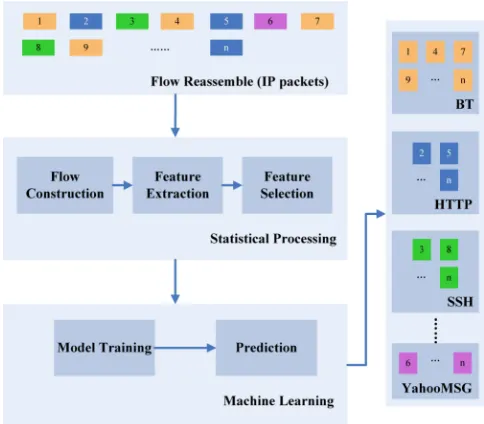
Fig. 2. The statistical-based analytics mechanism
with some labels of known domains. At last, a new unknown domain of bot can be detected if no label is assigned to a cluster.
III. KEY CHALLENGES OF BIG TRAFFIC ANALYTICS
As the previous section revealed, traffic analytics is a primary foundation for dealing with emerging issues in cyber security. This section lists the key components of traffic analytics and the associated challenges in the context of big data. We elaborate traffic classification in three key facets — real time, robustness and efficiency corresponding to the three characteristics of big data featured in terms of volume, variety and velocity [4].
A. Real time classification by using statistical features
Statistical feature based traffic classification is as useful as port-based and payload-based classifications. Because the network traffic data grow exponentially with the rapid de-ployment of high bandwidth demanding services, the based and payload-based classifications failed to meet the big data requirements [10], [1], [11]. Specifically, the port-based classification identifies the applications port-based on the port number extracted from the packets according to the IANA standards [1]. Because the port number can be easily modified or fabricated, the accuracy of the port-based classification is too low to fulfill the requirements of cyber security applica-tions. Conversely, the payload-based classification recognizes
the protocol signature by inspecting the payload of packets. Comparing with the port-based method, the payload-based method produces more accurate results but at a significantly higher computational cost. The statistical-based classification balances accuracy and cost by analyzing and extracting statisti-cal characteristics from trafffic flows generated by applications without inspecting the contents of individual packets. Because of this holistic view, the statistical-based classification can be used to analyze encrypted traffic widely used in Virtual Private Networks, WiFi, Tor networks and so on.The protocol signature by inspecting the payload of packets. Comparing with the port-based method, the payload-based method produces more accurate results but at a significantly higher computational cost. The statistical-based classification balances accuracy and cost by analyzing and extracting statisti-cal characteristics from trafffic flows generated by applications without inspecting the contents of individual packets. Because of this holistic view, the statistical-based classification can be used to analyze encrypted traffic widely used in Virtual Private Networks, WiFi, Tor networks and so on.
Tthe protocol signature by inspecting the payload of packets. Comparing with the port-based method, the payload-based method produces more accurate results but at a significantly higher computational cost. The statistical-payload-based classification balances accuracy and cost by analyzing and extracting statisti-cal characteristics from trafffic flows generated by applications without inspecting the contents of individual packets. Because of this holistic view, the statistical-based classification can be used to analyze encrypted traffic widely used in Virtual Private Networks, WiFi, Tor networks and so on. Machine learning techniques are vital for the statistical-based traffic classification. The traffic can be processed by supervised learning, also known as classification, or by unsu-pervised learning, also known as clustering. Figure 2 depicts the work flow — the collected packets are firstly grouped into traffic flows before certain statistical features such as packet size and arrival time can be obtained and later selected; the data in the feature space are then fed to the machine learning algorithm. Due to the nature of network applications, the training data fed to the machine learning algorithm can be inbalanced and/or polluted. An inbalanced data set often consists of non-uniformly distributed packets of different kinds; and a polluted data set often contains multiple wrongly labeled samples. The labeled data are used to train the machine learning algorithms, after a certain amount of time, predictive models will be built up and used as classifiers or predictors to classify testing data.
Generally, network traffic contains statistical features such as packet size, inter-arrival time, flow idle time, distribution of duration time, and so on, according to Nguyen and Armitage
flow directly out of the box. For example, naive Bayes and decision tree can build up a model for classification and prediction. More-over, k-Nearest Neighbor algorithm is another statistical-based classification method.
Nevertheless, the statistical-based classification is not per-fect. There are primarily three limitations. Firstly, it is difficult and expensive to obtain a balanced training data set with the uniformly distributed traffic classes from real-world networks. With an unbalanced data set, the classes with a dominantly large number of instances are trained more accurately than the rest. The implication can be problematic when we try to identify a small portion of malicious packets from a huge number of normal packets. According to [12], such adversary information decreases the effectiveness of machine learning remarkably. Secondly, the statistical data that we collected and processed as training set might not be representative during the deployment period. For instance, data collected from one network may not be applicable else where. Thirdly, the presence of unknown classes also affects the machine learning results. An unknown class is a traffic class that existed in the testing data set but is not included or recognized in the training data set. Therefore, there could be error in classification as if a new class data occurs in the testing set.
B. Robust classification by recognizing unknown classes
Despite of the challenges in real time traffic classifica-tion, exploitation of zero-day vulnerabilities greatly affects the accuracy of traffic classification [5]. The reason is that statistical-based traffic classification relies on machine learning algorithms. These classifiers cannot classify an unknown traffic which is caused by the exploitation of the zero-day vulnerabili-ties.
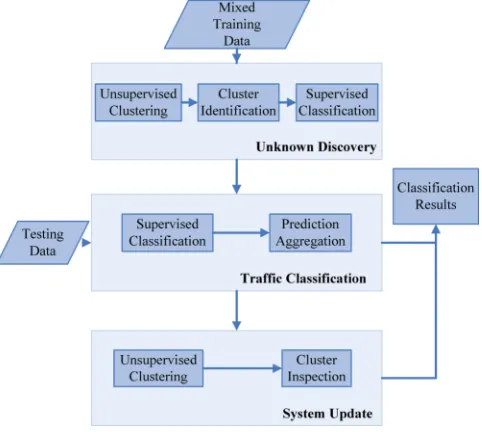
Fig. 3 processing classification
There are three processes in constructing RTC including unknown discovery, classification with unknown class, and system update.
RTC has powerful classification ability in handling zero-day traffic’s discrimination together with the traffic that the classifiers are familiar with. Figure 3 shows the mechanism of RTC. In the first stage of RTC, unknown traffic are detected automatically prior to classification. The unlabeled samples are collected from a specific network obtaining the mixture of predefined traffic and new traffic. Then a two-step method is employed in distinguishing zero-day traffic from others. That is, an unsupervised learning method, k-means, is used to sep-arate the mixture data into several clusters, while the labeled training instances help to identify the unknown traffic groups. And the zero-day class is captured in the unknown clusters with no or very few labeled instances assigned. Additionally, there may be more than one unknown application, thus the second step is to group them into a temporary super set for all unknown classes. After the processed data are all labeled, RTC starts the classification stage by applying supervised learning algorithms with some heuristics to aggregate the prediction.
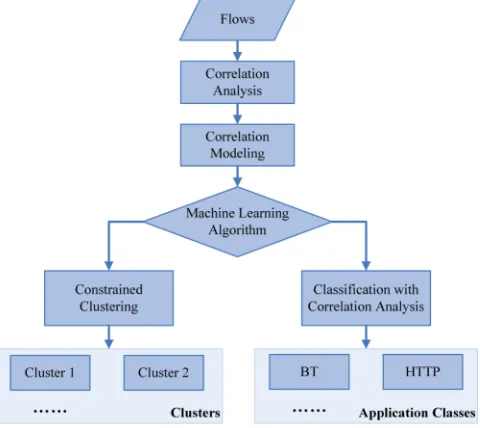
Fig. 4 correlation analysis
Fig. 4. The figure presents the mechanism of correlation analysis. Correlation models are proposed and merged in the machine learning algorithm after the correlation analysis of the flows. In the unsupervised clustering, the correlation model is applied as constraints when clustering and helps to improve the purity of each cluster. As for the supervised classification, application classes is better predicted after the correlation analysis combined with classification results.
In order to build an intelligent system with classifying class in fine-grained level, the traffic classification system should be updated when necessary. Specifically, the classifier should be equipped with the knowledge of unknown classes detected in the first stage instead of putting all unfamiliar traffic into a general category. In this third stage, k-means is applied again to cluster the previous data set. Then, several flows of each cluster are selected and inspected manually. If all the samples in one cluster are detected as unknown traffic, all flows in this cluster are acted as training inputs for classifier and a new class is labeled. After all new classes are found, they will be appended to previous known class set. Thus, the training data set is updated, whilst classifiers keep learning more unknown classes.
is that the distribution of traffic classes is static, which is not always true in the real-world networks. In addition, it is also a problem to accurately and precisely define an unknown class, especially when there are numerous new classes. Moreover, the cost of classification significantly increases with the growing size of training data set, whereas the accuracy rate will decrease rapidly with an increasing number of classes.
C. Efficient classification by using correlation
Correlation technique is applied in traffic classification to improve the classification efficiency without incurring too much processing time. Correlation technique can help us to identify the traffic with little or minimal prior knowledge.
An example is provided by Ma et al. [6] where correlation technique combined with the protocol model derived during the traffic classification. In their work, the correlated infor-mation of several unlabeled traffic flows is the same protocol described in their packets according to the same distribution of one protocol. Since not all flows in one application share one protocol, their correlation is partially correlated. As a result, they successfully classified the network flows automatically with only protocols provided. Another utilization of correlation information is based on the similar user behaviors [3].
Correlation technique not only can classify traffic data but also can improve clustering results by increasing each cluster’s purity. In Wang et al. [7], correlated information are presented as equivalence set constraints which can reveal the flows with same protocols in application-layer and sharing for. As shown in Figure 4, they used the unlabeled statistical features extracted from the raw packets in unsupervised clustering with correlation analysis applied in. In other words, the flow correlation information was used as constraints when clustering those data and helped increasing the purity of each clusters. Wang et al. named the integrated method as Set-Based Constrained K-Means. Herein, the equivalence set are allocated with 3-tuple heuristics among the five features described for each flow including source IP address, source port number, destination IP address, destination port number, and the protocol. As a result, the classifiers after cluster identification combined with correlation analysis perform sig-nificantly better than those ones without correlation applied in terms of accuracy and computation time.
From Zhang et al. [13], correlation method also makes pos-itive effects on supervised classification. The specific method they applied is named as Bag of Flow (BoF), which means the correlated traffic flows from one application are gener-ated together as a bag. Specifically, three-tuple heuristic is considered in a short period of time, that is, destination IP address, destination port number and the protocol in each flow traffic. Incorporating with supervised learning method they used, Nearest Neighbor classifier, several bags instead of numerous traffic flows are presented as input training data set. Figure 4 presents that the correlation technique contributes to their prediction phase, by combining the predicted results that the trained classifier get and the flow correlation analysis with vote mechanism. That is, the majority of predicted results for a set of network traffic data in one same bag, will be the final classification results of all those data. A probabilistic framework is built for BoF model to reduce the average classification error in each bag’s prediction according to the Bayesian decision theory.
In terms of the challenge of correlation technique, we can conclude a few points. It still remains an open question about the way of identifying the new correlation based on the knowledge of traffic domain. The second problem is on how to correlate information among traffic data collected from different sources [3], which the data fusion problem should be further investigated.
contents can also be considered as correlation based on payload-based traffic classification. And no matter which the correlation technique is combined with supervised learning algorithms
[5]or unsupervised learning algorithms [7], they all improved accuracy rate for traffic classification comparing with using machining learning algorithm alone. Additionally, to solve the unknown class problem, the robust traffic classification should combine with unsupervised learning and supervised learning with as little manual intervention as possible. Wherein the unsupervised learning can cluster flows of the same class to obtain known and unknown classes, and supervised learning can classify flows with unknown classes labeled manually. It would be ideal to further reduce the level and the frequency and intensity of the manual intervention.
IV. DISCUSSION ON FUTURE WORK
Although the state-of-art technologies attain cyber security to some extend, there are challenges. Such challenges will require more attention with respect to cyber security problems.
As for the robutness technique, RTC mechanism assumes that the labeling results that human expert is of high accuracy, which is problematic due to the availability of the experts and the unavoidable human errors. Then classifiers are suggested to be retrained for a long period of time. Therefore, the system updated is triggered not only when new classes should be equipped but also when previous known classes are learned
V. CONCLUSION
In this paper, we started with introducing traffic analytics for cyber security applications from three aspects — intrusion detection, malware analysis, and botnet detection. In general, all detection applications employ various traffic classifica-tion to distinguish the abnormal traffic from other normal traffics identified from prior knowledge. To enhance the cy-ber security, some techniques are summarized with detailed description. Different from two packet-based classifications, flow statistical-packet-based traffic classification is a new important tool for current big data analysis. Flow statistical-based traffic classification not only can tackle the problem of various and changeable packets, but also is able to handle the encrypted traffic flow which is popular in use of contemporary and complex network. Robust network traffic classification can detect unknown traffic, which is an essential improvement in cyber security for most malicious traffic is unknown from current systems. Such detection requires both unsupervised learning and supervised learning. Thus, the performance of classifiers can be significantly enhanced by using correlated information derived from various methods and integrated with machine learning algorithms. Furthermore, we discussed the limitations of state of the art techniques and pointed out future work. All in all, continuous research efforts are needed to improve automatic traffic analytics and to apply it broadly to address critical cyber security issues.
again with new set of data training. And the costs in both time and money will increase when labors are involved with examining many unknown classes. To enhance the level of efficiency of RTC, sub-bag of flow is proposed by Zhang et al. [5]. Specifically, instead of using only one bag consisting of correlated flows, several sub-bags are constructed inside of one bag. And the flows in each sub-bag are collected from the same user and are sharing with 4-tuple rather than 3-tuple in BoF by adding an extra protocol-related feature.
In addition, the correlations among flows remain mostly underused, though some of correlated information had already identified, like 5-tuple feature among traffic flow including source IP, destination IP, source port, destination port and protocol [13]. For example, the attacker’s behavior that is analyzed and reflected on traffic flow data can be generalized and classified as a key feature in detecting malicious traffic. And this key feature can also be regarded as a piece of correlated information.
flows are too few to provide sufficient information for classifiers. As a result, the accuracy in classification of class RTSP will be far lower than the accuracy of class BitTorrent performed by the same classifier. Moreover, since the malicious and offensive applications almost always maintain minority, the big data with unbalanced classes structure makes the traffic classification methods difficult to identify abnormal traffic with a small amount among massive network traffic. To significantly improve the performance of classifier, we may have to introduce a preprocessing step when the portion of each class can be controlled manually before finalizing training data set.
REFERENCES
[1] T. T. Nguyen and G. Armitage, “A survey of techniques for internet traffic classification using machine learning,” IEEE Communications Surveys & Tutorials, vol. 10, no. 4, pp. 56–76, 2008.
[2] X. Gui, J. Liu, M. Chi, C. Li, and Z. Lei, “Analysis of malware application based on massive network traffic,” China Communications, vol. 13, no. 8, pp. 209–221, 2016.
[3] A. Dainotti, A. King, F. Papale, A. Pescape et al., “Analysis of a/0 stealth scan from a botnet,” in Proceedings of the 2012 ACM conference on Internet measurement conference. ACM, 2012, pp. 1–14.
[4] S. Suthaharan, “Big data classification: Problems and challenges in net-work intrusion prediction with machine learning,” ACM SIGMETRICS Performance Evaluation Review, vol. 41, no. 4, pp. 70–73, 2014.
[5] J. Zhang, X. Chen, Y. Xiang, W. Zhou, and J. Wu, “Robust network traffic classification,” IEEE/ACM transactions on networking, vol. 23, no. 4, pp. 1257–1270, 2015.
[6] J. Ma, K. Levchenko, C. Kreibich, S. Savage, and G. M. Voelker, “Unexpected means of protocol inference,” in Proceedings of the 6th ACM SIGCOMM conference on Internet measurement. ACM, 2006, pp. 313–326.
[7] Y. Wang, Y. Xiang, J. Zhang, W. Zhou, G. Wei, and L. T. Yang, “Internet traffic classification using constrained clustering,” IEEE Transactions on Parallel and Distributed Systems, vol. 25, no. 11, pp. 2932–2943, 2014.
[8] Z. Ling, J. Luo, K. Wu, W. Yu, and X. Fu, “Torward: Discovery, blocking, and traceback of malicious traffic over tor,” IEEE Transactions on Information Forensics and Security, vol. 10, no. 12, pp. 2515–2530, 2015.
[9] M. Antonakakis, R. Perdisci, Y. Nadji, N. Vasiloglou, S. Abu-Nimeh, W. Lee, and D. Dagon, “From throw-away traffic to bots: detecting the rise of dga-based malware,” in Presented as part of the 21st USENIX Security Symposium (USENIX Security 12), 2012, pp. 491–506.
[10] A. W. Moore and D. Zuev, “Internet traffic classification using bayesian analysis techniques,” in ACM SIGMETRICS Performance Evaluation Review, vol. 33, no. 1. ACM, 2005, pp. 50–60.
[11] H. Dahmouni, S. Vaton, and D. Rossé, “A markovian signature-based approach to ip traffic classification,” in Proceedings of the 3rd annual ACM workshop on Mining network data. ACM, 2007, pp. 29–34.
[12] B. Biggio, B. Nelson, and P. Laskov, “Poisoning attacks against support vector machines,” in Proceedings of the 29th International Conference on Machine Learning, J. Langford and J. Pineau, Eds., 2012, pp. 1–8.