AUTHENTICATION AND ACCESS CONTROL
FOR MULTI KEYWORD RANKED SEARCH
OVER ENCRYPTED DATA-AMRSED
Megha Baraskar, Prof. Dr. K.R. KolheM.E. Student, Dept. of Information Technology, MAEERS MIT, Savitribai Phule Pune University, India
Associate Professor, Dept. of Information Technology, MAEERS MIT, Savitribai Phule Pune University, India
ABSTRACT
:
Owner of data driven to outsource their composite data management systems from local positions to thecommercial open cloud for prodigious economic savings and flexibility .Keyword search on cloud having numerous advantages, as the owner of data will get powerful tool to precisely describe his informational need . But for protecting data confidentiality, sensitive data have to be encrypted before outsourcing, which obsoletes traditional utilization of data based on keyword query search. Thus, permitting an encrypted cloud data search service is of vital prominence. In this paper we define and try to solve the stimulating problem of authentication and access control for multi keyword ranked search over encrypted data in cloud computing, and to establish a set of strict confidentiality requirements for such a secure cloud data utilization system. Among various multi-keyword semantics, and to choose the efficient similarity measure of “coordinate matching,” i.e., as many matches as possible, to capture the relevance of data documents to the search query. Further use “inner product similarity” to quantitatively evaluate such similarity measure. In this project first to propose a basic idea for the AMRSED based on secure inner product computation, and then give two significantly improved AMRSED schemes to achieve various stringent confidentiality requirements in two different threat models. To improve search experience of the data search service, further extend the two schemes to support more search semantics. Extensive performance evaluations have shown that the proposed scheme can achieve better efficiency in terms of the functionality and computation overhead compared with existing ones. For the future work, to investigate on the authentication and access control issues in searchable encryption technique.
KEYWORDS: AMRSED, Blind Storage, cloud computing
I.
INTRODUCTIONII. SYSTEM ARCHITECTURE
III. EXISTING SYSTEM
In existing method data owner can be encrypted the documents and the cloud server, documents can be decrypted in cloud. the In order to meet the practical search requirements, search over encrypted data should support the following three functions. First, the searchable encryption schemes should support multi-keyword search, and provide the same user experience as searching in Google search with different keywords; single keyword search is far from satisfactory by only returning very limited and inaccurate search results. Although the existing schemes aim at providing integrity verification for different data storage systems, the problem of supporting both public auditability and data dynamics has not been fully addressed. How to achievea secure and efficient design to seamlessly integrate these two important components for data storage service remains an open challenging task in Cloud Computing.
IV. PROPOSED SYSTEM
We define and solve the challenging problem of confidentiality-preserving multi-keyword ranked search over encrypted cloud data (AMRSED), and establish a set of strict confidentiality requirements for such a secure cloud data utilization system to become a reality. Among various multi-keyword semantics, we choose the efficient principle of “coordinate matching”. Here we are providing better security in owner‟s upload side as well as on the download side. For better security client splitting that single file into nine different blocks and providing a unique identification number for each block
.
V. PROPOSED SCHEME
In this section, we give a detailed description of our scheme. We firstly propose to implement the semantic multi-keyword ranked search
.
A. AMRSED APPROACH
As an effort towards the issue, in this paper, we propose an efficient multi-keyword ranked search scheme over encrypted mobile cloud data (AMRSED) through blind storage. Our main contributions can be summarized as follows: 1. We introduce a relevance score in searchable encryption to achieve multi-keyword ranked search over the encrypted mobile cloud data. In addition to that, we construct an efficient index to improve the search efficiency.
2. By modifying the blind storage system in the AMRSED, we solve the trapdoor disassociation problem and
mask access pattern of the search user from the cloud server.
of the search user. Moreover, we implement extensive experiments, which show that the AMRSED can achieve
enhanced efficiency in the terms of functionality and search efficiency compared with existing proposals
.
B. SECURITY REQUIREMENTS
Specifically, the AMRSED aims to provide the following four security requirements:
1.
Confidentiality of Documents and Index: Documents and index should be encrypted before beingoutsourced to a cloud server. The cloud server should be prevented from prying into the outsourced documents and cannot infer any associations between the documents and keywords using the index.
2.
Trapdoor Confidentiality: Since the search user would like to keep her searches from being exposed to thecloud server, the cloud server should be prevented from knowing the exact keywords contained in the trapdoor of the search user.
3.
Trapdoor disassociation: The trapdoors should not be linkable, which means the trapdoors should be totallydifferent even if they contain the same keywords. In other words, the trapdoors should be randomized rather than determined. The cloud server cannot infer any associations between two trapdoors.
4.
Masking Access Pattern of the Search User: Access pattern is the sequence of the searched results. In theEMRS, the access pattern should be totally masked from the cloud server. Specifically, the cloud server cannot learn the total number of the documents stored on it or the size of the searched document even when the search user retrieves this document from the cloud server
.
C. BLIND STORAGE SYSTEM
A blind storage system is built on the cloud server to sup- port adding, updating and deleting documents and masking the access pattern of the search user from the cloud server. In the blind storage system, all documents are divided into fixed-size blocks. These blocks are indexed by a sequence of random integers generated by a document-related seed. In the view of a cloud server, it can only see the blocks of encrypted documents uploaded and downloaded. Thus, the blind storage system leaks little information to the cloud server. Specifically, the cloud server does not know which blocks are of the same document, even the total number of the documents and the size of each document. Moreover, all the documents and index can be stored in the blind storage system to achieve a searchable encryption scheme.
VI. PERFORMANCE ESTIMATION
A. FUNCTIONALITY
Considering a large number of documents and search users in a cloud environment, searchable encryption schemes should allow confidentiality-preserving multi-keyword search and return documents in a order of higher relevance to the search request. As shown in TABLE 1, we compare functionalities among the EMRS, Cash‟s scheme, Cao‟s scheme and Naveed‟s scheme.
B. SEARCH EFFICIENCY
Confidentiality-preserving multi- keyword ranked
search over
encrypted cloud data
Secure kNN
computation on
encrypted databases
Dynamic searchable encryption via blind storage AMRSED M u lt i-k ey wo rd
yes yes yes
Re su lt Ra n k in g
yes yes
Re lev an ce S co rin g
yes yes
As we can see, the search time in Cao‟s scheme linearly increases with the scale of the dataset, which is impractical for large-scale dataset. In the EMRS, by adopting the inverted index z which is built in the blind storage system, we achieve a sub linear computation overhead compared with Cao‟s scheme. Upon receiving stag, the cloud server can use stag to access blind storage and retrieve the encrypted relevance vector on the blocks indexed by the stag. These blocks consist of blocks of documents containing the stag-related keyword and some dummy blocks. Thus, the EMRS can significantly decrease the number of documents which are relevant to the searched keywords. Then, the cloud server only needs to compute the inner product of two (d+2)-dimension vectors for the associated documents rather than computing relevance scores for all documents as that in Cao‟s scheme . The computation complexity for search operation in the EMRS is O(α%sd), where %s represents the the number of documents which contain the keyword applied by the keyword-related token stag and the α is the extension parameter that scales the number of blocks in a document to the number of blocks in the set Sf . The value of %s can be small if the search user typically chooses the estimated least frequent keyword, such that the computation cost for search on the cloud server is significantly reduced. The computation cost of search phase is mainly affected by the number of documents in the dataset and the size of the keyword dictionary. In our experiments, we implement the index on the memory to avoid the time-cost I/O operations. Note that, although the time costs of search operation are linearly increasing in both schemes , the increase rate of the AMRSED is less than half of that in Cao‟s scheme.
C. MEASURE
VII.
SECURITY ANALYSISA. CONFIDENTIALITY OF DOCUMENTS AND INDEX
The documents are encrypted by the traditional symmetric cryptography technique before being outsourced to the cloud server. Without a correct key, the search user and cloud server cannot decrypt the documents. As for index confidentiality, the relevance vector for each document is encrypted using the secret key M1, M2, and S. And the descriptors of the documents are encrypted using CPABE technique. And only the search user with correct attribute keys can decrypt the descriptor ABEυi(idi||Ki||x) to get the document id and the associated symmetric key. Thus, the confidentiality of documents and index can be well protected.
B. TRAPDOOR CONFIDENTIALITY
When a search user generates her trapdoor including the keyword-related token stag and encrypted query vector Q, she randomly chooses two numbers r and t. Then, for the query vector q, the search user extends it as (rq,r,t) and encrypts the query vector using the secret key M1,M2 and S. Without the secret key M1,M2, S and K9, the cloud server cannot pry into the trapdoor. Thus, the keyword information In the trapdoor is totally masked from the cloud server in the EMRS and trapdoor confidentiality is well protected.
C. TRAPDOOR DISASSOCIATION
Trapdoor disassociation is defined as that the cloud server cannot infer associations between any two trapdoors. Even though the cloud server cannot decrypt the trapdoors, any association between two trapdoors may lead to the leakage of the search user‟s confidentiality. We consider whether the two trapdoors including stag and the encrypted query vector Q can be linked to each other or to the keywords.
D. MASKING ACCESS PATTERN OF THE SEARCH USER
The access pattern means the sequence of the searched results .In Cash‟s scheme andCaos scheme, the search user directly obtains the associated documents from the cloud server, which may reveal the association between the search request and the documents to the cloud server. In the EMRS by modifying the blind storage system, access pattern is well masked from the cloud server.
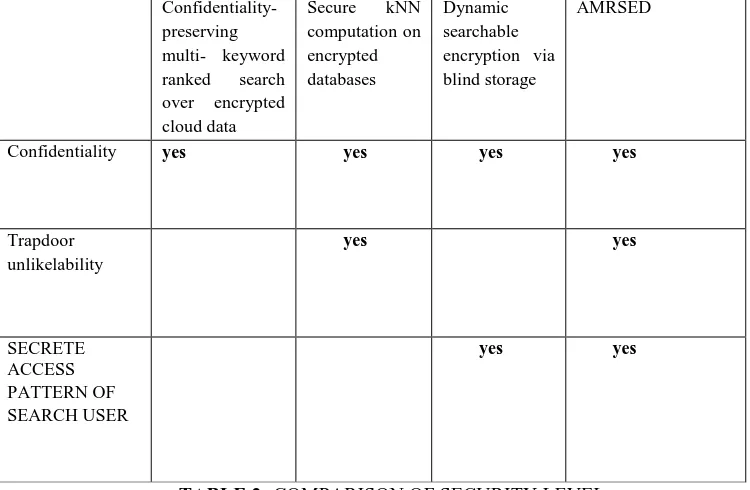
TABLE 2- COMPARISON OF SECURITY LEVEL
Confidentiality-preserving multi- keyword ranked search over encrypted cloud data
Secure kNN
computation on encrypted databases
Dynamic searchable encryption via blind storage
AMRSED
Confidentiality yes yes yes yes
Trapdoor unlikelability
yes yes
SECRETE ACCESS PATTERN OF SEARCH USER
VIII. RELATED WORK
Keyword based search on encrypted data is a promising technique that offers the search facility over the encrypted cloud data. It can mainly be classified into two types: keyword based search on Public-key Encryption and keyword based search on Symmetric Encryption. One can adopt the inverted index TSet, which maps the keyword to the documents containing it, to accomplish efficient multi-keyword search for freebase datasets or large scale databases .Blind storage system achieve searchable encryption and mask the access pattern of the search user. However, only single-keyword search is supported. Here this propose a security analysis with trapdoor confidentiality system and provide an security in download side.
IX.
CONCLUSIONIn this paper,we have proposed a multi-keyword ranked search scheme to enable accurate, efficient and secure search over encrypted mobile cloud data. Security analysis have demonstrated that proposed scheme can effectively achieve confidentiality of documents and index, trapdoor confidentiality, trapdoor disassociation, and masking access pattern of the search user. Extensive performance evaluations have shown that the proposed scheme can achieve better efficiency in terms of the functionality and computation overhead compared with existing ones. For the future work, will investigate on the authentication and access control issues in searchable encryption technique and provide an block insertion method to split the files and provide unique identification method and using decryption key download the files in the users side. This method can achieve the search efficiency.
REFERENCES
[1] N. Cao, C. Wang, M. Li, K. Ren, and W. Lou, „„Confidentiality-preserving multi- keyword ranked search over encrypted cloud data,‟‟ IEEE Trans. Parallel Distrib. Syst., vol. 25, no. 1, pp. 222–233, Jan. 2014.
[2] W. K. Wong, D. W. Cheung, B. Kao, and N. Mamoulis, „„Secure kNN computation on encrypted databases,‟‟ in Proc. ACM SIGMOD Int. Conf. Manage. Data, 2009, pp. 139–152.
[3] M. Naveed, M. Prabhakaran, and C. A. Gunter, „„Dynamic searchable encryption via blind storage,‟‟ in Proc. IEEE Symp. Secur. Confidentiality, May 2014, pp. 639–654.
[4] H. Pang, J. Shen, and R. Krishnan, „„Confidentiality-preserving similarity-based text retrieval,‟‟ ACM Trans. Internet Technol., vol. 10, no. 1, p. 4, 2010.
[5] D. Cash, S. Jarecki, C. Jutla, H. Krawczyk, M.-C. Roşu, and M. Steiner, „„Highly-scalable searchable symmetric encryption with support for Boolean queries,‟‟ in Proc. CRYPTO, 2013, pp. 353–373.
[6] H. Liang, L. X. Cai, D. Huang, X. Shen, and D. Peng, „„An SMDP-based service model for interdomain resource allocation in mobile cloud networks,‟‟ IEEE Trans. Veh. Technol., vol. 61, no. 5, pp. 2222–2232, Jun. 2012.
[7] M. M. E. A. Mahmoud and X. Shen, „„A cloud-based scheme for protecting source-location privacy against hotspot-locating attack in wireless sensor networks,‟‟ IEEE Trans. Parallel Distrib. Syst., vol. 23, no. 10, pp. 1805–1818, Oct. 2012.
[8] Q. Shen, X. Liang, X. Shen, X. Lin, and H. Y. Luo, „„Exploiting geodistributed clouds for a e-health monitoring system with minimum service delay and privacy preservation,‟‟ IEEE J. Biomed. Health Inform., vol. 18, no. 2, pp. 430–439, Mar. 2014.
[9] H. T. Dinh, C. Lee, D. Niyato, and P. Wang, „„A survey of mobile cloud computing: Architecture, applications, and approaches,‟‟ Wireless Commun. Mobile Comput., vol. 13, no. 18, pp. 1587–1611, Dec. 2013.
[10]H. Li, Y. Dai, L. Tian, and H. Yang, „„Identity-based authentication for cloud computing,‟‟ in Cloud Computing. Berlin, Germany: Springer-Verlag, 2009, pp. 157–166.
[11]W. Sun, et al., „„Confidentiality-preserving multi-keyword text search in the cloud supporting similarity-based ranking,‟‟ in Proc. 8th ACM SIGSAC Symp. Inf., Comput. Commun. Secur., 2013, pp. 71–82.
[12]B.Wang,S.Yu,W.Lou,andY.T.Hou,„„Confidentiality-preservingmulti-keyword fuzzy search over encrypted data in the cloud,‟‟ in Proc. IEEE INFOCOM, Apr./May 2014, pp. 2112–2120.
[13]E. Stefanov, C. Papamanthou, and E. Shi, „„Practical dynamic searchable encryption with small leakage,‟‟ in Proc. NDSS, Feb. 2014.
[14]Y. Yang, H. Li, W. Liu, H. Yang, and M. Wen, „„Secure dynamic searchable symmetric encryption with constant document update cost,‟‟ in Proc. GLOBECOM, Anaheim, CA, USA, 2014.
[15]D. Cash, S. Jarecki, C. Jutla, H. Krawczyk, M.-C. Roşu, and M. Steiner, „„Highly-scalable searchable symmetric encryption with support for Boolean queries,‟‟ in Proc. CRYPTO, 2013, pp. 353–373.
[16]N. Cao, C. Wang, M. Li, K. Ren, and W. Lou, „„Confidentiality-preserving multikeyword ranked search over encrypted cloud data,‟‟ IEEE Trans. Parallel Distrib. Syst., vol. 25, no. 1, pp. 222–233, Jan. 2014.
[18]M. Naveed, M. Prabhakaran, and C. A. Gunter, „„Dynamic searchable encryption via blind storage,‟‟ in Proc. IEEE Symp. Secur. Confidentiality, May 2014, pp. 639–654.
[19]H. Pang, J. Shen, and R. Krishnan, „„Confidentiality-preserving similarity-based text retrieval,‟‟ ACM Trans. Internet Technol., vol. 10, no. 1, p. 4, 2010.
[20]J. Yu, P. Lu, Y. Zhu, G. Xue, and M. Li, „„Toward secure multikeyword top-k retrieval over encrypted cloud data,‟‟ IEEE Trans. Dependable Secure Comput., vol. 10, no. 4, pp. 239–250, Jul./Aug. 2013.
[21]A. Lewko and B. Waters, „„Decentralizing attribute-based encryption,‟‟ in Proc. EUROCRYPT. Berlin, Germany: Springer-Verlag, 2011, pp. 568–588.
[22]NSF Research Awards Abstracts 1990-2003. [Online]. Available: http://kdd.ics.uci.edu/databases/nsfabs/nsfawards.html, accessed 2004.
[23]D. Boneh, G. D. Crescenzo, R. Ostrovsky, and G. Persiano, „„Public key encryption with keyword search,‟‟ in Proc. EUROCRYPT, 2004, pp. 506–522.
[24]D. Boneh and B. Waters, „„Conjunctive, subset, and range queries on encrypted data,‟‟ in Proc. TCC, 2007, pp. 535–554.
[25]B. Zhang and F. Zhang, „„An efficient public key encryption with conjunctive-subset keywords search,‟‟ J. Netw. Comput. Appl., vol. 34, no. 1, pp. 262–267, Jan. 2011.