• No results found

Optimum Frequency Planning For Efficient Channel Utilization

N/A
N/A
Protected

Academic year: 2020

Share "Optimum Frequency Planning For Efficient Channel Utilization"

Copied!
6
0
0

Loading.... (view fulltext now)

Full text

(1)

ISSN(Online): 2320-9801

ISSN (Print): 2320-9798

International Journal of Innovative Research in Computer

and Communication Engineering

(An ISO 3297: 2007 Certified Organization)

Vol. 4, Issue 1, January 2016

Optimum Frequency Planning For Efficient

Channel Utilization

Anitha1, Dr. S. Perumal Sankar2

M.Tech Scholar, Dept. of ECE, Toc H Institute of Science and Technology, Ernakulam, India1 Professor, Dept. of ECE Toc H Institute of Science and Technology, Ernakulam, India2

ABSTRACT: There is a rapidly growing demand for wireless telecommunications; however, the restricted number of channels is a significant bottleneck of mobile cellular systems capacity. The Frequency Assignment Problem (FAP) is one of the key issues in the design of GSM networks (Global System for Mobile communications), and will remain important in the foreseeable future. A new problem encoding is devised for the minimum span frequency assignment problem in wireless communications networks which is compact and general. Using the new encoding, which reduces search space dramatically over previous problem encodings, an optimization algorithm is developed which combines a genetic algorithm global search with a computationally efficient local search method. The best up to date frequency plans for the considered version of the FAP had been obtained by using parallel memetic algorithms. However, such approaches suffer from premature convergence with some real world instances. Multiobjectivisation is a technique which transforms a mono-objective optimization problem into a multi-objective one with the aim of avoiding stagnation.

KEYWORDS: FAP; Memetic Algorithm; Multiobjectivisation

I. INTRODUCTION

Mobile communication networks have undergone a dramatic expansion over the last few decades. The Frequency Assignment Problem (FAP) plays an important role in the design of these networks. This problem of frequency assignment is also referred to as Automatic Frequency Planning (AFP) and Channel Assignment Problem (CAP). Planning refers to construction of a network which is able to provide services to all the customers wherever they are need. The main target of network planning is achieving acceptable grade of service while maintaining maximum coverage and capacity with good speech quality.

The main issue which inhibits the indefinite growth of user-based capacity is the scarcity of usable radio spectrum resource. As a result, the radio frequencies have to be effectively reused a number of times for several thousand transceivers by utilizing the inherent property associated with propagation of radio waves that the signal strength decreases with increase in distance . The reuse should take place after a safe minimum distance such that cells having same frequencies (co-channels) do not interfere with each other. Additionally, no two-neighbor cells/sites should use adjacent frequencies to avoid adjacent channel interference.

(2)

ISSN(Online): 2320-9801

ISSN (Print): 2320-9798

International Journal of Innovative Research in Computer

and Communication Engineering

(An ISO 3297: 2007 Certified Organization)

Vol. 4, Issue 1, January 2016

When a cellular provider applies for a GSM network deployment license, it buys several frequencies for traffic and a few for broadcast transmission. Among these one broadcast channel frequency along with several frequencies (for traffic) are allocated for each sector. Each BTS will have only one broadcast channel (BCCH) carrier frequency, but can several traffic channel (TCH) carrier frequencies. Here we are doing BCCH channel planning for cells.

A broadcast control channel (BCCH) is a point to multipoint; unidirectional (downlink) channel used in the Um interface the GSM cellular standard. BCCH is designated as a beacon channel and is required to transmit continuously at full power. The Broadcast Control Channel (BCCH) is a logical broadcast channel used by the base station in a GSM network to send details about the identity of the network. This information is used by a mobile station to get access to the network. The information includes the Mobile Network Code (MNC), the Location Area Code (LAC) and a list of frequencies used by the neighboring cells. Any GSM ARFCN that includes a BCCH is deputed as a beacon channel and is required to transmit continuously at full power.

Memetic Algorithms (MAs) have been widely applied to frequency assignment problem. They are a synergy of a population-based technique with separate individual learning or local improvement procedures for problem search. The algorithm is a revised version of a (1 +1) Evolutionary Algorithm (EA), integrated with a local search. In this paper we use multi objective memetic algorithm for frequency planning.

The simulation tools used are ATOLL and MATLAB. ATOLL is used to create the network, assign BCCH frequencies to each sector and to calculate the interference between cell sectors. Algorithm is coded in MATLAB and interference information from ATOLL act as input to algorithm to generate a new BCCH frequency assignment.

II. RELATED WORK

Sung-Soo Kima et al (2005) devised a new problem encoding for the minimum span frequency assignment problem in wireless communications networks which combines a genetic algorithm global search with a computationally proficient local search method [6]. This paper developed a hybrid genetic algorithm and local search process (termed a memetic algorithm) for the MS-FAP. Lam T. Bui et al (2005) presents a paper that investigates the use of evolutionary multi-objective optimization methods (EMOs) for solving single-objective optimization problems in dynamic environments [3]. They extend this work by looking at the dynamic single objective task and observe a number of different possibilities for the artificial objective function. Francisco Luna et al (2008) introduced a new mathematical formulation for the problem in which the frequency plans are evaluated by using precise interference information coming from a real GSM network [9]. They developed an ant colony optimization (ACO) algorithm to tackle this problem. Muhammad Umair et al (2012) presents a novel and inventive algorithm for automatic generation and optimization of the frequency plan whereby automatic frequency planning and optimization has been done using the concept of Inter-Cell Dependency Matrix (ICDM) which contains cell correlations in terms of the affect one cell has on the other primarily with regards to the co-channel interference[13]. M. M. Haider et al (2014) presents a work in which AFP is implemented in real cellular network of different major cities of Pakistan using Automatic Frequency Optimization System (AFOS) tool [14]. AFP using AFOS tool has resulted in enhancing network quality and performance as improvement in Call Drop Rate (CDR) has been observed in each city ranging from 14% to 35%.

III. METHODOLOGY

(3)

ISSN(Online): 2320-9801

ISSN (Print): 2320-9798

International Journal of Innovative Research in Computer

and Communication Engineering

(An ISO 3297: 2007 Certified Organization)

Vol. 4, Issue 1, January 2016

The main aim of the frequency-planning task is to increase the efficiency of the spectrum usage, keeping the interference in the network below some desired level. Therefore it is always linked to interference predictions. Some software’s are used with automatic frequency allocation algorithms for finding the most favorable solutions. The frequency allocation is generally guided by the information such as channel necessity on cell basis according to the capacity planning, channel spacing constraints according to BTS specification, quality of service requirement which is preserved to acceptable interference, traffic density distribution over the service area, concert of advanced system features etc. The frequency assignment is based on cell-to-cell interference probability estimation according to the network topology, field strength distribution and traffic load.

A. Frequency Reuse

A frequency used in one cell can be reused in another cell at a certain distance. This distance is called reuse distance. The advantage of digital system is that they can reuse frequencies more efficiently than the analogue ones, i.e. the reuse distance can be shorter, and the capacity increased. A cellular system is based in reuse of frequencies. All the offered frequencies are separated into different frequency groups this is done so that a certain frequency always belongs to a definite frequency group. The frequency groups together form a cluster.

B. Interference Calculations

The reference interference ratio is defined in GSM as the interference ratio for which the required performance in terms of bit error rate or residual bit error rate is met. The reference interference ratios for BS and all types MSs are the following

:

Co channel interference: C/Ic <= 8 dB

First adjacent channel interference: C/Ia1 <= -9 dB

Second adjacent channel interference: C/Ia2 <= -41 dB

C. Co Channel Interference

The carrier to interference (C/I) ratio for a given mobile receiver can be calculated as follows:

C/I=C/(I1+I2+……..+Ik) (1)

Where k is the number of co channel interfering cells. For regular grid case it is possible to simplify the calculations by using the popular path loss expressions.

D. Interference Matrix And Cost Function

An Interference matrix estimates the level of contact between any two cells in a cellular network. Value of a cost function in an assignment algorithm depends on constraints and an IM. Therefore inaccuracies in an IM will degrade quality of the frequency plan.

=

The interference matrix is an N×N matrix, with N equal to the number of cells to be considered. The interference matrix describes, for each cell, the total amount of affected traffic in a particular cell by interference from all other cells (if the cell uses the identical or one of the adjacent frequencies). Affected traffic means that the traffic has a C/I worse than a certain threshold. A threshold of 8 dB has been used here.

An interference matrix describes interaction between any two cells in a GSM network, Element IM (ij) indicates the degradation of network quality (i.e. cost) if cells i and j operate on a same frequency. Usually this cost is derived from expected radio interference on cell i area. Assuming an accurate IM for a given GSM network is known, the frequency plan maximizing the quality of the network is found by minimizing a cost function.

(2)

In equation (2) i is the frequency and a is the cell being considered. k is the cells with a co-channel and j is the cells with an adjacent channel. From equation, each frequency contributes with two factors, an adjacent and a co-channel

            ... ... ... ... ... ... ... 3 3 2 3 1 3 3 2 2 2 1 2 3 1 2 1 1 1 S S S S S S S S S S S S S S S S S S I I I I I I I I I             ... ... ... ... ... 0 92 . 0 975 . 0 ... 78 . 0 0 452 . 0 ... 976 . 0 192 . 0 0

  j k j channel adj Cost factor adj k channel co Cost a i level

(4)

ISSN(Online): 2320-9801

ISSN (Print): 2320-9798

International Journal of Innovative Research in Computer

and Communication Engineering

(An ISO 3297: 2007 Certified Organization)

Vol. 4, Issue 1, January 2016

contribution [1].The co-channel factor is calculated based on direct values from the interference matrix, while the adjacent channel involvement is simply the co-channel contribution weighted by an adjacent factor (adj-factor). In this project it has been set to 1.5 %.

E. Multiobjectivised Memetic Algorithm

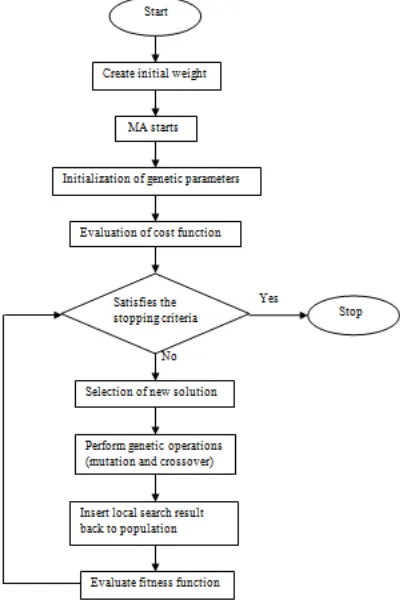
The algorithm is a modified version of a (1 +1) Evolutionary Algorithm (EA), combined with a local search specifically designed to deal with this version of the FAP [5]. Memetic algorithms are a synergy of a population based approach with separate individual learning or local enhancement procedures for problem search. These algorithms are also referred to in the literature as Baldwinian Evolutionary Algorithms, Lamarckian Evolutionary Algorithms, Cultural Algorithms or Genetic Local Search. MAs are of great importance because they perform some orders of magnitude faster than traditional genetic algorithms for some problem domains.

Fig 1: Flow Chart of Algorithm

The term multiobjectivisation refer to the reformulation of originally mono-objective problems as multi-objective ones. Multiobjectivisation changes the fitness landscape, so it can be useful to avoid local optima and consequently, to make easier the resolution of the problem. The two objectives that we considered in our cost function are co channel interference and adjacent channel interference.

The following features expand the algorithm further:

1. The interference from the BCCH is completely load independent (beacon signal). Furthermore, the BCCH contains information for identifying cells for access, paging and measurements of neighboring cells. Therefore power control and DTX cannot be used on the downlink BCCH channels.

2. Optimization goes on for a definite (large) number of loops, while minimizing a cost- function. However, the program can be stopped whenever desired.

(5)

ISSN(Online): 2320-9801

ISSN (Print): 2320-9798

International Journal of Innovative Research in Computer

and Communication Engineering

(An ISO 3297: 2007 Certified Organization)

Vol. 4, Issue 1, January 2016

entire large area. It is therefore possible to plan only one cell within a large area, as well as a large cluster of cells within an even larger area.

4. Both Co-channel and adjacent interference is included.

IV.SIMULATION RESULTS

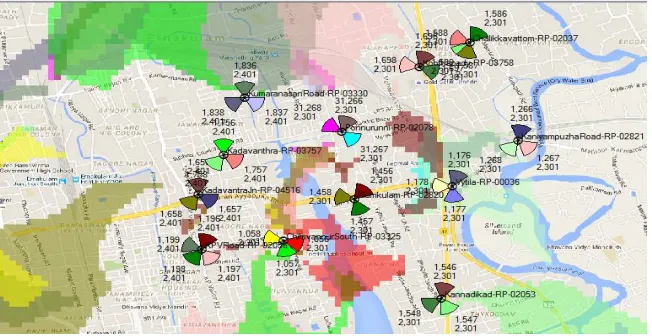
The reference solution is obtained as shown in fig 2, here BCCH channel planning is done, where constraints such as separation requirements for channels are not violated which gives a feasible initial solution in ATOLL software. In fig 2 the white region shows the region without interference and coloured regions shows regions with interference. After applying the frequency plan obtained using multiobjective memetic algorithm in the network, the interference has decreased as seen in fig 3.

Fig 2: ATOLL Plot Before Applying Multiobjective Memetic Algorithm

Fig 3: ATOLL Plot After Applying Multiobjective Memetic Algorithm

V. CONCLUSION

(6)

ISSN(Online): 2320-9801

ISSN (Print): 2320-9798

International Journal of Innovative Research in Computer

and Communication Engineering

(An ISO 3297: 2007 Certified Organization)

Vol. 4, Issue 1, January 2016

oriented. The proposed algorithm is efficient and consumes less time because it never assigns co and adjacent frequencies to co-sited cells while on the other hand the co-channel breakage is also negligibly small.

REFERENCES

1. Thomas Toftegaard Nielsen, Jeroen Wigard, Per Henrik Michaelsen and Preben Mogensen, “Resource allocation in a frequency hoppingPCS1900/GSM/DCS1800 type of network,” in Conference Paper In Vehicular Technology Conference, IEEE 38th August 1999.

a. M. J. Kuurne, “On GSM mobile measurement based interference matrix generation,” in IEEE 55th Vehicular Technology Conference, VTC Spring, pp 1965 – 1969, 2002

2. L. Bui, H. Abbass, and J. Branke, “Multiobjective optimization for dynamic environments,” in Evolutionary Computation, IEEE Congress on, Vol 3, pp. 2349 – 2356, 2005.

3. Yew-Soon Ong, Meng-Hiot Lim, Ning Zhu, and Kok-Wai Wong, “Classification of Adaptive Memetic Algorithms: A Comparative Study,” in IEEE Transactions On Systems, Man, And Cybernetics—Part B: Cybernetics, Vol 36, No 1, February 2006.

4. F. Luna, C. Blum, E. Alba, and A. J. Nebro, “ACO vs EAs for solving a real-world frequency assignment problem in GSM networks,” in Genetic and Evolutionary Computation Conference (GECCO 2007), pp 94 – 101, 2007.

5. S.-S. Kim, A. E. Smith, and J.-H. Lee, “A memetic algorithm for channel assignment in wireless FDMA systems,”in Computers & Operations Research, Vol 34, pp 1842 – 1856, 2007.

6. Prof. T. Venkateswarlu, K. Naresh, “An Automatic Frequency Planning Of GSM Networks Using Evolutionary Algorithms,” in International Journal of Engineering Research and Applications (IJERA), Vol 1, Issue 3, pp 626-632,2008.

7. Mehran Atamanesh, Forouhar Farzaneh,“ Frequency Planning of GSM Cellular Communication Network in Urban Areas including traffic distribution, a Practical Implementation,” in Asia-Pacific Sympsoium on Electromagnetic Compatibility & 19th International Zurich Symposium on Electromagnetic Compatibility, 19–22 May 2008

8. F. Luna, A. J. Nebro, E. Alba, and J. J. Durillo, “Solving large-scale real-world telecommunication problems using a grid-based genetic algorithm,” in Engineering Optimization, Vol 40, No 11, pp 1067–1084,2008

9. Su Chao, Lan Lina, Yu Cuibo,Gou Xuerong, Zhang Xiaohua, “A new method of frequency planning for new cells in GSM,” in 2nd Conference on Environmental Science and Information Application Technology, 2010.

10. Iyad Amro, Wasel Ghanem, “GSM Automatic Frequency Planning with the Aid of Genetic Algorithms,” in Fifth International Conference on Genetic and Evolutionary Computing, 2011.

11. Zhang Haiyang,“The Methods of Frequency Plan in GSM,”Wireless Communication Networking and Mobile Computing (WiCOM), in 7th International Conference on IEEE, pp 1-4 , Sept 2011.

12. Muhammad Umair, Waleed Bin Shahid and Masab Javed Abbasi, “Automatic Frequency Planning and Optimization Algorithm for Cellular Networks,” in Proceedings of the World Congress on Engineering Vol 2,2012.

13. M. M. Haider, J. Yousaf, N. Qureshi, “Performance Evaluation of Automatic Frequency Planning Using Automatic Frequency Optimization System Tool,”in Frontiers of Information Technology (FIT), 12th International Conference in IEEE, pp 1-6, Dec 2014.

14. Prabhjot Singh, Mithilesh Kumar, Ambarish Das, “Effective frequency planning to Achieve improved KPI'S, TCH and SDCCH drops for a real GSM Cellular network,” in 12th International Conference on IEEE. pp 673-679, July 2014.

BIOGRAPHY

Anithais an M.Tech scholar in Wireless Technology in the Electronics and Communication Engineering Department in Toc H Institute of Science and Technology, Ernakulam, India.

Figure

Fig 1: Flow Chart of Algorithm
Fig 2: ATOLL Plot Before Applying Multiobjective  Memetic Algorithm

References

Related documents

Based on comparative analysis to the indigoidine gene clusters from other bacteria (Additional file 1 : Table S3) we propose that the putative indigoidine gene cluster of.. Table

FGCS’ experiences could provide educators with practical strategies to support FGCS and their decision to attend college.. The term Caucasian describes an individual with

Whereas much of the prior research in this area has focused on the dispersion of online content consumption across different sources at one point (e.g., Fox News website

Clinical and histological evaluation of human gingival recession treated with a subepithelial connective tissue graft and enamel matrix derivative (Emdogain): a

Skeide, Dilation theory and continuous tensor product systems of Hilbert modules, PQQP: Quantum Probability and White Noise Analysis XV (2003), World Scientific..

To reiterate, the hypotheses testing includes both a test of the hypothesised direct effects of an effort-reward imbalance and abusive supervision on PERs, and a test of

For the complexity analysis carried out in this section, we consider ground programs and polynomial-time computable aggregate functions (note that all example aggregate

The results on equity capital and lending in the previous subsection raise the question whether the correlation between relationship to an affected savings bank and firm em-