Unfounded Sets and Well-Founded Semantics
of Answer Set Programs with Aggregates
Mario Alviano [email protected]
Francesco Calimeri [email protected]
Wolfgang Faber [email protected]
Nicola Leone [email protected]
Simona Perri [email protected]
Department of Mathematics University of Calabria I-87030 Rende (CS), Italy
Abstract
Logic programs with aggregates (LPA) are one of the major linguistic extensions to Logic Programming (LP). In this work, we propose a generalization of the notions of un-founded set and well-un-founded semantics for programs with monotone and antimonotone aggregates (LPA
m,a programs). In particular, we present a new notion of unfounded set
forLPA
m,aprograms, which is a sound generalization of the original definition for standard
(aggregate-free)LP. On this basis, we define a well-founded operator forLPAm,aprograms,
the fixpoint of which is called well-founded model (or well-founded semantics) forLPAm,a
programs. The most important properties of unfounded sets and the well-founded seman-tics for standardLP are retained by this generalization, notably existence and uniqueness of the well-founded model, together with a strong relationship to the answer set seman-tics for LPA
m,a programs. We show that one of the ˜D-well-founded semantics, defined by
Pelov, Denecker, and Bruynooghe for a broader class of aggregates using approximating operators, coincides with the well-founded model as defined in this work on LPA
m,a
pro-grams. We also discuss some complexity issues, most importantly we give a formal proof of tractable computation of the well-founded model forLPA
m,aprograms. Moreover, we prove
that for generalLPA programs, which may contain aggregates that are neither monotone nor antimonotone, deciding satisfaction of aggregate expressions with respect to partial interpretations is coNP-complete. As a consequence, a well-founded semantics for general LPAprograms that allows for tractable computation is unlikely to exist, which justifies the restriction on LPAm,a programs. Finally, we present a prototype system extending DLV,
which supports the well-founded semantics forLPA
m,aprograms, at the time of writing the
only implemented system that does so. Experiments with this prototype show significant computational advantages of aggregate constructs over equivalent aggregate-free encodings.
1. Introduction
commonsense reasoning using logical languages with nonmonotonic consequence relations, which can better simulate some forms of human reasoning, allowing new knowledge to in-validate some of the previous conclusions. This observation opened a new and important research field, callednonmonotonic reasoning, and led to the definition and investigation of new logical formalisms, callednonmonotonic logics. The most popular nonmonotonic logics are circumscription (McCarthy, 1980, 1986), default logic (Reiter, 1980), and nonmonotonic modal logics (McDermott & Doyle, 1980; McDermott, 1982; Moore, 1985). Later on, from cross fertilizations between the field of nonmonotonic logics and that of logic programming, another nonmonotonic language, called Declarative Logic Programming (LP) has emerged, incorporating a nonmonotonic negation operator denoted by not. Declarative Logic Pro-gramming has gained popularity in the last years, and today it is a widely used formalism for knowledge representation and reasoning, with applications in various scientific disciplines and even in industry (Ricca, Alviano, Dimasi, Grasso, Ielpa, Iiritano, Manna, & Leone, 2010; Ricca, Grasso, Alviano, Manna, Lio, Iiritano, & Leone, 2011; Manna, Ricca, & Ter-racina, 2011; Manna, Ruffolo, Oro, Alviano, & Leone, 2011). InLPproblems are solved by means of declarative specifications of requirements to be achieved. No ad-hoc algorithms are required.
Several semantics for LP have been proposed in the literature, which have to take care about the inherent non-monotonicity of the not operator in programs. The well-founded semantics (Van Gelder, Ross, & Schlipf, 1991) is one of the most prominent among them. It associates a three-valued model, the well-founded model, to every logic program. Originally, the well-founded semantics has been defined for normal logic programs, that is, standard logic programs with nonmonotonic negation. A distinguishing property of the well-founded semantics is that existence and uniqueness of the well-founded model is guaranteed for all logic programs. Moreover, the well-founded semantics is computable in polynomial time with respect to the input program in the propositional case.
expressions and negative standard literals. In particular, we take advantage of this aspect for defining unfounded sets and, based on this definition, a well-founded semantics for the
LPAm,a fragment. The well-founded semantics for LPAm,a programs obtained in this way retains many desirable properties of the original well-founded semantics for LP, which it extends: For eachLPAm,a program a unique well-founded model exists, which is polynomial-time computable, approximates the programs answer sets, and coincides with the answer set on stratified LPAm,a programs.
Actually it turns out that the well-founded semantics thus obtained coincides (onLPA
m,a programs) with a well-founded semantics proposed by Pelov, Denecker, and Bruynooghe (2007). Pelov et al. define several semantics of logic programs with aggregates using vari-ous approximating immediate consequence operators. The notion of logic program adopted by Pelov et al. is more general than the one considered in the present work, allowing for arbitrary first-order formulas in bodies, unrestricted aggregates, and non-Herbrand in-terpretations. Because of the equivalence of the two semantics, some properties proved by Pelov et al. carry over to this work as well. This applies to the results that the well-founded model is total on stratified programs (Theorem 9), that the well-founded model is contained in each answer set (Theorem 16), and that the well-founded model is computable in polyno-mial time (Theorem 21). However, the framework introduced in this article is considerably different from the one developed by Pelov et al., which allows for giving alternative proofs to these result. Vice versa, this article contains many new results, which carry over to the framework of Pelov et al. on LPAm,a programs. In particular, it provides an alternative definition of the well-founded semantics, a characterization of answer sets by means of un-founded sets, and an implemented system computing the well-un-founded semantics, at the time of writing the only one of its kind.
We would like to point out that for most extensions of LPA
m,a programs that come to mind, the definition of unfounded sets would have to be considerably changed (see for in-stance the definition provided in Faber, 2005), and moreover the main desired properties of the well-founded semantics would no longer be guaranteed. For instance, the most obvi-ous extension, including aggregate expressions that are neither monotone nor antimonotone would most likely not be computable in polynomial time: In fact, while the evaluation of aggregate expressions with respect to partial interpretations is tractable for monotone and antimonotone aggregates, the same task is coNP-complete for general aggregate expres-sions. Also, for instance allowing aggregates in rule heads would necessarily complicate the definition of unfounded sets, would not guarantee the existence of a well-founded model for every program, and would most likely not guarantee polynomial-time computability.
The concepts defined in this paper directly give rise to a computation method for the well-founded semantics onLPAm,a programs. We have implemented this method, which is— to the best of our knowledge—the first of its kind. We have conducted experiments with this system on LPA
m,a encodings of a particular problem domain, and compared it with encodings not using aggregates. The latter encodings were tested with the system from which our prototype was derived and with XSB, a state-of-the-art system for computing the well-founded model. The experiments show a clear advantage of the LPA
m,a encodings run on our prototype system.
• We define a new notion of unfounded set for logic programs with monotone and antimonotone aggregates (LPAm,a programs). This notion is a sound generalization of the concept of unfounded set previously given for standard logic programs. We show that our definition coincides with the original definition of unfounded sets (Van Gelder et al., 1991) on the class of normal (aggregate-free) programs, and that it shares its distinguishing properties (such as the existence of the greatest unfounded set).
• We define a well-founded operatorWP for logic programs with aggregates, which
ex-tends the classical well-founded operator (Van Gelder et al., 1991). The total fixpoints of WP are exactly the answer sets ofP, and its least fixpoint WPω(∅) is contained in
the intersection of all answer sets. We also show that the operator is equivalent to an operator defined by Pelov et al. (2007).
• We provide a declarative characterization of answer sets in terms of unfounded sets. In particular, we prove that the answer sets of an LPAm,a program are precisely the unfounded-free models.
• We show that reasoning with aggregates without restrictions may easily increase the complexity of the computation. In particular, we prove that deciding the truth or falsity of an aggregate expression with respect to a partial interpretation is a coNP-complete problem. However, while the problem is intractable in general, it is polynomial-time solvable for monotone and antimonotone aggregates.
• We analyze the complexity of the well-founded semantics, confirming and extending results in the work of Pelov et al. (2007). Importantly, it turns out that Wω
P(∅)
is polynomial-time computable for propositional LPAm,a programs. For non-ground programs, the data-complexity remains polynomial, while the program complexity rises from P to EXPTIME, as for aggregate-free programs.
• We present a prototype system supporting the well-founded semantics defined in this article. The prototype, obtained by extendingDLV, is the first system implementing a well-founded semantics for (unrestricted)LPAm,a programs.
• We report on experimental results on the implemented prototype. More specifically, we define the Attacks problem, a problem inspired by the classic Win-Lose problem often considered in the context of the well-founded semantics for standard logic pro-grams. We compare the execution times of our prototype with anLPAm,aencoding and with equivalent LP encodings. In particular, one of the tested LP encodings is ob-tained by means of a compilation of aggregates into standardLP, which is also briefly presented in this paper. The obtained results evidence computational advantages for the problem encoding using aggregate expressions over those without them.
The presentation is organized as follows. In Section 2 we present the basics of the
Section 6 we discuss the implemented prototype system and the experimentation. Finally, related work is discussed in Section 7, and in Section 8 we draw our conclusions.
2. The LPA Language
Syntax, instantiation, interpretations and models of LPA programs are introduced in this section. Moreover, we introduce theLPAm,a fragment of the language, for which we define a well-founded semantics in Section 3. For additional background on standard LP, we refer to the literature (Gelfond & Lifschitz, 1991; Baral, 2003).
2.1 Syntax
We assume sets of variables, constants, and predicates to be given. Similar to Prolog, we assume variables to be strings starting with uppercase letters and constants to be non-negative integers or strings starting with lowercase letters. Predicates are strings starting with lowercase letters. An arity (non-negative integer) is associated with each predicate. Moreover, the language allows for using built-in predicates (i.e., predicates with a fixed meaning) for the common arithmetic operations over positive integers (i.e., =,≤,≥, +, ×, etc.; written in infix notation), which are interpreted in the standard mathematical way.
2.1.1 Standard Atom
A term is either a variable or a constant. A standard atom is an expression p(t1, . . . , tn), wherepis a predicateof aritynandt1, . . . , tnare terms. An atomp(t1, . . . , tn) is ground if t1, . . . , tn are constants.
2.1.2 Set Term
Aset termis either a symbolic set or a ground set. Asymbolic setis a pair{Terms:Conj}, whereTerms is a list of terms (variables or constants) andConj is a conjunction of standard atoms, that is, Conj is of the form a1, . . . , ak and each ai (1 ≤ i ≤ k) is a standard atom. Intuitively, a set term{X:a(X, c), p(X)} stands for the set ofX-values making the conjunctiona(X, c), p(X) true, i.e.,{X|a(X, c)and p(X)are true}. Aground setis a set of pairs of the formhconsts:conji, whereconsts is a list of constants andconj is a conjunction of ground standard atoms.
2.1.3 Aggregate Function
An aggregate function is of the form f(S), where S is a set term, and f is an aggregate function symbol. Intuitively, an aggregate function can be thought of as a (possibly partial) function mapping multisets of constants to a constant. Throughout the remainder of the paper, we will adopt the notation of theDLVsystem (Leone, Pfeifer, Faber, Eiter, Gottlob, Perri, & Scarcello, 2006) for representing aggregates.
Example 1 The most common aggregate functions are listed below: • #min, minimal term, undefined for the empty set;
• #count, number of terms;
• #sum, sum of integers;
• #times, product of integers;
• #avg, average of integers, undefined for the empty set.
2.1.4 Aggregate Atom
Anaggregate atomis a structure of the formf(S)≺T, wheref(S) is an aggregate function, ≺ ∈ {<, ≤, >,≥} is a comparison operator, and T is a term (variable or constant). An aggregate atom f(S)≺T is ground if T is a constant and S is a ground set.
Example 2 The following are aggregate atoms inDLV notation: #max{Z:r(Z), a(Z, V)}> Y
#max{h2 :r(2), a(2, m)i,h2 :r(2), a(2, n)i}>1
2.1.5 Literal
A literalis either (i) a standard atom, or (ii) a standard atom preceded by thenegation as failuresymbolnot, or (iii) an aggregate atom. Two standard literals are complementary if they are of the form a and not a, for some standard atom a. For a standard literal ℓ, we denote by ¬.ℓ the complement of ℓ. Abusing of notation, ifL is a set of standard literals, then¬.Ldenotes the set {¬.ℓ| ℓ∈L}.
2.1.6 Program
A rule r is a construct of the form
a:−ℓ1, . . . , ℓm.
where a is a standard atom, ℓ1, . . . , ℓm are literals, and m ≥ 0. The atom a is referred to as the headof r, and the conjunctionℓ1, . . . , ℓm as the bodyof r. If the body is empty (m= 0), then the rule is calledfact. We denote the head atom by H(r) =a, and the set of body literals by B(r) ={ℓ1, . . . , ℓm}. Moreover, the set of positive standard body literals is denoted by B+(r), the set of negative standard body literals by B−(r), and the set of aggregate body literals byBA(r). A ruler is ground ifH(r) and all the literals inB(r) are ground. A programis a set of rules. A program is ground if all its rules are ground.
2.1.7 Safety
A local variable of a rule r is a variable appearing solely in sets terms of r; a variable of r which is not local isglobal. A rulerissafeif both the following conditions hold: (i) for each global variableX ofr there is a positive standard literalℓ∈B+(r) such thatX appears in ℓ; (ii) each local variable of r appearing in a symbolic set {Terms:Conj} also appears in
Example 3 Consider the following rules:
p(X) :−q(X, Y, V), #max{Z:r(Z), a(Z, V)}> Y. p(X) :−q(X, Y, V), #sum{Z:r(X), a(X, S)}> Y. p(X) :−q(X, Y, V), #min{Z:r(Z), a(Z, V)}> T.
The first rule is safe, while the second is not because the local variableZ violates condition (ii). Also the third rule is not safe, since the global variable T violates condition (i).
2.2 Program Instantiation, Interpretations and Models
In Section 3 we define a well-founded semantics for a relevant class of LPA programs. The well-founded semantics is defined for ground programs, while programs with variables are associated with equivalent ground programs. In this section we introduce preliminary notions such as program instantiation, interpretations and models.
2.2.1 Universe and Base
Given an LPA program P, the universe of P, denoted by UP, is the set of constants
appearing inP. Thebase of P, denoted byBP, is the set of standard atoms constructible
from predicates of P with constants in UP.
2.2.2 Instantiation
A substitution is a mapping from a set of variables to UP. Given a substitution σ and
an LPA object obj (rule, set, etc.), we denote by obj σ the object obtained by replacing each variable X in obj by σ(X). A substitution from the set of global variables of a rule r (to UP) is a global substitution for r; a substitution from the set of local variables of a
set termS (to UP) is a local substitutionfor S. Given a set term without global variables
S ={Terms:Conj}, theinstantiation of S is the following ground set:
inst(S) ={hTermsσ:Conjσi |σ is a local substitution for S}.
A ground instance of a rule r is obtained in two steps: First, a global substitution σ forr is applied, and then every set term S in rσ is replaced by its instantiation inst(S). The instantiationGround(P) of a program P is the set of instances of all the rules in P.
Example 4 Consider the following programP1:
q(1) :−notp(2,2). q(2) :−notp(2,1). t(X) :−q(X), #sum{Y :p(X, Y)}>1. p(2,2) :−notq(1). p(2,1) :−notq(2).
The instantiation Ground(P1) ofP1 is the following program:
q(1) :−notp(2,2). q(2) :−notp(2,1). t(1) :−q(1), #sum{h1 :p(1,1)i, h2 :p(1,2)i}>1. p(2,2) :−notq(1). p(2,1) :−notq(2). t(2) :−q(2), #sum{h1 :p(2,1)i, h2 :p(2,2)i}>1.
2.2.3 Aggregate Function Domain
Example 5 Let us look at common domains for the aggregate functions of Example 1: #count is defined over 2UP
, #sum and #times over 2Z, #min, #max and #avg over 2Z\ {∅}.
2.2.4 Interpretation
An interpretation I for an LPA program P is a consistent set of standard ground literals, that is, I ⊆ BP ∪ ¬.BP and I ∩ ¬.I = ∅. We denote by I+ and I− the set of standard
positive and negative literals occurring in I, respectively. An interpretation I is total if I+∪ ¬.I− =BP, otherwise I is partial. The set of all the interpretations of P is denoted
by IP. Given an interpretation I and a standard literal ℓ, the evaluation of ℓwith respect
toI is defined as follows: (i) ifℓ∈I, then ℓis true with respect to I; (ii) if ¬.ℓ∈I, then ℓ is false with respect to I; (iii) otherwise, if ℓ6∈ I and ¬.ℓ 6∈ I, then ℓ is undefined with respect to I. An interpretation also provides a meaning to set terms, aggregate functions and aggregate literals, namely a multiset, a value, and a truth value, respectively. We first consider a total interpretation I. The evaluation I(S) of a set term S with respect to I is the multiset I(S) defined as follows: Let SI = {ht
1, ..., tni | ht1, ..., tn :Conji ∈ S and all the atoms inConj are true with respect to I}; I(S) is the multiset obtained as the projection of the tuples ofSI on their first constant, that is,I(S) = [t1| ht1, ..., tni ∈SI]. The evaluationI(f(S)) of an aggregate functionf(S) with respect to I is the result of the application off on I(S).1 If the multisetI(S) is not in the domain off, thenI(f(S)) =⊥ (where ⊥is a fixed symbol not occurring inP). A ground aggregate atomℓ=f(S)≺k is true with respect to I if bothI(f(S))6=⊥and I(f(S))≺k hold; otherwise,ℓ is false.
Example 6 LetI1be a total interpretation havingI1+={f(1), g(1,2), g(1,3), g(1,4), g(2,4), h(2), h(3), h(4)}. Assuming that all variables are local, we can check that:
• #count{X:g(X, Y)}>2 is false; indeed, ifS1 is the corresponding ground set, then S1I1 ={h1i,h2i},I1(S1) = [1,2] and #count([1,2]) = 2.
• #count{X, Y : g(X, Y)} > 2 is true; indeed, if S2 is the corresponding ground set, thenS2I1 ={h1,2i,h1,3i,h1,4i,h2,4i},I1(S2) = [1,1,1,2] and #count([1,1,1,2]) = 4. • #times{Y :f(X), g(X, Y)}<= 24 is true; indeed, if S3 is the corresponding ground
set, thenS3I1 ={h2i,h3i,h4i},I1(S3) = [2,3,4] and #times([2,3,4]) = 24.
• #sum{X :g(X, Y), h(Y)}<= 3 is true; indeed, if S4 is the corresponding ground set, thenS4I1 ={h1i,h2i},I1(S4) = [1,2] and #sum([1,2]) = 3.
• #sum{X, Y :g(X, Y), h(Y)}<= 3 is false; indeed, ifS5 is the corresponding ground set, thenS5I1 ={h1,2i,h1,3i,h1,4i,h2,4i},I1(S5) = [1,1,1,2] and #sum([1,1,1,2]) = 5.;
• #min{X :f(X), h(X)} >= 2 is false; indeed, if S6 is the corresponding ground set, thenS6I1 =∅,I1(S6) =∅, andI1(#min(∅)) =⊥(we recall that∅is not in the domain of #min).
We now consider a partial interpretation I and refer to an interpretation J such that I ⊆J as anextensionof I. If a ground aggregate atom ℓ is true (resp. false) with respect to each total interpretation J extending I, then ℓ is true (resp. false) with respect to I; otherwise,ℓ is undefined.
Example 7 Let S7 be the ground set in the literal ℓ1 = #sum{h1 :p(2,1)i,h2 :p(2,2)i}> 1, and consider a partial interpretation I2 = {p(2,2)}. Since each total interpretation extendingI2 contains eitherp(2,1) or not p(2,1), we have either I2(S7) = [2] or I2(S7) = [1,2]. Thus, the application of #sumyields either 2>1 or 3>1, and thus ℓ1 is true with respect toI2.
Remark 1 Observe that our definitions of interpretation and truth values preserve “knowl-edge monotonicity”: If an interpretationJ extendsI (i.e.,I ⊆J), each literal which is true with respect toI is true with respect to J, and each literal which is false with respect to I is false with respect to J as well.
2.2.5 Model
Given an interpretationI, a rulerissatisfiedwith respect toI if at least one of the following conditions is satisfied: (i) H(r) is true with respect to I; (ii) some literal in B(r) is false with respect to I; (iii) H(r) and some literal in B(r) are undefined with respect toI. An interpretation M is a model of an LPA program P if all the rules r in Ground(P) are satisfied with respect toM.
Example 8 Consider again the programP1 of Example 4. Let I3 be a total interpretation forP1 such thatI3+={q(2), p(2,2), t(2)}. Then I3 is a minimal model ofP1.
2.3 The LPAm,a Language
The definition ofLPAm,a programs, the fragment ofLPA analyzed in this paper, is based on the following notion of monotonicity of literals.
2.3.1 Monotonicity
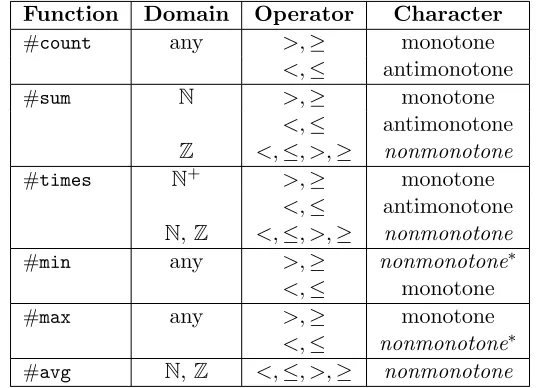
Given two interpretations I and J, we say that I ≤ J if I+ ⊆ J+ and I− ⊇ J−. A ground literal ℓ is monotone if, for all interpretations I, J such that I ≤J, we have that: (i) ℓ true with respect to I implies ℓ true with respect to J, and (ii) ℓ false with respect to J implies ℓ false with respect to I. A ground literal ℓ is antimonotone if the opposite happens, that is, for all interpretationsI, J such that I ≤J, we have that: (i) ℓfalse with respect to I implies ℓ false with respect to J, and (ii) ℓ true with respect to J implies ℓ true with respect to I. A ground literal ℓ is nonmonotone if ℓ is neither monotone nor antimonotone. Note that positive standard literals are monotone, whereas negative standard literals are antimonotone. Aggregate literals, instead, may be monotone, antimonotone or nonmonotone. Some examples are shown below and the complete picture for the most common aggregate functions is summarized in Table 1.
Table 1: Character of the most common aggregate literals. Function Domain Operator Character #count any >,≥ monotone
<,≤ antimonotone
#sum N >,≥ monotone
<,≤ antimonotone
Z <,≤, >,≥ nonmonotone
#times N+ >,≥ monotone <,≤ antimonotone
N,Z <,≤, >,≥ nonmonotone
#min any >,≥ nonmonotone∗
<,≤ monotone
#max any >,≥ monotone
<,≤ nonmonotone∗
#avg N,Z <,≤, >,≥ nonmonotone
∗
Antimonotone if the context guarantees that the set term of the aggregate never becomes empty.
#count{Z :r(Z)}>1; #sum{Z:r(Z)} ≥10. Ground instances of the following literals are instead antimonotone:
#count{Z :r(Z)}<1; #sum{Z:r(Z)} ≤10.
2.3.2 LPAm,a Programs
LetLPAm,a denote the fragment of LPA allowing monotone and antimonotone literals. For an LPAm,a rule r, the set of its monotone and antimonotone body literals are denoted by Bm(r) and Ba(r), respectively. An LPA
m,a programP is stratified if there exists a function || · ||, called level mapping, from the set of predicates of P to ordinals, such that for each paira,bof predicates, occurring in the head and body of a ruler ∈ P, respectively: (i) ifb appears in an antimonotone literal, then ||b||<||a||, (ii) otherwise ||b|| ≤ ||a||. Intuitively, stratification forbids recursion through antimonotone literals (for aggregate-free programs this definition coincides with the common notion of stratification with respect to negation).
Example 10 Consider anLPAm,a program consisting of the following rules: q(X) :−p(X), #count{Y :a(Y, X), b(X)} ≤2.
p(X) :−q(X), b(X).
and assume that the predicates a and b are defined by facts, which we do not include explicitly. The program is stratified, as the level mapping ||a||=||b||= 1, ||p||=||q||= 2 satisfies the required conditions. If we add the rule b(X) :− p(X), then no such level-mapping exists, and the program becomes unstratified.
they occur. Some aggregates that are nonmonotone by the definition given above, might not manifest their nonmonotone effects in a given context: If one limits the interpretations to be considered to those that do not violate the program in which the literal occurs, some interpretation pairs that violate monotonicity and antimonotonicity may no longer be present. In fact, one could refine the definition in this way (considering only pairs of non-violating interpretations of a given context program). The modified definition would enlarge the class ofLPAm,a programs, while retaining all of the results in this paper, but for simplicity of exposition we refrain from doing it formally. As an example, any aggregate atom involving #max with a <operator is formally not in LPAm,a, but when one considers occurrences in a program that has no non-violating interpretation I such that I(S) = ∅ (where S the set term of the aggregate), then the aggregate behaves in an antimonotone way in that particular program. We have noted these cases by a footnote in Table 1.
3. Unfounded Sets and Well-Founded Semantics
In this section we introduce a new notion of unfounded set for LPAm,a programs, which extends the original definition for aggregate-free programs introduced by Van Gelder et al. (1991). Unfounded sets are then used for extending the well-founded semantics, originally defined for aggregate-free programs by Van Gelder et al., to LPAm,a programs. We also highlight a number of desirable properties of this semantics. In the following we deal with ground programs, so we will usually denote by P a ground program. We will also use the notation L ∪ ¬˙ .L′ for the set (L\L′)∪ ¬.L′, where L and L′ are sets of standard ground
literals.
Definition 1 (Unfounded Set) A setX ⊆BP of ground atoms is an unfounded set for
anLPAm,a programP with respect to a (partial) interpretationI if and only if, for each rule r∈ P having H(r)∈ X, at least one of the following conditions holds:
(1) some (antimonotone) literal inBa(r) is false with respect to I, or
(2) some (monotone) literal in Bm(r) is false with respect toI ∪ ¬˙ .X.
Intuitively, each rule with its head atom belonging to an unfounded set X is already satisfied with respect toI (in case condition (1) holds), or it is satisfiable by taking as false all the atoms in the unfounded set (in case condition (2) holds). Note that, according to the definition above, the empty set is an unfounded set with respect to every program and interpretation.
Example 11 Consider an interpretationI4 ={a(1), a(2), a(3)} for the following program P2:
r1: a(1) :−#count{h1 :a(1)i,h2 :a(2)i,h3 :a(3)i}>2.
r2: a(2).
r3: a(3) :−#count{h1 :a(1)i,h2 :a(2)i,h3 :a(3)i}>2.
As formalized below, Definition 1 generalizes the one given by Van Gelder et al. (1991) for aggregate-free programs: A set of standard atoms X ⊆ BP is an unfounded set for a
program P with respect to an interpretationI if and only if, for each ruler∈ P such that H(r)∈ X, either (i)B(r)∩ ¬.I6=∅, or (ii)B+(r)∩ X 6=∅.
Theorem 1 For an aggregate-free program P, Definition 1 is equivalent to the one intro-duced in the work of Van Gelder et al. (1991).
Proof. For an aggregate-free programP, conditions (1) and (2) of Definition 1 are equiv-alent to (a)B−(r)∩ ¬.I 6=∅ and (b)B+(r)∩ ¬.(I ∪ ¬˙ .X)6=∅, respectively. Condition (b) is equivalent to B+(r)∩(¬.(I \ X)∪ ¬.¬.X) 6= ∅, which holds if and only if either (b.1) B+(r)∩ ¬.(I\ X) =6 ∅, or (b.2) B+(r)∩ X 6= ∅. Condition (b.2) is exactly condition (ii) in the work of Van Gelder et al. Concerning condition (b.1), since B+(r) contains only positive literals, we can ignore the negative literals in¬.(I\ X), that is, the positive literals inI \ X. By noting that the negative literals inI\ X are precisely the negative literals in I, we can then conclude that (b.1) is equivalent to B+(r)∩ ¬.I6=∅. Finally, by combining the previous statement with condition (a) above, we obtain condition (i) in the work of Van
Gelder et al. ✷
Thus, Definition 1 is an alternative characterization of unfounded sets for aggregate-free programs. In fact, while condition (1) of Definition 1 does not exactly cover the first one in Van Gelder et al., condition (2) catches all cases of the second in the work of Van Gelder et al. and those “missed” by condition (1).
Theorem 2 If X and X′ are unfounded sets for anLPA
m,a program P with respect to an interpretationI, thenX ∪ X′ is an unfounded set forP with respect to I.
Proof. Let r ∈ P be such that H(r) ∈ X ∪ X′. We want to show that either (1) some
(antimonotone) literal in Ba(r) is false with respect to I, or (2) some (monotone) literal in Bm(r) is false with respect to J =I ∪ ¬˙ .(X ∪ X′). By symmetry, we can assume that
H(r) belongs to X. Since X is an unfounded set with respect to I by hypothesis, either (a) some (antimonotone) literal inBa(r) is false with respect to I, or (b) some (monotone) literal in Bm(r) is false with respect to K =I ∪ ¬˙ .X. Case (a) is equals to (1). Thus, it remains to prove that case (b) implies (2). Indeed, we have that J ≤K becauseJ+⊆K+ and J− ⊇ K−. Therefore, by definition of monotonicity, each monotone literal ℓ which is false with respect toK is false with respect toJ as well, and so we are done. ✷ As a corollary of Theorem 2, the union of all the unfounded sets is an unfounded set as well.
Corollary 3 The union of all the unfounded sets for anLPAm,a programP with respect to an interpretationI is an unfounded set forP with respect to I as well. We refer to this set as thegreatest unfounded set ofP with respect to I, denoted by GU SP(I).
Below is an important monotonicity property of the greatest unfounded set.
Proof. Since GU SP(J) is the union of all the unfounded sets for P with respect to J by
definition, it is enough to show that X =GU SP(I) is an unfounded set forP with respect
toJ. Thus, we want to show that, for each ruler∈ P such thatH(r)∈ X, either (1) some (antimonotone) literal inBa(r) is false with respect to J, or (2) some (monotone) literal in Bm(r) is false with respect to J ∪ ¬˙ .X. We already know thatX is an unfounded set forP with respect toI by Corollary 3. Therefore, either (a) some (antimonotone) literal inBa(r) is false with respect to I, or (b) some (monotone) literal in Bm(r) is false with respect to I ∪ ¬˙ .X. SinceI ⊆J, we have that J andJ ∪ ¬˙ .X are extensions of the interpretationsI and I ∪ ¬˙ .X, respectively. Hence, by Remark 1, (a) implies (1) and (b) implies (2), and so
we are done. ✷
We are now ready for extending the well-founded operator defined by Van Gelder et al. (1991) to the case ofLPA
m,a programs.
Definition 2 Let P be an LPAm,a program. The immediate logical consequence operator
TP :IP →2BP and thewell-founded operatorWP :IP →2BP∪¬.BP are defined as follows:
TP(I) ={ℓ∈BP | ∃r ∈ P such that H(r) =ℓ
and all the literals in B(r) are true with respect toI} WP(I) =TP(I)∪ ¬.GU SP(I).
Intuitively, given an interpretation I for a program P, WP derives as true a set of
atoms belonging to every model extending I (by means of the TP operator). Moreover,
WP derives as false all the atoms belonging to some unfounded set for P with respect to
I (by means of theGU SP operator). Note that TP(I) and GU SP(I) are set of atoms, so
WP(I)+ = TP(I) and WP(I)− = ¬.GU SP(I). The following proposition formalizes the
intuition that Definition 2 extends theWP operator defined by Van Gelder et al. (1991) for
standard programs toLPA
m,a programs.
Proposition 5 Let P be an aggregate-free program. The WP operator of Definition 2
coincides with the WP operator defined by Van Gelder et al. (1991).
Proof. Since WP is equal to the union of TP and ¬.GU SP in both cases, we have just to
show that our definitions of TP and GU SP coincide with those introduced by Van Gelder
et al. (1991) for aggregate-free programs.
• The two immediate logical consequence operators (TP) coincide for an aggregate-free
programP. Indeed, for each ruler ∈ P,B(r) has only standard literals.
• Our definition of GU SP(I) coincides with the one of Van Gelder et al. (1991) for an
aggregate-free programP and an interpretation I. Indeed, in both casesGU SP(I) is
defined as the union of all the unfounded sets forP with respect toI, and our notion of unfounded set coincides with the one in the work of Van Gelder et al. for standard
programs by Theorem 1. ✷
We next show that a fixpoint of the well-founded operator WP is a (possibly partial)
∅
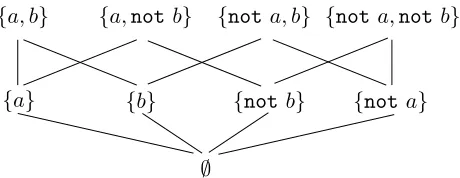
[image:14.612.209.439.89.178.2]{a} {b} {not b} {nota} {nota, b} {not a,not b} {a, b} {a,notb}
Figure 1: A meet semilattice
Theorem 6 Let P be an LPAm,a program and M a (partial) interpretation. If M is a fixpoint ofWP, then M is a (partial) model of P.
Proof. Let us assume thatWP(M) =M holds. Thus,TP(M)⊆M and¬.GU SP(M)⊆M
hold. Consider now a rule r ∈ P. If all the literals in B(r) are true with respect to M, then H(r) ∈ TP(M) ⊆ M. If H(r) is false with respect to M, then H(r) ∈ GU SP(M).
Since GU SP(M) is an unfounded set for P with respect to M by Corollary 3, either some
literal inBa(r) is false with respect to M, or some literal inBm(r) is false with respect to M ∪ ¬˙ .GU SP(M) =M. We can then conclude thatr is satisfied byM. ✷
The theorem below states that WP is a monotone operator in the meet semilattice
in-duced onIP by the subset-containment relationship. We recall here that a meet semilattice
is a partially ordered set which has a meet (or greatest lower bound) for any nonempty finite subset. An example of such a meet semilattice for a program with base {a, b} is reported in Figure 1.
Theorem 7 Let P be an LPAm,a program. The well-founded operator WP is a monotone
operator in the meet semilatticehIP,⊆i.
Proof. SinceWP is equal to the union of TP and ¬.GU SP by Definition 2, we have just to
prove the monotonicity of the operators TP andGU SP.
• We first show thatTP is a monotone operator, that is, for each pair of interpretations
I, J forP such thatI ⊆J, it holds thatTP(I)⊆ TP(J). Consider an atomℓ∈ TP(I).
By Definition 2, there is a ruler ∈ P such that H(r) =ℓ and all the literals inB(r) are true with respect to I. Since I ⊆J, we can conclude that all the literals in B(r) are true with respect toJ as well (see Remark 1), and so H(r) =ℓbelongs to TP(J)
by Definition 2.
• We already know that GU SP is a monotone operator from Proposition 4: For each
pair of interpretationsI, JforP such thatI ⊆J, it holds thatGU SP(I)⊆GU SP(J).
✷ We can now prove that the sequence W0=∅,Wn+1=WP(Wn) is well-defined, that is, each element of the sequence is an interpretation.
Theorem 8 Let P be an LPAm,a program. The sequence W0 = ∅, Wn+1 = WP(Wn) is
Proof. We use strong induction. The base case is trivial, sinceW0 =∅. In order to prove the consistency ofWn+1 =TP(Wn)∪¬.GU SP(Wn), we assume the consistency of everyWm such that m ≤ n. Since WP is a monotone operator by Theorem 7, it is enough to show
thatGU SP(Wn)∩Wn+1 =∅. To this end, we next show that any set X of atoms such that X ∩Wn+1 6=∅is not an unfounded set forP with respect toWn(and so is not contained in GU SP(Wn)). LetWm+1 be the first element of the sequence such thatX ∩Wm+1 6=∅(note thatm≤n). Consider any atomℓ∈ X ∩Wm+1. By definition ofTP, there is a rule r ∈ P
having H(r) = ℓ and such that all the literals in B(r) are true with respect to Wm. Note that no atom inWm can belong toX (for the way in whichWm+1 has been chosen). Thus, by Remark 1, all the literals in B(r) are true with respect to both Wn and Wn ∪ ¬˙ .X (we recall thatWn⊇Wm because WP is monotone). This ends the proof, as neither condition
(1) nor (2) of Definition 1 hold for ℓ. ✷ Theorem 8 and Theorem 7 imply thatWP admits a least fixpoint (Tarski, 1955), which
is referred to as the well-founded model of P. The well-founded semantics of an LPA
m,a program P is given by this model. We can now state a first important property of the well-founded semantics ofLPAm,a programs.
Property 1 For everyLPA
m,a program, the well-founded model always exists and is unique.
Another important property of well-founded semantics easily follows from Proposition 5.
Property 2 On aggregate-free programs, the well founded semantics as defined in this paper coincides with the classical well-founded semantics of Van Gelder et al. (1991).
Although the well-founded model, in general, might leave some atoms as undefined, there are cases where Wω
P(∅) is a total interpretation.
Example 12 Consider the following programP3:
a(1) :−#sum{h1 :a(1)i,h2 :a(2)i}>2. a(2) :−b.
b:−notc.
The iterated application of WP yields the following sets:
1. WP(∅) ={nota(1), notc};
2. WP({not a(1), notc}) ={nota(1), notc, b};
3. WP({not a(1), notc, b}) ={not a(1), notc, b, a(2)} =WPω(∅).
In this case, the well-founded model is total. Indeed, each atom inBP is either true or false
with respect toWω
P(∅).
Theorem 9 On stratified LPAm,a programs, the well-founded model is total.
Proof. Let P be a stratified LPAm,a program. In order to prove that Wω
P(∅) is total, we
show that each (standard) atom inBP\WPω(∅) is false with respect toWPω(∅). By definition
of stratification, there is a level mapping || · || of the (standard) predicates of P such that, for each pair a, b of standard predicates occurring in the head and body of a rule r ∈ P, respectively, the following conditions are satisfied: (i) ifbappears in an antimonotone literal, then ||b|| < ||a|| holds; (ii) otherwise, if b appears in a monotone literal, then ||b|| ≤ ||a|| holds. We are then in order to define a non-decreasing sequence of subsets ofBP as follows:
L0 = ∅
Li+1 = Li∪ {ℓ∈BP | the predicate of ℓisp and ||p||=i}, ∀i∈N.
Our aim is then to show that, for eachi∈N, the setLi+1\Wω
P(∅) is contained in¬.WPω(∅)−.
We use induction on i. The base case is trivial because L0 = ∅ holds by definition. Now suppose that all the atoms inLi\ WPω(∅) are false with respect to WPω(∅) in order to show
that all the atoms in Li+1\ WPω(∅) are false with respect to WPω(∅) as well. To this end,
we prove that Li+1 \ WPω(∅) is an unfounded set for P with respect to WPω(∅). Consider
a rule r ∈ Ground(P) with H(r)∈ Li+1\ Wω
P(∅). We want to show that either (1) some
(antimonotone) literal in Ba(r) is false with respect to Wω
P(∅), or (2) some (monotone)
literal inBm(r) is false with respect to Wω
P(∅) ˙∪ ¬.(Li+1\ WPω(∅)). Since H(r)∈Li+1, by
definition of stratification the following propositions hold:
(a) each literal inBa(r) is either a negated standard atom belonging toLi, or an aggregate literal depending only on atoms in Li;
(b) each literal in Bm(r) is either a standard atom belonging to Li+1, or an aggregate literal depending only on atoms in Li+1.
Since H(r) 6∈ Wω
P(∅) (that is, H(r) 6∈ TP(WPω(∅))), there is a literal ℓ in B(r) such that ℓ
is not true with respect to Wω
P(∅) (by definition of TP). If ℓ is an antimonotone literal, we
apply (a) and the induction hypothesis and conclude that (1) holds (ℓcannot be undefined with respect to Wω
P(∅), soℓmust be false). Ifℓis a monotone literal, we apply (b) and the
induction hypothesis and conclude that (2) holds (ℓ cannot be undefined with respect to Wω
P(∅) ˙∪ ¬.(Li+1\ WPω(∅)) and WPω(∅) ˙∪ ¬.(Li+1\ WPω(∅)) ≤ WPω(∅) holds, so ℓ must be
false). ✷
4. Answer Set Characterization via Unfounded Sets
The well-founded semantics is a three-valued semantics, that is, each program is associ-ated with a model in which atoms are either true, false or undefined. Other semantics in the literature associate programs with two-valued models (i.e., models without undefined atoms). A commonly accepted two-value semantics in LP is the answer set semantics. In this section we present a number of results concerning unfounded sets and answer sets of
Definition 3 (Minimal Model) A total model M for P is (subset-)minimal if no total model N forP exists such that N+ ⊂M+. Note that, under these definitions, the words
interpretationand modelrefer to possibly partial interpretations, while a minimal model is always a total interpretation.
We next provide the transformation by which the reduct of a ground program with respect to a total interpretation is formed. Note that this definition is a generalization (Faber et al., 2004) of the Gelfond-Lifschitz transformation (1991) for standard logic programs.
Definition 4 (Program Reduct) Given an LPA program P and a total interpretation I, let Ground(P)I denote the transformed program obtained fromGround(P) by deleting rules in which a body literal is false with respect toI, i.e.:
Ground(P)I ={r ∈Ground(P)| all the literals in B(r) are true with respect toI}.
We are now ready for introducing the notion of answer set for LPA programs.
Definition 5 (Answer Set for LPA Programs) Given an LPA programP, a total in-terpretation M of P is an answer set of P if and only if M is a minimal model of Ground(P)M.
Example 13 Consider two total interpretations I5 ={p(0)} and I6 ={not p(0)} for the following two programs:
P4={p(0) :−#count{X:p(X)}>0.} P5={p(0) :−#count{X:p(X)} ≤0.}
We then obtain the following transformed programs:
Ground(P4)I5 =Ground(P4) ={p(0) :−#count{h0 :p(0)i}>0.}
Ground(P4)I6 =∅
Ground(P5)I5 =∅
Ground(P5)I6 =Ground(P5) ={p(0) :−#count{h0 :p(0)i} ≤0.}
Hence,I6 is the only answer set ofP4. Indeed,I5 is not a minimal model ofGround(P4)I5. Moreover,P5 has no answer sets. Indeed,I5 is not a minimal model of Ground(P5)I5, and I6 is not a model ofGround(P5)I6 =Ground(P5).
Note that any answer set M of P is also a total model of P because Ground(P)M ⊆ Ground(P), and the rules in Ground(P)\Ground(P)M are satisfied with respect to M (by Definition 4, each of these rules must have at least one body literal which is false with respect toM).
On the language LPAm,a considered in this work, answer sets as defined in Definition 5 coincide with stable models as defined by Pelov, Denecker, and Bruynooghe (2003) and hence also those defined by Pelov et al. (2007) and Son et al. (2007). This equivalence follows from Propositions 3.7 and 3.8 of Ferraris (2011), which respectively state that stable models of Pelov et al. (2003) onLPAm,a coincide with a semantics defined by Ferraris (2011), which in turn coincides with Definition 5 on a larger class of programs. This means that all our results involving answer sets also hold for these other semantics onLPAm,a. On the other hand, this also implies that some of the results (for example Theorem 16) are consequences of results in the work of Pelov et al. (2007) by virtue of Theorem 24 in Section 7.
Definition 6 (Unfounded-free Interpretation) An interpretationI for anLPAm,a pro-gram P is unfounded-free if and only if I ∩ X = ∅ holds for each unfounded set X for P with respect toI.
For total interpretations, an equivalent characterization of the unfounded-free property is given below.
Lemma 10 A total interpretationI for anLPAm,a programP is unfounded-free if and only if the empty set is the only subset ofI+ which is an unfounded set forP with respect toI. Proof. (⇒) Straightforward: By Definition 6, I is disjoint from all the unfounded set for P with respect to I.
(⇐) We prove the contrapositive: IfI is not unfounded-free, then there exists a non-empty subset of I+ which is an unfounded set forP with respect toI. From Definition 6, if I is not unfounded-free, then there exists an unfounded setX forP with respect toI such that I∩ X 6=∅. We next show that I∩ X is an unfounded set for P with respect to I, i.e., for each rule r ∈ P such that H(r) ∈ I ∩ X, either (1) some (antimonotone) literal in Ba(r) is false with respect to I, or (2) some (monotone) literal inBm(r) is false with respect to I ∪ ¬˙ .(I∩ X). SinceX is an unfounded set, by Definition 1, either (a) some (antimonotone) literal inBa(r) is false with respect toI, or (b) some (monotone) literal inBm(r) is false with respect toI ∪ ¬˙ .X. Thus, we can end the proof by showing thatI ∪ ¬˙ .X =I ∪ ¬˙ .(I∩ X). To this end, observe that (i) ¬.X = ¬.(X \I) ∪ ¬.(I ∩ X). Moreover, since I is total, ¬.(BP \I+) = I−, and thus (ii) ¬.(X \I) = ¬.(X \I+) ⊆ I− ⊆ I \ X. By using (i) in
I ∪ ¬˙ .X = (I\ X)∪ ¬.X and simplifying with (ii) we obtainI ∪ ¬˙ .X = (I\ X)∪ ¬.(I∩ X). We conclude by observing that I \ X = I \(I ∩ X), and thus I ∪ ¬˙ .X = I ∪ ¬˙ .(I∩ X)
holds. ✷
Now we give another interesting characterization of total models for LPAm,a programs.
Lemma 11 A total interpretation M is a (total) model for an LPAm,a program P if and only if ¬.M− is an unfounded set forP with respect toM.
Proof. We start by observing that each rule r ∈ P such that H(r) ∈M+ is satisfied by M. Thus, we have to show that, for each rule r ∈ P with H(r) ∈ ¬.M−, some literal in B(r) is false with respect toM if and only if either (1) some (antimonotone) literal inBa(r) is false with respect to M, or (2) some (monotone) literal in Bm(r) is false with respect to M ∪ ¬˙ .(¬.M−). To this end, it is enough to prove that M ∪ ¬˙ .(¬.M−) = M holds. By definition, (∗) M ∪ ¬˙ .(¬.M−) = (M \ ¬.M−)∪ ¬.¬.M−. From the consistency ofM we have that M and ¬.M− are disjoint. Moreover, ¬.¬.M− =M− is a subset of M. By simplifying (∗) with the last two sentences, we obtain M ∪ ¬˙ .(¬.M−) =M. ✷
Now we give further characterizations of answer sets forLPAm,a programs.
Proof. (⇒) We prove the contrapositive: If a total model M of an LPAm,a program P is not unfounded-free, then M is not an answer set ofP. By Lemma 10, since M is a total interpretation and it is not unfounded-free, there exists an unfounded set X for P with respect toM such that X ⊆M+ and X 6=∅. Therefore, to prove that M is not an answer set ofP, we next show thatM ∪ ¬˙ .X is a model ofPM such thatM ∪ ¬˙ .X ⊂M. To this end, consider a ruler∈ PM. By Definition 4 of reduct, all the literals inB(r) are true with respect toM, and soH(r)∈M+ because M is a model of P and PM ⊆ P. We now have to consider two cases:
1. H(r)6∈ X. In this case, H(r)∈M ∪ ¬˙ .X as well.
2. H(r)∈ X. In this case, since X is an unfounded set forP with respect to M, either (1) some literal inBa(r) is false with respect toM, or (2) some literal inBm(r) is false with respect toM ∪ ¬˙ .X. By previous considerations, sincer∈ PM, (1) cannot hold, and so we can conclude that some literal inB(r) is false with respect to M ∪ ¬˙ .X.
Hence, we have that r is satisfied by M ∪ ¬˙ .X either by head (in case H(r) 6∈ X), or by body (in caseH(r)∈ X), and so we are done.
(⇐) We prove the contrapositive: If a total model M of an LPAm,a program P is not an answer set of P, thenM is not unfounded-free. SinceM is a model ofP ⊇ PM but not an answer set ofP, there exists a total modelN of PM such that N+⊂M+. We next show thatM+\N+ is an unfounded set forP with respect toM, that is, for each ruler ∈ P such thatH(r)∈M+\N+, either (1) some (antimonotone) literal in Ba(r) is false with respect toM, or (2) some (monotone) literal inBm(r) is false with respect toM ∪ ¬˙ .(M+\N+).
We start by showing thatM ∪ ¬˙ .(M+\N+) =N. By definition, (a)M∪ ¬˙ .(M+\N+) = (M \(M+ \ N+))∪ ¬.(M+ \ N+). From N+ ⊂ M+ we have (b) M \(M+ \N+) = N+∪M−. Moreover, sinceN and M are total interpretations andN+⊂M+, we have (c) N−⊃M− and (d)¬.(M+\N+) =N−\M−. Thus, by using (b) and (d) in (a) we obtain M ∪ ¬˙ .(M+\N+) =N+∪M−∪(N−\M−), and by observing thatM−∪(N−\M−) =N− holds because of (c), we conclude (e) M ∪ ¬˙ .(M+\N+) =N+∪N−=N.
Consider now a ruler∈ P such that H(r)∈M+\N+. We have to deal with two cases: 1. r∈ P \ PM. In this case, by Definition 4, there must be a literalℓ∈B(r) such thatℓ is false with respect toM. Ifℓis an antimonotone literal, then (1) holds. Otherwise, ℓis a monotone literal and soℓis false with respect toN as well, sinceN ≤M; thus, (2) holds because of (e).
2. r ∈ PM. In this case, since N is a model of PM and H(r) is false with respect to N (becauseH(r)∈M+\N+by assumption), there must be a literalℓ∈B(r) such that ℓis false with respect to N. Ifℓis an antimonotone literal, thenℓis false with respect toM as well, sinceN ≤M, and so (1) holds. Otherwise,ℓ is a monotone literal and
(2) holds because of (e). ✷
We are then ready to state an important connection between answer sets and unfounded sets.
Proof. (⇒) LetM be an answer set ofP. By Lemma 11,¬.M−is an unfounded set forP with respect to M, and hence GU SP(M)⊇ ¬.M−. By Theorem 12,M is unfounded-free,
and henceGU SP(M)⊆ ¬.M− because M is total. In sum,GU SP(M) =¬.M−.
(⇐) LetM be a total interpretation such thatGU SP(M) =¬.M−. ThenMandGU SP(M) =
¬.M−are disjoint, and soM is unfounded-free. Moreover, by Corollary 3,GU SP(M) =M−
is an unfounded set for P with respect toM and so, by applying Lemma 11, we conclude thatM is a model ofP. We are then in order to apply Theorem 12 (M is an unfounded-free model ofP) and conclude thatM is an answer set of P. ✷ The following theorem shows that answer sets of LPAm,a programs are exactly the total fixpoints of the well-founded operator defined in Section 3.
Theorem 14 Let M be a total interpretation for an LPAm,a program P. Then M is an answer set for P if and only if M is a fixpoint of the well-founded operator WP.
Proof. (⇒) LetMbe an answer set ofP. We want to show thatM is a fixpoint ofWP, that
is, WP(M) = M. Our aim is then to show that TP(M) = M+ and ¬.GU SP(M) = M−.
Since M is an answer set, by applying Theorem 13, we obtain GU SP(M) = ¬.M−, which
is equivalent to¬.GU SP(M) =M−. Therefore, it remains to prove thatTP(M) =M+:
(⊆) Consider an atom ℓ ∈ TP(M). By Definition 2, there is a rule r ∈ P such that
H(r) =ℓand all the literals in B(r) are true with respect toM. Thus, ℓ∈M+ holds becauseM is a model ofP.
(⊇) Consider an atom ℓ∈M+. SinceM is an answer set of P, we can apply Theorem 12 and conclude that M is unfounded-free. Hence, the (singleton) set {ℓ} ⊆M+ is not an unfounded set for P with respect to M. Thus, by Definition 1, there is a rule r ∈ P such that H(r) = ℓ and neither (1) some (antimonotone) literal in Ba(r) is false with respect toM, nor (2) some (monotone) literal inBm(r) is false with respect toM ∪ ¬˙ .{ℓ}. Since M is a total interpretation, neither (1) nor (2) is equivalent to both (i) all the (antimonotone) literals inBa(r) are true with respect to M, and (ii) all the (monotone) literals inBm(r) are true with respect toM ∪ ¬˙ .{ℓ}. By observing thatM ∪ ¬˙ .{ℓ} ≤M, we can state that (ii) implies that all the (monotone) literals in Bm(r) are true with respect toM as well. By combining the latter statement with (i) we obtain that all the literals in B(r) are true with respect to M, and soℓ∈ TP(M)
by Definition 2.
(⇐) Let M be a total fixpoint of WP, i.e., WP(M) = M. Thus, M− = ¬.GU SP(M) by
Definition 2, and soM is an answer set forP because of Theorem 13. ✷ Observe that Theorem 14 is a generalization of Theorem 5.4 of Van Gelder et al. (1991) to the class ofLPAm,a programs. It is also worth noting thatWP(I) extendsI preserving its
“correctness”: IfI is contained in an answer setM, thenWP(I) may add toI some literals
of M, but never introduces any literal which would be inconsistent with M.
Proof. This is a trivial consequence of the monotonicity of the operatorWP (Theorems 7)
and Theorem 14. Indeed, by Theorems 7, WP is I ⊆ M implies WP(I) ⊆ WP(M), and
WP(M) =M by Theorem 14. ✷
We next show that the well-founded model of an LPAm,a program is contained in all the answer sets (if any) of P. We would like to point out that due to Theorem 24 in Section 7 (showing the equivalence of the well-founded operators defined in this work and the one defined in Pelov et al., 2007) and Propositions 3.77 and 3.8 of Ferraris (2011; showing the equivalence of answer sets in Faber et al., 2011 and stable models in Pelov et al., 2007), the following results also hold by virtue of the definitions of the well-founded and stable semantics in the work of Pelov et al., in particular due to Proposition 7.3 of that paper. We nevertheless also provide a proof using the concepts defined earlier.
Theorem 16 LetP be anLPAm,a program. For each answer set M of P,Wω
P(∅)⊆M.
Proof. LetM be an answer set ofP. Note thatWω
P(∅) is the limit of the sequenceW0 =∅,
Wn = WP(Wn−1). We show that Wn ⊆ M by induction on n. The base case is trivially true sinceW0 =∅ by definition. Now assume Wn ⊆M in order to show that Wn+1 ⊆M. Since Wn+1 = WP(Wn) by definition and Wn ⊆ M by induction hypothesis, we apply Proposition 15 and conclude thatWn+1⊆M. ✷
The theorem above suggests another property of well-founded semantics forLPA
m,a pro-grams.
Property 3 The well-founded semantics forLPAm,a programs approximates the answer set semantics: The well-founded model is contained in the intersection of all answer sets (if any).
By combining Theorem 14 and Theorem 16, we obtain the following claim.
Corollary 17 Let P be an LPA
m,a program. If WPω(∅) is a total interpretation, then it is
the unique answer set of P.
Therefore, by combining Theorem 9 and the corollary above, we obtain another property of well-founded semantics forLPAm,a programs.
Property 4 On stratified LPAm,a programs, the well-founded model coincides with the unique answer set.
5. The Complexity of the Well-Founded Semantics
Lemma 18 Let I be a partial interpretation for a ground LPAm,a program P. We define two total interpretations forP as follows: Imin=I∪ ¬.(BP\I) andImax=I∪(BP\ ¬.I).
For each (ground) aggregate literalA occurring in P, the following statements hold:
1. IfA is a monotone literal, thenA is true (resp. false) with respect to I if and only if A is true with respect toImin (resp. false with respect toImax).
2. If A is an antimonotone literal, then A is true (resp. false) with respect to I if and only if A is true with respect toImax (resp. false with respect to Imin).
Proof. We start by noting that Imin (resp. Imax) is a total interpretation extending I and such that all the standard atoms which are undefined with respect to I are false with respect to Imin (resp. true with respect to Imax). Thus, we have (∗)Imin≤I ≤Imax. IfA is monotone and true with respect toImin (resp. false with respect toImax), thenAis true (resp. false) with respect to I because of (∗). IfA is antimonotone and true with respect to Imax (resp. false with respect to Imin), then A is true (resp. false) with respect to I because of (∗). We end the proof by observing that if A is true (resp. false) with respect toI, then Ais true with respect to Imin andImax by definition. ✷
We are now ready to analyze the computational complexity of the well-founded semantics forLPA
m,a programs. Our analysis will lead to prove the following fundamental property.
Property 5 The well-founded model for a groundLPAm,aprogram is efficiently (polynomial-time) computable.
Given Corollary 25, this property also follows from Theorem 7.4 in the work of Pelov et al. (2007). In the following, we will provide an alternative proof based on the concepts defined earlier in this paper, which also leads to several interesting intermediate results.
Property 5 is not trivial because aggregates may easily increase the complexity of the evaluation. Indeed, even deciding the truth of an aggregate with respect to a partial inter-pretation is intractable in general; a similar observation has already been made by Pelov (2004). However, this task is polynomial-time computable for the aggregate literals occur-ring in LPAm,a programs.
Proposition 19 Deciding whether a ground aggregate literal A is true (resp. false) with respect to a partial interpretation I is:
(a) co-NP-complete in general;
(b) polynomial-time computable ifA is either a monotone or an antimonotone literal.
time (if the aggregate function can be computed in polynomial time with respect to the size of the input multiset, as we are assuming).
As for the hardness, we first consider the problem of checking the truth of an aggre-gate and provide a polynomial-time reduction from TAUTOLOGY. The TAUTOLOGY problem is co-NP-complete and can be stated as follow: Given a proposition formula Φ on variables X1, . . . , Xn, does each truth assignment v for the variables X1, . . . , Xn satisfy the formula Φ? Without loss of generality, we assume that Φ is a 3-DNF formula of the form
Φ =D1∨ · · · ∨Dm,
where each disjunct Di is a conjunction ℓ1i ∧ℓ2i ∧ℓ3i, and each ℓ j
i is a positive or negative literal (note that, in the context of TAUTOLOGY, the term “literal” denotes a variable Xk or a variable preceded by the negation symbol ¬). For a given Φ, we then consider a partial interpretationI ={⊤}and construct an aggregate literal A= #sum{S} ≥1, where S contains two groups of elements. The elements in the first group represent disjuncts of Φ and are
h1 :γ(ℓ1i), γ(ℓi2), γ(ℓ3i)i, i= 1, . . . , m ,
where, for each i = 1, . . . , m and j = 1, . . . ,3, the propositional atom γ(ℓji) is defined as follows:
γ(ℓji) =
xtk ifℓji is a positive literal Xk, for some k∈ {1, . . . , n}.
xfk ifℓji is a negative literal ¬Xk, for some k∈ {1, . . . , n}.
The elements in the second group represent variables of Φ and are as follows:
h 1, xk:⊤ i h−1, xk:xtki h−1, xk:xfki h 1, xˆk:xtk, x
f ki
, k= 1, . . . , n ,
wherexkand ˆxkare constants associated with the variableXk. Note that, for each variable Xk of Φ, there are two atoms in A,xtk and x
f
k. Thus, for each interpretation J, four cases are possible:
(1) {not xtk, not xkf} ⊆ J: In this case, only h1, xk:⊤i contribute to the evaluation of A, and its contribution is 1;
(2) {xtk, xfk} ⊆ J: In this case, all the four elements contribute to the evaluation of A, and thus their contribution is 1−1 + 1 = 1 (note thath−1, xk:xtkiand h−1, xk:xfki give a total contribution of−1 because of our pure set approach);
(3) {xtk, not xfk} ⊆J: In this case, only h1, xk:⊤i and h−1, xk:xtki contribute, giving 1−1 = 0;
(4) {not xt k, x
f
k} ⊆J: In this case, only h1, xk:⊤i and h−1, xk:x f
Thus, for eachk∈ {1, . . . , n}, the total contribution of the four elements ofSassociated with the variableXk is either 0 or 1. Note that also the total contribution of the other elements ofS (i.e., those in the first group) is either 0 or 1. Therefore, if there is k∈ {1, . . . , n} such that either case (1) or (2) occurs, the interpretation J trivially satisfies A. Otherwise, J is such that, for each variable k∈ {1, . . . , n}, either (3) or (4) occurs. In this case, we say thatJ is agood interpretation.
We next define a one-to-one mapping between the set of assignments for Φ and the set of good interpretations. Letv be an assignment for Φ. The good interpretation Iv associated withv is such that ⊤ ∈Iv and
{xtk, notxfk} ⊆Iv ifv(Xk) = 1
{not xtk, xfk} ⊆Iv ifv(Xk) = 0
, k= 1, . . . , n .
We want to show thatv satisfies Φ if and only ifAis true with respect toIv. SinceIv is a good interpretation, the elements ofS in the second group give a total contribution of 0, and so we have just to consider the elements ofS in the first group. These elements give a contribution of 1 if and only if{γ(ℓ1i), γ(ℓ2i), γ(ℓ3i)} ⊆I holds for at least onei∈ {1, . . . , n}, and this holds if and only v(Di) = 1 holds for the disjunct Di. We can then conclude that A is true with respect toIv if and only v(Φ) = 1.
Concerning the check of falsity of an aggregate, we can start from a 3-DNF formula Φ and construct an aggregate literal A′ = #sum{S} < 1, where S is obtained as described above. Then Φ is a tautology if and only if A′ is false with respect toI ={⊤}.
(b) Let I be a partial interpretation for an LPAm,a program P and A an aggregate literal occurring inP. We want to show that deciding whetherAis true (resp. false) with respect toI can be done in polynomial-time in the size ofBP. By Lemma 18, it is enough to evaluate
the aggregate with respect to either Imin = I∪ ¬.(BP \I) or Imax =I ∪(BP \ ¬.I). We
then end the proof by observing that the interpretationsImin andImax can be constructed in polynomial time, and that the value of the aggregate function inA can be computed in polynomial time with respect to the size of the input multiset by assumption. ✷ In order to prove the tractability of the well-founded semantics we need an efficient method for computing the greatest unfounded set, which is part of the well-founded operator WP. Hence, we next give a polynomial-time construction of the setBP\GU SP(I) by means
of a monotone operator.
Definition 7 Let I be an interpretation for an LPAm,a program P. The operator φI : 2BP →2BP is defined as follows:
φI(Y) = {ℓ∈BP | ∃r ∈ P withH(r) =ℓsuch that
no (antimonotone) literal inBa(r) is false with respect to I, and all the (monotone) literals in Bm(r) are true with respect toY \ ¬.I−}
The least fixpoint of φI coincides with the greatest unfounded set of P with respect to I.
1. The φI operator has a least fixpointφωI(∅);
2. GU SP(I) =BP\φωI(∅).
Proof. The φI operator is a monotonically increasing operator in the meet semilattice hBP,⊆i, and it therefore admits a least fixpointφωI(∅) (Tarski, 1955). We next prove that
GU SP(I) =BP\φωI(∅) in two steps:
(⊆) We first observe thatφωI(∅) can be computed iteratively, starting from the empty set, as the limit of the sequenceF0=∅,Fi+1=φI(Fi). Thus, we prove by induction oni thatGU SP(I)⊆BP\Fiholds. The base case is trivial, sinceF0=∅by definition and GU SP(I) is a subset of BP by Definition 1. We then assume GU SP(I)⊆BP\Fi in order to prove thatGU SP(I)⊆BP\Fi+1. SinceGU SP(I) is an unfounded set forP
with respect toI by Theorem 2, by Definition 1 we have that, for eachℓ∈GU SP(I)
and for each rule r ∈ P with H(r) = ℓ, either (1) some (antimonotone) literal in Ba(r) is false with respect toI, or (2) some (monotone) literal inBm(r) is false with respect toI ∪ ¬˙ .GU SP(I). We want to show that such a ℓdoes not belong to Fi+1, that is, each rule r as above is such that either (i) some (antimonotone) literal in Ba(r) is false with respect to I, or (ii) some (monotone) literal in Bm(r) is not true with respect toFi\ ¬.I− (recall that Fi+1 =φI(Fi) by definition). Since (1) and (i) are equals, we have to show that (2) implies (ii). To this end, assume that there is a (monotone) literalℓ′ ∈Bm(r) which is false with respect to I ∪ ¬˙ .GU S
P(I). Our
aim is to show thatℓ′ is false with respect to J = (Fi\ ¬.I−)∪ ¬.(BP\(Fi\ ¬.I−)), since in this case ℓ′ would be not true with respect to Fi \ ¬.I− (see Lemma 18). We start by proving that (I ∪ ¬˙ .GU SP(I))− =I−∪ ¬.GU SP(I) is a subset of J−.
Observe that J− = ¬.(BP \ (Fi \ ¬.I−)) = I− ∪ ¬.(BP \ Fi) because ¬.I− is a
subset of BP. Thus, since GU SP(I) ⊆ BP \Fi by induction hypothesis, we obtain (I ∪ ¬˙ .GU SP(I))− = I−∪ ¬.GU SP(I) ⊆ I−∪ ¬.(BP \Fi) = J−. Since J is total,
(I ∪ ¬˙ .GU SP(I))− ⊆ J− implies that there is an extension K of I ∪ ¬˙ .GU SP(I)
such that K− ⊆J− and K+ ⊇ J− (for example, the one containing as true all the standard positive literals which are undefined with respect toI ∪ ¬˙ .GU SP(I)). Since
ℓ′ is false with respect to I ∪ ¬˙ .GU SP(I) by assumption and K is an extension of
I ∪ ¬˙ .GU SP(I), ℓ′ is false with respect to K by Remark 1. Thus, since J ≤K and
ℓ′ is monotone, the latter implies that ℓ′ is false with respect to J as well.
(⊇) We prove that BP \φωI(∅) is an unfounded set for P with respect to I, that is, for eachr∈ P withH(r)∈BP\φωI(∅), either (1) some (antimonotone) literal inBa(r) is
false with respect toI, or (2) some (monotone) literal in Bm(r) is false with respect to I ∪ ¬˙ .(BP\φωI(∅)). By Definition 7, H(r) 6∈ φωI(∅) implies either that (i) some (antimonotone) literal inBa(r) is false with respect toI, or that (ii) some (monotone) literal inBm(r) is not true with respect toφωI(∅)\ ¬.I−. Since (i) and (1) are equals, we have to show that (ii) implies (2). To this end, assume that there is a (monotone) literal ℓ ∈ Bm(r) which is not true with respect to φωI(∅)\ ¬.I−. Thus, there is an extension of φωI(∅)\ ¬.I− for which ℓ is false, and in particular ℓ must be false with respect to J = (φω