ISSN(Online): 2319-8753 ISSN (Print): 2347-6710
I
nternational
J
ournal of
I
nnovative
R
esearch in
S
cience,
E
ngineering and
T
echnology
(A High Impact Factor, Monthly, Peer Reviewed Journal)
Visit: www.ijirset.com
Vol. 7, Special Issue 2, March 2018
Secure and Efficient Cloud Data
Deduplication
B.S.Dhanyashri1 , S.Kiruthiha2 , P. Shanmathy3 , A.V. Kalpana4
U.G. Student, Department of Computer Engineering, Velammal Institute of Technology, Chennai,
Tamil Nadu, India1,2,3
Assistant Professor, Department of Computer Engineering, Velammal Institute of Technology, Chennai,
Tamil Nadu, India4
ABSTRACT: Data deduplication enables data storage systems to find and remove duplication within data without compromising its availability .The goal of data deduplication is to store more data in less space by storing and maintaining files into a single copy, where the redundant copies of data are replaced by a reference to this copy.Remote cloud storage have become an indispensable part for various applications in nowadays network, which store a large amount of data and provide the partial data needed. With the rapid growing of cloud storage services, such as cloud storage, encryption becomes an important technique for protecting the confidentiality of data.To upgrade the security of deduplication and ensure the information classification by changing the anticipated message into an erratic message. "Dataencryption provides an important guarantee for the security and privacy of clients’ data; it limits the manners of the accessibility and availability of the encrypted data.
KEYWORDS: Cloudstorageservice, confidentiality, dataencryption, security, privacy, accessibility
I. INTRODUCTION
Cloud has become a very important platform for information storage and processing .It modify primilarlyunlimited resources and delivers elastic services to end users.Cloud computing is to permit users to require enjoyall of thosetechnologies, while not the neccessity for deep experience with allofthem.Since 2006,the development rate of worldwide data has outperformed the anticipated straight inclination and expotential information development has brought about information deduplication procedures turn out to be progressively prevalent in both industry and academia.Thusfar,deduplication innovation has been ended up being to be remarkably viable for reinforcement stockpiling.
Information mining systems are utilized as a part of numerous exploration regions, including science, artificial intelligence, hereditary qualities and showcasing. While data mining techniques are a means to drive efficiencies and predict customer behavior, if used correctly, a business can set itself apart from its competition through the use of prescient analysis.Web mining, a sort of information mining utilized as a part of client relationship administration, incorporates data accumulated by customary information mining strategies and procedures over the web.Web mining aims to understand customer behavior and to evaluate how effective a particular website is Other data mining techniques include network approaches based on multitask learning for classifying designs, guaranteeing parallel and versatile execution of information mining calculations, the mining of extensive databases, the treatment of social and complex information writes, and machine learning.Machine learning is a type of data mining tool that designs specific algorithms from which to learn and predict.
ISSN(Online): 2319-8753 ISSN (Print): 2347-6710
I
nternational
J
ournal of
I
nnovative
R
esearch in
S
cience,
E
ngineering and
T
echnology
(A High Impact Factor, Monthly, Peer Reviewed Journal)
Visit: www.ijirset.com
Vol. 7, Special Issue 2, March 2018
departments can mine customer data to improve lead conversion rates or to create one-to-one marketing campaigns. Data mining information on historical sales patterns and customer behaviors can be used to build prediction models for future sales, new products and services.
II .LITERATURE REVIEW
In 2016,Zhihua Xia, Member, IEEE, Xinhui Wang, Xingming Sun, Senior Member. It builds an exceptional tree-based file structure and propose a "Greedy Depth-first Search" calculation to give proficient multi-watchword positioned loo.kGreedy DFS algorithm is used to achieve higher search efficiency.Two search scheme is used to protect privacy. In 2016,ZhirongShen, JiwuShu, and Wei Xue.In KSAC ,an primitive called HPE to enforce fine grained access control and perform multi field search query. File is retrieved whwn keyword matches query.
In 2017,Jianwei Yin, Yan Tang, Shuiguang Deng, Ying Li, and Albert Y. Zomaya, Fellow, IEEE.CTA amd DPE mechanism is used in dual-phase deduplication which runs on dynamic mode based on user’s input during runtime. In 2017,Jiguo Li, Yao Wang, Yichen Zhang and Jinguang Han.ABEis a popular technology that is used to protect the security of usersdata.so, it is important to check the rightness of outsourced decoding to guarantee security for clients' information.
In 2016,Yucheng Zhang, Dan Feng, Member, IEEE, Hong Jiang, Fellow, IEEE, Wen Xia.This paper proposes another CDC calculation called the Asymmetric Extremum (AE) algorithm.AE has higher lumping throughput, littler piece estimate change than the current CDC calculations, and can discover appropriate piece limits in low-entropy strings
III. PROPOSED SYSTEM
ISSN(Online): 2319-8753 ISSN (Print): 2347-6710
I
nternational
J
ournal of
I
nnovative
R
esearch in
S
cience,
E
ngineering and
T
echnology
(A High Impact Factor, Monthly, Peer Reviewed Journal)
Visit: www.ijirset.com
Vol. 7, Special Issue 2, March 2018
A.DATAOWNER
Information proprietor can transfer data's, that information are part into multipart information at that point send to trusted information checker, employment of the information checker is to produce signature key fromMD5 and compare with previous keys, if mismatch then that data send to Key generator Server , Job of the key generator are generate encryption key as user specified algorithm ,finally encrypt then stores in Database .Data owner will upload the file based on the category in CSP(Cloud Service Provider).
B.DATA OWNERDATASET
This Module creates data owner dataset,thisdataset only map owner with our uploaded data, it maintains common database to effectively find duplications. The server will use pairing computation over the whole database to realize the equality test. The equality test algorithm will finally output the correct result.The files will be uploading only once. If another data owner going to upload the same file in database means they will get the notification (the data is already uploaded in database).Data owner can save cost and time.
C.VERIFIER
In this modules, the third party auditor checks for the file integrity. If the file contains the same word as was in the file previously saved in the cloud then file will not store instead it shows error .TPA will filter the file. If the file has some updation with uniqueness then TPD will accept the file and encrypt the file and stored to the cloud.If the file is unique then that file will be directly stored in the cloud. . Since the data items and the deduplication decision datasets are randomly generated, the storage time of each data item is usually not the same each time.
D.SHARED DATASET
Share Dataset is an light weight dataset that only contain mapping file metadata information.In this project, it maintain one common big data database instead of unique because it efficiently discovers duplication and memory association, if information proprietor share our information to customer that information not replicate rather portray name.Datadeduplication enables data storage systems to find and remove duplication within data without compromising its availability.
E.SECURITY
To preserve the security in datasets, the file is encrypted and then the file is stored to the storage server. So if any authorized user request the file, the storage will initially declined their request or else if any user get the file, the files is encrypted and it is not in a readable format.Itimplements“Dynamic Encryption key Generation”.It implies every single shared datum just view with information proprietor authorization, so we can dodge from obscure access. Social users are group members they can only view and share the data. If data user wants to show the data,they need to get permission to data owner then data owner will send Encryption key after they can view the data. If data owner does not provide the KEY mean user cannot view the file.Data encryption provides an important guarantee for the security and privacy of clients data, it limits the manners of the accessibility and availability of the encrypted data.
ALGORITHM:
AES (acronym of Advanced Encryption Standard) is a symmetric encryption algorithm. The algorithm was developed by two Belgian cryptographer Joan Daemen and Vincent Rijmen. AES was intended to be effective in both equipment and programming, and backings a piece length of 128 bits and key lengths of 128, 192, and 256 bits
AES ALGORITHM:
String name=res.getString(1); Byte[] na=name.getBytes();
KeyGeneratorkeygenerator= KeyGenerator.getInstance("AES" SecretKeymyDesKey = keygenerator.generateKey() Cipher desCipher;
ISSN(Online): 2319-8753 ISSN (Print): 2347-6710
I
nternational
J
ournal of
I
nnovative
R
esearch in
S
cience,
E
ngineering and
T
echnology
(A High Impact Factor, Monthly, Peer Reviewed Journal)
Visit: www.ijirset.com
Vol. 7, Special Issue 2, March 2018
desCipher.init(Cipher.ENCRYPT_MODE,myDesKey); byte[] na1= desCipher.doFinal(na);
IV. RESULT
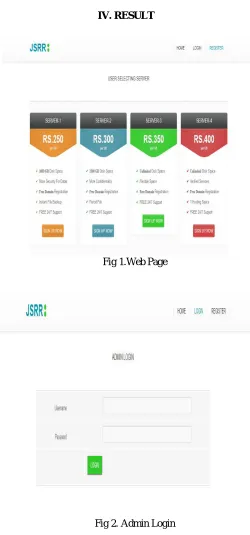
Fig 1.Web Page
ISSN(Online): 2319-8753 ISSN (Print): 2347-6710
I
nternational
J
ournal of
I
nnovative
R
esearch in
S
cience,
E
ngineering and
T
echnology
(A High Impact Factor, Monthly, Peer Reviewed Journal)
Visit: www.ijirset.com
Vol. 7, Special Issue 2, March 2018
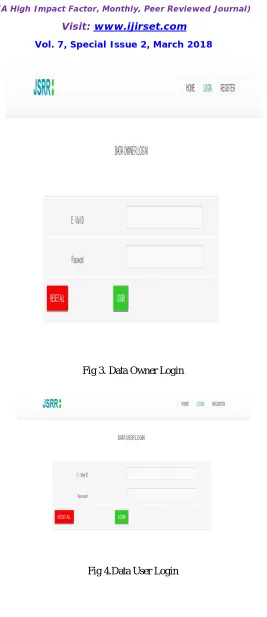
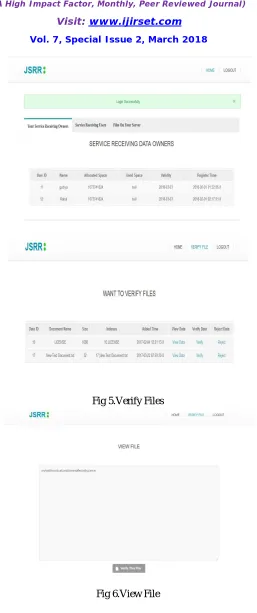
Fig 3. Data Owner Login
ISSN(Online): 2319-8753 ISSN (Print): 2347-6710
I
nternational
J
ournal of
I
nnovative
R
esearch in
S
cience,
E
ngineering and
T
echnology
(A High Impact Factor, Monthly, Peer Reviewed Journal)
Visit: www.ijirset.com
Vol. 7, Special Issue 2, March 2018
Fig 5.Verify Files
ISSN(Online): 2319-8753 ISSN (Print): 2347-6710
I
nternational
J
ournal of
I
nnovative
R
esearch in
S
cience,
E
ngineering and
T
echnology
(A High Impact Factor, Monthly, Peer Reviewed Journal)
Visit: www.ijirset.com
Vol. 7, Special Issue 2, March 2018
Fig 7.Search File
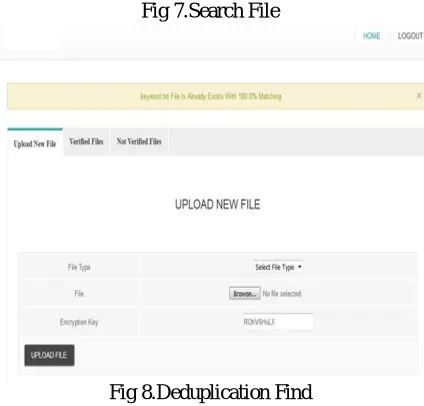
Fig 8.Deduplication Find
V. CONCLUSION
ISSN(Online): 2319-8753 ISSN (Print): 2347-6710
I
nternational
J
ournal of
I
nnovative
R
esearch in
S
cience,
E
ngineering and
T
echnology
(A High Impact Factor, Monthly, Peer Reviewed Journal)
Visit: www.ijirset.com
Vol. 7, Special Issue 2, March 2018
the assistance of guaranteeing the responsibility for shared document, scramblingdata using keys at user's will and realizing the anonymous store through the digital credential.
REFERENCES
[1] D.Song, D.Wagner, and A.Perrig, “Practical techniques for searcheson encrypted data,” in Proc. of IEEE S&P, 2000, pp. 44–55.
[2] Y.-C.Chang and M.Mitzenmacher, “Privacy preserving keyword searcheson remote encrypted data,” in Proc. of ACNS, 2005, pp. 391–421. [3] C.Wang, N.Cao, K.Ren, and W.Lou, “Enabling secure and efficientranked keyword search over outsourced cloud data,” IEEE Trans. ParallelDistrib. Syst., vol. 23, no. 8, pp. 1467–1479, 2012.
[4] P.Golle, J.Staddon, and B.R.Waters, “Secure conjunctive keywordsearch over encrypted data,” in Proc. of ACNS, 2004, pp. 31–45. [5]D.Boneh and B.Waters,“Conjunctive, subset, and range queries onencrypted data,” in Proc. of TCC, 2007, pp. 535–554.
[6]Y.Hwang andP.Lee,“Publickeyencryption with conjunctive keywordsearch and its extension to a multi-user system,” in Proc. of Pairing,2007, pp. 2–22.
[7] E.Shen, E.Shi, and B.Waters, “Predicate privacy in encryptionsystems,” in Proc. of TCC, 2009, pp. 457–473
[8] W.K.Wong, D.W.Cheung, B.Kao, and N. Mamoulis, “Secure knncomputation on encrypted databases,” in Proc. of ACM SIGMOD, 2009, pp.139–152.
[9] N.Cao, C.Wang, M.Li, K.Ren, and W.Lou, “Privacy-preservingmulti-keyword ranked search over encrypted cloud data,” in Proc. OfINFOCOM, 2011, pp. 829–837.
[10]J.S.Vaidya and C.Clifton“Privacy-preserving multi-keyword ranked search over encryptedcloud data,” IEEE Trans. Parallel Distrib.Syst., vol. 25, no. 1, pp. 222–233, 2014.
[11] S. Kamara, C. Papamanthou, and T. Roeder, “Dynamic searchable symmetric encryption,” in Proc. of the ACM Conference on Computer and Communications Security, NC, USA, Oct. 2012, pp. 965–976.
[12] S. Kamara and C. Papamanthou, “Parallel and dynamic searchable symmetric encryption,” in Proc. of Financial Cryptography, Okinawa, Japan, Apr. 2013, pp. 258–274.
[13] M. Naveed, M. Prabhakaran, and C. Gunter, “Dynamic searchable encryption via blind storage,” in Proc. of IEEE Symposium on Security and Privacy, CA, USA, May 2014, pp. 639–654.
[14] R. Agrawal, J. Kiernan, R. Srikant, and Y. Xu, “Order preserving encryption for numeric data,” in Proc. of ACM SIGMOD, Paris, France, Jun. 2004, pp. 563–574.
[15] H. Hacigumus, B. Iyer, C. Li, and S. Mehrotra, “Executing sql over encrypted data in the database-service-provider model,” in Proc. of ACM SIGMOD, Madison, Wisconsin, Jun. 2002, pp. 216–227.
[16] H. Kadhem, T. Amagasa, and H. Kitagawa, “A secure and efficient order preserving encryption scheme for relational databases,” in Proc. of the International Conference on Knowledge Management and Information Sharing, Valencia, Spain, Oct. 2010, pp. 25–35.
[17] R. A. Popa, C. M. S. Redfield, N. Zeldovich, and H. Balakrishnan, “Cryptdb: Protecting confidentiality with encrypted query processing,” in Proc. of ACM Symposium on Operating Systems Principles, Cascais, Portugal, Oct. 2011, pp. 85–100.
[18] R. A. Popa, F. Li, and N. Zeldovich, “An ideal-security protocol for order-preserving encoding,” in Proc. of IEEE Symposium on Security and Privacy, CA, USA, May 2013, pp. 463–477.
[19] X. Chen, J. Li, J. Ma, Q. Tang, and W. Lou, “New algorithms for secure outsourcing of modular exponentiations,” IEEE Transactions on Parallel and Distributed Systems, vol. 25(9), pp. 2386–2396, Jul. 2014.