http://dx.doi.org/10.4236/psych.2015.66071
Fixation Effects on Forward and Backward
Recall in a Spatial Working Memory Task
Yuhei Oi1, Yoshifumi Ikeda2, Hideyuki Okuzumi1, Mitsuru Kokubun1, Toyohiko Hamada1,
Takashi Sawa1
1Department of Special Needs Education, Tokyo Gakugei University, Koganei, Japan 2Department of Special Needs Education, Joetsu University of Education, Joetsu, Japan Email: [email protected]
Received 4 April 2015; accepted 11 May 2015; published 13 May 2015
Copyright © 2015 by authors and Scientific Research Publishing Inc.
This work is licensed under the Creative Commons Attribution International License (CC BY).
http://creativecommons.org/licenses/by/4.0/
Abstract
This study was designed to investigate whether fixation on the items to be remembered provided a beneficial effect on spatial working memory. A spatial working memory task based on the Corsi blocks task was assigned to 24 participants (12 men, 12 women; M age = 21.5 yr., SD = 1.3, range = 18 - 24) who were later asked to recall a sequence of targets in forward and backward order. When participants were asked to memorize the sequence while maintaining fixation on each tar-get, both beneficial and disruptive effects were found in the recall performance for backward re-call, but not for forward recall. Results suggest that some memory processes that proceed without fixation on the presented items are more important for backward recall.
Keywords
Corsi-Like Task, Eye Movement, Serial Recall, Short-Term Memory
1. Introduction
The capability for temporal storage and processing of spatial information, which is necessary for daily life, has been widely studied in the framework of working memory. Spatial working memory is the ability to remember a location where something is perceived and the ability to recall a series of visited locations (Vandierendonck & Szmalec, 2011). During the last few decades, a great deal of research has specifically examined spatial working memory.
compute-rized version of the task with some modification (e.g., Fischer, 2001; Smyth & Scholey, 1994). In addition, spa-tial working memory is often measured using the task in forward and backward recall directions (e.g., Isaacs & Vargha-Khadem, 1989; Kessels, van den Berg, Ruis, & Brands, 2008).
Several lines of research suggest that control processes involved in eye movements play a key role in main-taining spatial information in working memory (e.g.,Baddeley, 1986; Postle, Idzikowski, Della Sala, Logie, & Baddeley, 2006). Most studies show that task-irrelevant eye movements interfere with spatial working memory (e.g., Lawrence, Myerson, & Abrams, 2004; Pearson & Sahraie, 2003). On the other hand, a beneficial effect of eye movement on spatial working memory was also reported. Saint-Aubin, Tremblay, & Jalbert (2007) investi-gated the effect of fixation duration on recall performance for forward order in a spatial working memory task. A main outcome of the study was the finding that the fixation requirement, not the fixation duration, on the items to be remembered increased recall performance across all serial positions. Furthermore, the beneficial ef-fect of fixation was found for location recall, but not for order recall.
As described above, several lines of research report the effects of eye movement on spatial working memory. Nevertheless, the relation between spatial working memory and eye movement remains unclear. In addition, studies investigating the beneficial effects of fixation on spatial working memory have been less available. A need exists to investigate the role of eye movement on spatial working memory with various factors related to eye movement, e.g., fixation (Tremblay, Saint-Aubin, & Jalbert, 2006). Therefore, this study was conducted to examine the relation between fixation and spatial working memory; particularly, whether requiring participants to engage in fixating on the items to be remembered enhanced recall performance in a spatial working memory task. This study investigated the effects of fixation on spatial working memory not only for forward but also for backward recall.
2. Method
2.1. ParticipantsTwenty-four undergraduate and graduate students (12 men, 12 women; M age = 21.5 yr., SD = 1.3, range = 18 - 24) volunteered to participate in the experiment. All had normal or corrected-to-normal vision. The experimental protocol was administered in accordance with the guidelines of the Declaration of Helsinki and was approved by the institutional review board. Informed consent was obtained from all participants before the assessment ses-sion. No participant showed any hesitation in performing the tasks.
2.2. Materials
For the experiment, participants performed a computerized spatial working memory task based on the Corsi blocks task. At the start of each trial, a black fixation cross was presented in the center of the screen (29.27˚ × 16.71˚; 65 cm viewing distance) for 2000 msec. Subsequently, seven black squares of 1.87˚ were presented for 1000 msec, one at a time, at 500 msec intervals. Locations of the squares were selected quasi-randomly within an invisible 9 × 16 grid into which the screen was divided, with the restriction that no target area was able to overlap any other target area. For each square, the target area was a 3 × 3 grid square centered at the square. The target area was set up for the scoring of participants’ responses. In addition, because previous studies reported that the number of path crossings and the spatial length of sequence affect recall performance (Parmentier & Andrés, 2006; Parmentier, Elford, & Maybery, 2005), any sequence contained no path crossings and a total of distances between subsequent squares was controlled.
2.3. Apparatus
Stimulus displays were presented on a 17-inch color monitor (1280 × 720 pixel resolution) by a core i3-based computer running SuperLab (Cedrus Corp.). Eye movements were recorded using an eye tracker (TM3; Eye-Tech Digital Systems Inc.) with QG-PLUS application (Ditect Co. Ltd.) at a sampling rate of 55 Hz. This eye tracker has an infrared camera and two infrared light sources. The accuracy for recording the eye movements was 5˚ or less. Both pupils of each participant’s eyes were tracked in this study.
2.4. Procedure
chinrest, located 65 cm distant from the monitor.
After the nine-point calibration procedure, the memory task was initiated. Participants were asked to recall a sequence of seven squares in the forward or the backward order. The presentation of all target squares was com-pleted, followed by a black screen for 500 msec. Then on a blank white screen, participants indicated the loca-tion of the targets in order using a mouse. Participants were instructed to respond as quickly and accurately as possible. Every time a participant pressed the left-hand mouse button to indicate the location, the experimenter counted aloud the number of the responses, from one to seven. No other feedback was given to the response. In each recall direction, two conditions related to eye movements were given. In the fixation condition, the partici-pants were instructed to memorize the locations and their sequence while maintaining fixation on each target from its appearance to its disappearance. In the free condition, participants were instructed to memorize the lo-cations and their sequence without restriction of their eye movements. Participants were tested in four blocks (2 conditions × 2 recall directions) in the memory task. In addition, in all the blocks, participants were instructed to keep their hands stationary while a sequence of targets was being presented. Two practice trials and five expe-rimental trials were administered in each block. The order of the blocks was counterbalanced among partici-pants.
2.5. Analysis
Participants’ responses in the memory task were classified into any one of the three categories: correct recall, location error, or order error. Correct recall was a response that was within the target area at the correct serial position. A response that was outside of any target area was counted as a location error. A response was record-ed as an order error if it was within a target area but at a wrong serial position. A 2 (condition: fixation and free condition) × 7 (serial position: 1 - 7) repeated measures analysis of variance (ANOVA) on each category was conducted separately for forward recall and backward recall. Greenhouse-Geisser correction was applied if Mauchly’s test of sphericity indicated that the sphericity assumption was violated.
Eye movements scored in the memory task were analyzed for the fixation duration. When the eye position stayed within a circle with a radius of 30 pixels over 100 msec, it was regarded as a fixation on the area. Fixa-tion duraFixa-tions were computed by summing up the duraFixa-tions of all fixaFixa-tions on each target area while each target was being presented. A 2 (condition: fixation and free condition) × 2 (recall direction: forward and backward) × 7 (serial position: 1 - 7) repeated measures ANOVA on fixation duration was conducted. As with described above, the Greenhouse-Geisser correction was applied if Mauchly’s test of sphericity indicated that the assump-tion of sphericity was violated.
3. Results
3.1. Correct Recall
Figure 1 shows the mean probability of correct recall: the left panel shows forward recall; the right panel shows backward recall. For forward recall, the 2 (condition) × 7 (serial position) ANOVA showed a significant effect of serial position (F6, 138 = 7.02, p < .001; ηp2 = .23), but not of condition (F1, 23 = 0.27, ns; ηp2 = .01), nor of in-teraction (F6, 138 = 0.74, ns; ηp2 = .03). Post hoc Bonferroni tests revealed that the differences between serial po-sition 1 and serial popo-sitions 4, 5, and 6 and between serial popo-sition 2 and serial popo-sition 5 were significant (p
< .05). For backward recall, the analysis indicated a significant effect of serial position (F4.15, 95.49 = 56.53, p
< .001; ηp2 = .71), but not of condition (F1, 23 = 4.05, ns; ηp2 = .15). However, the interaction was significant (F4.47, 102.91 = 3.14, p < .05; ηp2 = .12). Simple main effect tests revealed significantly reduced correct recall at serial positions 1 and 3, and better recall at serial position 6 in the fixation condition relative to the free condi-tion (p < .05). The differences among serial positions in both fixation and free conditions were also significant (p < .001). In sum, contrary to expectations, fixation on the items to be remembered did not provide a beneficial effect on the overall recall performance. In contrast, recall performance was impaired by fixating on the items to be remembered at serial positions 1 and 3 for backward recall.
3.2. Location Error
Figure 1. Mean probability of correct recall for forward recall (left panel) and backward recall (right panel) as a function of the serial position and condition. Error bars represent the standard error of means.
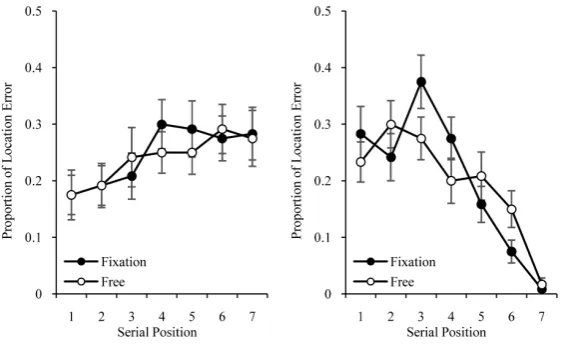
Figure 2. Mean proportion of location error for forward recall (left panel) and backward recall (right panel) as a function of the serial position and condition. Error bars represent the standard error of means.
tion (forward recall, F6, 138 = 2.20, p < .05; ηp2 = .09; backward recall, F6, 138 = 19.10, p < .001; ηp2 = .45), but not of condition (forward recall: F1, 23 = 0.09, ns; ηp2 = .004, backward recall: F1, 23 = 0.12, ns; ηp2 = .01), nor of in-teraction (forward recall: F6, 138 = 0.32, ns; ηp2 = .01, backward recall: F4.44, 102.13 = 2.04, ns; ηp2 = .08). Post hoc Bonferroni tests revealed no differences among serial positions for forward recall. However, for backward recall, the differences between serial positions 1, 2, and 4 and serial positions 6 and 7, between serial position 3 and serial positions 5 - 7, and between serial positions 5 and 6 and serial position 7 were significant (p < .05). No differences were found in location accuracy by condition for either forward or backward recall.
3.3. Order Error
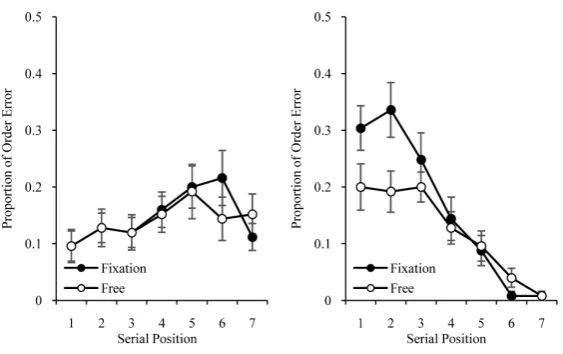
Figure 3 shows the mean proportion of order error: the left panel is for forward recall; the right panel is for backward recall. For forward recall, the ANOVA indicated a significant effect of serial position (F6, 138 = 2.91, p
[image:4.595.173.455.305.478.2]Figure 3. Mean proportion of order error for forward recall (left panel) and backward recall (right panel) as a function of the serial position and condition. Error bars represent the standard error of means.
at serial positions 1 and 2 in the fixation condition relative to the free condition (p < .05). The differences among serial positions in both fixation and free condition were also significant (p < .001). The analysis indicated that the memory impairment due to fixating the items to be remembered resulted from the increment of order error.
3.4. Fixation Duration
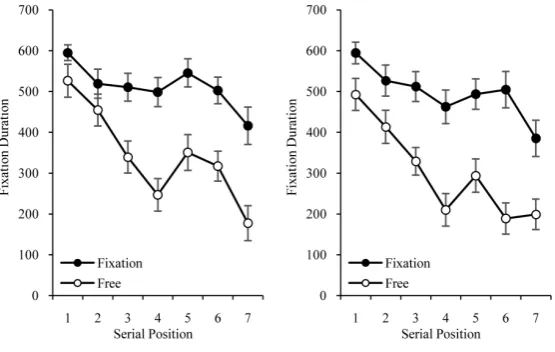
Figure 4 shows the mean ratio of fixation duration: the left panel is for forward recall; the right panel is for backward recall. The 2 (condition) × 2 (recall direction) × 7 (serial position) ANOVA indicated significant ef-fects of condition (F1, 23 = 80.76, p < .001; ηp2 = .78), recall direction (F1, 23 = 2.71, ns; ηp2 = .11), and serial po-sition (F3.16, 72.73 = 39.35, p < .001; ηp2 = .63), and a significant interaction between condition and serial position (F4.64, 106.72 = 7.43, p < .001; ηp2 = .24). Simple main effect tests indicated significantly increased fixation dura-tions at all serial posidura-tions in the fixation condition relative to the free condition. In addition, a simple main ef-fect of serial position was significant for both fixation and free condition (p < .001), indicating that fixation du-rations decreased as targets were presented. This was the case even in the fixation condition.
4. Discussion
This study examined whether requiring participants to engage in fixating on the items to be remembered in a spatial working memory task contributed to recall performance, particularly accuracy for location. The results showed that the benefit by fixation was limited on serial position 6 for backward recall, where participants were able to recall immediately. No benefit was apparent by fixation for forward recall. Rather, for backward recall, recall performance was impaired at serial positions 1 and 3, or the latter part of recall, by requiring fixation on each target. Examination of details of the impairment revealed that order errors were increased. In sum, contrary to the literature, fixation in this study provided no apparent beneficial effect.
Figure 4. Mean fixation duration on targets for forward recall (left panel) and backward recall (right panel) as a function of the serial position and condition. Error bars represent the standard error of means.
for forward recall. The beneficial effect attributable to fixation is given only on location recall in the literature. Because rehearsal plays a role in maintaining order information (Smyth, 1996) as well as location information (Awh, Jonides, & Reuter-Lorenz, 1998), if a rehearsal is prevented, then order errors should have increased. However, this was also not the case, perhaps because a sequence of targets prepared in this study contain no- crossing. In such a sequence, it is less likely to confound near targets, so maintaining order information may be-come easier even in the fixation condition.
More importantly, for backward recall, the beneficial effect by fixation was observed at the former part of re-call, but also caused impairment at the latter part of recall. This impairment suggests that the recall performance at the latter part of recall is more sensitive to a rehearsal, because the need exists to maintain information much longer to recall at the latter part of recall for backward recall. In addition, the fact that fixation on each target particularly impairs order recall suggests that sequence information is more easily influenced by the absence of a rehearsal.
However, this impaired order recall is explainable more specifically in terms of encoding. Results of some studies have suggested that the Corsi blocks task involves different memory processes for forward and backward recall: sequential processes for forward and spatial-simultaneous processes for backward recall (Cornoldi & Mammarella, 2008; Mammarella & Cornoldi, 2005). With those suggestions, spatial-simultaneous processes for backward recall may be disrupted by requiring fixation in this study because it is likely that maintaining fixation on each target leads to sequential processing of information. This sequential processing might be reflected on the typical serial position curve observed in the fixation condition for forward recall. If participants process infor-mation sequentially, not spatial-simultaneously or visually in the fixation condition for backward recall, then the results are well explained along with the finding that a binding of location and order information visually is im-portant in the backward Corsi blocks task (Vandierendonck & Szmalec, 2004). Actually, the order error might increase because location and order information were not bound for sequential processes.
Regarding eye movement data, fixation durations during encoding in the free condition decreased as targets were presented. This result accords with those reported in the literature (Godijn & Theeuwes, 2012; Saint-Aubin et al., 2007). However, contrary to expectations, this tendency remained even in the fixation condition despite the instruction of fixation. Combined with the result that fixation durations increase at all serial positions in the fixation condition, the results suggest that some memory processes that proceed without fixation on the target presented are so important that participants are forced to sacrifice fixation durations somewhat against the in-struction. To determine what memory processes indeed go in spatial working memory, it is necessary to select more appropriate paradigms and to analyze eye movements during a memory task more specifically. It would also be useful to analyze the results of saccadic eye movements, which could be not examined in this study.
demonstrated. Furthermore, the results suggest that some memory processes which proceed without fixation on the items being presented are relied upon to a greater degree for backward recall.
References
Awh, E., Jonides, J., & Reuter-Lorenz, P. A. (1998). Rehearsal in Spatial Working Memory. Journal of Experimental Psy-chology: Human Perception and Performance, 24, 780-790. http://dx.doi.org/10.1037/0096-1523.24.3.780
Baddeley, A. D. (1986). Working Memory. Oxford: Oxford University Press.
Cornoldi, C., & Mammarella, I. C. (2008). A Comparison of Backward and Forward Spatial Spans. Quarterly Journal of Experimental Psychology, 61, 674-682. http://dx.doi.org/10.1080/17470210701774200
Fischer, M. H. (2001). Probing Spatial Working Memory with the Corsi Blocks Task. Brain and Cognition, 45, 143-154. http://dx.doi.org/10.1006/brcg.2000.1221
Godijn, R., & Theeuwes, J. (2012). Overt Is No Better than Covert When Rehearsing Visuo-Spatial Information in Working Memory. Memory & Cognition, 40, 52-61. http://dx.doi.org/10.3758/s13421-011-0132-x
Isaacs, E. B., & Vargha-Khadem, F. (1989). Differential Course of Development of Spatial and Verbal Memory Span: A Normative Study. British Journal of Developmental Psychology, 7, 377-380.
http://dx.doi.org/10.1111/j.2044-835X.1989.tb00814.x
Kessels, R. P., van den Berg, E., Ruis, C., & Brands, A. M. (2008). The Backward Span of the Corsi Block-Tapping Task and Its Association with the WAIS-III Digit Span. Assessment, 15, 426-434. http://dx.doi.org/10.1177/1073191108315611 Lawrence, B. M., Myerson, J., & Abrams, R. A. (2004). Interference with Spatial Working Memory: An Eye Movement Is
More than a Shift of Attention. Psychonomic Bulletin & Review, 11, 488-494. http://dx.doi.org/10.3758/BF03196600 Mammarella, I. C., & Cornoldi, C. (2005). Sequence and Space: The Critical Role of a Backward Spatial Span in the
work-ing Memory Deficit of Visuospatial Learnwork-ing Disabled Children. Cognitive Neuropsychology, 22, 1055-1068. http://dx.doi.org/10.1080/02643290442000509
Milner, B. (1971). Interhemispheric Differences in the Localization of Psychological Processes in man. British Medical Bul-letin, 27, 272-277.
Parmentier, F. B., & Andrés, P. (2006). The Impact of Path Crossing on Visuo-Spatial Serial Memory: Encoding or Rehear-sal Effect? Quarterly Journal of Experimental Psychology, 59, 1867-1874. http://dx.doi.org/10.1080/17470210600872154 Parmentier, F. B., Elford, G., & Maybery, M. (2005). Transitional Information in Spatial Serial Memory: Path
Characteris-tics Affect Recall Performance. Journal of Experimental Psychology: Learning, Memory, and Cognition, 31, 412-427. http://dx.doi.org/10.1037/0278-7393.31.3.412
Pearson, D., & Sahraie, A. (2003). Oculomotor Control and the Maintenance of Spatially and Temporally Distributed Events in Visuo-Spatial Working Memory. Quarterly Journal of Experimental Psychology, 56, 1089-1111.
http://dx.doi.org/10.1080/02724980343000044
Postle, B. R., Idzikowski, C., Della Sala, S., Logie, R. H., & Baddeley, A. D. (2006). The Selective Disruption of Spatial Working Memory by Eye Movements. Quarterly Journal of Experimental Psychology, 59, 100-120.
http://dx.doi.org/10.1080/17470210500151410
Saint-Aubin, J., Tremblay, S., & Jalbert, A. (2007). Eye Movements and Serial Memory for Visual-Spatial Information: Does Time Spent Fixating Contribute to Recall? Experimental Psychology, 54, 264-272.
http://dx.doi.org/10.1027/1618-3169.54.4.264
Smyth, M. M. (1996). Interference with Rehearsal in Spatial Working Memory in the Absence of Eye Movements. Quarterly Journal of Experimental Psychology, 49, 940-949. http://dx.doi.org/10.1080/713755669
Smyth, M. M., & Scholey, K. A. (1994). Interference in Immediate Spatial Memory. Memory & Cognition, 22, 1-13. http://dx.doi.org/10.3758/BF03202756
Tremblay, S., Saint-Aubin, J., & Jalbert, A. (2006). Rehearsal in Serial Memory for Visual-Spatial Information: Evidence from Eye Movements. Psychonomic Bulletin & Review, 13, 452-457. http://dx.doi.org/10.3758/BF03193869
Vandierendonck, A., & Szmalec, A. (2004). An Asymmetry in the Visuo-Spatial Demands of Forward and Backward Recall in the Corsi Blocks Task. Imagination, Cognition and Personality, 23, 225-231.
http://dx.doi.org/10.2190/MEEH-UYHG-UY9J-MQ04