Available online: https://edupediapublications.org/journals/index.php/IJR/ P a g e | 849
Design Thermal and Structural Analysis of Piston Using
Composite Materials by Fea Method
A.Rakesh
[email protected]
Assistant Professor, Dept of MECH, Aurora Scientific and Technology Research Academy, Bandlaguda, Hyderabad, Telangana, India.
Abstract:
A piston is a component of reciprocating engines, reciprocating pumps, gas compressors and
pneumatic cylinders, among other similar
mechanisms. It is the moving component that is contained by a cylinder and is made gas-tight by piston rings Piston that transfer the combustive gases power to the connecting rod. To improve the efficiency of the engine there is a need to study about the piston. Pistons that are usually made up with alloy steels that show the grate resistant against thermal loads and structural loads. In the project we design a piston by using solid works 2016 design software and we did the structural load analysis and thermal analysis by applying various materials such as composites on piston in ansys workbench software.
Introduction
An internal combustion engine is defined as an engine in which the chemical energy of the fuel is released inside the engine and used directly for mechanical work, as opposed to an external combustion engine in which a separate combustor is used to burn the fuel. The internal combustion engine was conceived and developed in the late 1800s. It has had a significant impact on society, and is considered one of the most significant inventions
of the last century. The internal combustion engine has been the foundation for the successful development of many commercial technologies. For example, consider how this type of engine has transformed the transportation industry, allowing the invention and improvement of automobiles, trucks, airplanes and trains.
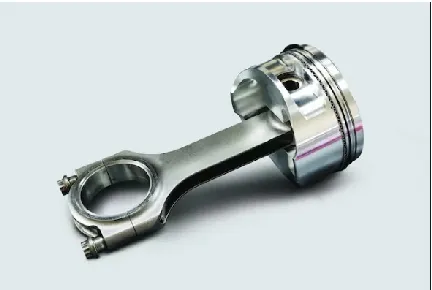
Fig : piston with connecting rod
Available online: https://edupediapublications.org/journals/index.php/IJR/ P a g e | 850 Automobile components are in great demand these
days because of increased use of automobiles. The increased demand is due to improved performance and reduced cost of these components. R&D and testing engineers should develop critical components in shortest possible time to minimize launch time for new products. This necessitates understanding of new technologies and quick absorption in the development of new products .A piston is a moving component that is contained by a cylinder and is made gas-tight by piston rings. In an engine its purpose is to transfer from expanding gas in the cylinder to the crank shaft via piston rod and or connecting rod. As an important part in an engine piston endures the cyclic gas pressure and inertia forces at work and this working condition may cause the fatigue damage of the piston. The investigations indicate that greatest stress appears on the upper end of the piston and stress concentration is one of the mainly reason for fatigue failure
literature survey
Aluminum alloys are ready to cast by all common casting techniques (Budinski 2001).
In order to improve the wear performance, a metal based insert is reinforced with the base alloy. Cast iron and steel inserts normally reinforced with the light weight alloy during the casting process. To achieve the bonding between aluminum and cast iron, special patented processes are used. The presence of dirt and oxide induces trouble to the bonding between insert and alloy. The component was coated with a tin layer by dipping or electro plating and subsequent heat treatments were carried out before casting (Cole and Andrew T 1991).
Gravity die casting and the pressure casting methods are used for the Al-Fin process. A special casting technique derived from the so called Al-Fin process is used in the manufacture of piston by gravity die casting and squeeze casting method. Al-Fin process is also known as Al-Fer process which is achieved by diffusion bond between the insert and aluminum alloy.
Zone Ching Lin and Din yan chen (1995) studied on Cubic Boron Nitride (CBN) a sintered product, which can be used as a cutting tool material for hard turning and for higher productivity.
Modeling:
Piston Design The piston is designed according to the procedure and specification which are given in machine design and data hand books. The dimensions are calculated in terms of SI Units. The pressure applied on piston head, temperatures of various areas of the piston, heat flow, stresses, strains, length, diameter of piston and hole, thicknesses, etc., parameters are taken into consideration Design Considerations for a Piston. In designing a piston for an engine, the following points should be taken into consideration: It should have enormous strength to withstand the high pressure.
It should have minimum weight to withstand the inertia forces.
It should form effective oil sealing in the cylinder.
It should provide sufficient bearing area to prevent undue wear.
Available online: https://edupediapublications.org/journals/index.php/IJR/ P a g e | 851
It should be of sufficient rigid construction to withstand thermal and mechanical distortions.
It should have sufficient support for the piston pin.
Objective:
Designing the piston for 150 cc petrol engine taking reference to the existing piston.
Design is modified to get better results
Creating of 3D model in Solidworks and then by using CAE tools Simulation Xpress Study
Meshing of 3D model in Simulation Xpress Study Material Aluminium 2024-T361 alloy, aluminium silicon carbide aluminium metal matrix and aluminum silicon magnesium alloy are selected for the study
Piston Rings:
Piston rings commonly used on small engines include the compression ring, wiper ring, and oil ring. A compression ring is the piston ring located in the ring groove closest to the piston head.
A wiper ring is the piston ring with a tapered face located in the ring groove between the compression ring and the oil ring.
An oil ring is the piston ring located in the ring groove closest to the crankcase. The oil ring is used to wipe excess oil from the cylinder wall during piston movement.
Fig; piston cut section
Piston rings seal the combustion chamber, transferring heat to the cylinder wall and controlling oil consumption. A piston ring seals the combustion chamber through inherent and applied pressure. Inherent pressure is the internal spring force that expands a piston ring based on the design and properties of the material used. Inherent pressure requires a significant force needed to compress a piston ring to a smaller diameter. Inherent pressure is determined by the uncompressed or free piston ring gap.
Fig: piston rings
A piston pin bore is a through hole in the side of the piston perpendicular to piston travel that receives the piston pin.
A ring groove is a recessed area located around the perimeter of the piston that is used to retain a piston ring.
Materials:
Available online: https://edupediapublications.org/journals/index.php/IJR/ P a g e | 852 generally preferable materials are
cast iron
aluminum alloys
grey cast iron
chromium coatings for rings
Thin, hard coatings produced by PVD or CVD include coating compositions like titanium nitride (TiN), chromium nitride (CrN); however coatings of this type are currently used exclusively for small series production for competition engines and selected production engines (Federal Mogul, 1998, Broszeit et al., 1999). Multilayer TiTiN coatings have been experimentally deposited onto cast-iron piston rings, and the coating is claimed to be more wear resistant than a chromium plated or phosphated surface, particularly when the number of layers is high (Zhuo et al., 2000).
Introduction to composites:
Composite materials have been widely used to improve the performance of various types of structures. Compared to conventional materials, the main advantages of composites are their superior stiffness to mass ratio as well as high strength to weight ratio. Because of these advantages, composites have been increasingly incorporated in structural components in various industrial fields.
Basic Concepts of Composite Materials:
Composite materials are basically hybrid materials formed of multiple materials in order to utilize their individual structural advantages in a single structural material. The constituents are combined at a
macroscopic level and are not soluble in each other. The key is the macroscopic examination of a material wherein the components can be identified by the naked eye. Different materials can be combined on a microscopic scale, such as in alloying of metals, but the resulting material is, for all practical purposes, macroscopically homogeneous, i.e. the components cannot be distinguished by the naked eye and essentially acts together.
Theoretical Analysis:
By carrying out an analysis and experiments on the piston , and depending on the principle of cooling piston with oil in order to permit the piston to carry more thermal loads without having more damages with increasing the engine speed rate . And there are two types of pistons according to the cooling case , the first type is the piston with the cooling gallery in which the cooling oil is passed , and the second type is the solid piston where the cooling is limited to the under crown surface only.
It has been developed a program for analysis diesel engine piston .This program depends on the Finite Elements method in the procedure of analysis.
Heat Transfer Coefficients Calculations
The heat transfer from the combustion gases is assumed to be similar to the turbulent heat transfer of gases in a cylinder as follows:
Nu = C Rem Prn
Maximum Thickness of Barrel (t3)
t3=0.03*(D+b+4.5mm)
Available online: https://edupediapublications.org/journals/index.php/IJR/ P a g e | 853 b= t1+0.4
stress calculation
Stress on Piston Crown
6b= 16tH3pD22
Thermal Stress
6t=E* Coefficient of thermal Expansion*Temp. Difference
INTRODUCTION TO SOLID WORKS
Solid works mechanical design automation software is a feature-based, parametric solid modeling design tool which advantage of the easy to learn windows
TM graphical user interface. We can create fully
associate 3-D solid models with or without while utilizing automatic or user defined relations to capture design intent.
Parameters refer to constraints whose values determine the shape or geometry of the model or assembly. Parameters can be either numeric parameters, such as line lengths or circle diameters, or geometric parameters
Modeling Of Piston:
Specification of piston
.
Specification of piston
Draw sketch as follow and revolve.
Four different views of piston
Finite Element Analysis
Finite Element Analysis (FEA) is a computer-based numerical technique for calculating the strength and behavior of engineering structures. It can be used to calculate deflection, stress, vibration, buckling behavior and many other phenomena. It also can be used to analyze either small or large scale deflection under loading or applied displacement. It uses a numerical technique called the finite element method (FEM).
Ansys:
post-Available online: https://edupediapublications.org/journals/index.php/IJR/ P a g e | 854 processing. These advancements alone represent a
major step ahead on the path forward in Simulation Table: the software offers the following types of studies
Meshing:
The software uses the Finite Element Method (FEM). FEM is a numerical technique for analyzing engineering designs. FEM is accepted as the standard analysis method due to its generality and suitability for computer implementation. FEM divides the model into many small pieces of simple shapes called elements effectively replacing a complex problem by many simple problems that need to be solved simultaneously.
Material Properties:
ANSYS ANALYSIS ON PISTON: Thermal analysis
Modal
Mesh
Temperature load
400 deg C
Convection
Available online: https://edupediapublications.org/journals/index.php/IJR/ P a g e | 855
RESULTS
ALUMINIUM ALLOY Temperature Distribution
Heat Flux
ALLUMINIUM SILICON CARBIDE Temperature Distribution
Heat Flux
ALUMINIUM METAL MATRIX (KS1275) Temperature Distribution
Heat Flux
Available online: https://edupediapublications.org/journals/index.php/IJR/ P a g e | 856
Heat Flux
STATIC ANALYSIS ON PISTON Fixed Support
Pressure load
RESULTS
ALUMINIUM ALLOY Stress
Strain
Deformation
Available online: https://edupediapublications.org/journals/index.php/IJR/ P a g e | 857
Strain
Deformation
ALUMINIUM METAL MATRIX (KS1275) Stress
Strain
Deformation
Available online: https://edupediapublications.org/journals/index.php/IJR/ P a g e | 858
Strain
Deformation
Results Tables:
Steady state thermal analysis results:
Static structural analysis results:
Conclusion:
Modeling and analysis of piston is done
Modeling of piston is done in solid works 2016 design software by using various commands
The solid works part file is converted into IGS file and imported to ansys workbench.
Then steady state thermal analysis is carried out at maximum temperature 400deg and convection of 30deg
Analysis is performed on four different materials one generally used Aluminium alloy, and remaining advance composite materials such as Aluminium silicon carbide, Aluminium metal matrix and Aluminium silicon magnesium alloy.
Temperature distribution and heat flux all over the surface area of piston crown and skirt is noted and tabulated.
Than Static structural analysis is carried out on piston at 5MPa pressure load with all four materials in ansys workbench
Maximum stress, deformation, maximum strain and weight are noted and tabulated.
Available online: https://edupediapublications.org/journals/index.php/IJR/ P a g e | 859 Graphite) a composite material is showing
efficient results because of good strength to weight ratio compare to other materials.
Hence Al-SiC-Graphite is preferable among the three applied materials. Thus this material can be used for future scope.
14. References:
[1] Kanniga E., Selvaramarathnam K., Sundararajan M., "Embedded control using mems sensor with voice command and CCTV camera", Indian Journal of Science and Technology, ISSN : 0974-6846, 6(S6) (2013) pp.4794-4796.
[2] R. Bhagat, Y. M. Jibhakate, Thermal Analysis and Optimization of I.C. Engine Piston Using Finite Element Method, International Journal of Modern Engineering Research (IJMER), Vol.2, Issue.4, pp.2919-2921, 2012.
[3] Das M.P., Jeyanthi Rebecca L., Sharmila S., "Evaluation of antibacterial and antifungal efficacy of Wedelia chinensis leaf extracts", Journal of Chemical and Pharmaceutical Research, ISSN : 0975 – 7384, 5(2) (2013) pp.265-269.
[4] R.S.Khurmi,J.K.Gupta, A Text Book of Machine Design, S.Chand& Co., pp. 1132-1144, 2004.
AUTHOR PROFILE
A.RAKESHM.Tech is currently