ISSN 2286-4822
www.euacademic.org DRJI Value: 5.9 (B+)
An Investigation of the Effects of a Period of
Individual and Team Plays on the Social
Development of Educable Mentally Retarded
Children
1JAMAL FAZEL KALKHORAN2
Associate Professor Department of Physical Education and Sport Sciences, University of Tehran, Iran; MORTEZA HOMAYOUNNIA Master of Science of Motor Behavior University of Tehran, Iran ALI ABAZARI Master of Science Counseling
University of Tehran, Iran
Abstract:
Children learn to collaborate with and attract children of their own age, to observe others' rights, to live a team life and to develop many more social processes through play. The present study aimed at investigating the effects of a period of individual and team plays on the social development of educable mentally retarded children. In this quasi-experimental study, two experimental and one control group were used with the pretest-posttest design. The statistical population consisted of mentally retarded students (aged between 8 and 11) in Tehran province. Two schools were selected from special schools of Tehran province by cluster sampling method. Then, 45 male students were randomly selected from the students of these schools and assigned to three groups (each group 15 subjects) of experimental (10.7+0.3) and control (10.5+0.4). After the parents' consent, experimental subjects performed the school plays for a month, 12 sessions, and 3 sessions per week. Covariance and Tukey post hoc test were used to analyze the
1 Translator: Maryam Mehdizadeh Baghbani (M.A.), University of Tehran,
data. The results showed that the mean scores of social development in experimental groups drastically increased in the posttest (P=0.001). In addition, there was a significant difference in the mean between the experimental and control groups while there was no significant difference in the mean between the team and individual experimental
groups (P˂0.001). It can be concluded that team plays in mentally
retarded children can lead to their better adaptability and relations in their community. It is suggested that proper facilities should be established for the physical activity of these children and they should be involved in social interactions so that they can get rid of isolation and loneliness.
Key words: Team and Individual Plays, Social Development,
Mentally Retarded Children.
1. Introduction
investigate the effects of team and individual plays on social development of mentally retarded children.
2. Method
In this quasi-experimental study, there were three groups: team plays, individual plays and control and a pretest-posttest design were used.
2.1 Participants
The statistical population consisted of mentally retarded students aged between 8 and 11 in Tehran province. Firstly, two schools were selected from special schools of cities of Tehran province through cluster sampling method. Then, 45 students were randomly selected from the students of these schools. The selected students were randomly assigned to three groups (each group 15 subjects): two experimental groups and one control group. After the parents filled out the consent forms, the study started.
The intervention for one experimental group consisted of team plays while it consisted of individual plays for the other experimental group during one month, 12 sessions and 3 sessions per week. Individual plays and team plays were performed while the control group did not receive any plays and training.
2.2 Research instrument
group from birth to 30 years of age. The reliability coefficient was reported as 0.92 through retest of 123 subjects. It should be noted that the interval of retest was one day to 9 months. The validity coefficient of this scale was reported as 0.89.
2.3 Statistical Analysis
To analyze the data, descriptive statistics were used. In addition, inferential statistics such as covariance were used after the normal distribution of data and homogeneity of variance among groups were assured.
In order to meet research ethics, the procedures and aims of the study were explained to the parents and they were justified that this study was only a scientific survey and people were free to choose to participate in this study or not.
3. Results
The descriptive findings of this study consisted of mean and standard deviation statistics. Table 1 shows all the variables under study.
Table 1: Mean and standard deviation of all groups in Vineland Social Maturity Scale
Group Subjects Pretest Posttest
mean SD mean SD
Experimental (team play)
15 11.01 1.01 12.42 0.63
Experimental (individual play)
15 11.06 1.24 11.27 1.34
Control play 15 10.58 1.29 11.16 1.22
Table 2: homogeneity of variances in experimental and control groups for social development in posttest
Table 3 showed that P was big; therefore, the hypothesis of the homogeneity of variance of social development scores for the two groups was confirmed at error level of 0.05 or 0.01. The results of covariance can be used for this hypothesis.
Table 3: the results of covariance, the difference in social development in all groups
Table 3 showed that considering the pretest scores as the dependent variable, educational interventions (team and individual plays) made a significant difference between experimental and control groups (P=0.007). Also, the statistical power was 0.98 units which showed the appropriateness of sampling size.
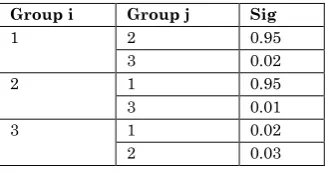
To compare means of social development in pairs in experimental and control groups, Tukey post hoc test was used.
Table 4: Tukey test to compare the mean of social development in pairs in experimental and control groups
Group i Group j Sig
1 2 0.95
3 0.02
2 1 0.95
3 0.01
3 1 0.02
2 0.03
Table 4 showed a significant difference in mean between experimental and control groups while there was no significant
F statistic DF of numerator DF of denominator P
1.456 1 14 0.243
Sum of squares
DF Mean of squares
F sig Eta Power
of test Pretest 18.36 1 18.36 25.03 0.0001 0.29 0.98
Group 9.48 2 5.17 6.12 0.007 0.19 0.81
difference in mean between team and individual experimental groups.
4. Discussion
From a social perspective, sport is an approach in discovering and examining motor talents while the individual is establishing his specific relationship with the world and himself. Those who enter the sport world will learn how to learn; will discover how to deal with the world and the responsibilities and how to conquer different skills, techniques and symbolic processes using their unique methods. Then, they trust themselves and their competences in being attached to the world and as they are observing and feeling these experiences, they prepare themselves to learn other experiences and to accept those patterns with lower homogeneity [5]. The results of this study showed that team plays had a higher effect on social development of children compared with the individual plays. Play is natural for children; they can use it to understand themselves and their inner characteristics and employ these characteristics. In individual and team plays, children have the opportunity to understand and respond to their feelings and to expose their inner problems through these plays. Similar to adults who express their problems through talking, children use plays as tools to express their feelings and emotions; through play, they find an opportunity to expose their inner feelings resulted from tensions, failures, aggressions, fears and confusions. Plays alleviate many pains and behavioral disorders in children and children find an opportunity to express their anger through plays (for instance, through hitting their dolls). Overall, plays and movements are considered as assuring factors through which children can get familiarized with their environment and feel secure [19].
development. Those environments such as schools and educational institutes where physical education is considered to be important for educable mentally retarded children can play an important role in social development of children [12]. Probably, the most important role physical education at schools and physical education courses play for mentally retarded children is that these children grow as useful members of their society; consequently, it can be stated that not many courses can replace or be compared with physical education and sport [20]. These results confirmed Skaines (2006) findings; in his research entitled "Playfulness in children with autistic disorder and their typically developing peers", he stated that due to their variety, school plays had an effect on infrastructures of different dimensions of motor-perceptual abilities and those plays appropriate to children's motor abilities can play an important role in children's development and can show the priority of active children over inactive ones if they are educated correctly and appropriately [21]. Brosnan (2002) in his research reported that soccer players had more mental health than wrestlers and the reason could be that soccer was a team sport [16].
Mendez& FoglE, 2002in a research on the relationship
hand, Tomporowski (2008) in his research found no significant relationship between individual and team physical activities and social development. He stated that after some sessions of activity, no difference was observed in social development between the children in team group and those in the individual group. It seems that the reason was that the researchers could not provide the team group with special training for their social development [1].
5. Conclusion
The findings of the present study showed that special attention should be paid to team plays of mentally retarded children at special schools as these plays can create higher adaptability and self-sufficiency in these children and consequently these children can gain personal abilities such as personal hygiene, dressing ability, eating ability and other beneficial affairs. It is suggested that those physical education teachers who work with mentally retarded children should be educated, environments suitable for physical activity of these children should be established and these children should be involved in social activities so that they can get rid of loneliness and isolation.
References
[1] Davis, C. L., Tomporowski, P. D., Boyhe, C.A., Wallev, J. H., Miller ,P. H & Naglieri, J. A. (2007). Effect of aerobic exercise on over weight children cognitive functioning a randomized controlled trail, Research Quarterly for Exercise and Sport, 5(2), 35-41.
learning disabilities. In L. Meltzer (Ed.), Executivefunction in education (pp. 5–18). New York: Guilford Press.
[3] Atlantis E, Chin-Mio C, et al .(2004).The association between exercise and health-related quality of life subjects whit mental disorders. Prevent Medicine. Volume 39, issue2, 424-34.
[4] Nober, A. C & Reill, J. (2004). Time is of the essence. Trends in Cognitive Sciences, 8, 387-389
[5] Michalowski, M. P & Kozima, H. (2007). Methodological issues in facilitating rhythmicplay with. 16 IEEE international conference on Ronot & Human InteractiveCommunication. [6] Steel, M. (2004). Making the case for early Identification and Intervention for young children at for risk learning Disabilities. Children Education Journal, 32(2), 75-79.
[7] Haywood, K.M &Getchell, N. (2002).”Life spans motor development”. (Third Ed). Champaign, IL; Human kinetics. [8] Hooper, S. R., Swartz, C. W., Wakely, M. B., Dekruif, R. E & Montgomery, J. w. (2002). Executive functioning in elementary school children with and without \problems in written expression. Journal of Learning Disabilities, 35, 57-68. [9] De Villiers, J.G., & Pyers, J.E. (2002). "Complements to cognition: A longitudinal study of the relationship between complex syntax and false-belief-understanding". Cognitive Development, 17, PP:1037-1060.
[10] Coe, D. P., Pivarnik, J. M., Womack, C. J., Reeves, M. J & Malina, R. M. (2006). Effect of physical education and activity levels, on academic achievement in children. Medicine and sciences in sport and exercise, 38, 15-19.
[11] Gartlan, M. & Strosnider, R. (2013). Learning Disability and young children: Identification and Intervention. Learning Disability Quarterly, 30(1), 63-72.
[13] Joheson, J. P., Im-Bolter, N & Pascal-Leone, J. (2003). Developmental of mental attention in gifted and mainstream children: The role of mental capacity, inhabitation,and speedof processing. Child Development,74, 1594-1614.
[14] Leisman, G & Melillo, R. (2010). Effects of motor sequence training on attentional performance in ADHD children. Int J Disabil Hum Dev, 9(4). by Walter de GruyereBerlin New York. DOI 10. 1515/IJDHD.
[15] Lerner, J. W.(2003). Children whit Learning Disabilities: Theories, diagnosis & teaching strategies. Boston: Hoghton Millfflin. Boston: Allyn and Bacon.
[16] Brosnan, M., Demetre. J., Hamill, S., Robson, K., Shepherd, H & Cody, G. (2002).Executive functioning in adult and children with development dyslexia. Neuropsychological, 40, 2144-2155.
[17] Corapci, F. (2008). "The role of child temperament on head start preschoolers’ social competence in the context of cumulative risk". Journal of Applied Developmental Psychology, 29, PP: 1-16.
[18] Loger.D.Briaszgoonor. (1998). "The role of physical activity in the prevention and treatment of noncommunicable disease". Journal of Rapp Trimmest static mond; 4: P: 242250.
[19] Clawson, M. (2002). Play of language: Minority children in an early childhood setting. In J.L. Roopnarine (Ed.), Conceptual, social-cognitive, and contextual issues in the fields of play (Vol. 4, pp. 93-116). Westport, CT: Ablex.
[20] Cote, S., Zoccolillo, M., Tremblay, R.E., Nagin, D., & Vitaro, F. (2001). "Predicting girls’ conduct disorder in adolescence from childhood trajectories of disruptive behaviors". Journal of the American Academy of Child and Adolescent Psychiatry, 40, PP: 678-684.