© 2014, IJCSMC All Rights Reserved 225 Available Online atwww.ijcsmc.com
International Journal of Computer Science and Mobile Computing
A Monthly Journal of Computer Science and Information Technology
ISSN 2320–088X
IJCSMC, Vol. 3, Issue. 10, October 2014, pg.225 – 230
RESEARCH ARTICLE
Mobile Computing Equipping
Different Network Scenario’s
Aniket Vinod Kene
Student of Master of Engineering in (CS & IT)
HVPM’s College of Engineering and Technology, Amravati, India
[email protected]
Abstract: Mobile computing is human–computer interaction by which a computer is expected to be transported during normal usage. Mobile computing involves mobile communication, mobile hardware, and mobile software. Communication issues include ad hoc and infrastructure networks as well as communication properties, protocols, data formats and concrete technologies. Hardware includes mobile devices or device components. Mobile software deals with the characteristics and requirements of mobile applications. Mobile computing is increasingly becoming more powerful and more affordable paving the way for solving problems in many emerging applications. In this paper we also see the limitation and devices of the mobile computing environment. There are many important practical issues which are also cover in this paper.
Keywords: Mobile Computing, Ad hoc network, GIS, GPS, Portable Devices
I. Introduction
Mobile computing is increasingly becoming more powerful and more affordable paving the way for solving problems in many emerging applications. In particular, mobile computing is expected to be the main computing platform used in applications whose operation relies on some of the field crews, fleets of vehicles collecting data, and/or processing tasks in real time. Example applications include emergency services, utilities, transportation, rescue missions, telecommunications, scientific field studies, and environmental monitoring, Mobile- Healthcare services and planning. Through wireless communications, mobile computers in such applications are connected to dispatch centers or other mobile computers. Mobile multi-hop ad hoc networks provide the capability for communication for these applications. An infrastructure topology may, or may not, be used in conjunction with the network. [1] Networked mobile computers constantly change their points of access to other computers. In an ad hoc only configuration, two computers can communicate directly or they communicate via packets that go through a series of hops through several mobile computers. The former is referred to as a single-hop ad hoc network. The latter is called a multi-hop ad hoc network.
The first mobile terminal to which the packet is sent en route to its destination forms a point of access
to the source. After receiving the packet, this mobile terminal becomes the source and the next mobile terminal en route becomes the point of access and so on. In case a fixed infrastructure exists, the points of access are usually referred to as base stations or access points that are fixed and not mobile.
© 2014, IJCSMC All Rights Reserved 226
available service, location, and direction of motion since they serve only a particular coverage area determined by the receiver sensitivity and the received signal strength (RSS).
Several packet routing strategies exist for ad hoc multi-hop wireless networks that determine the routing of packets using algorithms that have been commonly employed for non-dynamic environments. By equipping each mobile computer with a Global Positioning System
(GPS) receiver and employing geographic information system (GIS) techniques, such strategies can be made more efficient as they take into account location, direction of movement, terrain and other factors. A fixed point of access can also benefit from knowledge of location of the mobile. For example, this fixed point of access will be able to allocate resources (like spectrum or QoS) in advance for a mobile that is expected to arrive within its coverage area.
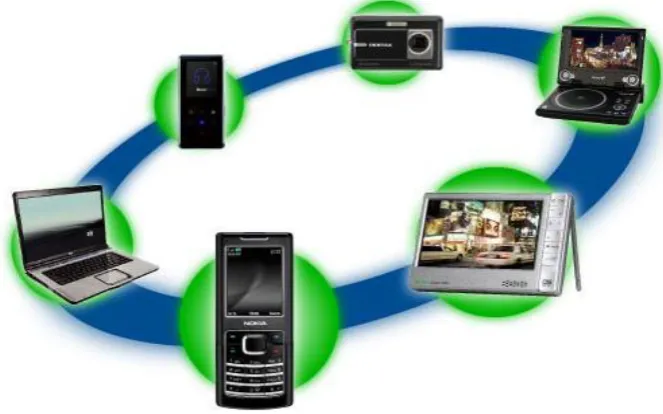
Fig. Application of mobile computing for any device in network
There are at least three different classes of mobile computing items:
Portable computers, compacted lightweight units including a full character set keyboard and primarily intended as hosts for software that may be parametrized, as laptops, notebooks, notepads, etc.
Mobile phones including a restricted key set primarily intended but not restricted to for vocal communications, as cell phones, smart phones, phonepads, etc.
Wearable computers, mostly limited to functional keys and primarily intended as incorporation of software agents, as watches, wristbands, necklaces, keyless implants, etc.
The existence of these classes is expected to be long lasting, and complementary in personal usage, none replacing one the other in all features of convenience. Mobile security or mobile phone security has become increasingly important in mobile computing. It is of particular concern as it relates to the security of personal information now stored on the smartphone.
II. Limitations of Mobile Computing
Range & Bandwidth: Mobile Internet access is generally slower than direct cable connections, using technologies such as GPRS and EDGE, and more recently HSDPA and HSUPA 3G and 4Gnetworks. These networks are usually available within range of commercial cell phone towers. Higher speed wireless LANs are inexpensive but have very limited range.
© 2014, IJCSMC All Rights Reserved 227
Power consumption: When a power outlet or portable generator is not available, mobile computers must rely entirely on battery power. Combined with the compact size of many mobile devices, this often means unusually expensive batteries must be used to obtain the necessary battery life.
Transmission interferences: Weather, terrain, and the range from the nearest signal point can all interfere with signal reception. Reception in tunnels, some buildings, and rural areas is often poor.
Potential health hazards: People who use mobile devices while driving are often distracted from driving and are thus assumed more likely to be involved in traffic accidents. [3] While this may seem obvious, there is considerable discussion about whether banning mobile device use while driving reduces accidents or not. [4],[5] Cell phones may interfere with sensitive medical devices. Questions concerning mobile phone radiation and health have been raised.
Human interface with device: Screens and keyboards tend to be small, which may make them hard to use. Alternate input methods such as speech or handwriting recognition require training.
III. Some practical issues using mobile computing
A. Authentication and Pervasive Computing
With today's technology, many applications rely on the existence of small devices that can exchange information and form communication networks. In a significant portion of such applications, the confidentiality and integrity of the communicated messages are of particular interest. [6] For this work the two novel techniques for authenticating short encrypted messages that are directed to meet the requirements of mobile and pervasive applications. By taking advantage of the fact that the message to be authenticated must also be encrypted, the provably secure authentication codes that are more efficient than any message authentication code in the literature. The key idea behind the proposed techniques is to utilize the security that the encryption algorithm can provide to design more efficient authentication mechanisms, as opposed to using standalone authentication primitives.
B. Overview of Ad hoc network
An ad hoc network is a collection of mobile nodes equipped with wireless communication adapters, these nodes dynamically form a temporary network without the need of any existing network infrastructure. A mobile ad hoc network, or MANET, is a temporary infrastructure less network, formed by a set of mobile hosts that dynamically establish their own network, without relying on any central administration. Mobile hosts used in MANET have to ensure the roles that were ensured by the powerful fixed infrastructure in traditional networks. This is a challenging task. Moreover, the network's environment has some features that add extra complications, such as the frequent topology changes caused by nodes' mobility, and the unreliability and the bandwidth limitation of wireless channels. The Security services are same as that of other communication network i.e. Availability, reliability, confidentiality, Authentication, etc. As Ad hoc networks arise in rapid deployment scenarios they also have to be capable of bearing with challenges.
C. The Impact of Rate Adaptation in Mobile Ad Hoc Networks
© 2014, IJCSMC All Rights Reserved 228
D. Global Positioning System
The Global Positioning System (GPS) is a space-based satellite navigation system that provides location and time information in all weather conditions, anywhere on or near the Earth where there is an unobstructed line of sight to four or more GPS satellites. [8] The system provides critical capabilities to military, civil and commercial users around the world. It is maintained by the United States government and is freely accessible to anyone with a GPS receiver.
A GPS receiver calculates its position by precisely timing the signals sent by GPS satellites high above the Earth. Each satellite continually transmits messages that include:
the time the message was transmitted and,
satellite position at time of message transmission.
The receiver uses the messages it receives to determine the transit time of each message and computes the distance to each satellite using the speed of light. Each of these distances and satellites' locations defines a sphere, so the receiver is located at the point where the spheres intersect. [9] These distances and satellites' locations are used to compute the location of the receiver using the navigation equations. This location is then displayed, perhaps with a moving map display or latitude and longitude; elevation or altitude information may be included, based on height above the geoid
Applications:
While originally a military project, GPS is considered a dual-use technology, meaning it has significant military and civilian applications. GPS has become a widely deployed and useful tool for commerce, scientific uses, tracking, and surveillance. GPS's accurate time facilitates everyday activities such as banking, mobile phone operations, and even the control of power grids by allowing well synchronized hand-off switching
E. Geographic Information System
A geographic information system (GIS) is a computer system designed to capture, store, manipulate, analyze, manage, and present all types of spatial or geographical data. The acronym GIS is sometimes used for geographical information science or geospatial information studies to refer to the academic discipline or career of working with geographic information systems and is a large domain within the broader academic discipline of Geoinformatics. [10] GIS can relate unrelated information by using location as the key index variable. Locations or extents in the Earth space–time may be recorded as dates/times of occurrence, and x, y, and z coordinates representing, longitude, latitude, and elevation, respectively. All Earth-based spatial–temporal location and extent references should, ideally, be relatable to one another and ultimately to a "real" physical location or extent. This key characteristic of GIS has begun to open new avenues of scientific inquiry.
Modern GIS technologies use digital information, for which various digitized data creation methods are used. The most common method of data creation is digitization, where a hard copy map or survey plan is transferred into a digital medium through the use of a CAD program, and geo-referencing capabilities. [11] With the wide availability of ortho-rectified imagery (both from satellite and aerial sources), heads-up digitizing is becoming the main avenue through which geographic data is extracted. Heads-up digitizing involves the tracing of geographic data directly on top of the aerial imagery instead of by the traditional method of tracing the geographic form on a separate digitizing tablet.
IV. Portable computing devices
Several categories of portable computing devices can run on batteries but are not usually classified as laptops: portable computers, PDAs, ultra mobile PCs (UMPCs), tablets and smartphones.
A. Portable Computer
© 2014, IJCSMC All Rights Reserved 229 B. Personal Digital Assistant (PDA)
A personal digital assistant (PDA) (discontinued) is a small, usually pocket-sized, computer with limited functionality. It is intended to supplement and to synchronize with a desktop computer, giving access to contacts, address book, notes, e-mail and other features.
C. Ultra Mobile PC
An ultra mobile PC (discontinued) is a full-featured, PDA-sized computer running a general-purpose operating system.
D. Tab
A tablet computer that lacks a keyboard (also known as a non-convertible tablet) is shaped like a slate or a paper notebook. Instead a physical keyboard it has a touchscreen with some combination ofvirtual keyboard, stylus and/or handwriting recognition software. Tablets may not be best suited for applications requiring a physical keyboard for typing, but are otherwise capable of carrying out most of the tasks of an ordinary laptop.
E. Smartphone
A smartphone has a wide range of features and install-able applications.
F. Carputer
A carputer is installed in an automobile. It operates as a wireless computer, sound system, GPS, and DVD player. It also contains word processing software and is bluetooth compatible. [14]
G. Pentop
A Pentop (discontinued) is a computing device the size and shape of a pen. It functions as a writing utensil, MP3 player, language translator, digital storage device, and calculator. [15]
V. Conclusion
Mobile computing is increasingly becoming more powerful and more affordable paving the way for solving problems in many emerging applications. Mobile computing involves mobile communication, mobile hardware, and mobile software. Communication issues include ad hoc and infrastructure networks as well as communication properties, protocols, data formats and concrete technologies. With this issues and some limitations that we have seen in this paper, We can develop fast and efficient techniques in the networking field which leads to some wider usefulness.
References
[1] E.M. Royer and C-K. Toh, “A review of current routing protocols for ad hoc mobile wireless networks”,
IEEE Personal Communications Magazine, April 1999.
[2] K. Pahlavan, P. Krishnamurthy, et al., “Handoff in hybrid mobile data networks”, IEEE Personal
Communications Magazine, April 2000.
[3] http://www.distraction.gov/stats-and-facts/
[4] Hands Free Cell Phones No Safer, Insurance Study Claims | Hands Free Info
[5] Study: Distractions, not phones, cause car crashes | Signal Strength - CNET News
[6]
Mobile Computing, IEEE Transactions on (Volume:13 , Issue: 3 )[7] Mobile Computing, IEEE Transactions on (Volume:13 , Issue: 11 )
© 2014, IJCSMC All Rights Reserved 230
[9] National Research Council (U.S.). Committee on the Future of the Global Positioning System; National Academy of Public Administration (1995). The global positioning system: a shared national asset: recommendations for technical improvements and enhancements. National Academies Press. p. 16. ISBN 0-309-05283-1. Retrieved August 16, 2013., Chapter 1, p. 16.
[10] "Geographic Information Systems as an Integrating Technology: Context, Concepts, and Definitions". ESRI. Retrieved 9 June 2011.
[11] Clarke, K. C., 1986. Advances in geographic information systems, computers, environment and urban systems, Vol. 10, pp. 175–184.
[12] Phifer, Lisa. "Mobile VPN: Closing the Gap", SearchMobileComputing.com, July 16, 2006.
[13] Gier, Jim. "Wireless Network Industry Report", Wireless Nets, Ltd.
[14] Carputer - Engadget