Available online: https://edupediapublications.org/journals/index.php/IJR/ P a g e | 3664
Evaluation of Management Methods for Developing
Organizations in Perspective of Leadership
K. Venkata Rao & Dr. D. Sucharitha
Research Scholar, Shri J.J.T. University, Rajasthan
Associate Professor Holy Mary Institute Of Technology & Science [email protected]
ABSTRACT:
The aim of good management is to provide
services to the community in an
appropriate, efficient, equitable, and sustainable manner. This can only be achieved if key resources for service provision, including human resources, finances, hardware and process aspects of care delivery are brought together at the point of service delivery and are carefully
synchronized. Critical management
considerations for assessment and
planning, managing the care process, human resources, interacting with the community, and managing information are
covered in the Planning, Human
Resources, Integration. The research paper is based on a questionnaire survey obtained from the 91 companies. This paper is one of the few studies which
investigate the relationship between
management tools and techniques and organizational performance. The findings show the level of management tools utilization and possibilities influencing performance. The study of organisations, their structure and management is important for the manager.
Keywords: management, leadership, organizations.
INTRODUCTION:
Managing is essential in all organized co-operation, as well as at all levels of
Available online: https://edupediapublications.org/journals/index.php/IJR/ P a g e | 3665
degree of overlap. But what exactly is leadership (as opposed to management) development and how can individuals and organisations get the most out of it?
LITERATURE REVIEW:
Iseri-Say et al. (2008) is focused on the issue how the adoption of management tools (the study considered the group of 25 tools) influences organizational performance. Their findings show a significant positive relationship between competitive positioning, organizational integrity, performance capabilities, customer equity, financial results and adoption of management tools and techniques.
Richard Bolden (2007) In this article I review recent trends in management and leadership development in the UK, arguing that much of the current growth is driven by financial, political and market pressures, to the relative neglect of philosophical and pedagogical perspectives on the nature and purpose of management, leadership and education within contemporary society. Whilst there is a general shift from formalised programmes towards flexible, experiential and customised provision, it seems that insufficient attention remains directed towards individual and organisational needs and requirements.
Matthew R. Fairholm (2009) This paper presents an integration of leadership ideas, strategic thinking and traditional planning activities in an effort to make important connections and important distinctions. The result is an outline of the foundations of strategic thinking.
Natalia V. Samosudova Certain characteristics applicable to leaders and managers are mentioned. Attitude and
obligations of a modern construction project manager are discussed, along with the challenges the construction industry represents these days. Ideas about methods of complex analysis for further research and identifying leadership tactics and their impact on the success of the development organization are suggested.
THEORY OF MANAGEMENT
“Management is the process of planning, organizing, leading and controlling the efforts of organization members and of using all other organizational resources to achieve stated organizational goals”. A central part of the study of organisation and management is the development of management thinking and what might be termed management theory. The application of theory brings about change in actual behaviour. Managers reading the work of leading writers on the subject might see in their ideas and conclusions a message about how they should behave. This will influence their attitudes towards management practice. The study of management theory is important for the following reasons:
It helps to view the interrelationships between the development of theory, behaviour in organisations and management practice.
An understanding of the development of management thinking helps in understanding principles underlying the process of management.
Available online: https://edupediapublications.org/journals/index.php/IJR/ P a g e | 3666
Many of the earlier ideas are of continuing importance to the manager and later ideas on management tend to incorporate earlier ideas and conclusions. Management theories are
interpretive and evolve in line with changes in the organisational environment.
Many of the classical writers were concerned with the improvement of management as a means of increasing productivity. At this time, emphasis was on the problem of obtaining increased productivity from individual workers through the technical structuring of the work organisation and the provision of monetary incentives as the motivator for higher levels of output. A major contributor to this approach was F. W. Taylor, the ‘father’ of scientific management. Taylor believed that in the same way that there is a best machine for each job, so there is a best working method by which people should undertake their jobs. He considered that all work processes could be analysed into discrete tasks and that by scientific method it was possible to find the ‘one best way’ to perform each task. Each job was broken down into component parts, each part timed and the parts rearranged into the most efficient method of working.
Managers who have these leadership qualities are a credit to the services they manage. However managers must ensure that day-to-day processes run well to produce the desired results. Certain attributes are required for a manager to be effective, including:
■ Clarity of purpose and tasks; ■ good organizational skills;
■ ability to communicate tasks and expected results effectively;
■ ability to negotiate various administrative and regulatory processes; ■ good delegation skills.
Leadership is an activity on the part of the managers to get something done by others, willingly and not by compulsion. Leadership is a process of influence on a group. Leadership is the ability of a manager to induce subordinates to work with confidence. Thus leadership is a psychological process of influencing followers and providing guidance, directing and leading the people in an organization towards attainment of the objectives of the enterprise.
MANAGEMENT TOOLS AND
TECHNIQUES:
Management tools and techniques can be applied in different areas, such as (1) general management, (2) marketing management, (3) operations management, (4) financial management, (5) human resource management, (6) information technology, (7) management science, (8) planning and resource allocation and (9) efficiency and effectiveness.
Available online: https://edupediapublications.org/journals/index.php/IJR/ P a g e | 3667
Therefore, management tools and techniques are powerful lever which can help managers to define and develop
proposed solution to the existing problems inside the organization.
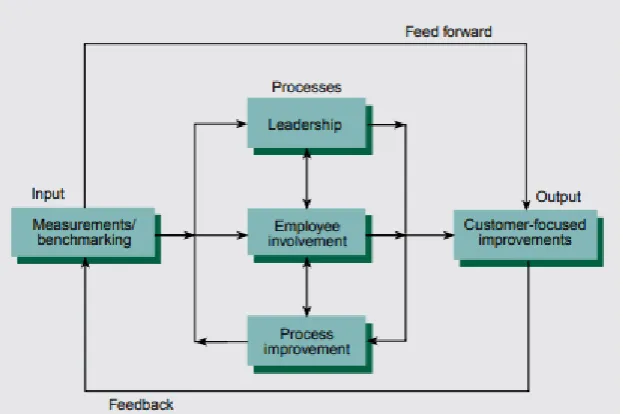
Fig 1. A system of management for organizational improvement
In an organizational improvement context, analysis and decision includes the leadership, employee involvement, process improvements, and communications necessary to tailor a specific response. The third element, response, represents the output of the system. In an organizational improvement context, an output could be customer-focused improvements in product or performance. Thus, the system of management for organizational improvement has five interrelated components as shown in Fig. 1.
Management development methods in IT companies as follows:
1. Internal skills programmes
2. External courses, seminars and conferences
3. mentoring/coaching 4. Formal qualifications 5. in-company job-rotation
6. External assignments, placements and/or secondments
7. E-learning.
In all countries in the study there was a relatively low preference for on-the-job development (such as job rotation and assignments) and a strikingly low uptake of E-learning given the interest of providers in this form of delivery. Within the UK there is a higher than average use of qualifications-based development, despite the relatively low rating of this with regards to “what makes an effective manager.
Most training and development interventions offered in-house and by external training providers can be classified into four types:
1. Learning about leadership and
organisations: primarily involves
Available online: https://edupediapublications.org/journals/index.php/IJR/ P a g e | 3668
methods to present leadership theory and research.
2. Self/team analysis and exploration of
leadership styles: a series of methods
(including psychometrics, 360 degree feedback, coaching and sensitivity training) to raise awareness of self and others and how this impacts upon leadership styles.
3. Experiential learning and simulation:
approaches that emphasise the importance of ‘learning by doing’, such as outward bound courses, action learning and role play.
4. Top level strategy courses: executive
development courses designed for senior managers. Often associated with prestigious business schools and qualifications
With regards to personalised and tailored provision, coaching is particularly popular with organisations and managers but its extension to large numbers of individuals is limited by cost and the availability of high quality coaches. 360 degree feedback, like many approaches, is found to be most powerful when integrated within a comprehensive development programme and is significantly affected by the following three factors: a work context supportive of skills development, the
belief of the participant that people can improve their skills, and a belief that they themselves are capable of improving and developing.
RESULTS AND DISCUSSION:
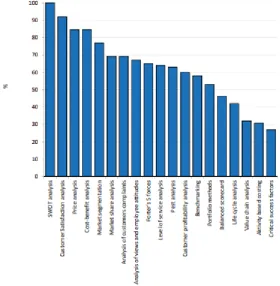
As was mentioned above, the list of the management tools and techniques is based on the previous studies with focus on the use of strategic tools and techniques. Where we investigated the nature of 31 management tools and techniques by determining the utilization and satisfaction level with them by companies in Czech Republic. In our previous research, it was observed that fifteen strategic management tools and techniques were used by over 50% of companies. The sample of the research consists of 91 respondents. The questionnaire includes three parts; the first part involves questions concerning the organization details (sector; industry; number of employees), demographic questions. The next part indicates the utilization level of nineteen management tools and techniques in Czech companies. Each participant was required to state which of the strategic management tools and techniques the company utilize. The participants indicated the level of utilization.
Sample Characteristics
Subjects Descriptions
Private Public
Sector 77 (85%) 14 (15%)
IT Service Other
Available online: https://edupediapublications.org/journals/index.php/IJR/ P a g e | 3669
Size of company
0-49 employees
50-250 employees
+ 250 employees
14
(15.4%)
28 (30.8%)
49 (53.8%)
Position General
Manager
Finance Director
Marketing manager
CEO(owner)
16
(17.6%) 22 (24.2%)
40 (44%) 13 (14.3%)
Experience in position
> 2 years 2 - 5 years 6-10 years < 10 years
7 (7.7%) 22
(24.2%)
37 (40.7%)
25 (27.5%)
The characteristics of the respondents were classified by position and experience in current position. The survey of this study conducted on 40 marketing managers, 22 finance directors, 16 general managers and 13 chief executive officers of 91 companies that operate in Czech Republic. The working time in the position of the respondents vary between 6 -10 years (40.7 %), more than 10 years (27.5 %); 2-6 years (24.2 %) and less than 2 years (7.7 %). The characteristics of the companies were classified by sector/ nature of business, and size of company. Most of the
Available online: https://edupediapublications.org/journals/index.php/IJR/ P a g e | 3670
Fig. 1 – Use of strategic management tools and techniques CONCLUSION:
This study provides empirical evidence regarding strategic management tools and techniques utilization as well as exploring relationship between strategic management tools and techniques utilization and organizational performance in required companies. Furthermore, the paper provides new evidence to understand the effect of strategic management tools and techniques utilization on organizational performance, drawing on data from Czech companies. To have a more balanced impression of organizational performance we used the combination of financial and non-financial outcomes. This complex analysis may help us comprehend specific leadership needs and demands of organizations belonging to different contexts; and what influences the tactics leaders use to make a company more effective and successful. Further research
in leadership’s impact on the success of modern development companies of various scales is necessary.
REFERENCES:
[1]. Iseri-Say, A., Toker, A., & Kantur, D. (2008), “Do popular management techniques improve performance?”, Journal of Management Development, 27 (7), 660-677. DOI: http://dx.doi. org/10.1108/02621710810883580
[2]. Richard Bolden (2007), “Trends and Perspectives in Management and Leadership Development”, Business Leadership Review, Vol No IV, Issue No: II, PP: 1-13
[3]. Matthew R. Fairholm (2009), “Leadership and Organizational Strategy”, The Innovation Journal: The Public Sector Innovation Journal, Volume 14(1).
Available online: https://edupediapublications.org/journals/index.php/IJR/ P a g e | 3671
MATEC Web of Conferences, Vol No: 106, PP: 1-10
[5]. R.Arvey, M.Rotundo, W.Johnson, Z.Zhang, M.McGue, The Leadership Quarterly 17, 1–20 (2006)
[6]. Conger, J.A., (2010). Developing leadership talent: Delivering on the promise of structured programs. In R. Silzer & B.E. Dowell (Eds.), Strategy-driven talent management: A leadership imperative (pp. 281-311). San Francisco, CA: Jossey-Bass
[7]. Day, D. V. (2000). Leadership development: A review in context. The Leadership Quarterly, 11, 581-613.
[8]. .Lamoreaux, K. (2007). High-impact leadership development: Best practices, vendor profiles and industry solutions. Oakland, CA: Bersin & Associates.
[9]. Peterson (2002). Management development: Coaching and mentoring
programs. In K. Kraiger, (Ed.), Creating, implementing, and managing effective training and development (pp. 160-191). San Francisco, CA: Jossey-Bass
[10]. Gulick, L. 1937. “Notes of the theory of organization”. In L. Gulick & L. Urwick (Eds.), Papers on the Science of Administration (pp. 3-13). New York: Institute of Public Administration.
[11]. Al-khadash, H. A., & Feridun, M. (2006). Impact of Strategic Initiatives in Management Accounting on Corporate Financial Performance: Evidence from Amman Stock Exchange. Journal of Managing Global Transitions, 4 (4), 299 – 312, from http://ssrn.com/abstract=938782
[12]. Iseri-Say, A., Toker, A., & Kantur, D. (2008). Do popular management techniques improve performance? Journal of Management Development, 27 (7),
660-677. DOI: http://dx.doi.