N A N O E X P R E S S
Open Access
Synthesis of Spherical Silver-coated
Li
4
Ti
5
O
12
Anode Material by a
Sol-Gel-assisted Hydrothermal Method
Jun Li
*, Si Huang, Shuaijun Xu, Lifang Lan, Lu Lu and Shaofang Li
Abstract
Ag-coated spherical Li4Ti5O12composite was successfully synthesized via a sol-gel-assisted hydrothermal method using an ethylene glycol and silver nitrate mixture as the precursor, and the influence of the Ag coating contents on the electrochemical properties of its was extensively investigated. X-ray diffraction (XRD) analysis indicated that the Ag coating does not change the spinel structure of Li4Ti5O12. The electrochemical impedance spectroscopy (EIS) analyses demonstrated that the excellent electrical conductivity of the Li4Ti5O12/Ag resulted
from the presence of the highly conducting silver coating layer. Additionally, the nano-thick silver layer, which was uniformly coated on the particles, significantly improved this material’s rate capability. As a consequence, the silver-coated micron-sized spherial Li4Ti5O12exhibited excellent electrochemical performance. Thus, with an appropriate silver content of 5 wt.%, the Li4Ti5O12/Ag delivered the highest capacity of 186.34 mAh g−
1 at 0.5C, which is higher than that of other samples, and maintained 92.69% of its initial capacity at 5C after 100 cycles. Even at 10C after 100 cycles, it still had a capacity retention of 89.17%, demonstrating remarkable cycling stability.
Trial registration:ISRCTN NARL-D-17-00568
Keywords:Silver coating, Li4Ti5O12/Ag, Lithium-ion batteries, Electrochemical performance
Highlights
1. Spherical Li4Ti5O12/Ag composites were synthesized
via a sol-gel-assisted hydrothermal method using ethylene glycol and a silver nitrate mixture as the precursor for the coating layer, which significantly improved the electronic conductivity and the electrochemical performance of Li4Ti5O12.
2. The spherical morphology could induce a large tap density and consequently enhance the volumetric energy density.
Background
Over the last decade, rechargeable lithium-ion batteries (LIBs) have demonstrated many advantages. They are light weight; have a small size, high voltage and high energy density; and have been attracting intense interest as an
electrochemical energy storage device to reduce exhaust emissions and for fuel economy [1, 2]. However, the price of lithium precursors, safety and life issues, and low power density are obstacles for the application of LIBs for large-scale energy storage in the future [3]. Therefore, to develop substitute materials to meet the demands of the safety of the large-scale storage, great efforts have been made [4].
Cube spinel lithium titanate (Li4Ti5O12) materials, the
anode materials of Li-ion batteries, have been become a promising material because of their zero-strain structural characteristic during the intercalation and deintercalation process of Li4Ti5O12 [5–9]. This material has a platform
lithium insertion and extraction voltage of ~ 1.55 V (vs. Li/ Li+), avoiding the formation of lithium-consuming solid electrolyte interface (SEI) films, which should be beneficial for enhancing safety and good cycling of the LIBs. There-fore, Li4Ti5O12has become one of the potential materials
in commercial applications and scientific research. Li4Ti5O12 has been prepared via various of methods, for
example, solid-state, electroless deposition, microwave, and sol-gel method. Regarding the solid-state method,
* Correspondence:[email protected]
Faculty of Chemical Engineering and Light Industry,, Guangdong University of Technology, No. 100 Waihuan xi Road, Guangzhou Higher Education Mega Center, Panyu District, Guangzhou, Guangdong 510006, China
some studies have shown that it has a simple synthesis route and low synthesis cost because of the shorter dis-tance for Li+diffusion and electron transfer, Li4Ti5O12
ex-hibits an excellent rate capability, but the solid-state reaction cannot provide a uniform morphology with a narrow size. However, the electroless deposition process has a complex synthesis route. For the sol-gel synthesis of Li4Ti5O12, several researchers have reported that it can
yield products with a uniformly homogeneous distribution and narrow particles with good stoichiometric control.
Despite these many advantages, the major drawbacks of Li4Ti5O12 are its poor electronic and ionic conductivity
and its slow Li-ion diffusion coefficient, which results in a poor rate capacity. Numerous strategies, including crystal-lite size reduction [10], doping with high valence metal ions [11–13], and coating with conducting phases [14–17], have been adopted to improve the discharge/charge transport properties of electrodes. In addition, another way to enhance the electronic conductiv-ity is to synthesize nanostructured Li4Ti5O12. The
nano-structures provide a larger electrode/electrolyte contact area to increase the intercalation kinetics and reduce the diffusion paths to accelerate Li+and electron transport [18]. Among these approaches, the most effective way to im-prove the electrochemical properties of Li4Ti5O12 is
con-ductive surface modification. Aslihan et al. [2] synthesized Li4Ti5O12 via the sol-gel method, and then the
as-synthesized Li4Ti5O12 was surface-coated with silver via
electroless deposition. The results showed that silver coat-ing (Ag coatcoat-ing) affords a highly conductive matrix for Li+ insertion, improving the electronic conductivity. Zhu et al. [19] prepared carbon-coated nano-sized Li4Ti5O12
nano-porous micro-spheres with a remarkable rate capability via a carbon pre-coating process in combination with a spray drying method, and indicated that the micron-sized spher-ical particles induce a large tap density, resulting in the en-hancement of the volumetric energy density. However, how to synthesize Ag-coated micron-sized Li4Ti5O12 spherical
particles via a sol-gel-assisted hydrothermal method has not been reported.
Herein, we report a sol-gel-assisted hydrothermal method to synthesize the micron-sized spherical Li4Ti5O12/Ag
com-posite using ethylene glycol and a silver nitrate mixture as a precursor, and the content of the Ag coating was adjusted by controlling the amount of silver element in the precur-sor. The electrochemical properties of the Li4Ti5O12/Ag
with spherical morphology were investigated in detail.
Experimental
Synthesis of Pristine Li4Ti5O12and Modification of its
Surface with Ag
Synthesis of the Spherical Precursor Via the Sol-Gel Method
The spherical precursor titanium glycolate (TG) was syn-thesized by the sol-gel method. First, 2 mL of tetrabutyl
titanate was added slowly to the solution, which con-tained AgNO3(at an appropriate amount to be soluble
in 50 mL of glycol), under vigorous stirring to form the precursor solution. Second, the precursor solution was added to a 150 mL of acetone mixture that contained 0.1 mL Tween 80, and agitation was continued for 1 h at room temperature to form precipitates. Then, the precipitates were aged for 8 h, separated by filtration, and washed twice with anhydrous alcohol. Finally, the precursor powders were obtained by heat treatment at 80 °C for 6 h in an oven followed by grinding.
Synthesis of Spherical Li4Ti5O12/Ag
The spherical Li4Ti5O12/Ag was prepared via the
hydrothermal method. First, LiOH·H2O and the
precur-sor in a molar ratio of 3.9:1 were homogeneously mixed by stirring with 40 mL of alcohol as the media for 1 h to form a mixture, which was then heated at 180 °C for 12 h in sealed Teflon wares until precipitates were obtained. Second, the precipitates were collected via centrifugation (5000 rpm, 5 min) and further washed with anhydrous ethanol several times. Then, they were dried in an oven at 80 °C for 2 h. Finally, the precipi-tates were heated in a muffle furnace at 700 °C for 2 h (heating rate of 5 °C·min−1) in air after they were
Fig. 1XRD patterns of the Li4Ti5O12/Ag. (a) 0 wt.%, (b) 1 wt.%, (c)
[image:2.595.305.539.86.272.2]3 wt.%, (d) 5 wt.%, and (e) 7 wt.%
Table 1Lattice parameters of the Li4Ti5O12/Ag composites
coated with different Ag contents
Content of Ag, wt.% Lattice parameter (a = b = c), nm
0 0.83577
1 0.83572
3 0.83574
5 0.83576
[image:2.595.304.537.648.731.2]ground and then naturally cooled to room temperature to obtain spherical Li4Ti5O12/Ag powder.
Material Characterization
The structure of the Li4Ti5O12 samples were identified
via X-ray diffraction (XRD, Rigaku D/max-PC2200) using a Cu Kαradiation (λ = 0.15405 nm) source with a scan rate of 4 °min−1 from 10° to 80° and operated at 40 KV and 20 mA. The morphology and particle size of the materials were explored via SEM (scanning electron microscopy, Supra 55 Zeiss) and TEM (transmission electron microscopy, JEOL-2100).
Electrochemical Measurements
The electrochemical performances of the products were tested using a CR2025 coin-type cell. The working elec-trodes were prepared by mixing 80 wt.% Li4Ti5O12/Ag
ac-tive materials, 10 wt.% conducac-tive Super-P, and 10 wt.% polyvinylidene fluoride (PVDF) binder in N-methyl-2-pyrrolidone (NMP) solvent to form a uniform slurry. Then, the slurry was cast onto an aluminum foil and dried under vacuum at 80 °C for 12 h to remove the residual solvent. Then, the foil was pressed and cut into disks. A Celgard 2400 polypropylene microporous membrane and lithium foil were used as the separator and the negative electrode, respectively. The electrolyte solution was 1 M LiPF6 in ethylene carbonate (EC),
dimethyl carbonate (DMC), and ethylene methyl car-bonate (EMC) in a volumetric ratio of 1:1:1. The cells were assembled in an argon-filled glove box, where both the moisture and oxygen levels were kept below 1 ppm. The electrochemical tests of the products were evaluated using a LAND CT2001A test system (Wuhan, China). Cyclic voltammetry (CV) tests were recorded on a CHI600A electrochemical workstation at a 0.1 mV s−1 scan rate from 1.0 to 2.5 V (vs. Li/ Li+). EIS measurements
were performed in the frequency range of 100 KHz to 10 mHz with a perturbation of 5 mV.
Results and Discussion
Structural and Morphological Properties
The effect of the amount of Ag additive on the Li4Ti5O12/Ag powders was investigated. The XRD
pat-terns of the Ag-coated spherical Li4Ti5O12 composites
are given in Fig. 1. It can be easily seen that the major diffraction peaks of all specimens appear at 18.4°, 35.54°, 43.2°, 57.2°, 62.8°, and 66.1° and are indexed as the (111), (311), (400), (333), (440), and (531), respectively. That peaks are in good agreement with the Li4Ti5O12
standard diffraction pattern [20], except for characteris-tic patterns of the Ag metal (2θ= 38.1°, 44.3°, 64.4°). No impurity diffraction peaks were detected in any of the specimens. Moreover, the peak intensity of silver corres-pondingly increased as the amount of Ag increased.
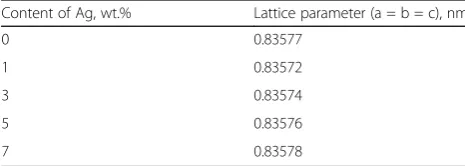
Lattice parameters of the Li4Ti5O12/Ag samples with
different Ag coatings are provided in Table 1. No significant changes with the Ag content increase were observed. Thus, it was suggested that silver is mainly coating in the form of the elemental Ag on the surface of Li4Ti5O12particles but not penetrating into the lattice
of spinel Li4Ti5O12. Because the ionic radius of Ag+
(0.126 nm) is substantially larger than that of the Ti4+ (0.068 nm), the as-synthesized Li4Ti5O12/Ag sample was
just a composite of the Ag metal and the Li4Ti5O12
phase.
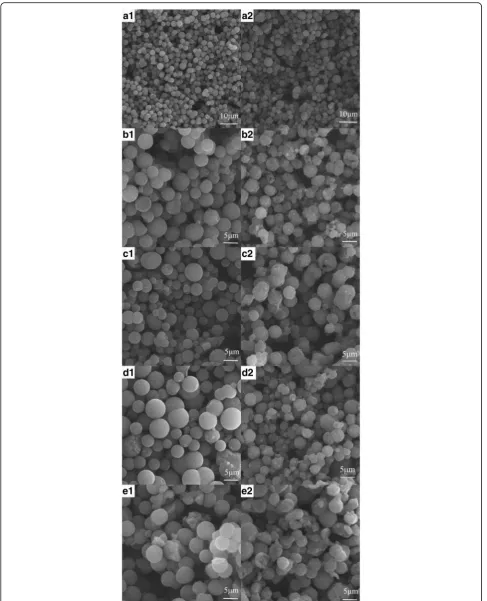
Figure 2 shows the SEM images of the as-prepared precursor (a1-e1) and Li4Ti5O12/Ag (a2-e2). As shown in
Fig. 2, all samples exhibit a uniformly spherical structure with a narrow size distribution of 5–10 μm, which is beneficial to a contact between the active materials and electrode. From the SEM images, the spherical precursor, titanium glycolate (TG) particles, shows a smooth line,
[image:4.595.57.540.536.715.2]whereas the Li4Ti5O12/Ag particles presents a rough line.
Moreover, a good dispersion could enlarge the electrode-electrolyte contact area and significantly accelerate the transportation of Li+ and electron. However, the surface of the Li4Ti5O12/Ag samples are not obviously smoother than
that of the as-prepared precursor and titanium glycolate, and they exist to a certain extent as an agglomeration. Moreover, the particle sizes of different Li4Ti5O12/Ag
com-posites are much larger than that of Ag-free Li4Ti5O12;
however, the agglomeration phenomenon becomes more obvious with an increasing in silver content.
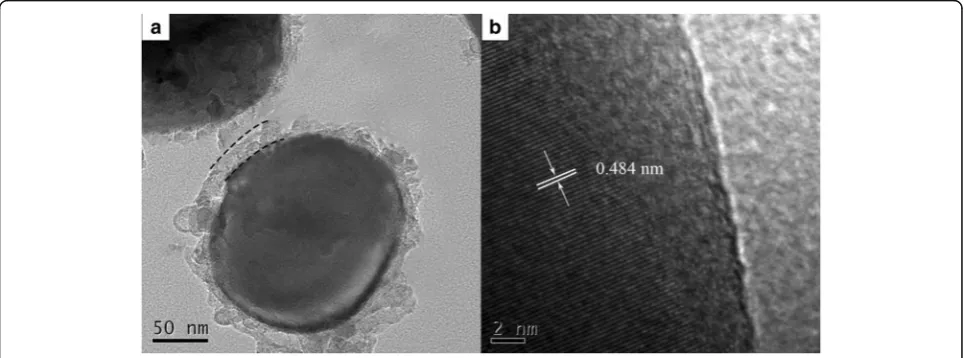
The distribution of silver in the interior of the micron-sized particles was further investigated, and TEM and HRTEM analyses were provided in Fig. 3. The TEM images (Fig. 3a) show that the 5 wt.% Ag-coated
micron-sized-spherical Li4Ti5O12 particles are uniformly coated by a
silver layer with a thickness of 3~4 nm, indicating that the silver layer builds a conductive network on the surface of the entire material, which facilitates the lithium ion and electron transport. As shown in Fig. 3b, the surface of the micron-sized Li4Ti5O12/Ag particles are not smooth, and
thed-spacing of the 5 wt.% Ag-coated Li4Ti5O12particles
is 0.484 nm, which matches well with that of the LTO (111) plane. This suggests that no new phase was gener-ated on the surface of the LTO particles, but there was a thin coating layer on the particles.
[image:5.595.58.537.276.716.2]Electrochemical Properties
Figure 4 shows the first charge-discharge curves of the micron-sized spherical Li4Ti5O12/Ag electrodes coated
with different Ag contents at the different rates. As it can be seen from Fig. 4, all of the profiles exhibit an extremely flat voltage plateau of 1.55 V (vs. Li/Li+), indicating a two-phase transition between Li4Ti5O12and
Li7Ti5O12 for lithium insertion [21]. The voltage
plat-form of Li4Ti5O12/Ag composites is longer than that of
Ag-free Li4Ti5O12. With an increasing content of Ag, for
a longer discharge platform of the Li4Ti5O12/Ag
com-posites, the ability to maintain the platform is stronger, suggesting that good electronic conductivity can effect-ively reduce the polarization of the material during the electrode reaction process, and improve the utilization of the material.
As shown in Fig. 4, Ag-free Li4Ti5O12 delivered an
initial discharge-specific capacity of 167.62 mAh g−1at a rate of 0.5C, whereas the delivered capacity of the Ag-coated micron-sized spherical Li4Ti5O12composites
increased with increasing silver amount: 170.10, 179.54, and 186.34 mAh g−1for 1, 3, and 5 wt.%, respectively. But 7 wt.% Ag-coated Li4Ti5O12 exhibited a somewhat
different behavior. The delivered discharge-specific capacity decreased with increasing silver amount: 175.86 mAh g−1 for 7 wt.%. The 5 wt.% Ag-coated Li4Ti5O12 gained the highest initial discharge capacity,
and the initial discharge-specific capacities reached 186.34, 172.47, 154.12, and 136.06 mAh g−1at the specific currents of 0.5, 1, 5, and 10C, respectively. Due to the poor electronic conductivity and sluggish Li+ diffusion, the material exhibits a large polarization at high charge/ discharge rates. The highly conductive Ag additive can significantly enhance the surface intercalation reaction and reduce the polarization [20, 22]. Even the highest Ag content (7 wt.%) can provide the longest voltage plateau, and the metal silver itself cannot be fully intercalated into the lithium. Instead, the high content of Ag will lead to a decrease in the specific capacity of Li4Ti5O12/Ag.
There-fore, an appropriate silver content can not only effectively improve the conductivity of the Li4Ti5O12and reduce the
polarization of the Li4Ti5O12in the reaction process but
can also reduce the loss of the reversible capacity due to the Ag coating.
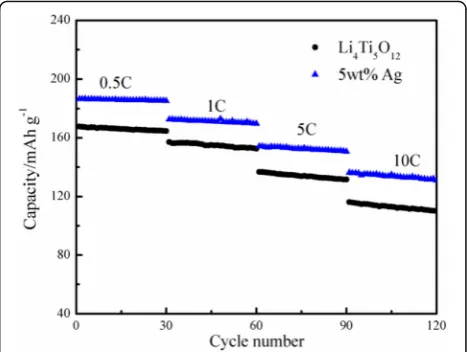
The rate capabilities of the Ag-free Li4Ti5O12 and
5 wt.% Ag-coated Li4Ti5O12 composite were analyzed at
current densities of 0.5, 1, 5, and 10C, and the results are shown in Fig. 5. As shown, the initial capacity of the 5 wt.% Ag-coated Li4Ti5O12 composite at 5C was
154.12 mAh g−1. After 30 cycles, the capacity was still maintained at 150.50 mAh g−1, retaining over 97.65% of the initial capacity. When it was further increased to 10C, the discharge capacity apparently dropped from 136.06 mAh g−1 to 130.81 mAh g−1 after 30 cycles. While the retention efficiency of the capacity could still be maintained at 96.14%. What is more, the cycling performance of the Li4Ti5O12/Ag composite was
significantly better than that of the Ag-free Li4Ti5O12at
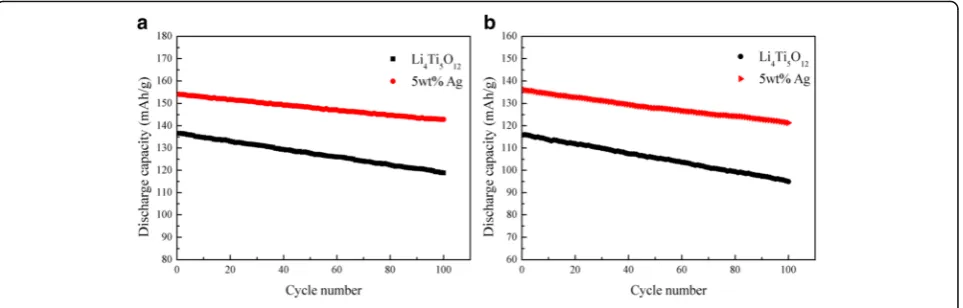
various charge-discharge rates. As shown in Fig. 6a, with an appropriate silver contents of 5 wt.%, the silver-coated Li4Ti5O12 delivered the highest capacity of
186.34 mAh g−1 at 0.5C, which is higher than that of other samples, and maintained 92.69% of its initial capacity at 5C after 100 cycles. Even at 10C after 100 cy-cles (Fig. 6b), it still had a capacity retention of 89.17%, demonstrating remarkable cycling stability. The results suggested that under the favorable experimental condi-tions, the Li4Ti5O12 surface Ag coating not only
en-hanced the electron and ionic conductivity but also obviously increased the electron transport during the lithium insertion/extraction reaction and significantly improved the cycle stability of the Li4Ti5O12.
Figure 7 presents the cyclic voltammograms (CVs) of the Ag-free Li4Ti5O12 and 5 wt.% Ag-coated
Li4Ti5O12 composite obtained at a slow rate of
0.1 mV s−1. Obviously, reversible redox peaks between 1.0 and 2.5 V were obtained, which are attributed to the insertion and extraction of lithium ions, suggesting no intermediate phase formation during lithium insertion and de-insertion. Meanwhile, the redox peak area of these two curves is almost equal, indicating a high coulombic ef-ficiency [23]. The potential differences between the oxida-tion and reducoxida-tion peaks of the 5 wt.% Ag-coated Li4Ti5O12 is 0.244 V, which is slightly lower than that of
the Ag-free Li4Ti5O12(0.24 V). This suggests that
appro-priately surface coating the highly conductive Ag additive significantly reduced the polarization of the Li4Ti5O12
sample and effectively improved its electrochemical performance. Moreover, the redox peaks of the 5 wt.% Ag-coated Li4Ti5O12are sharper and larger than that of
Ag-free Li4Ti5O12, which indicates that an appropriate
Ag coating can improve the dynamic performance of the electrode.
[image:6.595.305.539.88.264.2]Electrochemical impedance spectroscopy (EIS) mea-surements of Ag-free Li4Ti5O12 and 5 wt.% Ag-coated
Li4Ti5O12were conducted in the frequency range of 105
to 0.01 Hz before galvanostatic cycles. Additionally, the equivalent circuit (inset) and corresponding impedance data are shown in Fig. 8. In the equivalent circuit, Rs represents the electrolyte solution resistance, which re-flects the electric conductivity of the electrolyte, separ-ator, and electrodes. (intersection with the Z′ axis at a high frequency),Rct shows the charge-transfer resistance in materials,CPEis the double-layer and passivation film capacitance, and Wis the Warburg impedance, which is related to lithium ion diffusion in the low frequency region. The parameters obtained by fitting are listed in Table 2. As shown in Fig. 8, both EIS curves were com-posed of a depressed semicircle in the high-frequency region and an oblique straight line in the low-frequency region. The diameter of the semicircle stands for the charge-transfer resistance, and the oblique straight line is related to the Warburg impedance [24]. The impedance
of the semicircles in the high frequency region corres-pond to the electrode and liquid electrolyte interface charge transfer process, and the straight line in the low frequency region can be expressed as the lithium ions’ diffusion behavior in the oxide structure [25–28]. As shown from Fig. 8, the diameter of the semicircle of the 5 wt.% Ag-coated Li4Ti5O12is shorter than that of bare
Li4Ti5O12, indicating that a proper amount of Ag
coat-ing could enhance the electronic conductivity of Li4Ti5O12, and this has to do with the charge-transfer
process, where Li+ and electrons reach the electrode surface simultaneously to complete the reaction. This mainly depends on the redox reaction across the sur-face of the active materials. The smaller charge-transfer resistance of the 5 wt.% Ag-coated Li4Ti5O12reflected a
faster charge transfer reactions at their electrode/elec-trolyte interfaces.
The lithium ion chemical diffusion coefficient can be calculated from the plot in the low-frequency region by using the following Eq. (1) [29–33].
Fig. 8EIS patterns of the pure Li4Ti5O12and the Li4Ti5O12coated
with different Ag contents
Fig. 7CV curves of the Ag-free and the 5 wt.% Ag-coated Li4Ti5O12composite
[image:7.595.59.541.88.242.2] [image:7.595.306.538.521.701.2] [image:7.595.57.292.522.702.2]DLiþ¼ R
2T2
2A2n4F4C2 Liσw2
ð1Þ
Here, DLiþ is the lithium-ion diffusion coefficient,Ris
the gas constant (8.314 JK mol−1), T is the absolute temperature (298 K), A is the surface area of the elec-trode,nis the number of electrons per molecule attend-ing the electronic transfer reaction, F is the Faraday constant (96,500 C mol−1), CLi is the concentration of
lithium ions in the Li4Ti5O12 electrode, and σw is the Warburg factor, which has the following relationship withΖre:
Ζre ¼RSþRctþσw⋅ω−0:5 ð2Þ
Additionally, the relationship betweenZreand the
recip-rocal square root of frequency in the low frequency is shown in Fig. 9. All of the parameters obtained and calcu-lated from the EIS are summarized in Table 2. As shown in Table 2, DLiþ of the 5 wt.% Ag-coated Li4Ti5O12 is
6.73 × 10⁻¹¹, which is one order of magnitude higher than that of Li4Ti5O12 (8.69 × 10⁻¹²). The 5 wt.% Ag-coated
Li4Ti5O12 has the largest lithium diffusion coefficient
compared with that of Ag-free Li4Ti5O12 and 1, 3, and
7 wt.% Ag-coated Li4Ti5O12composites, indicating that
coating with Ag is an effective way to improve the elec-tronic conductivity. Consequently, the rate capacity of the 5 wt.% Ag-coated Li4Ti5O12 can be substantially
improved.
Conclusions
Anode materials spherical Li4Ti5O12/Ag composites
with a high tap density were prepared by a sol-gel-assisted hydrothermal method. The electrochemical tests show that the appropriate amount of Ag coating can significantly improve the electronic conductivity of Li4Ti5O12 and enhance the cycle stability. The optimum
content of silver is 5wt.%, which can get excellent electro-chemical performance. However, the excessive silver content will cause the electrochemical properties of material worse. Therefore, appropriate Ag-coated spherical Li4Ti5O12
composite is a superior lithium storage material with a high capacity and excellent safety, and it has real potential as a promising material in power lithium ion batteries.
Acknowledgements
This work is supported by Science and Technology Plan Foundation of Guangdong (2015A050502046) and Science and Technology Plan Foundation of Guangdong (201704030031).
Authors’Contributions
The idea is from JL, the manuscript was mainly written by SH and LL. The figures were mainly drawn by SX and LL and were calibrated by SL. All authors read and approved the final manuscript.
Ethics Approval and Consent to Participate
Not applicable.
Consent for Publication
Not applicable.
Competing Interests
The authors declare that they have no competing interests.
Publisher’s Note
Springer Nature remains neutral with regard to jurisdictional claims in published maps and institutional affiliations.
Received: 12 August 2017 Accepted: 13 October 2017
References
1. Wang Z, Liu E, Guo L, Shi C, He C, Li J, Zhao N (2013) Cycle performance improvement of Li-rich layered cathode material Li[Li0.2Mn0.54Ni0.13Co0.13]O2
by ZrO2coating. Surf Coat Technol 235:570–576
2. Erdas A, Ozcan S, Nalci D, Guler MO, Akbulut H (2015) Novel Ag/Li4Ti5O12
binary composite anode electrodes for high capacity Li-ion batteries. Surf Coat Technol 271:136–140
3. Chen C, Xu H, Zhou T, Guo Z, Chen L, Yan M, Mai L, Hu P, Cheng S, Huang Y, Xie J (2016) Integrated intercalation-based and interfacial sodium storage in graphene-wrapped porous Li4Ti5O12nanofibers composite aerogel. Adv
Energy Mater 6:136–140
4. Chen C, Wen Y, Hu X, Ji X, Yan M, Mai L, Hu P, Shan B, Huang Y (2015) Na+intercalation pseudocapacitance in graphene-coupled titanium oxide
enabling ultra-fast sodium storage and long-term cycling. Nat Commun 6:6929–6936
Fig. 9Graph ofZreplotted againstω−0.5at the low frequency
region for the Li4Ti5O12and Li4Ti5O12coated with different
[image:8.595.56.292.111.198.2]Ag contents
Table 2Impedance parameters of the pure Li4Ti5O12and the
Li4Ti5O12/Ag composites coated with different silver contents
Samples Rs/Ω Rct/Ω DLi/cm2s−1
Li4Ti5O12 5.84 87.16 8.69 × 10⁻¹²
Li4Ti5O12/Ag (1 mass%) 4.56 77.44 2.14 × 10⁻¹¹
Li4Ti5O12/Ag (3 mass%) 4.38 66.62 3.75 × 10⁻¹¹
Li4Ti5O12/Ag (5 mass%) 4.13 57.87 6.73 × 10⁻¹¹
[image:8.595.57.292.502.692.2]5. Ge H, Hao TT, Osgodd H, Zhang B, Chen L, Cui LX, Song XM, Ogoke O, Wu G (2016) Advanced mesoporous spinel Li4Ti5O12/rGO composites with
increased surface lithium storage capability for high-power lithium-ion batteries. ACS Appl Mater Interfaces 8:9162–9169
6. Bhatti HS, Anjum DH, Ullah S, Ahmed B, Habib A, Karim A, Hasanain SK (2016) Electrochemical characteristics and Li+ ion intercalation kinetics of Dual-Phase Li4Ti5O12/Li2TiO3composite in the voltage range 0–3 V. J Phys
Chem C 120:9553–9561
7. Alaboina P, Ge Y, Uddin MJ, Liu Y, Lee D, Park S, Zhang XW (2016) Nanoscale porous lithium titanate anode for superior high temperature performance. ACS Appl Mater Interfaces 8:12127–12133
8. Mu DB, Chen YJ, Wu B, Huang R, Jiang Y, Li L, Wu F (2016) Nano-sized Li4Ti5O12/C anode material with ultrafast charge/discharge capability for
lithium ion batteries. J Alloys Compd 671:157–163
9. Long DH, Jeong MG, Lee YS, Choi W, Lee JK, Oh IH, Jung HG (2015) Coating Lithium Titanate with nitrogendoped carbon by simple refluxing for high-power lithium-ion batteries. ACS Appl Mater Interfaces 7:10250–10257 10. Kavan L, Prochazka J, Spitler TM, Kalbac M, Zukalova MT, Drezen T, Gratzel M
(2003) Li Insertion into Li4Ti5O12(spinel) charge capability vs. particle size in
thin-film electrodes. J Electrochem Soc 150:A1000–A1007 11. Chen CH, Vaughey JT, Jansen AN, Dees DW, Kahaian AJ, Goacher T,
Thackeray MM (2001) Studies of Mg–substituted Li4–xMgxTi5O12spinel
electrodes (0≤x≤1) for lithium batteries. J Electrochem Soc 148:A102–A104 12. Wolfenstine J, Allen JL (2008) Electrical conductivity and charge
compensation in Ta doped Li4Ti5O12. J Power Sources 180:582–585
13. Cheng Q, Tang S, Liu C, Qian L, Zhao J, Liang J, Yan J, Liu Z, Cao Y-C (2017) Preparation and electrochemical performance of Li4-xMgxTi5O12as anode
materials for lithium-ion battery. J Alloys Compd 722:229–234 14. Park KS, Benayad A, Kang DJ, Doo SG (2008) Nitridation-driven conductive
Li4Ti5O12for lithium ion batteries. J Am Chem Soc 130:14930–14931
15. Wang YQ, Guo L, Guo YG, Li H, He XQ, Tsukimoto S, Ikuhara Y, Wan LJ (2012) Rutile-TiO2nanocoating for a high-rate Li4Ti5O12anode of a lithium-ion
battery. J Am Chem Soc 134:7874–7879
16. Jung H, Myung S, Yoon CS, Son S, Oh KH, Amine K, Scrosati B, Sun Y (2011) Microscale spherical carbon-coated Li4Ti5O12as ultra high power anode
material for lithium batteries. Energy Environ Sci 4:1345–1351
17. Cheng Q, Tang S, Liu C, Qian L, Zhao J, Liang J, Wei F, Liu Z-Q, Cao Y-C Preparation of carbon encapsulated Li4Ti5O12anode material for lithium ion battery through
pre-coating method. Ionics. https://doi.org/10.1007/s11581-017-2093-y 18. Liu D, Cao G (2010) Engineering nanostructured electrodes and fabrication
of film electrodes for efficient lithium ion intercalation. Energy Environ Sci 3:1218–1237
19. Zhu G, Liu H, Zhuang J, Wang C, Wang Y, Xia Y (2011) Carbon-coated nano-sized Li4Ti5O12nanoporous-microsphere as anode material for high-rate
lithium-ion batteries. Energy Environ Sci 4:4016–4022
20. Huang SH, Wen ZY, Zhu XJ, Gu ZH (2004) Preparation and electrochemical performance of Ag doped Li4Ti5O12. Electrochem Commun 6:1093–1097
21. Lan C-K, Bao Q, Huang Y-H, Duh J-G (2016) Embedding nano-Li4Ti5O12in
hierarchical porous carbon matrixes derived from water soluble polymers for ultra-fast lithium ion batteries anodic materials. J Alloys Compd 673:336–348 22. Huang SH, Wen ZY, Yang XJ, Gu ZH, Xu XH (2005) Improvement of the
high-rate discharge properties of LiCoO2with the Ag additives. J Power
Sources 148:72–77
23. Li J, Huang S, Li SF, Xu SJ, Pan CY (2017) Synthesis and electrochemical performance of Li4Ti5O12/Ag composite prepared by electroless plating.
Ceram Int 43:1650–1656
24. Zhu W, Yang H, Zhang W, Huang H, Tao X, Xia Y, Gan Y, Guo X (2015) Synthesis and electrochemical performance of Li4Ti5O12/C nanocrystallines
for high-rate lithium ion batteries. RSC Adv 5:74774–74782
25. Wu FX, Li XH, Wang ZX, Guo HJ, Wu L, Xiong XH, Wang XJ (2011) Preparation of TiO2nanosheets and Li4Ti5O12anode material from natural ilmenite. Powder
Technol 213:192–198
26. Li J, Jin YL, Zhang XG, Yang H (2007) Microwave solid-state synthesis of spinel Li4Ti5O12nanocrystallites as anode material for lithium-ion batteries.
Solid State Ionics 178:1590–1597
27. Wan ZN, Cai R, Jiang SM, Shao ZP (2012) Nitrogen- and TiN-modified Li4Ti5O12: one-step synthesis and electrochemical performance optimization.
J Mater Chem 22:17773–17781
28. Shenouda AY, Murali KR (2008) Electrochemical properties of doped lithium titanate compounds and their performance in lithium rechargeable batteries. J Power Sources 176:332–339
29. Yi T-F, Fang Z-K, Deng L, Wang L, Xie Y, Zhu Y-R, Yao J-H, Dai C (2015) Enhanced electrochemical performance of a novel Li4Ti5O12composite as
anode material for lithium-ion battery in a broad voltage window. Ceram Int 41:2336–2341
30. Yi T-F, Yang S-Y, Tao M, Xie Y, Zhu Y-R, Zhu R-S (2014) Synthesis and application of a novel Li4Ti5O12composite as anode material with
enhanced fast charge-discharge performance for lithium-ion battery. Electrochim Acta 134:377–383
31. Yi T-F, Yang S-Y, Zhu Y-R, Ye M-F, Xie Y, Zhu R-S (2014) Enhanced rate performance of Li4Ti5O12anode material by ethanol-assisted hydrothermal
synthesis for lithium-ion battery. Ceram Int 40:9853–9858
32. Liu W, Shao D, Luo G, Gao Q, Yan G, He J, Chen D, Yu X, Fang Y (2014) Enhanced rate performance of Li4Ti5O12anode material by ethanol-assisted
hydrothermal synthesis for lithium-ion battery. Electrochim Acta 133:578–582 33. Yi T-F, Chen B, Shen H-Y, Zhu R-S, Zhou A-N, Qiao H-B (2013) Spinel