N A N O E X P R E S S
Open Access
Nonlinear thermo-optical properties of
two-layered spherical system of gold nanoparticle
core and water vapor shell during initial stage
of shell expansion
Victor K Pustovalov
1*and Liudmila G Astafyeva
2Abstract
Nonlinear thermo-optical properties of two-layered spherical system of gold nanoparticle core and water vapor shell, created under laser heating of nanoparticle in water, were theoretically investigated. Vapor shell expansion leads to decreasing up to one to two orders of magnitude in comparison with initial values of scattering and extinction of the radiation with wavelengths 532 and 633 nm by system while shell radius is increased up to value of about two radii of nanoparticle. Subsequent increasing of shell radius more than two radii of nanoparticle leads to rise of scattering and extinction properties of system over initial values. The significant decrease of radiation scattering and extinction by system of nanoparticle-vapor shell can be used for experimental detection of the energy threshold of vapor shell formation and investigation of the first stages of its expansion.
PACS: 42.62.BE. 78.67. BF
Background
Metal nanoparticles (NPs) and other nanostructures are widely used in nanotechnology, physical chemistry, cata-lysis, biology, and laser nanomedicine for different pur-poses during past 10 years [1-15] (also see the references in these papers). The determination of sizes, concentrations, and placements of NPs in different media is carried out by different methods-transmission electron microscopy, small-angle X-ray scattering, laser scanning microscopy, optical diagnostics, etc. [1-15]. In many cases, optical detection and diagnostics of NPs via scattering have the advantages in comparison with others and can be carried out on the base of detection of radiation scattered from NPs placed in some medium (liquid). However, as NP radiusr0 decreases, the scat-tered intensity drops as r06 and, as result, the detection difficulties will be increased [16]. Effective strategy for solving of this difficulty could be the use of nonlinear
thermo-optical effects as a result of NP optical absorp-tion and heating.
Nonlinear thermo-optical effects can be achieved under the action of laser radiation on NP, absorption of laser energy, NP heating, heat exchange with surround-ing liquid, and its explosive vaporization. The liquid eva-porates around rapidly heated NP, and spherical vapor shell (bubble) is formed near to an NP surface. It is pos-sible to determine the temperature of heated NP, or determine the thermal refractive index change of ambi-ent medium or formation of vapor shell (bubble) in the heated vicinity of absorbing NP [8,17]. The formation and expansion of vapor nanobubbles is attractive tool for diagnostics and applications in laser nanotechnology [8,18-26]. The resulting shell around laser-heated NP can cause spatial confined and highly localized thermo-mechanical damage to the surrounding medium. This feature should be taken into account for practical appli-cations. The process is observed by means of the detec-tion of transmission and scattering of the probe laser beam with wavelength 633 nm [19,22-26].
Nonlinear thermo-optical properties of two-layered spherical system of gold nanoparticle core and water * Correspondence: [email protected]
1
Belarusian National Technical University, Independence pr. 65, Minsk, 220013, Belarus
Full list of author information is available at the end of the article
vapor shell, created under laser heating of nanoparticle in water, were theoretically investigated in this paper.
Results and discussion
At fairly short pulses of intense radiation, heating of NP and surrounding liquid medium (water) can occur at the rates of 1012 to 1014 K/s and more. Intense heat exchange in the surface layer of the NP drops the sur-face temperature of the NP and raises the temperature of the surrounding layers of water to a value of the order of the explosive ebullition (boiling) temperature of water [27] and higher. The nucleus vapor bubble origi-nated in overheated water around the particle with achievement of threshold temperature in the range of 373 to 647 K (critical temperature for water) [27]. Thereafter, a very rapid (explosive) ebullition of the water occurs and the system goes into an equilibrium state characterized by the generation of a new phase-water vapor. A vapor shell formed around NP has an initial saturated water vapor pressure of about approxi-mately 1 to102 atm at temperature of 100 to 500 C which induces a subsequent rapid expansion of the vapor shell [8].
Experimental investigations of vapor shell (bubble) formation and its dynamics in water under action of laser pulses on NP were carried out in [18-26]. It used gold NPs with diameters10 to 250 nm [18,19], 9 to 100 nm [20,21], 250 nm [22,23], and 30 nm [24-26] under laser pulse action with wavelengths l= 400 nm [20,21], 532 and 527 nm [22-26], and 900 and 1,064 nm [18,19]. Continuous probe laser (l = 633 nm) was used for monitoring of optical transmission through NP-shell area and for diagnostics of optical properties of NPs with surrounding vapor shells. Small-angle scattering method of the X-ray pulses was used for investigation of bubble properties in [20,21]. Formation and expansion of vapor bubble with radii of about 3r0 and more led to decreasing of transmission of probe laser radiation in mentioned above experiments. Experimental investiga-tions of initial stage of vapor shell expansion did not carry out.
Nonlinear thermo-optical properties of two-layered spherical system of gold nanoparticle core and water vapor shell arising under laser heating of nanoparticle in water are theoretically investigated in this paper. The basic attention was given to the research of initial and following stages of bubble expansion. The investigation was performed on the base of theoretical modeling of absorption, scattering, and extinction of laser radiation with wavelengthsl = 532, 633, and 780 nm by system of NP core-vapor shell. It was assumed that the two-layered spherical system consists of a spherical homoge-neous core of radius r0 with the complex refractive indexm0 = n0-i0of core material (gold), enveloped by
the spherically symmetric homogeneous shell of radius r1 with the complex refractive index m1 = n1-i1 of water vapor shell. The particle is located in the homoge-neous non-absorbing medium with a refractive indexnm
(water). Absorption σabs=πr21Kabs, scattering
σsca=πr12Ksca, and extinction σext=πr12Kext efficiency cross sections were numerically calculated, whereKabs, Ksca, and Kext are efficiency factors of absorption, scat-tering, and extinction of radiation [16] by spherical sys-tem NP-core and vapor-shell (bubble) with outer shell radiusr1.
Refractive indexm1 of water vapor is presented in [28] in the ranges of radiation wavelengths 404 to 706 nm, temperature 100°C to 500°C and pressure 1 to 200 bar of water vapor. Analysis of presented values of m1 shows that the change of refractive index of water vapor m1 in the interval of wavelengths 404 to 780 nm on refractive indexm1 of water vapor is equal to approxi-mately 0.01% to 0.04% and can be neglected. For com-puter modeling of optical properties of shell, we choose one average valuem1≈1.001-i0. This value of refraction index of water vapor refraction m1 [28] can be used in the ranges of pressure approximately 5 to 20 bar and temperatures approximately 100°C to 500°C with devia-tion approximately 1%. Such parameters of water vapor are realized in experiments in real situation of formation and dynamics of bubble under action of moderate inten-sity (energy deninten-sity) of laser pulses. Investigations of optical properties of pure gas (vapor) bubbles were car-ried out in [29]. Optical parameters of gold were taken from [30] and for surrounding water from [31].
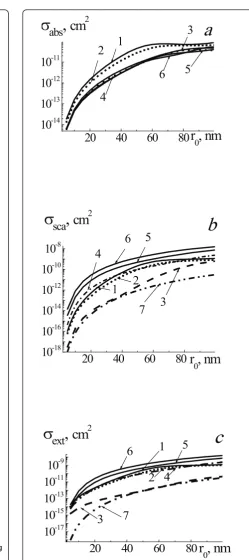
Figure 1 presents efficiency cross sections of absorp-tion sabs, scattering ssca, and extinctionsext of laser radiation with wavelength 532 nm by two-layered sphe-rical system gold NP core and water vapor shell, placed in water for the range of NP radiir0= 5 to 100 nm and radii of systemr1= r0 (pure gold NP),r1= r0 +0.1r0,r1 = r0 +1r0,r1= r0 +2r0,r1= r0 +3r0, andr1 = r0+4r0, and for homogeneous vapor bubble with radius r0 = 5 to 100 nm. Increasing of vapor shell thickness leads to substantial monotonous decreasing ofsabs from two to eight times for all range of 5 <r0 < 100 nm and for the interval of shell vapor thicknesses Δr1 <r0, Δr1 =r1-r0. Further increasing of vapor shell thickness weakly influ-ences the sabs. It means that the absorbance of laser radiation by the NP is sharply decreased at formation of thin shielded vapor shell and then it is weakly changed for thick shells. Cross section of absorption sabs for pure vapor bubble is much smaller thansabsfor system NP-shell and does not present at Figures 1 and 2.
0
20
40
60
80
10
-1310
-1210
-1110
-10V
abs,
cm
2r
0,
nm
1 2 3
4,5,6
a
20
40
60
80
10
-1610
-1410
-1210
-1010
-8V
sca,
cm
2r
0, nm
1
2
3
5
b
7
4
6
20 40 60 80
10-18 10-16 10-14 10-12 10-10 10-8
V
ext,
cm
2r
0,
nm
1
2
3
4
5 6
c
[image:3.595.282.532.80.642.2]7
Figure 1Efficiency cross sections of absorptionsabs, scattering
ssca, and extinctionsextof laser radiation. Efficiency cross
sections of absorptionsabs(a), scatteringssca(b), and extinction sext(c) of laser radiation with wavelength 532 nm by two-layered
spherical system gold NP core and water vapor shell placed in water for the range of NP radiir0= 5 to 100 nm and radii of system r1= r0(1, pure gold NP, straight line)r1= r0+0.1r0(2, dotted line), r1= r0+1r0(3, dashed line),r1= r0+ 2r0(4, dashed-dotted line),r1 = r0+3r0(5, straight line), andr1= r0+4r0(6, straight line), and for
homogeneous vapor bubble withr0(7, dashed-double dotted line).
20
40
60
80
10
-1410
-1310
-1210
-11r
0, nm
V
abs
,
cm
21
2
3
4
5
a
6
20
40
60
80
10
-1810
-1610
-1410
-1210
-1010
-8V
sca
,
cm
2r
0, nm
1
2
3
5
6
4
7
b
20
40
60
80
10
-1710
-1510
-1310
-1110
-9V
ext
,
cm
2r
0, nm
1
2
3
c
4
5
[image:3.595.65.337.87.622.2]7
6
Figure 2Efficiency cross sections ofsabs(a),ssca(b), andsext
(c) of laser radiation. With wavelength 633 nm by two-layered spherical system gold NP-core, water vapor-shell placed in water for the range of NP radiir0= 5 to 100 nm, and radii of systemr1= r0
(1, pure gold NP, straight line),r1= r0+0.1r0(2, dotted line),r1= r0 +1r0(3, dashed line),r1= r0+2r0(4, dashed-dotted line),r1= r0+
3r0(5, straight line), andr1= r0+4r0(6, straight line), and for
vastly larger than r0 (Δr1 ≈ 4r0), values of ssca grow from 10 to 50 times for all values of r0 in comparison with initial value ssca for pure NP. As to sext, the dependences of the extinction of laser radiation of such system NP core-water vapor shell onr0 and vapor shell thickness Δr1 resemble that in the case of scattering. Values ofsextdecrease for all values ofr0 in the interval of vapor shell thicknesses Δr1 ≤ r0 and then grow at first for large values of core radii and thereafter in all intervals of the core sizes. We see nonlinear dependence ofsscaand sext on vapor shell thickness during bubble formation, and increase ofΔr1till Δr1≤ r0 leads to sig-nificant decrease ofssca andsext. Following increase of Δr1 > r0leads to increase ofsscaand sext.
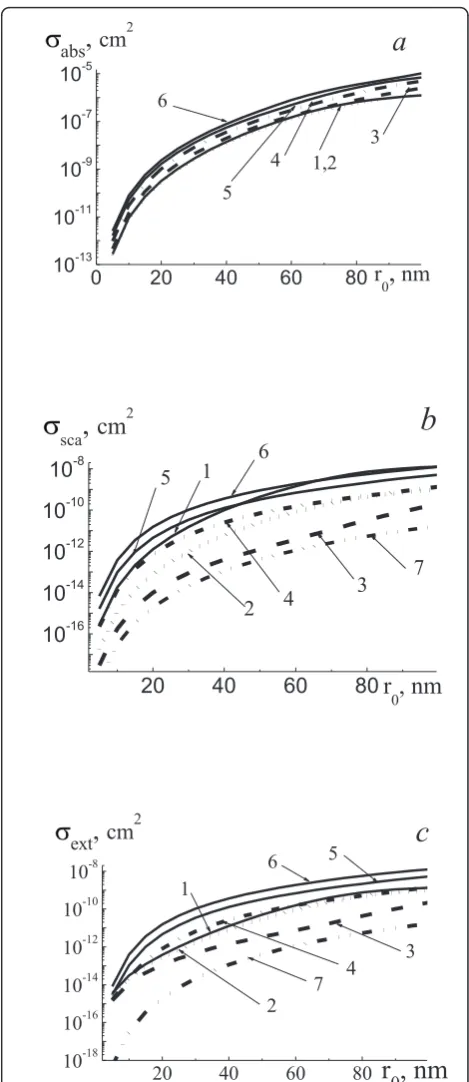
Figure 2 presents efficiency cross sections of absorp-tion sabs, scattering ssca, and extinction sextof probe laser radiation with wavelength 633 nm by two-layered spherical system gold NP core and water vapor shell for the range of NP radii r0 = 5 to 100 nm and different radii of system and for homogeneous vapor bubble with r0. Influence of vapor shell thickness on thermo-optical properties of system NP-vapor shell for probe radiation with wavelength 633 nm is analogical one as for the case of laser radiation with wavelength 532 nm. It is especially extended to the cross sections of absorption
sabsof considered NPs. In the case of the cross sections of scattering and extinction character of dependences
ssca(r0) andsext(r0) for different values of Δr1 are simi-lar. Furthermore, when increasingΔr1(Δr1≈ 4r0), values ofsscagrow from 100 to 10 times in the dependence on the r0. Notice that the scattering and extinction cross sections of homogeneous water vapor bubbles of differ-ent sizes in water are very small and is 2-3 orders less than for pure gold and two-layered system NP-vapor shell (line 7, Figures 1 and 2).
[image:4.595.304.539.86.628.2]It is well known that the formation of vapor bubble in liquid leads to significant increasing of radiation scatter-ing, and extinction by bubble and bubble itself can be visible [16,32]. Nonlinear behavior mentioned above (decreasing of sabs, ssca, andsext during increasing of Δr1 tillΔr1 ≤ r0) leads to bleaching of medium during initial stage of vapor shell expansion. This behavior exists for different values ofm1.
Figure 3 presents efficiency cross sections of absorp-tion sabs, scattering ssca, and extinctionsext of laser radiation with wavelength 780 nm by two-layered sphe-rical system gold NP core and water vapor shell with refractive index of vaporm1 = 1,001-i0. The increase of vapor shell thickness tillΔr1 <r0 for l= 780 nm leads to insignificant decrease of efficiency cross sections of absorptionsabs(10% ÷ 15%), and then, at increase in a shell thickness to five times, absorption grows almost in 10 times (Figure 3a). In the case of scattering and extinction of NPs (Figure 3b,c), the dependencies ofssca
0 20 40 60 80 10-13
10-11 10-9 10-7 10-5
r
0,
nm
a
abs
,
cm
2
1,2 3 4
5 6
20
40
60
80
10
-1610
-1410
-1210
-1010
-8sca
,
cm
2
r
0, nm
1
2
3
5
b
7
4
6
20 40 60 80
10-18 10-16 10-14 10-12 10-10 10-8
ext
,
cm
2
r
0, nm
1
2
3 4 5 6
c
7
Figure 3Efficiency cross sectionssabs(a),ssca(b), andsext(c)
of laser radiation. With wavelength 780 nm by two-layered spherical system gold NP core and water vapor shell with refractive index of vaporm1=1.001-i0 placed in water for the range of NP
radiir0= 5 to 100 nm and radii of systemr1= r0(1, pure gold NP,
straight line),r1= r0+0.1r0(2, dotted line),r1= r0+1r0(3, dashed
line),r1= r0+ 2r0(4, dashed-dotted line),r1= r0+3r0(5, straight
line), andr1= r0+4r0(6, straight line), and for homogeneous vapor
(r0) andsext(r0) for wavelength 780 nm are similar as for other considered wavelengths.
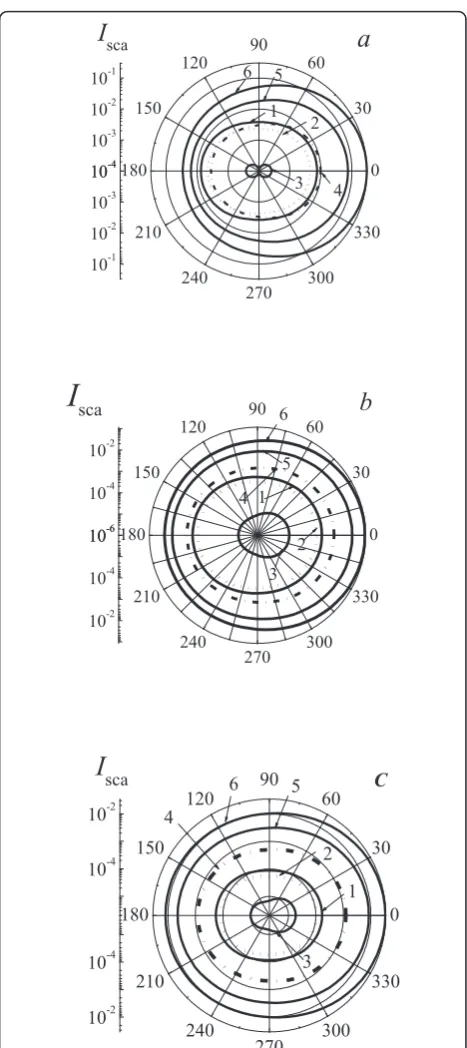
Figure 4 presents angular distributions (optical indica-trixes) of radiation intensity Iscawith wavelengths l= 532, 633, and 780 nm scattered by two-layered spherical system gold NP core and water vapor shell for the NP radius r0 = 20 nm and different radii of systemr1. The increase of vapor shell thickness till Δr1 ≤ r0 for l = 532, 633, and 780 nm leads to decrease of scattered radiation intensity in approximately 50 ÷ 300 times in all scattered directions. Only at Δr1 ≈ 2r0 scattering intensity is approximately equal initial distribution of scattered radiation from pure NP. Then, further growth of vapor shell thickness tends to essential increase of scattered radiation intensity (in 20 ÷ 100 times for Δr1 = 4r0) in comparison to the case of pure Au NP. This fact is well correlated with the behavior of ssca(Figures 1 and 2). With growth of Δr1, optical indicatrixes become essentially extended in the forward direction (angle 0°). We have to note that mathematical modeling of optical indicatrixes of scattered radiation was inde-pendently carried out on the base of optical constants without use of calculated values ofssca. This behavior of indicatrixes of scattered radiation is additional evidence of nonlinear (decreasing and increasing) properties of system NP core and vapor shell during initial stages of bubble expansion tillr1≤2r0.
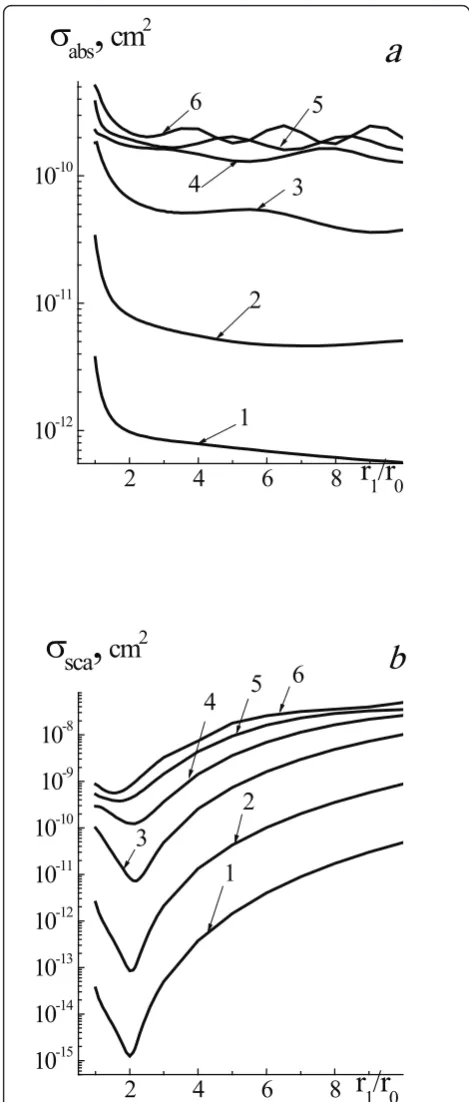
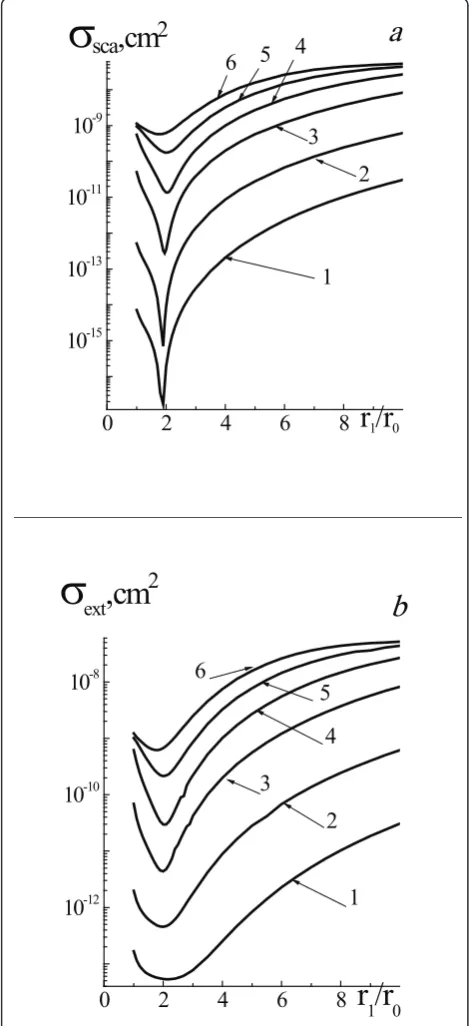
Figure 5 presents cross sections sabs andssca of laser radiation with wavelength 532 nm by two-layered sphe-rical system gold NP core and water vapor shell for the radiir0 = 10, 20, 40, 60, 80, and 100 nm as a function of the radii relationsr1/r0 in the interval of radiir1 = (1 to 10)r0. As shown in Figure 4a, absorption cross sec-tionssabs are decreased for all range of 1 <r1/r0 < 10 and for the interval of core radii 10 nm≤ r0 ≤100 nm. At first, this decrease is reasonably sharp from two to four times, and then after achievement of valueΔr1 ≤r0, sabs slowly reduces. It is determined by the shielded effect of vapor shell when irradiation cannot reach the absorbing core. The growth of the core radii results in essential increase of absorption cross sectionssabsas long asr0 ≤60 nm. For r0 ≤60 nm, the dependence of sabs(r0) becomes oscillating and undergoes less effect of core radius. Scattering cross sections of ssca are also lowered in the interval of 1 <r1/r0< 2 (Figure 4b). Then, sscais sharply increased in the intervalr1/r0 = 2 to 10. Scattering cross section sscais decreased up to one to two orders of magnitude depending onr0, for example, forr0 = 20 nm is decreased fromssca = 2.5 × 10⁻¹²cm2 (r1/r0 = 1) tossca= 8.5 × 10⁻¹⁴cm2 (r1/r0 = 2) forl= 532 nm. After achievement of minimal value, ssca increases and at r1 = (2 to 3.5) r0 cross section ssca achieves initial value ofssca(r1 =r0). It means that the scattering property of system NP-vapor shell is equal
0 30 60 90 120
150
180
210
240
270 300
330
10-4
10-3
10-2
10-1
10-4
10-3
10-2
10-1
I
sca1 2
3 4
5 6
a
0 30 60 90 120
150
180
210
240
270 300
330
10-6
10-4
10-2
10-6
10-4
10-2
I
sca1
2 3 4
5
6
b
0 30 60 90 120
150
180
210
240
270 300 330 10-4
10-2
10-4
10-2
I
sca1 2
3 4
5
6 C
Figure 4Angular distributions (optical indicatrixes) of radiation intensityIsca. With wavelength 532 nm (a), 633 nm (b), and 780 (c)
nm scattered by two-layered spherical system gold NP core and water vapor shell placed in water for the NP radiusr0= 20 nm and
radii of systemr1= r0(1, pure gold NP, straight line),r1= r0+0.1r0
(2, dotted line),r1= r0+1r0(3, straight line),r1= r0+2r0(4,
dashed-dotted line),r1= r0+3r0(5, straight line),r1= r0+4r0(6,
straight line). Direction of laser radiation propagation is from left to right (from 180° to 0°). Polar coordinates show angles for scattered radiation in the range 0° to 360°; scaleIscashows arbitrary units of
initial value ofsscafor pure NP at this value ofr1. After this moment, the increase of r1/r0 leads to growth of ssca up to values two to four orders of magnitude greater than initial values of this one. This effect is due to the complicated two-layered spherical system, and the fact that the growth of vapor shell leads to change of median complex refractive index of two-layered NP: the real part of the complex refractive index increases and the imaginary part is decreased. Therefore, at first, the scattering cross sections of NPs fall and then begin to grow when expanding the vapor shell thickness and value ofr1/r0 increases.
Figure 6 shows the scatteringssca and extinctionsext cross sections of probe laser radiation with wavelength 633 nm by two-layered spherical system gold NP core and water vapor shell for the radii r0 = 10, 20, 40, 60, 80, and 100 nm as a function of the radii relationsr1/r0 in the interval of radii r1 = (1 to 10) r0. Influence of vapor shell thickness on scattering properties of system NP-vapor shell for probe radiation with wavelength 633 nm is analogical as for the laser radiation with wave-length 532 nm. Character of dependences ssca(r0) and sext(r0) for different values ofr0 are similar. Extinction cross section sext is decreased from 2 to 20 times depending on r0, for example, for r0 = 40 nm is decreased fromsext= 6.2 × 10⁻¹⁰cm2(r1/r0 = 1) tosext = 3 × 10-11cm2 (r1/r0 = 2) forl= 633 nm.
Conclusions
We found the general trends of nonlinear behavior of NP-vapor shell system-decrease of absorption and decrease and subsequent increase of scattering and extinction with increasing of shell radius, beginning from the initial period of shell expansion. Vapor shell formation can produce one to two orders of magnitude of decreasing of scattered radiation during initial stage of shell expansion till radiusr1 ≤2r0. The amplification of scattering intensity is mainly due to increasing of shell radiusr1 >2r0.
Such behavior of thermo-optical properties of spheri-cal system gold NP core and water vapor shell depend-ing of shell thicknessΔr1, NP radiusr0, wavelength, and optical properties of vapor (pressure and temperature of vapor) can open new options for optical detection of the moment of vapor shell formation and investigation of the initial stage of its dynamics with small thickness of vapor shell.
Different situations can be realized. Optical detection of single NP is usually realized by irradiation of probe laser radiation and optical detection of scattered radia-tion and extincradia-tion by NP. Suppose that single NP can
2
4
6
8
10
-1210
-1110
-10a
V
abs
,
cm
2r
1/r
01
2
3
4
5
6
2
4
6
8
10
-1510
-1410
-1310
-1210
-1110
-1010
-910
-8V
sca
,
cm
2r
1/r
0b
1
2
3
[image:6.595.55.290.87.639.2]4
5
6
Figure 5Efficiency cross sectionssabs(a) andssca(b) of laser
radiation. With wavelength 532 nm by two-layered spherical system gold NP core and water vapor shell for the radiir0= 10 nm
be visualized using of probe radiation without laser pump irradiation and vapor shell formation, it means that optical scattering of radiation by pure single NP is enough to be detected. After laser pump irradiation and shell formation and during initial stage of shell dynamics
withΔr1≤r0, intensity of scattered radiation by system NP-shell will be decreased (see Figures 1, 2, 3 and 4), and this system could not be visualized. Only after substantial increasing of Δr1up toΔr1≈ (2 to 3)r0and more and increasing of intensity of scattered radiation by system NP-shell it will be possible to visualize this system.
Optical detection of system of NPs in some medium is based on the detection of transmitted radiation through this dispersed medium. The formation of vapor shells with small thicknesses on NPs under pump laser irradia-tion leads to substantial decreasing of sext for probe radiation 633 nm (see Figures 1, 2, and 3). It means that the moment of initial formation of nanoshells around NPs can be detected by increasing of transmitted probe radiation intensity. Then, after substantial increasing of Δr1>r0up to Δr1 ≈(2 to 5) r0 transmitted probe inten-sity will be decreased.
Applications of laser-induced vapor nanoshells are proposed for selective tissue damage on the cellular level, anticancer therapy, when selective destruction of cells containing NPs can be triggered due to these ones [3-8]. Vapor nanoshells formed around laser-heated NPs can serve as contrast agents in optical diagnostics and optoacoustic tomography, etc. Vapor bubble formation around NPs and its expansion can be used for optical limiting and switching in suspensions.
The significant decrease of radiation scattering and extinction by system of nanoparticle-vapor shell can be used for experimental detection of the energy threshold of bubble formation and investigation of the first stages of its expansion.
Methods
We used modified Mie theory developed for two-layer spherical system particle-shell [33,32,34,35] to model absorption, scattering, and extinction of pumpl = 532 and 780 nm and probel= 633 nm radiations by spheri-cal system of gold NP core and water vapor shell. The expressions for the optical characteristics of two-layered sphere (efficiency cross sections of absorption, scatter-ing, and extinction) are presented in terms of the ampli-tude coefficients given by the theory of diffraction of electromagnetic radiation on two-layered spherical parti-cle [33,32,34,35].
Abbreviations NPs: nanoparticles.
Author details
1Belarusian National Technical University, Independence pr. 65, Minsk,
220013, Belarus2B.I. Stepanov Institute of Physics, National Academy of
Sciences of Belarus, Independence pr. 68, 220072, Minsk, Belarus
Authors’contributions
VKP and LGA carried out all investigations together. All authors read and approved the final manuscript.
0
2
4
6
8
10
-1510
-1310
-1110
-9V
sca
,cm
2
r
1/r
01
2
3
4
5
6
a
0
2
4
6
8
10
-1210
-1010
-8V
ext,cm
2
r
1/r
01
2
3
4
5
6
[image:7.595.56.291.91.605.2]b
Figure 6Efficiency cross sectionsssca(a) andsext(b) of laser
radiation. With wavelength 633 nm by two-layered spherical system gold NP core and water vapor shell for the radiir0= 10 nm
Authors’information
VKP is a professor of Belarusian National Technical University, Independence pr. 65, Minsk, 220013, Belarus. LGA is a chief scientist of B.I. Stepanov Institute of Physics, National Academy of Sciences of Belarus, Independence pr. 68, 220072, Minsk, Belarus.
Competing interests
The authors declare that they have no competing interests.
Received: 20 January 2011 Accepted: 12 July 2011 Published: 12 July 2011
References
1. Adleman JR, Boyd DA, Goodwin DG, Psaltis D:Heterogeneous catalysis mediated by plasmon heating.Nano Lett2009,9:4417-4420. 2. Narayanan R, El-Sayed MA:Some aspects of colloidal nanoparticle
stability, catalytic activity, and recycling potential.Topics in Catalysis2008, 47:15-23.
3. Halas N:The photonic nanomedicine revolution: let the human side of nanotechnology emerge.Nanomedicine2009,4:369-375.
4. Liu Z, Hung W, Aykol M, Valley D, Cronin S:Optical manipulation of plasmonic nanoparticles, bubble formation and patterning of SERS aggregates.Nanotechnology2010,21:105304, (5 pp).
5. Huang X, Jain P, El-Sayed MA:Plasmonic photothermal therapy (PPTT) using gold nanoparticles.Lasers Med Sci2008,23:217-221.
6. Jain P, Lee K, El-Sayed I, El-Sayed M:Calculated absorption and scattering properties of gold nanoparticles of different size, shape and
composition: applications in biological imaging and biomedicine.J Phys Chem B2006,110:7238-7243.
7. Kim JW, Shashkov E, Galanzha E, Kotarigi V, Zharov V:Photothermal antimicrobial nanotherapy and nanoidiagnostics with self-assembling carbon nanotube clusters.Lasers Surg Med2007,39:622-629. 8. Pustovalov VK, Smetannikov AS, Zharov VP:Photothermal and
accompanied phenomena of selective nanophotothermolysis with gold nanoparticles and laser pulses.Laser Phys Lett2008,5:775-792. 9. Muto H, Miajima K, Mafune F:Mechanism of laser-induced size reduction
of gold nanoparticles as studied by laser pulse excitation.J Phys Chem C
2008,112:5810-5815.
10. Hu M, Petrova H, Chen J, McLellan JM, Siekkinen AR, Marquez M, Li X, Xia Y, Hartland GV:Ultrafast laser studies of the photothermal properties of gold nanocages.J Phys Chem B Lett2006,110:1520-1524.
11. Watanabe M, Takamura H, Sugai H:Preparation of ultrafine Fe-Pt alloy and Au nanoparticle colloids by KrF excimer laser solution photolysis.
Nanoscale Res Lett2009,4:565-571.
12. Xiao X, Lu J, Li Y:LiMn2O4microspheres: synthesis, characterization and
use as a cathode in lithium ion batteries.Nano Res2010,3:733-737. 13. Stalmashonak A, Podlipensky A, Seifert G, Graener H:Intensity driven laser
induced transformation of Ag nanospheres to anisotropic shapes.Appl Phys B2009,94:459-465.
14. Wang L, Zhao W, Tan W:Bioconjugated silica nanoparticles: development and applications.Nano Res2008,1:99-115.
15. Khan S, Yuan Y, Abdolvand A, Schmidt M, Crouse P, Li L, Liu Z, Sharp N, Watkins KJ:Generation and characterization of NiO nanoparticles by continuous wave fiber laser ablation in liquid.Nanopart Res2009, 11:1421-1427.
16. Bohren CF, Huffman DR:Absorption and Scattering of Light by Small Particles.New York: Wiley; 1983.
17. Zharov VP, Lapotko DO:Photothermal imaging of nanoparticles and cells.
Sel Top Quant Electron2005,11:733-751.
18. Zharov VP, Letfullin RR, Galitovskaya EN:Microbubbles-overlapping mode for laser killing of cancer cells with absorbing nanoparticle clusters.J Phys D Appl Phys2005,38:2571-2581.
19. Akchurin G, Khlebtsov B, Tuchin V, Zharov V, Khlebtsov N:Gold nanoshell photomodification under a single-nanosecond laser pulse accompanied by color-shifting and bubble formation phenomena.Nanotechnology
2008,18:015701.
20. Kotaidis V, Plech A:Cavitation dynamics on the nanoscale.Appl Phys Lett
2005,87:213102.
21. Kotaidis V, Dahmen C, von Plessen G, Springer F, Plech A:Excitation of nanoscale vapor bubbles at the surface of gold nanoparticles.J Chem Phys2006,124:184702.
22. Neumann J, Brinkmann R:Boiling nucleation on melanosomes and microbeads transiently heated by nanosecond and microsecond laser pulses.J Biomed Opt2005,10:024001.
23. Neumann J, Brinkmann R:Self-limited growth of laser-induced vapor bubbles around single microabsorbers.Appl Phys Lett2008,93:033901. 24. Lapotko D:Pulsed photothermal heating of the media during bubble generation around gold nanoparticles.Int J Heat Mass Transfer2009, 52:1540-1543.
25. Lapotko D:Optical excitation and detection of vapor bubbles around plasmonic nanoparticles.Optics Express2009,17:2538-2556.
26. Lukianova-Hleb E, Hanna E, Hafner J, Lapotko D:Tunable plasmonic nanobubbles for cell theranostics.Nanotechnology2010,21:085102. 27. Scripov VP:Metastable liquids.Berlin: Wiley; 1974.
28. Thormahlen I, Straub J, Grigull U:Refractive index of water and its dependence on wavelength, temperature and density.J Phys Chem Ref Data1985,14:933-945.
29. Kokhanovsky A:Optical properties of bubbles.J Opt A Pure Appl Opt2003, 5:47-53.
30. Johnson PB, Christy RW:Optical constants of the noble metals.Phys Rev B
1972,6:4370-4379.
31. Zuev VE:Propagation of visible and infrared waves in atmosphere. Moscow: Sov. Radio; 1970.
32. Babenko VA, Astafyeva LG, Kuzmin VN:Electromagnetic Scattering in Disperse Media.Berlin-Chichester: Springer-Praxis; 2003.
33. Kattawar GW, Hood DA:Electromagnetic scattering from a spherical polydispersion of a coated spheres.Appl Opt1976,15:1996-1999. 34. Bhandari R:Scattering coefficients for a multilayered sphere: analytic
expressions and algorithms.Appl Opt1985,24:1960-1967. 35. Pustovalov V, Astafyeva L, Jean B:Computer modeling of the optical
properties and heating of spherical gold and silica-gold nanoparticles for laser combined imaging and photothermal treatment.
Nanotechnology2009,20:225105.
doi:10.1186/1556-276X-6-448
Cite this article as:Pustovalov and Astafyeva:Nonlinear thermo-optical properties of two-layered spherical system of gold nanoparticle core and water vapor shell during initial stage of shell expansion.Nanoscale Research Letters20116:448.
Submit your manuscript to a
journal and benefi t from:
7Convenient online submission
7Rigorous peer review
7Immediate publication on acceptance
7Open access: articles freely available online
7High visibility within the fi eld
7Retaining the copyright to your article