BIROn - Birkbeck Institutional Research Online
Longo, Matthew R. (2017) Distorted body representations and skilled action.
In: Grünbaum, T. and Christensen, M.S. (eds.) Sensation of Movement.
Current Issues in Consciousness Research.
Abingdon, UK: Routledge.
ISBN 9781138646339. (In Press)
Downloaded from:
Usage Guidelines:
Please refer to usage guidelines at or alternatively
Distorted body representations and skilled action
Matthew R. Longo
Department of Psychological Sciences, Birkbeck, University of London
Address correspondence to:
Matthew R. Longo
Department of Psychological Sciences
Birkbeck, University of London
Malet Street, London WC1E 7HX
United Kingdom
Abstract
Several aspects of somatosensory perception require that immediate sensory signals be
integrated with stored representations of body size and shape. Recent research has
revealed that both tactile size perception and position sense rely on highly distorted
representations of the body. The presence of such distortions raises a fundamental
problem. The lack of proprioceptive afferent information is known to cause devastating
impairments in skilled action, suggesting that position sense plays a critical role in
skilled action. How then can the obvious fact of skilled action co-exist with distorted
representations of the body? In this chapter I will review research on distorted body
representations underlying position sense and discuss several ways in which such
distortions might be reconciled with dexterous action. I will end with some speculations
Action necessarily involves a change in the location of body parts, and awareness
of action is in large part an awareness of this change. Perceiving the location of body
parts in external space requires that immediate sensory signals be combined with
stored representations of body size and shape. Recent studies have found that these
representations are highly distorted, at least in the specific case of the hand. This raises
the question how skilled action can co-exist with distorted body representations
underlying position sense. In this chapter I will discuss research investigating body
representations underlying position sense and describe several ways in which the
existence of such distortions might be reconciled with the clear fact of dexterous action.
I will finish with a brief discussion of the implications of this research for motor
awareness.
Distorted body representations underlying position sense
Several classes of sensory signals provide information used for position sense.
Receptors in joints themselves signal flexion or extension, receptors in the skin signal
the extent to which the skin is stretched, and receptors is muscle spindles signal
muscular contraction or lengthening (for review see Proske & Gandevia, 2012). These
signals, along with efferent copies of motor commands provide information about the
overall postural configuration of the body (Burgess, Wei, Clark, & Simon, 1982). It is
critical to note, however, that all of these signals provide information about the angles
of the different joints, that is the relative degree of flexion or extension at each joint. No
signal – or combination of signals – provides direct information about the absolute
location of body parts in external space.
The location of body parts is, thus, not specified by anything resembling a global
“dead reckoning”, in which the location of a body part is specified by the combination of
the direction each joint is oriented with information about the distance between each
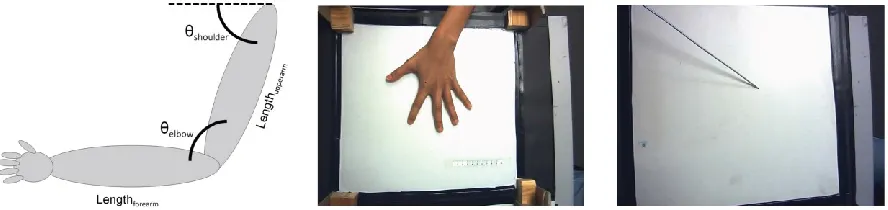
adjacent pair of joints. This situation is depicted in the left panel of Figure 1. To perceive
the location of a distal body part such as the wrist relative to the shoulder, information
about the angles of the shoulder and elbow joints (θshoulder and θelbow) needs to be
integrated with information about the lengths of the upper arm and forearm
(Lengthupperarm and Lengthforearm) connecting the joints together. While the angles are
specified by immediate sensory signals, the lengths are not, and thus must come from
stored representations of body size and shape. It is, of course, not mysterious where
such representations might come from, given the constant presence of the body in our
visual field and our lifetime of experience with it. The point is simply that position sense
requires that immediate sensory signals be integrated with stored representations of
[image:5.595.76.520.439.544.2]body size and shape, what Longo, Azañón, and Haggard (2010) called a body model.
Figure 1: Left panel: Schematic illustration of the need for a body model in position sense. Perceiving the position of the wrist relative to the shoulder requires information not only about joint angles (θshoulder and θelbow) but also about the length of the upper and forearm (Lengthupperarm and Lengthforearm). While
information about joint angles is specified by immediate proprioceptive signals, information about body part length is not, suggesting it must come from a stored body model. Centre and right panels: The paradigm of Longo and Haggard (2010) for measuring the body model. The participant lays their hand flat on the table (centre) and uses a long baton to indicate the perceived location of landmarks on their hand on an occluding board (right). Responses are captured by an overhead camera. The size and shape of the body model can be assessed by investigating the internal configuration of localizations of multiple landmarks, without regard to differences in actual and perceived location
The need for something like a body model for position sense has been identified
1984; Gurfinkel & Levick, 1991; Soechting, 1982; van Beers, Sittig, & Denier van der
Gon, 1998), but it has generally been assumed that such information is readily available
and unproblematic. This assumption seems reasonable for several reasons. First, while
the size and proportions of the body may change over developmental time scales, on a
day-to-day basis the body is largely constant. Second, the body is ubiquitous in
perceptual experience, and indeed is probably the most familiar object we perceive.
Finally, as discussed in more detail below, lack of accurate information about the body
would seem to pose fundamental problems for skilled action. Nevertheless, Gurfinkel
and Levick (1991) reported intriguing anecdotal evidence suggesting that position
sense may, nevertheless rely on a distorted body model. They asked participants to
localize two parts of their arm in external space, finding that the distance between the
judged locations was less than the true distance between those parts.
Longo and Haggard (2010) developed a task to measure the body model
underlying position sense in the case of the hand. The participant places their hand
palm-down on a table underneath an occluding board. The participant is then asked to
localize different parts of their hand by placing the tip of a long baton on the place on
the board directly above where it feels like each part is located. This paradigm is shown
in the right two panels of Figure 1. Across trials, participants localized 10 landmarks,
the tip and the knuckle of each finger. Previous studies of position sense have generally
focused on the so-called ‘error of localisation’, the different between the true location of
a landmark and the participant’s judgment. By obtaining localization judgments for
multiple landmarks, however, this paradigm takes a fundamentally different approach
and investigates the internal configuration of judged locations for the different
allowed Longo and Haggard (2010) to construct perceptual maps of the representation
of hand size and shape.
The resulting perceptual maps from 18 participants in Experiment 1 from Longo
and Haggard (2010) is shown in Figure 2. The perceptual maps (in black) from each
participant were placed in mutual alignment using a statistical method called
Procrustes alignment (Rholf & Slice, 1990), which superimposes each map, removing
differences in location, rotation, and size. This allows a grand-average perceptual map
to be constructed, as depicted by the black lines. For comparison, an analogous map was
constructed for the actual configuration of participants’ hands, depicted by the grey
lines. Remarkably, the perceptual maps were highly distorted, and in a consistent
manner from person to person. Specifically, there were three clear patterns of
distortion: (1) overestimation of hand width (i.e., the distance between pairs of
knuckles); (2) underestimation of finger length (i.e., the distance between the knuckle
and tip of each finger); and (3) a radial-ulnar gradient, with underestimation of finger
[image:7.595.78.293.526.720.2]length increasing from the thumb to the little finger.
into best-fitting alignment. The black dots show the judged locations of each landmark. Again, maps from different participants were placed into best-fitting Procrustes alignment. The warped grid shows how a perfectly square grid superimposed onto actual hand shape would have to be deformed to transform actual hand shape into represented hand shape, using a thin-plate spline.
These distortions bear intriguing similarities to known distortions of the
somatosensory system. For example, the overestimation of hand width compared to
length mirrors anisotropies found in the geometry of the receptive fields of individual
neurons in the spinal cord and primary somatosensory cortex which are generally
shaped like ovals elongated along the proximo-distal limb axis (Alloway, Rosenthal, &
Burton, 1989; Brooks, Rudomin, & Slayman, 1961; Brown, Fuchs, & Tapper, 1975).
Similarly, the perceived distance between two touches is bigger when the touches are
oriented across the width of the hand than along it’s length (Green, 1982; Longo &
Haggard, 2011; Le Cornu Knight, Longo, & Bremner, 2014; Miller, Longo, & Saygin,
2014). On the glabrous skin of the palm, receptive fields of somatosensory neurons tend
to be more circular than on the hand dorsum (DiCarlo & Johnson, 2002; DiCarlo,
Johnson, & Hsiao, 1998). Correspondingly, there is also a reduction in the anisotropy of
perceived tactile distance on the palm (Longo & Haggard, 2011; Longo, Ghosh, & Yahya,
2015a) and in the distortions of perceptual maps of position sense (Longo & Haggard,
2012a). Thus, there appears to be a mutual inter-relation between the geometry of
receptive fields in somatosensory cortex, the perceived metric properties of touch, and
the body model underlying position sense.
Subsequent studies have replicated this basic pattern of distortion in the body
model under a wide variety of conditions (Ferrè, Vagnoni, & Haggard, 2013; Longo,
2014, 2015b; Longo & Haggard 2012a, 2012b; Longo, Long, & Haggard, 2012; Longo,
Mancini, & Haggard, 2015b; Lopez, Schreyer, Preuss, & Mast, 2012; Mattioni & Longo,
distortions are found for both the right and left hands (Longo & Haggard, 2010), with
the hand in various postures (Longo, 2015; Longo & Haggard, 2012), with the presence
or absence of visual input (Longo, 2014), when participants localize touch rather than
verbally-specified landmarks (Longo et al., 2015b; Mattioni & Longo, 2014), and even to
an extent for non-hand objects (Saulton et al., 2015). Two recent studies, however, have
found that the magnitude of distortions is clearly reduced when participants localize
landmarks on a seen rubber hand based on visual memory (Longo et al., 2015c; Saulton
et al., 2016).
Longo and Haggard (2010) argued that this distorted body model underlying
position sense is distinct from the conscious body image. In addition to the localization
task described above, they obtained measures of the body image of the hand using a
‘template matching’ procedure (Gandevia & Phegan, 1999). Participants were shown an
array of images of left hands that had been stretched to have different shapes, some
being very long and slender, and others highly squat and fat. They chose from the set of
images the one most similar in shape to the perceived shape of their own left hand. No
sign of distortions like those found with the localization task was apparent for the body
image, however, a result consistent with several subsequent studies (e.g., Longo, 2015c;
Longo & Haggard, 2012b). On the basis of this dissociation, Longo and Haggard (2010)
claimed that position sense relies on an implicit representation of the body, which while
massively distorted remains inaccessible to conscious introspection. Subsequent
research has suggested that some types of body image judgments may show some
evidence of similar distortions (Longo & Haggard, 2012b), and aspects of the distortions
such as the overall underestimation of finger length may reflect conceptual
misunderstanding of where the knuckles are located in the hand (Longo, 2015d; Longo
How can distorted body representations coexist with skilled action?
The results presented in the previous section provide clear evidence the position
sense relies on a massively distorted representation of body size and shape, at least in
the case of the hand. This begs the question of how our obvious ability to act
dexterously can co-exist with such distortions. A first approach to this question might
suggest that proprioception simply isn’t of critical importance for action. This view,
however, is dramatically contradicted by cases in which people have lost
proprioception, which results in massive impairments in skilled action (Cole & Paillard,
1995; Rothwell et al., 1982). For example, consider the case of patient I.W., described
vividly by the neurologist Jonathan Cole (1995) in his book Pride and a Daily Marathon.
At the age of 19, I.W. suffered a near total loss of sensory fibers below the neck
following an auto-immune reaction, leaving him with a complete loss of tactile and
proprioceptive signals from the body. Critically, however, efferent signals carrying
motor information to the body were not affected. If position sense (and touch) were not
critical for skilled action, then I.W. should have had only modest, if any, motor
difficulties. In fact, I.W. was profoundly impaired in his ability to act. In the immediate
period following his deafferentation, I.W. was unable to sit up, stand, walk, pick up or
hold object manually, or even to feed himself. Over a period of years, I.W. taught himself
how to control his actions, learning again to walk, to perform household activities, and
even to drive a car, a story movingly told by Cole (1995).
From the current perspective, however, the critical point is that I.W. learned how
to perform these actions in an entirely different way than neurologically intact people.
Actions which are effortless to most people, such as walking, require intense
the loss of position sense, but his story nevertheless dramatically emphasizes the
critical role of proprioception in everyday skilled action. Thus, position sense appears to
be critical for skilled action and also to rely on a highly distorted representation of the
size and shape of the body. This seems to raise a dilemma about how dexterous and
skilled action can exist alongside large distortions, a problem that Wong (in press) has
called ‘the distortion challenge’. In the remainder of this section, I will discuss four ways
in which the distortion challenge might be answered.
First, one might question whether systematic, constant errors are any more
problematic than random, variable errors. The distortions described above might lead
to consistent errors of movement being made in the same direction across multiple
attempts. It is well established, however, quite aside from the issue of distortions that
passive position sense is highly inaccurate, with large trial-to-trial variability. For
example, Tillery, Flanders, and Soechting (1991) asked participants to use a pointer to
judge the perceived location of their hand following a passive movement. Not only were
participants poor at performing this task, but they were highly inconsistent from
trial-to-trial. In terms of the consequences for motor control, it is not obvious why systematic
distortions, which would lead to constant errors, are any more problematic than purely
random variable errors. It is no more problematic to mis-reach consistently to the right
than to miss by an equal amount, but in a random direction on each trial. Indeed,
constant errors could be thought of as less problematic because they can be learned and
correctly with practice, unlike random variable errors. From this perspective, the
problem for skilled action is not distortion per se, but error more generally. This
argument does not, of course, provide any insight into this problem, but simply suggests
that the presence of the distortions described above does not provide any additional
Second, the distortions described above concern only the use of position sense to
perceive the absolute location in space of part of the body. According to the logic of
Longo and Haggard (2010) described above only joint angles are specified by
immediate afferent signals, and a body model is required for using this information to
identify exactly where part of the body is located. But for many uses of proprioception
in motor control information about joint angles may be sufficient. Consider, for
example, the adjustments we make to the distribution of our weight onto our feet as we
stand or walk. One important function of such adjustments is to ensure that weight is
not distributed in such a way that our ankle rolls, which could result in a sprain or
break. For this purpose, knowing the absolute location of the ankle in external space is
irrelevant. What matters instead is that the ankle remain within a safe range of rotation.
The rapid adjustments we make if we accidently step on the edge of a curb show the
sensitivity of the motor system to the rotation of the ankle joint. For this purpose, a
body model is not needed and the distortions described above are irrelevant. It is likely
that many other uses of proprioception in skilled action similarly depend largely or
exclusively on monitoring of joint angles, rather than absolute spatial locations.
Third, some studies have suggested that limb movements may be specified in
terms of the relative tension of agonist and antagonist muscles required to achieve the
desired final position, a model known as ‘final position control’ (e.g., Bizzi, Accornero,
Chapple, & Hogan, 1984; Polit & Bizzi, 1978). This contrasts with the model of motor
control in which a movement is coded as a vector deviation from a perceived starting
position to a desired ending position. The important point about final position control in
the present context is that it does not require that the absolute starting position of the
limb be known. Consider, for example, the experiment of Polit and Bizzi (1978).
to perceive the location of their arms outside of vision, and trained to reach for a light.
Sometimes the lights in the room would be turned off before the monkey reached, so
that they were dependent on their memory of the visually-specified location of their
arm. The critical condition was the case in which the monkey’s arm was displaced after
the lights had gone off, but before the monkey had started their reach. As the monkey
had no way of knowing that it’s arm had moved, movements coded as a vector deviation
from the starting location should have resulted in systematic misreaching by an amount
equal to the unseen displacement. In contrast to this prediction, the monkeys were able
to reach successfully for the light. Thus, despite being completely unaware of the
starting location of the limb, the monkey was nevertheless able to place the limb in the
desired final state. This suggests that the movement had not been coded in terms of its
absolute spatial trajectory, but rather in terms of the relative degrees of flexion and
extension of the pairs of antagonistic muscles controlling limb posture. Thus, to the
extent that skilled action relies on specification of endpoints and does not require
detailed specification of starting locations, then distortions of position sense may pose
relatively modest problems for behaviour. The misperceptions of limb perception due
to the distortions described above are relatively small compared with the
misperceptions of the monkeys in Polit and Bizzi’s (1978) study, which nevertheless did
not impair their ability to successfully reach for desired targets.
Fourth, and finally, one could appeal to the fact that position sense is only one
source of information about limb location among several others, a position advanced by
Wong (2014; in press). For example, efferent copies of motor commands will specify
end points of actions, which then become estimates of current location after completion
of the action. Similarly, tactile cues about contact of the limb with objects and surfaces
provides clear information about body location. The distortions identified by Longo and
Haggard (2010) relied on a laboratory situation which artificially isolated
proprioceptive position sense independent of other cues for limb location. In real-life
situations in which position sense is merely one cue among many for limb location, the
distortions described above may pose relatively modest problems for skilled action.
More generally, no sense is perfect, and multisensory integration of information across
modalities allows the deficiencies of any individual sense to be compensated for by
others.
The so-called ‘distortion challenge’ (Wong, in press) arises from the facts that (a)
body representations underlying position sense are highly distorted (Longo & Haggard,
2010), and (b) that position sense is critically important for skilled action (Cole &
Paillard, 1995). I have discussed four ways in which this apparent discrepancy might be
addressed: (1) by questioning whether distortions are actually more problematic for
motor control than well-established variable errors (Tillery et al., 1991), (2) by
emphasizing that many uses of proprioception require only information about joint
angles rather than absolute location, (3) by highlighting the extent to which motor
commands specify movement endpoints rather than precise spatial trajectories (Polit &
Bizzi, 1978), and (4) by identifying the diverse set of multisensory cues which
complement proprioceptive position sense and may compensate for distortions (Wong,
in press). These interpretations are clearly not mutually exclusive, and all may
contribute to some extent in meeting the distortion challenge and accounting for the
obvious fact of dexterous action despite the clear distortions in the body model
underlying position sense.
I will conclude by discussing some implications of distorted body
representations for understanding the sensation of movement. The first point I wish to
emphasize is the extent to which such distortions are implicit, and outside of conscious
awareness. As discussed above, Longo and Haggard (2010) argued that the distorted
body model they described was distinct from the conscious body image given that no
analogous distortions were found when participants selected the hand most like theirs
from an array of hand images which had been stretched to varying degrees, ranging
from extremely long and slender to extremely squat and fat. Though subsequent studies
have shown that certain aspects of these distortions can be found in attenuated form
with more explicit judgments (e.g., Longo, 2015d; Longo & Haggard, 2012), people are
not generally aware of distortions in their representation of their hand.
That much of the operation of position sense and its role in motor control
operates outside of awareness is also shown by the case of patient I.W. Though he
re-learned to perform many types of actions, this required that he devote constant focus
and attention to the position and orientation of his limbs. Thus, I.W. was forced to rely
on conscious attentional resources to achieve functions which, in the presence of intact
position sense, are accomplished automatically and outside of conscious awareness, as
part of the cognitive unconscious (Kihlstrom, 1987).
So far, I have emphasized the relation of distorted body representations to
unconscious mental processes. It is important, however, to note that while participants
in the study of Longo and Haggard (2010) were not aware of the distorted perceptual
maps which they were producing, they were of course aware of the response they were
making on each trial. Moreover, the judgment was specifically of the felt location of a
given landmark. Thus, the perception of bodily location which the body model is
of the body model itself is not. The distortions of the body model are therefore not
References
Alloway, K. D., Rosenthal, P., & Burton, H. (1989). Quantitative measurement of
receptive field changes during antagonism of GABAergic transmission in primary
somatosensory cortex of cats. Experimental Brain Research, 78, 514-532.
Bizzi, E., Accornero, N., Chapple, W., & Hogan, N. (1984). Posture control and trajectory
formation during arm movement. Journal of Neuroscience, 4, 2738-2744.
Brooks, V. B., Rudomin, P., & Slayman, C. L. (1961). Peripheral receptive fields of
neurons in the cat’s cerebral cortex. Journal of Neurophysiology, 24, 302-325.
Brown, P. B., Fuchs, J. L., & Tapper, D. N. (1975). Parametric studies of dorsal horn
neurons responding to tactile stimuli. Journal of Neurophysiology, 38, 19-25.
Burgess, P. R., Wei, J. Y., Clark, F. J., & Simon, J. (1982). Signaling of kinesthetic
information by peripheral sensory receptors. Annual Review of Neuroscience, 5,
171-187.
Cole, J. (1995). Pride and a daily marathon. Cambridge, MA: MIT Press.
Cole, J., & Paillard, J. (1995). Living without touch and peripheral information about
body position and movement: Studies with deafferented subjects. In J. Bermúdez,
A. Marcel, & N. Eilan (eds.) The Body and The Self (pp. XX-YY). Cambridge, MA:
MIT Press.
Craske, B., Kenny, F. T., & Keith, D. (1984). Modifying an underlying component of
perceived arm length: Adaptation of tactile location induced by spatial
discordance. Journal of Experimental Psychology: Human Perception and
Performance, 10, 307-317.
alert monkey. Behavioural Brain Research, 135, 167-178.
DiCarlo, J. J., Johnson, K. O., & Hsiao, S. S. (1998). Structure of receptive fields in area 3b
of primary somatosensory cortex in the alert monkey. Journal of Neuroscience,
18, 2626-2645.
Ferrè, E. R., Vagnoni, E., & Haggard, P. (2013). Vestibular contributions to bodily
awareness. Neuropsychologia, 51, 1445-1452.
Gandevia, S. C., & Phegan, C. M. (1999). Perceptual distortions of the human body image
produced by local anesthesia, pain and cutaneous stimulation. Journal of
Physiology, 514, 609-616.
Green, B. E. (1982). The perception of distance and location for dual tactile pressures.
Perception and Psychophysics, 31, 315-323.
Gurfinkel, V. S., & Levick, Y. S. (1991). Perceptual and automatic aspects of the postural
body scheme. In J. Paillard (Ed.), Brain and space (pp. 147-162). Oxford: Oxford
University Press.
Kihlstrom, J. F. (1987). The cognitive unconscious. Science, 237, 1445-1452.
Le Cornu Knight, F., Longo, M. R., & Bremner, A. J. (2014). Categorical perception of
tactile distance. Cognition, 131, 254-262.
Longo, M. R., Azañón, E., & Haggard, P. (2010). More than skin deep: Body
representation beyond primary somatosensory cortex. Neuropsychologia, 48,
655-668.
Experimental Brain Research, 232, 1241-1247.
Longo, M. R. (2015a). Implicit and explicit body representations. European Psychologist,
20, 6-15.
Longo, M. R. (2015b). Posture modulates implicit hand maps. Consciousness and
Cognition, 36, 96-102.
Longo, M. R. (2015c). Three-dimensional coherence of the conscious body image.
Quarterly Journal of Experimental Psychology, 68, 1116-1123.
Longo, M. R. (2015d). Intuitive anatomy: Distortions of conceptual knowledge of hand
structure. Cognition, 142, 230-235.
Longo, M. R. (in press). Distorted body representations in healthy cognition. Quarterly
Journal of Experimental Psychology.
Longo, M. R., & Haggard, P. (2010). An implicit body representation underlying human
position sense. Proceedings of the National Academy of Sciences USA, 107,
11727-11732.
Longo, M. R., & Haggard, P. (2011). Weber's illusion and body shape: Anisotropy of
tactile size perception on the hand. Journal of Experimental Psychology: Human
Perception and Performance, 37, 720-726.
Longo, M. R., & Haggard, P. (2012a). A 2.5-D representations of the human hand. Journal
of Experimental Psychology: Human Perception and Performance, 38, 9-13.
Longo, M. R., & Haggard, P. (2012b). Implicit body representations and the conscious
Longo, M. R., Ghosh, A., & Yahya, T. (2015a). Bilateral symmetry of distortions of tactile
size perception. Perception, 44, 1251-1262.
Longo, M. R., Long, C., & Haggard, P. (2012). Mapping the invisible hand: A body model
of a phantom limb. Psychological Science, 23, 740-742.
Longo, M. R., Mancini, F., & Haggard, P. (2015b). Implicit body representations and
tactile spatial remapping. Acta Psychologica, 160, 77-87.
Longo, M. R., Mattioni, S., & Ganea, N. (2015c). Perceptual and conceptual distortions of
implicit hand maps. Frontiers in Human Neuroscience, 9, 656.
Lopez, C., Schreyer, H.-M., Preuss, N., & Mast, F. W. (2012). Vestibular stimulation
modifies the body schema. Neuropsychologia, 50, 1830-1837.
Margolis, A. N., & Longo, M. R. (2015). Visual detail about the body modulates tactile
localisation biases. Experimental Brain Research, 233, 351-358.
Mattioni, S., & Longo, M. R. (2014). The effects of verbal cueing on implicit hand maps.
Acta Psychologica, 153, 60-65.
Miller, L. E., Longo, M. R., & Saygin, A. P. (2014). Tool morphology constrains the effects
of tool use on body representations. Journal of Experimental Psychology: Human
Perception and Performance, 40, 2143-2153.
Polit, A., & Bizzi, E. (1978). Processes controlling arm movements in monkeys. Science,
201, 1235-1237.
body shape, body position and movement, and muscle force. Physiological
Reviews, 92, 1651-1697.
Rohlf, F. J., & Slice, D. E. (1990). Extensions of the Procrustes methods for the optimal
superimposition of landmarks. Systematic Zoology, 39, 40-59.
Rothwell, J. C., Traub, M. M., Day, B. L., Obeso, J. A., Thomas, P. K., & Marsden, C. D.
(1982). Manual motor performance in a deafferented man. Brain, 105, 515-542.
Saulton, A., Dodds, T. J., Bülthoff, H. H., & de la Rosa, S. (2015). Objects exhibit body
model like shape distortions. Experimental Brain Research, 233, 1471-1479.
Saulton, A., Longo, M. R., Wong, H. Y., Bülthoff, H. H., & de la Rosa, S. (2016). The role of
visual similarity and memory in body model distortions. Acta Psychologica, 164,
103-111.
Soechting, J. F. (1982). Does position sense at the elbow reflect a sense of elbow joint
angle or one of limb orientation? Brain Research, 248, 392-395.
Tillery, S. I., Flanders, M., & Soechting, J. F. (1991). A coordinate system for the synthesis
of visual and kinesthetic information. Journal of Neuroscience, 11, 770-778.
van Beers, R. J., Sittig, A. C., Denier van der Gon, J. J. (1998). The precision of
proprioceptive position sense. Experimental Brain Research, 122, 367-377.
Wong, H. Y. (2014). On the multimodality of body perception in action. Journal of
Consciousness Studies, 21, 130-139.
Wong, H. Y. (in press). On proprioception in action: Multimodality versus
Acknowledgments
The author was supported by European Research Council Starter Grant BODYBUILDING