Key issues for implementing knowledge
management in relational contracting
project settings
Bakri, AS, Ingirige, MJB and Amaratunga, RDG
Title
Key issues for implementing knowledge management in relational
contracting project settings
Authors
Bakri, AS, Ingirige, MJB and Amaratunga, RDG
Type
Conference or Workshop Item
URL
This version is available at: http://usir.salford.ac.uk/9766/
Published Date
2010
USIR is a digital collection of the research output of the University of Salford. Where copyright
permits, full text material held in the repository is made freely available online and can be read,
downloaded and copied for noncommercial private study or research purposes. Please check the
manuscript for any further copyright restrictions.
Key Issues for Implementing Knowledge Management
in Relational Contracting Project Settings
Bakri, A.S.
School of Built Environment, University of Salford, UK (email: [email protected])
Ingirige, B.
School of Built Environment, University of Salford, UK (email: [email protected])
Amaratunga. D.
School of Built Environment, University of Salford, UK (email: [email protected])
Abstract
The necessity of relational approaches or inter-organisational relationships in construction industry might due to the nature of construction itself which often highly specialised, complex projects, involving various participants, and also with extended durations for commencement and completion. Since the construction project teams works as a disparate collection of separate organisations rather than as a unified team, the project teams suffers from lack of integration. Besides this, there is still an unwillingness to share knowledge between the construction participants, thus, there is poor knowledge flow. Relational Contracting (RC) is one way to solve the problems of fragmentation. It is believed that RC when integrated with Knowledge Management (KM) can successfully address the major problems of the industry. RC and KM are two significant management paradigms where communication is a common issue. The concepts of trust, knowledge sharing, cooperation and commitment are significant in both literatures. The issue of culture is also important to be considered. Implementing effective KM in RC project settings involves various challenges that need to be considered. Therefore, the aim of this paper is to highlight the key issues in order to give better understanding before any construction participants could embark into a RC project setting and at the same time considering to implementing KM in order to improve project performance within the construction industry.
1. Background to the study
The construction industry involves a wide range of different activities and participants from the design to the construction stages of a project. The industry is often typified as fragmented where the traditional construction process involves players that are disconnected from each other and work in isolation resulting inefficiencies (Latham, 1994). It has long been suffering from little cooperation, limited trust and ineffective communication, thus resulting in an adversarial relationship between different parties (Chan et al., 2004b). Generally, construction project teams are composed of different hierarchically and interlinked parties, such as clients/owners, architects, engineers, quantity surveyors, main contractors, subcontractors, specialist contractors and suppliers. As a result, this situation creates complicated relationships within project teams and they can adversely affect a project’s performance if they are not managed effectively (Walker et al, 2000a). Over the last decade, Relational Contracting (RC) has thus been introduced to be an innovative and non-confrontational relationship-based approach to the procurement of construction in many countries, such as the UK, the USA, Australia and Hong Kong (Rahman and Kumaraswamy, 2005; Palaneeswaran et al., 2003). RC is an approach to manage such complex relationships between the players in construction teams (Chan et al., 2010).
and public-private partnerships in the construction industry in order to improve integration/ collaboration and project performance. At the same time, KM can be used to facilitate better relationships within project teams by giving more focus on the aspect of trust, communication, cooperation, and teamwork. Besides all this, it is also important to understand some barriers of effective KM within RC project settings. This paper therefore aimed to highlight the literature review of several key issues of implementing KM in RC projects.
2. Relational Contracting (RC): a brief overview
Theories that emphasise the benefits of close, long-term relationships among different organisations are receiving increasing emphasis throughout the academic literature. One of the theories that have received high attention is Relational Contracting (RC). Relational contracting (RC) (also known as relational contract theory) has been defined as “the relations among parties to the process of projecting exchange into the future” (Macneil, 1980, p4). Previously, Macaulay (1963) defined RC as the working relationship amongst the parties who do not always follow the legal mechanism offered by the written contracts, and the parties themselves govern the transactions within mutually acceptable social guidelines, Therefore, the relationship itself develops obligations among the construction parties (Chan et al., 2010). In RC theory, a need for enforcement of formal contract or agreement is of less importance than the need to maintain the relationship for future cooperation (Arrighetti et al., 1997). RC is an appropriate way forward to provide the necessary flexibility in smothering contractual relationships and overcoming transactional barriers to teambuilding (Rahman and Kumaraswamy, 2004). Colledge (2005, p31) defines RC as “a transaction or contracting mechanism that seeks to give explicit recognition to the commercial “relationship between the parties to the contract. In essence, the terms of the contract assume less important than the relationship itself, with mechanisms for delivery that focus on trust and partnership.” Key issues that have been arisen from literature include trust (e.g. Swan et al., 2002, McDermott et al., 2005), commitment, mutuality, openness, flexibility, long-term perspectives, teamwork and honesty (Cheng et al., 2004). It was also suggested by Kwawu and Hughes (2007) that the success of the relationship is basically dependent on mutual trust, commitment and cooperation in both performance and further planning.
2.1 RC in the construction industry
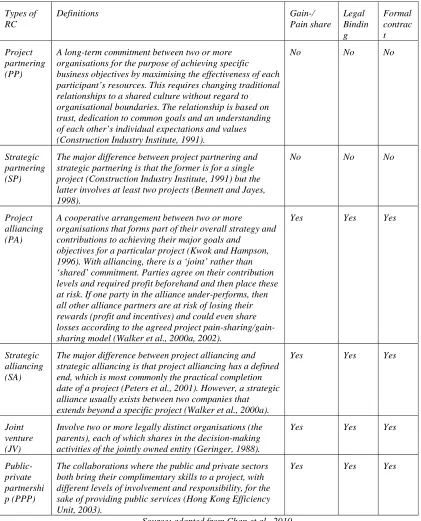
Table 1: Summary of definitions, comparisons and similarities in various types/form of RC. Types of RC Definitions Gain-/ Pain share Legal Bindin g Formal contrac t Project partnering (PP)
A long-term commitment between two or more organisations for the purpose of achieving specific business objectives by maximising the effectiveness of each participant’s resources. This requires changing traditional relationships to a shared culture without regard to organisational boundaries. The relationship is based on trust, dedication to common goals and an understanding of each other’s individual expectations and values (Construction Industry Institute, 1991).
No No No
Strategic partnering (SP)
The major difference between project partnering and strategic partnering is that the former is for a single project (Construction Industry Institute, 1991) but the latter involves at least two projects (Bennett and Jayes, 1998).
No No No
Project alliancing (PA)
A cooperative arrangement between two or more
organisations that forms part of their overall strategy and contributions to achieving their major goals and
objectives for a particular project (Kwok and Hampson, 1996). With alliancing, there is a ‘joint’ rather than ‘shared’ commitment. Parties agree on their contribution levels and required profit beforehand and then place these at risk. If one party in the alliance under-performs, then all other alliance partners are at risk of losing their rewards (profit and incentives) and could even share losses according to the agreed project pain-sharing/gain-sharing model (Walker et al., 2000a, 2002).
Yes Yes Yes
Strategic alliancing (SA)
The major difference between project alliancing and strategic alliancing is that project alliancing has a defined end, which is most commonly the practical completion date of a project (Peters et al., 2001). However, a strategic alliance usually exists between two companies that extends beyond a specific project (Walker et al., 2000a).
Yes Yes Yes
Joint venture (JV)
Involve two or more legally distinct organisations (the parents), each of which shares in the decision-making activities of the jointly owned entity (Geringer, 1988).
Yes Yes Yes
Public-private partnershi p (PPP)
The collaborations where the public and private sectors both bring their complimentary skills to a project, with different levels of involvement and responsibility, for the sake of providing public services (Hong Kong Efficiency Unit, 2003).
Yes Yes Yes
Source: adapted from Chan et al., 2010
(2000) viewed RC as an umbrella concept which implying an approach to projects that emphasizes teamwork and cooperation. Palaneeswaran et al. (2003) viewed that win-win RC approaches such as partnering and alliancing provide vehicles for clients and contractors to drive towards excellence by achieving quality with greater value. Kumaraswamy et al. (2005) stressed that RC is a philosophy that has to be tailored for each situation to which it is applied. Therefore, it is important for companies considering RC to evaluate their business objectives, analyse the roles of RC in assisting them to achieve those objectives and determine the appropriate style of collaboration to implement (Chan et al., 2010). RC provides a more efficient and more effective contracting mechanism for certain types of transactions particularly where these demand close collaboration of parties to realise a complex construction project or long term development programmes (Colledge, 2005). At a project level in construction, RC can improve working relationships between all project stakeholders, can facilitate efficient and effective construction, can enhance financial returns and can minimise the incidence and make easier the conflict resolution (Colledge, 2005). RC can benefit clients, main contractors, consultants, sub-contractors and on-site employees (Palaneeswaran et al., 2003). Several benefits have been identified from previous literature and Chan et al. (2010) concluded that the main benefits that was most frequently cited was i) better cost control; ii) better working relationship; iii) sharing of risk; iv) better time control; v) efficient problem solving; and vi) enhanced communication.
3. Knowledge Management (KM): a brief overview
Knowledge has become one of the critical driving forces for business success. It is one of the most important organisational resources, the one sure source of lasting competitive advantage (Nonaka and Takeuchi, 1995). Organisations are becoming more knowledge intensive and the needs for leveraging the value of knowledge are increasing. As a result, knowledge has been treated systematically just like other tangible resources and many organisations are exploring the field of knowledge management (KM) in order to improve and sustain their competitiveness. Internal knowledge, such as operational procedures, special skills, and technical know-how, makes the most valuable asset for organisations (Spender, 1996).
knowledge transfer (Esmi and Ennals, 2009). It is not sufficient to have knowledge assets, patents, or other intellectual property. The firm must be capable of translating the knowledge into value for customers.
The increase of understandings on the value of knowledge has brought more interest on the management of it. Knowledge management (KM) has been defined in many different ways. Wiig (1997) suggests that KM deals with the management of knowledge-related activities which includes creating, organising, sharing and using knowledge in order to create value for an organisation. A more formal definition of KM, given by the American Productivity and Quality Center, is the strategies and processes of identifying, capturing and leveraging knowledge (Carrillo and Chinowsky, 2006). Within the KM literature, there are at least two classifications of knowledge processes. Nonaka and Takeuchi (1995) define one in which there are four processes: internalisation, externalisation, combination, and socialisation. Another classification of knowledge processes is focuses on the lifecycle of knowledge within an organisation (Alavi and Leidner, 2001; Davenport and Prusak, 1998; Teece, 1998). It includes knowledge generation (creation and knowledge acquisition), knowledge codification (storing), knowledge transfer (sharing), and knowledge application. The present state of KM is primarily concerned with the capture, codifying, transfer and sharing both tacit and explicit knowledge (Nonaka, 1994) which both types of knowledge can be manage through the use of technology, and soft human-related factors such as leadership, vision, strategy, reward systems and culture (Maqsood, et al., 2003). Such knowledge generally resides in employees’ heads in a tacit form. Organisations have been provided with new tools for the capture, coding, transfer and sharing of knowledge such as the internet, intranets, and ICT (information communication technologies) (Maqsood et al., 2003). Unfortunately, these initiatives resulted in ineffective KM (Davenport and Prusak, 2000; Fernie et al., 2002). Storey and Barnett (2000) points out that the failure of KM initiatives was affected from the role of human factors such as top management support, organisational culture, motivation, and training.
3.1 KM in the construction industry
KM in the construction industry: at inter-organisational level, which is within projects, across temporary, multidiscipline project organisations; and at intra-organisational level, i.e. within individual firms (Kamara et al., 2002). Kamara et al. (2002) points out that tacit knowledge is gaining attention and the management of it is very important, as engineers, architects and other professionals are not ready to use and follow best practice from the past, due to the unique and complex nature of construction projects. Tacit knowledge evolves from past practices and experience of individuals, and the company’s intangible assets come from shared practices of individuals. When tacit knowledge is made explicit, it becomes the basis of new knowledge such as concepts, images, and written documents. The challenge of KM is to make it explicit through the balanced use of technology, and soft human-related factors like leadership, vision, strategy, reward systems and culture (Maqsood et al., 2003). Previous researches results revealed the importance of tacit knowledge in relation to organisational performance and achievement of competitive advantage and has further highlighted the relevance of tacit knowledge in the construction industry (Pathirage et al., 2007). Several problems for tacit knowledge are loss of experience, loss of know-how, problem-solution loss and loss of innovation (Tsergn and Lin, 2004). Therefore, the above mentioned problems can be solved by the implementation of KM by construction organisations and can be extended to construction project settings.
3.2 KM in the context of RC
important and it requires high level of trust, commitment, and knowledge and information sharing based upon partners who share a common vision of the future (Maqsood et al., 2003). The next section discussed these key issues of implementing KM within the RC project settings.
4. Key issues for implementing KM within RC project settings
4.1 Knowledge sharing
Lee (2001, p.324) has defined knowledge sharing as “activities of transferring or disseminating knowledge from one person, group, or organisation to another. Knowledge sharing is defined as the process by which individuals mutually exchange their knowledge or ideas and collaboratively generate new knowledge (Magnini, 2008). Nonaka and Takeuchi (1995) emphasized KM by creating new knowledge continuously within organisations, where KM and sharing is achieved through the interactions and conversion between tacit and explicit knowledge: socialisation, externalisation, combination, and internalisation, which also indirectly facilitates the knowledge sharing between organisation and its members (Choo, 2003; Meso and Smith, 2000). They argued that effective knowledge sharing depends on the mutual understanding and respect of team members. Hendriks (1999) contended that knowledge sharing is a process of communication. He argued that knowledge is not like other commodity that can passed around freely, it is tied to a knowing subject. Knowledge sharing presumes a relation between at least two parties, one that possesses knowledge and the other that acquires knowledge, and as a result, effective communication becomes essential in the process of knowledge sharing. Eriksson and Dickson (2000) and Senge (1997) point out that organisation should create a conducive environment for knowledge sharing. They argued that knowledge sharing is different from information sharing in that knowledge sharing requires more than just communicating the information to the other party; knowledge sharing includes helping the other party understand the contents of the information communicated and learn from the information so as to reconstruct the information into his/ her own knowledge and to develop new capabilities.
necessary to understand the characteristic of the knowledge itself (tacit or explicit knowledge), in order to obtain effective knowledge sharing. Before any KM initiatives can take place in effective manner in any RC project, it is important to first identify the types of knowledge that can be shared between the project participants.
4.2 Trust
Trust has been considered as one of the most complex issues within construction project teams, and is a critical factor for the success of RC implementation. Rowlinson and Cheung (2004b) viewed that trust between RC partners is vital because it creates an opportunity and willingness for further alignment, reduces the need for partners to continually monitor one another behaviour, reduces the need for formal controls, and reduces the tensions created by short-term inequities. In the context of KM, it is very important for each project participants in a RC project setting to build a high level of trust between them in order to success in both RC and KM implementation. Chan et al. (2010) identified several key elements of trust such as relationship, contact people with the information, truthfulness, reliability of information, perform what is said, exchange and sharing of ideas, having faith in the person, and sharing good and bad information. In construction industry, trust is negatively affected by many factors such as lack of honest communications and reliability, and the problems in the delivery of the project (Khalfan et al., 2007). It is more important to build trust between employees and employer in order to motivate and retain knowledge workers in the organisations. Goman (2002) points out that trust and confidence in construction leaderships makes a more cooperative knowledge sharing environment. For construction project to be completed on time, every member of a construction project must feel confident that they can trust the other team members and can make real contribution. In this way, team members’ knowledge, views and contribution will be shared among themselves. This point is very much relevance to the implementation of KM especially during the sharing of knowledge within different project participants in a RC project setting. Good KM initiatives create trust that helps to break down cultural barriers and alter the way individuals and group share their knowledge (Low and Mohammed (2005). Without trust, project participants may be less willing to share knowledge with others. Once knowledge is shared, it becomes public to every one, and this creates a situation where some team members may be afraid of losing their privileged status if they share their own expertise or special skills (Ma et al., 2008). As a result, it is necessary to have a high level of trust to make sure knowledge sharing is perceived fair and well recognised within the project participants in order to encourage more knowledge sharing.
4.3 Commitment
continuance commitment (a need to comply) relates to a transactional exchange in which extrinsic rewards are provided; and iii) normative (ought to) commitment results in obligation and duty in which grudging acceptance. In order to achieve successful implementation of KM within RC project settings, it is important to understand the impact of commitment. In the context of this study, commitment can be regarded as the willingness for the involved parties to integrate continuously to the unanticipated problems (Bresnen and Marshall, 2000a; Cheng et al., 2000). More committed parties are expected to balance the attainment of short-term objectives with long-term goals, and achieve both individual and joint missions without raising the fear of opportunistic behaviour (Mohr and Spekman, 1994). In implementing KM initiatives in RC projects, all parties should commit their best effort to support KM activities such as knowledge sharing within the project participants and the commitment should be established throughout all management levels (Stonehouse et al., 1996; Li et al., 2005).
4.4 Culture
5. Conclusion
In this paper, the key issues that need to be considered in order to implement KM within RC project settings are discussed based on previous literature review. Organisations need to value and manage both knowledge and relationships in order to improve integrations within construction players. It is important to understand the interaction between the complementary paradigms of KM and RC. Clearly, successful KM implementation or initiatives and the great potential of using RC to engage the construction industry clients and practitioners in overcoming the fragmentation and adversarial nature of contracting is not being fully realized in practice.
References
Alavi, M. And Leidner, D.E. (2001), ‘Review: knowledge management and knowledge management systems: conceptual foundations and research issues”, MIS Quarterly 25 (1), pp. 107–36.
Alsagoff, SA and McDermott, P (1994), In Rowlinson, S (ed.) Relational Contracting: A prognosis for the UK construction industry? Proceedings of CIB W92, Procurement Systems-East Meets West, University of Hong Kong, 11-19
Arrighetti, A, Bachmann, R and Deakin, S (1997) Contract law social norms and inter-firm cooperation. Cambridge Journal of Economics, 21(2), 172-95.
Bresnen, M. and Marshall, N. (2000a) ‘Building partnerships: case studies of client-contractor collaboration in the UK construction industry,’ Construction Management andEconomics 18 (7), pp. 819–832.
Carrillo, P.M. and Chinowsky, P. (2006), ‘Exploiting knowledge management: the engineering and construction perspective.’ ASCE Management in Engineering, Vol. 22, No. 1, pp. 2-10
Carrillo, P.M, Robinson, HS, Al-Ghasani, AM, and Anumba, CJ (2004), Knowledge management in construction: drivers, resources and barriers, Project Management Journal, Vol. 35, No.1, pp.46-56
Chan, A.P.C., Chen, D.W.M., Chiang, B.S.T., Chan, E.H.W., and Ho, K.S.K. (2004b). Exploring critical success factors for partnering in construction projects. Journal of Construction, Engineering and Management, ASCE, Vol 130 No.2, pp 188-198
Chan, AP, Chan, DW and Yeung, JF (2010) Relational Contracting for Construction Excellence: Principles, Practices and Case Studies, Spon Press, London and NewYork
Cheng, E.W.L, Li, H. and Love, P.E.D (2000). Establishment of critical success factors for construction partnering. Journal of Management in Engineering. ASCE, Vol 16, No.2, pp. 84-92
Cheng, E. W. L., Li, H., Love, P. E. D. and Irani, Z. (2004) Strategic alliances: A model for establishing long-term commitment to inter-organisational relations in construction. Building and Environment, 39, 459-468.
Choo, C.W. (2003). Perspectives on managing knowledge in organisations. Cataloging and Classification Quarterly, Vol.37, No.1/2, pp. 205-220
Colledge, B. (2005). ‘Relational contracting: creating value beyond the project,’ Lean Construction Journal 2 (1), pp. 30–45.
Dainty, A.R.J., Briscoe, G.H. and Millet, S.J. (2001) ‘New perspectives on construction supply chain integration,’ Supply Chain Management 6 (4), pp. 163–173.
Dainty, A., Qin, J. and Carillo, P.M. (2005). ‘HRM strategies for promoting knowledge sharing within construction project organisations.’ In Knowledge Management in the Construction Industry: A Socio-Technical Perspective. Kazi, A.S. (ed.), Idea Group Publishing
Davenport, T.H. and Prusak, L. (1998), Working Knowledge: Managing What Your Organisation Knows. Boston, MA: Harvard Business School Press.
Davenport, T.H., De Long, D.W., and Beers, M.C. (1998) ‘Successful knowledge management projects,’ Sloan Management Review 39 (2), pp. 43–57.
Eriksson, V. and Dickson, D.W. (2000). Knowledge sharing in high technology companies. Proceedings of American Conference on Information Systems, AIS/AMCIS
Egan, J. (1998) Rethinking Construction: The report of the Construction Task Force to the Deputy Prime Minister, John Prescott, on the Scope for Improving the Quality and Efficiency of UK Construction. London: Department of the Environment
Esmi, R. and Ennals, R. (2009). ‘Knowledge management in construction companies in the UK.’ AI & Society Journal, Vol. 24, No. 2.
Fernie, S., Weller, S., Green, D., Newcombe, R., and Williams, M. (2002). ‘Knowledge sharing: A softly-softly approach. In: Proceedings of the International Symposium of the working Commission CIB W92 (Procurement Systems), 14-17 January, Trinidad and Tobago, pp 555-576.
Fong, P.S.W. and Chu, L.(2006). ‘Exploratory study of knowledge sharing in contracting companies: a sociotechnical perspective.’ Journal of Construction Engineering and Management (ASCE), pp. 928-939
Goman, K.C. (2002). ‘Five reasons people don’t tell what they know.’ Destination KM: Viewpoint (June). Available at: http://www.destinationkm.com
Hasanali, F. (2002) ‘Critical success factors of knowledge management’; available at:
www.kmadvantage.com/docs/km_articles/CriticalSuccess_Factors_of_KM.pdf.
Hendriks, P. (1999). Why share knowledge? The influence of ICT on motivation for knowledge sharing. Knowledge and Process Management. Vol. 6, No. 2, pp. 91-100
Hung, Y.C., Huang, S.M., Lin, Q.P. and Tsai, M.L. (2005), “Critical factors in adopting a knowledge management system for the pharmaceutical industry”, Industrial Management & Data System, Vol. 105, No. 2, pp. 164-183
Ingirige, B. and Sexton, M. (2006) ‘Alliances in construction: investigating initiatives and barriers for long-term collaboration,’ Engineering, Construction and Architectural Management 13 (5), pp. 521– 535.
Inkpen, A (1996). Creating knowledge through collaboration. California Management Review, Vol. 39, No.1, pp.123-140
Kamara, J.M., Chimay, A.J., and Carrillo, P.M. (2002) ‘A CLEVER approach to selecting a knowledge management strategy,’ International Journal of Project Management 20 (3) pp. 205–211.
Khalfan, M.M.A., McDermott, P., and Swan, W. (2007). ‘Building trust in construction projects.’ Supply Chain Management: An International Journal, Vol. 12, No. 6, pp. 385-391
Khamseh, H.M. and Jolly, D.R. (2008) ‘Knowledge transfer in alliances: determinant factors,’ Journal of Knowledge Management 12 (1), pp. 37–50.
Kogut, B. (1988) ‘Joint ventures: theoretical and empirical perspectives,’ Strategic Management Journal 9 (4), pp. 319–32.
Kogut, B., and Zander, U. (1992), “Knowledge of the firm, combinative capabilities and the replication of technology”, Organisation Science, Vol. 3, No. 3, pp. 383-397.
Kwawu, W. and Hughes, W. (2007) ‘Are relational and formal contracts implemented as substitutes in the UK construction industry?’ in Boyd, D., ed., Proceedings of the 23rd Annual Association of Researchers in Construction Management Conference 1, Belfast, UK, pp. 97–106.
Latham, M. (1994) Constructing the Team: Final Report of the Government/Industry Review of Procurement and Contractual Aarrangements in the UK Construction Industry. London:HMSO.
Lee, J. (2001). The impact of knowledge sharing, organisational capacity and partnership quality on IS outsourcing success. Information and Management. Pp. 325-335
Li, B., Akintoye, A., Edwards, P.J., and Hardcastle, C. (2005) ‘Critical success factors for PPP/PFI projects in the UK construction industry,’ Construction Management and Economics 23 (5), pp. 459– 471.
Liebowitz, J. (1999) ‘Key ingredients to the success of an organisation’s knowledge management strategy,’ Knowledge and Process Management 6 (1), pp. 37–40.
Low, S.W. and Mohammed, A.H. (2005). ‘The development of knowledge sharing culture in construction industry.’ In Proceedings of the 4th MICRA Conference (unpublished)
Ma, Z., Qi, L., and Wang, K. (2008). Knowledge sharing in Chinese construction project teams and its affecting factors: an empirical study, Chinese Management Studies, Vol. 2, No. 2, pp. 97-108
Macaulay, S. (1963). Non-Contractual relations in Business: A Preliminary Study. American Sociological Review, Vol. 28, pp. 55-67.
Macneil, I.R. (1974) ‘The many futures of contracts,’ Southern California Law Review 47, pp. 691– 816.
Macneil, I.R (1978). Contracts: Adjustment of Long-term Economic Relations Under Classical, Neoclassical, and Relational Contract Law, Northwestern University Law Review, Vol. 72, No. 5, Part 2, pp. 854-905.
Macneil, I.R. (1980). The New Social Contract: An Inquiry into Modern Contractual Relations, New Haven, NJ, Yale University Press.
Magnini, V.P. (2008). ‘Practicing effective knowledge sharing in international hotel joint ventures.’ International Journal of Hospitality Management, Vol. 27, No. 2, pp. 249-258
Maqsood, T., Finegan., A.D. and Walker, D.H.T. (2003). ‘Extending knowledge management across the supply chains in the construction industry: Knowledge sharing in construction supply chains.’ Second International Conference on Construction in the 21st Century (CITC-II). “Sustainability and Innovation in Management and Technology” 10-12 December, Hong Kong.
McDermott, P and O’Dell, C. (2001) Overcoming cultural barriers to sharing knowledge, Journal of Knowledge Management, Vol. 5, No. 1, pp. 76-85
McDermott, P. Khalfan, M.M.A., and Swan, W. (2005). ‘Trust in construction projects,’ Journal of Financial Management of Property and Construction 10 (1), pp. 19–31.
Meso, P., and Smith, R. (2000) A resource-based view of organisational knowledge management systems, Journal of Knowledge Management, Vol 4, No 3, pp.224-234
Mohr, J. and Spekman, R. (1994). ‘Characteristics of partnering success: partnering attributes, communication behaviour, and conflict resolution techniques.’ Strategic Management Journal, Vol.15, No.1, pp. 135-152
Nonaka, I. (1994). ‘A dynamic theory of organisational knowledge creation,’ Organisation Science 5 (1), pp. 14–37.
Nonaka, I. and Takeuchi, H. (1995) The Knowledge Creating Company: How Japanese Companies Create Dynamics of Innovation. Oxford: Oxford University Press.
Palaneeswaran, E., Kumaraswamy, M.M., Rahman, M.M. and Ng, T. (2003) ‘Curing congenital construction industry disorders through relationally integrated supply chains’. Building and Environment, 38, 571-582.
Pathirage, C. P., D. G. Amaratunga, and Haigh, R. (2007). ‘Tacit knowledge and organizational performance.’ Journal of Knowledge Management 11(1): 115-126.
Polanyi, M. (1966), The Tacit Dimension, Routledge and Keoan, London.
Rahman, M.M. and Kumaraswamy, M.M. (2002) ‘Joint risk management through transactionally efficient relational contracting,’ Construction Management andEconomics 20 (1), pp., 45–54.
Rahman, M.M. and Kumaraswamy, M.M. (2004). ‘Potential for implementing relational contracting and joint risk management.’ Journal of Management and Engineering, 20(4), 178-189
Rahman, M.M., Kumaraswamy, M.M., and Ng, S.T. (2003) ‘Reengineering construction project teams,’ in Molenaar, K.R. and Chinowsky, P.S., eds. Proceedings of the American Society of Civil EngineersConstruction Research Congress, Hawaii.
Robinson, H.S., Carrillo, P.M, Anumba, C.J. and Al-Ghassani, A.M. (2005). ‘Knowledge management practices in large construction organisations.’ Engineering, Construction and Architectural Management, Vol. 12, No. 2, pp. 431-445
Rowley, J. (2004). Partnering paradigms? Knowledge Management and Relationship Marketing. Journal of Industrial Management & Data Systems, Vol 104, No. 2, pp. 149-157
Rowlinson, S., and Cheung, F.Y.K (2004b). A review of the concepts and definitions of the various forms of relational contracting. Proceedings of the International Symposium of the CIB W92 on Procurement Systems ‘Project Procurement for Infrastructure Construction’, 7-10 January, Chennai, India
Siemieniuch, C.E. and Sinclair, M.A. (1999) ‘Organisational aspects of knowledge life-cycle management in manufacturing,’ International Journal of Human-Computer Studies 51 (3), pp. 517– 547.
Smith, H. and McKeen, JD (2003) Instilling a knowledge-sharing culture, KM Forum (2)
Senge, P (1997). Sharing knowledge, Executive Excellence, Vol. 14, No.11, pp.17-19
Spender, J.C., (1996), Making knowledge the basis of a dynamic theory of the firm, Strategic Management Journal, Vol. 17, pp. 45-62
Stonehouse, J.H., Hudson, A.R., and O’Keefe, M.J. (1996). Private-public partnerships: the Toronto Hospital experience. Canadian Business Review, Vol. 23, No.2, pp.17-20
Swan, W., McDermott, P., Wood, G., Abott, C., and Thomas, A. (2002) Trust in Construction: Achieving Cultural Change. Salford: Centre of Construction Innovation.
Singley, M.K., Anderson, J.R. (1989), The Transfer of Cognitive Skill, Harvard University Press, Cambridge
Teece, D. J. (1998), Capturing value from knowledge assets, California Management Review, Vol. 40, No.3, pp. 55-79
Titus, S. and Brochner, J. (2005). ‘Managing information flow in construction supply chains.’ Construction Innovation, Vol. 5, pp. 71-82
Venzin, M., von Krogh, G. and Roos, J. (1998), `Future research into knowledge management’.’ in von Krogh, G.,Roos, J. and Kleine, D. (Eds), Knowing in Firms, Sage Publications, London.
Walker, D.H.T., Hampson, K.D, and Peters, R.J. (2000a). Project alliancing and project parnering- What’s the difference? Partner selection on the Australian National Museum Project- A case study. In: Serpell, A. (ed.). Proceedings of CIBW92 Procurement System Symposium on Information and Communication in Construction Procurement, Santiago, Chile, pp. 641-655
Wiig, K. (1997), Integrating intellectual capital an knowledge management, Long Range Planning, Vol. 30, No.3, pp.399-405
Wong, K.Y. (2005) Critical success factors for implementing knowledge management in small and medium enterprises, Industrial Management & Data Systems 105 (3), pp. 261–279.