International Journal of Emerging Technology and Advanced Engineering
Website: www.ijetae.com (ISSN 2250-2459, ISO 9001:2008 Certified Journal, Volume 9, Issue 3, March 2019)
79
Brain Computer Interface
Richitha Dayara
1, Shruti Bargava Choubey
2Sreenidhi Institute of Science and Technology, Hyderabad, India
Abstract—For generations, humans have fantasized about
the ability to communicate and interact with machines through thought alone or to create devices that can peer into person’s mind and thoughts. These ideas have captured the imagination of humankind in the form of ancient myths and modern science fiction stories. However, it is only recently that advances in cognitive neuroscience and brain imaging technologies have started to provide us with the ability to interface directly with the human brain.Primarily driven by growing societal recognition for the needs of people with physical disabilities, researchers have used these technologies to build brain computer interfaces (BCIs), communication systems that do not depend on the brain’s normal output pathways of peripheral nerves and muscles. In these systems, users explicitly manipulate their brain activity instead of using motor movements to produce signals that can be used to control computers or co mmunicationdevices.The impact of this work is extremely high, especially to those who suffer from devastating neuromuscular injuries and neurodegenerative diseases such as amyotrophic lateral sclerosis, which eventually strips individuals of voluntary muscular activity while leaving cognitive function intact.
Keywords—cognitiveneuroscience, peripheralnerves,
neuroprosthetics, phylogenetics
I. INTRODUCTION
For generations, humans have fantasized about the ability to communicate and interact with machines through thought alone or to create devices that can peer into person’s mind and thoughts. These ideas have captured the imagination of humankind in the form of ancient myths and modern science fiction stories .However, it is only recently that advances in cognitive neuroscience and brain imaging technologies have started to provide us with the ability to interface directly with the human brain. This ability is made possible through the use of sensors that can monitor some of the physical processes that occur within the brain that correspond with certain forms of thought. [2]
Figure1.Introduction to BCI
II. HISTORY
The history of brain –computer interfaces (BCIs) starts with Hans Berger's discovery of the electrical activity of the human brain and the development of electroencephalography (EEG). In 1924 Berger was the first to record human brain activity by means of EEG. Berger was able to identify oscillatory activity in the brain by analyzing EEG traces. One wave he identified was the alpha wave. [2]
III. ARCHITECTURE OF BRAIN
Contrary to popular simplifications, the brain is not a general-purpose computer with a unified central processor. Rather, it is a complex assemblage of competing sub-systems, each highly specialized for particular tasks(Carey2002). By studying the effects of brain injuries and, more recently, by using new brain imaging technologies, neuroscientists have built detailed topographical maps associating different parts of the physical brain with distinct cognitive functions. The brain can be roughly divided into two main parts:
1.Cerebral Cortex 2.Sub-cortical regions.
Cerebral Cortex System
International Journal of Emerging Technology and Advanced Engineering
Website: www.ijetae.com (ISSN 2250-2459, ISO 9001:2008 Certified Journal, Volume 9, Issue 3, March 2019)
80 The cortex supports most sensory and motor processing as well as ―higher‖ level functions including reasoning,planning, language processing, and pattern recog nition. This is the regionthat current BCI work has largely focused on.
Sub-cortical Regions
Sub-cortical regions are phylogenetically older and include a are associated with controlling basic functions including vital functions such as respiration, heart rate, and temperature regulation, basic emotional and instinctive responses such as fear and reward, reflexes, as well as learning and memory.
Fig2.Functional areas of cerebral cortex (Lateral view)
Cerebral Cortex System (Geography of Thoughts)
The cerebral cortex is split into two hemispheres that often have very different functions. For instance, most language functions lie primarily in the left hemisphere, while the right hemisphere controls many abstract and spatial reasoning skills. Also, most motor and sensory signals to and from the brain cross hemispheres, meaning that the right brain senses and controls the left side of the body and vice versa. The brain can be further divided into separate regions specialized for different functions.
For example, occipital regions at the very back of the head are largely devoted to processing of visual information. Areas in the temporal regions, roughly along the sides and lower areas of the cortex, are involved in memory, pattern matching, language processing, auditory processing.
Brain Imaging Technologies
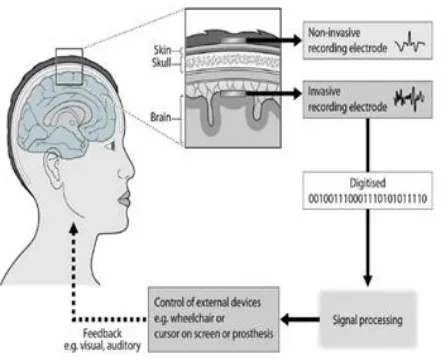
[image:2.612.336.560.489.669.2]There are two general classes of brain imaging technologies: invasive technologies, in which sensors are implanted directly on or in the brain, and non-invasive technologies, which measure brain activity using external sensors. Although invasive technologies provide high temporal and spatial resolution, they usually cover only very small regions of the brain .Additionally, these techniques require surgical procedures that often lead to medical complications as the body adapts, or does not adapt, to the implants. Furthermore, once implanted, these technologies cannot be moved to measure different regions of the brain. While many researchers are experimenting with such implants, we will not review this research in detail as we believe these techniques are unsuitable for human-computer interaction work and general consumer use .We summarize and compare the many non-invasive technologies that use only external sensors. While the list may seem lengthy, only Electroencephalography (EEG) and Functional Near Infrared Spectroscopy (fNIRS) present the opportunity for inexpensive, portable, and safe devices, properties we believe are important for brain-computer interface applications in HCI work. [1][2]
International Journal of Emerging Technology and Advanced Engineering
Website: www.ijetae.com (ISSN 2250-2459, ISO 9001:2008 Certified Journal, Volume 9, Issue 3, March 2019)
81 IV. ELECTROENCEPHALOGRAPHY
EEG uses electrodes placed directly on the scalp to measure the weak (5-100µV) electrical potentials generated by activity in the brain. Because of the fluid, bone, and skin that separate the electrodes from the actual electrical activity, signals tend to be smoothed and rather noisy. Hence, while EEG measurements have good temporal resolution with delays in the tens of milliseconds, spatial resolution tends to be poor, ranging about 2-3cm accuracy at best, but usually worse. Two centimeters on the cerebral cortex could be the difference between inferring that the user is listening to music when they are in fact moving their hands. We should note that this is the predominant technology in BCI work .
Functional Near Infrared Spectroscopy (fNIRS)
fNIRS technology, on the other hand, works by projecting near infrared light in to the brain from the surface of the scalp and measuring optical changes at various wavelengths as the light is reflected back out (for a detailed discussion of fNIRS. The NIR response of the brain measures cerebral hemodynamic and detects localized blood volume and oxygenation changes. Since changes in tissue oxygenation associated with brain activity modulate the absorption and scattering of the near infrared light photons to varying amounts, fNIRS can be used to build functional maps of brain activity. This generates images similar to those produced by traditional Functional Magnetic Resonance Imaging (fMRI) measurement. Much like fMRI, images have relatively high spatial resolution (<1 cm) at the expense of lower temporal resolution (>2 –5 seconds), limited by the time required for blood to flow into the region.
In brain-computer interface research aimed at directly controlling computers, temporal resolution is of utmost importance, since users have to adapt their brain activity based on immediate feedback provided by the system. Forinstance, it would be difficult to control a cursor without having interactive input rates. Hence, even though the low spatial resolution of these to low information transfer rate and poor localization of brain activity, most researchers currently adopt EEG because of the high temporal resolution it offers. However, in more recent attempts to use brain sensing technologies to passively measure user state, good functional localizatio n is crucial for modeling the users’ cognitive activities as accurately as possible. The two technologies are nicely complementary and researchers must carefully select the right tool for their particular work.[3][5][6]
Figure3. Schematics of BCI
V. IMPLANTATION OF ARTIFICIAL EYES (1978) In 2002, Jens Neumann, also blinded in adulthood, became the first in a series of 16 paying patients to receive Do belle’s second generation implant, marking one of the earliest commercial uses of BCIs. The second generation device used a more sophisticated implant enabling better mapping of phosphenes into coherent vision. Phosphenes are spread out across the visual field in what researchers call "the starry-night effect". Immediately after his implant, Jens was able to use his imperfectly restored vision to drive an automobile slowly around the parking area of the research institute.
International Journal of Emerging Technology and Advanced Engineering
Website: www.ijetae.com (ISSN 2250-2459, ISO 9001:2008 Certified Journal, Volume 9, Issue 3, March 2019)
82
Monkey Operated a Robotic Arm (2008)
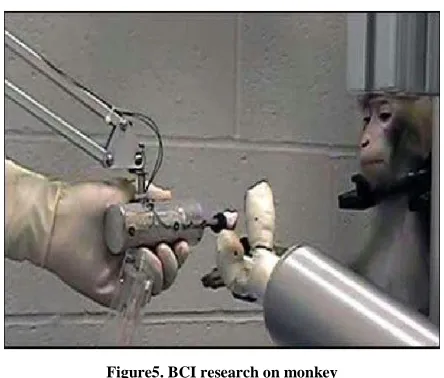
In May 2008, a monkey controlled a robotic arm to feed himself In University of Pittsburgh Medical Center.
Figure5. BCI research on monkey
First Human Brain to Brain Communication (2012)
University of Washington researchers have performed what they believe is the first noninvasive human-to-human brain interface, with one researcher able to send a brain signal via the Internet to control the hand motions of a fellow researcher. Using electrical brain recordings and a form of magnetic stimulation, Rajesh Rao sent a brain signal to Andrea Stocco on the other side of the UW campus, causing Stocco’s finger to move on a keyboard.
While researchers at Duke University have demonstrated brain-to-brain communication between two rats, and Harvard researchers have demonstrated it between a human and a rat, Rao and Stocco believe this is the first demonstration of human-to-human brain interfacing.
Figure6. Fist human brain to brain communication
In above figure, University of Washington researcher Rajesh Rao, left, plays a computer game with his mind. Across campus, researcher Andrea Stocco, right, wears a magnetic stimulation coil over the left motor cortex region of his brain. Stocco’s right index finger moved involuntarily to hit the ―fire button as part of the first human brain-to-brain interface demonstration. [3][4]
VI. APPLICATIONS OF BCI Restoring Physical Disabilities
[image:4.612.57.279.174.363.2]One of the most critical needs for people with severe physical disabilities is restoring the ability to communicate. The field of BCI research and development has since focused primarily on neuroprosthetics applications that aim at restoring damaged hearing, sight and movement.
Figure 7. Basic diagram of a handicapped controlling computer with BCI
Communication
Communication systems that do not depend on the brain’s normal output pathways of nerves and muscles. In these systems, users explicitly manipulate their brain activity instead of using motor movements to produce signals that can be used to control computers or communication devices. The impact of this work is extremely high, especially to those who suffer from devastating neuromuscular injuries and neurodegenerative diseases such as amyotrophic lateral sclerosis, which eventually strips individuals of voluntary muscular activity while leaving cognitive function intact
Robotics
International Journal of Emerging Technology and Advanced Engineering
Website: www.ijetae.com (ISSN 2250-2459, ISO 9001:2008 Certified Journal, Volume 9, Issue 3, March 2019)
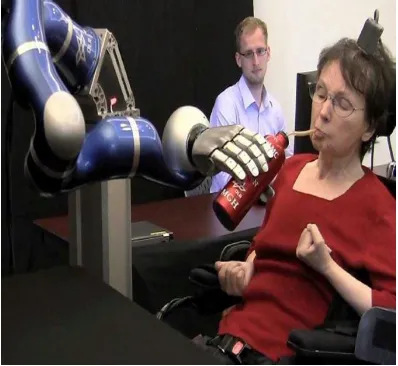
[image:5.612.69.268.302.485.2]83 Recent work with BCIs, however, has shown that robotic control is indeed possible with brain signals. Applications for neural-controlled robots currently center on assistive technologies—helper‖ robots— but BCI control has been proposed for military and industrial applications as well. One of the earliest BCI-controlled robots, the experiment explored the effects of real-world feedback (the movement of the robot) in conjunction with a P300-basedBCI, which depends on user attention. The robot was configured to perform the steps to make coffee, such as getting powdered coffee, sugar, and cream, and stirring the mixture with a spoon. The results showed that users can effectively attend to real-world feedback while operating an attention-based BCI.
Figure 8. A lady controlling a robotic arm to feed herself
Virtual Reality
In the BCI research world that have more practical purposes. The early work in virtual environments is described in Bayliss and Ballard (2000), which details a study of a P300 BCI controlling a virtual apartment and a virtual driving simulator. Subsequent work as detailed in Pfurtscheller et al. (2006) incorporates the Reactor ―cave environment, an immersive virtual world which the user navigates using a BCI. The subject can ―walk through the virtual world by imagining foot movement, and can touch things in the virtual world by imagining reaching and hand movement.
VII. CONCLUSION
Research and development in Brain Computer Interfaces has exploded in the last ten years, both in the technologies available and the number of organizations involved in the field.
BCIs have now evolved beyond laboratory experimental systems and some are now offered as commercial products. No longer are the realm of science fiction, BCIs becoming a viable and effective alternative for assistive technology and a plethora of mainstream applications. New paradigms of interaction open even more possibilities for BCI and create new fields of study, such as neural imaging for computational user experience. However, many obstacles remain for BCI researchers. BCIs are still notoriously slow and error-prone compared to traditional input technologies .More research is essential in order to develop techniques to reduce both neural and environmental artifacts, to reduce error rates, and to increase accuracy. For BCI systems to be feasible for mainstream real-world use in the home and office, they must be simple, small, wearable, and unobtrusive. New sensor technologies such as dry EEG electrodes and fNIR emitter / detectors must be perfected. Adaptive systems must be sufficient to automatically Calibrate and ―tune‖ BCIs to an individual’s brain signal patterns without expert assistance. These are daunting challenges, but as the BCI field matures, effectiveness and accuracy are increasing. The BCI field is rapidly approaching critical mass to develop the human-computer interaction methods of the future.
REFERENCES
[1] Adams L, Hunt L, Moore M (2003) The aware system: Prototyping an augmentative communication interface. Paper presented at the Proceedings of the Rehabilitation Engineering Society of North America (RESNA).Archinoetics Inc (2009) Brain Painting, fromhttp://www.archinoetics.com/ Bayliss J, Ballard D (2000) A virtual reality test bed for brain-computer interface research. IEEE Trans Rehabil Eng 8(2):188
[2] 190Bell C, Shenoy P, Chalodhorn R, Rao R (2008) Control of a humanoid robot by a noninvasive brain-computer interface in humans. J Neural Eng 5:214
[3] 220Birbaumer N, Cohen L (2007) Brain-computer interfaces: Communication and restoration of movement in paralysis. J Physiol 579:621
[4] 636Birbaumer N, Hinterberger T, Kubler A, Neumann N (2003) The thought-translation device (TTD): Neurobehavioral mechanisms and clinical outcome.IEEE Trans Neural Syst Rehabil Eng 11(2):120 [5] 123Blankertz B, Dornhege G, Krauledat M, Müller KR, Kunzmann
V, Losch F etal (2006) The Berlin brain-computer interface: EEG-based communication without subject training. IEEE Trans Neural Syst Rehabil Eng 14(2):14