Mutations with Hair Shape Phenotypes Abnormalities—
The Morphogenetic Waves and Related Diseases
Junmin Wang
1, Guannan Wang
2, Jintao Zhang
1*1Laboratory Animal Center, Zhengzhou University, Zhengzhou, China; 2College of Life Sciences, Henan Agricultural University,
Zhengzhou, China.
Email: *[email protected]
Received June 10th, 2013; revised July 8th, 2013; accepted July 16th, 2013
Copyright © 2013 Junmin Wang et al. This is an open access article distributed under the Creative Commons Attribution License, which permits unrestricted use, distribution, and reproduction in any medium, provided the original work is properly cited.
ABSTRACT
Hair morphology is one of the most conspicuous features of human variation. The hair follicle has attracted significant
attention as a model for the investigation of diverse biological problems. Whereas, very little is known about the genes
influencing the morphology and structure of the hair shaft. Curly hair is very common character of hair phenotypes of
human, while most congenital curl occurs owing to genetic factors and some are closely related with genetic diseases.
This review highlights current related genes reported affecting hair curliness and human diseases which are due to gene
mutations.
Keywords: Waved Hair; Curly Hair; Gene Mutations; Diseases
1. Introduction
A mammal’s pelage is generally one of its first notice-
able attributes and is aesthetically pleasing. Moreover,
the skin is an essential organ which protects the organism
from invasion of pathogens and chemicals and prevents
the escape of liquids and nutrients [1]. Its ectodermal
appendages, such as hair, feather and tooth, are attractive
models for understanding the mechanisms underlying
epithelial mesenchymal interactions [2].
Hair is composed of terminally differentiated, dead
keratinocytes (trichocytes), which are compacted into a
fibre of amazing tensile strength, the hair shaft. Hair
morphogenesis and epidermal development are orches-
trated by an array of cytokines and growth factors [3].
The presence of hair is characteristic for mammals, in
which it exerts a wide range of tasks, including physical
protection, thermal insulation, camouflage, dispersion of
sweat and sebum, sensory and tactile functions, and so-
cial interactions [4]. In human society, hair is of enor-
mous, psychosocial importance, and many human dis-
eases are associated with abnormalities in hair follicle
morphogenesis, cycling, and structure.
A hair grows from the papilla and with the exception
of that point of generation is made up of dead, cornified
cells. It consists of a shaft that projects above the skin,
and a root that is imbedded in the skin. Its basic compo-
nents are keratin (a protein), melanin (a pigment), and
trace quantities of metallic elements [5]. These elements
are deposited in the hair during its growth and/or ab-
sorbed by the hair from an external environment. After a
period of growth, the hair remains in the follicle in a
resting stage to eventually be sloughed from the body. As
the place of origin of the hair, the structural change of
hair follicle could directly cause the change of hair phe-
notype [6,7].
The hair follicle represents an attractive experimental
system because of its accessibility, dispensability, and
self-renewal capacity. Owing to its complex but highly
organised architecture, this mini-organ can serve as an
excellent model for investigating aspects of stem cell
biology, cell lineage specification, cell differentiation,
patterning processes, and cell-cell interactions [8,9]. In
addition, hair follicles and shafts are of significant cos-
metic relevance. The follicle provides the source for hair
production and, thus, eventually determining appearance
by affecting the hair shaft’s structure and shape. Hair
features are not only affected by the follicle’s capacity to
give rise to a normal shaft but also by the so-called hair
growth cycle which controls the periodic growth and
shedding of hair.
Human hair is one of most keratinous fibres. There are
various fibre shapes in human hair and it is commonly
accepted that the curliness of hair fibres is roughly clas-
sified by their ethnic origin in the three major ethnic
groups: African hair which has a strong curl shape, Cau-
casian hair which has a moderately waved shape, and
Asian hair which is apt to have a comparatively straight
shape [10]. The corresponding difference in the internal
nanostructure, however, still remains unrevealed.
The structured pattern of hair is determined by their
length, width, and shape. Whereas the prototype hair is
straight, hair can adopt different shapes owing to bend-
ing. In principle, bending could be achieved by diverse
means. Differences in cell proliferation on opposite sides
of the hair follicle would inevitably give rise to hair cur-
vature [11]. Understanding the factors that contribute to
the curly morphology of human hair is important for an-
thropological and physiological studies. According to a
recent report, hair curling in man is a consequence of
different proliferation rates within the hair follicle that
appear to be reflected by the shape of the follicle [12,13].
This correlation is reminiscent of the potential link be-
tween follicle and hair size.
Curliness has commonly been assessed using words
such as straight, wavy, curly and frizzy, a variety of at-
tributes of subjective nature with no clear definition and
limits [14]. Curly hair is very common character of hair
phenotypes of human, which is caused by many reasons.
Most congenital curl occurs as the result of genetic
fac-tors and some are closely related with genetic diseases.
Genetic analyses of common diseases in humans have re-
vealed that gene mutations are involved in diseases. Ge-
nome sequencing projects of various mammalian species
followed by comparative genome analyses have revealed
that a large number of genes are shared among species.
Thus, it is thought that mutations found in model animals
and animals carrying such mutations are of large signifi-
cance in studying hair growth regulation and the rela-
tionship with some hereditary diseases.
2. The Curly Hair-Specific Genes
Several genetic alterations with different follicular local-
izations of the primary aberration give rise to curly or
wavy hair and curly pelage is an easily recognized trans-
species coat anomaly, moreover, several detailed studies
in various mammalian species. In mice, Caracul (Ca)
mice, a dominant mutation mapped to mouse chromo-
some 15 and missense point to a single amino acid ex-
change at the beginning of the a-helical rod domain of
Krt71, a few amino acids apart from four identified Ca
alleles possess curly hair and vibrissae after birth [15].
two novel krt 71
rco12and
rco13mutant mice, displaying a
wavy pelage and curly vibrissae, have been identified as
missense point mutations in the first exon of the krt
71gene [16]. In rat, the autosomal dominant Rex (Re)
mutation in the Krt71 gene, on chromosome 7, causes
wavy body hair in Re/+ and body hair loss in Re/Re rats
after the first molt. The homozygote exhibits more waved
pelage and smaller body size and histological analysis of
1-month-old mice revealed bent hair follicles and fragile
hair shafts, vibrissae of the homozygote are more
strongly curled than those in the heterozygote [17,18].
Recently, genome-wide single-nucleotide polymor-
phism (SNP) association studies led to candidate gene
screening for the curly/wavy coat of the portuguese water
dog. A SNP in keratin-71 (KRT71) was shown to cause a
nonsynonymous mutation in exon 2, having been re-
cently identified in curly hair in dogs [19]. In cat, a com-
plex sequence alteration of the KRT 71 gene, also caus-
ing a splice variation, was identified in the Devon Rex
breed with curly coats [20]. In cattle, an autosomal re-
cessive form has been described in Hereford cattle, an
8-bp deletion mutation occurring in exon 1 causes an
early truncated KRT71 protein resulting in a curly-hair
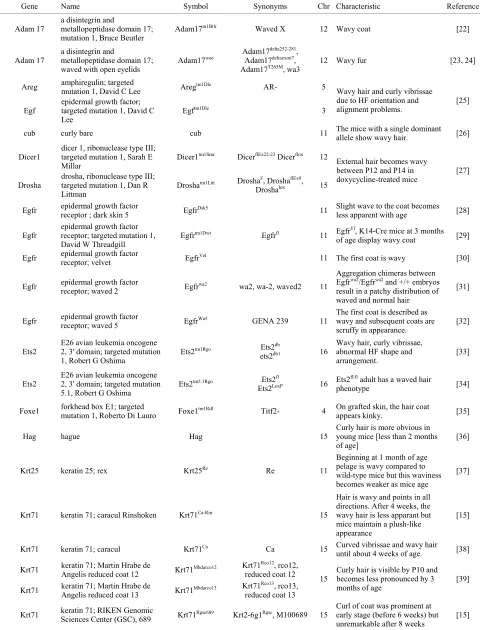
coat [21]. More gene mutations affecting the
morphoge-netic waves are showed in the Table 1.
3. Hair Curliness-Related Inherited Diseases
3.1. Pseudofolliculitis Barbae (PFB)
Table 1. Genes mutations causing the morphogenetic waves.
Gene Name Symbol Synonyms Chr Characteristic Reference
Adam 17 a disintegrin and metallopeptidase domain 17; mutation 1, Bruce Beutler
Adam17m1Btlr Waved X 12 Wavy coat [22]
Adam 17
a disintegrin and
metallopeptidase domain 17;
waved with open eyelids Adam17
woe Adam17
delta252-281,
Adam17deltaexon7,
Adam17T265M, wa3 12 Wavy fur [23, 24]
Areg amphiregulin; targeted mutation 1, David C Lee Aregtm1Dle AR- 5
Egf epidermal growth factor; targeted mutation 1, David C Lee
Egftm1Dle 3
Wavy hair and curly vibrissae due to HF orientation and
alignment problems. [25]
cub curly bare cub 11 The mice with a single dominant allele show wavy hair. [26]
Dicer1
dicer 1, ribonuclease type III; targeted mutation 1, Sarah E
Millar Dicer1
tm1Smr DicerflEx22-23 Dicerflox 12
Drosha drosha, ribonuclease type III; targeted mutation 1, Dan R Littman
Droshatm1Litt DroshaF, DroshaflEx9,
Droshalox 15
External hair becomes wavy between P12 and P14 in
doxycycline-treated mice [27]
Egfr epidermal growth factor receptor ; dark skin 5 EgfrDsk5 11 Slight wave to the coat becomes
less apparent with age [28]
Egfr epidermal growth factor receptor; targeted mutation 1, David W Threadgill
Egfrtm1Dwt Egfrfl 11 Egfrf/f, K14-Cre mice at 3 months
of age display wavy coat [29]
Egfr epidermal growth factor receptor; velvet EgfrVel 11 The first coat is wavy [30]
Egfr epidermal growth factor receptor; waved 2 Egfrwa2 wa2, wa-2, waved2 11
Aggregation chimeras between Egfrwa2/Egfrwa2 and +/+ embryos
result in a patchy distribution of waved and normal hair
[31]
Egfr epidermal growth factor receptor; waved 5 EgfrWa5 GENA 239 11 The first coat is described as wavy and subsequent coats are
scruffy in appearance. [32]
Ets2
E26 avian leukemia oncogene 2, 3' domain; targeted mutation
1, Robert G Oshima Ets2
tm1Rgo Ets2db
ets2db1 16
Wavy hair, curly vibrissae, abnormal HF shape and
arrangement. [33]
Ets2 E26 avian leukemia oncogene 2, 3' domain; targeted mutation 5.1, Robert G Oshima
Ets2tm5.1Rgo Ets2fl
Ets2LoxP 16 Ets2
fl/fl adult has a waved hair
phenotype [34]
Foxe1 forkhead box E1; targeted mutation 1, Roberto Di Lauro Foxe1tm1Rdl Titf2- 4 On grafted skin, the hair coat
appears kinky. [35]
Hag hague Hag 15
Curly hair is more obvious in young mice [less than 2 months
of age] [36]
Krt25 keratin 25; rex Krt25Re Re 11
Beginning at 1 month of age pelage is wavy compared to wild-type mice but this waviness becomes weaker as mice age
[37]
Krt71 keratin 71; caracul Rinshoken Krt71Ca-Rin 15
Hair is wavy and points in all directions. After 4 weeks, the wavy hair is less apparant but mice maintain a plush-like appearance
[15]
Krt71 keratin 71; caracul Krt71Ca Ca 15 Curved vibrissae and wavy hair
until about 4 weeks of age. [38]
Krt71 keratin 71; Martin Hrabe de Angelis reduced coat 12 Krt71Mhdarco12 Krt71Rco12, rco12,
reduced coat 12
Krt71 keratin 71; Martin Hrabe de Angelis reduced coat 13 Krt71Mhdarco13 Krt71Rco13, rco13,
reduced coat 13
15 Curly hair is visible by P10 and becomes less pronounced by 3 months of age
[39]
Krt71 keratin 71; RIKEN Genomic Sciences Center (GSC), 689 Krt71Rgsc689 Krt2-6g1Rgsc, M100689 15 Curl of coat was prominent at early stage (before 6 weeks) but
unremarkable after 8 weeks
Continued
Liph lipase, member H; targeted mutation 1, Junken Aoki Liphtm1Aoki PA-PLA1alpha- 16 Wavy hair cuticle [40]
Notch1 notch 1; targeted mutation 2, Raphael Kopan Notch1tm2Rko fN1, N1f, NICD1fl,
Notch1flox, Notch1tm1Shn 2 Regions of wavy hair that have a twisted, knotted morphology [41]
Ppp1r13l
protein phosphatase 1, regulatory (inhibitor) subunit
13 like; waved 3 Ppp1r13l
wa3 7 Curly hairs. Thinner hair shafts. At P8, abnormal shape and
orientation of HFs. [42]
Ppp1r13l
protein phosphatase 1, regulatory [inhibitor] subunit 13 like; waved with open eyelids 2
Ppp1r13lwoe2 7 Beginning around P14 and
remaining throughout life [25]
Sgk3 serum/glucocorticoid regulated kinase 3; fuzzy Iasi congenital atrichia
Sgk3fz-ica 1 Sparse hair,curly vibrissae, abnormal hair shaft morphology,
abnormal hair cycle
[43]
Sgk3
serum/glucocorticoid regulated kinase 3; fuzzy Mark D
Fleming Sgk3
fz-Mdf 1 [44]
Sgk3 serum/glucocorticoid regulated kinase 3; targeted mutation 1, David Pearce
Sgk3tm1Dpea Sgk3- 1
Early hair follicle development is normal, however by P4 the follicles have failed to enlarge and migrate deep into the subcutis
[45]
Stk11
serine/threonine kinase 11; targeted mutation 1.1, Ronald
DePinho Stk11
tm1.1Rdp Lkb1lox 10 Adult hair is wavy [46]
Tg[EGFR]0Jlj transgene insertion 0, Jose Luis Jorcano Tg[EGFR]0Jlj K5-HERCD-533, T0
Dominant negative. Short and waved hairs and curly whiskers. Degeneration and destruction of HFs in 3 to 4 weeks old mouse.
[47]
Tg[Notch1]1Anc transgene insertion 1, Angela M Christiano Tg[Notch1]1Anc
Wavy hairs and short, curly vibrissae. Defect in differentiation of the inner root sheath. Persistence of inner root sheath remnants in later stage of the hair cycle.
[48]
Tg[Notch1]A5Rko transgene insertion A5, Raphael Kopan Tg[Notch1]A5Rko MHKA-NotchdeltaE Decreased curvature of zigzag
hairs [49]
Tgfα
transforming growth factor alpha; targeted mutation 1,
Ashley R Dunn Tgfα
tm1Ard Tgfαlpha - 6 Attenuated slightly with age [50]
Tgfα
transforming growth factor alpha; targeted mutation 1, University of North Carolina
Tgfαtm1Unc TGFalpha-, Tgfatm1Dcl 6 Between 2 - 4 weeks of age the coat develops a wavy
appearance. [51]
Tgfα transforming growth factor alpha; waved 1 Tgfαwa1 wa-1, waved 6
Wavy hair is obvious at 10 days of age, extreme waviness of the first coat is lost in later hair generations but the coat never looks normal
[52]
Tgm3
transglutaminase 3, E polypeptide; targeted mutation
1, Susan John Tgm3
tm1Sjo 2 Wavy hair is most obvious in the
first four weeks of life [53]
Trpv3
transient receptor potential cation channel, subfamily V, member 3; targeted mutation 1.2, David E Clapham
Trpv3tm1.2Clph V3 KO 11 HFs were gently curved and pointed in different directions
with variable angles. [54]
3.2. Tricho-Dento-Osseous (TDO)
Tricho-dento-osseous syndrome is a rare human genetic
disorder first distinguished by Lichtenstein
et al
., in 1972
[60]. It is a highly penetrant autosomal dominant trait
characterized by curly kinky hair in infancy, enamel hy-
poplasia, taurodontism, thickening of cortical bones and
variable expression of craniofacial morphology [61].
Diagnostic criteria are based on the generalized enamel
defects, severe taurodontism especially of the mandibular
first permanent molars, an autosomal dominant mode of
inheritance, and at least one of the other features (
i.e
.,
nail defects, bone sclerosis, and curly, kinky or wavy hair
present at a young age that may straighten out later).
Kinky or tightly curled hair at birth may be a characteris-
tic and distinguishing feature in many families and aid in
diagnosing TDO from hypomaturation-type amelogene-
sis imperfecta [62,63]. TDO syndrome is considered the
ectodermal dysplasia with a high penetrance even if the
individual signs and symptoms can be present in variable
intensities. Genetic studies have shown a mutation in the
DLX3 gene on chromosome 17q21 and a 4 bp deletion in
the DLX3 gene associated with TDO, which has also
been identified [64]. Some families have been reported to
have wavy hair or curly hair at birth that straightened out
a few years later [65-67]. Seow [68] reported that the hair
defects may vary among affected members of the same
family. Mayer
et al
. [62] reported that an 8-year-old girl
with TDO syndrome had uncombable hair, enamel hy-
poplasia and enlarged pulp chambers of the molar teeth.
Electron microscopic examination of the curly hair
showed a flattened hair shaft with longitudinal grooves.
3.3. Oculo-Dento-Digital Dysplasia (ODDD)
Oculo-dento-digital dysplasia is a rare autosomal domi-
nant congenital disorder caused by mutations in con-
served domains of the gap junction alpha 1 gene (GJA1
or Connexin 43 (CX43)) located on chromosome 6q21-
q23.2 with two exons separated by an 11-kb intron [69].
Abnormalities observed in ODDD affect the eye, denti-
tion, and digits of the hands and feet [70]. Patients pre-
sent with a characteristic facial appearance, narrow nose,
and hypoplastic alae nasi. Neurological problems are
known to occur as well as conductive hearing loss, car-
diac defects, and anomalies of the skin, hair, and nails.
Curly/kinky hair with features of early trichorrhexis
nodosa was identified in a 13 years old girl with ODDD
[71], this in accord with the observation by Kjaer
et al
.,
who found curly hair in seven out of nine affected sub-
jects harboring a mutation in the Cx43 gene in a Danish
family over five generations [72].
3.4. Woolly Hair (WH)
Woolly hair is a group of hair shaft disorders, which re-
fers to an abnormal variant of fine, tightly curled hair that
often exhibits decreased pigmentation. Hutchinson
et al
.
[73] classified woolly hair into 3 variants: woolly hair
nevus, autosomal dominant hereditary woolly hair, and
autosomal recessive familial woolly hair. Since then, WH
has also been observed in association with several ge-
netic conditions, such as Naxos disease and Carvajal
syndrome, both of which are characterized by cardio-
myopathy, palmoplantar keratoderma, and WH, and are
caused by mutations in the plakoglobin [74] and desmo-
plakin [75] genes, respectively. Furthermore, most
nota-bly is Noonan syndrome and cardiofaciocutaneous (CFC)
syndrome. Andy J. Chien described a family with woolly
hair and ulerythema ophryogenes spanning four genera-
tions, which have been associated with Noonan syn-
drome and CFC, and he found that this family did not
exhibit any of the other findings characteristic of either
Noonan syndrome or CFC, similar to a previously
de-scribed pedigree with hereditary woolly hair [76]. In
ad-dition to these syndromes, WH without associated
find-ings (non-syndromic WH) has also been described [77].
4. Acknowledgements
This publication was supported by grants from China
Natural Science Foundation (#31071923).
REFERENCES
[1] A. Abbasi, “Molecular Evolution of HR, A Gene That Regulates the Postnatal Cycle of the Hair Follicle,” Scien-tific Reports, Vol. 1, No. 32, 2011, pp.1-7.
doi:10.1038/srep00032
[2] J. Hwang, T. Mehrani, S. E. Millar and M. I. Morasso, “Dlx3 is a Crucial Regulator of Hair Follicle Differen- tiation and Cycling,” Development, Vol. 135, No. 18, 2008, pp. 3149-3159. doi:10.1242/dev.022202
[3] E. Fuchs and S. Raghavan, “Getting under the Skin of Epidermal Morphogenesis,” Nature Reviews Genetics, Vol. 3, No. 3, 2002, pp. 199-209. doi:10.1038/nrg758 [4] M. R. Schneider, R. Schmidt-Ullrich and R. Paus, “The
Hair Follicle as A Dynamic Miniorgan,”Current Biology, Vol. 19, No. 3, 2009, pp. 132-142
doi:10.1016/j.cub.2008.12.005
[5] M. A. Rogers, L. Langbein, S. Praetzel-Wunder, H. Win- ter and J. Schweizer, “Human Hair Keratin-Associated Proteins (KAPs),” International Review of Cytology, Vol. 251, 2006, pp. 209-263.
doi:10.1016/S0074-7696(06)51006-X
[6] L. Langbein and J. Schweizer, “Keratins of the Human Hair Follicle,” International Review of Cytology, Vol. 243, 2005, pp.1-78. doi:10.1016/S0074-7696(05)43001-6 [7] Y. Shimomura and M. Ito, “Human Hair Keratin-Associ- ated Proteins,” Journal of Investigative Dermatology Symposium Proceedings, Vol. 10, No. 3, 2005, pp. 230- 233.doi:10.1111/j.1087-0024.2005.10112.x
Journal of Cell Biology, Vol. 180, No. 2, 2008, pp. 273- 284. doi:10.1083/jcb.200708185
[9] E. Fuchs and V. Horsley, “More Than One Way to Skin,” Genes Development, Vol. 22, No. 8, 2008, pp. 976-985. doi:10.1101/gad.1645908
[10] Y. Kajiura, S. Watanabe, T. Itou, K. Nakamura, A. Iida, K. Inoue, N. Yagi, Y. Shinohara and Y. Amemiya, “Struc- tural Analysis of Human Hair Single Fibres by Scanning Microbeam SAXS,” Journal of Structural Biology, Vol. 155, No. 3, 2006, pp. 438-444.
doi:10.1016/j.jsb.2006.04.008
[11] T. Schlake, “Determination of Hair Structure and Shape,” Seminars in Cell& Developmental Biology, Vol. 18, No. 2, 2007, pp. 267-273. doi:10.1016/j.semcdb.2007.01.005 [12] S. Thibaut, O. Gaillard, P. Bouhanna, D. W. Cannell and
B. A. Bernard, “Human Hair Shape Is Programmed From the Bulb,” British Journal of Dermatology, Vol. 152, No.4, 2005, pp. 632- 638.
doi:10.1111/j.1365-2133.2005.06521.x
[13] Lindelof, B. Forslind, M. A. Hedblad and U. Kaveus, “Human Hair Form Morphology Revealed by Light and Scanning Electron Microscopy and Computer Aided Three-Dimensional Reconstruction,” Archives of Derma- tology, Vol. 124, No. 9, 1988, pp. 1359-1363.
doi:10.1001/archderm.1988.01670090015003
[14] G. Loussouarn, A.L. Garcel, I. Lozano, C. Collaudin, C. Porter, S. Panhard, D. Saint-Léger and R. de La Mettrie, “Worldwide Diversity of Hair Curliness: A New Method of Assessment,” International Journal of Dermatology, Vol. 46, Suppl. 1, 2007, pp. 2-6.
doi:10.1111/j.1365-4632.2007.03453.x
[15] Y. Kikkawa, A. Oyama, R. Ishii, I. Miura, T. Amano, Y. Ishii, Y. Yoshikawa, H. Masuya, S. Wakana, T. Shiroishi, C. Taya and H. Yonekawa, “A Small Deletion Hotspot in the Type II Keratin Gene Mk6irs1/Krt2-6g on Mouse Chromosome 15, A Candidate for Causing the Wavy Hair of the Caracul (Ca) Mutation,” Genetics, Vol. 165, No. 2, 2003, pp. 721-733.
[16] F. Runkel, M. Klaften, K. Koch, V. Böhnert, H. Büssow, H. Fuchs, T. Franz and M. Hrabé de Angelis, “Morphol-ogic and Molecular Characterization of Two Novel Krt71 (Krt2-6g) Mutations: Krt71rco12 and Krt71rco13,” Mam- malian Genome, Vol. 17, No. 12, 2006, pp. 1172-1182. doi:10.1007/s00335-006-0084-9
[17] T. Kuramoto, R. Hirano, M. Kuwamura and T. Serikawa, “Identification of the Rat Rex Mutation as A 7-Bp Dele- tion at Splicing Acceptor Site of the Krt71 Gene,” The Journal of Veterinary Medical Science, Vol. 72, No. 7, 2010, pp. 909-912. doi:10.1292/jvms.09-0554
[18] T. Kuramoto, M. Yokoe, K. Yagasaki, T. Kawaguchi, K. Kumafuji and T. Serikawa, “Genetic Analyses of Fancy Rat-Derived Mutations,” Experimental Animals, Vol. 59, No. 2, 2010, pp. 147-155. doi:10.1538/expanim.59.147 [19] E. Cadieu, M. W. Neff, P. Quignon, K. Walsh, K. Chase,
H. G. Parker, B. M. VonHoldt, A.Rhue, A. Boyko, A. Byers, A. Wong, D. S. Mosher, A. G. Elkahloun, T. C. Spady, C. André, K. Gordon Lark, M. Cargill, C. D. Bustamante, R. K. Wayne and E. A. Ostrander, “Coat Variation in the Domestic Dog is Governed by Variants
in Three Genes,” Science, Vol. 326, No. 5949, 2009, pp. 150-153.doi:10.1126/science.1177808
[20] B. Gandolfi, C. A. Outerbridge, L. G. Beresford, J. A. Myers, M. Pimentel, H. Alhaddad, J. C. Grahn, R. A. Grahn and L. A. Lyons, “The Naked Truth: Sphynx and Devon Rex Cat Breed Mutations in KRT71,” Mammalian Genome, Vol. 21, No. 9-10, 2010, pp.509-515.
doi:10.1007/s00335-010-9290-6
[21] A. D. Markey, J. F. Taylor, R. D. Schnabel, S. D. McKay, M. C. McClure and J. E. Beever, “A Deletion Mutation in Krt71 is Associated with Congenital Hypotrichosis in Hereford Cattle,” Plant & Animal Genomes XVIII Con-ference, San Diego, 9-13 January 2010, p. 552.
[22] K. Brandla, L.Sun, C. Neppl, O. M. Siggsa, S. M. Le Gallc, W. Tomisatoa, X.H. Li, X. Du, D. N. Maennel, C. P. Blobel and B. Beutler, “MyD88 Signaling in Nonhe- matopoietic Cells Protects Mice Against Induced Colitis by Regulating Specific EGF Receptor Ligands,” Pans, Vol. 107, 2010, pp. 19967-19972.
doi:10.1073/pnas.1014669107
[23] B. Chang, N. L. Hawes, R. E. Hurd, J. Wang, D. Howell, M. T. Davisson, T. H. Roderick, S. Nusinowitz and J. R. Heckenlively, “Mouse Models of Ocular Diseases,” Vis- ual Neuroscience, Vol. 22, No. 5, 2005, pp. 587-593. [24] L. Hassemer, S. M. Le Gall, R. Liegel, M. McNally, B.
Chang, C. J. Zeiss, R. D. Dubielzig, K. Horiuchi, T. Ki- mura, Y. Okada, C. P. Blobel and D. J. Sidjanin, “The Waved with Open Eyelids (Woe) Locus is A Hypomor- phic Mouse Mutation in Adam17,” Genetics, Vol. 185, No. 1, 2010, pp. 245-255.
doi:10.1534/genetics.109.113167
[25] N. C. Luetteke, T. H. Qiu, S. E. Fenton, K. L. Troyer, R. F. Riedel, A. Chang and D. C. Lee, “Targeted Inactiva- tion of the EGF and Amphiregulin Genes Reveals Dis- tinct Roles for EGF Receptor Ligands in Mouse Mam- mary Gland Development,” Development, Vol. 126, No. 12, 1999, pp. 2739-2750.
[26] K. R. Johnson, P. W. Lane, S. A. Cook, B. S. Harris, P. F. Ward-Bailey, R. T. Bronson, B. L. Lyons, L. D. Shultz and M. T. Davisson, “Curly Bare (Cub), A New Mouse Mutation on Chromosome 11 Causing Skin and Hair Abnormalities, and A Modifier Gene (Mcub) on Chro- mosome 5,” Genomics, Vol. 81, No. 1, 2003, pp. 6-14. doi:10.1242/dev.070920
[27] M. Teta, Y. S. Choi, T. Okegbe, O. H. Tam, M. M. Chong, J. T. Seykora, A. Nagy, D. R. Littman, T. Andl and S. E. Millar, “Inducible Deletion of Epidermal Dicer and Drosha Reveals Multiple Functions for Mirnas in Postnatal Skin,” Development, Vol. 139, No. 8, 2012, pp. 1405-1406.
[28] K. R. Fitch, K. A. McGowan, C. D. van Raamsdonk, H. Fuchs, D. Lee, A. Puech, Y. Hérault, D. W. Threadgill, M. Hrabé de Angelis and G. S. Barsh, “Genetics of Dark Skin in Mice,” Genes & Development, Vol. 17, No. 2, 2003, pp. 214-228. doi:10.1101/gad.1023703
[30] X. Du, K. Tabeta, K. Hoebe, H. Liu, N. Mann, S. Mudd, K. Crozat, S. Sovath, X. Gong and B. Beutler, “Velvet, A Dominant Egfr Mutation That Causes Wavy Hair and Defective Eyelid Development in Mice,” Genetics, Vol. 166, No. 1, 2004, pp. 331-340.
doi:10.1534/genetics.166.1.331
[31] A. Mclaren, “The Microscopic Appearance of Waved-2 Mouse Hairs,” Genetics Research, Vol. 17, No. 3, 1971, pp. 257-260.doi:10.1017/S0016672300012271
[32] C. Thaung, K. West, B. J. Clark, L. McKie, J. E. Morgan, K. Arnold, P. M. Nolan, J. Peters, A. J. Hunter, S. D. Brown, I. J. Jackson and S. H. Cross, “Novel ENU-In- duced Eye Mutations in The Mouse: Models for Human Eye Disease,” Human Molecular Genetics, Vol. 11, No. 7, 2002, pp.755-767. doi:10.1093/hmg/11.7.755
[33] H. Yamamoto, M. L. Flannery, S. Kupriyanov, J. Pearce, S. R. McKercher, G. W. Henkel, R. A. Maki, Z. Werb and R. G. Oshima, “Defective Trophoblast Function in Mice with A Targeted Mutation of Ets2,” Genes & De- velopment, Vol. 12, No. 9, 1998, pp. 1315-1326.
doi:10.1101/gad.12.9.1315
[34] G. Wei, R. Srinivasan, C. Z. Cantemir-Stone, S. M. Sharma, R. Santhanam, M. Weinstein, N. Muthusamy, A. K. Man, R. G. Oshima, G. Leone and M. C. Ostrowski, “Ets1 and Ets2 are Required for Endothelial Cell Survival During Embryonic Angiogenesis,” Blood, Vol. 114, No. 5, 2009, pp. 1123-1130. doi:10.1182/blood-2009-03-211391 [35] A. Brancaccio, A. Minichiello, M. Grachtchouk, D. An-
tonini, H. Sheng, R. Parlato, N. Dathan, A. A. Dlugosz and C. Missero, “Requirement of the Forkhead Gene Foxe1, a Target of Sonic Hedgehog Signaling, in Hair Follicle Morphogenesis,” Human Molecular Genetics, Vol. 13, No. 21, 2004, pp. 2595-2606.
doi:10.1093/hmg/ddh292
[36] C. Poirier, A. Yoshiki, K. Fujiwara, J. L. Guénet and M. Kusakabe, “Hague (Hag): A New Mouse Hair Mutation with an Unstable Semidominant Allele,” Genetics, Vol. 162, No. 2, 2002, pp. 831-840.
[37] S. Tanaka, I. Miura, A. Yoshiki, Y. Kato, H. Yokoyama, A. Shinogi, H. Masuya, S. Wakana, M. Tamura and T. Shiroishi, “Mutations in the Helix Termination Motif of Mouse Type I IRS Keratin Genes Impair the Assembly of Keratin Intermediate Filament,” Genomics, Vol. 90, No. 6, 2007, pp. 703-711. doi:10.1016/j.ygeno.2007.07.013 [38] L. C. Dunn, “Caracul a Dominant Mutation,” The Journal
of Heredity, Vol. 28, No. 10, 1937, pp. 334.
[39] F. Runkel, M. Klaften, K. Koch, V. Böhnert, H. Büssow, H. Fuchs, T. Franz and M. H. de Angelis, “Morphologic and Molecular Characterization of Two Novel Krt71 (Krt2-6g) Mutations: Krt71rco12 and Krt71rco13,” Mam-
malian Genome, Vol. 17, No. 12, 2006, pp. 1172-1182. doi:10.1007/s00335-006-0084-9
[40] A. Inoue, N. Arima, J. Ishiguro, G. D. Prestwich, H. Arai and J. Aoki, “LPA-Producing Enzyme PA-PLA1αRegu-
lates Hair Follicle Development by Modulating EGFR Signalling,” The EMBO Journal, Vol. 30, No. 20, 2011, pp. 4248-4260.
[41] Y. H. Pan, M. H. Lin, X. L.Tian, H. T. Cheng, T. Gridley, J. Shen and R. Kopan, “Γ-Secretase Functions Through
Notch Signaling to Maintain Skin Appendages But Is Not Required for Their Patterning or Initial Morphogenesis,” Developmental Cell, Vol. 7, No. 5, 2004, pp. 731-743. doi:10.1016/j.devcel.2004.09.014
[42] J. Herron, C. Rao, S. Liu, L.Laprade, J. A. Richardson, E. Olivieri, C. Semsarian, S. E. Millar, L. Stubbs and D. R. Beier, “A Mutation in NFkB Interacting Protein 1 Results in Cardiomyopathy and Abnormal Skin Development in Wa3 Mice,” Human Molecular Genetics, Vol. 14, No. 5, 2005, pp. 667-677. doi:10.1093/hmg/ddi063
[43] L. Mecklenburg, D. J. Tobin, M. V. Cirlan, C. Craciun and R. Paus, “Premature Termination of Hair Follicle Morphogenesis and Accelerated Hair Follicle Cycling in Iasi Congenital Atrichia (Fzica) Mice Points to Fuzzy as a Key Element of Hair Cycle Control,” Experimental Der- matology, Vol. 14, No. 8, 2005, pp. 561-570.
doi:10.1111/j.0906-6705.2005.00343.x
[44] D. R. Campagna, A. O. Custodio, B. B. Antiochos, M. V. Cirlan and M. D. Fleming, “Mutations in the Serum/ Glu- cocorticoid Regulated Kinase 3 (Sgk3) Are Responsible for the Mouse Fuzzy (Fz) Hair Phenotype,” Journal of Investive Dermatology, Vol. 128, No. 3, 2008, pp. 730- 732. doi:10.1038/sj.jid.5701089
[45] J. A. McCormick, Y. X. Feng, K. Dawson, M. J. Behne, B. Yu, J. Wang, A. W. Wyatt, G. Henke, F. Grahammer, T. M. Mauro, F. Lang and D. Pearce, “Targeted Disrup- tion of the Protein Kinase SGK3/CISK Impairs Postnatal Hair Follicle Development,” Molecular Biology of the Cell, Vol. 15, No. 9, 2004, pp. 4278-4288.
doi:10.1091/mbc.E04-01-0027
[46] S. Gurumurthy, A. F. Hezel, E. Sahin, J. H. Berger, M. W. Bosenberg and N. Bardeesy, “LKB1 Deficiency Sensi- tizes Mice to Carcinogen-Induced Tumorigenesis,” Can- cer Research, Vol. 68, No. 1, 2008, pp. 55-63.
doi:10.1158/0008-5472.CAN-07-3225
[47] R. Murillas, F. Larcher, C. J. Conti, M. Santos, A. Ullrich and J. L. Jorcano, “Expression of a Dominant Negative Mutant of Epidermal Growth Factor Receptor in the Epi- dermis of Transgenic Mice Elicits Striking Alterations in Hair Follicle Development and Skin Structure,” The EMBO Journal, Vol. 14, No. 21, 1995, pp. 5216-5223.
[48] H. Uyttendaele, A. A. Panteleyev, D. de Berker, D. T. Tobin and A. M. Christiano, “Activation of Notch1 in the Hair Follicle Leads to Cell-Fate Switch and Mohawk Alopecia,” Differentiation, Vol. 72, No. 8, 2004, pp. 396- 409. doi:10.1111/j.1432-0436.2004.07208006.x
[49] M. H. Lin, C. Leimeister, M. Gessler and R. Kopan, “Activation of the Notch Pathway in the Hair Cortex Leads to Aberrant Differentiation of the Adjacent Hair- Shaft Layers,” Development, Vol. 127, No. 11, 2000, pp. 2421-2432.
[50] B. Mann, K. J. Fowler, A. Gabriel, E. C. Nice, R. L. Williams and A. R. Dunn, “Mice with a Null Mutation of the TGF Alpha Gene Have Abnormal Skin Architecture, Wavy Hair, and Curly Whiskers and Often Develop Cor- neal Inflammation, ” Cell, Vol. 73, No. 2, 1993, pp. 249- 261. doi:10.1016/0092-8674(93)90227-H
in Hair Follicle and Eye Abnormalities in Targeted and Waved-1 Mice,” Cell, Vol. 73, No. 2, 1993, pp. 263-278. doi:10.1016/0092-8674(93)90228-I
[52] M. J. Trigg, “Hair Growth in Mouse Mutants Affecting Coat Texture,” Journal of Zoology, Vol. 168, No. 2, 1972, pp. 165-198.
[53] S. John, L. Thiebach, C. Frie, S. Mokkapati, M. Bechtel, R. Nischt, S. Rosser-Davies, M. Paulsson and N. Smyth, “Epidermal Transglutaminase (Tgase 3) Is Required for Proper Hair Development, but Not the Formation of the Epidermal Barrier,” PLoS ONE, Vol. 7, No. 4, 2012, Ar- ticle ID: e34252. doi:10.1371/journal.pone.0034252 [54] X. Cheng, J. Jin, L. Hu, D. Shen, X. P. Dong, M. A.
Samie, J. Knoff, B. Eisinger, M. L. Liu, S. M. Huang, M. J. Caterina, P. Dempsey, L. E. Michael, A. A. Dlugosz, N. C. Andrews, D. E. Clapham and H. Xu, “TRP Channel Regulates EGFR Signaling in Hair Morphogenesis and Skin Barrier Formation,” Cell, Vol. 141, No. 2, 2010, pp. 331-343. doi:10.1016/j.cell.2010.03.013
[55] P. Baden, M. F.Champliaud, J. P. Sundberg and A. Viel, “Targeted Deletion of the Sciellin Gene Resulted in Nor- mal Development and Maturation,” Genesis, Vol. 42, No. 4, 2005, pp. 219-228. doi:10.1002/gene.20133
[56] H. Winter, D. Schissel, D. A. Parry, T. A. Smith, M. Lio- vic, E. Birgitte Lane, L. Edler, L. Langbein, L. F. Jave- Suarez, M. A. Rogers, J. Wilde, G. Peters and J. Schwei- zer, “An Unusual Ala12Thr Polymorphism in the 1A α- Helical Segment of the Companion Layer-Specific Kera- tin K6hf: Evidence for a Risk Factor in the Etiology of the Common Hair Disorder Pseudofolliculitis Barbae,” Jour- nal of Investigative Dermatology, Vol. 122, No. 3, 2004, pp. 652-657. doi:10.1111/j.0022-202X.2004.22309.x [57] J. Schweizer, L. Langbein, M. A. Rogers and H. Winter,
“Hair Follicle-Specific Keratins and Their Diseases,” Ex- perimental Cell Research, Vol. 313, No. 10, 2007, pp. 2010-2020. doi:10.1016/j.yexcr.2007.02.032
[58] M. Ribera, N. Fernández-Chico and M. Casals, “Pseudo- folliculitis Barbae,” Actas Dermosifiliogáficas, Vol. 101, No. 9, 2010, pp. 749-757. doi:10.1016/j.ad.2010.03.011 [59] C. Chamcheu, I. A. Siddiqui, D. N. Syed, V. M. Adhami,
M. Liovic and H. Mukhtar, “Keratin Gene Mutations in Disorders of Human Skin and Its Appendages,” Archives of Biochemistry and Biophysics, Vol. 508, No. 2, 2011, pp. 123-137. doi:10.1016/j.abb.2010.12.019
[60] J. Lichtenstein, R. Warson, R. Jorgenson, J. P. Dorst and V. A. McKusick, “The Tricho-Dento-Osseous (TDO) Syn- drome,” The American Journal of Human Genetics, Vol. 24, No. 5, 1972, pp. 569-582.
[61] T. Nguyen, C. Phillips, S. Frazier-Bower and T. Wright, “Craniofacial Variations in the Tricho-Dento-Osseous Syn- drome,” Clinical Genetics, Vol. 83, No. 4, 2013, pp. 375- 379. doi:10.1111/j.1399-0004.2012.01907.x
[62] E. Mayer, C. Baal, M. Litschauer-Poursadrollah, W. Hem- mer and R. Jarisch, “Uncombable Hair and Atopic Der- matitis in a Case of Trichodento-Osseous Syndrome,” Journal der Deutschen Dermatologischen Gesellschaft, Vol. 8, No. 2, 2010, pp. 102-104.
doi:10.1111/j.1610-0387.2009.07159_supp.x
[63] R. P. Elzay and D. H. Chamberlain, “Differential Diagno-
sis of Enlarged Dental Pulp Chambers: A Case Report of Amelogenesis Imperfecta with Taurodontism,” ASDC Jour- nal of Dentistry Children, Vol. 53, No. 5, 1986, pp. 388- 390.
[64] B. Al-Batayneh, “Tricho-Dento-Osseous Syndrome: Diag- nosis and Dental Management,” International Journal of Dentistry, Vol. 2012, No. 2012, 2012, Article ID: 514692. doi:10.1155/2012/514692
[65] S. D. Shapiro, F. L. Quattromani, R. J. Jorgenson and R. S. Young, “Tricho-Dento-Osseous Syndrome: Heteroge- neity or Clinical Variability,” American Journal of Medi- cal Genetics, Vol. 16, No. 2, 1983, pp. 225-236. doi:10.1002/ajmg.1320160212
[66] Duverger, D. Lee, M. Q. Hassan, S. X. Chen, F. Jaisser, J. B. Lian and M. I. Morasso, “Molecular Consequences of A Frameshifted DLX3 Mutant Leading to Tricho-Dento- Osseous Syndrome,” The Journal of Biological Chemistry, Vol. 283, No. 29, 2008, pp. 20198-20208.
doi:10.1074/jbc.M709562200
[67] M. Melnick, E. D. Shields and A. H. El-Kafrawy, “Tri- chodento-Osseous Syndrome: A Scanning Electron Micro- scopic Analysis,” Clinical Genetics, Vol. 12, No. 1, 1977, pp. 17-27. doi:10.1111/j.1399-0004.1977.tb00896.x [68] W. K. Seow, “Trichodentoosseous (TDO) Syndrome:
Case Report and Literature Review,” Pediatric Dentistry, Vol. 15, No. 5, 1993, pp. 355-361.
[69] W. A. Paznekas, B. Karczeski, S. Vermeer, R. B. Lowry, M. Delatycki, F. Laurence, P. A. Koivisto, L. van Mal- dergem, S. A. Boyadjiev, J. N. Bodurtha and E. W. Jabs, “GJA1 Mutations, Variants, and Connexin 43 Dysfunc- tion as It Relates to the Oculodentodigital Dysplasia Phe- notype,” Human Mutation, Vol. 30, No. 5, 2009, pp. 724- 733. doi:10.1002/humu.20958
[70] W. A. Paznekas, S. A. Boyadjiev, R. E. Shapiro, O. Daniels, B. Wollnik, C. E. Keegan, J. W. Innis, M. B. Dinulos, C. Christian, M. C. Hannibal and E. W. Jabs, “Connexin 43 (GJA1) Mutations Cause the Pleiotropic Phenotype of Oculodentodigital Dysplasia,” The Ameri- can Journal of Human Genetics, Vol. 72, No. 2, 2003, pp. 408-418. doi:10.1086/346090
[71] K. W. Kjaer, L. Hansen, H. Eiberg, P. Leicht, J. M. Opitz and N. Tommerup, “Novel Connexin 43 (GJA1) Mutation Causes Oculo-Dento-Digital Dysplasia with Curly Hair,” American Journal of Medical Genetics, Vol. 127A, No. 2, 2004, pp. 152-157. doi:10.1002/ajmg.a.20614
[72] S. C. Kelly, P. Ratajczak, M. Keller, S. M. Purcell, T. Griffin and G. Richard, “A Novel GJA 1 Mutation in Oculodento-Digital Dysplasia with Curly Hair and Hy- perkeratosis,” European Journal of Dermatology, Vol. 16, No. 3, 2006, pp. 241-245.
[73] P. E. Hutchinson, R. J. Cairns and R. S. Wells, “Woolly Hair: Clinical and General Aspects,” Transactions of the St. Johns Hospital Dermatological Society, Vol. 60, No. 2, 1974, pp. 160-177.
Hair (Naxos Disease),” The Lancet, Vol. 355, No. 9221, 2000, pp. 2119-2124.
doi:10.1016/S0140-6736(00)02379-5
[75] E. E. Norgett, S. J. Hatsell, L. Carvajal-Huerta, J. C. Ca- bezas, J. Common, P. E. Purkis, N. Whittock, I. M. Leigh, H. P. Stevens and D. P. Kelsell, “Recessive Mutation in Desmoplakin Disrupts Desmoplakin—Intermediate Fila- ment Interactions and Causes Dilated Cardiomyopathy, Woolly Hair and Keratoderma,” Human Molecular Gene- tics, Vol. 9, No. 18, 2000, pp. 2761-2766.
doi:10.1093/hmg/9.18.2761
[76] A. J. Chien, M. C. Valentine and V. P. Sybert, “Heredi-tary Woolly Hair and Keratosis Pilaris,” Journal of the American Academy of Dermatology, Vol. 54, No. 2, 2006, pp. S35-S39. doi:10.1016/j.jaad.2005.01.092